RCMP deployed to Wet’suwet’en territory

“RCMP raid is on the horizon.” Gidimt’en Checkpoint.

Gidimt’en Checkpoint

11/17/2021 URGENT UPDATE – Dozens of RCMP have deployed onto Wet’suwet’en territory.
A charter plane full of RCMP have landed at the Smithers airport, with between 30 and 50 officers equipped with camo duffel bags. Police loaded onto two buses and unmarked, rental pick-up trucks and headed out towards the yintah. An RCMP helicopter is reported to be heading to the area.
Throughout today, helicopters have circled over our camps, conducting low, deliberate flights for surveillance.
The road into our yintah remains blocked by RCMP at 28km, with hereditary chiefs, food, and medical supplies being turned away.
In the middle of a climate emergency, as highways and roads are being washed away and entire communities are being flooded and evacuated, the Province has chosen to send busloads of police to criminalize Wet’suwet’en water protectors and to work as a mercenary force for oil and gas.
We will not back down.
We need all eyes on Wet’suwet’en Yintah.
We need boots on the ground.
We need solidarity actions throughout Canada.
#ShutDownCanada
#AllOutForWedzinKwa

Wet’suwet’en land defenders and supporters say inaction from B.C. and Canada left them no choice but to enforce an eviction order against Coastal GasLink workers and deactivate road access to the project, a pair of measures that have prompted the provincial and federal governments to call for a peaceful resolution to the blockades.

“We were sending a clear message to the province, to Canada, and they weren’t acting on it — they weren’t hearing what we were saying — so we had to get a little bit louder,” Gidimt’en camp spokesperson Sleydo’ Molly Wickham told The Narwhal in an interview. “They’re destroying absolutely everything that is important to us in our territory. And they have been continuing to do work, despite the eviction order last year.”

The sole access route to Coastal GasLink project sites and work camps housing some 500 people was cut off after the company failed to act on an eviction order issued on Sunday. Tensions have been steadily escalating in Gidimt’en clan territory south of Houston, B.C., since September as the pipeline company began preparing to drill under the Wedzin Kwa (Morice) River.

The Wet’suwet’en eviction order isn’t new. It was first issued on Jan. 4, 2020, by the hereditary chiefs.

“Anuc ‘nu’at’en (Wet’suwet’en law) is not a ‘belief’ or a ‘point of view,’ ” the chiefs wrote at the time. “It is a way of sustainably managing our territories and relations with one another and the world around us, and it has worked for millennia to keep our territories intact. Our law is central to our identity. The ongoing criminalization of our laws by Canada’s courts and industrial police is an attempt at genocide, an attempt to extinguish Wet’suwet’en identity itself.”

UPDATED: Wet’suwet’en land defenders say B.C., federal inaction prompted enforcement of Coastal GasLink eviction By Matt Simmons, Energetic City, Nov 16, 2021

When Chief Dsta’hyl arrived on a Saturday morning in October, the big construction vehicles rumbled back and forth over the cold mud. He watched an excavator dig into the soil, its yellow, hydraulic arm moving against the green backdrop of forests that he has called home all his life.

The area that was being prepared for construction lies within the territory of the Wet’suwet’en, a First Nation in what is currently called British Columbia, Canada. As a supporting chief from the Likhts’amisyu clan, Dsta’hyl had been tasked with enforcing Wet’suwet’en law in the area.

The scene he was witnessing — construction crews preparing to build a pipeline through Wet’suwet’en territory, without their consent — represented a blatant violation of those laws. And Dsta’hyl had seen enough. After warning the on-site construction managers that they were trespassing, he arrived the next day and approached a pair of orange-vested security subcontractors employed by TC Energy, the company building the fracked gas pipeline known as Coastal GasLink, or CGL. He notified them that he would be seizing one of their excavators and then stepped onto the hulking vehicle and disabled it by disconnecting its battery and other components. Though he planned to leave the vehicle in place, Dsta’hyl said he wanted to make a statement to the company, which the traditional leaders decided to evict from their territory last year.

Canada sides with a pipeline, violating Wet’suwet’en laws — and its own. Despite a Supreme Court ruling, Coastal GasLink is on track to be built through unceded land by Mark Armao, Grist, Nov 18, 2021

Minister’s statement on Coastal Gaslink Project

Mike Farnworth, Minister of Public Safety and Solicitor General, has released the following statement in relation to current events around the Coastal GasLink project:

“Yesterday’s blockades of the Morice River Forest Service Road have put at risk emergency access and the delivery of critical services to more than 500 Coastal GasLink workers, and the good faith commitments made between the Office of the Wet’suwet’en and the Province of B.C. to develop a new relationship based on respect.

“The B.C. government is calling on all those involved to de-escalate the current confrontation and move quickly to eliminate the blockades through peaceful means.

#DivestCGL #WetsuwetenStrong #AllOutForWedzinKwa

Wet’suwet’en Enforce Mandatory Evacuation

You never know what might happen when you join a struggle for justice. One day in January 2020, I saw this video, “Coastal Gaslink Evicted from Unist’ot’en Territory”. I was amazed! I had been working for years on the Keystone XL and Dakota Access Pipeline resistance. But had not known about the Wet’suwet’en peoples in British Columbia and their efforts to protect the water and their beautiful lands from construction of the Coastal Gaslink pipeline.

I was especially interested because of the issues of Indigenous rights and began to closely follow these stories. https://landbackfriends.com/?s=wetsuweten

Not surprisingly there was little written about this in the mainstream media. Then, as now, the Wet’suwet’en asked supporters to share their stories on social media, which I did. My Quaker meeting wrote a statement about this and sent a letter to British Columbia Premier John Horgan, January 26, 2020. (below)

On February 7, 2020, several of us held a vigil in Des Moines, Iowa, to support the Wet’suwet’en. This vigil was life changing for me because that is where I met Ronnie James, an Indigenous organizer with many years of experience. I first learned of the concepts of Mutual Aid from Ronnie and to this day we work on Des Moines Mutual Aid projects. Mutual Aid and LANDBACK have become the focus of my study and writing. https://landbackfriends.com/

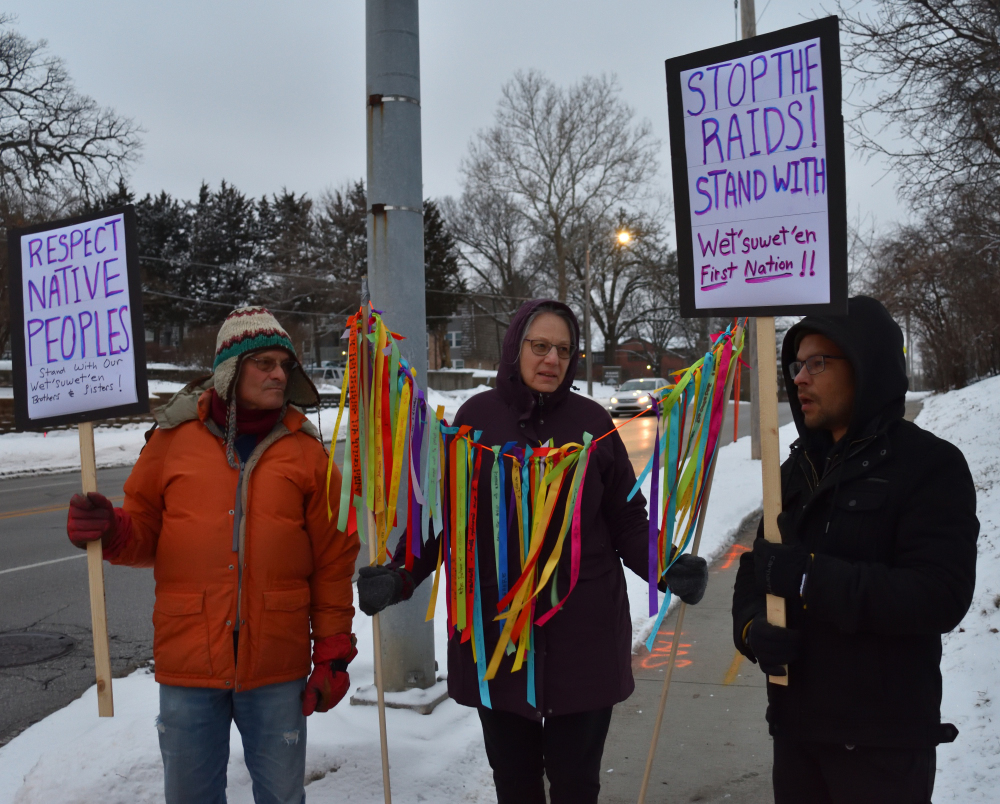
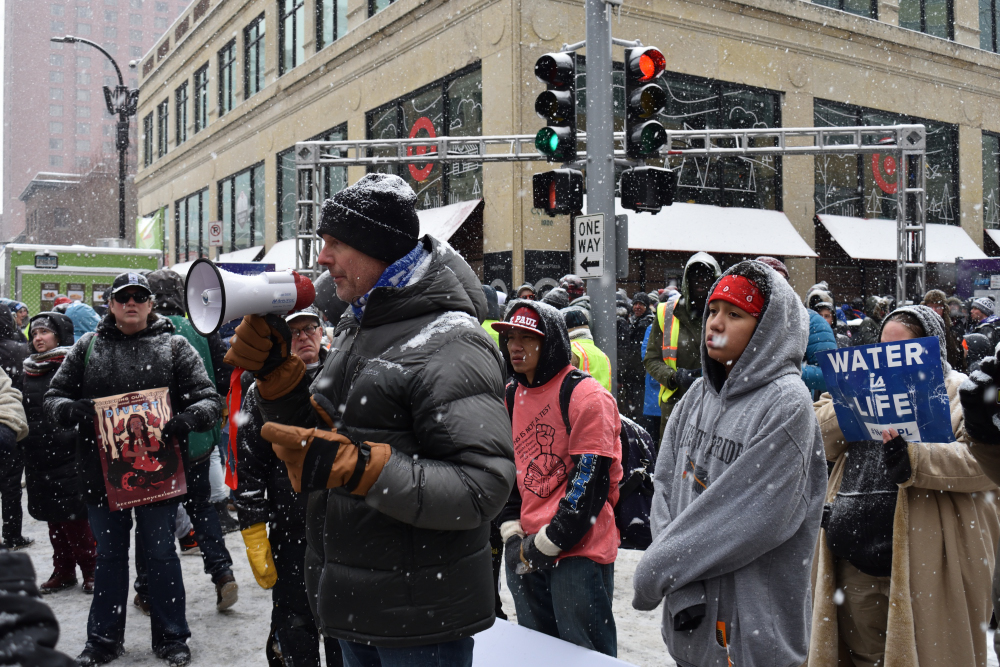
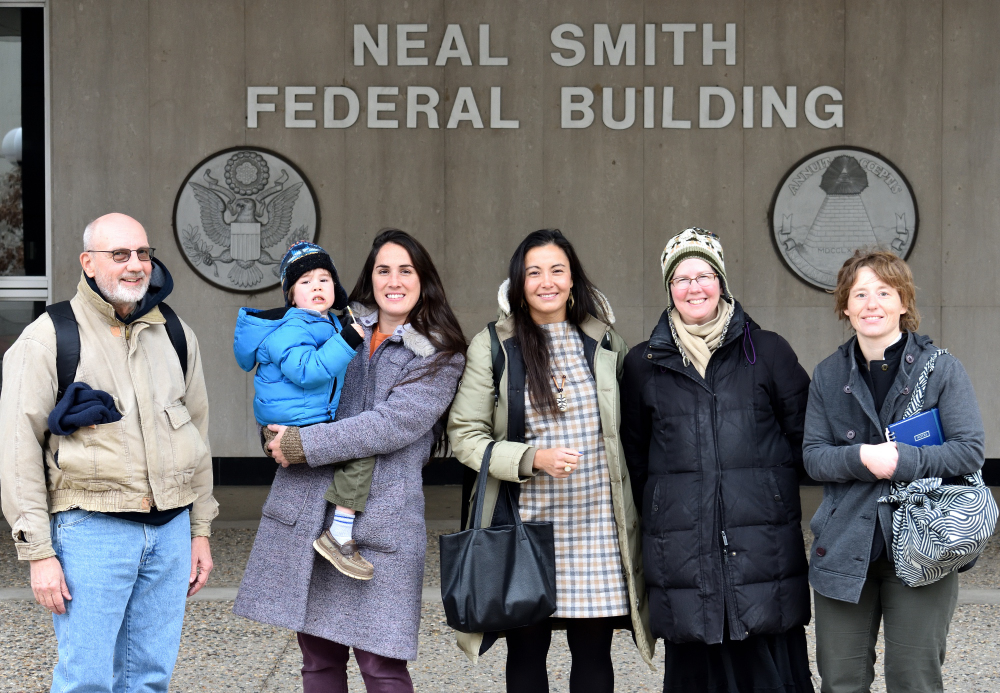
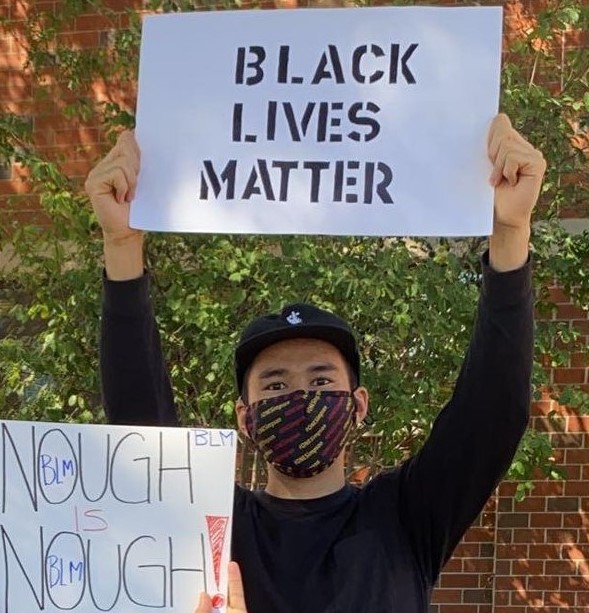
This photo was taken a couple of weeks ago when some of our Mutual Aid friends offered their support for the Wet’suwet’en. You probably notice using the same signs we used in 2020.

The reason for all this backstory is because Sunday the Wet’suwet’en enforced the eviction notice that was first given to Coastal Gaslink in the video above, in January, 2020. Following are stories of what has happened since. You can find updates on twitter at https://twitter.com/Gidimten

The Gidimt’en Clan of the Wet’suwet’en Nation has told Coastal GasLink it will enforce the eviction of pipeline workers from its territories in central B.C.

The enforcement notice, issued at 5 a.m. PT Sunday, provided an eight-hour window for CGL workers to move out of the territory before the access road was blocked.  

Jennifer Wickham, media co-ordinator for the Gidimt’en checkpoint, which monitors access to part of the territory, says the Morice River Forest Service Road is now impassible for all vehicles, including supply trucks. She says only a handful of CGL workers were seen leaving the area before the blockades went up along the access road Sunday afternoon.

On Sept. 25, members of the Gidimt’en Clan of the Wet’suwet’en and supporters established a camp on a CGL work site south of Houston, halting plans to drill under the Wedzin Kwa (Morice River). Wickham called the river “the major concern” right now. She says the enforcement notice is “the next step” in the actions taken to protect the Wet’suwet’en sacred headwaters, salmon spawning river, and source of clean drinking water. 

Wet’suwet’en clan members say they are enforcing eviction of Coastal GasLink from territories. The enforcement notice, issued early Sunday, provided 8 hours for workers to leave before roads blocked By Kate Partridge, CBC News, Nov 15, 2021

This morning, we upheld our laws and issued a mandatory evacuation order for all pipeline workers trespassing on our territory. We are enforcing the eviction order from January 2020, where Wet’suwet’en Hereditary Chiefs representing all clans of our nation stood together and removed Coastal GasLink from our lands. We will never abandon our children to live in a world with no clean water. We uphold our ancestral responsibilities. We continue to protect our yintah and invite all of our supporters to join us on the ground or to take action where you stand.There will be no pipelines on Wet’suwet’en territory.

For more info www.yintahaccess.com#AllOutForWedzinKwa#ResponsibiliyNotRights#WetsuwetenStrong


“This morning Cas Yikh enforced the eviction to Coastal GasLink. CGL was given 8 hours to evacuate the yintah.

CGL has been trespassing and violating our laws for too long. We will continue to uphold our laws! Join us.”

May be an image of text

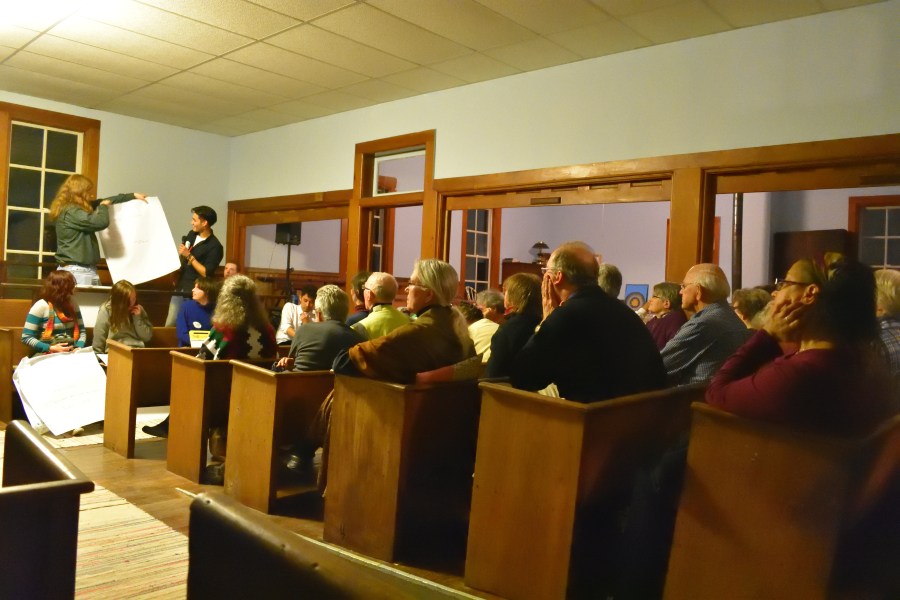
Bear Creek Friends (Quaker) meetinghouse is in the Iowa countryside. Many members have been involved in agriculture and care about protecting Mother Earth. A number of Friends have various relationships with Indigenous peoples. Some Friends have worked to protect water and to stop the construction of fossil fuel pipelines in the United States, such as the Keystone XL and Dakota Access pipelines.

We are concerned about the tensions involving the Wet’suwet’en Peoples, who are working to protect their water and lands in British Columbia. Most recently they are working to prevent the construction of several pipelines through their territory. Such construction would do severe damage to the land, water, and living beings.

Bear Creek Friends (Quaker) Meeting, Iowa Yearly Meeting (Conservative) January 26, 2020

John Horgan.
PO BOX 9041 STN PROV GOVT
VICTORIA, BC V8W 9E1.
Email premier@gov.bc.ca

John Horgan,

We’re concerned that you are not honoring the tribal rights and unceded Wet’suwet’en territories and are threatening a raid instead.

We ask you to de-escalate the militarized police presence, meet with the Wet’suwet’en Hereditary Chiefs, and hear their demands:

That the province cease construction of the Coastal Gaslink Pipeline project and suspend permits.

That the United Nations Declaration on the Rights of Indigenous Peoples (UNDRIP) and tribal rights to free, prior, and informed consent (FPIC) are respected by the state and RCMP.

That the Royal Canadian Mounted Police (RCMP) and associated security and policing services be withdrawn from Wet’suwet’en lands, in agreement with the most recent letter provided by the United Nations Committee on the Elimination of Racial Discrimination’s (CERD) request.

That the provincial and federal government, RCMP and private industry employed by Coastal GasLink (CGL) respect Wet’suwet’en laws and governance system, and refrain from using any force to access tribal lands or remove people.

Bear Creek Monthly Meeting of Friends (Quakers)
19186 Bear Creek Road, Earlham, Iowa, 50072

#WetsuwetenStrong
#AllOutForWedzinKwa
#NoPipelineNovember

COP 26 and Beyond Coal and Gas Alliance

COP 26 can only be seen as a failure since there was no agreement to end fossil fuel extraction and use. Nothing short of that will even slow down environmental collapse. It is not true that the deal “keeps 1.5C within reach” as COP26 President Alok Sharma says. Already the temperature has increased 1.1C. We are on a path to reach at least 2.7C by 2100, if drastic changes aren’t made immediately.

China and India will have to explain themselves to climate-vulnerable nations, COP26 President Alok Sharma has said as the summit ends.

It comes after the two nations pushed for the language on coal to change from “phase out” to “phase down” in the deal agreed in Glasgow.

But Mr Sharma insisted the “historic” deal “keeps 1.5C within reach”.

Under the Glasgow climate pact:

  • Countries were asked to republish their climate action plans by the end of next year, with more ambitious emissions reduction targets for 2030
  • There is an emphasis on the need for developed countries to increase the money they give to those already suffering the effects of climate change – beyond the current $100bn annual target
  • The language about coal has been included for the first time ever in a global climate deal
  • A pledge in a previous draft to “phase out” coal was instead watered down to a commitment to “phase down” coal

COP26: China and India must explain themselves, says Sharma by Malu Cursino, BBC News, Nov 14, 2021


Ed Miliband, shadow business and energy secretary, told the Sky News’ Trevor Phillips programme that “keeping 1.5 degrees alive is frankly in intensive care”.

He said: “The task of the world is to halve global emissions over the coming decade, that’s by 2030, that’s what the scientists tell us is necessary to keep 1.5 degrees alive.

COP26: China and India must explain themselves, says Sharma by Malu Cursino, BBC News, Nov 14, 2021

https://beyondoilandgasalliance.com/
Beyond Oil and Gas Alliance

A new diplomatic alliance to phase out global oil and gas production was formally launched at the UN climate change conference in Glasgow on Thursday, signaling an emerging international front in the fight against climate change.

The Beyond Oil and Gas Alliance, which Quebec announced it would join last week, is led by Costa Rica and Denmark, and now also includes France, Greenland, Ireland, Sweden, Wales, and Quebec as “core” members, California, Portugal, and New Zealand as “associate” members, and Italy which joined as a “friend” of the alliance.

Core membership means the country — or province, in the case of Quebec — has committed to end new exploration permits. Associate members must demonstrate efforts towards an oil and gas phase-out, like ending fossil fuel subsidies. The alliance expects to add new members in the coming months, including Scotland, according to news reports, which could upend the United Kingdom’s oil extraction plans, given much of its reserves are in the North Sea.

“There’s no future for oil and gas in a 1.5-degree world,” said Denmark’s Minister for Climate Dan Jørgensen, at the launch.

Here are the countries that joined the Beyond Oil and Gas Alliance By John Woodside, Canada’s National Observer, November 11th 2021

On 7 November, during the COP26 Coalition People’s Summit, I was on the jury of The People’s Tribunal on the UNFCCC (United Nations Framework Convention on Climate Change) and its failure to address a range of issues. We heard from a range of rapporteurs and witnesses, each speaking with great feeling about the differential climate catastrophes on nature and on human life. Every minute, $11 million is spent to subsidise fossil fuels (that’s $5.9 trillion spent in 2020 alone); this money underwrites the cascading climate catastrophe, yet few funds are raised to mitigate the negative effects of fossil fuels or to transition to renewable forms of energy. The remainder of this newsletter details the findings of the Tribunal, which was comprised of Ambassador Lumumba Di-Aping (former Chief Climate Negotiator for the G77 and China), Katerina Anastasiou (Transform Europe), Samantha Hargreaves (WoMin African Alliance), Larry Lohmann (The Corner House), and me.

There were six charges put before the Tribunal concerning the failures of the UNFCCC to:

  • address the root causes of climate change;
  • address global social and economic injustices;
  • come up with appropriate climate finance for planetary and social survival, including the rights of future generations;
  • create pathways to a just transition;
  • regulate corporations and avoid the corporate capture of the UNFCCC process; and
  • recognise, promote, and protect the Rights of Nature law.


The jury of five listened carefully to the special prosecutor, to the rapporteurs, and to the witnesses. We were unified in our conclusion that the UNFCCC, which was signed by 154 nations in 1992 and ratified by 197 countries by 1994, has utterly failed the peoples of the world and all species that rely on a healthy planet to survive by failing to stop climate change. This perilous inaction has failed to limit the increase of the average global temperature.

In its latest 2021 reports, the Intergovernmental Panel on Climate Change (IPCC) found that the Earth has reached an average temperature increase of 1.1 degrees, while sub-Saharan Africa is close to breaching the ‘safe’ 1.5 degree mark.

The UNFCCC has forged an intimate partnership with the very corporations that have created the climate crisis. It has allowed powerful governments to threaten poor countries into submission, guaranteeing certain misery and death for hundreds of millions of people in the poorest parts of the world over the next two decades.

The UNFCCC’s inaction has permitted powerful oil, mining, agriculture, logging, aviation, fishing, and other corporations to continue their carbon intensive activities unfettered. This has contributed to a growing biodiversity crisis: recent estimates suggest that anywhere from 2,000 species (at the low end) to 100,000 species (at the high end) are being exterminated each year. The UNFCCC is implicated in mass extinction.

The UNFCCC has refused to democratise the process and to listen to those on the frontlines of the crisis. This includes the one billion children who live in the 33 countries that are at ‘extremely high risk’ due to the climate crisis – in other words, almost half of the world’s 2.2 billion children – as well as indigenous communities and working-class and peasant women from the countries and nations that bear the brunt of a crisis that they did not produce.

As the world confronts a rapidly escalating climate crisis – evidenced by flooding, droughts, cyclones, hurricanes, rising sea levels, furious fires, and new pandemics – the poorest, most vulnerable, and highly indebted nations are owed a great climate debt.

Powerful nations in the UNFCCC have forced a rollback on earlier commitments to global redress for the long history of unequal and uneven development between nations. Developed countries pledged $100 billion per year for the climate fund but they have failed to provide that money, thereby neglecting their own commitments. Instead, developed countries plough trillions of dollars into their own national efforts to mitigate the impacts of climate change and support adaptation to a warming climate, while the poorest and most heavily indebted nations are left to fend for themselves.

We, the jury, find that the UNFCCC violated the UN Charter, which demands that UN members states ‘take effective collective measures for the prevention and removal of threats to peace’ (Chapter 1). The Charter charges states ‘to achieve international cooperation in solving international problems’.

The UNFCCC has also violated Chapter IX of the UN Charter, ignoring Article 55’s demand to create ‘conditions of stability and well-being’ as well as ‘economic progress and social progress’ and to promote ‘universal respect for, and observance of, human rights.’ Furthermore, the UNFCCC has violated Article 56, which enjoins member states to take ‘joint and separate action in cooperation’ with the UN.

We, the jury of the People’s Tribunal, find the UNFCCC guilty of the charges made by the special prosecutor and established by the witnesses. In light of our sentence, we claim the following measures of redress for the peoples of the world: (list follows)

WHY ARE YOU ASKING US TO COMPROMISE ON OUR LIVES? By Vijay Prashad, Tricontinental: Institute for Social Research, November 12, 2021


COP26 Not Nearly Enough

I’ve followed the work of Chase Iron Eyes and the Lakota People’s Law Project for years. He was involved in the Dakota Access pipeline struggle at Standing Rock, including begin arrested there. In the video below, he and his daughter, Tokata, talk about why everything discussed at COOP26 isn’t nearly enough.

As we near the end of COP26 — the United Nations’ most recent climate conference in Glasgow, Scotland — we have reason for concern. Because, while nations the world over have again come together to talk about addressing the climate emergency, activists — including a host of Indigenous People and organizations — are watching closely and sending a strong message from the frontlines: everything being discussed and promised at COP26 isn’t nearly enough. This past week, my daughter, Tokata, and I appeared on Christiane Amanpour’s show, broadcast on both PBS and CNN, to talk about COP26, our anti-pipeline stands, and the future of Indigenous and climate justice.

As Tokata’s friend, Greta Thunberg, put it in Glasgow, “It is not a secret that COP26 is a failure. It should be obvious that we cannot solve the crisis with the same methods that got us into it in the first place.”

I suspect you’ll agree with Greta, Tokata, and me when we say solving global warming isn’t going to be easy. It will demand sacrifices on the part of individuals and nations and a willingness to embrace a diversity of perspectives — from the latest climate science to the wisdom of Indigenous peoples. Our voices matter, because we have long practiced living in harmony with Unci Maka, our Grandmother Earth, and all the other species who inhabit her.

Chase Iron Eyes

In the video he says the human species is at a very vulnerable, but teachable moment. Our social contract is broken and requires social, economic, and racial justice. That solutions to our environmental crisis depend on Indigenous liberation. And yet, he is hopeful because Standing Rock raised global consciousness and once progress is made, there is no turning back.

There was an emotional part of the video, when Tokata was asked how she felt about the remains of native children being uncovered on the grounds of the institutions of forced assimilation. About learning of these atrocities while she is in school herself, a tool of the genocide of her people. She said she gives thanks for those children. And feeling she is carrying on their legacy.

The video ends with Chase talking about their work building bridges with non-Indigenous people. Let’s come together.

 Indian Child Welfare Act

I’m discouraged to learn about the latest tactics to use children, once again, as leverage to take away Native rights. The intentional cruelty of the violent removal of children to the institutions of forced assimilation was what finally broke Indigenous resistance to stealing the land, and its resources, from native peoples.

The previous administration also used the intentional cruelty of stealing children from those trying to enter the country called the United States.

The Indian Child Welfare Act (ICWA) was enacted in 1978 to help keep Native children in Native homes. The Friends Committee on National Legislation (FCNL) worked closely with Congress to enact the legislation. One benefit of ICWA was to give Native families the legal right to keep their children out of those schools.

If the Supreme Court overturns the Indian Child Welfare Act (ICWA) — a federal law that keeps Native children with Native families — tribal sovereignty could soon be a thing of the past in the U.S. Should the Supreme Court rule in the plaintiffs’ favor in the case of Brackeen v. Haaland, we could quickly see a return to blatant, pre-1978 genocidal practices — when Native babies were legally stripped of their families, culture, and identities.

It’s critical that every one of us take immediate action. Before you do anything else today, sign our petition telling President Biden and the Department of Justice to defend ICWA, Secretary Haaland, and tribal sovereignty with every available means.

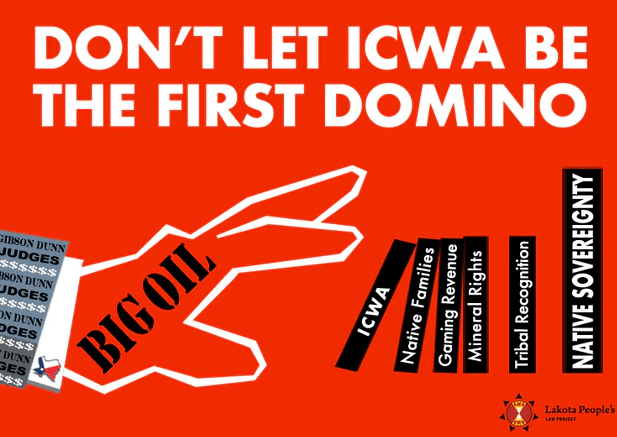
In this landmark case, the Brackeens — the white, adoptive parents of a Diné child in Texas — seek to overturn ICWA by claiming reverse racism. Joined by co-defendants including the states of Texas, Ohio, Louisiana, and Indiana, they’re being represented pro bono by Gibson Dunn, a high-powered law firm which also counts oil companies Energy Transfer and Enbridge, responsible for the Dakota Access and Line 3 pipelines, among its clients. This lawsuit is the latest attempt by pro-fossil fuel forces to eliminate federal oversight of racist state policies, continue the centuries-long genocide of America’s Native populations, and make outrageous sums of money for energy magnates, gaming speculators, and fossil fuel lawyers. The story below may seem unbelievable, but it is 100 percent true.

Key Points to Take Away

  • Big Oil’s lawyers, Texas, and three other states with very few Native inhabitants are attacking the Indian Child Welfare Act (ICWA).
  • The Texas Attorney General is asking the Supreme Court to declare ICWA unconstitutional.
  • The Plaintiffs argue that tribal affiliations should be considered racial, rather than political, designations.
  • Overturning ICWA could be the first legal domino in a broader attack on tribal rights and sovereignty.

TEXAS, BIG OIL TARGET INDIAN CHILDREN IN BID TO END TRIBAL SOVEREIGNTY By Sarah Rose Harper and Jesse Phelps, Lakota People’s Law Project, September 22, 2021
If the Supreme Court overturns the Indian Child Welfare Act, Native children, mineral rights, and tribal self-determination could quickly become collateral damage.

I can only write from the perspective of a settler, but I do want to highlight a few of the current struggles. We have a responsibility to educate ourselves about the history of the founding of the United States, to join in struggle with those who are oppressed and to transform our society to end these devastating institutions.

The Tulalip tribe in Everett, Washington also participated in the national day on September 30 with a vigil and speak out. They called it Residential Boarding School Awareness Day or Orange Shirt Day because one survivor Phyllis Webstad’s favorite orange shirt was taken from her on the first day of school. It wasn’t until 1978, through the Indian Child Welfare Act, that indigenous parents gained the right to keep their children out of those schools. Now that act is under threat of being overturned by the US Supreme Court and big oil is behind that attack.

That big oil would go after indigenous children is a response to the effectiveness of indigenous leadership in the fight to protect the planet. A recent report led by the Indigenous Environmental Network found that just in the past ten years, indigenous resistance to fossil fuel projects “stopped or delayed greenhouse gas pollution equivalent to at least one-quarter of annual U.S. and Canadian emissions.”

INDIGENOUS PEOPLE’S DAY REMINDS US TO ACKNOWLEDGE AND SUPPORT INDIGENOUS STRUGGLES By Margaret Flowers, Popular Resistance, October 11, 2021

We are talking about the potential destruction of all tribal law, the taking of all tribal lands, and the elimination of all Native sovereignty.

Chase Iron Eyes

Indian Child Welfare Act Under Attack

On Sept. 3, the U.S. solicitor general, Cherokee Nation, Morongo Band of Mission Indians, Oneida Nation, and Quinault Indian Nation filed cert petitions with the U.S. Supreme Court in Brackeen v. Haaland to defend the constitutionality of the Indian Child Welfare Act (ICWA).

This law was enacted in 1978 to help keep Native children in Native homes. FCNL worked closely with Congress to enact the legislation. In ICWA cases, the first preference is that the child go to an extended family member for placement, even if the relative is non-Native. The second preference is placement with someone within the child’s tribe, and the third preference is placement with another tribe.

The state of Texas, however, is continuing to challenge the constitutionality of ICWA. They claim that it’s a race-based system that makes it more difficult for Native children to be adopted or fostered into non-Native homes. A Supreme Court response to the tribes’ petition and Texas’ petition is due Oct. 8.

September Native American Legislative Update By Portia Kay^nthos Skenandore-Wheelock, Friends Committee on National Legislation, September 30, 2021

To those of you invested in anti-pipeline movements, know that this fight is no different from those we’ve undertaken at Standing Rock against the Dakota Access pipeline or in Minnesota against Line 3,” said Chase Iron Eyes, Lakota Law Co-Director and Lead Counsel. “It’s the same enemy using a different tactic to poison the planet. This is almost certainly Big Oil coming through the back door, and the danger may now be even greater. The victim is not just Mother Earth, her waters, and her sacred womb. It’s not just the Indigenous women and families on the front lines of the epidemic of missing and murdered Indigenous women and girls. It’s not even just the children being protected by ICWA. We are talking about the potential destruction of all tribal law, the taking of all tribal lands, and the elimination of all Native sovereignty. The only difference is that, this time, it certainly appears that Big Oil and its allies are using children as human missiles and the courts as the lever to accomplish its destructive agenda — all, of course, in the name of corporate profits.”

TEXAS, BIG OIL TARGET INDIAN CHILDREN IN BID TO END TRIBAL SOVEREIGNTY By Sarah Rose Harper and Jesse Phelps, Lakota People’s Law Project, September 22, 2021. If the Supreme Court overturns the Indian Child Welfare Act, Native children, mineral rights, and tribal self-determination could quickly become collateral damage.

Native children and U.S. Secretary of the Interior Deb Haaland are under legal attack in Brackeen v. Haaland. The powerful people behind the lawsuit include both Big Oil and the State of Texas. If their attempt to have a conservative-majority Supreme Court overturn the Indian Child Welfare Act is successful, the door will be open to the total elimination of tribal sovereignty. Take action now to stop this horrific attack on Native rights!

Petition Text:

Dear President Biden and attorneys for the Department of Justice,

As the Supreme Court decides on whether to render judgment in the case of Brackeen v. Haaland, I write today to ask you to do everything in your power to protect the Indian Child Welfare Act and defend Secretary Deb Haaland. We need strong federal protection of Native families and tribal sovereignty.

Please file every available motion, prepare every legal argument judiciously, and do everything else you can to stop this attack on tribal citizens. The plaintiffs will not be easily stopped. Should the Supreme Court accept this case and validate the plaintiffs’ argument that tribes do not have the power to place their own enrolled children in tribal kinship care, we will have crossed a rubicon into dangerous legal territory that could ultimately lead to the disbanding of tribal nations — and the loss of tribal lands, gaming revenues, and mineral rights.

It’s no coincidence that the same attorneys — Gibson Dunn — representing the plaintiffs in this case also have deep ties to fossil fuel interests such as Enbridge and TC Energy (the oil conglomerates responsible for attacking tribal interests through the Line 3 and Dakota Access pipelines, respectively).

The Indigenous peoples of this land have always deserved better. The few gains made over centuries littered with oppression, and in the face of overwhelming systemic racism, must not be lost now. Please fight hard to protect original Americans. Please do everything possible to stop this attack on children, families, and sovereignty.
https://action.lakotalaw.org/action/protect-icwa

#ICWA

COP 26 and continued colonial capitalism

As expected, little was accomplished at the recent COP 26 meetings because countries with capitalist economic systems were in control. Industrial nations’ policies will continue to protect the capitalist economic system and the fossil fuel industry regardless of the environmental consequences.
See: https://landbackfriends.com/?s=capitalism

The Free
https://thefreeonline.wordpress.com/2021/09/29/its-decolonization-or-extinction-and-that-starts-with-land-back/

I often write about the necessity of replacing the capitalist economic system as essential to addressing our evolving environmental catastrophes. Recently The Free blog of post-capitalist transition re-blogged my post, It’s Decolonization or Extinction. And that starts with Land-Back. Many people and organizations are working toward a post-capitalist world.

And yet, even as humanity faces perhaps the greatest existential crisis in its species’ history, the public debate on climate barely mentions the underlying economic system that brought us to this point and which continues to drive us toward the precipice. Ever since its emergence in the seventeenth century, with the creation of the first limited liability shareholder-owned corporations, capitalism has been premised on viewing the planet as a resource to exploit — its overriding objective to maximize profits from that exploitation as rapidly and extensively as possible. Current mainstream strategies to resolve our twin crises of climate breakdown and ecological overshoot without changing the underlying system of growth-based global capitalism are structurally inadequate

Solving the Climate Crisis Requires the End of Capitalism by Jeremy Lent, originally published by Patterns of Meaning, October 13, 2021

Current mainstream strategies to resolve our twin crises of climate breakdown and ecological overshoot without changing the underlying system of growth-based global capitalism are structurally inadequate

Jeremy Lent

This is doubly tragic because the dominance of capitalist governments also meant Indigenous peoples didn’t have a voice at COP 26. It is Indigenous knowledge that can help repair Mother Earth.

“The Cop is a big business, a continuation of colonialism where people come not to listen to us, but to make money from our land and natural resources,” said Ita Mendoza, 46, an indigenous land defender from the Mixteca region of Oaxaca in southern Mexico, attending Cop for the first time. “What benefits does the Cop bring when more than a thousand people fighting to keep the planet alive have been killed [since Paris]?”

“It’s a testament of our resilience that even after hundreds of years of colonization and betrayal that we indigenous communities are still willing to sacrifice our lives, health and energy for this last-ditch attempt to save the planet,” said Ruth Miller, climate justice director of the Alaska-based Native Movement, a Dena’ina Athabaskan and Ashkenazi Russian Jewish woman, who is a member of the Curyung tribe.

“We’re here offering sustainable solutions to the rest of the world that require an ideological shift, not a green industry built on colonialism and repression. It’s up to them if they listen or not.”

INDIGENOUS VOICES ARE MISSING AT COP26 by Nina Lakhani, The Guardian, November 4, 2021

As the United Nations Climate Change Conference—also known as COP26—got underway in Glasgow, Scotland this week, Indigenous activists from around the world warned that failure to center their peoples’ voices and solutions would seriously hamper efforts to tackle the growing planetary emergency.

“We can develop actions based on our culture and our traditional knowledge.”

“Today, the climate is warming, the animals are disappearing, the rivers are dying and our plants don’t flower like they did before,” Txai Suruí, a law student, activist, and member of the Paiter Suruí people of northwestern Brazil, said during Sunday’s COP26 opening ceremony. “The Earth is speaking. She tells us that we have no more time.”

“Indigenous people are in the frontline of the climate emergency, and we must be at the center of the decisions happening here,” she stressed. “We have ideas to postpone the end of the world.”

Kyle Whyte, a member of the Citizen Potawatomi Nation in Oklahoma who serves on U.S. President Joe Biden’s White House Environmental Justice Advisory Council, told NBC News that “if countries don’t get on board with us, leaving out the people who steward a lot of the lands, it’s not just a moral issue anymore. It will have a devastating effect on the speed at which the rest of the world will get to sustainability.”

‘The Earth Is Speaking’: Indigenous Activists Tell COP26 There’s No Climate Solution Without Them. “Indigenous people are in the frontline of the climate emergency, and we must be at the center of the decisions happening here. We have ideas to postpone the end of the world.” by BRETT WILKINS, Common Dreams, November 1, 2021

Not Enough Being Done for MMIW

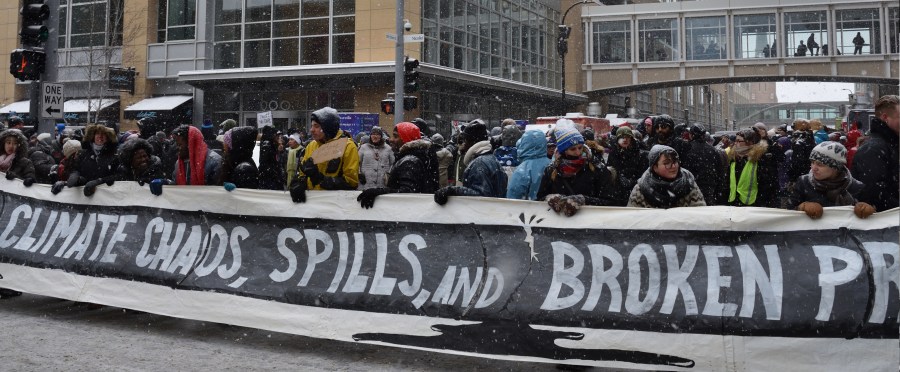
I was not aware of the epidemic of violence against, and the disappearance and/or murder of Indigenous women prior to getting to know some Indigenous people. I first became aware when I rode in a van, organized by Ed Fallon, to Minneapolis February 3, 2018, the day before the Super Bowl was played there. Minneapolis is the US Bank headquarters, and the Super Bowl was played in the US Bank stadium. US Bank has been involved in funding many fossil fuel projects. We gathered outside the bank offices with signs to call attention to that.

Heading for Minneapolis, Feb 4, 2018.

I was surprised when the speakers all talked about Missing and Murdered Indigenous Women (MMIW), sometimes expressed as Missing and Murdered Indigenous Relatives (MMIR). I was just learning much of this violence came from the man camps, the living quarters for those work on the construction of fossil fuel pipelines.

Those who spoke, Sikowis Nobiss, Donnielle Wanatee, Kathy Byrnes and Ed Fallon, would become friends of mine. In these photos you can see the Missing and Murdered Women artwork held by several of the speakers.

That fall (2018) I participated on the First Nation-Farmer Climate Unity March. My friend Foxy Onefeather carried the MMIW sign during our eight-day, ninety-four mile walk along the path of the Dakota Access Pipeline. Many stories, photos and videos of that march can be found here: https://firstnationfarmer.com/

Foxy Onefeather

One goal of the First Nation-Farmer Climate Unity March was to create friendships and the beginning of trust among the marchers, so we could work together on things of common concern. One of the first things several of us did together was meet with Senator Chuck Grassley’s staff in Des Moines.

There were two pieces of legislation in Congress related to Native Affairs. One was the SURVIVE Act which is intended to get more funds from the Victims of Crime Act to Native communities. The second is Savanna’s Act, which allows tribal police forces to have jurisdiction over non-Native people on Native land, access to criminal databases and expanded collection of crime statistics. Senator Grassley was involved in the passage of the Victims of Crime Act.

Jeff, Fox, Shazi, Sikowis, Shari and Sid

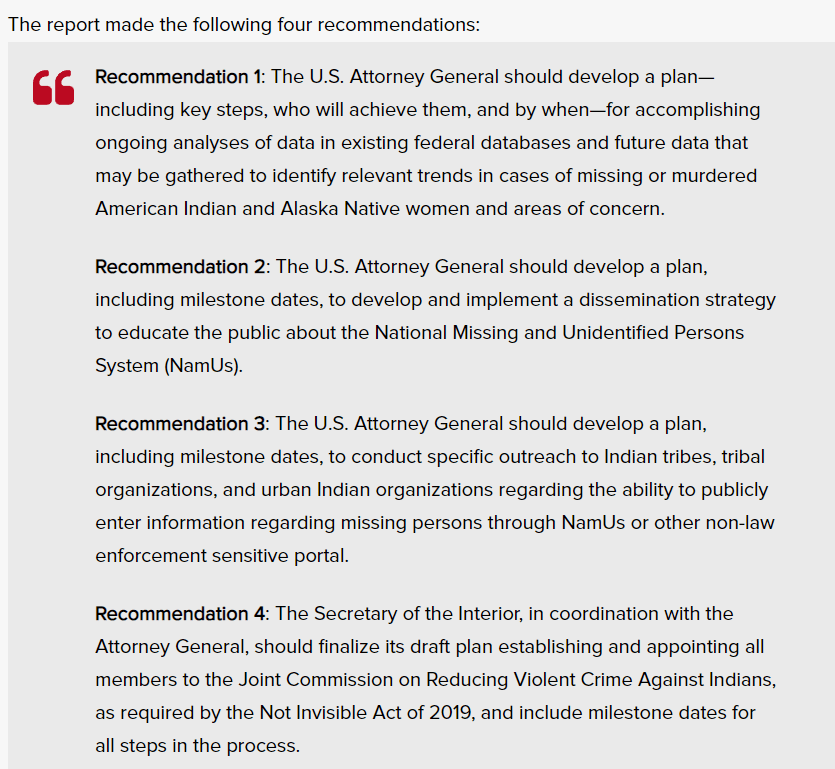
This Monday a report was released saying the federal response to missing and murdered Indigenous women needs improvement.

The Missing or Murdered Indigenous Women; New Efforts Are Underway but Opportunities Exist to Improve the Federal Response GAO report concluded the U.S. Department of Justice (DOJ) and U.S. Department of the Interior (DOI) have missed numerous deadlines set by the Not Invisible Act and Savanna’s Act, and it recommended that the departments develop an action plan to ensure they’re doing all they can to combat the crisis of missing and murdered Indigenous women.

U.S. Sen. Catherine Cortez Masto (D-NV), a member of the Senate Committee on Indian Affairs, called on the Biden administration to do more to address the crisis of missing and murdered Indigenous women (MMIW) after the U.S. Government Accountability Office (GAO) released a report finding that the government has not done enough to respond to the crisis.

Sen. Cortez Masto has led efforts in the Senate to protect Indigenous women and girls, and she asked that the GAO put together this report to investigate the federal response to violence facing Native women across the country.

NOT ENOUGH IS BEING DONE FOR MISSING AND MURDERED INDIGENOUS WOMEN GAO Report Says of Federal Government by Native News Online, November 3, 2021

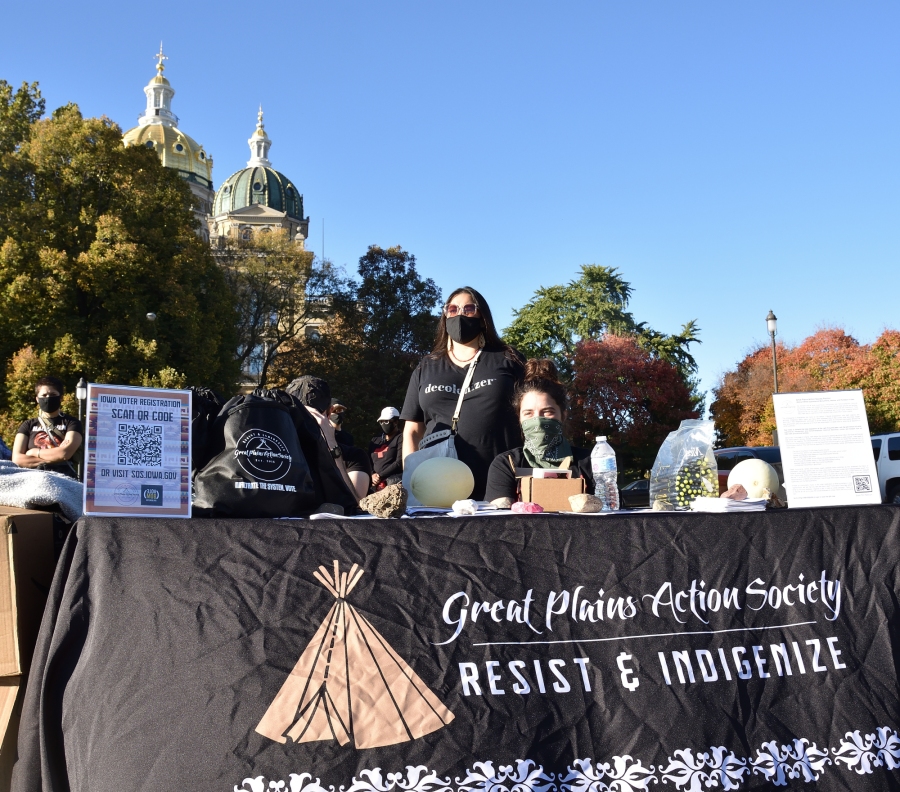
Great Plains Action Society

#MMIW

Capitalism must be reprogrammed with mutual aid

There is a lot of attention on the COP26 climate conference in Glasgow, Scotland. I am certain little will be done that can even slow down the rapidly accelerating environmental chaos for several reasons.

Industrial nations have waited far too long to begin to seriously work to get greenhouse gas emissions under control. While every effort should be made to cut emissions, it is painfully obvious that protecting our environment is not a priority of industrialized nations, which continue to expand fossil fuel projects and to subsidize the fossil fuel industry.

Existing governments’ policies will continue to protect the capitalist economy regardless of the environmental consequences. This means we must replace the capitalist economic system. See also: Rejecting capitalism

There is a time lag between the injection of emissions into the atmosphere, and when the effects of those emissions are seen. If burning fossil fuels ended immediately, carbon dioxide levels would continue to rise.

The Alternative?

For thousands of years Indigenous peoples have lived in harmony with Mother Earth. We must follow Indigenous leadership now. See: Indigenous Led Green New Deal

Although the world’s Indigenous population continues to experience unequal access to influential forums such as COP26, they have had an outsize role in calling attention to the impacts of climate change.

Globally, Indigenous people comprise only 5 percent of the population yet manage 80 percent of the world’s biodiversity such as forests, tundra and mountains. And although they exert the smallest carbon footprint, they are among the most vulnerable to the impacts of climate change, according to research published in the academic journal, Nature Sustainability.

“Indigenous peoples are action makers, innovators, through their traditional knowledge,” wrote Hindou Oumarou, a member of the Facilitative Working Group, in the United Nations Sustainable Development Goals blog. Ibrahim is a member of the Mbororo pastoralist people in Chad and president of the Association for Indigenous Women and Peoples of Chad.

“For centuries, Indigenous peoples have protected the environment, which provides them food, medicine and so much more,” she said. “Now it’s time to protect and benefit from their unique traditional knowledge to bring concrete and natural solutions to fight climate change.”

INDIGENOUS LEADERS FACE BARRIERS TO UN CLIMATE CONFERENCE By Mary Annette Pember, Indian Country Today, September 18, 2021


… what if the question all water protectors and land defenders asked was, why don’t we just overturn the system that makes development a threat in the first place? This system, again, is capitalism. 

Rather than taking an explicitly conservationist approach, the Red Deal instead proposes a comprehensive, full-scale assault on capitalism, using Indigenous knowledge and tried-and-true methods of mass mobilization as its ammunition. In this way, it addresses what are commonly thought of as single issues like the protection of sacred sites—which often manifest in specific uprisings or insurrections—as structural in nature, which therefore require a structural (i.e., non-reformist reform) response that has the abolition of capitalism via revolution as its central goal.

We must be straightforward about what is necessary. If we want to survive, there are no incremental or “non-disruptive” ways to reduce emissions. Reconciliation with the ruling classes is out of the question. Market-based solutions must be abandoned. We have until 2050 to reach net-zero carbon emissions. That’s it. Thirty years.

The struggle for a carbon-free future can either lead to revolutionary transformation or much worse than what Marx and Engels imagined in 1848, when they forewarned that “the common ruin of the contending classes” was a likely scenario if the capitalist class was not overthrown. The common ruin of entire peoples, species, landscapes, grasslands, waterways, oceans, and forests—which has been well underway for centuries—has intensified more in the last three decades than in all of human existence.

Nation, The Red. The Red Deal (pp. 21-22). Common Notions. Kindle Edition.


Following is a diagram I’ve been working on to illustrate the dangers of capitalism, and the alternatives, LandBack, Abolition, and Mutual Aid.


I’m of the firm opinion that a system that was built by stolen bodies on stolen land for the benefit of a few is a system that is not repairable. It is operating as designed, and small changes (which are the result of huge efforts) to lessen the blow on those it was not designed for are merely half measures that can’t ever fully succeed.

So the question is now, where do we go from here? Do we continue to make incremental changes while the wealthy hoard more wealth and the climate crisis deepens, or do we do something drastic that has never been done before? Can we envision and create a world where a class war from above isn’t a reality anymore?”

Ronnie James

capitalism must be reversed and dismantled. meaning that capitalistic practices must be reprogrammed with mutual aid practices

Des Moines Black Liberation

mutual aid is the new economy. mutual aid is community. it is making sure your elderly neighbor down the street has a ride to their doctor’s appointment. mutual aid is making sure the children in your neighborhood have dinner, or a warm coat for the upcoming winter. mutual aid is planting community gardens.
capitalism has violated the communities of marginalized folks. capitalism is about the value of people, property and the people who own property. those who have wealth and property control the decisions that are made. the government comes second to capitalism when it comes to power.
in the name of liberation, capitalism must be reversed and dismantled. meaning that capitalistic practices must be reprogrammed with mutual aid practices.

Des Moines Black Liberation

Updates from the Wet’suwet’en

Following are updates related to the continuing struggles of the Wet’suwet’en peoples related to the attempted construction of the Coastal GasLink pipeline through their territories. One of the reasons I follow this work so closely is because this is a real time example of the Indigenous leadership we need now.

WET’SUWET’EN STRONG, ONE MONTH ON:
Coyote Camp Victory on the Gidimt’en Frontline

We’re celebrating over one month of Wet’suwet’en re-occupation on Cas Yikh yintah, where Coastal GasLink plans to destroy Wedzin Kwa. Our call out for allies was answered! We have boots on the ground and ongoing solidarity actions from our relatives all across so-called canada. This struggle is far from over but we will never give up. We need your support now! Join us at camp or organize where you are.
United, we will no longer endure genocide against our people!
Come to the land. yintahaccess.com/come-to-camp
Host a solidarity rally.
Pressure government, banks, and investors.
yintahaccess.com/take-action-1
Donate. http://go.rallyup.com/wetsuwetenstrong
Spread the word. #WetsuwetenStrong #AllOutForWedzinKwa #NoPipelineNovember

Gidimt’en Access Point

RBC IS KILLING ME
Oct 29th Global Day of Action
Wet’suwet’en Territories Cas Yikh Yintah

Gidimt’en Checkpoint is turning up the heat and putting pressure on the top five funders of the Coastal GasLink project, like RBC that continue to violate Wet’suwet’en Sovereignty and criminalize Wet’suwet’en title.

These projects spend millions of dollars on Royal Canadian Mounted Police (RCMP) who harass and restrict Wet’suwet’en Hereditary Chiefs and members from their territories. The RCMP’s violent raids with lethal overwatch and removing us from our own lands are in direct opposition to Indigenous constitutional rights and UNDRIP.

RBCIsKillingMe represents the irreversible destruction that this pipeline brings to the Lands, Salmon, Waters, Our People and all earths inhabitants. It is all of our responsibility to stand up and save the earth and our future generations.

RBC is the biggest funder of fossil fuels in Canada. The company has poured over $200 Billion into fossil fuel investments since the Paris climate agreement was signed. Let’s let these Investors know to Divest in projects that contribute to Climate Chaos and to STOP KILLING US!

On November 1st, the UN climate conference in Glasgow (COP26) will begin, with a focus on climate finance. This provides us with a crucial opportunity to pressure RBC into ceasing fossil fuel investment and respecting Indigenous rights.

For more info visit yintahaccess.com
#AllOutForWedzinKwa


Spiritual basis of justice work

This morning my Quaker meeting will continue to discuss our work for peace and justice. In preparation, I’ve been praying about the spiritual basis of justice work.

Quakers have a long history of work related to Indigenous peoples, including participation in the institutions of forced assimilation (sometimes referred to as boarding or residential schools).

In the following, Paula Palmer writes about her spiritual leading that led to a ministry related to Quakers and Native peoples. She writes, “from our twenty-first-century vantage point, we know (or can learn) how Native people suffered and continue to suffer the consequences of actions that Friends committed 150 ago with the best of intentions. Can we hold those good intentions tenderly in one hand, and in the other hold the anguish, fear, loss, alienation, and despair borne by generations of Native Americans?”

What happened at those institutions is generating attention these days as the remains of thousands of children are being uncovered on the grounds of these institutions.

What I’ve been praying about for years is how Quakers could have become involved in those institutions? Not to judge what individual Friends might have done but wondering how the Spirit could have guided them to participate. This is a clear example of white supremacy and dominance. Those involved thought the Native children should be forced to learn the ways of the white society that was engulfing them.

This has led me to pray about:

  • How can Friends work spiritually toward truth and reconciliation?
  • What things might we be doing now that are not spiritually grounded?
  • How can we challenge and support each other to seek a spiritual basis for our work now?

As Paula Palmer writes, “who are Friends today? Knowing what we know now, will Quakers join us in honest dialogue? Will they acknowledge the harm that was done? Will they seek ways to contribute toward healing processes that are desperately needed in Native communities?”

Last year I responded to a call that came from two sources: from Spirit, in the manner of Friends experiencing leadings, and from a coalition of Native American organizations that is working to bring about healing for Native people who still carry wounds from the Indian boarding schools.

My leading started with a nudge four years ago and grew into a ministry called Toward Right Relationship with Native Peoples. This ministry has grown in depth and breadth under the loving care of the Boulder (Colo.) Meeting. Working in partnership with Native American educators, I learned about their efforts to bring healing to the Native people, families, and communities that continue to suffer illness, despair, suicide, violence, and many forms of dysfunction that they trace to the Indian boarding school experience.

The National Native American Boarding School Healing Coalition says that for healing to occur, the full truth about the boarding schools and the policy of forced assimilation must come to light in our country, as it has in Canada. The first step in a truth, reconciliation, and healing process, they say, is truth telling. A significant piece of the truth about the boarding schools is held by the Christian churches that collaborated with the federal government’s policy of forced assimilation. Quakers were among the strongest promoters of this policy and managed over 30 schools for Indian children, most of them boarding schools, during the nineteenth and early twentieth centuries. The coalition is urging the churches to research our roles during the boarding school era, contribute this research to the truth and reconciliation process, and ask ourselves what this history means to us today.

Native organizations are not asking us to judge our Quaker ancestors. They are asking, “Who are Friends today? Knowing what we know now, will Quakers join us in honest dialogue? Will they acknowledge the harm that was done? Will they seek ways to contribute toward healing processes that are desperately needed in Native communities?” These are my questions, too.

Quaker Indian Boarding Schools. Facing Our History and Ourselves by Paula Palmer, Friends Journal, Oct 1, 2016


The country known as Canada went through a year’s long process of truth and reconciliation. The document referenced below is about what was learned in that process. A similar process is beginning in the land called the United States.
See: https://landbackfriends.com/2021/10/26/native-american-legislative-update/


It is due to the courage and determination of former students—the Survivors of Canada’s residential school system—that the Truth and Reconciliation Commission of Canada (TRC) was established. They worked for decades to place the issue of the abusive treatment that students were subjected to at residential schools on the national agenda. Their perseverance led to the reaching of the historic Indian Residential Schools Settlement Agreement.
All Canadians must now demonstrate the same level of courage and determination,
as we commit to an ongoing process of reconciliation. By establishing a new and respectful relationship between Aboriginal and non-Aboriginal Canadians, we will restore what must be restored, repair what must be repaired, and return what must be returned.

What We Have Learned. Principles of Truth and Reconciliation. The Truth and Reconciliation Commission of Canada

Minute approved by Iowa Yearly Meeting (Conservative)

To this day we have not come to grips with fundamental injustices our country was built on, the cultural genocide and theft of land from Native Americans, the enslavement of African Americans and the legal justifications of bestowing rights and privileges on white land-owning men. The consequences of these injustices continue to plague our society today. And will continue to impact us until we do what is necessary to bring these injustices to light and find ways to heal these wounds.

Several Friends recently assisted Boulder Meeting Friend, Paula Palmer, to lead workshops and discussions as part of her ministry “toward right relationships with Native people.” Part of the tragedy of the theft of Native land is that some Native people don’t have the concept of land as property, belonging to a landowner. Rather they have a spiritual connection to Mother Earth, that the land is sacred and not something that can be claimed as property by anyone. Being forced to leave their land broke their spiritual bonds with the land.

Native people have asked us to begin work toward reconciliation and healing. The first step needed is truth telling, recognizing that injury or harm has taken place. One of the important parts of holding “right relationship” workshops is to determine which Native nations were on the land before white settlers arrived.

Iowa Yearly Meeting (Conservative) 2019

This battle is far from over

The conflict in the Wet’suwet’en territories continues. The arrest of hereditary Chief Dsta’hyl and Kolin Sutherland-Wilson was a definite escalation. Both have since been released.

We talked about the Wet’suwet’en again this morning as we, Des Moines Mutual Aid, were working on our food project. Support of the Wet’suwet’en isn’t an official project of Des Moines Mutual Aid. But of interest to many of us. This photo was taken a couple of weeks ago after we were done with the food giveaway.

Support for the Wet’suwet’en, Des Moines, Iowa, 10/16/2021

RCMP officers arrested two people on Wet’suwet’en territory Wednesday evening, including a hereditary chief who was held in jail overnight.
Chief Dsta’hyl (Adam Gagnon) of the nation’s Likhts’amisyu Clan was released from the Houston RCMP detachment Thursday, according to B.C.’s prosecution service.
Kolin Sutherland-Wilson from the Gitxsan Nation, who was taken into custody along with Dsta’hyl on Wednesday, was conditionally released the same day.

“It’s so insulting, and actually unbelievable, that they would arrest a hereditary name carrier and bring it to this level, for what — an industry?” said Wet’suwet’en Hereditary Chief Na’Moks, John Ridsdale, as he awaited details about the arrests Thursday.

Arrest of Wet’suwet’en Hereditary Chief ‘So Insulting’. Chief Dsta’hyl spent the night in jail for his role in protesting the Coastal GasLink pipeline by Amanda Follett Hosgood, The Tyee, 10/29/2021

I have been following the efforts of Kolin Sutherland-Wilson and his brother Denzel since January 2020 when he sat in front of the British Columbia Legislature for a week. I hadn’t known about the history of Gitxsan support of the Wet’suwet’en.
https://jeffkisling.com/?s=kolin

The Gitxsan have a long history of supporting the Wet’suwet’en. The neighbouring nations worked together on the decade-long Delgamuukw and Gistay’wa court case, which ended with the Supreme Court of Canada confirming title to their respective territories in 1997.

Sutherland-Wilson was the first to begin supporting the Wet’suwet’en at the B.C. legislature in January 2020, a protest of one that steadily grew into a nationwide shut down of transportation and shipping routes.

Arrest of Wet’suwet’en Hereditary Chief ‘So Insulting’. Chief Dsta’hyl spent the night in jail for his role in protesting the Coastal GasLink pipeline by Amanda Follett Hosgood, The Tyee, 10/29/2021

OCT 28, 2021 – FOR IMMEDIATE RELEASE

UNCEDED LIKHTS’AMISYU TERRITORY – HOUSTON, BC – On October 27, Likhts’amisyu Hereditary Chief Dsta’hyl was arrested and forcibly removed from unceded Likhts’amisyu territory, along with Kolin Sutherland-Wilson of the Gitxsan Git’luuhl’um’hetxwit wilp. Sutherland-Wilson was released on October 27, and Dini ze’ Dsta’hyl was held overnight and released October 28.
https://likhtsamisyu.com/2021/10/28/wetsuweten-chief-dstahyl-arrested-upholding-wetsuweten-law/

…. As far as Wet’suwet’en go, I guess we’ve fought this fight for a long time and we are not given up now. We never give up. I’m telling everybody out there to not give up hope on us because this battle is far from over. We are gonna continue this campaign that might not be here and it might not be me but you’re gonna see you know young officers and young Warriors rising up. They are silly that they didn’t just work with me. Yeah I’m a lot more passive than a lot of ones that may come. That’s what I’m saying.
Dini Ze’Dsta’hyl
Likhts’amisyu Clan

I’m glad to see support to resist the Coastal GasLink pipeline from the Extinction Rebellon.