Two difficult truths

My friend Ed Fallon addresses a subject I’ve written a lot about, the large and rapid migration of people to the Midwest as the west coast continues to experience worsening droughts. And wildfires fed by dried trees and brush. Following are excerpts from a recent email message from Ed.
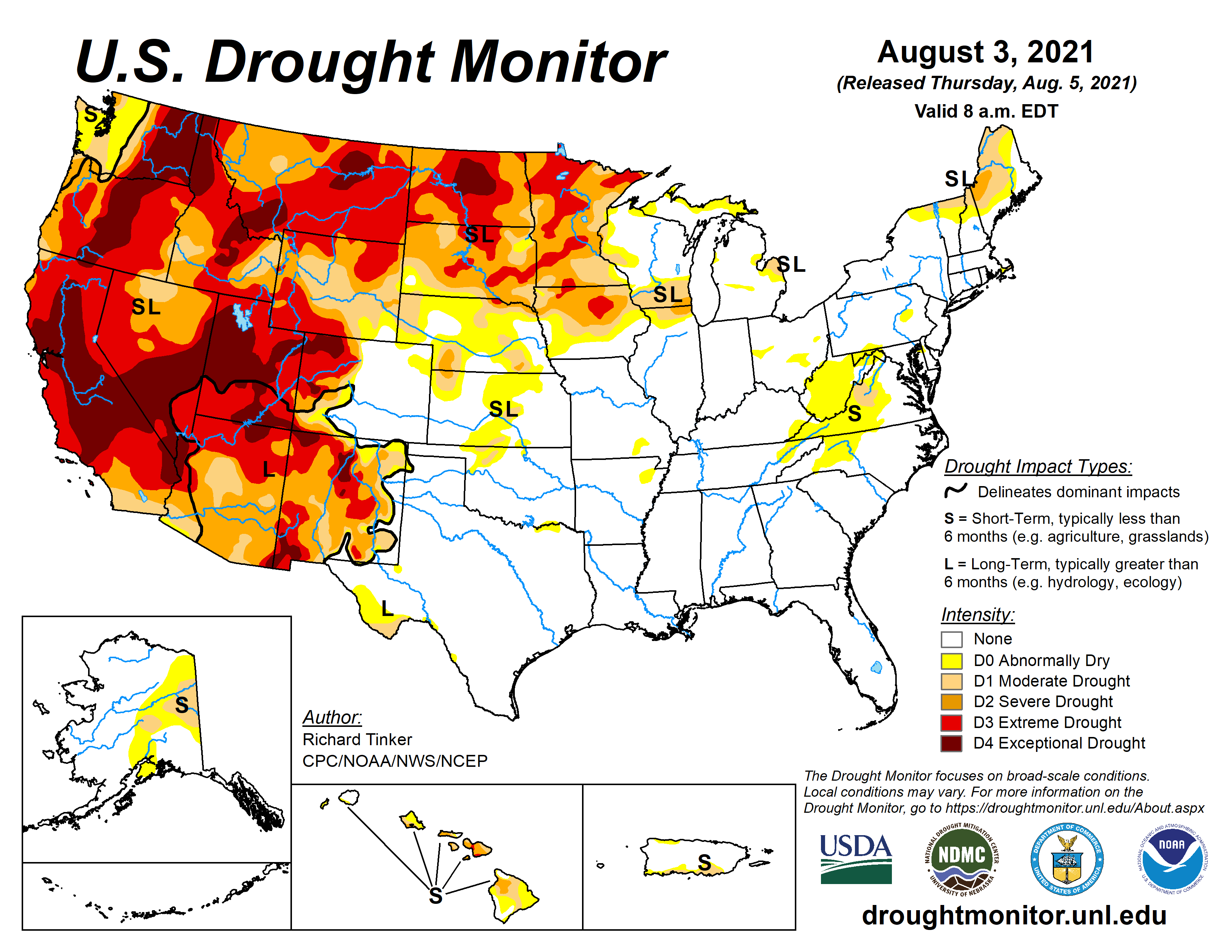
https://droughtmonitor.unl.edu/

The highlight of my week occurs every Thursday at 8:00 a.m. Sadly, it’s not a good highlight.

That’s when the National Drought Mitigation Center releases its update about conditions across the US. Sure, I study the map of the Midwest, where things have improved in some areas. But I spend more time analyzing the map of the US West, where drought conditions continue to worsen each week.

The situation in the West is so bad that those of us living in regions blessed with reliable rainfall need to be honest about two difficult truths.

1. West Coast migrants will move to the Midwest

With the prognosis for ongoing and worsening drought, there is simply no way 70 million people can continue to live in the US West. Even before the Midwest sees migration from coastal areas lost to sea-level rise, we need to prepare for the surge of migrants from our western neighbors.
How soon will the exodus from the West begin? Next year. Yup, 2022. That’s my prediction. The situation is that bad.

2. Second, the Midwest needs to commence an overhaul of its biggest industry: agriculture

Second, the Midwest needs to commence an overhaul of its biggest industry: agriculture. Out West, 80-90 percent of the water from the Colorado River is used for irrigation. Without water, farming at its current scale will not survive. As western farms abandon operations, places with adequate rain will need to fill the food-production void.

In the Midwest, instead of fields and fields of corn and soybeans (largely consumed by cars, animals, and laboratories), those fields need to grow actual food. This won’t be an easy transition. It will take innovation, sacrifice, and boldness. It will also take time, which we don’t have a lot of. So we need to get started now.

The only viable solution to the West’s drought problem in the New Climate Era is a drastically smaller population coupled with a radically altered economic model founded on that bedrock of conservative principles: conservation.

Ed Fallon


My friend Sikowis (Christine Nobiss) of the Great Plains Action Society has written an excellent zine that addresses the need to overhaul agricultural practices in the Midwest. Following are excepts from that zine.

The crew at Great Plains Action Society has a lot to say about resisting colonial-capitalism, taking climate action, and abolishing white supremacy. All our zines are free to use and disseminate to the public as we believe in copyleft–the practice of granting the right to freely distribute and modify intellectual characteristics with the requirement that the same rights be preserved in derivative works created from that property. This does not, of course, apply to our culture, heritage, and traditions, in any way, which has long been exploited by white supremacist identity thieves. 
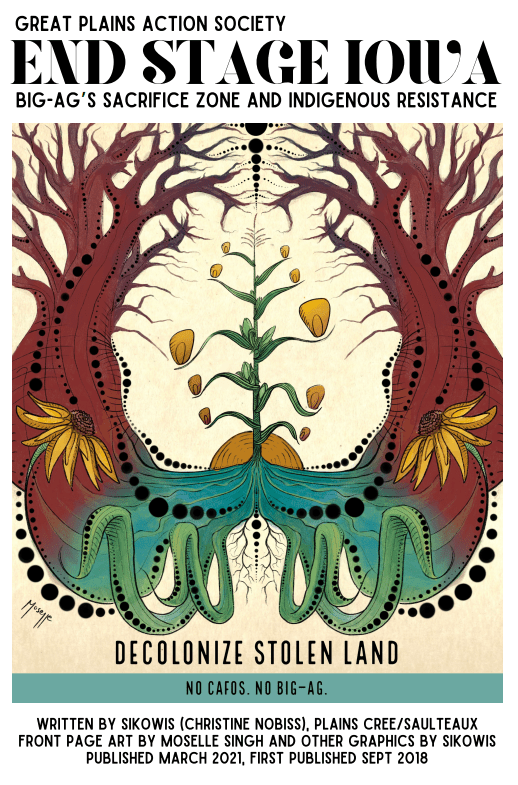
The problem with iowa: Big-Ag’s Sacrifice zone

This zine provides an Indigenous perspective on the environmental catastrophe known as the State of Iowa where the water is poisoned, animals are dying, the soil is disappearing, and the landscape is turning into a desert. Indigenous concepts such as regenerative agriculture, sustainable land use, and compassion for the earth have been violently oppressed by an imperialist heteropatriarchy to make way for colonial-capitalist farming practices which are now killing us and wreaking havoc on the climate. The only way to heal this land is to adopt Indigenous ways of being and uplift an Indigenous regenerative economy

Long Term Goal in Iowa

Great Plains Action Society’s long-term goal is to rematriate extensive swaths of Iowa in order to revive tallgrass prairie, restore buffalo populations, along with many other insects, birds, fish, and animal species eradicated from these lands. The buffalo is a keystone species of the prairie as their migratory patterns, individual movements, and diet assist in creating hardier flora resistant to sickness and climate shifts or irregular weather patterns.

Prairie reclamation is vital to resolving Iowa’s environmental issues and combating the global climate crisis. For instance, most prairie grasses have deep and extensive root systems effectively holding soil in place and protecting them from drought conditions. This is particularly important due to increased severe recipitation events and eventual large-scale drought caused by climate change. Prairie plants also help to clean water sources. Most importantly, prairie reclamation can recapture billions of tons of carbon.

Short Term Goals

Organize and Change Laws

Along with many others in Iowa, Great Plains Action Society wants to remove and change dangerous laws that allow colonial farming practices to continue. Our collective is lobbying, writing, campaigning for a factory farm moratorium as well as a lift on Iowa’s Ag-Gag law. We are a member of the Iowa Alliance for Sustainable Agriculture who is a leading coalition working on better land stewardship and livestock production practices. We have also worked with other organizations like Iowa Citizens for Community Improvement, The Pesticide Action Network, Bioneers, SOCAP, and The Women, Food and Agriculture Network to lobby, speak, and help develop projects. For instance, we consulted on a two-year project with the Pesticide Action Network who released an animation on the global repercussions of Big-Ag, which can be found at https://www.seedsandtruth.com/

Building communities for the (near) future

We need to model how to build sustainable communities not only for climate refugees coming to the Midwest, but also for ourselves. When water no longer flows through the pipes, sewer systems fail and there is no electricity, we will all become climate refugees.

These will become chaotic times as people are forced to abandon the lives of comfort they are familiar with. There will be a great need for spiritual support. Especially as traditional church services will be disrupted, how do we envision spiritual support in the coming time?

There have been numerous experiments to build intentional community. But the model needed now must be created with the intention of being replicated many times over with minimal complexity, using locally available materials—a pre-fab community.

Pre-fab Community
  • Community hub with housing and other structures
    • Simple housing
      • Straw bale houses, sod houses, tents
      • Automobiles, buses and RVs
    • Passive solar and solar panels
    • Stores, school, meetinghouse
    • Central kitchen, bathrooms and showers
  • Surrounding fields for food and straw
  • Water supply
    • Wells, cisterns and/or rain barrels
  • Power
    • Solar, wind, horse
  • Manufacturing
    • Pottery
    • Sawmill
  • Communication
    • Radio
    • local networks
  • Transportation
    • Bicycles
    • Horses
    • Pedal powered vehicles
  • Medical
    • Stockpile common medications
    • Essential diagnostic and treatment equipment
    • Medical personnel adapt to work in community
  • Spiritual

Corrosive of the human spirit

I am broken, trying to make sense of Quakers’ involvement with the institutions of forced assimilation, the Native residential schools. In the news now because of the verification of the remains of hundreds, soon to be thousands, of children on the grounds of those institutions in both the US and Canada. Verified because Native peoples have known they were there, because thousands of children never returned home.

I can not imagine the trauma. The children forcibly removed from their families. The community not knowing if the children would ever return. Their future was stolen. Those who did return often no longer fit into the community. I only recently learned this intentional cruelty was meant to break the resistance of those Native peoples that did not want to give up their land.

I’ve read that we aren’t to feel guilt or blame for what happened in the past. But we are called to learn about the wrongs, learn the truth. Then begin to work for reconciliation and healing. Canada went through such a process, involving the government and the entire country, several years ago. Secretary of the Interior, Deb Haaland, has initiated a Federal investigation of forced assimilation in this country.

From our twenty‐first‐century vantage point, we know (or can learn) how Native people suffered and continue to suffer the consequences of actions that Friends committed 150 ago with the best of intentions. Can we hold those good intentions tenderly in one hand, and in the other hold the anguish, fear, loss, alienation, and despair borne by generations of Native Americans?

Native organizations are not asking us to judge our Quaker ancestors. They are asking, “Who are Friends today? Knowing what we know now, will Quakers join us in honest dialogue? Will they acknowledge the harm that was done? Will they seek ways to contribute toward healing processes that are desperately needed in Native communities?” These are my questions, too.

Quaker Indian Boarding Schools. Facing Our History and Ourselves by Paula Palmer, Friends Journal, October 1, 2016

Although I believe we should not feel guilt, I have not yet been able to to get past my own sense of that. My head and my heart are out of synch. For a time I’ve felt I needed to distance myself from my Quaker communities. I struggle to discern if this was a spiritual leading, or just an emotional reaction. I’m still not sure. I know I continue to feel guilt. And projected this same guilt toward Friends in general. I know that is wrong and am working hard, praying to find my out of this.

Unearthing the truth was necessary not only for the victims to heal, but for the perpetrators as well. Guilt, even unacknowledged guilt, has a negative effect on the guilty. One day it will come out in some form or another. We must be radical. We must go to the root, remove that which is festering, cleanse and cauterize, and then a new beginning is possible.

Forgiveness gives us the capacity to make a new start. That is the power, the rationale, of confession and forgiveness. It is to say, “I have fallen but I am not going to remain there. Please forgive me.” And forgiveness is the grace by which you enable the other person to get up, and get up with dignity, to begin anew. Not to forgive leads to bitterness and hatred, which, just like self-hatred and self-contempt, gnaw away at the vitals of one’s being. Whether hatred is projected out or projected in, it is always corrosive of the human spirit.

Truth and Reconciliation BY DESMOND TUTU, Greater Good Magazine, SEPTEMBER 1, 2004

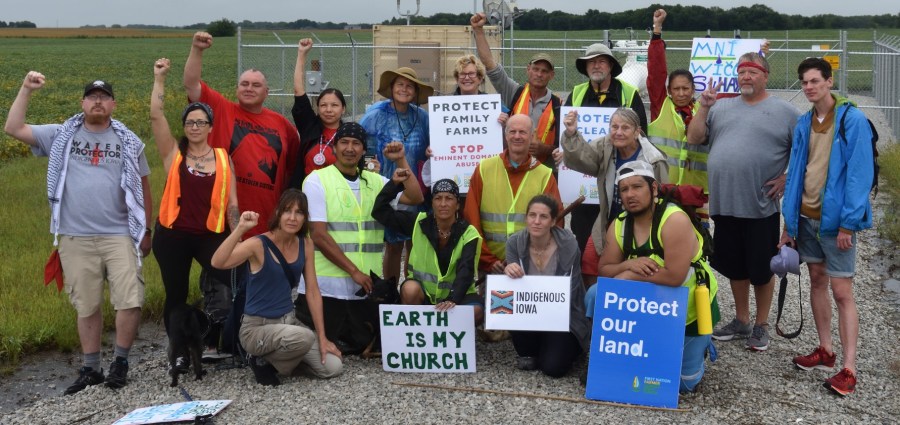
If has been tremendously helpful to have become friends with Native people I began to know as we walked and camped together for 94 miles along the path of the Dakota Access pipeline in 2018. The main intention of that sacred journey was to create a community of native and non-native people who began to know and trust each other so we could work together. That intention was achieved.

And yet, in another way, I have more of a sense of the trauma of assimilation from seeing the terrible effects on my friends.

As Paula Palmer wrote above, “Will they [Quakers] seek ways to contribute toward healing processes that are desperately needed in Native communities?” These are my questions, too.

I need to deal with my guilt before I can contribute to the healing processes.

I am deeply grateful for the acceptance and generosity of my Des Moines Mutual Aid community, which includes Native people. That is helping me move away from this destructive guilt.

I have faith I will be led to a better place.

First Nation-Farmer Climate Unity March September 2018

Students advocate for those who are houseless

The specter of potentially millions of people becoming houseless because of the termination of the moratorium on evictions reminds me of the students camping in the rain to call attention to the problem in Indianapolis.

On  December 5, 2015, Brebeuf Jesuit High School students camped out on the Circle downtown to highlight the problem of homelessness in Indianapolis.  The president of the city council and two councilors were present, too. The term homeless was used then.

The rain didn’t dampen their spirits (much). My friend Jim Poyser had asked me to take photos of the event. I almost decided not to go when I saw how hard it was raining. I lived about a mile from downtown and didn’t have a car. And I didn’t have a way to contact Jim. But something kept urging me to at least see if they were there. It was a memorable night I’m glad I didn’t miss.

Fortunately I had a hood for my camera. The video is a slideshow of some of the photos I took that night.

The students had more presentations and rallies in the following months.


Houseless not homeless!

Those who are forced into being without an abode and/or dwelling are all to quickly deemed less than citizens. In many regards are even treated as less than human. How about thinking that we are NOT homeless, nor last-class citizens or non-human? We think, have feelings, have intellect and struggle. How would you feel to be thought of as anything less than human just for circumstances due to those of profit/gain/control?

Houseless, not homeless!

Mutual Aid Case study 1

Things at our weekly Mutual Aid free food project didn’t go as usual. Which is a good illustration of how and why Mutual Aid works so well.

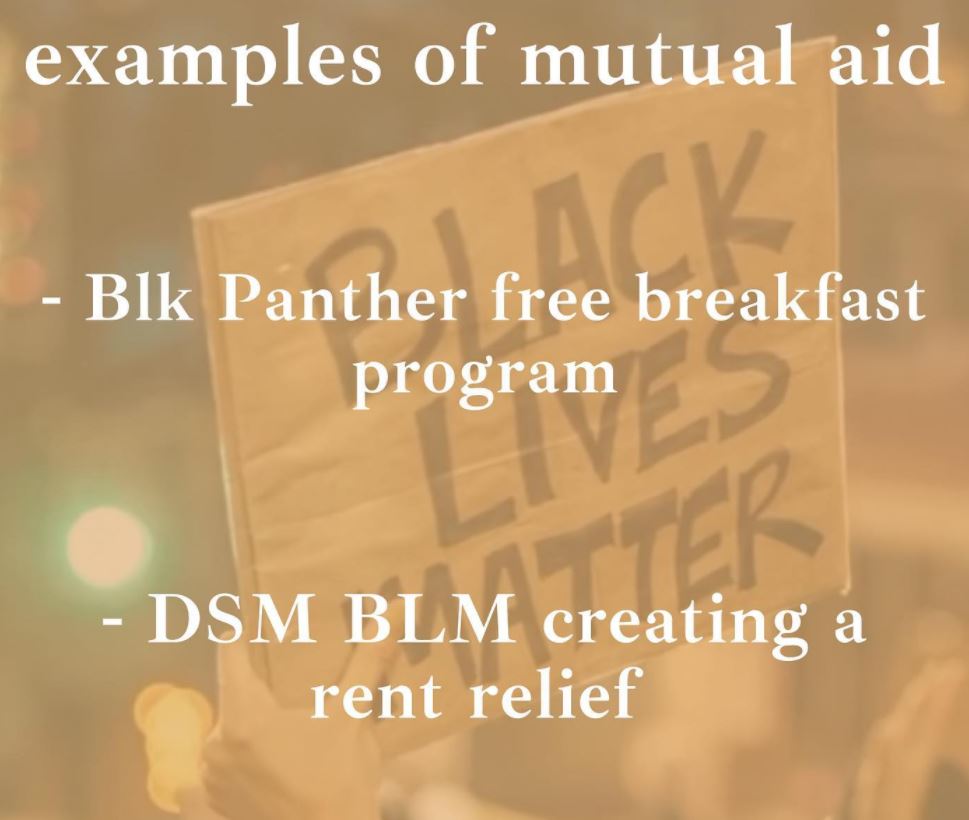
Every Saturday morning my Des Moines Mutual Aid group comes to Trinity Las Américas United Methodist Church in downtown Des Moines, Iowa. There we continue the free food program that was started by the Black Panthers in the 1960’s. see: Feeding the hungry

When I arrived, there were a number of people already in the basement, none of whom I knew. And the tables were set up differently. Someone asked me if I was with Des Moines Mutual Aid, introducing himself as Alejandro Alfaro-Santiz, pastor of the church. Several months ago Ronnie James asked if I knew Alejandro, saying he was an amazing organizer (which was something coming from someone who is a great organizer himself).

Alejandro told me they were running a COVID vaccine clinic this morning. And that he had spoken to Ronnie about the change. Just then Ronnie arrived and said Alejandro was going to show him where to find the tables for us to use.

Now this is a small thing but illustrates the flat hierarchy that is the basis of Mutual Aid. Rather than Ronnie telling me to come with him, he started up the steps with Alejandro. It was up to me to decide if I should go along. I went with them to the THIRD floor where the tables were. We began to fold up the legs and carry the tables down. Others joined us as we went back up for more. They laughed when I said we were getting our cardio workout.

We set these tables up in the yard of the public school across the street from the church, eventually setting up about 25 of them. Although it had rained earlier we were blessed the rain held off for the rest of the morning.

It’s kind of magical how the food boxes are created. When we begin there might be about a dozen empty boxes. So we put the food that will eventually end up in a box in piles on the table itself. Then as each box of food to be distributed is emptied, that becomes a box to fill with one of the piles of food sitting on the table. Eventually there are usually enough boxes for all the piles of food. In the rare times that hasn’t worked out, plastic bags are used for the remainder.

There are often a few minutes of rest between the arrival of food to be distributed from various sources. We share our stories, getting to know each other better. We’re all wearing masks, so it can take a second to figure out who you’re talking to. You have to be careful about what you share on social media because law enforcement scans for that kind of information.

I met person 1 four or five months ago. He had been otherwise occupied and hadn’t been at the church for some time. But I read about the work he was doing for Iowa Citizens for Community Improvement. And I’d seen him “like” my photos sometimes. This morning he said he enjoyed the photos of the deer I posted on Facebook yesterday. He introduced me to a young person who wanted to become involved in Mutual Aid. I later heard from someone else, who themselves (person 2) had been arrested at a Des Moines City Council meeting, that person 1 had been arrested, also. And that he had been hurt in the process.

Person 2 said the police were much rougher than they needed to be. She was targeted for arrest because she was videotaping what was going on. When I asked if they took her phone, she told me she had arranged for another person to take it if it looked like she was going to be arrested. So the police didn’t get her phone. Good to plan ahead.

Despite the fact that we needed to totally rearrange our process, we were ready for the cars to come down the line to pick up the food at the designated time of 10 o’clock.

While the food was being distributed, some of us began to clean and fold up the tables, and carry them back up to the third floor of the church.

As I was getting ready to leave, Ronnie asked if the tables had gotten back to their original locations. Just checking that we all had done our part in cleaning up.

I hope this shows how we stay connected through multiple means.

This is how Mutual Aid works. Being able to adapt. Taking your own initiative. Maintaining a flat hierarchy. Sharing stories. Sharing the joy.


Eviction

The failure of the US Congress to act to address the crisis of those who face eviction is a glaring example of our broken political, economic and social justice systems. Politicians who objected to renewal of the moratorium on evictions should have come up with an alternative. But did not. Conservative estimates show between 50,000 and 65,000 people face eviction in Iowa in August (Des Moines Register).

Everyone has the right to food, water and shelter.

This is another example of the importance of Mutual Aid. Another example of not waiting for help from the government. 50,000 evictions cannot be handled by one Mutual Aid group like my Des Moines Mutual Aid group. But Mutual Aid groups in every community would. Think about starting your own Mutual Aid group. In the meantime, please donate here.

Des Moines Mutual Aid

July 25 · Applications have re-opened… but we need your help to keep them that way.
Please donate to the fund so we can continue to provide relief to our neighbors in the form of rent, utilities and more.
DONATE Venmo: venmo.com/desmoines_mutualaid
PayPal: bit.ly/dsmblmrentrelief
APPLYbit.ly/dsmrentrelief

May be a cartoon of text that says 'APPLICATIONS ARE OPEN. DONATE SO WE CAN CONTINUE TO PROVIDE RELIEF TO OUR NEGHBORS. DONATE Venmo: @DesMoines_MutualAid Cash app: $DSMBLMRentRelief Paypal: Ly/DSMBLMRentRelief APPLY MOINES bit.ly/dsmrentrelief RENT RELIEF FUND MOILD'
(18) Des Moines Mutual Aid | Facebook

How to find help if you’re facing eviction
For renters who may get an eviction notice, the first piece of advice experts say is: Stay put.
A tacked-on notice from your landlord does not mean your family must leave your apartment, said Eric Burmeister, executive director of the Polk County Housing Trust Fund. Only a judge can order a notice to vacate. The process can take 30 to 60 days.
Experts say it’s better to call for help before a formal eviction notice is filed with the courts. Many nonprofit organizations can help with finding assistance and negotiating a payment plan with your landlord to avoid a court order.
It’s also important not to skip the eviction hearing. If a renter does, the judge can issue a default judgement in favor of the landlord. 

There are several numbers to call for help: 
United Way: 211
Iowa Legal Aid: 800-332-0419
Iowa Rent and Utility Assistance Program: iowahousingrecovery.com, 855-300-5885
Polk County rental assistanceIMPACT Community Action Partnership: 515-518-4770

The federal freeze on evictions ends Saturday. Thousands of Iowa renters could be at risk by Ian Richardson and Kim Norvell, Des Moines Register, July 30, 2021

What kind of ancestor do you want to be?

In these increasingly troubled times I find myself thinking about the concept of sensemakingthe action or process of making sense of or giving meaning to something, especially new developments and experiences. 

It is increasingly difficult to make sense of all that is going on today. All the bad things I had anticipated for the future are suddenly happening now. And things I never imagined, like the assaults on truth and science, come at a time when they are desperately needed.

At the collective level, a loss of sensemaking erodes shared cultural and value structures and renders us incapable of generating the collective wisdom necessary to solve complex societal problems like those described above. When that happens the centre cannot hold.

Threats to sensemaking are manifold. Among the most readily observable sources are the excesses of identity politics, the rapid polarisation of the long-running culture war, the steep and widespread decline in trust in mainstream media and other public institutions, and the rise of mass disinformation technologies, e.g. fake news working in tandem with social media algorithms designed to hijack our limbic systems and erode our cognitive capacities. If these things can confound and divide us both within and between cultures, then we have little hope of generating the coherent dialogue, let alone the collective resolve, that is required to overcome the formidable global-scale problems converging before us.

Pontoon Archipelago or: How I Learned to Stop Worrying and Love Collapse. By James Allen, originally published by Medium
June 18, 2019

sensemaking the action or process of making sense of or giving meaning to something, especially new developments and experiences

Celebrants have an important part to play in the legacy humanity caries into the future. I suggest that our responsibility as ceremonialists, as humans who help other humans meaningfully connect with the web of life, is to find ways now to help people connect with the story of this world’s beauty, even as the world we love recedes. I believe there is a gift we can bring to our communities, to help people learn the art of losing. To help us all to meet the rising tides.

Celebrants & Ceremony in Response to Climate Grieving, Dina Stander, July 26, 2019

I believe faith communities and Indigenous ways need to play a crucial role in helping us move through the oncoming, increasingly severe chaos. Faith can provide sensemaking for those who have no framework for making sense of our broken systems.

People of faith can be celebrants. Indigenous peoples are celebrants, their cultures based upon a timeless connection to Mother Earth.

The problems before us are emergent phenomena with a life of their own, and the causes requiring treatment are obscure. They are what systems scientists call wicked problems: problems that harbour so many complex non-linear interdependencies that they not only seem impossible to understand and solve, but tend to resist our attempts to do so. For such wicked problems, our conventional toolkits — advocacy, activism, conscientious consumerism, and ballot casting — are grossly inadequate and their primary utility may be the self-soothing effect it has on the well-meaning souls who use them.

If we are to find a new kind of good life amid the catastrophes these myths have spawned, then we need to radically rethink the stories we tell ourselves. We need to dig deep into old stories and reveal their wisdom, as well as lovingly nurture the emergence of new stories into being.

Pontoon Archipelago or: How I Learned to Stop Worrying and Love Collapse. By James Allen, originally published by Medium
June 18, 2019

How do we rethink the stories we tell ourselves? We need to let go of the stories we have discovered to be untrue. Learn about, and embrace stories of other cultures. Seek, and really listen for, Spiritual guidance. Then actually implement that guidance.

One idea is to share stories from earlier times. “We need to dig deep into old stories and reveal their wisdom.” The Quaker Stories Project is an example. https://quakerstories.wordpress.com/

We need to re-think those stories. To consider what they say about our world today. To see if they represent something we have lost. Something it might be good to return to. The past leading into the future.

Seeking out new people and experiences are ways we can create new stories. For more than a year I have been learning new stories from my friends in the Mutual Aid community. We have been learning, together, how to live and work together in ways without a vertical hierarchy. Where decisions no longer come from leaders who try to wield power without consent. As my friend Ronnie James, who is my Mutual Aid mentor says:

I’m of the firm opinion that a system that was built by stolen bodies on stolen land for the benefit of a few is a system that is not repairable. It is operating as designed, and small changes (which are the result of huge efforts) to lessen the blow on those it was not designed for are merely half measures that can’t ever fully succeed.

So the question is now, where do we go from here? Do we continue to make incremental changes while the wealthy hoard more wealth and the climate crisis deepens, or do we do something drastic that has never been done before? Can we envision and create a world where a class war from above isn’t a reality anymore?”

Ronnie James

Our ancestors are ashamed of us, my friends. We are the people who disgraced the past, to create a myth called “the future.” That myth failed because there was no soul in it, no depth, no humanity. It was a vision of power, control, slavery, and violence, if we strip the gloss away

We’re Losing the Battle for the Future | by umair haque | Jul, 2021 | Eudaimonia and Co (eand.co)

It all comes down to what type of ancestor I want to be for my descendants. Do I want to be a regular nobody that did nothing to protect our planet or do I want to be like Crazy Horse who fought and died for the little bit of land that we have left to protect? We have that chance right now to make that decision. This kind of resistance runs through all of our blood because we are the Indigenous Peoples of these lands. It’s at vital choice for the survival of humankind.

What Kind of Ancestor Do you Want to Be? Why I Fight the KXL by TaSina Sapa Win, February 28, 2019

Resist

Resistance is a powerful concept.

As I pray and learn about atrocities and injustices, the courage of resisters in all struggles, through all time, inspire me.

My own first experience with resistance came when I was 18 years old and faced the decision regarding registering for the draft (Selective Service System). The stories of, the example of many Quaker men I knew, helped me immensely to decided to resist the draft. My friend and Quaker mentor, Don Laughlin, collected stories of Quaker resistance: Young Quaker Men Face War and Conscription

It was an act of resistance when we walked and camped along the route of the Dakota Access pipeline, from Des Moines to Fort Dodge, Iowa, for a week in 2018. You can read the many stories, and see the photos of this sacred journey here.
First Nation-Farmer Unity – First Nation peoples and farmers working together (firstnationfarmer.com)

I spent many years resisting other fossil fuel pipelines, including the Keystone XL pipeline. And was peripherally involved with the Wet’suwet’en peoples’ resistance to the Coastal GasLink pipeline.

Now I am involved with those who are resisting colonial capitalism and white supremacy. As we build Mutual Aid communities. As we work for LANDBACK.

I don’t know what I will write each morning, as I wait in quiet and pray. The following poem triggered this today.

Resist

Brandy Nālani McDougall

Qawem ya sha’abi, qawemhum. Resist my people, resist them.
—Dareen Tatour

Hawaiians are still here. We are still creating, still resisting.
—Haunani-Kay Trask


Stand in rage as wind and current clash
                                       rile lightning and thunder
fire surge and boulder crash

         Let the ocean eat and scrape away these walls
Let the sand swallow their fences whole
                       Let the air between us split the atmosphere

We have no land             No country
             But we have these bodies              these stories
this language of rage                    left 

                 This resistance is bitter
and tastes like medicine                 Our lands 
               replanted in the dark and warm             there

We unfurl our tangled roots                stretch
                             to blow salt across
             blurred borders of memory  

             They made themselves
fences and bullets             checkpoints 
gates and guardposts                           martial law

They made themselves
            hotels and mansions         adverse 
possession             eminent domain and deeds

                   They made themselves 
                                                       shine 
                                           through the plunder

They say we can never— They say 
                           we will never—because
            because they— 

            and the hills and mountains have been 
mined for rock walls                    the reefs 
            pillaged for coral floors

They say we can never—
                           and the deserts and dunes have been
shoveled and taken for their houses and highways—

                because we can never— because 
the forests have been raided                      razed 
and scorched and we                                 we the wards

refugees          houseless          present-
absentees       recognition refusers        exiled
uncivilized       disposable        natives

protester-activist-terrorist-resisters—
               our springs and streams have been
dammed—so they say we can never return

                       let it go accept this 
progress         stop living
            in the past—

but we make ourselves
         strong enough to carry all of our dead
                engrave their names in the clouds

We gather to sing whole villages awake 
        We crouch down to eat rocks like fruit
                 to hold the dirt the sand in our hands 

to fling words 
           the way fat drops of rain 
                   splatter off tarp or corrugated roofs

We remember the sweetness                We rise from the plunder
           They say there is no return                             
                   they never could really make us leave

Copyright © 2021 by Brandy Nālani McDougall. Originally published in Poem-a-Day on July 23, 2021, by the Academy of American Poets.

“‘Resist’ was inspired by Palestinian poet Dareen Tatour’s courage to stand against the ongoing Israeli occupation of Palestinian land and ethnic cleansing of her people. In 2015, for the poetic line ‘Qawem ya sha’abi, qawemhum’ (Resist, my people, resist them), she was imprisoned on charges of ‘incitement to violence’ and sentenced to five months in jail and years under house arrest. This poem ‘Resist’ reflects on both the militarized violence and creative decolonial connections between Palestine and Hawaiʻi, which was an independent country prior to the U.S. military-backed overthrow in 1893 and the subsequent illegal annexation to the U.S. in 1898. Our own continued struggle as Kānaka ʻŌiwi includes protecting our lands and waters from U.S. military bases and testing, bombing, dumping, housing, and recreational sites, and protecting our people from related health hazards, poverty, and hopelessness. We will forever resist the destruction of our homelands and how they are being used to test weapons that bring horrific violence to others. I intend ‘Resist’ to be a poem of solidarity for the Palestinian people.”

Brandy Nālani McDougall

Intertwined threads

Writing is a spiritual practice for me. Sitting at the computer, I try to quiet my mind to hear what I should write. In times past a writer would sit in front of a blank page. This morning there are intertwined threads.

There are many reasons news of the remains of Native children profoundly affects me.

My career began with five years in neonatal intensive care. The rest doing research at that children’s hospital. I was blessed to be immersed with children everyday. I attempt to retain childlike qualities. Children are my heroes. I love the idea of children as sacred beings.

In almost every indigenous language of what is now known as the Americas there is a word for children that translates to English as sacred beings. Acknowledging in thoughts, words and actions that our children are sacred beings provides not only the necessary healthy intention and consciousness that will benefit our children; this acknowledgement reminds us as parents to once again be open with our own hearts.

Knowing children as sacred beings brings forth a healthy and healing strength of humility from within us as parents and adults. The youth are our teachers with a profound message for this world. When we as parents and adults acknowledge the Sacredness within ourselves it becomes difficult to not acknowledge this within others – especially our children. We have all been manifested as sacred beings, and although we are able to forget, we are unable to change the truth of what we have been created as, and always will be.

For parents who struggle to see themselves as sacred beings, simply allow your children to remind you of what you’ve forgotten. At birth through their newborn cries the children sing a song to their parents and the world. At this very moment hundreds of sacred beings, answered prayers, messengers of light are manifesting in all cultures and languages. They’re all entering this world singing a song of a sacred contract that can never be broken, only temporarily forgotten. The children’s song is reminding us. Listen…

Raising Sacred Beings,  by Anthony Goulet, The Good Men Project. August 29, 2014

One of this morning’s threads relates to brutal honesty. I’ve often thought of the following quote. I haven’t always been but will try to be brutally honest in what follows.

Being brutally honest does not necessarily mean you are correct.

Well, I have to tell you something, and you may not like to hear it. But if you struggle with the art of being frank, you need to hear this. It will make you a better person, a better communicator and a better blogger.
So here it is …
You’re a coward.
If you can’t be brutally honest with people, especially when you know it’s in their best interest, you’re a coward.
You’re not doing anyone a favor by withholding a truth from them, even if it’s difficult for them to hear.
The only person you’re protecting is yourself. Because you’re afraid of the consequences to you.
But it’s not about you.
Being honest is about making sure your audience has the information they need to make good decisions. That includes information they may not like.

THE BRUTALLY HONEST GUIDE TO BEING BRUTALLY HONEST by Josh Tucker, SmartBlogger,Jan 30, 2019

I’ve stepped away from the Quaker community that has supported my spiritual life, my whole life. I’m not certain this is not just an emotional response to the atrocities of forced assimilation. I continue to pray to see if this is a true spiritual leading.
I wonder if I can remain a Quaker.

For the past several years I have been led to opportunities to become friends with a number of Native people. It takes much more than attending conferences or powwows or serving on committees to accomplish this. One opportunity was walking and camping for 94 miles along the path of the Dakota Access pipeline with a small group of native and non-native people. Through experiences like that, I’ve been blessed to come to some understandings through a gentle process of integration. But I am just at the beginning of this journey.

The word En’owkin in the Okanagan language elicits the metaphorical image of liquid being absorbed drop by single drop through the head (mind). It refers to coming to understanding through a gentle process of integration.

Jeanette Armstrong

What follows are generalities. But my understanding, expressed as brutally honestly as I can. When I refer to Quakers I mean white Quakers in the lands called the United States and Canada. That distinction is necessary because much relates to white supremacy.

  • Indigenous peoples have always lived in balance with nature.
  • Quakers are not and should immediately do everything possible to stop using fossil fuels.
  • We should immediately ramp up installation of local renewable energy sources.
  • Environmental chaos will only worsen. Extremely rapidly.
  • Indigenous ways are the only way to slow down the impending chaos.
  • I have grown spiritually from my experiences with Indigenous peoples. In ways I hadn’t as a Quaker.
  • White Quakers are too integrated into the culture of white supremacy and capitalism.
  • Friends need to understand how white culture continues to oppress and interfere with our relationships with black, Indigenous and other people of color (BIPOC).
  • Friends should be physically present in BIPOC communities so healing and reconciliation can occur.  To understanding through a gentle process of integration.
  • Friends should literally be on the front lines of BIPOC actions for justice.
  • Quakers should reject vertical hierarchies of power. Vertical hierarchies are the only way White supremacy can exist.
  • An alternative is Mutual Aid which is based upon a flat hierarchy. Quakers should participate in, and create Mutual Aid communities.
  • Quakers should learn about and participate in Land Back. The model for returning to Indigenous practices for community and stewardship of the land.
  • Hundreds of thousands of Native children were forcibly taken from their families to institutions of assimilation.
  • Thousands of children died in those schools, or during their escape.
  • Quakers were involved in various ways in forced assimilation.
  • Quakers should discern a response and act on it now. This is urgent. Rapidly increasing numbers of children found is devastating Indigenous communities. Should be devastating to Quakers.

In our way we are always told not to ask for anything. We are always told in our community, as a practice, that when we have to start asking for something, that’s when we’re agreeing that people be irresponsible. Irresponsible in not understanding what we’re needing, irresponsible in not seeing what’s needed, and irresponsible in not having moved our resources and our actions to make sure that need isn’t there, because this is the responsibility that we, and the people that surround us, mutually bear. So in our community we cannot go to a person and say, “I want you to do this for me.” All we can do is clarify for them what is happening and what the consequences are for our family, or for our community, or for the land. We must clarify for them what needs to be done and how it needs to be done, and then it is up to them and if they fall short of that responsibility, at some point they will face the same need themselves.

Indigenous Knowledge and Gift Giving by Jeanette Armstrong, syndicated from gift-economy.com, Jul 13, 2021

The website LANDBack Friends has many resources to help Quakers learn more about, and how to do these things. https://landbackfriends.com/

I have tried to clarify for Quakers what needs to be done and how it needs to be done, and then it is up to them and if they fall short of that responsibility, at some point they will face the same need themselves.

I thought of this photo I took yesterday when I read coming to understanding through a gentle process of integration in the quote above. The image was basically black, but by the gentle process of editing, the shapes and rainbows of colors emerged.


Gentile process of integration. Jeff Kisling

Tensions between Native peoples and Christian religions

There is growing sorrow and anger in Indigenous communities now. Related to the awful and expanding discoveries of the remains of children, thousands of them, found on the grounds of former Native residential schools.

A good friend told me he is trying to not let rage get in the way of his mourning. I know his son, and can’t imagine the conversations they might have had about this news.

It is so traumatic to imagine the terror of the children, who had to know about at least some of these deaths at their school. To have been abused in so many ways. Punished if they spoke their language. Not even be allowed their practices that might give comfort. Alone, isolated from their families. Knowing they could die themselves.

Interior Secretary Deb Haaland announced Tuesday that she is launching the Federal Indian Boarding School Truth Initiative, a first-of-its-kind comprehensive review of the “devastating history” of the U.S. government’s policy of forcing Native American children into boarding schools for assimilation into white culture.

Deb Haaland Launches Review of ‘Devastating’ Native American Boarding Schools. The Interior Department probe will identify Indigenous children who died at schools the U.S. government forced them into for assimilation into white culture By Jennifer Bendery, HuffPost, June 22, 2021

Quakers were involved in some of these schools. Not to say they mistreated the children. But the concept of trying to assimilate Native children into white culture is by definition cultural genocide.

What is our accountability today?

From our twenty-first-century vantage point, we know (or can learn) how Native people suffered and continue to suffer the consequences of actions that Friends committed 150 ago with the best of intentions. Can we hold those good intentions tenderly in one hand, and in the other hold the anguish, fear, loss, alienation, and despair borne by generations of Native Americans?

Native organizations are not asking us to judge our Quaker ancestors. They are asking, “Who are Friends today? Knowing what we know now, will Quakers join us in honest dialogue? Will they acknowledge the harm that was done? Will they seek ways to contribute toward healing processes that are desperately needed in Native communities?” These are my questions, too.

Quaker Indian Boarding Schools. Facing Our History and Ourselves By Paula Palmer, Friends Journal, October 1, 2016

I belong to the spiritual communities of Quakers and of my Native friends. There is great tension between these communities. The article below, “why we’re burning Bibles” describes a Native view of Christian religions. This was written by the Great Plains Action Society, where I have many friends. I am sure some Friends will object to these ideas. But we don’t have the right to pass judgement.

This is a confusing time for me. I’ve been learning and telling others about the Native boarding schools for years. I have spoken about this and apologized to each of my Native friends for the Quaker involvement in the residential schools.

Below is an Epistle to Friends Regarding Community, Mutual Aid and LANDBACK in which I write more about these things. My Native friends tell me the best way I can help them is by teaching others about the concepts of LANDBACK. So I’ve recently created the website LANDBACK Friends. There is a lot of information about the Native boarding schools there.

When I began to learn of the verification of the remains of Native children at those schools, I wondered how that might affect how Native peoples view Quakers, view me now. I am touched by them telling me I am still welcome to work with them.

Native organizations are not asking us to judge our Quaker ancestors. They are asking, “Who are Friends today? Knowing what we know now, will Quakers join us in honest dialogue? Will they acknowledge the harm that was done? Will they seek ways to contribute toward healing processes that are desperately needed in Native communities?”

Paula Palmer

Why We’re Burning Bibles

Stand with First Nations Peoples on Cancel KKKanada Day and burn your bibles for the rape, torture, and murder of Indigenous children. Use #bibleburner and post your video or pic online or on the event page.

In the wake of over 1300 unmarked/mass graves that have recently been uncovered on reservations such as the Cowessess and Tk’emlúps te Secwépemc First Nations in Canada, we demand truth, justice, and healing from genocidal policy set forth by the US and Canada that allowed Christian clergy to neglect, rape, torture, and murder Indigenous children. We also demand redress and reparations to the fullest extent as we know that there are thousands of Indigenous children also buried here in the US—and the search hasn’t even begun.

For now, we will start by expelling the codified christian text that is the blueprint behind our genocide. The Christian bible has proven to be the deadliest of all human-made weapons. It has been the permission slip for all of the atrocities following colonization. The cost of building the global Christian Empire is an ongoing and immeasurable loss that we can never truly have a full accounting for, as the newest discovered mass graves of our relatives painfully remind us today.

As we mourn the loss of our loved ones and relatives, murdered and discarded after being violently stolen from us, we don’t forget the who or the why. For over 100 years the churches have used these schools to destroy us, to “kill the indian to save the man”.

This has never been a secret.

This is why we reject the entire premise of the Christian faith and its supportive texts. The Bible remains a supportive tool to persecute Indigenous people. Rejecting this tool is vital to the continuation of supporting Indigenous people and our livelihood. We ask our supporters to join us in burning the Bible as an act of solidarity and to send a message to Christian faiths that we will no longer allow this tool to exist in our spaces.

Why We’re Burning Bibles

#everychildmatters
#bibleburner


An Epistle to Friends Regarding Community, Mutual Aid and LANDBACK

Dear Friends,

The measure of a community is how the needs of its people are met. No one should go hungry, or without shelter or healthcare. Yet in this country known as the United States millions struggle to survive. The capitalist economic system creates hunger, houselessness, illness that is preventable, and despair. A system that requires money for goods and services denies basic needs to anyone who does not have money. Black, Indigenous, and other people of color (BIPOC) are disproportionately affected. Systemic racism. The capitalist system that supports the white materialistic lifestyle is built on stolen land and genocide of Indigenous peoples, and the labor of those who were enslaved in the past or are forced to live on poverty wages today.

Capitalism is revealed as an unjust, untenable system, when there is plenty of food in the grocery stores, but men, women and children are going hungry, living on the streets outside. White supremacy violently enforces the will of wealthy white people on the rest of us.

It has become clear to some of us who are called Friends that the colonial capitalist economic system and white supremacy are contrary to the Spirit and we must find a better way. We conscientiously object to and resist capitalism and white supremacy.

capitalism has violated the communities of marginalized folks. capitalism is about the value of people, property and the people who own property. those who have wealth and property control the decisions that are made. the government comes second to capitalism when it comes to power.

in the name of liberation, capitalism must be reversed and dismantled. meaning that capitalistic practices must be reprogrammed with mutual aid practices. 
Des Moines Black Liberation Movement

Mutual Aid

How do we resist? We rebuild our communities in ways not based upon money. Such communities thrive all over the world. Indigenous peoples have always lived this way. Generations of white people once did so in this country. Mutual Aid is a framework that can help us do this today.

The concept of Mutual Aid is simple to explain but can result in transformative change. Mutual Aid involves everyone coming together to find a solution for problems we all face. This is a radical departure from “us” helping “them”. Instead, we all work together to find and implement solutions.  To work together means we must be physically present with each other. Mutual Aid cannot be done by committee or donations. We build Beloved communities as we get to know each other. Build solidarity. An important part of Mutual Aid is creating these networks of people who know and trust each other. When new challenges arise, these networks are in place, ready to meet them.

Another important part of Mutual Aid is the transformation of those involved. This means both those who are providing help, and those receiving it.

With Mutual Aid, people learn to live in a community where there is no vertical hierarchy. A community where everyone has a voice. A model that results in enthusiastic participation. A model that makes the vertical hierarchy required for white supremacy impossible.

Commonly there are several Mutual Aid projects in a community. The initial projects usually relate to survival needs. One might be a food giveaway. Another helping those who need shelter. Many Mutual Aid groups often have a bail fund, to support those arrested for agitating for change. And accompany those arrested when they go to court.

LANDBACK

The other component necessary to move away from colonial capitalism and white supremacy is LANDBACK.

But the idea of “landback” — returning land to the stewardship of Indigenous peoples — has existed in different forms since colonial governments seized it in the first place. “Any time an Indigenous person or nation has pushed back against the oppressive state, they are exercising some form of landback,” says Nickita Longman, a community organizer from George Gordon First Nation in Saskatchewan, Canada.

The movement goes beyond the transfer of deeds to include respecting Indigenous rights, preserving languages and traditions, and ensuring food sovereignty, housing, and clean air and water. Above all, it is a rallying cry for dismantling white supremacy and the harms of capitalism.

Returning the Land. Four Indigenous leaders share insights about the growing landback movement and what it means for the planet, by Claire Elise Thompson, Grist, February 25, 2020

What will Friends do?

It matters little what people say they believe when their actions are inconsistent with their words.  Thus, we Friends may say there should not be hunger and poverty, but as long as Friends continue to collaborate in a system that leaves many without basic necessities and violently enforces white supremacy, our example will fail to speak to mankind.

Let our lives speak for our convictions.  Let our lives show that we oppose the capitalist system and white supremacy, and the damages that result.  We can engage in efforts, such as Mutual Aid and LANDBACK, to build Beloved community. To reach out to our neighbors to join us.

We must begin by changing our own lives if we hope to make a real testimony for peace and justice.

We remain, in love of the Spirit, your Friends and sisters and brothers.

Prefab Communities

The recent days of triple digit temperatures and their effects are showing what the future will look like. That future is now, actually. People are beginning to panic. Systems of all types are failing.

Climate refugees will be forced to flee areas of drought, rising sea levels, devastation from severe storms. Migrants will be desperate for food and water. A desperation that will lead to violence. I don’t know how we can prepare for that.

What follows are parts of posts I’ve written over the past five years. I am less hopeful we can find ways to deal with climate refugees, as we have seen increasing polarization and violence across many divisions.

And yet, in some ways I’m more hopeful as I’ve been learning about, participating in Mutual Aid communities.

Building small communities in rural areas, or around urban farming, will give people fulfilling work to do, food to eat, shelter, and a caring community to belong to, restoring their dignity. These communities can work without requiring money in exchange for these things. Friends in Iowa City have experience with intentional community. And the Maharishi community in Fairfield, Iowa.

The most important consideration is water supply. Without water nothing else works. We will continue to see spreading and worsening droughts.

Following is a draft for creating new communities, not only for ourselves, but with the intention of creating a model that can be rapidly replicated. So the flood of climate refugees have a template to build their own self sufficient communities when they are forced to migrate. The UN Refugee Agency estimates that by 2050, up to 250 million people will be displaced by climate change.

Urgency

  • Environmental disasters
    • Weather extremes
      • Widespread and persistent drought, rising seas and more intense storms and fires
        • Destroyed homes, cities, land
        • Deadly air temperatures
        • Destroyed infrastructure
        • Water, food and energy scarcity
        • Resource wars
        • Collapsing social/political order
        • Climate refugees
    • Militarism and police states
    • Decreasing availability of complex health care and medications
    • Spiritual poverty

The Midwest

Here in the Midwest we are faced with two broad problems. How to adapt our own lives to deal with these changes, and what to do about the flood of people who will be migrating to the Midwest.

“Along America’s most fragile shorelines, [thousands] will embark on a great migration inland as their homes disappear beneath the water’s surface.” LA Times, Victoria Herrmann Jan 25, 2016

Since we will soon not be able to depend on municipal water and power, transport of food from distances, schools and hospitals, many will be forced to move to rural areas or create urban gardens and farms, where they can live and grow their own food.

The Choice

  1. One choice is to narrowly focus on the best we can do to prepare ourselves and immediate community to adapt to the coming changes.
  2. The other is to also work on ways we can help the many climate refugees who will likely be migrating to the Midwest. Help them learn to adapt and thrive. Although these days violence rather than cooperation seems more likely.

Building Communities-The Vision

We need to model how to build sustainable communities. There have been numerous such experiments in intentional community. But the model needed now must be created with the intention of being replicated many times over with minimal complexity, using locally available materials—a prefab community.

Prefab Community

  • Community hub with housing and other structures
    • Simple housing
      • Straw bale houses
      • Passive solar and solar panels
      • No kitchens or bathrooms (community ones instead)
    • Store, school, meetinghouse
    • Central kitchen and bathrooms
  • Surrounding fields for food and straw
  • Water supply
    • Wells, cisterns and/or rain barrels
  • Power
    • Solar, wind, hydro, horse
  • Manufacturing
    • 3 D printing
    • Pottery
    • Sawmill
  • Communication
    • Radio, local networks
  • Transportation
    • Bicycles
    • Electric vehicles
    • Horses
    • Pedal powered vehicles
  • Medical
    • Stockpile common medications
    • Essential diagnostic and treatment equipment
    • Medical personnel adapt to work in community
  • Spiritual
    • Meeting for worship
    • Meeting for business
    • Religious education

Mobil homes, buses and cars can be repurposed for shelter.

If/when local water supplies dry up in these new communities, people will be forced to move again.