Interwoven into a Fabric of Oppressive Systems

A recent article in Popular Resistance by Don Fitz is titled, “PATH TO EXTINCTION OR TO A LIVABLE FUTURE. Climate change is not a “thing-unto-itself” but is interwoven into a fabric of oppressive systems. Addressing climate change requires multiple approaches, including participatory economics, financial equality, and mutual aid networks.

COP 26 has shown, once again, that solutions for climate change will not come from societies whose goal is to maintain the status quo. That will not act to decrease fossil fuel extraction and use. That refuse to listen to the wisdom of Indigenous peoples who have lived for millennia in balance with Mother Earth.

It has long been said in many ways that problems cannot be solved by relying on individuals and institutions who created them. The novel crisis of climate change nested within intertwined social problems calls for new ways of thinking – ways which are manifested in new mutual aid groups, new trade unions, and new political institutions.

Stan Cox whacks all three dragon heads in his new book The Path to a Livable Future: A New Politics to Fight Climate Change, Racism and the Next Pandemic. He dismisses the anti-science and racism of climate denialists such as Trump, strips bare the insincerity of the early Biden administration, and uncovers the lurking dangers of energy denial.

The book goes beyond these. Cox demonstrates that climate change is not a “thing-unto-itself” which can be halted by a quick fix of a few trillion dollars; but, is a pernicious stain in an interwoven fabric of oppressive systems. This lays the groundwork for outlining a multiplicity of problems which must be addressed to confront climate change. These include reducing production via a participatory economy, establishing financial equality, and building mutual aid networks.

PATH TO EXTINCTION OR TO A LIVABLE FUTURE By Don Fitz, Popular Resistance, November 7, 2021

Readers of this blog know Mutual Aid is a focus of my study, writing, and work. https://landbackfriends.com/?s=%22mutual+aid%22 What Sam Cox says deepens my conviction of the importance of Mutual Aid as a pivotal part of change that is desperately needed now. To immediately address the consequences of our current fossil fuel-based economy.

But I wasn’t familiar with the term participatory economy. I updated the model I’ve been working on to include that. (See below)

The Participatory Economy model, also known as Participatory Economics, or Parecon, was developed by economists Michael Albert and Robin Hahnel and first formally presented in 1991 in Princeton University Press. Drawing on libertarian socialist ideas and real-world examples throughout history, their motivation was to inspire hope, inform strategy and to demonstrate that a viable and better alternative to the two dominant economic systems of the last century, capitalism and a command economy, is possible.

Participatory Economy


Another term I’ve just learned is “energy denial“. I’ve been guilty of thinking “alternative energy” would play a significant role in transitioning away from fossil fuels.

The term “energy denial” reflects an intense belief that “alternative energy” (AltE) such as solar, wind, and hydro-power cause nothing but trivial problems which should be ignored in order to allow unlimited expansion of production.  Michael Klare is one of innumerable progressive authors who use justified hysteria over climate change to demand unjustified spending of trillions of dollars on AltE.

Core to Cox’s analysis is a concept that runs so contrary to conventional leftist wisdom that many will not speak it, read it, or publish it.  He is at the forefront of authors willing to melt the golden calf of AltE.  He slams congressional proposals for a “Green New Deal,” noting that they fail to include any plans for restricting fossil fuel (FF) production and merely pretend that increases in solar and wind will cause a reduction in its use.  Reduction is not written into the plans because FFs are essential for manufacturing AltE equipment.  The book portrays the most troubling aspect of AltE to be its promotion as a panacea.  This contributes to the preservation of social structures that are most in need of replacement:

PATH TO EXTINCTION OR TO A LIVABLE FUTURE By Don Fitz, Popular Resistance, November 7, 2021

As a result, I’ve also changed this diagram by removing “renewable energy” and replacing that with “conservation“.

Thanks to bright green technologies, we can continuously grow the level of consumption on planet Earth and deliver a bloated North American lifestyle to all without inviting climate catastrophe or a general breakdown of natural ecosystems that support all living things.

That’s the big bold lie that politicians are telling themselves this week at yet another climate conference. Greta Thunberg calls such dissembling just so much “blah, blah, blah.”

As I’ll share in this piece, a number of brilliant energy critics from Vaclav Smil to William Rees have done the figuring, acknowledged the physical limits of things, and told us the truth. A truth that is not as uncomfortable as you might think.

It is this. We must contract the global economy, restructure technological society and restore what’s left of natural ecosystems if we want to live and breathe.

Returning to a 1970s Economy Could Save Our Future. We’d contract energy use by half. Shrinking consumption is the solution we can actually live with. Second of two By Andrew Nikiforuk, The Tyee, 4 Nov 2021

COP 26 and Beyond Coal and Gas Alliance

COP 26 can only be seen as a failure since there was no agreement to end fossil fuel extraction and use. Nothing short of that will even slow down environmental collapse. It is not true that the deal “keeps 1.5C within reach” as COP26 President Alok Sharma says. Already the temperature has increased 1.1C. We are on a path to reach at least 2.7C by 2100, if drastic changes aren’t made immediately.

China and India will have to explain themselves to climate-vulnerable nations, COP26 President Alok Sharma has said as the summit ends.

It comes after the two nations pushed for the language on coal to change from “phase out” to “phase down” in the deal agreed in Glasgow.

But Mr Sharma insisted the “historic” deal “keeps 1.5C within reach”.

Under the Glasgow climate pact:

  • Countries were asked to republish their climate action plans by the end of next year, with more ambitious emissions reduction targets for 2030
  • There is an emphasis on the need for developed countries to increase the money they give to those already suffering the effects of climate change – beyond the current $100bn annual target
  • The language about coal has been included for the first time ever in a global climate deal
  • A pledge in a previous draft to “phase out” coal was instead watered down to a commitment to “phase down” coal

COP26: China and India must explain themselves, says Sharma by Malu Cursino, BBC News, Nov 14, 2021


Ed Miliband, shadow business and energy secretary, told the Sky News’ Trevor Phillips programme that “keeping 1.5 degrees alive is frankly in intensive care”.

He said: “The task of the world is to halve global emissions over the coming decade, that’s by 2030, that’s what the scientists tell us is necessary to keep 1.5 degrees alive.

COP26: China and India must explain themselves, says Sharma by Malu Cursino, BBC News, Nov 14, 2021

https://beyondoilandgasalliance.com/
Beyond Oil and Gas Alliance

A new diplomatic alliance to phase out global oil and gas production was formally launched at the UN climate change conference in Glasgow on Thursday, signaling an emerging international front in the fight against climate change.

The Beyond Oil and Gas Alliance, which Quebec announced it would join last week, is led by Costa Rica and Denmark, and now also includes France, Greenland, Ireland, Sweden, Wales, and Quebec as “core” members, California, Portugal, and New Zealand as “associate” members, and Italy which joined as a “friend” of the alliance.

Core membership means the country — or province, in the case of Quebec — has committed to end new exploration permits. Associate members must demonstrate efforts towards an oil and gas phase-out, like ending fossil fuel subsidies. The alliance expects to add new members in the coming months, including Scotland, according to news reports, which could upend the United Kingdom’s oil extraction plans, given much of its reserves are in the North Sea.

“There’s no future for oil and gas in a 1.5-degree world,” said Denmark’s Minister for Climate Dan Jørgensen, at the launch.

Here are the countries that joined the Beyond Oil and Gas Alliance By John Woodside, Canada’s National Observer, November 11th 2021

On 7 November, during the COP26 Coalition People’s Summit, I was on the jury of The People’s Tribunal on the UNFCCC (United Nations Framework Convention on Climate Change) and its failure to address a range of issues. We heard from a range of rapporteurs and witnesses, each speaking with great feeling about the differential climate catastrophes on nature and on human life. Every minute, $11 million is spent to subsidise fossil fuels (that’s $5.9 trillion spent in 2020 alone); this money underwrites the cascading climate catastrophe, yet few funds are raised to mitigate the negative effects of fossil fuels or to transition to renewable forms of energy. The remainder of this newsletter details the findings of the Tribunal, which was comprised of Ambassador Lumumba Di-Aping (former Chief Climate Negotiator for the G77 and China), Katerina Anastasiou (Transform Europe), Samantha Hargreaves (WoMin African Alliance), Larry Lohmann (The Corner House), and me.

There were six charges put before the Tribunal concerning the failures of the UNFCCC to:

  • address the root causes of climate change;
  • address global social and economic injustices;
  • come up with appropriate climate finance for planetary and social survival, including the rights of future generations;
  • create pathways to a just transition;
  • regulate corporations and avoid the corporate capture of the UNFCCC process; and
  • recognise, promote, and protect the Rights of Nature law.


The jury of five listened carefully to the special prosecutor, to the rapporteurs, and to the witnesses. We were unified in our conclusion that the UNFCCC, which was signed by 154 nations in 1992 and ratified by 197 countries by 1994, has utterly failed the peoples of the world and all species that rely on a healthy planet to survive by failing to stop climate change. This perilous inaction has failed to limit the increase of the average global temperature.

In its latest 2021 reports, the Intergovernmental Panel on Climate Change (IPCC) found that the Earth has reached an average temperature increase of 1.1 degrees, while sub-Saharan Africa is close to breaching the ‘safe’ 1.5 degree mark.

The UNFCCC has forged an intimate partnership with the very corporations that have created the climate crisis. It has allowed powerful governments to threaten poor countries into submission, guaranteeing certain misery and death for hundreds of millions of people in the poorest parts of the world over the next two decades.

The UNFCCC’s inaction has permitted powerful oil, mining, agriculture, logging, aviation, fishing, and other corporations to continue their carbon intensive activities unfettered. This has contributed to a growing biodiversity crisis: recent estimates suggest that anywhere from 2,000 species (at the low end) to 100,000 species (at the high end) are being exterminated each year. The UNFCCC is implicated in mass extinction.

The UNFCCC has refused to democratise the process and to listen to those on the frontlines of the crisis. This includes the one billion children who live in the 33 countries that are at ‘extremely high risk’ due to the climate crisis – in other words, almost half of the world’s 2.2 billion children – as well as indigenous communities and working-class and peasant women from the countries and nations that bear the brunt of a crisis that they did not produce.

As the world confronts a rapidly escalating climate crisis – evidenced by flooding, droughts, cyclones, hurricanes, rising sea levels, furious fires, and new pandemics – the poorest, most vulnerable, and highly indebted nations are owed a great climate debt.

Powerful nations in the UNFCCC have forced a rollback on earlier commitments to global redress for the long history of unequal and uneven development between nations. Developed countries pledged $100 billion per year for the climate fund but they have failed to provide that money, thereby neglecting their own commitments. Instead, developed countries plough trillions of dollars into their own national efforts to mitigate the impacts of climate change and support adaptation to a warming climate, while the poorest and most heavily indebted nations are left to fend for themselves.

We, the jury, find that the UNFCCC violated the UN Charter, which demands that UN members states ‘take effective collective measures for the prevention and removal of threats to peace’ (Chapter 1). The Charter charges states ‘to achieve international cooperation in solving international problems’.

The UNFCCC has also violated Chapter IX of the UN Charter, ignoring Article 55’s demand to create ‘conditions of stability and well-being’ as well as ‘economic progress and social progress’ and to promote ‘universal respect for, and observance of, human rights.’ Furthermore, the UNFCCC has violated Article 56, which enjoins member states to take ‘joint and separate action in cooperation’ with the UN.

We, the jury of the People’s Tribunal, find the UNFCCC guilty of the charges made by the special prosecutor and established by the witnesses. In light of our sentence, we claim the following measures of redress for the peoples of the world: (list follows)

WHY ARE YOU ASKING US TO COMPROMISE ON OUR LIVES? By Vijay Prashad, Tricontinental: Institute for Social Research, November 12, 2021


COP26 Not Nearly Enough

I’ve followed the work of Chase Iron Eyes and the Lakota People’s Law Project for years. He was involved in the Dakota Access pipeline struggle at Standing Rock, including begin arrested there. In the video below, he and his daughter, Tokata, talk about why everything discussed at COOP26 isn’t nearly enough.

As we near the end of COP26 — the United Nations’ most recent climate conference in Glasgow, Scotland — we have reason for concern. Because, while nations the world over have again come together to talk about addressing the climate emergency, activists — including a host of Indigenous People and organizations — are watching closely and sending a strong message from the frontlines: everything being discussed and promised at COP26 isn’t nearly enough. This past week, my daughter, Tokata, and I appeared on Christiane Amanpour’s show, broadcast on both PBS and CNN, to talk about COP26, our anti-pipeline stands, and the future of Indigenous and climate justice.

As Tokata’s friend, Greta Thunberg, put it in Glasgow, “It is not a secret that COP26 is a failure. It should be obvious that we cannot solve the crisis with the same methods that got us into it in the first place.”

I suspect you’ll agree with Greta, Tokata, and me when we say solving global warming isn’t going to be easy. It will demand sacrifices on the part of individuals and nations and a willingness to embrace a diversity of perspectives — from the latest climate science to the wisdom of Indigenous peoples. Our voices matter, because we have long practiced living in harmony with Unci Maka, our Grandmother Earth, and all the other species who inhabit her.

Chase Iron Eyes

In the video he says the human species is at a very vulnerable, but teachable moment. Our social contract is broken and requires social, economic, and racial justice. That solutions to our environmental crisis depend on Indigenous liberation. And yet, he is hopeful because Standing Rock raised global consciousness and once progress is made, there is no turning back.

There was an emotional part of the video, when Tokata was asked how she felt about the remains of native children being uncovered on the grounds of the institutions of forced assimilation. About learning of these atrocities while she is in school herself, a tool of the genocide of her people. She said she gives thanks for those children. And feeling she is carrying on their legacy.

The video ends with Chase talking about their work building bridges with non-Indigenous people. Let’s come together.

Mutual Aid or Collapse

For a long time, we have been observing the breakdown of so many systems we depend on. In medicine we have the term ‘multi system organ failure’. I’ve begun to think of the dysfunction of our economic, political, educational, medical, spiritual, and social support web as being in multi system failure now.

We have three choices.

  1. We can try to continue to ignore these failures. But that is becoming increasingly difficult to do.
  2. We can try to repair those systems, hoping they will keep working a little longer.
  3. Or we can build something new. Which might be a return to how things once were.

The consequences of the Covid pandemic are a preview of the future if change doesn’t happen now. As in NOW. As umair haque says below, “And so what do you expect to happen? If change can’t, then only collapse is left.

I think of Covid as a message backwards, from the future. And it says something like this. Life as you knew it is now over. The future is now going to become a bitter and bruising battle for the basics. The basics. Air, water, food, medicine, energy. Things that many of us once took for granted, and assumed would simply be around, as if by magic.

That age is now coming to an end. Did you ever think that breathable air would be in short supply? Where you have to wear a mask, because the air could infect you with a respiratory virus? That is what the future looks like, except for all the basics.

Life as you know it really is coming to an end, my friend. If it hasn’t already. The problem? Not enough of us can face that simple fact with courage, grace, truth, kindness, love, and goodness. And so what do you expect to happen? If change can’t, then only collapse is left.

Things Feel Bleak Because This Way of Life is Coming to an End. The Lesson of 2021 is Either We Change — or Things Collapse Around Us by umair haque, Eudaimonia, Nov 7, 2021

The phrase about Covid as a message from the future reminds me of this Terry Tempest Williams quote.

The eyes of the future are looking back at us and they are praying for us to see beyond our own time. They are kneeling with hands clasped that we might act with restraint, that we might leave room for the life that is destined to come.

Terry Tempest Williams

When I decided to start my own blog about six years ago, I was led to call it Quakers, social justice, and revolution. I wondered what “revolution” might be about. Now I know this revolution is Mutual Aid. As my friend and Mutual Aid mentor Ronnie James says, “The recent past shows us that mutual aid is not only a tool of survival, but also a tool of revolution”.

“Mutual aid, a radical practice that has been undertaken by marginalized groups for decades”. Setting up Mutual Aid communities is more urgent now as systems we depended on are collapsing.

Mutual Aid Goes Mainstream” is the title of an article published yesterday. Subtitled “Now that the pandemic has shifted from an immediate to a chronic crisis, organizers have a chance to rethink the political implications of their efforts.”

Mutual Aid is one of the main subjects I’ve been writing about for some time.
See the Mutual Aid tab on this blog, https://landbackfriends.com/mutual-aid/
and this link to articles about Mutual Aid on my other website, Quakers, social Justice and revolution https://jeffkisling.com/?s=%22mutual+aid%22

I wrote “An Epistle to Friends Regarding Community, Mutual Aid and LANDBACK” that summarizes what Mutual Aid and LANDBACK are about.

Mutual aid, a radical practice that has been undertaken by marginalized groups for decades, became a mainstream buzzword almost overnight.

Lucia Geng

Last spring, within hours of the University of Chicago’s announcement that classes would be held online, students created a Facebook group to coordinate mutual aid efforts. Even with finals right around the corner, UChicago Mutual Aid came alive with activity. Students eagerly offered and accepted support in the form of advice, essential supplies like food and moving boxes, and spreadsheets listing leads on resources like housing. 

What I witnessed at my college was just one example of the many mutual aid networks, both college-based and non-college-based, that sprung up across the country in response to the COVID-19 pandemic. Mutual aid, a radical practice that has been undertaken by marginalized groups for decades, became a mainstream buzzword almost overnight.

Mutual aid efforts often arise during moments of crisis when those in positions of authority fail to help people, and when the importance of grassroots efforts comes into full focus. When the immediate crisis passes, groups may either fizzle out or choose to adapt to a new context.

“Mutual aid is a form of political participation in which people take responsibility for caring for one another and changing political conditions,” wrote organizer, lawyer, and mutual aid advocate Dean Spade in 2020. Mutual aid involves people “building new social relations that are more survivable.”

MUTUAL AID GOES MAINSTREAM by Lucia Geng, Dissent Magazine, November 9, 2021

I’ve been blessed to have become involved with a local Mutual Aid group for over a year. I’ve seen the concept in action and am now trying to get others involved in Mutual Aid. Some of the reasons why are because the underlying principle of Mutual Aid is the opposite of capitalism. At a time when millions of people are feeling hopeless about the future, isolated, and living in conditions of poverty, Mutual Aid is about supporting everyone in the community. Working in the present to provide food, shelter, and dignity. Not waiting for help from government systems. Government that serves the wealthy and not the rest of us.


As bleak as this is, there is a significant amount of resistance and hope to turn the tide we currently suffer under. We stand on the shoulders of giants that have been doing this work for centuries, and there are many lessons we can learn from.

The first, and possibly the most important, is that it was not always this way, which proves it does not have to stay this way. 

What we have is each other. We can and need to take care of each other. We may have limited power on the political stage, a stage they built, but we have the power of numbers.

Those numbers represent unlimited amounts of talents and skills each community can utilize to replace the systems that fail us.  The recent past shows us that mutual aid is not only a tool of survival, but also a tool of revolution. The more we take care of each other, the less they can fracture a community with their ways of war.

Ronnie James


Capitalist drive to environmental destruction

It seems a paradigm shift is required to understand we can only make progress to protect Mother Earth and future generations by replacing the capitalist economic system. I have struggled to find ways to express this to other white people. When I asked an Indigenous friend about this, he said those who are doing well economically won’t understand until they their circumstances change, and capitalism no longer works for them. Something that is happening to a rapidly increasing number of people.

The Free
https://thefreeonline.wordpress.com/https://thefreeonline.wordpress.com/

I often write about the necessity of replacing the capitalist economic system as essential to addressing our evolving environmental catastrophes. Recently The Free blog of post-capitalist transition re-blogged my post, It’s Decolonization or Extinction. And that starts with Land-Back. Many people and organizations are working toward a post-capitalist world.

As we gather in Glasgow for two weeks of deliberations for the UN Framework Convention on Climate Change Conference of Parties #26, (COP26) otherwise known as the “Conference of Polluters” or the “Conference of Profiteers,” we must be like Jesus in the temple overturning the tables of the money changers. We can no longer accept business as usual in the vein of moneyed interests suppressing ambition and holding us back from the bold commitments necessary to turn the tide of climate change. Too often, we members of frontline communities convene at these meetings, raise our voices and demands, yet find ourselves unwitting spectators to the parade of dominating capitalists who are more concerned with maintaining the status quo and corporate interests than saving the planet.

For Black, Indigenous and People of Color (BIPOC) in the US, capitalism has never really worked out. By design. Indigenous and Black people were not only unwelcome participants in the “free market” system; through enslavement, we were actually the commodities being traded in the market.

As the settlers established dominance, they institutionalized policies, practices and an economy that has evolved into the complex system that prevails today, one that is rooted in exploitation, enclosure of wealth and power, and ruling by force.

So it is that we find ourselves on a collision course with climate change. Energy is produced by extraction and burning of fossil fuels, which sends greenhouse gas emissions into the atmosphere and poisons the communities that host these facilities and practices. Moneyed interests invest in policymakers, trade associations, and political action committees that ensure that the suite of policies include everything from voter suppression to prison, school, and water privatization — all towards concentrating the spoils into the coffers of a handful of profiteers.

CAPITALISM HAS NEVER REALLY WORKED OUT FOR THE EARTH, or For BIPOC Communities. By Jacqueline Patterson, Island Press, November 2, 2021

Promoting anti-authoritarian, mutual-aid, voluntary-cooperation, horizontalism and culture of Sharing.

Buting Community Free Shop and Pantry

And yet, even as humanity faces perhaps the greatest existential crisis in its species’ history, the public debate on climate barely mentions the underlying economic system that brought us to this point and which continues to drive us toward the precipice. Ever since its emergence in the seventeenth century, with the creation of the first limited liability shareholder-owned corporations, capitalism has been premised on viewing the planet as a resource to exploit — its overriding objective to maximize profits from that exploitation as rapidly and extensively as possible. Current mainstream strategies to resolve our twin crises of climate breakdown and ecological overshoot without changing the underlying system of growth-based global capitalism are structurally inadequate.

Solving the Climate Crisis Requires the End of Capitalism by Jeremy Lent, originally published by Patterns of Meaning, October 13, 2021

We all know that massive climate action is needed. But our movements often get bogged down in individual actions and the immediate steps in front of us. We need to think bigger.

To get anywhere close to winning, we need to recognize the capitalist drive to environmental destruction, build up both the environmental and working-class movements and bring them together.

We only want the earth: a new pamphlet from rs21

I’ve worked on this diagram for some time to try to express these ideas. Capitalism (red box) is built on the labor of enslaved African Americans and the land and resources of Indigenous peoples. And to show continuing capitalism will produce more greenhouse gas emissions and worsening environmental chaos.

The solutions include transitioning to new, or returning to old social, political, and economic systems by means of the concepts LANDBACK, Abolition and Mutual Aid. “Promoting anti-authoritarian, mutual-aid, voluntary-cooperation, horizontalism and culture of Sharing.” –Buting Community Free Shop and Pantry


An example of Mutual Aid

Buting Community Free Shop and Pantry
Libreng Palengke
Mutual Aid Not Charity
Culture of Sharing

October 22, 2021

We packed 50 mix vegetables, good for “Pakbet” dish. One meal that can benefit four people in the family. We just put the banner and placards in front of our space with tables for vegetables to be given away for free for those in need. Our way to show solidarity to our neighborhood who were affected by the on-going pandemic crisis.

This self-managed initiatives strictly done by the community. We are not accepting, endorsing and promoting any dole-out or donation coming from the government, politician, Corporate sponsorship, party/NGO’s, foundation or any charitable institution.

This is done by the community, for the community.

Our dedication and passion on community-centered projects and values-oriented initiative will continue. Promoting anti-authoritarian, mutual-aid, voluntary-cooperation, horizontalism and culture of Sharing.

Buting Community Free Shop and Pantry

As we enter into COP26, we must remind ourselves that sometimes the most effective solutions are the simplest ones. We must also remind ourselves that those closest to the problem are best placed to design effective remedies

In the case of climate change, frontline communities are already showing us the way:

CAPITALISM HAS NEVER REALLY WORKED OUT FOR THE EARTH, or For BIPOC Communities. By Jacqueline Patterson, Island Press, November 2, 2021

More on Mutual Aid: https://landbackfriends.com/mutual-aid/

 Indian Child Welfare Act

I’m discouraged to learn about the latest tactics to use children, once again, as leverage to take away Native rights. The intentional cruelty of the violent removal of children to the institutions of forced assimilation was what finally broke Indigenous resistance to stealing the land, and its resources, from native peoples.

The previous administration also used the intentional cruelty of stealing children from those trying to enter the country called the United States.

The Indian Child Welfare Act (ICWA) was enacted in 1978 to help keep Native children in Native homes. The Friends Committee on National Legislation (FCNL) worked closely with Congress to enact the legislation. One benefit of ICWA was to give Native families the legal right to keep their children out of those schools.

If the Supreme Court overturns the Indian Child Welfare Act (ICWA) — a federal law that keeps Native children with Native families — tribal sovereignty could soon be a thing of the past in the U.S. Should the Supreme Court rule in the plaintiffs’ favor in the case of Brackeen v. Haaland, we could quickly see a return to blatant, pre-1978 genocidal practices — when Native babies were legally stripped of their families, culture, and identities.

It’s critical that every one of us take immediate action. Before you do anything else today, sign our petition telling President Biden and the Department of Justice to defend ICWA, Secretary Haaland, and tribal sovereignty with every available means.

In this landmark case, the Brackeens — the white, adoptive parents of a Diné child in Texas — seek to overturn ICWA by claiming reverse racism. Joined by co-defendants including the states of Texas, Ohio, Louisiana, and Indiana, they’re being represented pro bono by Gibson Dunn, a high-powered law firm which also counts oil companies Energy Transfer and Enbridge, responsible for the Dakota Access and Line 3 pipelines, among its clients. This lawsuit is the latest attempt by pro-fossil fuel forces to eliminate federal oversight of racist state policies, continue the centuries-long genocide of America’s Native populations, and make outrageous sums of money for energy magnates, gaming speculators, and fossil fuel lawyers. The story below may seem unbelievable, but it is 100 percent true.

Key Points to Take Away

  • Big Oil’s lawyers, Texas, and three other states with very few Native inhabitants are attacking the Indian Child Welfare Act (ICWA).
  • The Texas Attorney General is asking the Supreme Court to declare ICWA unconstitutional.
  • The Plaintiffs argue that tribal affiliations should be considered racial, rather than political, designations.
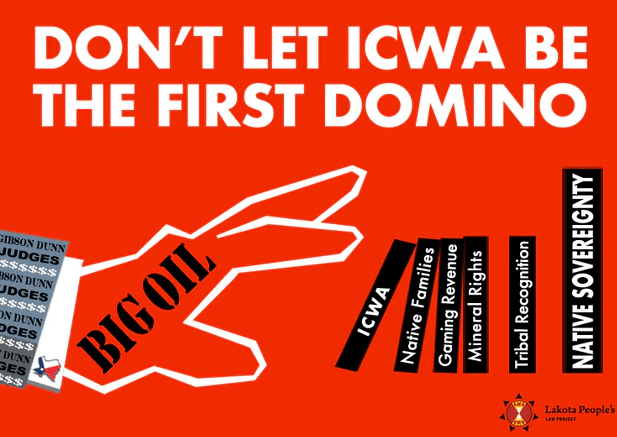
  • Overturning ICWA could be the first legal domino in a broader attack on tribal rights and sovereignty.

TEXAS, BIG OIL TARGET INDIAN CHILDREN IN BID TO END TRIBAL SOVEREIGNTY By Sarah Rose Harper and Jesse Phelps, Lakota People’s Law Project, September 22, 2021
If the Supreme Court overturns the Indian Child Welfare Act, Native children, mineral rights, and tribal self-determination could quickly become collateral damage.

I can only write from the perspective of a settler, but I do want to highlight a few of the current struggles. We have a responsibility to educate ourselves about the history of the founding of the United States, to join in struggle with those who are oppressed and to transform our society to end these devastating institutions.

The Tulalip tribe in Everett, Washington also participated in the national day on September 30 with a vigil and speak out. They called it Residential Boarding School Awareness Day or Orange Shirt Day because one survivor Phyllis Webstad’s favorite orange shirt was taken from her on the first day of school. It wasn’t until 1978, through the Indian Child Welfare Act, that indigenous parents gained the right to keep their children out of those schools. Now that act is under threat of being overturned by the US Supreme Court and big oil is behind that attack.

That big oil would go after indigenous children is a response to the effectiveness of indigenous leadership in the fight to protect the planet. A recent report led by the Indigenous Environmental Network found that just in the past ten years, indigenous resistance to fossil fuel projects “stopped or delayed greenhouse gas pollution equivalent to at least one-quarter of annual U.S. and Canadian emissions.”

INDIGENOUS PEOPLE’S DAY REMINDS US TO ACKNOWLEDGE AND SUPPORT INDIGENOUS STRUGGLES By Margaret Flowers, Popular Resistance, October 11, 2021

We are talking about the potential destruction of all tribal law, the taking of all tribal lands, and the elimination of all Native sovereignty.

Chase Iron Eyes

Indian Child Welfare Act Under Attack

On Sept. 3, the U.S. solicitor general, Cherokee Nation, Morongo Band of Mission Indians, Oneida Nation, and Quinault Indian Nation filed cert petitions with the U.S. Supreme Court in Brackeen v. Haaland to defend the constitutionality of the Indian Child Welfare Act (ICWA).

This law was enacted in 1978 to help keep Native children in Native homes. FCNL worked closely with Congress to enact the legislation. In ICWA cases, the first preference is that the child go to an extended family member for placement, even if the relative is non-Native. The second preference is placement with someone within the child’s tribe, and the third preference is placement with another tribe.

The state of Texas, however, is continuing to challenge the constitutionality of ICWA. They claim that it’s a race-based system that makes it more difficult for Native children to be adopted or fostered into non-Native homes. A Supreme Court response to the tribes’ petition and Texas’ petition is due Oct. 8.

September Native American Legislative Update By Portia Kay^nthos Skenandore-Wheelock, Friends Committee on National Legislation, September 30, 2021

To those of you invested in anti-pipeline movements, know that this fight is no different from those we’ve undertaken at Standing Rock against the Dakota Access pipeline or in Minnesota against Line 3,” said Chase Iron Eyes, Lakota Law Co-Director and Lead Counsel. “It’s the same enemy using a different tactic to poison the planet. This is almost certainly Big Oil coming through the back door, and the danger may now be even greater. The victim is not just Mother Earth, her waters, and her sacred womb. It’s not just the Indigenous women and families on the front lines of the epidemic of missing and murdered Indigenous women and girls. It’s not even just the children being protected by ICWA. We are talking about the potential destruction of all tribal law, the taking of all tribal lands, and the elimination of all Native sovereignty. The only difference is that, this time, it certainly appears that Big Oil and its allies are using children as human missiles and the courts as the lever to accomplish its destructive agenda — all, of course, in the name of corporate profits.”

TEXAS, BIG OIL TARGET INDIAN CHILDREN IN BID TO END TRIBAL SOVEREIGNTY By Sarah Rose Harper and Jesse Phelps, Lakota People’s Law Project, September 22, 2021. If the Supreme Court overturns the Indian Child Welfare Act, Native children, mineral rights, and tribal self-determination could quickly become collateral damage.

Native children and U.S. Secretary of the Interior Deb Haaland are under legal attack in Brackeen v. Haaland. The powerful people behind the lawsuit include both Big Oil and the State of Texas. If their attempt to have a conservative-majority Supreme Court overturn the Indian Child Welfare Act is successful, the door will be open to the total elimination of tribal sovereignty. Take action now to stop this horrific attack on Native rights!

Petition Text:

Dear President Biden and attorneys for the Department of Justice,

As the Supreme Court decides on whether to render judgment in the case of Brackeen v. Haaland, I write today to ask you to do everything in your power to protect the Indian Child Welfare Act and defend Secretary Deb Haaland. We need strong federal protection of Native families and tribal sovereignty.

Please file every available motion, prepare every legal argument judiciously, and do everything else you can to stop this attack on tribal citizens. The plaintiffs will not be easily stopped. Should the Supreme Court accept this case and validate the plaintiffs’ argument that tribes do not have the power to place their own enrolled children in tribal kinship care, we will have crossed a rubicon into dangerous legal territory that could ultimately lead to the disbanding of tribal nations — and the loss of tribal lands, gaming revenues, and mineral rights.

It’s no coincidence that the same attorneys — Gibson Dunn — representing the plaintiffs in this case also have deep ties to fossil fuel interests such as Enbridge and TC Energy (the oil conglomerates responsible for attacking tribal interests through the Line 3 and Dakota Access pipelines, respectively).

The Indigenous peoples of this land have always deserved better. The few gains made over centuries littered with oppression, and in the face of overwhelming systemic racism, must not be lost now. Please fight hard to protect original Americans. Please do everything possible to stop this attack on children, families, and sovereignty.

https://action.lakotalaw.org/action/protect-icwa

#ICWA

Indira Sheumaker on Des Moines City Council

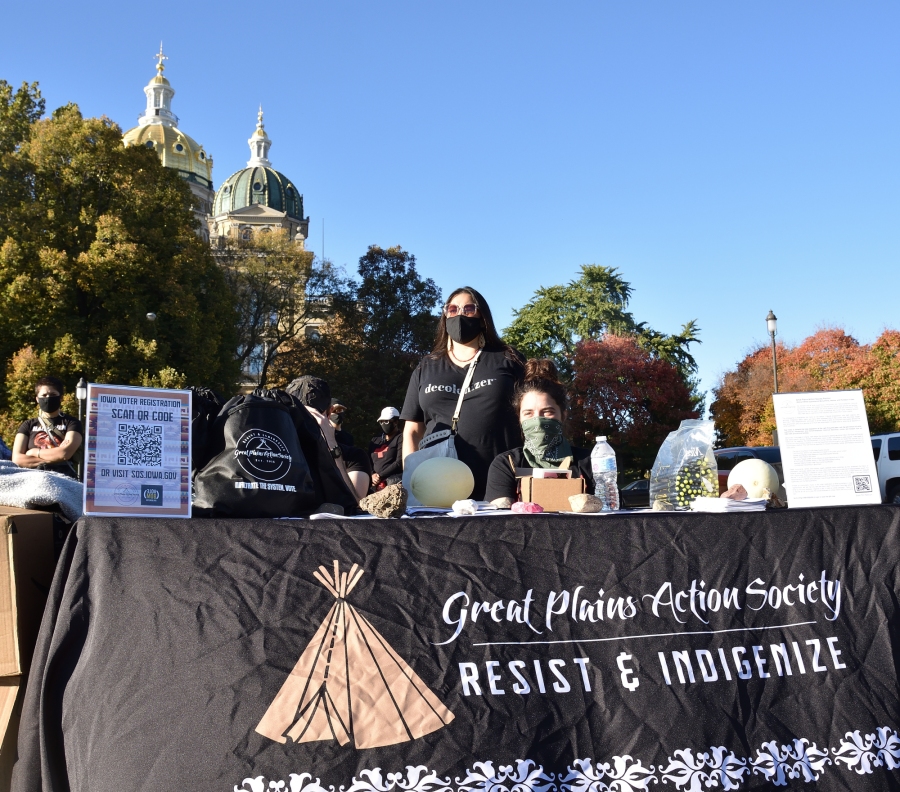
My friends at the Great Plains Action Society have a graphic that says “Infiltrate the system. Vote.” A variation comes to mind with the news that Indira Sheumaker was elected to the Des Moines City Council. “Infiltrate the system, run for office.” Indira has been involved in the Black Liberation Movement.

Des Moines voters sent a new, young candidate to the City Council chamber in Tuesday’s election, ousting a longtime incumbent, and supported keeping two other council members in office.  

First-time candidate Indira Sheumaker defeated incumbent Bill Gray in the Des Moines City Council’s Ward 1 race. Gray was first elected in 2014.

Sheumaker attended her first council meeting when the group voted on an ordinance to ban racial profiling by the police department. There, she said, she heard “a lot of passionate people” speak up — herself included — but she felt like city leaders moved quickly without considering additional action.

Sheumaker said she would not have run for office if it weren’t for her involvement in last year’s protests with the Black Liberation Movement.

“I got involved protesting, showing up to the (Iowa) Capitol, got tear-gassed … and then a lot of members from organizations and older members of the community were encouraging us to go to City Council meetings,” Sheumaker previously told the Des Moines Register.

Social justice advocate Indira Sheumaker defeats incumbent Bill Gray in Des Moines City Council race by Melody Mercado, Des Moines Register, Nov 4, 2021

From street activism to Des Moines City Council

Sheumaker, 27, represents a new generation of politics, forged during a summer of protests and activism following the murder of George Floyd in Minneapolis in May 2020. Already, she’s marshaled her influence to rally speakers at City Council meetings, organized protests against police brutality and created a grassroots campaign that toppled two-term incumbent Bill Gray.

Now, with a seat on the Des Moines City Council, she faces a new challenge as she seeks to channel that grassroots energy into her role as an elected official. The goal, she said, is not to settle into the entrenched political dynamics she has spent the last year and a half protesting, but to lift up new voices and create avenues for change by being more transparent about the inner workings of Des Moines city government.

“The stuff that isn’t talked about, but isn’t, you know, protected behind some kind of confidentiality barrier … I have no qualms about being completely open about that and telling people what’s going on because people need to know what’s happening in their city,” she said.

From street activism to Des Moines City Council: How might Indira Sheumaker shake up Iowa’s capital city? by Melody Mercado and Brianne Pfannenstiel, Des Moines Register, Nov 6, 2021

A summer of protests in 2020 brought issues of policing and racial justice to the forefront, and those issues shaped city elections in Iowa and across the country this fall.

In her own race, Sheumaker spoke openly about drawing inspiration from the protests, as well as her desire to redirect funding from the city’s police department into social programs, with an eventual goal of making the Des Moines Police Department obsolete.

“I want to be creating a public safety system in Des Moines that’s from the community, is built into the community, and is focused on transformative and restorative justice that is designed to lessen interaction between residents and police,” she said previously.

From street activism to Des Moines City Council: How might Indira Sheumaker shake up Iowa’s capital city? by Melody Mercado and Brianne Pfannenstiel, Des Moines Register, Nov 6, 2021

Defunding the Police for Safety and Justice

“We just won our campaign on a platform centered on Defunding the Police for Safety and Justice. It can be done,” Sheumaker said in a campaign statement. “My goal for this city has always been to work from the bottom up. Not the top down.” In her campaign, Sheumaker also stressed the importance of making food and housing accessible, flood preparedness, rent control, decriminalizing cannabis, tenant rights, and combating corporate greed.

“I want to be the kind of leader who is part of the community, the kind of leader people can talk to you,” Sheumaker told the crowd at a cafe in downtown Des Moines the night election results rolled in, according to Iowa Public Radio. She said given that she’s a protester and activist herself, she can’t tell people not to “show up” on her lawn.

Sheumaker became involved in politics after the police killing of George Floyd when she organized marches for racial justice in Des Moines. Since then, she’s worked steadily with the Black Liberation Movement (which supported her campaign) and advocated for defunding the police

This 27-year-old ran on a campaign to defund the police—and defeated longtime incumbent by Marissa Higgins, Daily Kos, Nov 4, 2021


I’ve been working on the idea of abolition of police and prisons, too. Following is a link to one blog post I’ve written.

https://landbackfriends.com/2021/08/31/abolition-and-racial-capitalism/

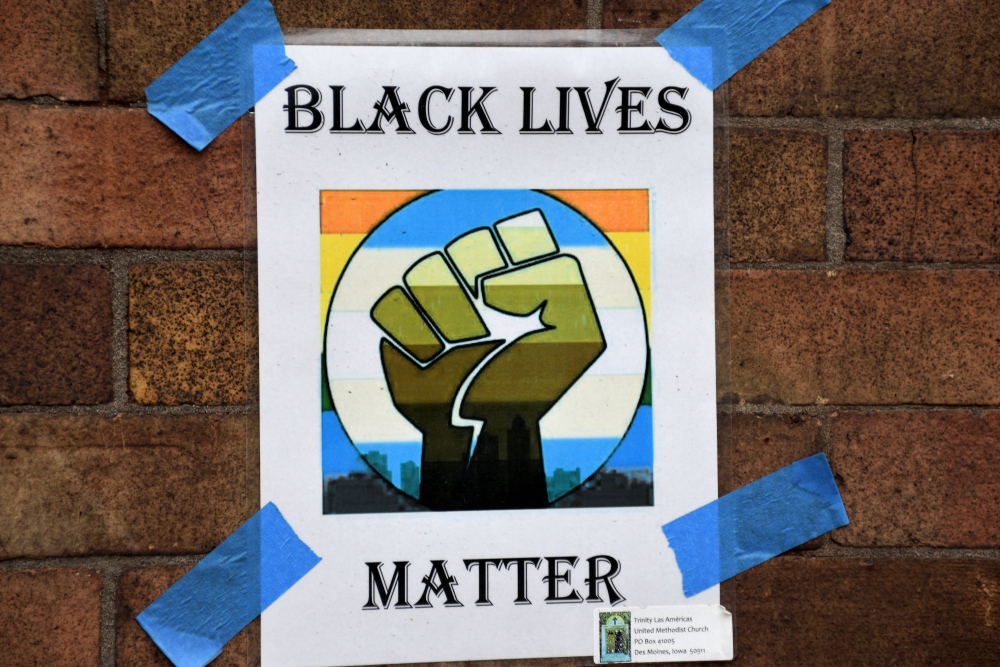
A photo in a news story showed Indira sitting in front of a memorial to black children. I drive past there when I go to Des Moines for our Mutual Aid food project. Here are some of my photos of that memorial.

COP 26 and continued colonial capitalism

As expected, little was accomplished at the recent COP 26 meetings because countries with capitalist economic systems were in control. Industrial nations’ policies will continue to protect the capitalist economic system and the fossil fuel industry regardless of the environmental consequences.
See: https://landbackfriends.com/?s=capitalism

The Free
https://thefreeonline.wordpress.com/2021/09/29/its-decolonization-or-extinction-and-that-starts-with-land-back/

I often write about the necessity of replacing the capitalist economic system as essential to addressing our evolving environmental catastrophes. Recently The Free blog of post-capitalist transition re-blogged my post, It’s Decolonization or Extinction. And that starts with Land-Back. Many people and organizations are working toward a post-capitalist world.

And yet, even as humanity faces perhaps the greatest existential crisis in its species’ history, the public debate on climate barely mentions the underlying economic system that brought us to this point and which continues to drive us toward the precipice. Ever since its emergence in the seventeenth century, with the creation of the first limited liability shareholder-owned corporations, capitalism has been premised on viewing the planet as a resource to exploit — its overriding objective to maximize profits from that exploitation as rapidly and extensively as possible. Current mainstream strategies to resolve our twin crises of climate breakdown and ecological overshoot without changing the underlying system of growth-based global capitalism are structurally inadequate

Solving the Climate Crisis Requires the End of Capitalism by Jeremy Lent, originally published by Patterns of Meaning, October 13, 2021

Current mainstream strategies to resolve our twin crises of climate breakdown and ecological overshoot without changing the underlying system of growth-based global capitalism are structurally inadequate

Jeremy Lent

This is doubly tragic because the dominance of capitalist governments also meant Indigenous peoples didn’t have a voice at COP 26. It is Indigenous knowledge that can help repair Mother Earth.

“The Cop is a big business, a continuation of colonialism where people come not to listen to us, but to make money from our land and natural resources,” said Ita Mendoza, 46, an indigenous land defender from the Mixteca region of Oaxaca in southern Mexico, attending Cop for the first time. “What benefits does the Cop bring when more than a thousand people fighting to keep the planet alive have been killed [since Paris]?”

“It’s a testament of our resilience that even after hundreds of years of colonization and betrayal that we indigenous communities are still willing to sacrifice our lives, health and energy for this last-ditch attempt to save the planet,” said Ruth Miller, climate justice director of the Alaska-based Native Movement, a Dena’ina Athabaskan and Ashkenazi Russian Jewish woman, who is a member of the Curyung tribe.

“We’re here offering sustainable solutions to the rest of the world that require an ideological shift, not a green industry built on colonialism and repression. It’s up to them if they listen or not.”

INDIGENOUS VOICES ARE MISSING AT COP26 by Nina Lakhani, The Guardian, November 4, 2021

As the United Nations Climate Change Conference—also known as COP26—got underway in Glasgow, Scotland this week, Indigenous activists from around the world warned that failure to center their peoples’ voices and solutions would seriously hamper efforts to tackle the growing planetary emergency.

“We can develop actions based on our culture and our traditional knowledge.”

“Today, the climate is warming, the animals are disappearing, the rivers are dying and our plants don’t flower like they did before,” Txai Suruí, a law student, activist, and member of the Paiter Suruí people of northwestern Brazil, said during Sunday’s COP26 opening ceremony. “The Earth is speaking. She tells us that we have no more time.”

“Indigenous people are in the frontline of the climate emergency, and we must be at the center of the decisions happening here,” she stressed. “We have ideas to postpone the end of the world.”

Kyle Whyte, a member of the Citizen Potawatomi Nation in Oklahoma who serves on U.S. President Joe Biden’s White House Environmental Justice Advisory Council, told NBC News that “if countries don’t get on board with us, leaving out the people who steward a lot of the lands, it’s not just a moral issue anymore. It will have a devastating effect on the speed at which the rest of the world will get to sustainability.”

‘The Earth Is Speaking’: Indigenous Activists Tell COP26 There’s No Climate Solution Without Them. “Indigenous people are in the frontline of the climate emergency, and we must be at the center of the decisions happening here. We have ideas to postpone the end of the world.” by BRETT WILKINS, Common Dreams, November 1, 2021

Not Enough Being Done for MMIW

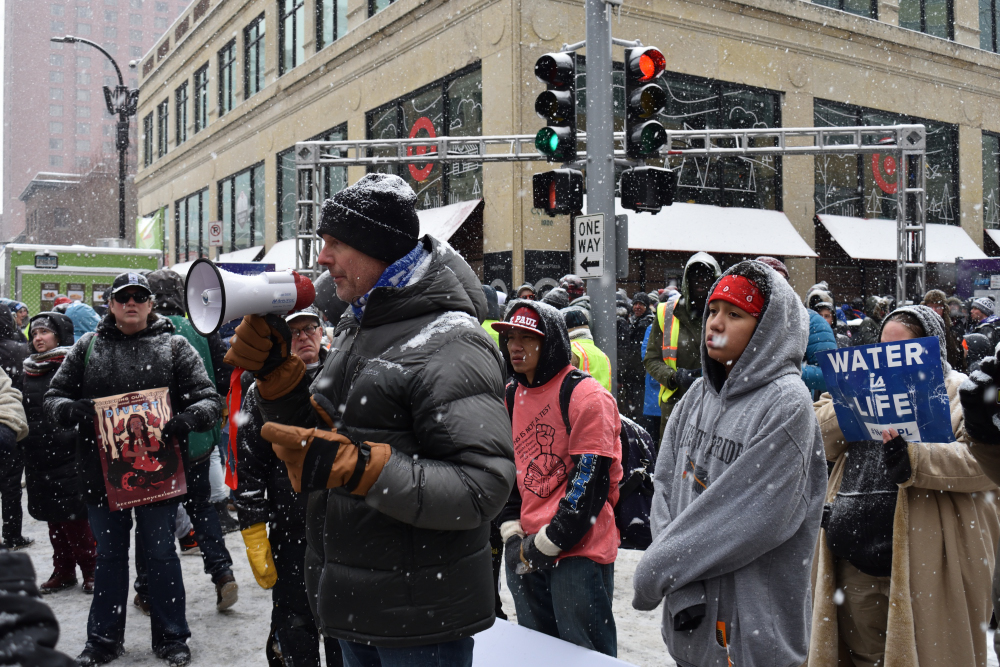
I was not aware of the epidemic of violence against, and the disappearance and/or murder of Indigenous women prior to getting to know some Indigenous people. I first became aware when I rode in a van, organized by Ed Fallon, to Minneapolis February 3, 2018, the day before the Super Bowl was played there. Minneapolis is the US Bank headquarters, and the Super Bowl was played in the US Bank stadium. US Bank has been involved in funding many fossil fuel projects. We gathered outside the bank offices with signs to call attention to that.

Heading for Minneapolis, Feb 4, 2018.

I was surprised when the speakers all talked about Missing and Murdered Indigenous Women (MMIW), sometimes expressed as Missing and Murdered Indigenous Relatives (MMIR). I was just learning much of this violence came from the man camps, the living quarters for those work on the construction of fossil fuel pipelines.

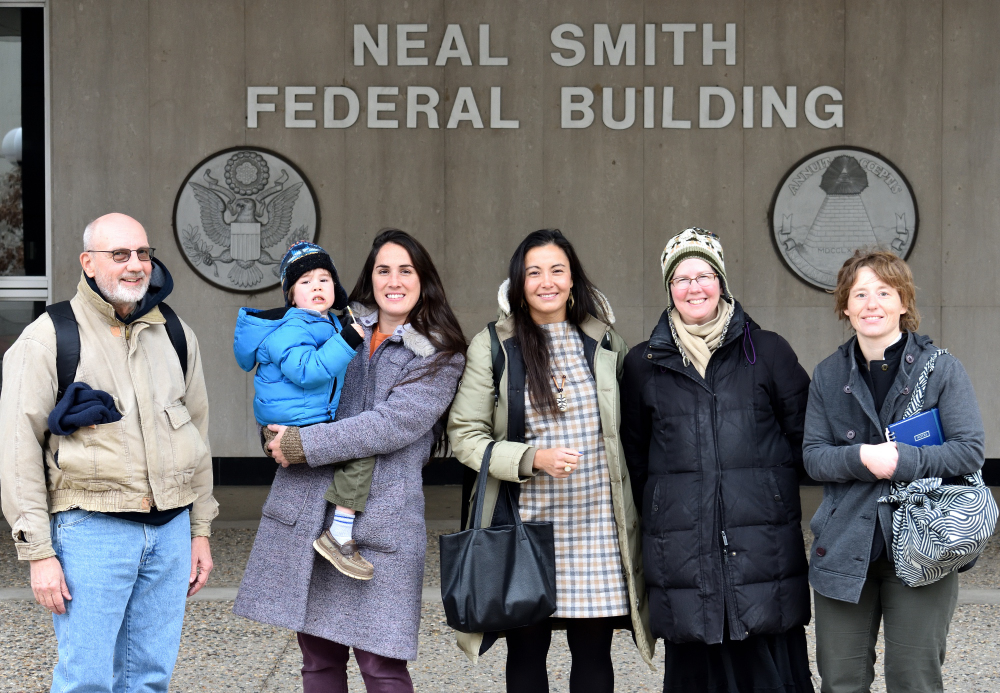
Those who spoke, Sikowis Nobiss, Donnielle Wanatee, Kathy Byrnes and Ed Fallon, would become friends of mine. In these photos you can see the Missing and Murdered Women artwork held by several of the speakers.

That fall (2018) I participated on the First Nation-Farmer Climate Unity March. My friend Foxy Onefeather carried the MMIW sign during our eight-day, ninety-four mile walk along the path of the Dakota Access Pipeline. Many stories, photos and videos of that march can be found here: https://firstnationfarmer.com/

Foxy Onefeather

One goal of the First Nation-Farmer Climate Unity March was to create friendships and the beginning of trust among the marchers, so we could work together on things of common concern. One of the first things several of us did together was meet with Senator Chuck Grassley’s staff in Des Moines.

There were two pieces of legislation in Congress related to Native Affairs. One was the SURVIVE Act which is intended to get more funds from the Victims of Crime Act to Native communities. The second is Savanna’s Act, which allows tribal police forces to have jurisdiction over non-Native people on Native land, access to criminal databases and expanded collection of crime statistics. Senator Grassley was involved in the passage of the Victims of Crime Act.

Jeff, Fox, Shazi, Sikowis, Shari and Sid

This Monday a report was released saying the federal response to missing and murdered Indigenous women needs improvement.

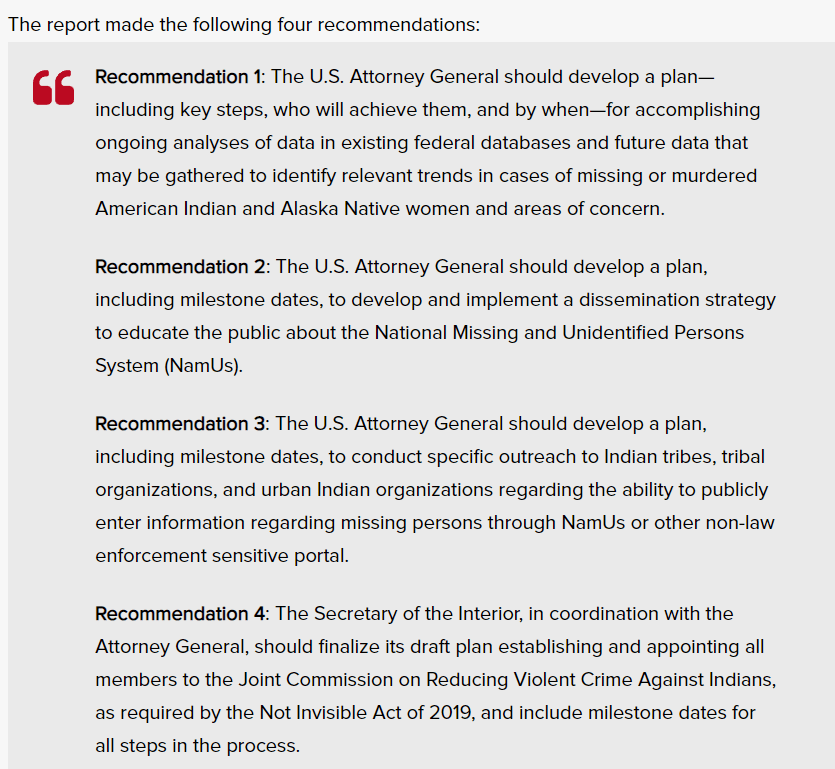
The Missing or Murdered Indigenous Women; New Efforts Are Underway but Opportunities Exist to Improve the Federal Response GAO report concluded the U.S. Department of Justice (DOJ) and U.S. Department of the Interior (DOI) have missed numerous deadlines set by the Not Invisible Act and Savanna’s Act, and it recommended that the departments develop an action plan to ensure they’re doing all they can to combat the crisis of missing and murdered Indigenous women.

U.S. Sen. Catherine Cortez Masto (D-NV), a member of the Senate Committee on Indian Affairs, called on the Biden administration to do more to address the crisis of missing and murdered Indigenous women (MMIW) after the U.S. Government Accountability Office (GAO) released a report finding that the government has not done enough to respond to the crisis.

Sen. Cortez Masto has led efforts in the Senate to protect Indigenous women and girls, and she asked that the GAO put together this report to investigate the federal response to violence facing Native women across the country.

NOT ENOUGH IS BEING DONE FOR MISSING AND MURDERED INDIGENOUS WOMEN GAO Report Says of Federal Government by Native News Online, November 3, 2021

Great Plains Action Society

#MMIW

Human Supremacy

This morning I had one of those “ah ha” moments, when something changes my perspective in a way that explains things that seemed inexplicable. I don’t remember hearing the term ‘human supremacy‘ before. But as soon as I read that I understood what it is. White supremacy been part of our national conversation for years. Human supremacy extends the idea of white supremacy to the domination of everything non-human by humans.

One of the most important points umair haque makes in the article referenced below is there are no hierarchies. That is the fundamental concept of Mutual Aid. In our Mutual Aid work, we monitor ourselves to avoid any vertical hierarchy from creeping in. That’s something you have to learn and practice when you begin to work in a Mutual Aid community. We are so used to having someone in charge, someone making decisions.

When there isn’t a vertical hierarchy, by definition there can be no supremacy.

As the systems now in place break down because of environmental, economic, and political chaos, we will be forced to find different ways of living. Mutual Aid is one possibility. One that gets away from human supremacy.

One of the most insightful authors I follow is umair haque. His article today is titled “The End of Human Supremacy”.

If I say to you that we need to end white supremacy, you’ll probably agree with me, wise and gentle person that you are. But this is a job, to tell you the truth, that we should have done long, long ago. The work before us this century is much harder, and goes much further. I call it the end of human supremacy.

What I mean by that is something like: at this juncture in history, we walking apes regard ourselves as supreme. Above and beyond everything else, at the top of our own self-imagined hierarchies of life and being. We’re way better — way more powerful than a dumb little virus, aren’t we? Maybe not. And because of that very mistake — human supremacy — our civilization has plunged into the beginnings of collapse.

Because our civilization is built on this pillar, “I think therefore I am,” our economies and societies have developed in a perverted way. They don’t think — therefore they aren’t. They aren’t people — they don’t deserve the rights and protections and guarantees of personhood. They are there to be subjugated, exploited, abused.

Do you see what I mean by human supremacy a little bit now? We’re the only “people” on this planet. And therefore, only we matter. We’ve made a tiny bit of progress. Sure, women and people of color are now allowed into the ranks of “people” — sometimes. But human beings sit still atop our great hierarchies. If I ask you to examine your conception of the world, it will be a modern one, not a premodern one — unlike the ancients, you probably won’t put human beings at the bottom…you’ll put them at the top.

And that’s what we have to undo.

We don’t belong at the top of any hierarchies. There are no hierarchies and there is no top. There are webs and spirals and links between things. But a top? It doesn’t exist. Our entire civilization was brought to a halt by a tiny microbe. Still think we’re at the top? OK, then imagine this. The fish clean the rivers we drink from, the insects and worms turn the soil of our harvests, the trees give us air to breathe. Top? What top?

The End of Human Supremacy. Our Civilization is Collapsing. But Can We Change Fast Enough to Stop It? by umair haque, Eudaimonia, Oct 31, 2021

Eileen Crist knows more than a person should, more than seems healthy, about dying birds and dying watersheds. She’s keenly aware of the global crisis of biodiversity loss and ecological collapse, and she sees what’s driving it: direct causes like climate change and what she calls the “ultimate causes” — population growth, overconsumption, and technological power. But the thing that really interests Crist, the thing that she’s been studying and publicizing for the past three decades as a professor and radical environmental thinker, is an even deeper question: Why is so little being done to address this planetary emergency?

She attempts, with a mix of intellectual rigor and lyrical passion, to provide an answer in her 2019 book, Abundant Earth: Toward an Ecological Civilization. The cause of our inaction, she says, is “human supremacy,” a largely unconscious belief that Homo sapiens are the masters of creation rather than just one humble species among millions. This worldview sanctions not only factory farming, clear-cut logging, mountaintop-removal mining, and bottom-trawl fishing, but also more commonplace behaviors such as cruising along in cars that slaughter wildlife and emit carbon dioxide. As long as human supremacy prevails, Crist writes, “humanity will remain unable to muster the will to scale down and pull back the burgeoning human enterprise that is unraveling Earth’s biological wealth.”

The most important thing to expose and dissect is human supremacy. It often gets referred to by the gentler term anthropocentrism. I view it as a widely shared, unconscious worldview that tells us we are superior to the rest of nature and thus entitled to treat nonhumans and their habitats however we please. Human specialness, human aboveness, and the sanctity of the human prerogative — those are key elements, along with our seizing the power of life and death over nonhumans and our aggressive control of all geographical space.

Human Supremacy by Sara Wright, April 21, 2021. Our Great Reckoning. Eileen Crist On The Consequences Of Human Plunder by LEATH TONINO, DECEMBER 2020

Since the inception of the patriarchal culture (ca. 10000 BCE) we have become conditioned to assume that human supremacy over nature is “natural law.” But there is nothing natural about human supremacy and derivatives such as male supremacy, white supremacy, and other such ideologies of domination. 

Musings on Human Supremacy, Religious Patriarchy, and Industrial Ecology by Luis Teodoro Gutiérrez, originally published by Mother Pelican, May 3, 2021