Wet’suwet’en 1/11/2022

The last time I wrote about the Wet’suwet’en was January 2nd, RCMP Invasion expected on Wet’suwet’en territory. It’s not that the RCMP have left, but there has been a change in tactics. The threat continues.

There’s no question that I am guilty of painting on the street because the reason is so important.

Shawn Selway

We should all show up at these rallies when we are asked to do so by Indigenous people. Believe me, you will feel much better than reading a newspaper about more dead children being found somewhere.

Shawn Selway

Our first rally in support of the Wet’suwet’en was on February 7, 2020.

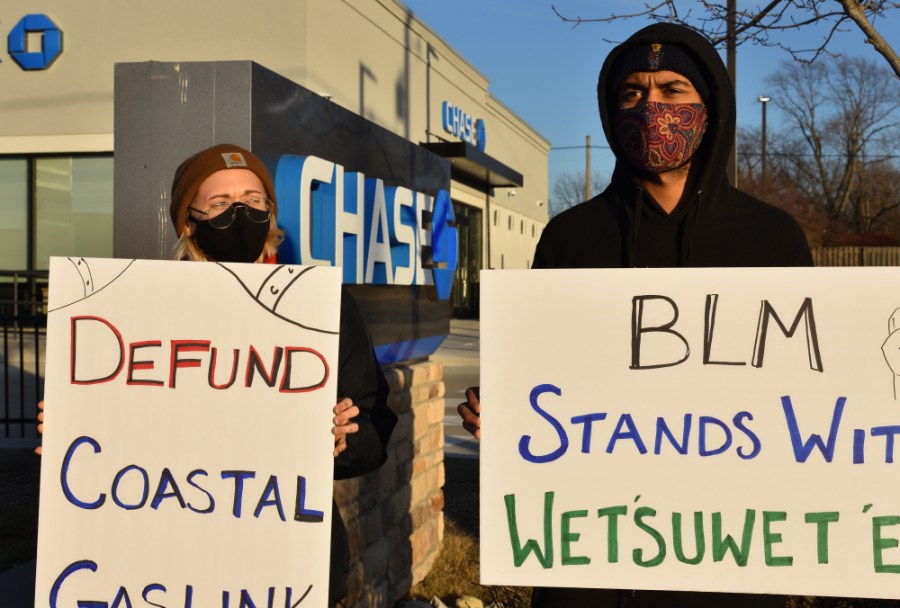
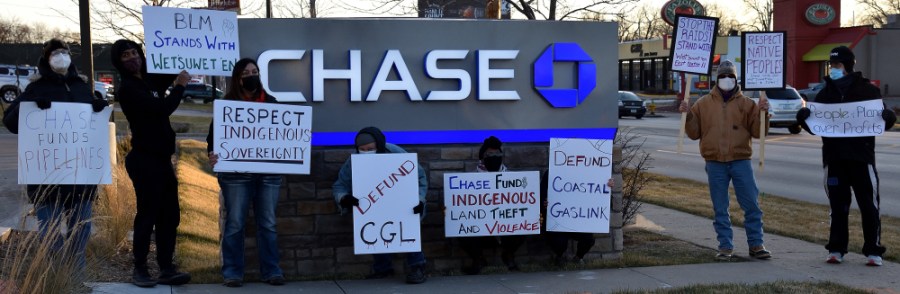
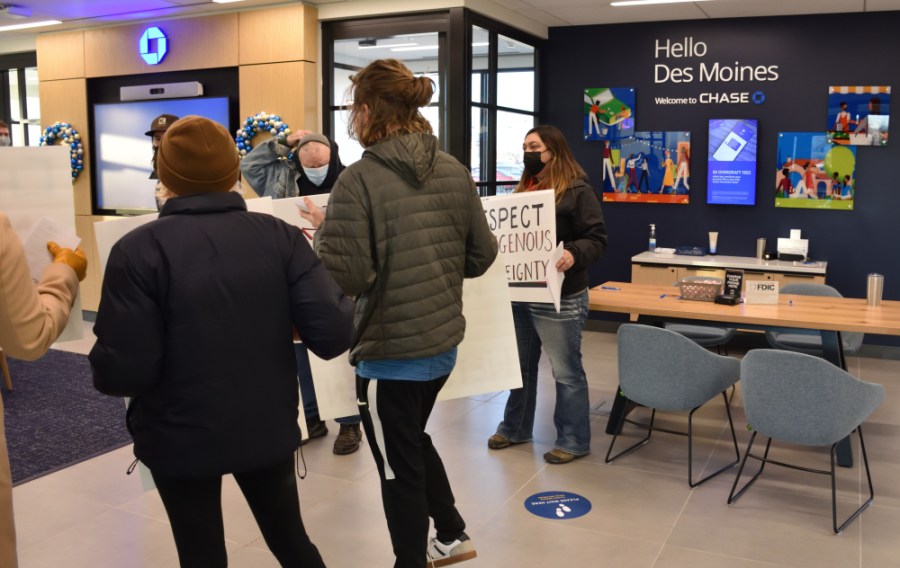
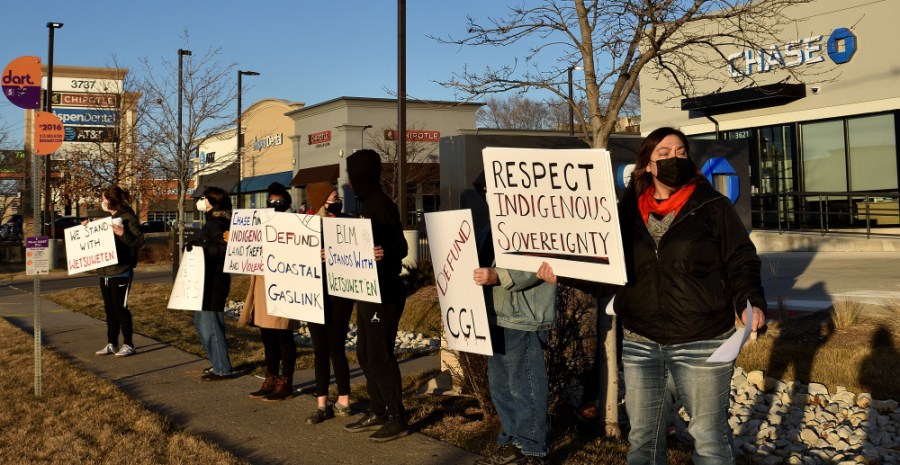
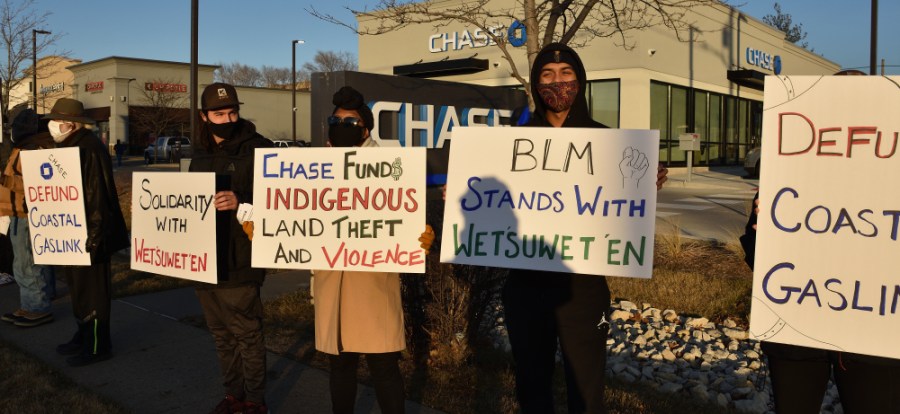
This is from the AFSC Midwest Digest, January 2022. Jon Krieg (AFSC), Patti McKee, Peter Clay, and I were among those at the rally to support the Wet’suwet’en at the Chase bank in Des Moines. (photos below)

https://www.afsc.org/story/midwest-digest-january-2022

Following is a statement from the Rainforest Action Network (RAN) in solidarity with the Wet’suwet’en peoples. I’ve worked with RAN since 2013 when I was trained to be an Action Lead in the Keystone Pledge of Resistance. The following relates to a letter to the editor I wrote that was published in the Indianapolis News about Indiana Senator Donnelly’s support of the Keystone pipeline.

I was glad to be called a RAN activist.

RAN @RAN May 15, 2014
@ran activist @jakislin calls out @sendonnelly on willfully ignoring the dangers of #KXL a_ran.org/iS #NoKXL

Big banks are bankrolling this pipeline: Will you rise up and join the Wet’suwet’en to protect their land?

Right now, Wet’suwet’en Indigenous rights are under attack: Canadian paramilitary troops flew into Indigenous lands in support of fossil fuel giant TC Energy, and their 417-mile fossil fuel pipeline — without the consent of hereditary chiefs. 

Wet’suwet’en hereditary chiefs are urgently calling out for massive global support. Will you take action in solidarity, Jeff?

The Canadian government and big banks like Chase and Royal Bank of Canada (RBC) are forcing disastrous oil pipelines on Wet’suwet’en territories and meeting peaceful protests with violence.

The Coastal Gaslink pipeline WILL have harmful impacts on water, wildlife, the Wet’suwet’en people — and on our global climate. In solidarity with them, tell big banks to stop financing Indigenous rights abuses.
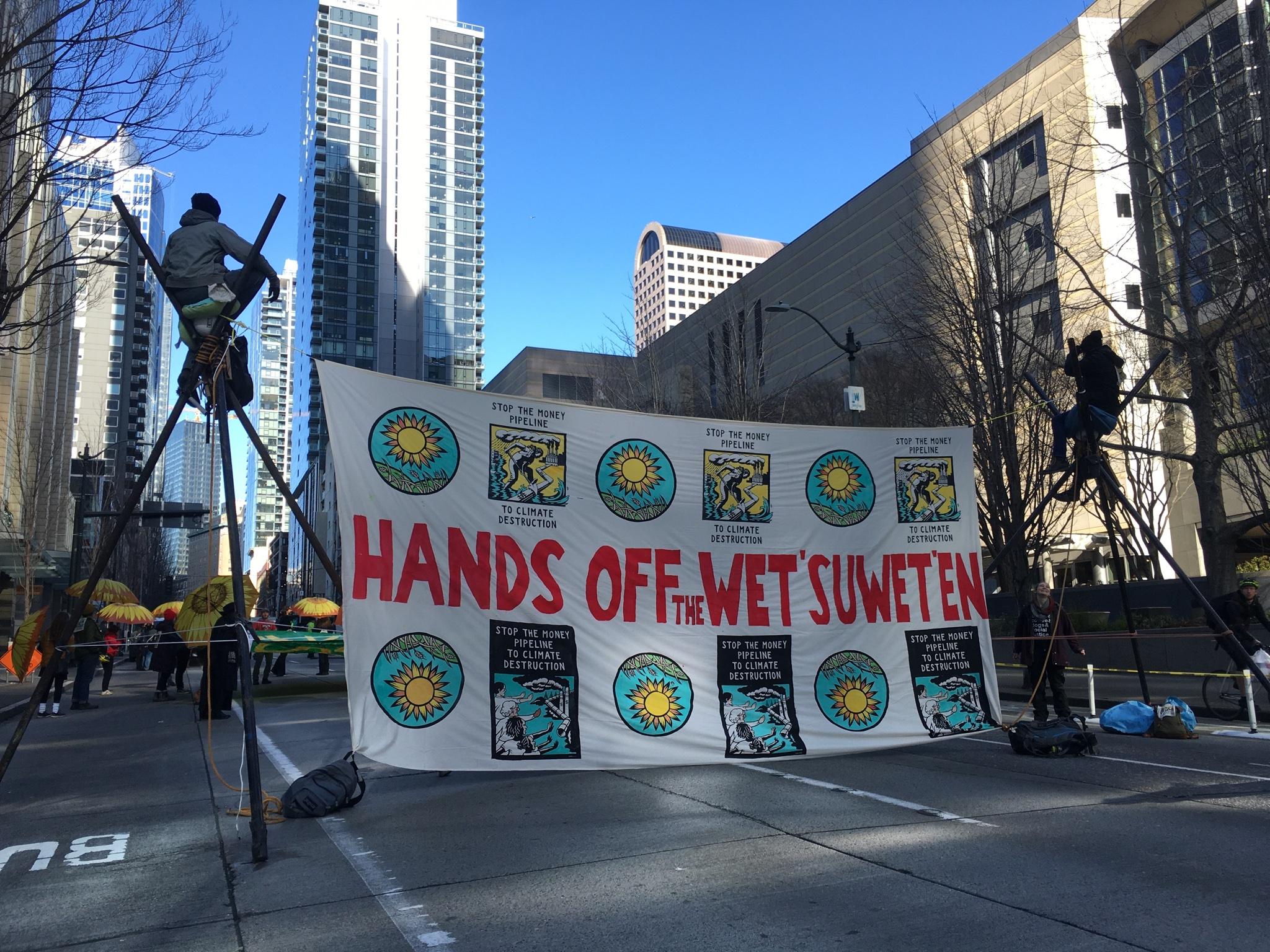
For the past twelve years, the Wet’suwet’en have asserted their sovereignty to stop fossil fuel companies from trespassing on their lands, and they have won. This community organized against two more huge pipelines and defeated them, and we know they can win. Coastal Gaslink is already way over budget. These banks know the investment is incredibly risky, and we have a chance to stop it.

Here in the U.S., we can support the Wet’suwet’en by fighting back against the financial backers of this climate-killing pipeline. Banks from the U.S. to Japan to Canada, including the #1 worst banker of fossil fuels JPMorgan Chase, are funneling BILLIONS in loans to TC Energy, the company behind Coastal GasLink. These banks are directly contributing to the destruction of sacred Wet’suwet’en land and the blatant violation of their rights. 

The bankers behind this pipeline must be held accountable for their role in destroying Indigenous lands and fueling the climate crisis. Will you rise up and join the Wet’suwet’en to protect their land?

We won’t let big banks destroy rivers, air, wildlife, and the climate while hurting people who are protecting what is rightfully theirs. There is no climate justice without Indigenous sovereignty, Jeff. 

“You can’t claim to be a climate leader and still allow a project that will be the largest point source of carbon emissions in our province. And you can’t say you’re adhering to the UN Declaration on the Rights of Indigenous Peoples when you clearly don’t have consent from the actual title holders, and when you’re in violation of the article that says Indigenous peoples can’t be forcibly removed from their own territory.”

ANALYSIS: Coastal GasLink, LNG Controversies Will Haunt B.C. NDP in 2022, Mitchell Beer, The Energy Mix, January 10, 2022

#RiseUpfortheFallen, #RebelForAction, #RebelForLife, #SeLeverPourNotreSurvie, #ActNow, – #AgirMaintenant, #TellTheTruth, – #DireLaVérité, #ExtinctionRebellionCanada, #ExtinctionRebellion, #XRTV, #XR, #IndigenousResistance , #alloutforwedzinkwa, #RCMPofftheYintah, #WetsuwetenStrong, #Cdnpoli , #BCpoli , #ClimateCollapse, #BiosphereCollapse, #DecolonizeBC, #RespectIndigenousSovereignty , #LandBack, #RCMPstanddown, #StopCGL , #StopTMX, #LeaveItInTheGround, #ClimateEmergency , #500YearsIndigenousResistance ,

Three years ago RCMP moved onto Wet’suwet’en territory, tearing down a barricade on a forest service road that blocked access to the planned route of the Coastal GasLink pipeline.

The single-day enforcement on Jan. 7, 2019, resulted in the arrest of 14 people, both Wet’suwet’en and their supporters. But it didn’t bring a resolution to the dispute over the pipeline, opposed by Wet’suwet’en Hereditary Chiefs.

Since then, dozens more have been arrested under an injunction granted to Coastal GasLink, which is building a 670-kilometre gas pipeline from northeast B.C. to an LNG processing facility on the coast in Kitimat.

And the conflict has brought increasing internal pressure on the BC NDP government to find a new approach that better reflects its stated commitment to Indigenous rights.

About 75 people have been arrested in total on the territory, with RCMP enforcement criticized as heavy handed and oppressive. In February 2020, 28 people were arrested over five days at several locations along the road. This November, at least 30 more were arrested over two days at a camp on Gidimt’en Clan territory and a worksite where Coastal GasLink plans to drill under the Morice River, known to the Wet’suwet’en as Wedzin Kwa.

And for three years, RCMP have continued patrolling the Morice, establishing a detachment on the remote resource road and racking up a bill for policing that now exceeds $20 million.

As rumours swirl about plans for a fourth police raid on Wet’suwet’en territory, the B.C. government faces growing pressure from within the NDP to find a new approach, with federal MPs, riding associations and high-profile supporters all calling for change — and getting very little response from B.C.’s ruling party.

BC NDP Faces Internal Pressure to Change Course on the Wet’suwet’en Crisis. The calls come from New Democrats across Canada and within the provincial party’s ranks by Amanda Follett Hosgood, TheTyee.ca, January 10, 2022

#wetsuwetenstrong
A matter of faith

There are two definitions of faith.

  • complete trust or confidence in someone or something.
  • strong belief in God or in the doctrines of a religion, based on spiritual apprehension rather than proof.

I wasn’t familiar with the use of apprehension above. I found one definition is “understanding or grasp”.

I spent a lot of time praying (faith) and thinking about the discussion we were going have at my Quaker meeting, Bear Creek (some of us via ZOOM) related to Mutual Aid. I’ve been deeply involved in Des Moines Mutual Aid (DMMA) for two years, writing nearly daily to share what I’ve been learning. It can be difficult to express lived experiences to those who haven’t had those experiences. Many Friends have had experiences that could be called Mutual Aid in their peace and justice work.

I made mistakes over the years because I had conflicts with the meeting related to the use of fossil fuels. (Meeting refers to my local meeting, Bear Creek.) I didn’t do a good job of inviting the meeting to engage with me about that. Although I understood there are major obstacles to reducing use of fossil fuels where there is no mass transportation, I have been humbled to face that problem myself since I moved to Iowa from Indianapolis several years ago.

One Friend from the meeting had a suggestion that helped us work together on fossil fuel issues. That resulted in the approval of the following Minute by our Yearly Meeting.

Radically reducing fossil fuel use has long been a concern of Iowa Yearly Meeting (Conservative).  A previously approved Minute urged us to reduce our use of personal automobiles.  We have continued to be challenged by the design of our communities that makes this difficult.  This is even more challenging in rural areas.  But our environmental crisis means we must find ways to address this issue quickly.

Friends are encouraged to challenge themselves and to simplify their lives in ways that can enhance their spiritual environmental integrity. One of our meetings uses the term “ethical transportation,” which is a helpful way to be mindful of this.

Long term, we need to encourage ways to make our communities “walkable”, and to expand public transportation systems.  These will require major changes in infrastructure and urban planning.

Carpooling and community shared vehicles would help.  We can develop ways to coordinate neighbors needing to travel to shop for food, attend meetings, visit doctors, etc.  We could explore using existing school buses or shared vehicles to provide intercity transportation.

One immediately available step would be to promote the use of bicycles as a visible witness for non-fossil fuel transportation.  Friends may forget how easy and fun it can be to travel miles on bicycles.  Neighbors seeing families riding their bicycles to Quaker meetings would have an impact on community awareness.  This is a way for our children to be involved in this shared witness.  We should encourage the expansion of bicycle lanes and paths.  We can repair and recycle unused bicycles and make them available to those who have the need.

Iowa Yearly Meeting (Conservative) 2017

That experience has helped me have more faith in the work of our meeting, in the sense of trust in the meeting. And helped me be a better listener.

We had the discussion about Mutual Aid at Bear Creek yesterday and I was very pleased. Friends had interesting and helpful questions and ideas. I was happy to hear what Friends had been doing in their communities related to Mutual Aid.

One of the most thought-provoking questions related to hierarchies. That any group would have differences, such as educational level or class, for example. I didn’t have a good answer at the time. The following video by Dean Spade explains this well. Of course, we all have different experiences and skills. Mutual Aid communities appreciate and encourage the use of community building skills. And helping people build new skills is encouraged.

Vertical versus horizontal hierarchies are related to decision making.

Two of the queries (questions) we considered yesterday relating to hierarchies were:

  • Do we recognize that vertical hierarchies are about power, supremacy and privilege? What are Quaker hierarchies?
  • Do we work to prevent vertical hierarchies in our peace and justice work?

Dean Spade wrote the best book I’m aware of about Mutual Aid. Mutual Aid, Building Solidarity during this Crisis (and the next) by Dean Spade, Verso, 2020

He teaches courses about Mutual Aid and has produced videos related to the subject. The following is a good discussion of horizontal group structures.

These workshops are about building mutual aid groups that can make decisions together, that include everybody, that can prevent and weather conflict, that can sustain work and sustain engagement, that can bring lots of new people into the work and so that it’s well resourced by people power. And that can be a bridge for people towards deeper and bolder movement engagement.

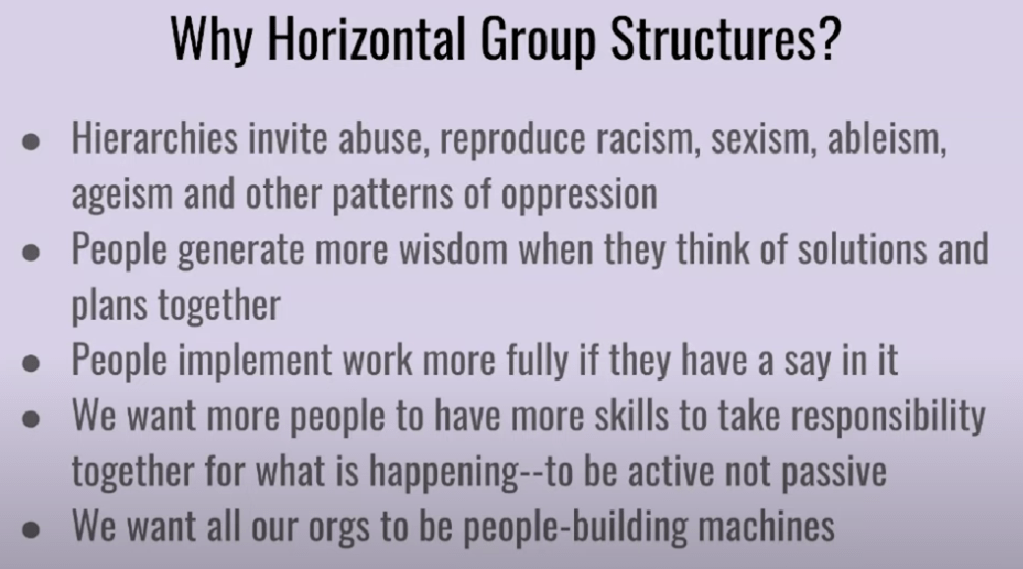
I strongly believe that horizontal group structures, meaning group structures where there’s no boss or executive director or main decider are the way to get there, for a number of reasons, and I want to share those in case that’s new for people.

One big reason is that hierarchies invite abuse and reproduce systems like racism, sexism, ableism, ageism, et cetera. I mean, we see it all the time. It’s like when you set something up as a hierarchy, oftentimes it’s men or white people bossing people around or old people bossing young people around or whatever.

And the bossing around can include worse forms of exploitation and abuse, also. I think that is inherent to hierarchy.

So we’ve seen forever in social justice movements, people set up hierarchical groups and then the same stuff plays out that they were trying to fight.

I think that’s worse, and it’s not as if it can’t happen in horizontal groups. We still have the dynamics. We still have that unlearning to do, but I think that hierarchy invites it.

Dean Spade: Horizontal Group Structures in Mutual Aid Work

Dean Spade: Horizontal Group Structures in Mutual Aid Work

Mutual Aid stories

For the past week I’ve been thinking and praying a lot about Mutual Aid in preparation for a discussion we plan to have at my Quaker meeting tomorrow.

As I have nearly every Saturday for the last year, I was with my Mutual Aid friends this morning for our weekly food distribution. Here are a few stories triggered from what happened this morning.

I had a clear spiritual leading to become involved in Des Moines Mutual Aid. For the sake of brevity, I’ll begin with my return to Iowa in 2017. I was looking for justice activists and soon had the opportunity to walk on the First Nation-Farmer Climate Unity March. A group of about ten native and ten non-native people walked and camped together for ninety-four miles, over eight days, along the path of the Dakota Access pipeline. The intention was for us to get to know each other as we shared stories, and that worked amazingly well. I got to know Sikowis Nobiss, Trisha Etringer, Matthew Lone Bear, Alton and Foxy Onefeather, and Donnielle Wanatee, among others. Various combinations of us worked together since then on things like racist monuments and mascots, Indigenous Peoples’ Day, and an Indigenous led Green New Deal.

There are a lot of photos and blog posts related to this sacred journey here: https://firstnationfarmer.com/ Part of the story relates to the support we received from Friends.

The summer of 2019 Peter Clay, Jim Glasson, Linda Lemons, and I helped arrange for Paula Palmer to have several sessions in the Midwest related to her ministry regarding Quakers and Indigenous peoples.

We wanted to continue this work. On February 7, 2020, we planned to meet at Friends House in Des Moines.

At that time, the Royal Canadian Mounted Police were attacking the Wet’suwet’en peoples in British Columbia. They were clearing the way for the construction of the Coastal GasLink pipeline through Wet’suwet’en territory. There was nothing about that in the mainstream press.

I learned about this when I saw the title of a YouTube video about the eviction of Coastal GasLink personnel from Wet’suwet’en territory. For many years I worked on the Keystone and Dakota Access pipelines resistance when I was in Indianapolis. I remember how shocked I was to see pipeline construction personnel evicted! I’m sure the Spirit led me to learn about the Wet’suwet’en. This struggle has become one of my primary areas of justice work since.

Returning to the February 7 meeting, we thought we would hold a rally in support of the Wet’suwet’en before the meeting we had already planned. I created a Facebook event in case anyone else might want to join us.

As the Spirit would have it though, Ronnie James saw that and joined us. I learned Ronnie has had over 20 years of experience as an Indigenous organizer. He was surprised anyone else in the Midwest knew about the Wet’suwet’en and came to check us out. A great organizing technique.

Peter Clay, Linda Lemons and Ronnie James

Over the subsequent two years Ronnie has become one of my closest friends, as well as my Mutual Aid mentor.

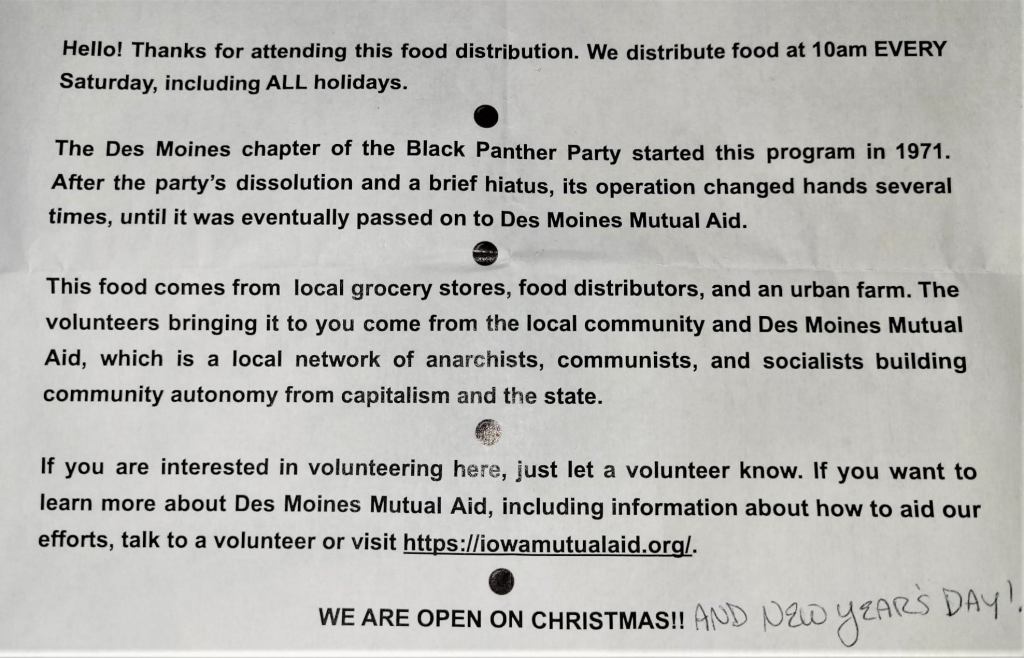
The Des Moines Mutual Aid project I’ve been involved in is the weekly food distribution project. There are many stories related to that but I’ll just tell about things that happened this morning.

About sixty boxes of food are put together in the basement of a church in Des Moines. Then they are taken outside and put on four tables, from which they are loaded into cars as they pull up. People know by word of mouth to park in the parking lot at 10 am. Then one of us directs them to drive up to the tables of food.

I learned those four long tables were donated to the church years ago from a mental health facility that my Quaker meeting, Bear Creek did a lot of work on.

This morning we could only find two of the tables. We looked all over and when we couldn’t find them, we carried a few smaller tables down from the third floor of the church. Shortly after though, when the bread that had been piled on some tables was put in the food boxes, we discovered the tables we were looking for had been hidden by the bread. We had a good laugh about that. Ronnie told me I’d have to write about that on my blog. This is a small example of how we all get to know each other as we work together.

The institutions of forced assimilation are often on my mind. Some Quakers had been involved in those institutions. Ronnie and I had a discussion about that.

I enjoyed hearing him talk about his son. Ronnie said, “he makes me happy (most of the time)”. I remember when Ronnie introduced me to him. He rarely says anything, but his voice sounds just like Ronnie’s. This morning I heard him say “dad”. When I left this morning, he was the only person in the basement. I said, “see you later” and he said, “see you later”. (It feels like I should not write his name. So many of those involved in Mutual Aid have had experiences with the police.)

I will finish by returning to the Wet’suwet’en peoples, who are yet again being threatened by the RCMP. When these latest threats began again in November, Ronnie and I talked about whether to do something in support. We decided to invite whoever wanted to hold signs in support after our Mutual Aid work was finished. It was like completing a circle from our initial meeting related to the Wet’suwet’en.

I don’t get opportunities to take photos when with my Mutual Aid friends, again because of concerns related to police. But this time it was OK because of the masks and each person had given permission. When people were lining up, someone said, “across the street”. I thought they meant to move across the street, but what was meant was to line up across the street. And after the first few shots someone said, “wait, am I the only one with a fist up?”

You might notice the sign on the far right. A 5-year-old attends every Saturday, the life of the party. I knew he liked to draw, so I brought markers and a blank sheet for him.

In December, the Wet’suwet’en called on supporters for solidarity actions. Chase bank funds the Coastal GasLink pipeline. A solidarity event was organized at a Chase bank in Des Moines. People were there from Mutual Aid, and Jon Krieg of the American Friends Service Committee (AFSC) and his partner Patti. You will also see one of the leaders of Des Moines Black Liberation there in support of the Wet’suwet’en.

Mutual Aid is the Quaker way of being in the world

This week I’ve been writing to help refine what I hope will happen when we discuss Mutual Aid at my Quaker meeting this weekend. Quakers have a practice of using questions (queries) to help focus and stimulate participation in consideration of topics such as peace, Quaker education, etc. In the tables below I’ve extracted queries from those we routinely consider that relate to Mutual Aid and added others I’ve written.

I think what I will have the most trouble conveying is Mutual Aid represents a paradigm shift away from our current situation. Away from capitalism, white supremacy, insurance-controlled healthcare, militarized police and punishment oriented judicial system, prisons, education that resists teaching critical thinking and promotes white supremacy, and domestic and global militarism. Away from commodifying all natural resources. Continuing extraction and burning of fossil fuels.

Simply put, Mutual Aid is the Quaker way of being in the world.

I’d like us to spend most of the hour’s discussion Sunday hearing what the people in the (Quaker) meeting say about these queries.

At the beginning of the discussion, I want to make the following points.

  • My introduction to Mutual Aid was in response to a strong Spiritual leading.
  • Mutual Aid is NOT charity.
  • Maintaining a flat or horizontal hierarchy is what makes Mutual Aid work.
    • The short video below “Horizontal Group Structures in Mutual Aid Work” does an excellent job of explaining this. The video is by Dean Spade, who wrote the book, “Mutual Aid: Building Solidarity During This Crisis (and the Next).” Verso.
    • MUTUAL is the key.
  • Removing the artificial hierarchies eliminates grouping people by race, class, gender, education, etc. There cannot be white supremacy, for example, if there is no vertical hierarchy.
  • Mutual Aid resists authoritarianism and colonization.
  • Mutual Aid is the Quaker way of being in the world.

The point that seems most difficult to grasp, but is most important to learn, is the difference between Mutual Aid and charity. Charity is an example of a vertical hierarchy. The donors are above the recipients. The recipients are often stigmatized. There is rarely any contact between the two. And there are often strings attached. Recipients must meet certain criteria to qualify for the help/money. And what is offered as help is often not what the recipients actually need.

“Mutual” is the key to Mutual Aid. It can never be “us” helping “them”. The whole community works together to identify and solve problems affecting everyone. There is the understanding that anyone of us might need the help that we are involved in providing. Someone I met when we were putting together boxes of food told me in the past, she was among those who needed the food.

I wrote about using questions (queries) to help guide the discussion and encourage participation by those attending. (Notes to Myself).

Queries related to Mutual Aid
Do we recognize that vertical hierarchies are about power, supremacy and privilege? What are Quaker hierarchies?
Do we work to prevent vertical hierarchies in our peace and justice work?
What are we doing to meet the survival needs of our wider community?
How are we preparing for disaster relief, both for our community, and for the influx of climate refugees?
Are we examples of a Beloved community? How can we invite our friends and neighbors to join our community?

The following lists some of the Yearly Meeting’s queries that apply to Mutual Aid.

Advices and Queries of Iowa Yearly Meeting (Conservative)
OutreachIn what ways do we cooperate with persons and groups with whom we share concerns? How do we reach out to those with whom we disagree?
Civic responsibilityIn what ways do we assume responsibility for the government of our community, state, nation and world?
Environmental responsibilityWhat are we doing about our disproportionate use of the world’s resources?
Social and economic justiceHow are we beneficiaries of inequity and exploitation? How are we victims of inequity and exploitation? In what ways can we address these problems?
What can we do to improve the conditions in our correctional institutions and to address the mental and social problems of those confined there? (This one is related to Abolition of police and prisons)
Peace and nonviolenceWhat are we doing to educate ourselves and others about the causes of conflict in our own lives, our families and our meetings? Do we provide refuge and assistance, including advocacy, for spouses, children, or elderly persons who are victims of violence or neglect?
Do we recognize that we can be perpetrators as well as victims of violence? How do we deal with this? How can we support one another so that healing may take place?
What Is Mutual Aid?

Mutual aid is collective coordination to meet each other’s needs, usually from an awareness that the systems we have in place are not going to meet them. Those systems, in fact, have often created the crisis, or are making things worse. We see examples of mutual aid in every single social movement, whether it’s people raising money for workers on strike, setting up a ride-sharing system during the Montgomery Bus Boycott, putting drinking water in the desert for migrants crossing the border, training each other in emergency medicine because ambulance response time in poor neighborhoods is too slow, raising money to pay for abortions for those who can’t afford them, or coordinating letter-writing to prisoners. These are mutual aid projects. They directly meet people’s survival needs, and are based on a shared understanding that the conditions in which we are made to live are unjust.

There is nothing new about mutual aid— people have worked together to survive for all of human history. But capitalism and colonialism created structures that have disrupted how people have historically connected with each other and shared everything they needed to survive. As people were forced into systems of wage labor and private property, and wealth became increasingly concentrated, our ways of caring for each other have become more and more tenuous.

Today, many of us live in the most atomized societies in human history, which makes our lives less secure and undermines our ability to organize together to change unjust conditions on a large scale. We are put in competition with each other for survival, and we are forced to rely on hostile systems— like health care systems designed around profit, not keeping people healthy, or food and transportation systems that pollute the earth and poison people— for the things we need. More and more people report that they have no one they can confide in when they are in trouble. This means many of us do not get help with mental health, drug use, family violence, or abuse until the police or courts are involved, which tends to escalate rather than resolve harm.

In this context of social isolation and forced dependency on hostile systems, mutual aid— where we choose to help each other out, share things, and put time and resources into caring for the most vulnerable— is a radical act.

Dean Spade. Mutual Aid: Building Solidarity During This Crisis (and the Next) (Kindle Locations 104-120). Verso.

There are three key elements of Mutual Aid.

  1. Mutual aid projects work to meet survival needs and build shared understanding about why people do not have what they need.
  2. Mutual aid projects mobilize people, expand solidarity, and build movements.
  3. Mutual Aid projects are participatory, solving problems through collective action rather than waiting for saviors.

    Mutual Aid, Building Solidarity during this Crisis (and the next) by Dean Spade, Verso, 2020

DateBlog posts related to Mutual Aid discussion
Mutual Aid in the Midwest
12/31/2021A Call for Quakers to Embrace Mutual Aid
1/2/2022What I Don’t Know About Mutual Aid
1/3/2022Notes to Myself
1/4/2022Notes to Myself Continued
1/5/2022Spirituality and Mutual Aid
1/5/2022More Notes on Mutual Aid
1/6/2022Does Mutual Aid speak to your condition?

We did distribute food on Christmas and New Year’s Day.

Does Mutual Aid speak to your condition?

For the past week I’ve been writing daily to prepare for a discussion at my Quaker meeting this Sunday. (See the table at the end listing those posts).

Yesterday’s post is an example of why I need to prepare. I went a bit off track. There is a lot to Mutual Aid, and we can’t cover it all in one hour. I hope there will be interest to continue to explore more about Mutual Aid after this weekend’s discussion.

In the quote below (Quaker) George Fox uses the term “speak to my condition”. I think that might be a way to frame Sunday’s discussion, does Mutual Aid speak to our condition today?

But as I had forsaken the priests, so I left the separate preachers also, and those esteemed the most experienced people; for I saw there was none among them all that could speak to my condition. And when all my hopes in them and in all men were gone, so that I had nothing outwardly to help me, nor could tell what to do, then, oh, then, I heard a voice which said, “There is one, even Christ Jesus, that can speak to thy condition”;

George Fox, (Quaker)

I wrote about using questions (queries) to help guide the discussion and encourage participation by those attending. (Notes to Myself).

Queries related to Mutual Aid
Do we recognize that vertical hierarchies are about power, supremacy and privilege? What are Quaker hierarchies?
Do we work to prevent vertical hierarchies in our peace and justice work?
What are we doing to meet the survival needs of our wider community?
How are we preparing for disaster relief, both for our community, and for the influx of climate refugees?
Are we examples of a Beloved community? How can we invite our friends and neighbors to join our community?

The following table lists some of the queries that we routinely use that apply to Mutual Aid.

Advices and Queries of Iowa Yearly Meeting (Conservative)
OutreachIn what ways do we cooperate with persons and groups with whom we share concerns? How do we reach out to those with whom we disagree?
Civic responsibilityIn what ways do we assume responsibility for the government of our community, state, nation and world?
Environmental responsibilityWhat are we doing about our disproportionate use of the world’s resources?
Social and economic justiceHow are we beneficiaries of inequity and exploitation? How are we victims of inequity and exploitation? In what ways can we address these problems?
What can we do to improve the conditions in our correctional institutions and to address the mental and social problems of those confined there? (This one is related to Abolition of police and prisons)
Peace and nonviolenceWhat are we doing to educate ourselves and others about the causes of conflict in our own lives, our families and our meetings? Do we provide refuge and assistance, including advocacy, for spouses, children, or elderly persons who are victims of violence or neglect?
Do we recognize that we can be perpetrators as well as victims of violence? How do we deal with this? How can we support one another so that healing may take place?

Mutual aid work is not easy. It means forming lasting commitments to doing hard work collaborating with people even when we have conflict. And facing the heart-wrenching realities of the systems we live under. It is also deeply satisfying work that transforms us from being exasperated passive observers of the shitstorm we’re living in to inspired builders of the new world we desperately crave.

Dr Stuart Jeanne Bramhall

There are three key elements of Mutual Aid.

  1. Mutual aid projects work to meet survival needs and build shared understanding about why people do not have what they need.
  2. Mutual aid projects mobilize people, expand solidarity, and build movements.
  3. Mutual Aid projects are participatory, solving problems through collective action rather than waiting for saviors.

    Mutual Aid, Building Solidarity during this Crisis (and the next) by Dean Spade, Verso, 2020
DateBlog posts related to Mutual Aid discussion
Mutual Aid in the Midwest
12/31/2021A Call for Quakers to Embrace Mutual Aid
1/2/2022What I Don’t Know About Mutual Aid
1/3/2022Notes to Myself
1/4/2022Notes to Myself Continued
1/5/2022Spirituality and Mutual Aid
1/5/2022More Notes on Mutual Aid

More notes on Mutual Aid

I’ve been preparing for a discussion my Quaker meeting will have this weekend about Mutual Aid. At the end of this is a table of posts I’ve been writing to help me organize my thoughts. I am not satisfied with how this post has turned out, but these are notes, not a finished document.

Stepping back from the details, I’m reflecting on what I hope will happen as a result of this discussion. My hope is that we begin to use Mutual Aid to guide our work, both in our Quaker meeting and how we do our work in the community for peace and justice.

Mutual Aid requires a paradigm shift from a community of primarily White Quakers immersed in the capitalist economic system, white supremacy, settler colonialism and land theft, forced assimilation, foreign and domestic militarism, state sanctioned violence, punishment oriented criminal justice system, fossil fuel power, and whatever you call our political systems.

Wow!

The greatest obstacle will be to persuade Friends that we should stop participating in those systems. Although that is looking more attractive as these systems are rapidly collapsing now.

Capitalism is economic slavery. Capitalism has forced millions into poverty. Capitalism denies shelter, food, water, healthcare quality education, and the ability to build any wealth at all to millions of people.

There were White Quakers who were involved in the institution of slavery. Even those who did not claim ownership of enslaved men, women and children benefited economically. Continue to benefit.

I don’t think we have many years of civilization left. But I think a few years hence people will look back at this time in a similar way to how we look back on slavery.

Quakers also have their history of participation in the institutions of forced assimilation to atone for. This is a significant barrier between Friends and Indigenous peoples.

In December 2020, Ronnie James and I had the following email exchange:

RonnieI don’t know what you can do. The church is the church’s past, which is its future. It continues to see my people as obstacles in its endless conquest.
JeffI was not feeling worthy of participating in Mutual Aid but thanks to you, I’ve signup up again for this weekend.
RonnieYou’re a good relative Jeff. To be blunt, there is too much damage that the church profits from and needs to protect to have any future there.
JeffI am afraid you are right.
RonnieI wish you the best. I imagine its a hard struggle.

Mutual aid work is not easy. It means forming lasting commitments to doing hard work collaborating with people even when we have conflict. And facing the heart-wrenching realities of the systems we live under. It is also deeply satisfying work that transforms us from being exasperated passive observers of the shitstorm we’re living in to inspired builders of the new world we desperately crave.

Dr Stuart Jeanne Bramhall
DateBlog posts related to Mutual Aid discussion
Mutual Aid in the Midwest
12/31/2021A Call for Quakers to Embrace Mutual Aid
1/2/2022What I Don’t Know About Mutual Aid
1/3/2022Notes to Myself
1/4/2022Notes to Myself Continued
1/5/2022Spirituality and Mutual Aid

Spirituality and Mutual Aid

This continues my preparation for a discussion about Mutual Aid at my Quaker meeting this weekend. A couple of days ago I wrote about using queries (questions) to invite people to participate in the discussion. And began to come up with some queries.

It occurred to me that some of the queries we already have are relevant to the discussion about Mutual Aid. I’ve listed some of those in this table.

Advices and Queries of Iowa Yearly Meeting (Conservative)
OutreachIn what ways do we cooperate with persons and groups with whom we share concerns? How do we reach out to those with whom we disagree?
Civic responsibilityIn what ways do we assume responsibility for the government of our community, state, nation and world?
Environmental responsibilityWhat are we doing about our disproportionate use of the world’s resources?
Social and economic justiceHow are we beneficiaries of inequity and exploitation? How are we victims of inequity and exploitation? In what ways can we address these problems?
What can we do to improve the conditions in our correctional institutions and to address the mental and social problems of those confined there? (This one is related to Abolition of police and prisons)
Peace and nonviolenceWhat are we doing to educate ourselves and others about the causes of conflict in our own lives, our families and our meetings? Do we provide refuge and assistance, including advocacy, for spouses, children, or elderly persons who are victims of violence or neglect?
Do we recognize that we can be perpetrators as well as victims of violence? How do we deal with this? How can we support one another so that healing may take place?

Iowa Yearly Meeting (Conservative) is the yearly meeting my Quaker meeting (Bear Creek) belongs to. (Note: Conservative means maintaining/conserving the beliefs and practices of early Friends). There is an unofficial Facebook group for the yearly meeting. I share most of my blog posts with this group, hence the reference to mutual aid in the following that Marshall Massey wrote recently.

The Christian position, rooted in Deuteronomy 10:14 and Psalm 24:1, is that the Earth and all it contains belongs to the Lord, and we have no more ownership of any part of it than inheres in the right to enjoy a measure of its fruits without selfishness. Thus the early Jerusalem church went so far as to abolish private property, to hold all things in common, and to give to the needy amongst them “as anyone had need” (Acts 2:44-46, 4:32-35).

Friends from the seventeenth through the nineteenth centuries carried this ancient testimony forward, not going all the way to the abolition of private property but certainly giving generously from its fruits to their meetings, pressuring those who failed to give, and relying upon committees of overseers (the Quaker equivalent of deacons) to distribute what had been given to the meeting to those who were in need. In some corners a measure of this practice persists today. This is a testimony of communal sharing and mutual aid (hello, Jeff Kisling!) that we inherit and can revive and carry forward in the very teeth of the American obsession with private wealth, and it is eminently applicable to the right sharing of whatever is in our hands. A meeting can give of its funds to any threadbare storefront church, if it feels so led, without any need of royalty calculations, on the grounds of love and faithfulness alone.

Marshall Massey, member of Iowa Yearly Meeting (Conservative)


Spirituality

I had been having a lot of trouble for the past several years, especially now that I’m blessed to have many Indigenous friends, about Christianity in general, and Quakers in particular related to the institutions and policy of forced assimilation. The only times I’ve brought up Quakers with Indigenous friends are when I’ve acknowledged and apologized for what was done.

Well, there was the time I briefly explained Quaker worship and we spent a little time in silence, holding hands, during the First Nation Farmer Climate Unity March (2018). Each time we walked over the Dakota Access Pipeline as we walked together from Des Moines to Fort Dodge (ninety-four miles) someone would offer prayers.

I bring this up because a number of my Mutual Aid friends are Indigenous people. I first learned about Mutual Aid when I met Ronnie James at a vigil for the Wet’suwet’en peoples in February, 2020. Ronnie is an Indigenous organizer and now a close friend. He mentored me as I learned about Mutual Aid.

I think Quakers and other Christians should be very careful about speaking about our religious beliefs, especially when with Native people.

On the other hand, one of the most impressive things about Mutual Aid, with it’s flat hierarchy, is people aren’t treated as belonging to any particular group. My Mutual Aid community has the greatest diversity I’ve ever experienced in the Midwest and we get along so well because of the mutuality concept. That alone should encourage Friends to seriously consider joining in the work of Mutual Aid.

Notes to myself continued

Yesterday I wrote about preparing for a discussion about Mutual Aid at my Quaker meeting this Sunday. Describing the use of queries, and then coming up with an initial series of questions.

Now I’m outlining the major topics to discuss. An hour isn’t much time, and the point of queries is to allow people time to respond to them.

I think I should begin by telling the story of how the Spirit led me to connect with Ronnie James, and how he mentored me about Mutual Aid. And then my experiences of being in that Mutual Aid community. It is important to speak from our own experiences.

What are the main points I want to make?

  • We have no choice but to find alternatives since the status quo has begun to and will increasingly collapse.
  • The status quo has been very different for different segments of our society.
  • This is a chance to build alternatives that are just and equitable.
  • This is an opportunity to conserve resources. To move toward living within ecological limits.
  • “It is about acknowledging that we Americans have enjoyed middle-class comforts at the expense of other peoples all over the world.” Grace Lee Boggs
  • A chance to live with spiritual integrity. Which we must do before we can speak to the spiritual needs of anyone else.
  • Mutual Aid addresses the above.

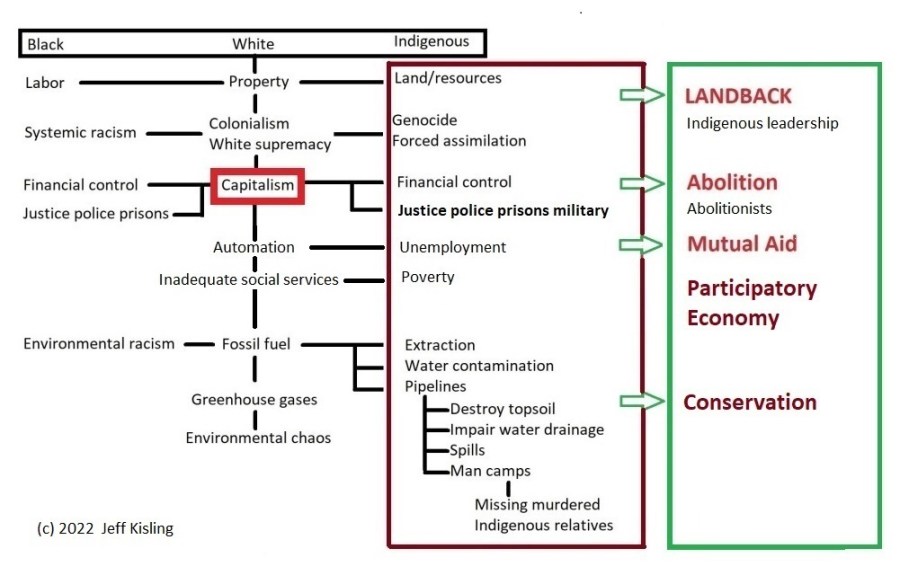
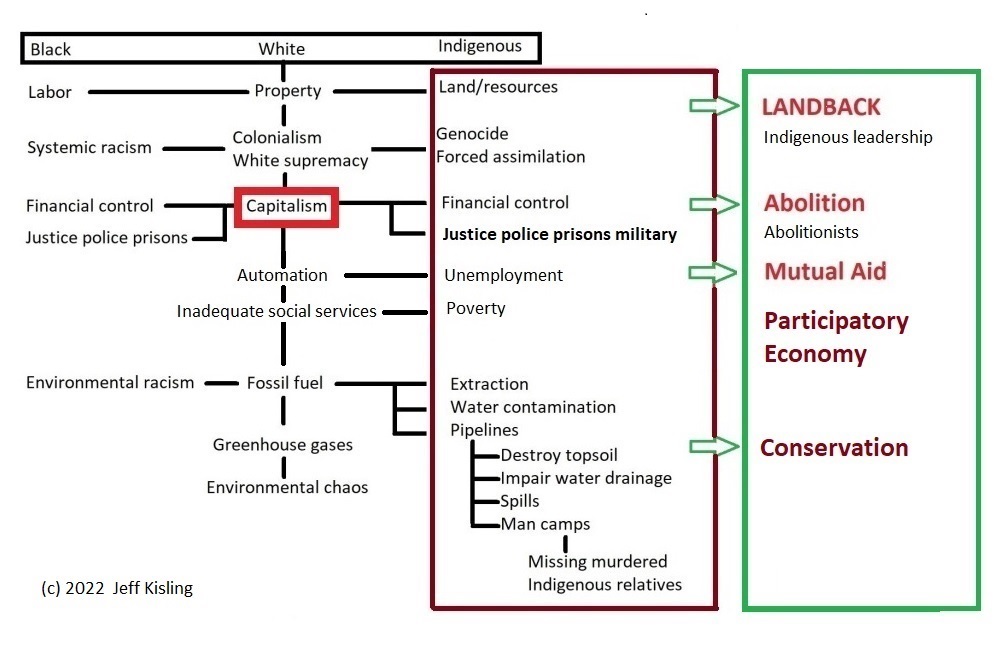
As these graphics explain, there is more than Mutual Aid involved in building the communities we want. Building Mutual Aid communities is a first step because it provides the framework for how a community works together and can address other things like abolition and LANDBACK.

Abolition and the mutual aid that we practice are inextricably linked.

I participate in the Prison Abolition Letter Writing Project that was started in 2018 as part of Central Iowa Democratic Socialists of America’s Prison and Police Abolition Working Group. Several of us from Des Moines Mutual Aid participate in the letter writing project.

And I am a member of the Quakers for Abolition Network (QAN).

We as White Quakers like to think of ourselves as ahead or better than dominant culture, but we have been complicit in a system and mindset that are ubiquitous. Claiming the full truth of our history and committing to repair the harms done are deeply spiritual acts of healing our own wounds of disconnection. I would argue it is the pathway upon which we can, perhaps for the first time, discover and invigorate our faith with its full promise.

What would it mean for us to take seriously and collectively as a Religious Society a call to finish the work of abolition, hand in hand and side by side with those affected and their loved ones? What would it mean for us to stand fully with the calls to abolish the police and fully fund community needs instead? What would it mean to reckon with our past complicity with harm and fully dedicate ourselves to the creation of a liberating Quaker faith that commits to build the revolutionary and healing faith we long to see come to fruition? What would it look like to finally and fully abolish slavery?

A Quaker Call to Abolition and Creation by Lucy Duncan, Friends Journal, April 1, 2021

The next American Revolution, at this stage in our history, is not principally about jobs or health insurance or making it possible for more people to realize the American Dream of upward mobility. It is about acknowledging that we Americans have enjoyed middle-class comforts at the expense of other peoples all over the world. It is about living the kind of lives that will not only slow down global warming but also end the galloping inequality both inside this country and between the Global North and the Global South. It is about creating a new American Dream whose goal is a higher Humanity instead of the higher standard of living dependent on Empire. It is about practicing a new, more active, global, and participatory concept of citizenship. It is about becoming the change we wish to see in the world.

The courage, commitment, and strategies required for this kind of revolution are very different from those required to storm the Winter Palace or the White House. Instead of viewing the U.S. people as masses to be mobilized in increasingly aggressive struggles for higher wages, better jobs, or guaranteed health care, we must have the courage to challenge ourselves to engage in activities that build a new and better world by improving the physical, psychological, political, and spiritual health of ourselves, our families, our communities, our cities, our world, and our planet.

Grace Lee Boggs, The Next American Revolution

Notes to myself

This morning I’m seeking guidance for a way to discuss the concepts of, and my experiences with Mutual Aid in preparation for a discussion about that with my Quaker meeting.

Quakers have a long tradition of prayerfully reflecting upon a series of questions, we call queries, to facilitate our discussions of topics like education, social and economic justice, peace and nonviolence. You can see these queries here: Advices and Queries.

The brilliance of using questions stimulates each of us to engage with the topic, whether we speak aloud about our reflections or not. To facilitate reflection and prayer rather than being lectured to.

Developing queries about Mutual Aid to guide this discussion might be the best approach. So, what should the queries be?

We need to discuss:

  • What is Mutual Aid?
  • What are the pros and cons of charity?
  • Why is Mutual Aid not charity?
  • Examples of vertical and flat/horizontal hierarchy
  • What are Quaker hierarchies?
  • What is the state of our peace and social justice work now?
  • What is a beloved community?
  • Is Mutual Aid closer to being a beloved community than our current conditions?
  • Why is Mutual Aid important now?
  • What is the state of our current economic (capitalism), justice, healthcare, education, and political systems?
  • Is capitalism an unjust economic system?
  • What will we do when our community experiences environmental, economic and/or political catastrophe?
  • What will we do when our shelter, power, and sources of food and water are disrupted?
  • What should we do to prepare for the migration of climate refugees to our communities?
  • How can we provide spiritual support for our wider communities?
  • Can we build Mutual Aid groups when people are physically separated?
  • What are the potential advantages and disadvantages of Mutual Aid?

Although many on the list above are questions, they are not necessarily the best expression of the queries for the discussion. I’ll be working on that next.

Change is difficult. It is far easier to maintain the status quo. But our status quo is rapidly unraveling.

The question below, “what will your choice be?” comes from the Wet’suwet’en peoples who are trying to protect their pristine lands and water from pipeline construction. “We make choices as to enter the uncomfortable place of change & movement, or we continue on this downward spiral.” [At the present time the Royal Canadian Mounted Police are preparing to invade the Wet’suwet’en territory.]

“We make conscious decisions to either sit back and watch, or stand up and be heard.
We make choices as to whether protect our future generations, or we allow for a destitute future for them.
We make choices as to enter the uncomfortable place of change & movement, or we continue on this downward spiral.
What will your choice be?
Will you sit back and allow for human rights violations to occur, or will you #RiseUp with us?”


Wet’suwete’n Access Point at Gidemt’en Facebook Page

Embracing Mutual Aid might be uncomfortable for some. Will we have the courage to enter the uncomfortable place of change and movement?

I’ve been working on this diagram to show relationships between the current situation and how Mutual Aid fits into this larger picture. I don’t think there will be time to include much of this in this Sunday’s discussion. But Mutual Aid is one piece of several changes (LANDBACK, Abolition and a better economic system) we need to make urgently.

There are three key elements of Mutual Aid.

  1. Mutual aid projects work to meet survival needs and build shared understanding about why people do not have what they need.
  2. Mutual aid projects mobilize people, expand solidarity, and build movements.
  3. Mutual Aid projects are participatory, solving problems through collective action rather than waiting for saviors.

    Mutual Aid, Building Solidarity during this Crisis (and the next) by Dean Spade, Verso, 2020

What I don’t know about Mutual Aid

Disclaimer: Before getting to that, I think I should make a disclaimer, especially since I shared the 2021 Peace and Social Concerns report of my yearly meeting, Iowa Yearly Meeting (Conservative). I included that because Mutual Aid is mentioned in the report. “These injustices are some of the effects of systems of white supremacy. The concept of Mutual Aid is becoming an increasingly used model for communities working for justice. The idea is to have a horizontal hierarchy, where everyone has a voice. And work to ensure a vertical hierarchy does not develop. Without a vertical hierarchy, there can, by definition, be no superiority. Several of our meetings are supporting existing Mutual Aid communities or considering creating their own. These are opportunities to begin to disengage from the colonial capitalist system and white supremacy. Ways we can model justice in our own meetings and communities.”

But that doesn’t mean what I’ve been writing on this blog has been approved by the Yearly Meeting.

What I do know about Mutual Aid comes from my two years of experience with Mutual Aid in Des Moines.

I met Ronnie James, and Indigenous organizer and now close friend, when he came to a vigil we held in February 2020 in support of the Wet’suwet’en people’s struggles to prevent the construction of the Coastal GasLink pipeline through their territories. He came because he wanted to know who was supporting the Wet’suwet’en, because their struggles were not being covered in the mainstream media. That was a good organizing strategy, a way to find allies.

Because of the COVID pandemic, he and I didn’t meet in person for several months. But during that time, he was very generous in teaching me about his work with Des Moines Mutual Aid (DMMA). I quickly saw there was much more to Mutual Aid than just distributing free food, or propane tanks for the houseless in winter. I could also tell the people involved in DMMA were very careful about who they associated with because they were on the police radar, so to speak. Several had been arrested, some several times, as they demonstrated to support Des Moines Black Liberation’s protests of police violence after the killing of George Floyd.

But after months of email exchanges, I felt we were getting to know each other well enough that I could ask if it would be appropriate to participate in his work. I knew it was important for allies to be careful about inviting ourselves into situations in ways that are not appropriate.

Fortunately, he said yes, and I have been participating in the food distribution part of Des Moine Mutual Aid nearly every Saturday morning since (for more than a year).

I thought I would see how this worked for a few weeks, and that might be the end of it. But I found the actual experience of being present in this community taught me so much that words written in emails could not.

When I arrived that first morning, apprehensive about what might happen, I was told this was Mutual Aid, which meant all of us were encouraged to take any food we wanted, ourselves. For many weeks I did not take any, but finally realized that was a mistake. It was like I wasn’t really buying into the mutual part of this. I realized this when one of my new friends, in a friendly manner, asked why I wasn’t taking any food. Now I do.

I also witnessed the truly uplifting way every volunteer greeted each car of people who came for the food. It was always, “hi, how are you doing? Have a great day.”

I also saw this insistence of avoiding any kind of vertical hierarchy. No one said, “do this, do that…”. When there was a problem, anyone with a solution was expected to just do it. Or when the van of food arrived, someone would say “the van is here” and whoever wasn’t doing something else would just go out and help unload the food.

Also, one of my new friends who volunteered to help with the food distribution told me she was once in the position of needing the food herself.

And I know my friends always show up. As they did yesterday, New Year’s Day, with a wind chill of -11 degrees. As we had on Christmas day the week before.

So a new person has to learn a new way of working together. Learn how to act in a situation where you aren’t told what to do by someone above you in a vertical hierarchy. To learn to be always aware of what is going on around you. See if there is something that needs to be done, then do it yourself.

Multiple times I’ve heard someone say these Saturday mornings together are the best part of their week. I feel that, too. That’s one of the important parts of Mutual Aid. We are enthusiastic about this work. It pulls people in when they are doing something that has an immediate impact.

This is one of the many reasons I’m encouraging Friends and others to learn about, create and participate in Mutual Aid. Most of the Quaker meetings I’m aware of have dwindling numbers of people attending their meetings. And we don’t attract many/any young people or Black, Indigenous and other people of color (BIPOC).

I’ve thought we should have more workcamps, as we did when I was growing up. Those were experiences people appreciated. Mutual Aid can be the answer today.

But there is a more fundamental reason to adopt Mutual Aid. We need to accept that our political and economic systems are failing. Are not meeting our needs. “We” being those of us fortunate to have had livable incomes. Those who don’t have known the failure of these systems their entire lives. We have no choice but to come up with alternatives. I believe Mutual Aid is one alternative.

Finally, we get to what I don’t know about Mutual Aid. The key to Mutual Aid is for everyone in the community to be involved in the work. But most of us live some distance from our Quaker meetings. Is it possible, or desirable, to find ways to create Mutual Aid communities if people are not physically present with each other? Is ZOOM Mutual Aid possible, or desirable?

I don’t know. If you have some ideas about this, please write them in the comments.

Thank you.

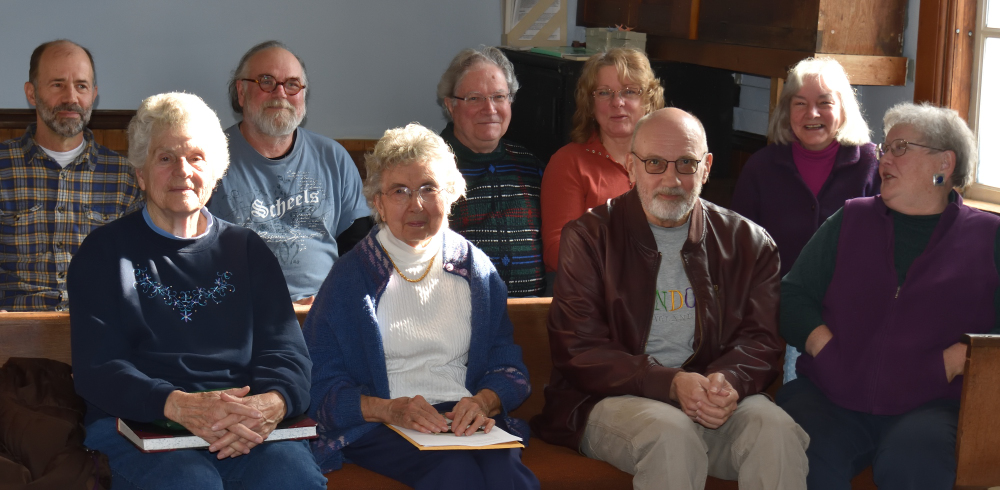
Bear Creek Friends