The eyes of the future are looking back at us


There is a native concept of considering what the effects of decisions made today will be on seven generations into the future.

The following quotation makes a two-way connection between us and future generations. Looking at each other over the generations.

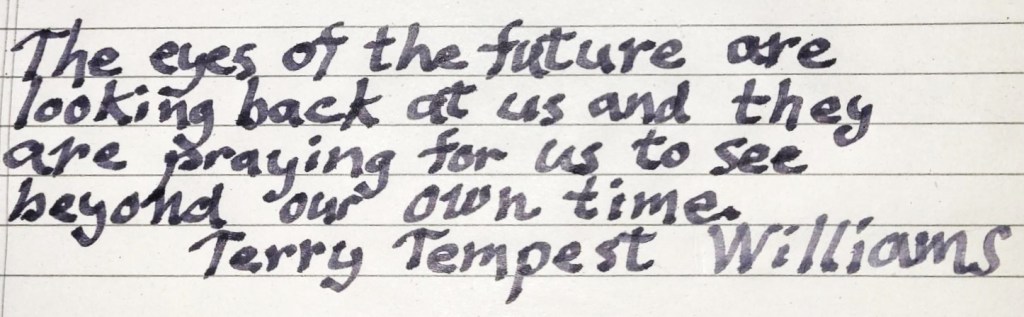
The eyes of the future are looking back at us and they are praying for us to see beyond our own time. They are kneeling with hands clasped that we might act with restraint, that we might leave room for the life that is destined to come. To protect what is wild is to protect what is gentle. Perhaps the wilderness we fear is the pause between our own heartbeats, the silent space that says we live only by grace. Wilderness lives by this same grace. Wild mercy is in our hands.

― Terry Tempest Williams, Refuge: An Unnatural History of Family and Place

Similarly, can we not look back at our ancestors? We are our ancestors’ future generation looking back.

I think about this a lot these days. As stories of the remains of native children on the grounds of the institutions of forced assimilation continue. Thousands of children never returned home.

I’ve been praying about what we are doing now and how much harm this is doing to future generations. My Spirit recoils from the likelihood there probably will not be a seventh, or sixth, or fifth generation because of the accelerating rate of environmental collapse.

What have we done?

What will we do?
As we work for change, we are admonished that we need to tell new stories. This morning I found this story Nico Santos tells, from the movie Dragon Rider.

“Wings”

Oh, I’ve been lost in the darkness
I heard your voice from afar
You weren’t my callin’
Whenever the night was starless
And I couldn’t see anymore
You showed me the mornin’

So I-I-I wanna let you know
When life has got you low

I’ll be your wings to fly
When there’s trouble on your mind
Whenever you’re ’bout to fall
There’s nothin’ I won’t try
‘Cause I’ll be your wings to fly
When you’re sufferin’ inside
Come hell or high water
Got you covered all my life
Let these wings take you
High, high
There’s nothin’ I won’t try

We built our own kinda fortress
Nothing can break us apart
Walls won’t be fallin’
These walls won’t be fallin’
I wouldn’t be if it wasn’t for you
I wouldn’t speak if it wasn’t the truth
You are my callin’
You are my callin’

So I-I-I wanna let you know
When life has got you low

I’ll be your wings to fly
When there’s trouble on your mind
Whenever you’re ’bout to fall
There’s nothin’ I won’t try
‘Cause I’ll be your wings to fly
When you’re sufferin’ inside
Come hell or high water
Got you covered all my life
Let these wings take you
High, high
There’s nothin’ I won’t try

You were my eyes, oh, when I couldn’t see
Were my voice, oh, when I couldn’t speak
Can I give it back to you?
Let me give it back to you
You were my legs, oh, when I couldn’t run
Were my heart when my own went numb
I’ll do what I have to do
Everything to get you through

I’ll be your wings to fly
When there’s trouble on your mind
Whenever you’re ’bout to fall
There’s nothin’ I won’t try
‘Cause I’ll be your wings to fly
When you’re sufferin’ inside
Come hell or high water
Got you covered all my life
Let these wings take you
High, high
There’s nothin’ I won’t try
Let these wings take you
High, high
There’s nothin’ I won’t try
Let these wings take you high

Nico Santos, WINGS from the movie Dragon Rider

Mutual Aid stories

For the past week I’ve been thinking and praying a lot about Mutual Aid in preparation for a discussion we plan to have at my Quaker meeting tomorrow.

As I have nearly every Saturday for the last year, I was with my Mutual Aid friends this morning for our weekly food distribution. Here are a few stories triggered from what happened this morning.

I had a clear spiritual leading to become involved in Des Moines Mutual Aid. For the sake of brevity, I’ll begin with my return to Iowa in 2017. I was looking for justice activists and soon had the opportunity to walk on the First Nation-Farmer Climate Unity March. A group of about ten native and ten non-native people walked and camped together for ninety-four miles, over eight days, along the path of the Dakota Access pipeline. The intention was for us to get to know each other as we shared stories, and that worked amazingly well. I got to know Sikowis Nobiss, Trisha Etringer, Matthew Lone Bear, Alton and Foxy Onefeather, and Donnielle Wanatee, among others. Various combinations of us worked together since then on things like racist monuments and mascots, Indigenous Peoples’ Day, and an Indigenous led Green New Deal.

There are a lot of photos and blog posts related to this sacred journey here: https://firstnationfarmer.com/ Part of the story relates to the support we received from Friends.

The summer of 2019 Peter Clay, Jim Glasson, Linda Lemons, and I helped arrange for Paula Palmer to have several sessions in the Midwest related to her ministry regarding Quakers and Indigenous peoples.

We wanted to continue this work. On February 7, 2020, we planned to meet at Friends House in Des Moines.

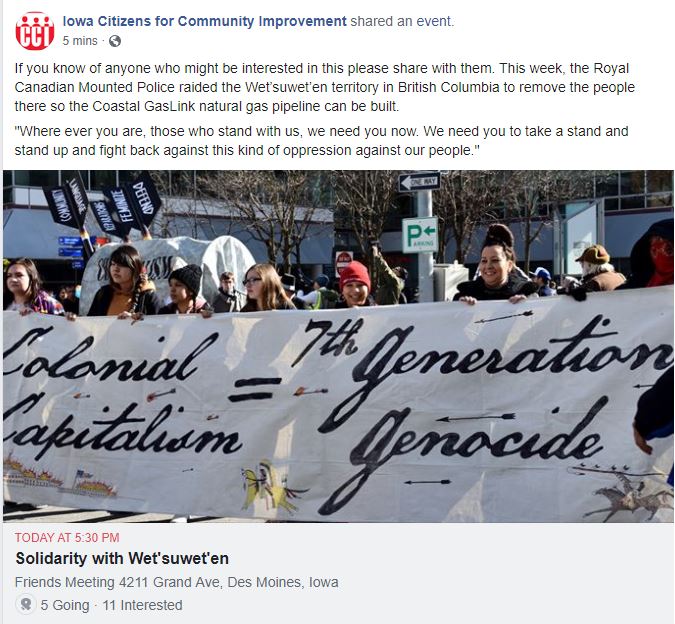
At that time, the Royal Canadian Mounted Police were attacking the Wet’suwet’en peoples in British Columbia. They were clearing the way for the construction of the Coastal GasLink pipeline through Wet’suwet’en territory. There was nothing about that in the mainstream press.

I learned about this when I saw the title of a YouTube video about the eviction of Coastal GasLink personnel from Wet’suwet’en territory. For many years I worked on the Keystone and Dakota Access pipelines resistance when I was in Indianapolis. I remember how shocked I was to see pipeline construction personnel evicted! I’m sure the Spirit led me to learn about the Wet’suwet’en. This struggle has become one of my primary areas of justice work since.

Returning to the February 7 meeting, we thought we would hold a rally in support of the Wet’suwet’en before the meeting we had already planned. I created a Facebook event in case anyone else might want to join us.

As the Spirit would have it though, Ronnie James saw that and joined us. I learned Ronnie has had over 20 years of experience as an Indigenous organizer. He was surprised anyone else in the Midwest knew about the Wet’suwet’en and came to check us out. A great organizing technique.

Peter Clay, Linda Lemons and Ronnie James

Over the subsequent two years Ronnie has become one of my closest friends, as well as my Mutual Aid mentor.

The Des Moines Mutual Aid project I’ve been involved in is the weekly food distribution project. There are many stories related to that but I’ll just tell about things that happened this morning.

About sixty boxes of food are put together in the basement of a church in Des Moines. Then they are taken outside and put on four tables, from which they are loaded into cars as they pull up. People know by word of mouth to park in the parking lot at 10 am. Then one of us directs them to drive up to the tables of food.

I learned those four long tables were donated to the church years ago from a mental health facility that my Quaker meeting, Bear Creek did a lot of work on.

This morning we could only find two of the tables. We looked all over and when we couldn’t find them, we carried a few smaller tables down from the third floor of the church. Shortly after though, when the bread that had been piled on some tables was put in the food boxes, we discovered the tables we were looking for had been hidden by the bread. We had a good laugh about that. Ronnie told me I’d have to write about that on my blog. This is a small example of how we all get to know each other as we work together.

The institutions of forced assimilation are often on my mind. Some Quakers had been involved in those institutions. Ronnie and I had a discussion about that.

I enjoyed hearing him talk about his son. Ronnie said, “he makes me happy (most of the time)”. I remember when Ronnie introduced me to him. He rarely says anything, but his voice sounds just like Ronnie’s. This morning I heard him say “dad”. When I left this morning, he was the only person in the basement. I said, “see you later” and he said, “see you later”. (It feels like I should not write his name. So many of those involved in Mutual Aid have had experiences with the police.)

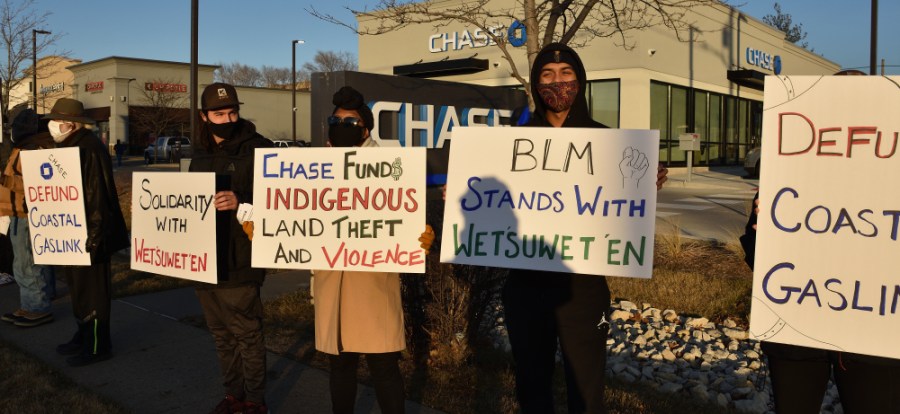
I will finish by returning to the Wet’suwet’en peoples, who are yet again being threatened by the RCMP. When these latest threats began again in November, Ronnie and I talked about whether to do something in support. We decided to invite whoever wanted to hold signs in support after our Mutual Aid work was finished. It was like completing a circle from our initial meeting related to the Wet’suwet’en.

I don’t get opportunities to take photos when with my Mutual Aid friends, again because of concerns related to police. But this time it was OK because of the masks and each person had given permission. When people were lining up, someone said, “across the street”. I thought they meant to move across the street, but what was meant was to line up across the street. And after the first few shots someone said, “wait, am I the only one with a fist up?”

You might notice the sign on the far right. A 5-year-old attends every Saturday, the life of the party. I knew he liked to draw, so I brought markers and a blank sheet for him.

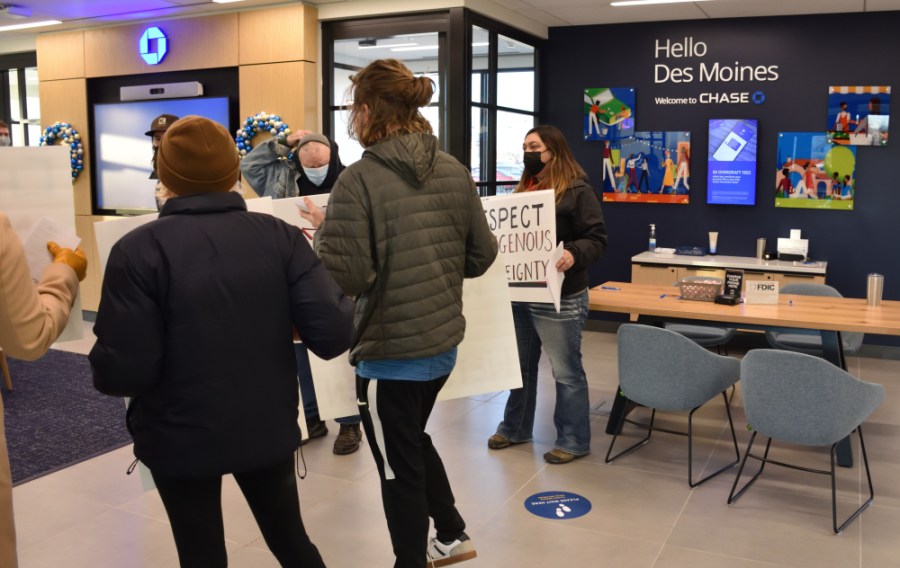
In December, the Wet’suwet’en called on supporters for solidarity actions. Chase bank funds the Coastal GasLink pipeline. A solidarity event was organized at a Chase bank in Des Moines. People were there from Mutual Aid, and Jon Krieg of the American Friends Service Committee (AFSC) and his partner Patti. You will also see one of the leaders of Des Moines Black Liberation there in support of the Wet’suwet’en.

 Indian Child Welfare Act

I’m discouraged to learn about the latest tactics to use children, once again, as leverage to take away Native rights. The intentional cruelty of the violent removal of children to the institutions of forced assimilation was what finally broke Indigenous resistance to stealing the land, and its resources, from native peoples.

The previous administration also used the intentional cruelty of stealing children from those trying to enter the country called the United States.

The Indian Child Welfare Act (ICWA) was enacted in 1978 to help keep Native children in Native homes. The Friends Committee on National Legislation (FCNL) worked closely with Congress to enact the legislation. One benefit of ICWA was to give Native families the legal right to keep their children out of those schools.

If the Supreme Court overturns the Indian Child Welfare Act (ICWA) — a federal law that keeps Native children with Native families — tribal sovereignty could soon be a thing of the past in the U.S. Should the Supreme Court rule in the plaintiffs’ favor in the case of Brackeen v. Haaland, we could quickly see a return to blatant, pre-1978 genocidal practices — when Native babies were legally stripped of their families, culture, and identities.

It’s critical that every one of us take immediate action. Before you do anything else today, sign our petition telling President Biden and the Department of Justice to defend ICWA, Secretary Haaland, and tribal sovereignty with every available means.

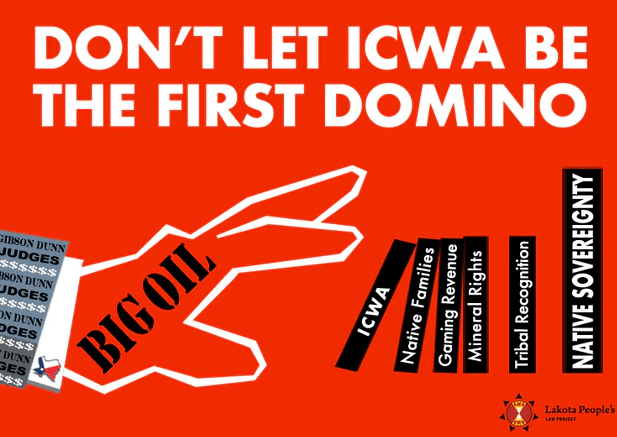
In this landmark case, the Brackeens — the white, adoptive parents of a Diné child in Texas — seek to overturn ICWA by claiming reverse racism. Joined by co-defendants including the states of Texas, Ohio, Louisiana, and Indiana, they’re being represented pro bono by Gibson Dunn, a high-powered law firm which also counts oil companies Energy Transfer and Enbridge, responsible for the Dakota Access and Line 3 pipelines, among its clients. This lawsuit is the latest attempt by pro-fossil fuel forces to eliminate federal oversight of racist state policies, continue the centuries-long genocide of America’s Native populations, and make outrageous sums of money for energy magnates, gaming speculators, and fossil fuel lawyers. The story below may seem unbelievable, but it is 100 percent true.

Key Points to Take Away

  • Big Oil’s lawyers, Texas, and three other states with very few Native inhabitants are attacking the Indian Child Welfare Act (ICWA).
  • The Texas Attorney General is asking the Supreme Court to declare ICWA unconstitutional.
  • The Plaintiffs argue that tribal affiliations should be considered racial, rather than political, designations.
  • Overturning ICWA could be the first legal domino in a broader attack on tribal rights and sovereignty.

TEXAS, BIG OIL TARGET INDIAN CHILDREN IN BID TO END TRIBAL SOVEREIGNTY By Sarah Rose Harper and Jesse Phelps, Lakota People’s Law Project, September 22, 2021
If the Supreme Court overturns the Indian Child Welfare Act, Native children, mineral rights, and tribal self-determination could quickly become collateral damage.

I can only write from the perspective of a settler, but I do want to highlight a few of the current struggles. We have a responsibility to educate ourselves about the history of the founding of the United States, to join in struggle with those who are oppressed and to transform our society to end these devastating institutions.

The Tulalip tribe in Everett, Washington also participated in the national day on September 30 with a vigil and speak out. They called it Residential Boarding School Awareness Day or Orange Shirt Day because one survivor Phyllis Webstad’s favorite orange shirt was taken from her on the first day of school. It wasn’t until 1978, through the Indian Child Welfare Act, that indigenous parents gained the right to keep their children out of those schools. Now that act is under threat of being overturned by the US Supreme Court and big oil is behind that attack.

That big oil would go after indigenous children is a response to the effectiveness of indigenous leadership in the fight to protect the planet. A recent report led by the Indigenous Environmental Network found that just in the past ten years, indigenous resistance to fossil fuel projects “stopped or delayed greenhouse gas pollution equivalent to at least one-quarter of annual U.S. and Canadian emissions.”

INDIGENOUS PEOPLE’S DAY REMINDS US TO ACKNOWLEDGE AND SUPPORT INDIGENOUS STRUGGLES By Margaret Flowers, Popular Resistance, October 11, 2021

We are talking about the potential destruction of all tribal law, the taking of all tribal lands, and the elimination of all Native sovereignty.

Chase Iron Eyes

Indian Child Welfare Act Under Attack

On Sept. 3, the U.S. solicitor general, Cherokee Nation, Morongo Band of Mission Indians, Oneida Nation, and Quinault Indian Nation filed cert petitions with the U.S. Supreme Court in Brackeen v. Haaland to defend the constitutionality of the Indian Child Welfare Act (ICWA).

This law was enacted in 1978 to help keep Native children in Native homes. FCNL worked closely with Congress to enact the legislation. In ICWA cases, the first preference is that the child go to an extended family member for placement, even if the relative is non-Native. The second preference is placement with someone within the child’s tribe, and the third preference is placement with another tribe.

The state of Texas, however, is continuing to challenge the constitutionality of ICWA. They claim that it’s a race-based system that makes it more difficult for Native children to be adopted or fostered into non-Native homes. A Supreme Court response to the tribes’ petition and Texas’ petition is due Oct. 8.

September Native American Legislative Update By Portia Kay^nthos Skenandore-Wheelock, Friends Committee on National Legislation, September 30, 2021

To those of you invested in anti-pipeline movements, know that this fight is no different from those we’ve undertaken at Standing Rock against the Dakota Access pipeline or in Minnesota against Line 3,” said Chase Iron Eyes, Lakota Law Co-Director and Lead Counsel. “It’s the same enemy using a different tactic to poison the planet. This is almost certainly Big Oil coming through the back door, and the danger may now be even greater. The victim is not just Mother Earth, her waters, and her sacred womb. It’s not just the Indigenous women and families on the front lines of the epidemic of missing and murdered Indigenous women and girls. It’s not even just the children being protected by ICWA. We are talking about the potential destruction of all tribal law, the taking of all tribal lands, and the elimination of all Native sovereignty. The only difference is that, this time, it certainly appears that Big Oil and its allies are using children as human missiles and the courts as the lever to accomplish its destructive agenda — all, of course, in the name of corporate profits.”

TEXAS, BIG OIL TARGET INDIAN CHILDREN IN BID TO END TRIBAL SOVEREIGNTY By Sarah Rose Harper and Jesse Phelps, Lakota People’s Law Project, September 22, 2021. If the Supreme Court overturns the Indian Child Welfare Act, Native children, mineral rights, and tribal self-determination could quickly become collateral damage.

Native children and U.S. Secretary of the Interior Deb Haaland are under legal attack in Brackeen v. Haaland. The powerful people behind the lawsuit include both Big Oil and the State of Texas. If their attempt to have a conservative-majority Supreme Court overturn the Indian Child Welfare Act is successful, the door will be open to the total elimination of tribal sovereignty. Take action now to stop this horrific attack on Native rights!

Petition Text:

Dear President Biden and attorneys for the Department of Justice,

As the Supreme Court decides on whether to render judgment in the case of Brackeen v. Haaland, I write today to ask you to do everything in your power to protect the Indian Child Welfare Act and defend Secretary Deb Haaland. We need strong federal protection of Native families and tribal sovereignty.

Please file every available motion, prepare every legal argument judiciously, and do everything else you can to stop this attack on tribal citizens. The plaintiffs will not be easily stopped. Should the Supreme Court accept this case and validate the plaintiffs’ argument that tribes do not have the power to place their own enrolled children in tribal kinship care, we will have crossed a rubicon into dangerous legal territory that could ultimately lead to the disbanding of tribal nations — and the loss of tribal lands, gaming revenues, and mineral rights.

It’s no coincidence that the same attorneys — Gibson Dunn — representing the plaintiffs in this case also have deep ties to fossil fuel interests such as Enbridge and TC Energy (the oil conglomerates responsible for attacking tribal interests through the Line 3 and Dakota Access pipelines, respectively).

The Indigenous peoples of this land have always deserved better. The few gains made over centuries littered with oppression, and in the face of overwhelming systemic racism, must not be lost now. Please fight hard to protect original Americans. Please do everything possible to stop this attack on children, families, and sovereignty.

https://action.lakotalaw.org/action/protect-icwa

#ICWA

Students teaching students

Yesterday I saw the great presentation, Online Pushback:UnBan Anti-Racism Education in Iowa, a forum by Indigenous youth of the Great Plains Action Society related to Iowa’s ban on teaching Critical Race Theory or Anti-Racism Education (video below).

Indigenous Youth Organizers, Alexandrea Walker and Keely Driscoll, have started a youth-led movement to demand that the current Iowa Administration unban Anti-Racism Education, aka, Critical Race Theory. For the sake of health and safety for all, it is imperative that Kim Reynolds reverse the overtly white supremacist decision to ban anti-racism education plus diversity, equity, and inclusion programming in the classroom and in all state-funded institutions

At the 12:15 mark in the video above, my friend Sikowis Nobiss introduces her son Alden who is in sixth grade. With the ban against teachers teaching about anti-racism, he spoke about his idea of students teaching each other as an alternative.

Sikowis: Hello everybody. I am here with my son today and his name is Alden and he’s in sixth grade. And he’s being affected by the ban on critical race theory or as we like to call it anti-racism education, decolonization work, diversity equity inclusion. Those are better terms for it because critical race theory is a term that they’re using to manipulate the situation, to make it sound like it’s critical, you know that it’s being like overtly hard on something when really it means how like you know analyzing something specifically or properly.
So, Alden is in grade six and you know he’s got some interesting thoughts about this, and I wanted to ask him like what does he think, what do you think about the ban on critical race theory?
Alden: It’s not that good.
Sikowis: How come?
Alden: I mean people should know that what happened in the past or else the history is just going to repeat itself. Just the same thing that happens over and over right? Seems like it isn’t going to stop if people don’t take action and more people like Reynolds is going to ban stuff.
Sikowis: And you had an interesting idea, you had said that teachers can’t teach critical race theory right? But students can. Can you tell us more about that?
Alden: The governor only said that teachers couldn’t say stuff like that and they couldn’t teach stuff like that, but that doesn’t mean schools can’t just be used to teach inside like only teachers.
Sikowis: So, who would teach like you want?
Alden: Kids to teach each other. Yeah the more educated kids that are like me I guess that know about what happened in the past.
Sikowis: Very good thank you so much Alden. We appreciate you making those remarks. That took a lot of bravery for him. I’m very proud of that.
I hope you guys could hear that. He basically thinks that if teachers can’t teach critical race theory then why can’t students do it? So that’s his idea. He thinks that students can teach each other in their spare time. During recess during, lunch time and that’s something that he’s going to try to do. So, we have a book that he’s going to share called 500 Years After Columbus, which is a curriculum guide for teaching better indigenous studies for k-12. So, he’s already taking a look at that.


Just as the final report from the National Inquiry into Missing and Murdered Indigenous Women and Girls triggered shock waves across the country, bringing conversations about violence against Indigenous people into the classroom, so did the discovery of 215 children’s remains at the Kamloops Indian Residential School earlier this year.

As the National Day for Truth and Reconciliation approaches, we can expect Canadian teachers are thinking about how they can better weave Indigenous perspectives into their lesson planning.

In the past, events like this rarely made it as national news, staying inside our Indigenous communities where the pain remained hidden from the rest of Canada. Now, teachers are talking about them with their students — how history and society influence individual situations of race-motivated violence and cultural genocide. It’s our responsibility to make sure they are equipped to teach the truth and acknowledge the important role schools play in reconciliation.

We owe it to all students to bring truth and drive reconciliation in classrooms by Linda Isaac & John Estabillo, National Observer, September 16th, 2021.

For specific teachings on Indian Boarding Schools and the United States assimilation policies—a history educators say is central in contextualizing present day culture for Native and non-Native youth alike— statistics are even bleeker.

“Over the course of the last couple of years, we’ve identified five states—only five states— that have even mentioned Indian boarding schools in their content in their state content standards, which is unimaginable,” said Sam Torres, director of research and programs at The Native American Boarding School Healing Coalition. Those states, surveyed by NABSHC in 2015, are: Arizona, Washington, Kansas, Oklahoma, and North Dakota. 

“It’s obviously a representation and reflection of what is being valued in educational and curricular context,” Torres said. 

For its part, NABSHC—an organization that has been at the helm of increasing public awareness on boarding schools since its founding nearly a decade ago—in 2020 released its first ever Truth and Healing Curriculum. The curriculum, available for free online, is made up of four lessons on Indian Boarding Schools focusing on history, impacts, stories, and healing.

The vast majority of Americans don’t learn about Indian boarding schools growing up. These Native leaders and educators want to change that by JENNA KUNZE, Native News Online, SEPTEMBER 13, 2021

We owe it to Indigenous educators who are triggered and challenged to deliver education around a topic like residential schools that have impacted them. Educators like me, who when viewing the images of children with their plain clothes, short hair, and empty eyes — identities stripped — still struggle to separate the pain we hold from lesson planning.

We also owe it to non-Indigenous educators who lack confidence in teaching because they weren’t taught the truth about the atrocities of the residential school system. This is a significant blocker to the successful integration of truth-telling in our classrooms, which can be solved by supporting educators in their journey of learning.

We must ensure the materials passed down to educators are written accurately by authentic voices. We need ongoing government funding and access to professional learning programs. Alberta is one province that does this well. Its Teacher Qualifications Standard requires educators to take courses in foundational knowledge of Indigenous history.

We owe it to all students to bring truth and drive reconciliation in classrooms by Linda Isaac & John Estabillo, National Observer, September 16th, 2021.

Ku Stevens’ Remembrance Run

Stories continue to emerge related to the remains of native children on the grounds of institutions of forced assimilation. Over 1,000 have been found on the grounds of several institutions in Canada so far. Searches are beginning in the land called the United States. Just last month nine children from the Carlisle boarding school in Pennsylvania were returned home. A number of my friends were involved in powerful ceremonies as the children’s’ caravan stopped in Sioux City, Iowa.

Following are stories related to forced assimilation and the Stewart Indian School in Nevada.

Stewart Indian School

First opened in 1890, Stewart Indian School was operated by the federal government for 90 years before it closed in 1980. Stewart and other boarding schools across the nation, were initially set up to forcefully educate Native American children in the late 1800s. This assimilation policy impacted thousands of Native students not only from the Great Basin tribal nations, but over 200 tribes over the school’s 90-year history.

Nevada Indian Commission

At the old (Stewart) school cemetery adjacent to the 240-acre campus, southwest of central Carson City, there are more than 170 marked graves. Those range in time from 1880, a year before the school existed, to the early 2000s. The marked gravesites include many with weathered, nearly-illegible headstones as well as easily-read marble markers and well-tended family plots. The wind-swept site on tribal land, protected by a fence and ringed with gnarled sagebrush, also encompasses an estimated 200 unmarked plots, whose occupants and dates of interment are a mystery.

Stewart Indian School’s 200 unmarked graves. ILLNESSES, ACCIDENTS AND EPIDEMICS TOOK THEIR TOLL ON NATIVE STUDENTS by Frank X. Mullen, Reno News and Review, August 15, 2021
Ku Stevens

When news broke of the mass graves found in Canada at residential schools earlier this year, one young cross country runner in Nevada thought of his own family.

Ku Stevens, Yerington Paiute Tribe, is 17, and a runner. His great grandfather Frank Quinn attended the Stewart Indian School in 1913. Quinn ran away three times.

He says he even felt his ancestors on his feet and he knows what he would say to his great grandfather if he was here today.

“Thanks for getting me this far because without him and the decisions he would have made to even run away from here, if he didn’t, I couldn’t possibly be here. Thanks for being a good man and wanting to be with your family and wanting to support them anyway you could. (Because) that’s family, you know, you would do anything for them,” Stevens said.

Retracing his ancestor’s boarding school escape. 17-year-old Ku Stevens honored his great-grandfather recently as part of a ‘Remembrance Run’ INDIAN COUNTRY TODAY, August 17, 2021

It’s about healing and bringing people together

Ku Stevens
Ku Stevens’ Remembrance Run

The discovery of hundreds of unmarked graves at tribal schools in Canada inspired a Native American teenager from Northern Nevada to recreate his great-grandfather’s escape from a similar school near Carson City.

Yerington Paiute tribal member Ku Stevens, one of the top prep cross-country runners in the state, plans to retrace the steps of his great-grandfather, Frank Quinn. He ran away from the Stewart Indian School three times, starting when he was 8.

Stevens had heard families stories about his great-grandfather his whole life but has grown to appreciate his courage.

“As of recently, I’ve kind of really understood the weight of what he had to do,” Stevens told State of Nevada, “and that’s why we’re trying to do this right now.”

The Yerington High School senior will honor his great-grandfather next month with a 50-mile run to bring awareness to the history of children being taken from families under a policy of forced assimilation of native peoples.

Teen Honors Great-Grandfather’s Escape From Tribal School by Bert Johnson, Nevada Public Radio, July 29, 2021
Ku Stevens, right, and his father Delmar Stevens, visit the Stewart Indian School in Carson City. The younger Stevens plans to run from the campus to Yerrington, recreating his great-grandfather’s efforts to escape the tribal school.

Thanks for getting me this far because without him and the decisions he would have made to even run away from here, if he didn’t, I couldn’t possibly be here. Thanks for being a good man and wanting to be with your family and wanting to support them anyway you could

Ku Stevens

Ku Stevens will not let history be forgotten.

Later this summer, the senior-to-be at Yerington High School plans to retrace his great-grandfather’s journey in escaping from the Stewart Indian School in Carson City.

He’s calling it: “The Remembrance Run.”

Stevens told the Reno Gazette Journal he was inspired earlier this year by the discovery of 215 children’s graves in Canada. The remains of the children were found on the grounds of the former Kamloops Indian Residential School.

The Stewart Indian School, which operated from about 1890 to 1980, was one of about 200 military-style boarding schools for native students nationwide.

Stevens’ great-grandfather, Frank Quinn, escaped from the Stewart Indian School and ran 50 miles when he was 8 years old to try to get back to his family home on the Yerington Paiute tribal reservation.

His route home went across the desert between Carson City and Yerington. He was returned to the school and escaped, again, three times in all.

Stevens’ great-grandmother Hazel, also a Paiute tribe member, was hidden by her family, who denied her existence when government officials came looking for her.

“It’s about remembering and education,” Stevens said. “Anybody can come out and run. It doesn’t matter what race you are. It’s about healing and bringing people together. It’s not just about remembering the segregation and the bad things of the past.”

Yerington teen to retrace escape from Stewart Indian School, Nevada Appeal, July 5, 2021
Stewart Indian School In Carson City To Be Included In Federal Probe

After nearly 1,000 unmarked graves were found at former Indian boarding schools in Canada, U.S. Interior Secretary Deb Haaland announced an initiative to study Indian schools here, including one just outside Carson City.

The former Stewart Indian School is now a state-run museum, but about half of the former campus, including its cemetery, was returned to the Washoe Tribe of Nevada and California. Officials with the Nevada Indian Commission announced earlier this month they were collecting information about the school so they would be ready to participate in the federal review.

Stacey Montooth, director of the commission, said the investigation is welcome but will touch a nerve in the state’s tribal community.

“To prepare for any questions that Secretary Haaland might have, I’ve met with elders and the burial committee from the Washoe Nation to try to get a sense of what they would like to see,” she said. “With permission from their leadership, I was able to go to the cemetery and we’re dealing with upwards of 200 unmarked graves.”

“The boarding schools were so impactful,” she told State of Nevada. “We had families that have never really ever been able to return to their traditional structure, nor have they been able to embrace modern-day America.”

Stewart Indian School In Carson City To Be Included In Federal Probe by Bert Johnson, Nevada Public Radio, July 14, 2021

Water walkers

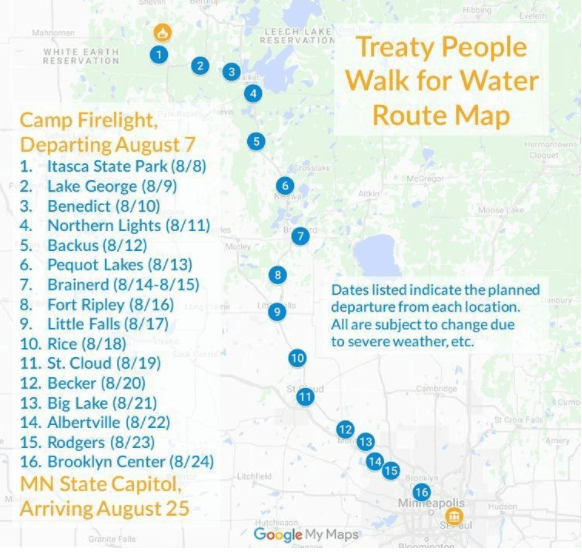
Water protectors are walking from the headwaters of the Mississippi to Minneapolis. They are walking 235 miles to the Minnesota State Capitol to tell President Biden to cancel the Line 3 Tar Sands pipeline permit. The video at the end of this discusses LN3: 7 TEACHINGS OF THE ANISHINAABE RESISTANCE.

This morning, water walkers left Fire Light Camp on the Mississippi on a walk to St. Paul. They will be walking for two weeks to their destination of the Minnesota State Capitol Building, arriving by August 25th. The Capitol Building will hold a large welcome event to celebrate the walkers, and tell President Biden to step in and direct the Army Corps to cancel this pipeline’s permits.

Water walk begins from headwaters of Mississippi, headed to Capitol by August 25 by Barbara With, Wisconsin Citizens Media Cooperative, August 7, 2021
https://wcmcoop.org/2021/08/07/water-walk-begins-from-headwaters-of-mississippi-headed-to-capitol-by-august-25/

Water walkers bound for the Minnesota State Capitol left Backus, MN this morning after spending the night at the home of an ally along the route. The walk began last Saturday at the Fire Light Water Protector camp situated on the Mississippi River.

Water protectors spent nearly three weeks camping on the roadside near the Upper Mississippi to monitor Enbridge’s drilling activity under the river as they construct the Line 3 Tar Sands pipeline. Enbridge has drilled under dozens of rivers and waterways, causing several major “frac outs” that spilled toxic drilling fluid into rivers and wetlands. The Minnesota Department of Natural Resources has not appeared to provide oversight or consistently monitor Enbridge’s work.

Walkers plan to make the 235 mile journey to the State Capitol by August 25. They are planning acts of civil disobedience in order to demand that those in power honor the treaties and protect the public water from a foreign corporation.

Water Walkers headed for the Capitol: Why They Walk by August 25 by Barbara With, Wisconsin Citizens Media Cooperative, August 12, 2021
https://youtu.be/6wwPn2pfugM

I’m reminded of the Native American youth who ran 2,000 miles from Standing Rock to Washington, DC, to deliver a petition to stop construction of the Dakota Access Pipeline (DAPL) in 2016.

“Most of us coming from the reservation have never been this far from home,” Bobbi Jean Three Legs, a resident of the Standing Rock Reservation, told PEOPLE on her 18th day of a 2,000-mile journey.

Three Legs spoke with PEOPLE from Frederick, Maryland – the last stop she and a group of 37 other Native Americans, mostly teens, made before completing a 2,000-mile run to Washington, D.C. to deliver the most important message of their lives.

The group ran from the Standing Rock Reservation in North Dakota all the way to Washington to hand over a petition started by Three Legs, 25, and Anna Lee Rain Yellowhammer, 13, to stop construction on a massive oil pipeline that would cross the Missouri River, putting their community’s sole water source at risk.

These Native American Youths Are Running 2,000 Miles to Protect Their Water “It feels like nobody’s thinking about our future,” Bobbi Jean Three Legs tells PEOPLE By Tiare Dunlap, PEOPLE Magazine, August 5, 2016

Reminded, also, of the sacred journey of a small group of us, walking and camping for eight days, 94 miles along the path of the Dakota Access Pipeline to call attention to the abuse of eminent domain to build the pipeline. Hoping that would stop the flow of oil through it, since at that point the pipeline was already in operation. https://firstnationfarmer.com/

The eyes of the future are looking back at us

There is a native concept of considering what the effects of decisions made today will be on seven generations into the future.

The following quotation makes a two way connection between us and future generations. Looking at each other over the generations.

The eyes of the future are looking back at us and they are praying for us to see beyond our own time. They are kneeling with hands clasped that we might act with restraint, that we might leave room for the life that is destined to come. To protect what is wild is to protect what is gentle. Perhaps the wilderness we fear is the pause between our own heartbeats, the silent space that says we live only by grace. Wilderness lives by this same grace. Wild mercy is in our hands.

― Terry Tempest Williams, Refuge: An Unnatural History of Family and Place

Similarly, can we not look back at our ancestors? We are our ancestors’ future generation looking back.

I think about this a lot these days. As stories of the remains of native children on the grounds of the institutions of forced assimilation continue. Thousands of children never returned home.

I’ve been praying about what we are doing now that future generations will see as wrong. My Spirit recoils from the likelihood there probably will not be a seventh, or sixth, or fifth generation because of the accelerating rate of environmental collapse.

What have we done?

What will we do?

Repatriation of Rosebud Sioux Tribe Children at Carlisle Indian Industrial School

No photo description available.

CARLISLE, Pa. — Twenty-three-year-old Christopher Eagle Bear from the Rosebud Sioux tribe in South Dakota has been growing out his hair since he visited the site of the former Carlisle Indian Industrial School six years ago. 

The trip, made by the Rosebud Sioux youth council in 2015, sparked a group of young tribal members to initiate a tribe-backed resolution to bring home their nine ancestors who died at the school as children some 140 years ago. 

Six years after his initial visit, Eagle Bear’s hair falls down below the waist of his traditional regalia. He is back in Carlisle this week to bring his relatives home. 

It’s a Circle

Five of the deceased children set to return home were among the first group of 84 Lakota children from the Rosebud and Pine Ridge Agencies that rolled into the Carlisle train station on Oct. 6, 1879, according to Pratt’s archived documents.

Their names were: Rose Long Face (Little Hawk), Dennis Strikes First (Blue Tomahawk), Maud Little Girl (Swift Bear), Alvan (Kills Seven Horses) and Dora Her Pipe (Brave Bull). Within the next four years, Friend Hollow Horn BearWarren Painter (Bear Paints Dirt), Lucy Take the Tail (Pretty Eagle), and Ernest Knocks Off (White Thunder) also arrived.

Russell Eagle Bear, tribal council member, addresses the youth after the press conference. “We’re really proud of you,” he said. “I’m really glad you’re speaking from your heart.”

After learning of their children’s deaths, Chiefs White Thunder and Swift Bear— the respective parents of Ernest and Maud— wrote to Pratt on Dec. 29, 1880. In their letter, they requested the bodies of their children be returned for burial, according to the original document archived by the Carlisle Indian School Digital Research Center. It is not known if Pratt ever responded, but the children were never returned.

“The letter should have been answered,” said Robert Becker, 67, Maud’s closest descendant who traveled with the tribe to Carlisle to bring his great grandmother back home. Becker said that although he felt disheartened by the apparent mistreatment of his ancestors at Carlisle, he would leave feeling “fully content” with the youth council’s work to bring their children home.

“It’s a circle,” he said. “It began with them, it’s going to end with them.”

The journey home from Carlisle, the tribe said, will symbolize the beginning of the healing ahead of them.

“Healing for me is uncovering trauma, whether you experience it or your parents or your grandparents experienced it,” Rachel Janis, 22, said on Tuesday. “When I was younger, I didn’t understand what I was going through. When we first came to Carlisle, although I never experienced boarding schools, I think that was another stem of where that might have come from. We got a lot of, ‘Oh this happened long ago. You weren’t even born when this happened.’

“But why can’t I sit with my grandma (and) have a conversation with her in Lakota? It’s a fear where they don’t want you to talk in Lakota or wear your traditional attire … They’re afraid because of what they went through at boarding schools.”

Rosebud Sioux Youth Council Returns to Carlisle Indian School to Bring Their Relatives Home BY JENNA KUNZE, Native News Online, JULY 14, 2021

From the video above:

We all must put down our ignorance and accidental racism of not addressing the truth that this country had with Indigenous people. We are not asking for pity. We are asking for understanding.

See also: The return of children from Carlisle boarding school – LANDBACK Friends

May be an image of 1 person and text that says 'Community Meal & Prayer for the Sičangu Relatives July 15th- 8pm War Eagle Park 4000 War Eagle Dr. Sioux City, IA Morning Morning Prayer/Departure July 16th- 7:30am Tyson Events Center Parking Lot Departure at 8am Bhid Them Home Matters'

Intertwined threads

Writing is a spiritual practice for me. Sitting at the computer, I try to quiet my mind to hear what I should write. In times past a writer would sit in front of a blank page. This morning there are intertwined threads.

There are many reasons news of the remains of Native children profoundly affects me.

My career began with five years in neonatal intensive care. The rest doing research at that children’s hospital. I was blessed to be immersed with children everyday. I attempt to retain childlike qualities. Children are my heroes. I love the idea of children as sacred beings.

In almost every indigenous language of what is now known as the Americas there is a word for children that translates to English as sacred beings. Acknowledging in thoughts, words and actions that our children are sacred beings provides not only the necessary healthy intention and consciousness that will benefit our children; this acknowledgement reminds us as parents to once again be open with our own hearts.

Knowing children as sacred beings brings forth a healthy and healing strength of humility from within us as parents and adults. The youth are our teachers with a profound message for this world. When we as parents and adults acknowledge the Sacredness within ourselves it becomes difficult to not acknowledge this within others – especially our children. We have all been manifested as sacred beings, and although we are able to forget, we are unable to change the truth of what we have been created as, and always will be.

For parents who struggle to see themselves as sacred beings, simply allow your children to remind you of what you’ve forgotten. At birth through their newborn cries the children sing a song to their parents and the world. At this very moment hundreds of sacred beings, answered prayers, messengers of light are manifesting in all cultures and languages. They’re all entering this world singing a song of a sacred contract that can never be broken, only temporarily forgotten. The children’s song is reminding us. Listen…

Raising Sacred Beings,  by Anthony Goulet, The Good Men Project. August 29, 2014

One of this morning’s threads relates to brutal honesty. I’ve often thought of the following quote. I haven’t always been but will try to be brutally honest in what follows.

Being brutally honest does not necessarily mean you are correct.

Well, I have to tell you something, and you may not like to hear it. But if you struggle with the art of being frank, you need to hear this. It will make you a better person, a better communicator and a better blogger.
So here it is …
You’re a coward.
If you can’t be brutally honest with people, especially when you know it’s in their best interest, you’re a coward.
You’re not doing anyone a favor by withholding a truth from them, even if it’s difficult for them to hear.
The only person you’re protecting is yourself. Because you’re afraid of the consequences to you.
But it’s not about you.
Being honest is about making sure your audience has the information they need to make good decisions. That includes information they may not like.

THE BRUTALLY HONEST GUIDE TO BEING BRUTALLY HONEST by Josh Tucker, SmartBlogger,Jan 30, 2019

I’ve stepped away from the Quaker community that has supported my spiritual life, my whole life. I’m not certain this is not just an emotional response to the atrocities of forced assimilation. I continue to pray to see if this is a true spiritual leading.

I wonder if I can remain a Quaker.

For the past several years I have been led to opportunities to become friends with a number of Native people. It takes much more than attending conferences or powwows or serving on committees to accomplish this. One opportunity was walking and camping for 94 miles along the path of the Dakota Access pipeline with a small group of native and non-native people. Through experiences like that, I’ve been blessed to come to some understandings through a gentle process of integration. But I am just at the beginning of this journey.

The word En’owkin in the Okanagan language elicits the metaphorical image of liquid being absorbed drop by single drop through the head (mind). It refers to coming to understanding through a gentle process of integration.

Jeanette Armstrong

What follows are generalities. But my understanding, expressed as brutally honestly as I can. When I refer to Quakers I mean white Quakers in the lands called the United States and Canada. That distinction is necessary because much relates to white supremacy.

  • Indigenous peoples have always lived in balance with nature.
  • Quakers are not and should immediately do everything possible to stop using fossil fuels.
  • We should immediately ramp up installation of local renewable energy sources.
  • Environmental chaos will only worsen. Extremely rapidly.
  • Indigenous ways are the only way to slow down the impending chaos.
  • I have grown spiritually from my experiences with Indigenous peoples. In ways I hadn’t as a Quaker.
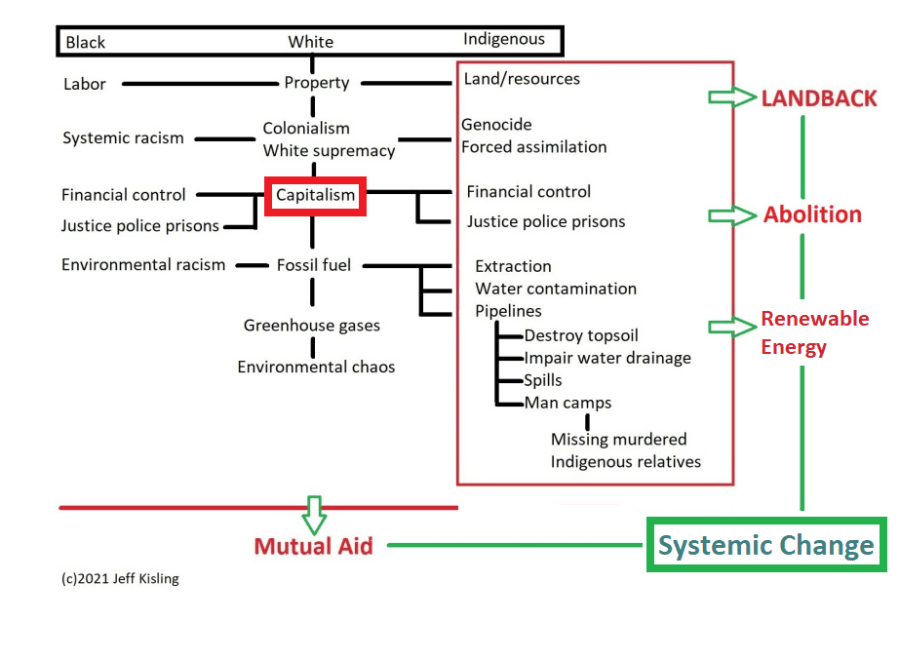
  • White Quakers are too integrated into the culture of white supremacy and capitalism.
  • Friends need to understand how white culture continues to oppress and interfere with our relationships with black, Indigenous and other people of color (BIPOC).
  • Friends should be physically present in BIPOC communities so healing and reconciliation can occur.  To understanding through a gentle process of integration.
  • Friends should literally be on the front lines of BIPOC actions for justice.
  • Quakers should reject vertical hierarchies of power. Vertical hierarchies are the only way White supremacy can exist.
  • An alternative is Mutual Aid which is based upon a flat hierarchy. Quakers should participate in, and create Mutual Aid communities.
  • Quakers should learn about and participate in Land Back. The model for returning to Indigenous practices for community and stewardship of the land.
  • Hundreds of thousands of Native children were forcibly taken from their families to institutions of assimilation.
  • Thousands of children died in those schools, or during their escape.
  • Quakers were involved in various ways in forced assimilation.
  • Quakers should discern a response and act on it now. This is urgent. Rapidly increasing numbers of children found is devastating Indigenous communities. Should be devastating to Quakers.

In our way we are always told not to ask for anything. We are always told in our community, as a practice, that when we have to start asking for something, that’s when we’re agreeing that people be irresponsible. Irresponsible in not understanding what we’re needing, irresponsible in not seeing what’s needed, and irresponsible in not having moved our resources and our actions to make sure that need isn’t there, because this is the responsibility that we, and the people that surround us, mutually bear. So in our community we cannot go to a person and say, “I want you to do this for me.” All we can do is clarify for them what is happening and what the consequences are for our family, or for our community, or for the land. We must clarify for them what needs to be done and how it needs to be done, and then it is up to them and if they fall short of that responsibility, at some point they will face the same need themselves.

Indigenous Knowledge and Gift Giving by Jeanette Armstrong, syndicated from gift-economy.com, Jul 13, 2021

The website LANDBack Friends has many resources to help Quakers learn more about, and how to do these things. https://landbackfriends.com/

I have tried to clarify for Quakers what needs to be done and how it needs to be done, and then it is up to them and if they fall short of that responsibility, at some point they will face the same need themselves.

I thought of this photo I took yesterday when I read coming to understanding through a gentle process of integration in the quote above. The image was basically black, but by the gentle process of editing, the shapes and rainbows of colors emerged.


Gentile process of integration. Jeff Kisling

Sioux City Native Youth Camp

May be an image of 3 people, child, people standing, outdoors and text that says 'PROTECT THE SACRED JULY 10 SIOUX CITY NATIVE YOUTH CAMP 11, RIVERSIDE PARK FOR YOUTH AGES 5-19 BUT BRING THE WHOLE FAMILY! FREE TO ALL! FREE FOOD! FREE T-SHIRTS! TWO DAYS OF CULTURE, GAMES, PHYSICAL FUN AND LEARNING! IMPORTANT!!! Pre-Register at bit.ly/ptsyouthcamp'

Event by Great Plains Action Society

Riverside Park Shelter #4 Sioux City, IA 51109

Price: Free · Duration: 1 day

Public  · Anyone on or off FacebookProtect

The Sacred Native Youth Camp

July 10, 2021 8am – 4pm
July 11, 2021 8am – 5pmRiverside Park, Shelter #4
1301 Riverside Blvd
Sioux City, Iowa

For youth ages 5-19
Pre-Registration at bit.ly/ptsyouthcamp

ABSOLUTELY FREE EVENT! WE WILL PROVIDE TWO SNACKS AND A LUNCH. YOUTH/FAMILIES WILL RECEIVE A FREE T-SHIRT IF THEY ATTEND BOTH DAYS.OPEN FOR ALL FAMILIES TO COME AND PARTICIPATE!

Indigenous youth often face added challenges throughout their childhood and adolescence. Some may have a strong support system while others may not. It is highly important that each and every Native youth feels empowered and inspired to reach their full potential. This is exactly what Protect The Sacred Native Youth Camp is all about. We are encouraging Native youth to participate in cultural and physical activities such as lacrosse, drumming, and dancing (to name a few). Our mission is to engage the Native youth in physical activities to promote healthier habits while learning about local tribes within the region. Knowledge is power and our hope is to help Native youth build a stronger Indigenous identity in order to stand up against abuse and injustice that they may face in their lifetime. Empowered and educated youth will help put an end to the Missing and Murdered Indigenous Relatives crisis, which is our long term goal.

A REGISTRATION BOOTH WILL BE SET UP ALL DAY FOR THE TWO DAYS.

Great Plains Action Society will be extending other activities after the daily sponsored event. We anticipate to have sweat each night and families are encouraged to stay overnight in our tipi’s that will be set up at Riverside Park near Shelter #4 if they wish to.

This event is a collaboration between Great Plains Action Society, Indian Youth of America, Mount Marty, UNO, and SD BRIN. 

Wellness

Link to Riverside Park, Sioux City Google Maps

https://www.google.com/maps/@42.5021221,-96.4653259,15.5z