Indian Child Welfare Act

I’m discouraged to learn about the latest tactics to use children, once again, as leverage to take away Native rights. The intentional cruelty of the violent removal of children to the institutions of forced assimilation was what finally broke Indigenous resistance to stealing the land, and its resources, from native peoples.

The previous administration also used the intentional cruelty of stealing children from those trying to enter the country called the United States.

The Indian Child Welfare Act (ICWA) was enacted in 1978 to help keep Native children in Native homes. The Friends Committee on National Legislation (FCNL) worked closely with Congress to enact the legislation. One benefit of ICWA was to give Native families the legal right to keep their children out of those schools.

If the Supreme Court overturns the Indian Child Welfare Act (ICWA) — a federal law that keeps Native children with Native families — tribal sovereignty could soon be a thing of the past in the U.S. Should the Supreme Court rule in the plaintiffs’ favor in the case of Brackeen v. Haaland, we could quickly see a return to blatant, pre-1978 genocidal practices — when Native babies were legally stripped of their families, culture, and identities.

It’s critical that every one of us take immediate action. Before you do anything else today, sign our petition telling President Biden and the Department of Justice to defend ICWA, Secretary Haaland, and tribal sovereignty with every available means.

In this landmark case, the Brackeens — the white, adoptive parents of a Diné child in Texas — seek to overturn ICWA by claiming reverse racism. Joined by co-defendants including the states of Texas, Ohio, Louisiana, and Indiana, they’re being represented pro bono by Gibson Dunn, a high-powered law firm which also counts oil companies Energy Transfer and Enbridge, responsible for the Dakota Access and Line 3 pipelines, among its clients. This lawsuit is the latest attempt by pro-fossil fuel forces to eliminate federal oversight of racist state policies, continue the centuries-long genocide of America’s Native populations, and make outrageous sums of money for energy magnates, gaming speculators, and fossil fuel lawyers. The story below may seem unbelievable, but it is 100 percent true.

Key Points to Take Away

  • Big Oil’s lawyers, Texas, and three other states with very few Native inhabitants are attacking the Indian Child Welfare Act (ICWA).
  • The Texas Attorney General is asking the Supreme Court to declare ICWA unconstitutional.
  • The Plaintiffs argue that tribal affiliations should be considered racial, rather than political, designations.
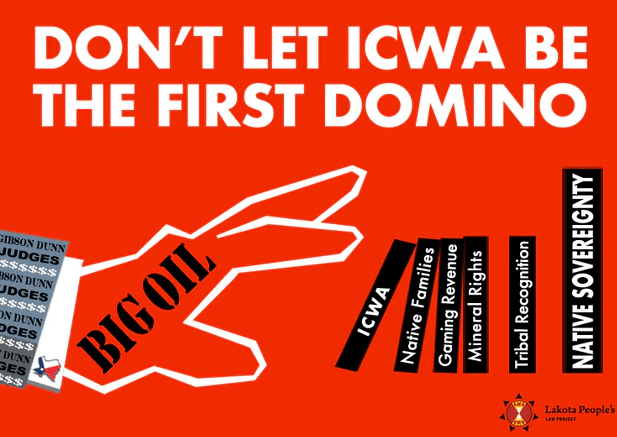
  • Overturning ICWA could be the first legal domino in a broader attack on tribal rights and sovereignty.

TEXAS, BIG OIL TARGET INDIAN CHILDREN IN BID TO END TRIBAL SOVEREIGNTY By Sarah Rose Harper and Jesse Phelps, Lakota People’s Law Project, September 22, 2021
If the Supreme Court overturns the Indian Child Welfare Act, Native children, mineral rights, and tribal self-determination could quickly become collateral damage.

I can only write from the perspective of a settler, but I do want to highlight a few of the current struggles. We have a responsibility to educate ourselves about the history of the founding of the United States, to join in struggle with those who are oppressed and to transform our society to end these devastating institutions.

The Tulalip tribe in Everett, Washington also participated in the national day on September 30 with a vigil and speak out. They called it Residential Boarding School Awareness Day or Orange Shirt Day because one survivor Phyllis Webstad’s favorite orange shirt was taken from her on the first day of school. It wasn’t until 1978, through the Indian Child Welfare Act, that indigenous parents gained the right to keep their children out of those schools. Now that act is under threat of being overturned by the US Supreme Court and big oil is behind that attack.

That big oil would go after indigenous children is a response to the effectiveness of indigenous leadership in the fight to protect the planet. A recent report led by the Indigenous Environmental Network found that just in the past ten years, indigenous resistance to fossil fuel projects “stopped or delayed greenhouse gas pollution equivalent to at least one-quarter of annual U.S. and Canadian emissions.”

INDIGENOUS PEOPLE’S DAY REMINDS US TO ACKNOWLEDGE AND SUPPORT INDIGENOUS STRUGGLES By Margaret Flowers, Popular Resistance, October 11, 2021

We are talking about the potential destruction of all tribal law, the taking of all tribal lands, and the elimination of all Native sovereignty.

Chase Iron Eyes

Indian Child Welfare Act Under Attack

On Sept. 3, the U.S. solicitor general, Cherokee Nation, Morongo Band of Mission Indians, Oneida Nation, and Quinault Indian Nation filed cert petitions with the U.S. Supreme Court in Brackeen v. Haaland to defend the constitutionality of the Indian Child Welfare Act (ICWA).

This law was enacted in 1978 to help keep Native children in Native homes. FCNL worked closely with Congress to enact the legislation. In ICWA cases, the first preference is that the child go to an extended family member for placement, even if the relative is non-Native. The second preference is placement with someone within the child’s tribe, and the third preference is placement with another tribe.

The state of Texas, however, is continuing to challenge the constitutionality of ICWA. They claim that it’s a race-based system that makes it more difficult for Native children to be adopted or fostered into non-Native homes. A Supreme Court response to the tribes’ petition and Texas’ petition is due Oct. 8.

September Native American Legislative Update By Portia Kay^nthos Skenandore-Wheelock, Friends Committee on National Legislation, September 30, 2021

To those of you invested in anti-pipeline movements, know that this fight is no different from those we’ve undertaken at Standing Rock against the Dakota Access pipeline or in Minnesota against Line 3,” said Chase Iron Eyes, Lakota Law Co-Director and Lead Counsel. “It’s the same enemy using a different tactic to poison the planet. This is almost certainly Big Oil coming through the back door, and the danger may now be even greater. The victim is not just Mother Earth, her waters, and her sacred womb. It’s not just the Indigenous women and families on the front lines of the epidemic of missing and murdered Indigenous women and girls. It’s not even just the children being protected by ICWA. We are talking about the potential destruction of all tribal law, the taking of all tribal lands, and the elimination of all Native sovereignty. The only difference is that, this time, it certainly appears that Big Oil and its allies are using children as human missiles and the courts as the lever to accomplish its destructive agenda — all, of course, in the name of corporate profits.”

TEXAS, BIG OIL TARGET INDIAN CHILDREN IN BID TO END TRIBAL SOVEREIGNTY By Sarah Rose Harper and Jesse Phelps, Lakota People’s Law Project, September 22, 2021. If the Supreme Court overturns the Indian Child Welfare Act, Native children, mineral rights, and tribal self-determination could quickly become collateral damage.

Native children and U.S. Secretary of the Interior Deb Haaland are under legal attack in Brackeen v. Haaland. The powerful people behind the lawsuit include both Big Oil and the State of Texas. If their attempt to have a conservative-majority Supreme Court overturn the Indian Child Welfare Act is successful, the door will be open to the total elimination of tribal sovereignty. Take action now to stop this horrific attack on Native rights!

Petition Text:

Dear President Biden and attorneys for the Department of Justice,

As the Supreme Court decides on whether to render judgment in the case of Brackeen v. Haaland, I write today to ask you to do everything in your power to protect the Indian Child Welfare Act and defend Secretary Deb Haaland. We need strong federal protection of Native families and tribal sovereignty.

Please file every available motion, prepare every legal argument judiciously, and do everything else you can to stop this attack on tribal citizens. The plaintiffs will not be easily stopped. Should the Supreme Court accept this case and validate the plaintiffs’ argument that tribes do not have the power to place their own enrolled children in tribal kinship care, we will have crossed a rubicon into dangerous legal territory that could ultimately lead to the disbanding of tribal nations — and the loss of tribal lands, gaming revenues, and mineral rights.

It’s no coincidence that the same attorneys — Gibson Dunn — representing the plaintiffs in this case also have deep ties to fossil fuel interests such as Enbridge and TC Energy (the oil conglomerates responsible for attacking tribal interests through the Line 3 and Dakota Access pipelines, respectively).

The Indigenous peoples of this land have always deserved better. The few gains made over centuries littered with oppression, and in the face of overwhelming systemic racism, must not be lost now. Please fight hard to protect original Americans. Please do everything possible to stop this attack on children, families, and sovereignty.

https://action.lakotalaw.org/action/protect-icwa

#ICWA

Capitalism must be reprogrammed with mutual aid

There is a lot of attention on the COP26 climate conference in Glasgow, Scotland. I am certain little will be done that can even slow down the rapidly accelerating environmental chaos for several reasons.

Industrial nations have waited far too long to begin to seriously work to get greenhouse gas emissions under control. While every effort should be made to cut emissions, it is painfully obvious that protecting our environment is not a priority of industrialized nations, which continue to expand fossil fuel projects and to subsidize the fossil fuel industry.

Existing governments’ policies will continue to protect the capitalist economy regardless of the environmental consequences. This means we must replace the capitalist economic system. See also: Rejecting capitalism

There is a time lag between the injection of emissions into the atmosphere, and when the effects of those emissions are seen. If burning fossil fuels ended immediately, carbon dioxide levels would continue to rise.

The Alternative?

For thousands of years Indigenous peoples have lived in harmony with Mother Earth. We must follow Indigenous leadership now. See: Indigenous Led Green New Deal

Although the world’s Indigenous population continues to experience unequal access to influential forums such as COP26, they have had an outsize role in calling attention to the impacts of climate change.

Globally, Indigenous people comprise only 5 percent of the population yet manage 80 percent of the world’s biodiversity such as forests, tundra and mountains. And although they exert the smallest carbon footprint, they are among the most vulnerable to the impacts of climate change, according to research published in the academic journal, Nature Sustainability.

“Indigenous peoples are action makers, innovators, through their traditional knowledge,” wrote Hindou Oumarou, a member of the Facilitative Working Group, in the United Nations Sustainable Development Goals blog. Ibrahim is a member of the Mbororo pastoralist people in Chad and president of the Association for Indigenous Women and Peoples of Chad.

“For centuries, Indigenous peoples have protected the environment, which provides them food, medicine and so much more,” she said. “Now it’s time to protect and benefit from their unique traditional knowledge to bring concrete and natural solutions to fight climate change.”

INDIGENOUS LEADERS FACE BARRIERS TO UN CLIMATE CONFERENCE By Mary Annette Pember, Indian Country Today, September 18, 2021


… what if the question all water protectors and land defenders asked was, why don’t we just overturn the system that makes development a threat in the first place? This system, again, is capitalism. 

Rather than taking an explicitly conservationist approach, the Red Deal instead proposes a comprehensive, full-scale assault on capitalism, using Indigenous knowledge and tried-and-true methods of mass mobilization as its ammunition. In this way, it addresses what are commonly thought of as single issues like the protection of sacred sites—which often manifest in specific uprisings or insurrections—as structural in nature, which therefore require a structural (i.e., non-reformist reform) response that has the abolition of capitalism via revolution as its central goal.

We must be straightforward about what is necessary. If we want to survive, there are no incremental or “non-disruptive” ways to reduce emissions. Reconciliation with the ruling classes is out of the question. Market-based solutions must be abandoned. We have until 2050 to reach net-zero carbon emissions. That’s it. Thirty years.

The struggle for a carbon-free future can either lead to revolutionary transformation or much worse than what Marx and Engels imagined in 1848, when they forewarned that “the common ruin of the contending classes” was a likely scenario if the capitalist class was not overthrown. The common ruin of entire peoples, species, landscapes, grasslands, waterways, oceans, and forests—which has been well underway for centuries—has intensified more in the last three decades than in all of human existence.

Nation, The Red. The Red Deal (pp. 21-22). Common Notions. Kindle Edition.


Following is a diagram I’ve been working on to illustrate the dangers of capitalism, and the alternatives, LandBack, Abolition, and Mutual Aid.


I’m of the firm opinion that a system that was built by stolen bodies on stolen land for the benefit of a few is a system that is not repairable. It is operating as designed, and small changes (which are the result of huge efforts) to lessen the blow on those it was not designed for are merely half measures that can’t ever fully succeed.

So the question is now, where do we go from here? Do we continue to make incremental changes while the wealthy hoard more wealth and the climate crisis deepens, or do we do something drastic that has never been done before? Can we envision and create a world where a class war from above isn’t a reality anymore?”

Ronnie James

capitalism must be reversed and dismantled. meaning that capitalistic practices must be reprogrammed with mutual aid practices

Des Moines Black Liberation

mutual aid is the new economy. mutual aid is community. it is making sure your elderly neighbor down the street has a ride to their doctor’s appointment. mutual aid is making sure the children in your neighborhood have dinner, or a warm coat for the upcoming winter. mutual aid is planting community gardens.
capitalism has violated the communities of marginalized folks. capitalism is about the value of people, property and the people who own property. those who have wealth and property control the decisions that are made. the government comes second to capitalism when it comes to power.
in the name of liberation, capitalism must be reversed and dismantled. meaning that capitalistic practices must be reprogrammed with mutual aid practices.

Des Moines Black Liberation

Updates from the Wet’suwet’en

Following are updates related to the continuing struggles of the Wet’suwet’en peoples related to the attempted construction of the Coastal GasLink pipeline through their territories. One of the reasons I follow this work so closely is because this is a real time example of the Indigenous leadership we need now.

WET’SUWET’EN STRONG, ONE MONTH ON:
Coyote Camp Victory on the Gidimt’en Frontline

We’re celebrating over one month of Wet’suwet’en re-occupation on Cas Yikh yintah, where Coastal GasLink plans to destroy Wedzin Kwa. Our call out for allies was answered! We have boots on the ground and ongoing solidarity actions from our relatives all across so-called canada. This struggle is far from over but we will never give up. We need your support now! Join us at camp or organize where you are.
United, we will no longer endure genocide against our people!
Come to the land. yintahaccess.com/come-to-camp
Host a solidarity rally.
Pressure government, banks, and investors.
yintahaccess.com/take-action-1
Donate. http://go.rallyup.com/wetsuwetenstrong
Spread the word. #WetsuwetenStrong #AllOutForWedzinKwa #NoPipelineNovember

Gidimt’en Access Point

RBC IS KILLING ME
Oct 29th Global Day of Action
Wet’suwet’en Territories Cas Yikh Yintah

Gidimt’en Checkpoint is turning up the heat and putting pressure on the top five funders of the Coastal GasLink project, like RBC that continue to violate Wet’suwet’en Sovereignty and criminalize Wet’suwet’en title.

These projects spend millions of dollars on Royal Canadian Mounted Police (RCMP) who harass and restrict Wet’suwet’en Hereditary Chiefs and members from their territories. The RCMP’s violent raids with lethal overwatch and removing us from our own lands are in direct opposition to Indigenous constitutional rights and UNDRIP.

RBCIsKillingMe represents the irreversible destruction that this pipeline brings to the Lands, Salmon, Waters, Our People and all earths inhabitants. It is all of our responsibility to stand up and save the earth and our future generations.

RBC is the biggest funder of fossil fuels in Canada. The company has poured over $200 Billion into fossil fuel investments since the Paris climate agreement was signed. Let’s let these Investors know to Divest in projects that contribute to Climate Chaos and to STOP KILLING US!

On November 1st, the UN climate conference in Glasgow (COP26) will begin, with a focus on climate finance. This provides us with a crucial opportunity to pressure RBC into ceasing fossil fuel investment and respecting Indigenous rights.

For more info visit yintahaccess.com
#AllOutForWedzinKwa


Spiritual basis of justice work

This morning my Quaker meeting will continue to discuss our work for peace and justice. In preparation, I’ve been praying about the spiritual basis of justice work.

Quakers have a long history of work related to Indigenous peoples, including participation in the institutions of forced assimilation (sometimes referred to as boarding or residential schools).

In the following, Paula Palmer writes about her spiritual leading that led to a ministry related to Quakers and Native peoples. She writes, “from our twenty-first-century vantage point, we know (or can learn) how Native people suffered and continue to suffer the consequences of actions that Friends committed 150 ago with the best of intentions. Can we hold those good intentions tenderly in one hand, and in the other hold the anguish, fear, loss, alienation, and despair borne by generations of Native Americans?”

What happened at those institutions is generating attention these days as the remains of thousands of children are being uncovered on the grounds of these institutions.

What I’ve been praying about for years is how Quakers could have become involved in those institutions? Not to judge what individual Friends might have done but wondering how the Spirit could have guided them to participate. This is a clear example of white supremacy and dominance. Those involved thought the Native children should be forced to learn the ways of the white society that was engulfing them.

This has led me to pray about:

  • How can Friends work spiritually toward truth and reconciliation?
  • What things might we be doing now that are not spiritually grounded?
  • How can we challenge and support each other to seek a spiritual basis for our work now?

As Paula Palmer writes, “who are Friends today? Knowing what we know now, will Quakers join us in honest dialogue? Will they acknowledge the harm that was done? Will they seek ways to contribute toward healing processes that are desperately needed in Native communities?”

Last year I responded to a call that came from two sources: from Spirit, in the manner of Friends experiencing leadings, and from a coalition of Native American organizations that is working to bring about healing for Native people who still carry wounds from the Indian boarding schools.

My leading started with a nudge four years ago and grew into a ministry called Toward Right Relationship with Native Peoples. This ministry has grown in depth and breadth under the loving care of the Boulder (Colo.) Meeting. Working in partnership with Native American educators, I learned about their efforts to bring healing to the Native people, families, and communities that continue to suffer illness, despair, suicide, violence, and many forms of dysfunction that they trace to the Indian boarding school experience.

The National Native American Boarding School Healing Coalition says that for healing to occur, the full truth about the boarding schools and the policy of forced assimilation must come to light in our country, as it has in Canada. The first step in a truth, reconciliation, and healing process, they say, is truth telling. A significant piece of the truth about the boarding schools is held by the Christian churches that collaborated with the federal government’s policy of forced assimilation. Quakers were among the strongest promoters of this policy and managed over 30 schools for Indian children, most of them boarding schools, during the nineteenth and early twentieth centuries. The coalition is urging the churches to research our roles during the boarding school era, contribute this research to the truth and reconciliation process, and ask ourselves what this history means to us today.

Native organizations are not asking us to judge our Quaker ancestors. They are asking, “Who are Friends today? Knowing what we know now, will Quakers join us in honest dialogue? Will they acknowledge the harm that was done? Will they seek ways to contribute toward healing processes that are desperately needed in Native communities?” These are my questions, too.

Quaker Indian Boarding Schools. Facing Our History and Ourselves by Paula Palmer, Friends Journal, Oct 1, 2016


The country known as Canada went through a year’s long process of truth and reconciliation. The document referenced below is about what was learned in that process. A similar process is beginning in the land called the United States.
See: https://landbackfriends.com/2021/10/26/native-american-legislative-update/


It is due to the courage and determination of former students—the Survivors of Canada’s residential school system—that the Truth and Reconciliation Commission of Canada (TRC) was established. They worked for decades to place the issue of the abusive treatment that students were subjected to at residential schools on the national agenda. Their perseverance led to the reaching of the historic Indian Residential Schools Settlement Agreement.
All Canadians must now demonstrate the same level of courage and determination,
as we commit to an ongoing process of reconciliation. By establishing a new and respectful relationship between Aboriginal and non-Aboriginal Canadians, we will restore what must be restored, repair what must be repaired, and return what must be returned.

What We Have Learned. Principles of Truth and Reconciliation. The Truth and Reconciliation Commission of Canada

Minute approved by Iowa Yearly Meeting (Conservative)

To this day we have not come to grips with fundamental injustices our country was built on, the cultural genocide and theft of land from Native Americans, the enslavement of African Americans and the legal justifications of bestowing rights and privileges on white land-owning men. The consequences of these injustices continue to plague our society today. And will continue to impact us until we do what is necessary to bring these injustices to light and find ways to heal these wounds.

Several Friends recently assisted Boulder Meeting Friend, Paula Palmer, to lead workshops and discussions as part of her ministry “toward right relationships with Native people.” Part of the tragedy of the theft of Native land is that some Native people don’t have the concept of land as property, belonging to a landowner. Rather they have a spiritual connection to Mother Earth, that the land is sacred and not something that can be claimed as property by anyone. Being forced to leave their land broke their spiritual bonds with the land.

Native people have asked us to begin work toward reconciliation and healing. The first step needed is truth telling, recognizing that injury or harm has taken place. One of the important parts of holding “right relationship” workshops is to determine which Native nations were on the land before white settlers arrived.

Iowa Yearly Meeting (Conservative) 2019

Native American Legislative Update

Following are legislative updates for October from Portia K. Skenandore-Wheelock, Congressional Advocate, Native American Advocacy Program, Friends Committee on National Legislation (FCNL). This is a link to information from FCNL related to Native Americans. On that page you can sign up to receive these legislative updates. https://www.fcnl.org/issues/native-americans

The Friends Committee on National Legislation is a national, nonpartisan Quaker organization that lobbies Congress and the administration to advance peace, justice, and environmental stewardship. https://www.fcnl.org/about

This month’s action is to Support the Establishment of a Truth and Healing Commission on Indian Boarding Schools.

“It is long overdue for the United States to acknowledge the historic trauma of the Indian boarding school era. In the 19th and early 20th centuries, Christian churches collaborated with the government to create hundreds of boarding schools for Native American children. The conditions at these schools, some of them Quaker-run, were unspeakable.
Now we must work with tribal nations to advance congressional efforts to establish a federal commission to formally investigate boarding school policy and develop recommendations for the government to take further action. Although the wrongs committed at these institutions can never be made right, we can start the truth, healing, and reconciliation process for the families and communities affected as we work to right relationship with tribal nations.
Remind your members of Congress of their responsibility to tribal nations and urge them to support the Truth and Healing Commission on Indian Boarding School Policies in the United States Act (S. 2907/H.R. 5444).”

This link will help you write and send a letter of support for the establishment of a Truth and Healing Commission.

As a constituent and person of faith, I welcome the introduction of the Truth and Healing Commission on Indian Boarding School Policies Act (S. 2907/H.R. 5444) and urge you to support this important legislation.

From the 1860s through the 1960s, U.S. federal boarding school policy sought to assimilate more than 100,000 Native children into white American culture at 367 boarding and day schools operated by 14 different denominations. The traumatic separation of Native children from their families, identity, traditions, and spiritual beliefs was often coupled with psychological and physical abuse administered at these institutions. Heartbreakingly, many of these children never returned home.

The faith community has begun acknowledging our complicity in the historic trauma of the boarding school era and is committed to locating, cataloguing, and sharing boarding school records with the commission and the public as part of the truth-telling process. Given the scale of this effort and the government’s central role in boarding school policy, I call on you to join this important work and establish a federal commission to formally investigate boarding school policy and develop recommendations for the government to take further action.

The intergenerational impact of federal boarding school policy is still felt today. Loss of indigenous languages and cultures, injury to tribal governance and sovereignty, and high poverty, poor health, and growing suicide rates continue to harm tribal communities across the country. The establishment of the commission is an important first step in starting the truth, healing, and reconciliation process for all of us.

I urge you to co-sponsor this vital legislation and make a public statement in support of it and ask that you encourage your colleagues in Congress to do the same.

Quaker Lobby Backs Indian Boarding School Investigation Legislation by Timothy McHugh, FCNL, October 4, 2021

Washington, DC – The Friends Committee on National Legislation (FCNL) welcomed late last week’s introduction of important legislation to investigate and address the atrocities committed at Indian boarding schools throughout the United States in the 19th and 20th centuries.

Contact Tim McHugh: media@fcnl.org, 202-903-2515

“For far too long, the truth of cultural genocide led by European-Americans at Indian boarding schools has remained hidden in secrecy and ignored. Christian churches, including Quakers, carry this burden of transgression against indigenous people. It is necessary and important for our government to investigate, acknowledge, and report the truth to help us move toward healing the injustice against American Indians, Alaska Natives and Native Hawaiians,” said Diane Randall, FCNL’s general secretary.

“History cannot be undone. But it also can’t be ignored. The faith community must acknowledge our complicity in the historic trauma of the boarding school era and work in solidarity with tribal nations to advance congressional efforts to establish a truth, reconciliation, and healing process for the families and communities affected,” Randall concluded.

Senator Elizabeth Warren (MA), Representative Sharice Davids (KS), and Representative Tom Cole (OK) introduced the Truth and Healing Commission on Indian Boarding School Policies in the United States Act to establish the first formal commission in US history to investigate and document the attempted termination of cultures and languages of Indigenous peoples, assimilation practices, and human rights violations that occurred against American Indians, Alaska Natives, and Native Hawaiians through Indian Boarding School policies. A final report will be due within five years of the commission’s creation.

“This bill is a positive first step toward addressing not only the crimes of the boarding school era but centuries of abuse, maltreatment, and genocide of Native people at the hands of the federal government. Acknowledging the truths tribal communities have always known is an important part of the healing and reconciliation process for all of us,” said Portia Kay^nthos Skenandore-Wheelock, FCNL’s Native American Advocacy Program Congressional Advocate.

“Our work must also continue beyond the Commission in supporting the Indigenous languages, cultures, and peoples these policies were intended to destroy and erase. Only then can we create a future where all our children are safe, loved, and proud of who they are.”

Bill Advances to Protect Native American Cultural Heritage

On Oct. 13, the House Committee on Natural Resources advanced the Safeguard Tribal Objects of Patrimony (STOP) Act of 2021 (H.R. 2930) by unanimous consent. This bipartisan bill would prohibit the export of Native American cultural items that were illegally obtained, provide for the return of items, and double criminal penalties for individuals convicted of selling or purchasing human remains or illegally obtained cultural items.

“Throughout history, Native American cultural items such as human remains, sacred objects, and objects of cultural patrimony have been looted and sold to collectors in our country and abroad,” said Rep. Leger Fernández (NM-3) during an earlier hearing on the bill. “The STOP Act gives Tribes, Pueblos, and Nations a tool to close the door on the illegal exportation of cultural objects.”

Similar legislation (S. 1471) has been approved by the Senate Indian Affairs Committee and is awaiting action by the full Senate.


Indigenous Land Acknowledgement

As we bear witness and lobby in solidarity with Native Americans, we also honor the Nacotchtank tribe on whose ancestral land the FCNL, FCNL Education Fund, and Friends Place on Capitol Hill buildings stand. They are also known as the Anacostans, the Indigenous people who lived along the banks of the Anacostia River, including in several villages on Capitol Hill and what is now Washington, D.C. By the 1700s, the Nacotchtank tribe had merged with other tribes like the Pamunkey and the Piscataway, both of which still exist today.

Friends Committee on National Legislation (FCNL)

National Day for Truth and Reconciliation

The first National Day for Truth and Reconciliation in Canada will be September 30. A schedule of events can be found here.

With the attention on the deaths of children in the native residential schools in the land called the United States, we are learning more about these atrocities here. Secretary of the Interior, Deb Haaland, has initiated an investigation of the institutions of forced assimilation in the U.S.

Canada went through an eight-year process to learn what happened in the residential schools there, the Truth and Reconciliation Commission of Canada (TRC). Quakers of the Canadian Yearly Meeting have been very involved in that process and ongoing work for reconciliation.

In 2007 the Truth and Reconciliation Commission of Canada (TRC) was established “to learn the truth about what happened in the residential schools and to inform all Canadians about what happened in the schools.”

In 2015 the Truth and Reconciliation Commission released its Final Report and 94 Calls to Action. TRC Chief Commissioner Murray Sinclair said, “We have described for you a mountain, we have shown you the path to the top. We call upon you to do the climbing.”

In 2011, Canadian Yearly Meeting, the national body of Canadian Quakers, had called on Quakers to actively engage in reconciliation efforts:

We are being invited by the Indigenous peoples of Canada as represented by the Indian Residential School Survivors, through the Indian Residential School Survivors Settlement Agreement, to enter a journey of truth finding and reconciliation. We encourage all Friends, in their Meetings for Worship and Monthly and Regional Meetings, boldly to accept this invitation and to engage locally, regionally, and nationally, actively seeking ways to open ourselves to this process…”

Truth and Reconciliation, Canadian Friends Yearly Meeting.

Truth and Reconciliation Commission of Canada

The Truth and Reconciliation Commission (TRC) provided those directly or indirectly affected by the legacy of the Indian Residential Schools system with an opportunity to share their stories and experiences.

About the Truth and Reconciliation Commission

The Indian Residential Schools Settlement Agreement, the largest class-action settlement in Canadian history, began to be implemented in 2007. One of the elements of the agreement was the establishment of the Truth and Reconciliation Commission of Canada to facilitate reconciliation among former students, their families, their communities and all Canadians.

The official mandate (PDF) of the TRC is found in Schedule “N” of the Settlement Agreement which includes the principles that guided the commission in its important work.

Between 2007 and 2015, the Government of Canada provided about $72 million to support the TRC’s work. The TRC spent 6 years travelling to all parts of Canada and heard from more than 6,500 witnesses. The TRC also hosted 7 national events across Canada to engage the Canadian public, educate people about the history and legacy of the residential schools system, and share and honour the experiences of former students and their families.

The TRC created a historical record of the residential schools system. As part of this process, the Government of Canada provided over 5 million records to the TRC. The National Centre for Truth and Reconciliation at the University of Manitoba now houses all of the documents collected by the TRC.

In June 2015, the TRC held its closing event in Ottawa and presented the executive summary of the findings contained in its multi-volume final report, including 94 “calls to action” (or recommendations) to further reconciliation between Canadians and Indigenous peoples.

In December 2015, the TRC released its entire 6-volume final report. All Canadians are encouraged to read the summary or the final report to learn more about the terrible history of Indian Residential Schools and its sad legacy.

To read the reports, please visit the National Centre for Truth and Reconciliation website.

What does reconciliation mean to Collin?

Many settlers wish they could ask Indigenous people questions about reconciliation without appearing foolish or rude. Canadian Friends Service Committee knows that not every settler has the opportunity to have open dialogue with Indigenous friends and neighbours. This is why we want to give you a chance to hear the answers to some important questions from some of our Indigenous partners, people that we work closely with and trust to give us honest responses, and who trust us enough to engage with this project!

Collin Orchyk is from Treaty 1, Peguis First Nation, Manitoba. Collin is a student in the Indigenous education program at the University of British Columbia and a former Youth Reconciliation Leader for Canadian Roots Exchange. He is also a singer/songwriter and has provided all background music for the videos in the Indigenous Voices on Reconciliation Series. Learn more at quakerservice.ca/reconciliation

More Indigenous voices on reconciliation

Quaker Paula Palmer and Friends Peace Teams have done years of work related to Right Relationship with Native Americans.
https://friendspeaceteams.org/trr/

A young Tohono Oʼodham man said in one of our workshops, “No one here today made these things happen, but we are the ones who are living now. And we’re all in this together.” And I think that’s what we need to hear. No one here today made all of these things happen, but we are the ones who are living now. So what are our opportunities to work with indigenous peoples, to engage them, to ask them, “What would right relationship look like?” Paula Palmer

Defend ICWA

It is difficult enough to learn about the removal, often by force, of native children from their families. And about the terrible things done to the children at the institutions of forced assimilation. The remains of thousands of children are being found on the grounds of many of those institutions. The numbers found are rapidly increasing with the use of ground penetrating radar. Indigenous peoples say these findings confirm what they already know. Thousands of children never returned to their families.

The explanation given was the children were being taught how to fit into white culture. It wasn’t until recently that I realized the intentional cruelty was the point. To break the resistance of tribes to removal from their lands. The cruelty worked.

As those institutions were eventually closed, children continued to be removed by state welfare systems. Often to be placed with non-native families.

The era of assimilative U.S. Indian boarding schools started to wane and eventually came to a close after government reports like the Meriam Report (1928) and the Kennedy Report (1969) found mistreatment and abuse to be rampant at the costly institutions. During this time, the federal government shifted its assimilative methods, using the Indian Adoption Project to transfer Native children from their homes and place them directly with white adoptive and foster families.

In full swing in the 1960s and 1970s, the adoption era saw (usually white) social workers deem huge proportions of Native families unfit for children. In fact, by 1978, as many as one-quarter to one-third of children were taken by social workers or other coercive means and either adopted out of the tribe or placed in the non-tribal foster care system. Although the Indian Child Welfare Act of 1978 (ICWA) was designed to address this form of cultural genocide, Native families continue to face very high levels of child removal. For example, in Alaska, where Native children make up 20% of the general child population, they represent 50.9% of children in Foster Care. In Nebraska, Native children make up just 1% of the general child population, but 9% of the children in foster care. (National Indian Child Welfare Association and The Pew Charitable Trusts, 2007).

 In 1978, the Indian Child Welfare Act (ICWA) was passed to re-establish tribal authority over Native children, due to high rates of state removal of children. In spite of ICWA’s passing, Native children were placed into foster care at high rates in Maine. Concerns about the contemporary relationship between the state welfare system and the tribes, as well as the lasting effects of foster care trauma on tribal communities, brought about the Maine Wabanaki-State Child Welfare Truth and Reconciliation Commission, the first Truth and Reconciliation Commission between Native peoples and child welfare.

The Maine Wabanaki-State TRC: Healing from historic trauma to create a better future By Genevieve Beck-Roe, American Friends Service Committee, Jan 27, 2016

Native children and U.S. Secretary of the Interior Deb Haaland are under legal attack in Brackeen v. Haaland. The powerful people behind the lawsuit include both Big Oil and the State of Texas. If their attempt to have a conservative-majority Supreme Court overturn the Indian Child Welfare Act is successful, the door will be open to the total elimination of tribal sovereignty. Take action now to stop this horrific attack on Native rights! (see petition below).
Lakota People’s Law Project

Texas, Big Oil Lawyers Target Native Children in a Bid to End Tribal Sovereignty

The Threat Summarized

If the Supreme Court overturns the Indian Child Welfare Act (ICWA) — a federal law that keeps Native children with Native families — tribal sovereignty could soon be a thing of the past in the U.S. Should the justices rule in the plaintiffs’ favor in the case of Brackeen v. Haaland, we could quickly see a return to blatant, pre-1978 genocidal practices — when Native babies were legally stripped of their families, culture, and identities.

It’s critical that every one of us take immediate action. Before you do anything else today, sign our petition telling President Biden and the Department of Justice to defend ICWA, Secretary Haaland, and tribal sovereignty with every available means.

In this landmark case, the Brackeens — the white, adoptive parents of a Diné child in Texas — seek to overturn ICWA by claiming reverse racism. Joined by co-defendants including the states of Texas, Ohio, Louisiana, and Indiana, they’re being represented pro bono by Gibson Dunn, a high-powered law firm which also counts oil companies Energy Transfer and Enbridge, responsible for the Dakota Access and Line 3 pipelines, among its clients. This lawsuit is the latest attempt by pro-fossil fuel forces to eliminate federal oversight of racist state policies, continue the centuries-long genocide of America’s Native populations, and make outrageous sums of money for energy magnates, gaming speculators, and fossil fuel lawyers. The story below may seem unbelievable, but it is 100 percent true.

Key Points to Take Away

  • Big Oil’s lawyers, Texas, and three other states with very few Native inhabitants are attacking the Indian Child Welfare Act (ICWA).
  • The Texas Attorney General is asking the Supreme Court to declare ICWA unconstitutional.
  • The Plaintiffs argue that tribal affiliations should be considered racial, rather than political, designations.
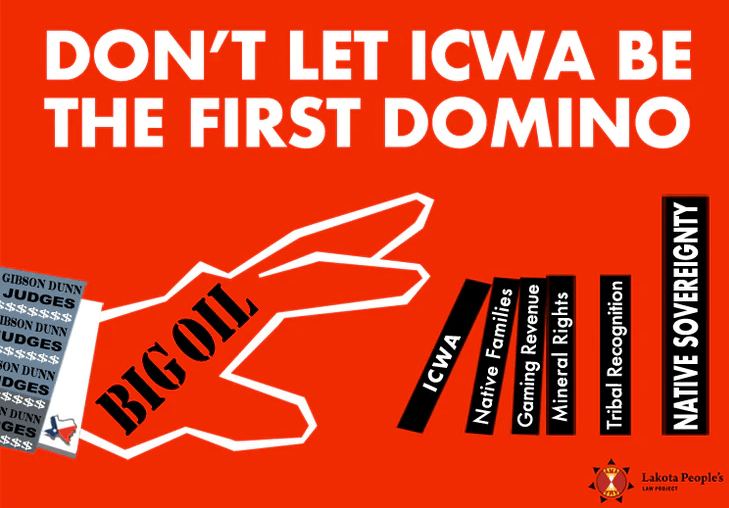
  • Overturning ICWA could be the first legal domino in a broader attack on tribal rights and sovereignty.

The Indian Child Welfare Act Protects Native Kids, Cultures, and Sovereignty

The Indian Child Welfare Act (ICWA) is the federal law that prioritizes Native care for Native children, which is critical to maintaining cultural connections, family ties, and kinship practices that have been intact for thousands of years. ICWA, signed into law in 1978, was conceived as a means of slowing the genocidal policies enacted by the United States and Canada, which included the forced placement of Indigenous children in Indian boarding schools for more than a century.

These schools were cruel institutions designed to enact genocide by separating the children from their cultural identities and severing ties with their families and communities. Thousands of Native and First Nations children died at these schools, where physical, mental, and sexual abuse were commonplace. After the era of boarding schools, during the Sixties Scoop, it became common practice for child welfare workers — hiding behind state law — to kidnap Native children and place them with white, Christian families as adoptees. This lasted well past the 1960s, and ICWA was ultimately passed to protect Native children and keep them with their kin.

Today, the State of Texas (among other plaintiffs) is suing the federal government in an attempt to overturn ICWA. If the plaintiffs are successful, this case will strike down the federal law that prioritizes Native care for Native children. But that’s not even the worst of it. The case would also open a door for the destruction of tribal sovereignty in the United States. The case — Brackeen v. Haaland — is slated to go before a conservative Supreme Court soon, should the justices accept it. It specifically names the defendant as U.S. Secretary of the Interior Deb Haaland — a Laguna Pueblo woman and the first Native person to hold a Cabinet secretary position in U.S. history.

The plaintiffs are essentially alleging racism against white people, arguing that ICWA violates the U.S. Constitution’s Equal Protection Clause. Tribal nations — backed by a prior Supreme Court decision — say that Native status is not a racial designation, but a political one.

This case poses an extreme and imminent danger to Native Peoples across the U.S. If the high court accepts the plaintiffs’ argument that tribal political designations should not count in custody cases, “Native” and “Indian” designations could then be dissolved entirely. That decision would position ICWA as the first domino to fall, potentially leading to the erosion — or total erasure — of Native rights in the only homelands Indigenous North Americans have ever known.

Lakota People’s Law Project
https://lakotalaw.org/news/2021-09-17/icwa-sovereignty


Petition to protect the Indian Child Welfare Act

Dear President Biden and attorneys for the Department of Justice,

As the Supreme Court decides on whether to render judgment in the case of Brackeen v. Haaland, I write today to ask you to do everything in your power to protect the Indian Child Welfare Act and defend Secretary Deb Haaland. We need strong federal protection of Native families and tribal sovereignty.

Please file every available motion, prepare every legal argument judiciously, and do everything else you can to stop this attack on tribal citizens. The plaintiffs will not be easily stopped. Should the Supreme Court accept this case and validate the plaintiffs’ argument that tribes do not have the power to place their own enrolled children in tribal kinship care, we will have crossed a rubicon into dangerous legal territory that could ultimately lead to the disbanding of tribal nations — and the loss of tribal lands, gaming revenues, and mineral rights.

It’s no coincidence that the same attorneys — Gibson Dunn — representing the plaintiffs in this case also have deep ties to fossil fuel interests such as Enbridge and TC Energy (the oil conglomerates responsible for attacking tribal interests through the Line 3 and Dakota Access pipelines, respectively).

The Indigenous peoples of this land have always deserved better. The few gains made over centuries littered with oppression, and in the face of overwhelming systemic racism, must not be lost now. Please fight hard to protect original Americans. Please do everything possible to stop this attack on children, families, and sovereignty.

You can sign this petition here:
https://action.lakotalaw.org/action/protect-icwa

Prophecy about black snake

When I first heard the Lakota prophecy about the black snake, I thought it was amazing that a sacred message from so long ago was coming true. What that said about Indigenous spirituality.

I thought the image of the black snake was so powerful. A symbol of the evils of the wanton disregard for Mother Earth and balance and what that means for future generations. I thought of one of the most powerful symbols in my life, the image of my beloved Rocky Mountains hidden in clouds of pollution.

There is an ancient Lakota prophecy about a black snake that would slither across the land, desecrating the sacred sites and poisoning the water before destroying the Earth. 

For many Indigenous people gathered near the Standing Rock Sioux reservation, that snake has a name — the Dakota Access pipeline.

‘We must kill the black snake’: Prophecy and prayer motivate Standing Rock movement. Indigenous leaders say effort to oppose Dakota Access pipeline rooted in power of prayer by Karen Pauls, CBC.CA, Dec 11, 2016

This reflection on the prophecy of the black snake was prompted by another story in today’s Des Moines Register about a proposed new carbon capture pipeline.

I should not have been surprised by the following story in the Des Moines Register, Company wants to build a carbon sequestration pipeline in 30 Iowa counties, but I was. It was predictable that unrealistic ideas would be put forth as the reality of deepening environmental chaos can no longer be ignored. As just today we are seeing the devastation of the aftermath of Hurricane Ida.

I hope the news about this pipeline might provide a teachable moment to illustrate why we need Indigenous leadership now. There are all kinds of reasons why a carbon capture pipeline should not be built. There is a matter of scale, ie what percentage of all the carbon emitted would be captured? How much energy is consumed by the capture process and to move the liquid through the pipeline? Can the liquid be safely stored for hundreds of years? How much more fertile farm ground will be destroyed by the pipeline construction? How much water is used? How many more relatives will be missing or murdered? How much profit will be generated, and for who?

I think this provides a clear example of why Indigenous liberation is the only hope for Mother Earth. Carbon capture pipelines are typical projects funded by banks, fossil fuel companies and white legislators and businessmen. Even though it is clear that continuing fossil fuel driven capitalism will only lead to increasingly dire environmental chaos. An existential threat. Our only hope is to stop spewing tons of fossil fuel emissions into the air.

Today’s Register story includes remarks made by my friends Lee Tesdell (my Scattergood School classmate) and Ed Fallon of Bold Iowa, about the company, Summit, who plans to build the carbon capture pipeline.

Summit hired Branstad, who was the U.S. ambassador to China under President Donald Trump, in March as a senior policy adviser to provide “oversight, leadership and guidance on public policy matters affecting stakeholders” in what the company says will be the world’s largest carbon capture and storage project.

At a Sept. 13 meeting in Ames, Lee Tesdell, a central Iowa farmland owner, asked whether any of the Iowa Utilities Board members were appointed by Branstad and whether they would recuse themselves from making a decision about whether Summit should receive a permit to build nearly 710 miles of pipeline across Iowa.

TesdelI, whose central Iowa farm is not in the pipeline’s pathway, said he believes board members Branstad appointed have a conflict of interest. “Either Branstad should resign from the Midwest Carbon Express team or they (board members) should recuse themselves,” he said.


In 2017, Lozier recused himself from the controversial Dakota Access oil pipeline case because he had represented a pro-pipeline lobby group in court as a private attorney before joining the utilities board.

Ed Fallon, a former state representative and vocal Dakota Access pipeline opponent, said he believes the Iowa Utilities Board members should recuse themselves. “Given their high-salary positions, they’re beholden to Branstad, and that gives the impression that they would be inclined to vote his way,” Fallon said.

Board members are required to spend their “whole time” on state utility issues. Huser earned a base salary of $128,890 last year, and Lozier, $122,428, according to the state employee salary book. No salary was recorded for Byrnes last year.

Critics of $4.5 billion carbon capture pipeline say Branstad appointees have conflict, should recuse themselves by Donnelle Eller, Des Moines Register, Sept 20, 2021

“I, Chief Arvol Looking Horse, of the Lakota, Dakota, and Nakota Nations, ask you to understand an Indigenous perspective on what has happened in America, what we call “Turtle Island.” My words seek to unite the global community through a message from our sacred ceremonies to unite spiritually, each in our own ways of beliefs in the Creator.”

“There needs to be a fast move toward other forms of energy that are safe for all nations upon Mother Earth. We need to understand the types of minds that are continuing to destroy the spirit of our whole global community. Unless we do this, the powers of destruction will overwhelm us.”

“To us, as caretakers of the heart of Mother Earth, falls the responsibility of turning back the powers of destruction. You yourself are the one who must decide.”

“You alone – and only you – can make this crucial choice, to walk in honor or to dishonor your relatives. On your decision depends the fate of the entire World.”

Important Message from Keeper of Sacred White Buffalo Calf Pipe. I, Chief Arvol Looking Horse ask you to understand an Indigenous perspective on what has happened in America, what we call “Turtle Island.” by CHIEF ARVOL LOOKING HORSE, Indian Country Today, Sept 7, 2017

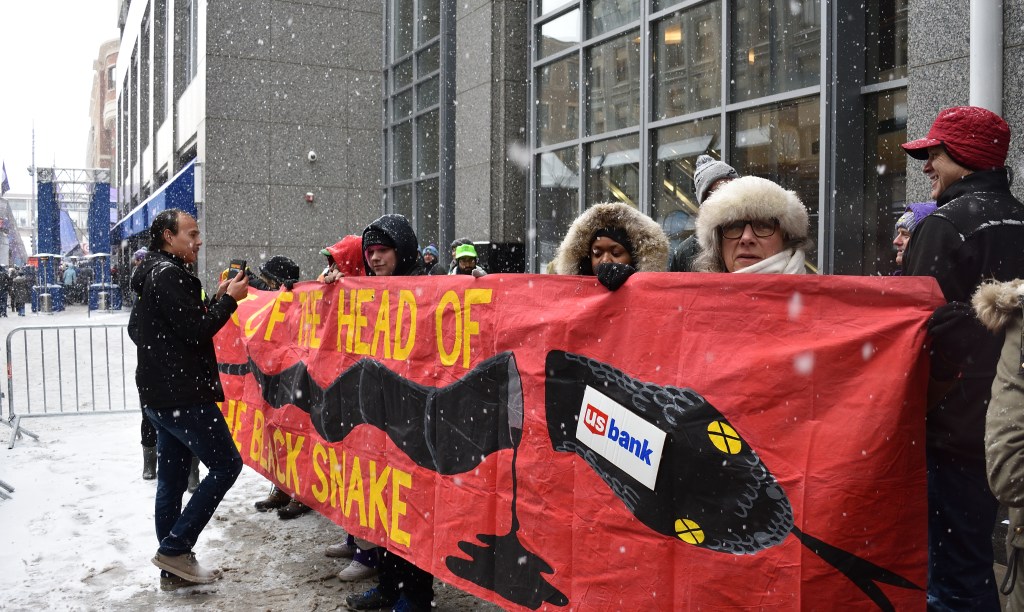
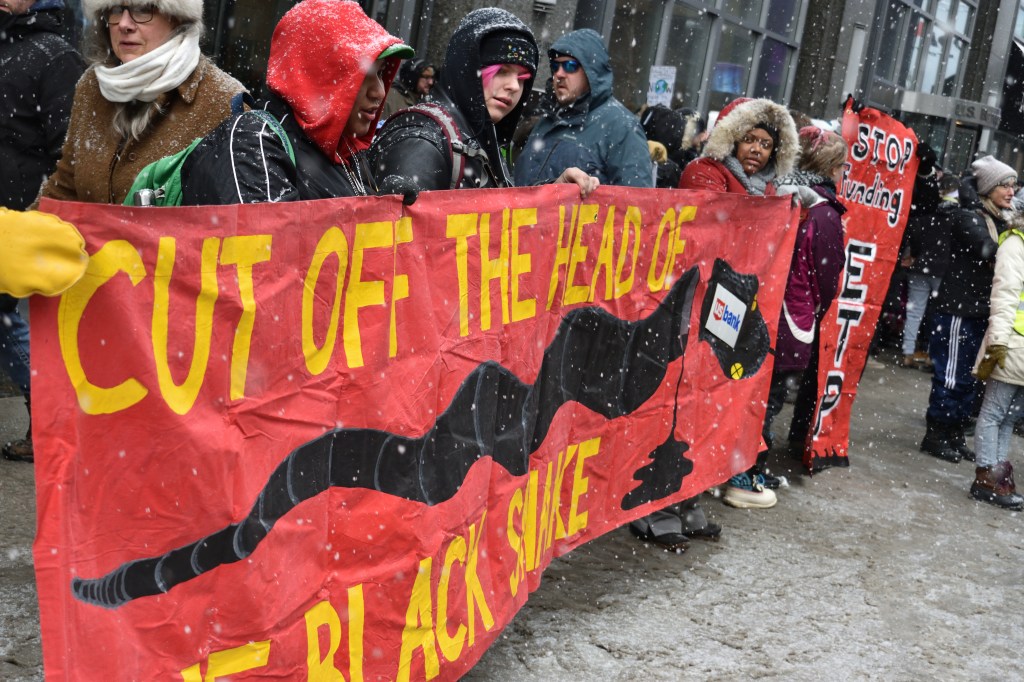
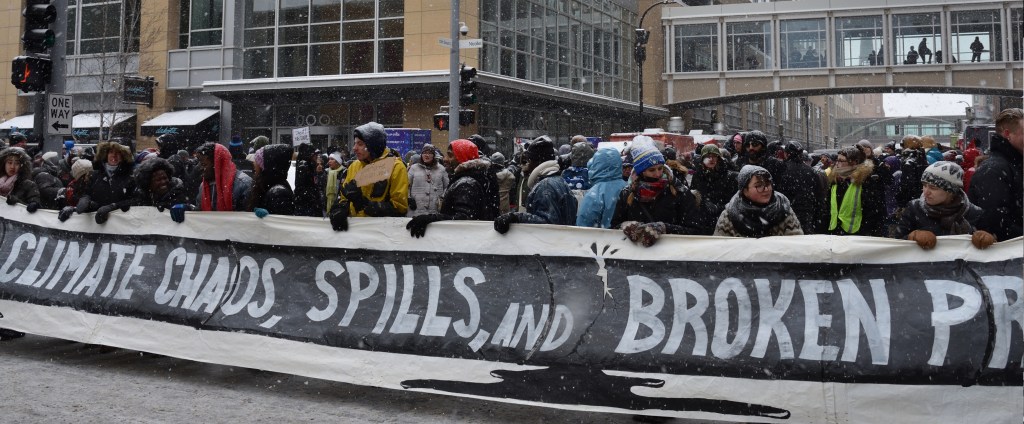
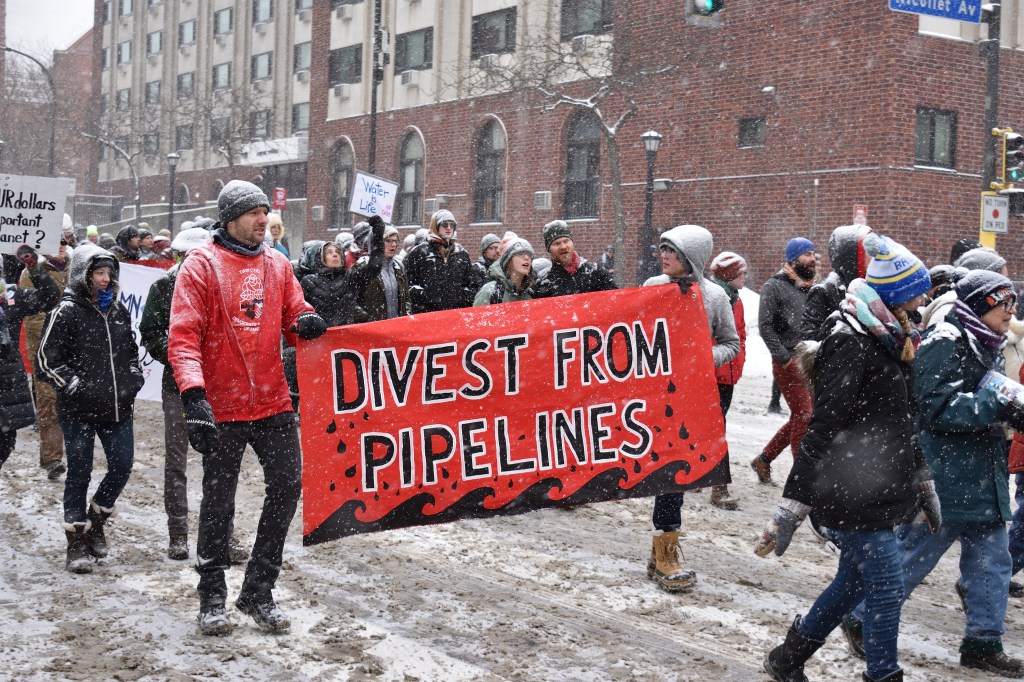
These are photos from the day a van full of us went to Minneapolis for a rally related to USBank’s funding of fossil fuel projects. Minneapolis is the headquarters of USBank.

Students teaching students

Yesterday I saw the great presentation, Online Pushback:UnBan Anti-Racism Education in Iowa, a forum by Indigenous youth of the Great Plains Action Society related to Iowa’s ban on teaching Critical Race Theory or Anti-Racism Education (video below).

Indigenous Youth Organizers, Alexandrea Walker and Keely Driscoll, have started a youth-led movement to demand that the current Iowa Administration unban Anti-Racism Education, aka, Critical Race Theory. For the sake of health and safety for all, it is imperative that Kim Reynolds reverse the overtly white supremacist decision to ban anti-racism education plus diversity, equity, and inclusion programming in the classroom and in all state-funded institutions

At the 12:15 mark in the video above, my friend Sikowis Nobiss introduces her son Alden who is in sixth grade. With the ban against teachers teaching about anti-racism, he spoke about his idea of students teaching each other as an alternative.

Sikowis: Hello everybody. I am here with my son today and his name is Alden and he’s in sixth grade. And he’s being affected by the ban on critical race theory or as we like to call it anti-racism education, decolonization work, diversity equity inclusion. Those are better terms for it because critical race theory is a term that they’re using to manipulate the situation, to make it sound like it’s critical, you know that it’s being like overtly hard on something when really it means how like you know analyzing something specifically or properly.
So, Alden is in grade six and you know he’s got some interesting thoughts about this, and I wanted to ask him like what does he think, what do you think about the ban on critical race theory?
Alden: It’s not that good.
Sikowis: How come?
Alden: I mean people should know that what happened in the past or else the history is just going to repeat itself. Just the same thing that happens over and over right? Seems like it isn’t going to stop if people don’t take action and more people like Reynolds is going to ban stuff.
Sikowis: And you had an interesting idea, you had said that teachers can’t teach critical race theory right? But students can. Can you tell us more about that?
Alden: The governor only said that teachers couldn’t say stuff like that and they couldn’t teach stuff like that, but that doesn’t mean schools can’t just be used to teach inside like only teachers.
Sikowis: So, who would teach like you want?
Alden: Kids to teach each other. Yeah the more educated kids that are like me I guess that know about what happened in the past.
Sikowis: Very good thank you so much Alden. We appreciate you making those remarks. That took a lot of bravery for him. I’m very proud of that.
I hope you guys could hear that. He basically thinks that if teachers can’t teach critical race theory then why can’t students do it? So that’s his idea. He thinks that students can teach each other in their spare time. During recess during, lunch time and that’s something that he’s going to try to do. So, we have a book that he’s going to share called 500 Years After Columbus, which is a curriculum guide for teaching better indigenous studies for k-12. So, he’s already taking a look at that.


Just as the final report from the National Inquiry into Missing and Murdered Indigenous Women and Girls triggered shock waves across the country, bringing conversations about violence against Indigenous people into the classroom, so did the discovery of 215 children’s remains at the Kamloops Indian Residential School earlier this year.

As the National Day for Truth and Reconciliation approaches, we can expect Canadian teachers are thinking about how they can better weave Indigenous perspectives into their lesson planning.

In the past, events like this rarely made it as national news, staying inside our Indigenous communities where the pain remained hidden from the rest of Canada. Now, teachers are talking about them with their students — how history and society influence individual situations of race-motivated violence and cultural genocide. It’s our responsibility to make sure they are equipped to teach the truth and acknowledge the important role schools play in reconciliation.

We owe it to all students to bring truth and drive reconciliation in classrooms by Linda Isaac & John Estabillo, National Observer, September 16th, 2021.

For specific teachings on Indian Boarding Schools and the United States assimilation policies—a history educators say is central in contextualizing present day culture for Native and non-Native youth alike— statistics are even bleeker.

“Over the course of the last couple of years, we’ve identified five states—only five states— that have even mentioned Indian boarding schools in their content in their state content standards, which is unimaginable,” said Sam Torres, director of research and programs at The Native American Boarding School Healing Coalition. Those states, surveyed by NABSHC in 2015, are: Arizona, Washington, Kansas, Oklahoma, and North Dakota. 

“It’s obviously a representation and reflection of what is being valued in educational and curricular context,” Torres said. 

For its part, NABSHC—an organization that has been at the helm of increasing public awareness on boarding schools since its founding nearly a decade ago—in 2020 released its first ever Truth and Healing Curriculum. The curriculum, available for free online, is made up of four lessons on Indian Boarding Schools focusing on history, impacts, stories, and healing.

The vast majority of Americans don’t learn about Indian boarding schools growing up. These Native leaders and educators want to change that by JENNA KUNZE, Native News Online, SEPTEMBER 13, 2021

We owe it to Indigenous educators who are triggered and challenged to deliver education around a topic like residential schools that have impacted them. Educators like me, who when viewing the images of children with their plain clothes, short hair, and empty eyes — identities stripped — still struggle to separate the pain we hold from lesson planning.

We also owe it to non-Indigenous educators who lack confidence in teaching because they weren’t taught the truth about the atrocities of the residential school system. This is a significant blocker to the successful integration of truth-telling in our classrooms, which can be solved by supporting educators in their journey of learning.

We must ensure the materials passed down to educators are written accurately by authentic voices. We need ongoing government funding and access to professional learning programs. Alberta is one province that does this well. Its Teacher Qualifications Standard requires educators to take courses in foundational knowledge of Indigenous history.

We owe it to all students to bring truth and drive reconciliation in classrooms by Linda Isaac & John Estabillo, National Observer, September 16th, 2021.

Unban Anti-racism Education in Iowa

The Great Plains Action Society youth organizers and experts across Iowa weigh in on white supremacy and the ban on Critical Race Theory. The bans on Critical Race Theory across the country are one of many examples of efforts to whitewash the truth.

Online Pushback: UnBan Anti-Racism Education in Iowa
May be an image of 2 people and text that says 'ONLINE PUSHBACK FORUM UNBAN ANTI-RACISM EDUCATION IN IOWA Hosted by Great Plains Action Society Youth Organizers Alexandrea Walker, Ho-Chunk Keely Driscoll, Meskwaki Youth and experts across lowa weigh in on white supremacy and the ban on Critical Race Theory September 15, 2021 @ 6:30 PM CST @ bit.ly/teachtruthforum'

YouTube Link youtube.com/watch?v=tIlz26X7T-U

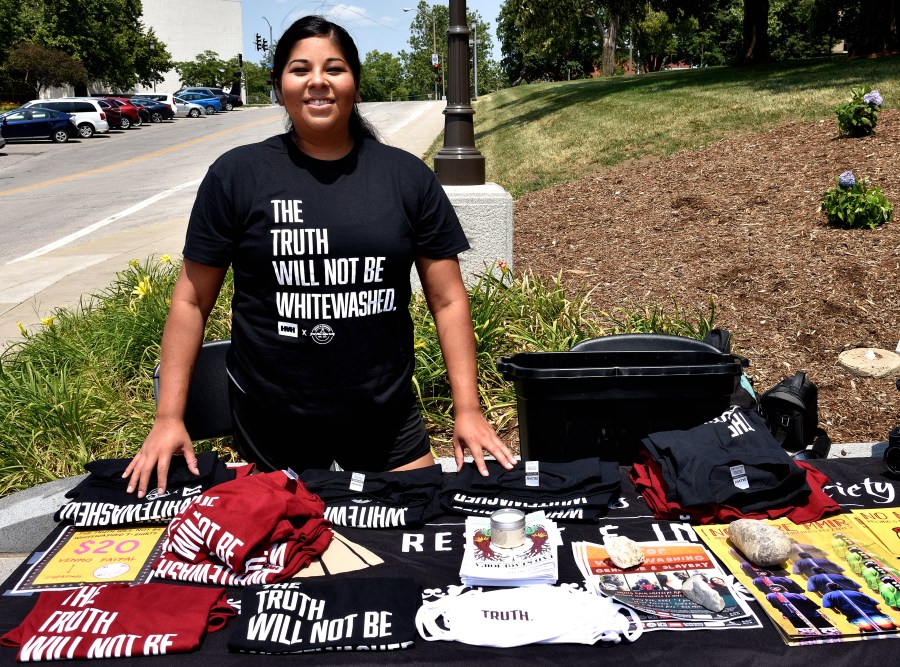
The Truth Will Not Be Whitewashed!

Indigenous Youth Organizers, Alexandrea Walker and Keely Driscoll, have started a youth-led movement to demand that the current Iowa Administration unban Anti-Racism Education, aka, Critical Race Theory. For the sake of health and safety for all, it is imperative that Kim Reynolds reverse the overtly white supremacist decision to ban anti-racism education plus diversity, equity, and inclusion programming in the classroom and in all state-funded institutions. Join Alex and Keely as they host a forum for youth and experts throughout Iowa to weigh in on this pressing issue. Guests TBA.

The Truth Will Not Be Whitewashed is a campaign founded by Great Plains Action Society and Humanize My Hoodie. We encourage others to join this effort. Please contact us if you are interested in joining our growing coalition.

Great Plains Action Society (You can send a message from this link)


This reminds me of the work of Lynne Howard and Des Moines Valley Friends’ (Quakers) to get draft counseling into the Des Moines public schools in 1970. They were successful! Resisting draft counseling was an effort to whitewash the truth about participating in the military.


PROPOSAL FOR DRAFT COUNSELING IN THE DES MOINES PUBLIC HIGH SCHOOLS

STATEMENT OF BELIEF:

We believe that all young men in the Des Moines Public High Schools should have access to adequate counseling by qualified counselors in regard to the Selective Service and its alternatives.  Qualified counselors are those persons who:

  1. Have received special draft counseling training
  2. Have a detailed knowledge and experience of the Selective Service Law and the administration thereof
  3. Are sensitive to the moral and spiritual implication of war and peace and individual conscience
  4. Have knowledge of where to refer students if they want counseling on a specific aspect of the Selective Service alternatives and options

We further believe that such counseling should be made available during school hours, similar to other available guidance counseling.

IMPLEMENTATION:

There in light of the above purpose we recommend that one of the following plans be used to implement this counseling program:

  1. That each high school in Des Moines provide adequate training of all guidance counselors in order that they be familiar with the Selective Service Law and its alternatives
  2. That each high school select one guidance counselor who would be specially trained (see above) to counsel and answer questions concerning the draft and its alternatives.  Other guidance counselors in the school could refer their students to this specially trained counselor, if this type of counseling is needed
  3. That each trained counselor would refer persons who need more intensive and specific counseling to appropriate groups.  (Particular religious groups, various branches of the Service, etc.)

The Peace Testimony Remains by Lynne Howard. September 15, 1970

What You Get into Will Change You

Recently a series of things happened that provoked some reflection. I saw the quote, “what you get into will change you. Sometimes in life you just don’t know what you’re getting into”, which prompted me to write the following.

A lot happened to me since retiring and returning to Iowa four years ago. I hadn’t given a lot of thought to what would happen when I returned to Iowa. I had stayed connected with Iowa Quakers and involved with them as much as I could from a distance. So, there were already some relationships to build on.

In Indianapolis I was blessed to have made many friends as we worked to protect water and oppose the Keystone XL and Dakota Access pipelines. I was also most fortunate to become involved with the Kheprw Institute (KI), a youth mentoring and empowerment community. And North Meadow Circle of Friends Quaker meeting. It was hard to leave but I stay in touch.

What follows are stories of my justice experiences since returning to Iowa. They are offered in case they might be helpful for you and your own work.

I’m frustrated more people don’t engage in justice work. Why are we here if not to grow and engage with family and our communities? Most people either don’t know how to engage or don’t want to. I’m frustrated because there is so much work to be done. We are experiencing environmental catastrophes that will only worsen and occur more frequently. We need masses of people to prepare now for the evolving chaos.

Also, these experiences will be good for you. I know from experience “what you get into will change you”. https://www.dailygood.org/story/2795/what-you-get-into-will-change-you-phyllis-cole-dai/

It is important to recognize “sometimes in life you just don’t know what you’re getting into.” Those can be times of great opportunity. I encourage you to get involved in opportunities like this, as long as doing so is relevant to what you are called to do.

What you get into will change you. Sometimes in life you just don’t know what you’re getting into.

Phyllis Cole-Dai

The most important step is to figure out what you should do. There are so many problems. Many people get burned out by trying to do too many things. People of faith rely on faith to help us figure this out. Keep what you are led to do in mind. You must be vigilant as you look for opportunities to get involved with justice work. And just as vigilant to decline to get involved in things not related to what you are called to do. Maintaining this focus is crucial for success.

First Nation-Farmer Climate Unity

I had long wanted to get to know some Indigenous people for numerous reasons, such as spirituality and sustainable living. Fortunately, an ideal opportunity to do so was to walk and camp along the path of the Dakota Access pipeline with a small group of native and nonnative people. The intention was for those in the group to get to know each other as we walked 10-15 miles/day, put up our tents, and have meals together.

During the First Nation-Farmer Climate Unity March (Sept. 1 – 8, 2018) Manape said we were on a sacred journey. During the March, Donnielle said we are a tribe. This morning I’m realizing the following stories about the past are part of my sacred journey. Also thinking of the many new friends found as part of this journey. I’m thinking how much I would have missed if I didn’t recognize and take advantage of this amazing opportunity.

Wet’suwet’en

Last Saturday morning began by watching a new video (see below) from the Wet’suwet’en people in British Columbia. Gidimt’en Checkpoint spokesperson Sleydo’ (Molly Wickham) and Elder Janet Williams found a film crew trespassing on Gidimt’en territory, making a commercial to promote Coastal Gaslink’s plans to tunnel beneath the sacred headwaters.

I first learned about the Wet’suwet’en’s struggles in January, 2020, when I saw a remarkable video of Sleydo’ evicting the Coastal GasLink workers from Wet’suwet’en territory. “All CGL workers have now been peacefully evicted from Unist’ot’en and Gidimt’en territories. Under the authority of Anuk nu’at’en (Wet’suwet’en law), and with support of the Wet’suwet’en hereditary chiefs of all five clans, the Wet’suwet’en are standing up for the last of our lands and we need you to stand with us. We will honour the instructions of our ancestors, and continue to protect our lands from trespassers.”

I began to follow what was happening with the Wet’suwet’en, especially when they started asking people to write about what was happening, since the mainstream media was not. A few of us, who had worked together on some Indigenous related events, organized a vigil in support of the Wet’suwet’en:

We didn’t expect anyone to join us. Fortunately, Ronnie James did. In the photo are Peter Clay, Linda Lemons and Ronnie James. Ronnie is an Indigenous organizer with many years of experience and interested to see who organized and attended our vigil. After he left, I realized I didn’t have a way to contact him. Fortunately, he accepted my Facebook Friend request. We began to have numerous conversations (via social media), where he patiently taught me a great deal about organizing, Indigenous thought, and Mutual Aid. (See: https://landbackfriends.com/mutual-aid/)


Peter Clay, Linda Lemons and Ronnie James
Mutual Aid

Meeting and becoming great fiends with Ronnie changed the course of my life. I eventually joined the work of Des Moines Mutual Aid (DMMA). Every Saturday morning, I participate in the free food distribution program. About a dozen of us put together sixty boxes of food, that we then put in the cars of those who need it. It is amazing this food distribution has been in existence in Des Moines since the Black Panthers organized the free breakfast program for school kids in the 1970’s.

Putting together the boxes of food, we move as a well-oiled machine. There is a little visiting as we pass each other when putting the food into boxes. I learn a lot about the justice work people are doing in central Iowa, since my Mutual Aid friends are also involved in many such projects.

Saturday there was a lull while waiting for another food delivery that provided a chance to talk with Ronnie. I mentioned the story below about the continued oppression of the Wet’suwet’en peoples and reminded him that we had met at the vigil for the Wet’suwet’en mentioned above. I told him that was something he taught me about organizing. Going to justice events to meet people. I said I wouldn’t have known about Mutual Aid if not for him attending that Wet’suwet’en vigil. He replied I probably would have learned about Mutual Aid because it had been in the news a lot recently.

Ronnie mentioned that was the first time he had been at Friends House, where the Wet’suwet’en vigil was held. Des Moines Mutual Aid has its offices in Friends House now. I had just spoken with Jon Krieg who works with the American Friends Service Committee (AFSC), whose offices had been in Friends House. Recently AFSC had moved out and Jon mentioned he missed visiting with Ronnie.

Des Moines Valley Friends meeting, which meets in a meetinghouse attached to Friends House, has been allowing another Mutual Aid group to use their kitchen to cook meals that are taken to the houseless camps.

Another set of connections relates to the Great Plains Action Society (GPAS), founded by my friend Christine Nobiss, who was also on the First Nation-Farmer Climate Unity March. Ronnie’s Mutual Aid work is supported by GPAS.

Prairie Awakening/Prairie Awoke

Saturday was also the day of the annual Prairie Awakening/Prairie Awoke ceremony, an annual event sponsored by the Dallas County Conservation Board. The ceremony is held in the Kuehn Conservation Area. My Quaker meeting, Bear Creek, has been involved with the ceremony for over ten years. A number of Friends attended.

While there, I was able to talk with my friend Rodger Routh, who grew up in the Earlham, Iowa (where Bear Creek meeting is) community. Rodger is a photographer/videographer and justice advocate, who is often at the same events I attend. Jon Krieg (AFSC, mentioned above) is also a photographer. It is common for the three of us to be at the justice related events.

LANDBACK

One of the principles of justice work is to follow the leadership of the communities affected by injustice. In Indianapolis, the Kheprw Institute would let us (Quakers in this case) know what we could do for them.

Recently I had a chance to ask Christine how nonnative people could best support her and her work now. She told me to learn and teach others about the concepts of LANDBACK. So, I created a website named LANDBACK Friends, where I’ve been sharing what I am learning about LANDBACK. https://landbackfriends.com/

Maintaining connections

As the completion of a circle, I was so glad to be contacted by my friends at the Kheprw Institute (KI) in Indianapolis. Aghilah contacted me because KI is interested to learn more about LANDBACK. Evidently, they have been following my blog since I left Indianapolis and reading what I’ve been writing about LANDBACK.

Quakers for Abolition Network

My blog also made it possible for one of my new friends, Jed Walsh, to contact me about the work he and Mackenzie Barton-Rowledge are doing related to abolition of police and prisons. I wrote a little in their article that was just published by the Western Friend, https://westernfriend.org/article/quakers-abolition-network.

Conclusion

We are moving more deeply into collapse. Fueled by the consequences of environmental chaos, our economic and political systems are failing. We must work now to build ways to deal with this collapse. I’ve been working on this diagram to illustrate how people are building such systems. It is important to build Mutual Aid communities. And embrace the principles of LANDBACK. “What you get into will change you”.


This document has a lot more information about Quakers, the Wet’suwet’en peoples, and LANDBACK. Scroll down to move through the document.


#LANDBACK