Lakota Nation vs. the United States

Art can be a powerful tool for justice and activism. Can reach the heart when the mind is closed.

Following is an announcement about a documentary film that is being produced, Lakota Nation vs. the United States. The announcement helps explain why the Black Hills are a focus of #LANDBACK.

LOS ANGELES — Documentary film studio XTR announced on Tuesday it is making Lakota Nation vs. the United States, a feature-length documentary chronicling the Lakota Indians’ present-day quest to reclaim the Black Hills.

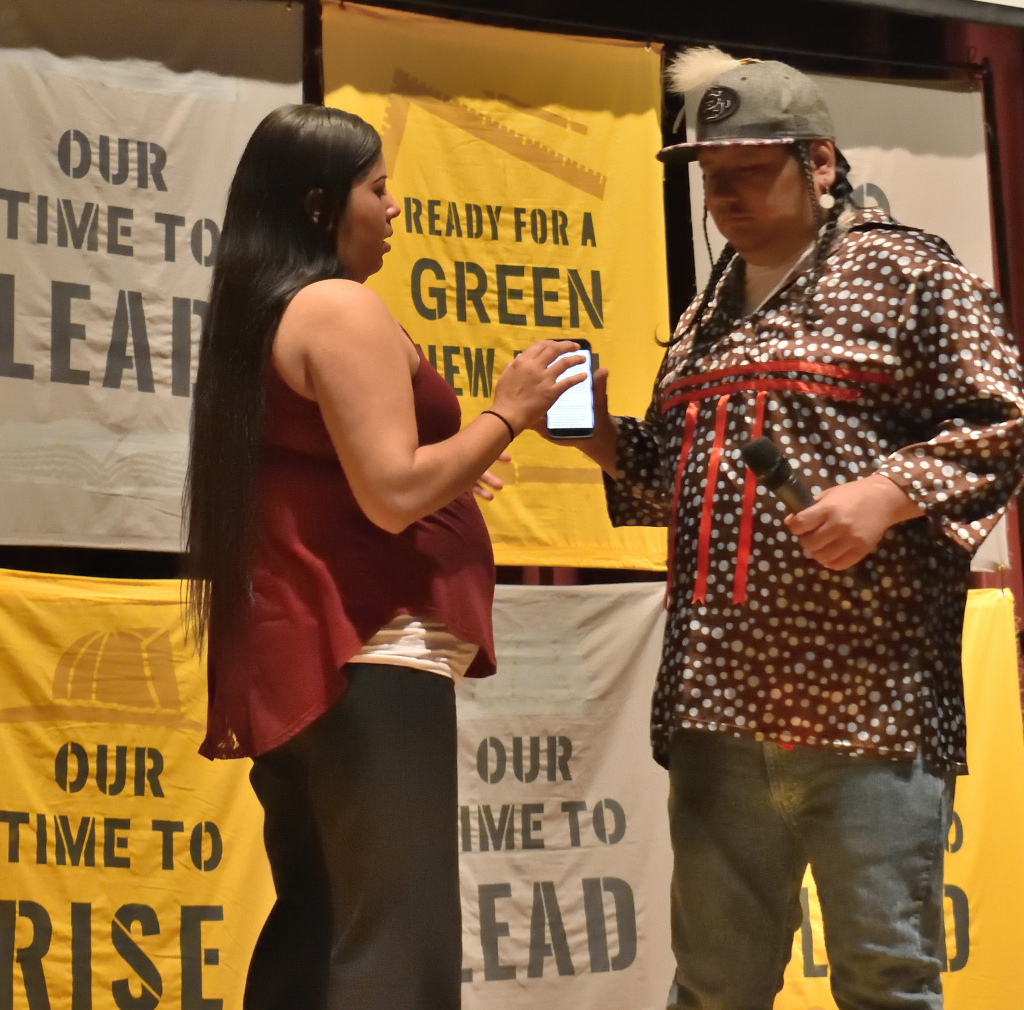
XTR is partnering with actor Mark Ruffalo and actress/author/activist and Emmy Award-winner Sarah Eagle Heart (Oglala Sioux) as executive producers on the documentary. Oglala Sioux Jesse Short Bull is directing the documentary alongside Laura Tomaselli. Benjamin Hedin is producing.

The Black Hills are considered sacred to the Lakota people, who say the land was stolen in violation of treaty agreements.

The film, which is currently in production, is the first documentary to amplify the tragic history of the land claim. Lakota Nation vs. the United States features interviews with a number of Indigenous citizens who are central to the effort to regain control of the Black Hills land that stretches across South Dakota, Wyoming and Montana. Adding to the team’s formidable strength are co-director Tomaselli and producer Hedin, the duo behind Sam Pollard’s critically acclaimed 2020 documentary, MLK/FBI.

“This is a timely story with powerful voices on screen and behind the scenes, driving essential change,” Ruffalo said. “The fight for Black Hills is far from over, and our intention is to support the Lakota people by raising awareness for the injustices they face in present-day America. The perception in many Americans’ minds is this is only historical, this ‘happened.’ What they don’t understand is that it is happening now. It is today, it is immediate and mostly hidden from your eye. This is a current issue.”

The testimony of the interviewees is complemented by a vibrant photographic aesthetic that depicts the sweeping immensity of the land as well as the reverence it inspires. The film also applies the subject of reparations within the context of the history of land theft and genocide, the U.S. government’s brutalist policy of extermination, for which no redress has been made to Indigenous nations.

“It is my life’s work to use powerful storytelling to share deep perspectives to implore social, environmental and Indigenous justice,” said Eagle Heart. “Knowledge and understanding are essential elements needed for advocacy and impactful change. The multilayered approach of this project helps accurately represent the Lakota people as we are now to allow healing and redressing.”

Highlighted in the film are Nick Tilsen, who was arrested protesting President Trump’s visit to Mount Rushmore in July 2020, and activist Krystal Two Bulls.

This story is placed in the present movement to return the Black Hills to its rightful caretakers and spiritual ancestors is as meaningful as any conversation we are having about race and justice in America today. 

Mark Ruffalo, Sarah Eagle Heart Co-producing Film on Present-Day Fight for Black Hills by Native News Online staff, Sept 21, 2021

This story is placed in the present movement to return the Black Hills to its rightful caretakers and spiritual ancestors is as meaningful as any conversation we are having about race and justice in America today.

But (Nick) Tilsen said he wants to use the monument as a way to teach truth — in a way that uncovers the country’s flawed history. He wants Mount Rushmore closed, then reopened under tribal control and with a new name — the Six Grandfathers Tribal Park, for the Lakota name of the rock formation where the monument is carved.

“What ends up happening at Mount Rushmore, we actually tell the true history of this land,” he said. “We tell the history of the treaties, we tell the history of these men that are on the mountain and what their policies were like,” adding that could spark conversations about how the history is connected to current issues among Native American communities, including high rates of poverty and incarceration.

Lakota activist: Mount Rushmore key in move to regain land. When then-President Donald Trump visited Mount Rushmore last year for a fireworks display, Lakota activist Nick Tilsen saw an opportunity to advance the Land Back Movement by STEPHEN GROVES Associated Press, March 24, 2021

Here are links to what I wrote about last year’s protests at Mount Rushmore, which two of my friends attended.
https://jeffkisling.com/2020/07/02/mount-rushmore-anti-trump-rally/
https://jeffkisling.com/2020/07/03/the-declaration-of-independence-for-white-males/
https://jeffkisling.com/2020/07/03/actions-at-mount-rushmore-7-3-2020/

LANDBACK is a movement that has existed for generations with a long legacy of organizing and sacrifice to get Indigenous Lands back into Indigenous hands. Currently, there are LANDBACK battles being fought all across Turtle Island, to the north and the South. 

As NDN Collective, we are stepping into this legacy with the launch of the LANDBACK Campaign as a mechanism to connect, coordinate, resource and amplify this movement and the communities that are fighting for LANDBACK. The closure of Mount Rushmore, return of that land and all public lands in the Black Hills, South Dakota is our cornerstone battle, from which we will build out this campaign. Not only does Mount Rushmore sit in the heart of the sacred Black Hills, but it is an international symbol of white supremacy and colonization. To truly dismantle white supremacy and systems of oppression, we have to go back to the roots. Which, for us, is putting Indigneous Lands back in Indigenous hands. 

LANDBACK Manifesto

Defend ICWA

It is difficult enough to learn about the removal, often by force, of native children from their families. And about the terrible things done to the children at the institutions of forced assimilation. The remains of thousands of children are being found on the grounds of many of those institutions. The numbers found are rapidly increasing with the use of ground penetrating radar. Indigenous peoples say these findings confirm what they already know. Thousands of children never returned to their families.

The explanation given was the children were being taught how to fit into white culture. It wasn’t until recently that I realized the intentional cruelty was the point. To break the resistance of tribes to removal from their lands. The cruelty worked.

As those institutions were eventually closed, children continued to be removed by state welfare systems. Often to be placed with non-native families.

The era of assimilative U.S. Indian boarding schools started to wane and eventually came to a close after government reports like the Meriam Report (1928) and the Kennedy Report (1969) found mistreatment and abuse to be rampant at the costly institutions. During this time, the federal government shifted its assimilative methods, using the Indian Adoption Project to transfer Native children from their homes and place them directly with white adoptive and foster families.

In full swing in the 1960s and 1970s, the adoption era saw (usually white) social workers deem huge proportions of Native families unfit for children. In fact, by 1978, as many as one-quarter to one-third of children were taken by social workers or other coercive means and either adopted out of the tribe or placed in the non-tribal foster care system. Although the Indian Child Welfare Act of 1978 (ICWA) was designed to address this form of cultural genocide, Native families continue to face very high levels of child removal. For example, in Alaska, where Native children make up 20% of the general child population, they represent 50.9% of children in Foster Care. In Nebraska, Native children make up just 1% of the general child population, but 9% of the children in foster care. (National Indian Child Welfare Association and The Pew Charitable Trusts, 2007).

 In 1978, the Indian Child Welfare Act (ICWA) was passed to re-establish tribal authority over Native children, due to high rates of state removal of children. In spite of ICWA’s passing, Native children were placed into foster care at high rates in Maine. Concerns about the contemporary relationship between the state welfare system and the tribes, as well as the lasting effects of foster care trauma on tribal communities, brought about the Maine Wabanaki-State Child Welfare Truth and Reconciliation Commission, the first Truth and Reconciliation Commission between Native peoples and child welfare.

The Maine Wabanaki-State TRC: Healing from historic trauma to create a better future By Genevieve Beck-Roe, American Friends Service Committee, Jan 27, 2016

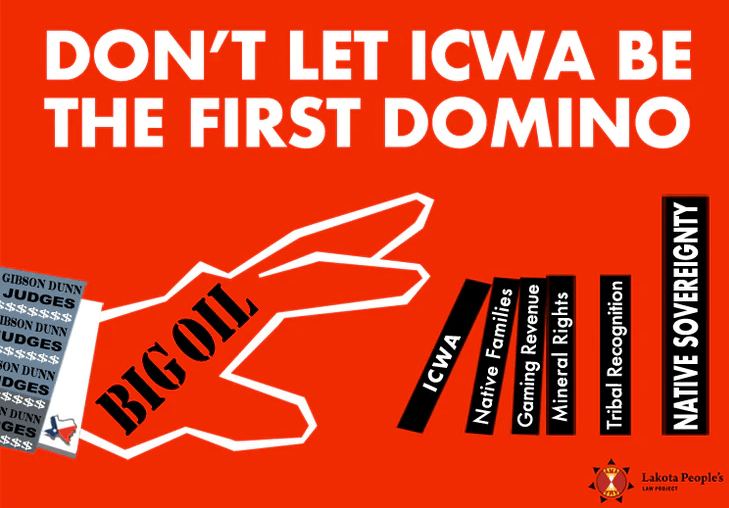
Native children and U.S. Secretary of the Interior Deb Haaland are under legal attack in Brackeen v. Haaland. The powerful people behind the lawsuit include both Big Oil and the State of Texas. If their attempt to have a conservative-majority Supreme Court overturn the Indian Child Welfare Act is successful, the door will be open to the total elimination of tribal sovereignty. Take action now to stop this horrific attack on Native rights! (see petition below).
Lakota People’s Law Project

Texas, Big Oil Lawyers Target Native Children in a Bid to End Tribal Sovereignty

The Threat Summarized

If the Supreme Court overturns the Indian Child Welfare Act (ICWA) — a federal law that keeps Native children with Native families — tribal sovereignty could soon be a thing of the past in the U.S. Should the justices rule in the plaintiffs’ favor in the case of Brackeen v. Haaland, we could quickly see a return to blatant, pre-1978 genocidal practices — when Native babies were legally stripped of their families, culture, and identities.

It’s critical that every one of us take immediate action. Before you do anything else today, sign our petition telling President Biden and the Department of Justice to defend ICWA, Secretary Haaland, and tribal sovereignty with every available means.

In this landmark case, the Brackeens — the white, adoptive parents of a Diné child in Texas — seek to overturn ICWA by claiming reverse racism. Joined by co-defendants including the states of Texas, Ohio, Louisiana, and Indiana, they’re being represented pro bono by Gibson Dunn, a high-powered law firm which also counts oil companies Energy Transfer and Enbridge, responsible for the Dakota Access and Line 3 pipelines, among its clients. This lawsuit is the latest attempt by pro-fossil fuel forces to eliminate federal oversight of racist state policies, continue the centuries-long genocide of America’s Native populations, and make outrageous sums of money for energy magnates, gaming speculators, and fossil fuel lawyers. The story below may seem unbelievable, but it is 100 percent true.

Key Points to Take Away

  • Big Oil’s lawyers, Texas, and three other states with very few Native inhabitants are attacking the Indian Child Welfare Act (ICWA).
  • The Texas Attorney General is asking the Supreme Court to declare ICWA unconstitutional.
  • The Plaintiffs argue that tribal affiliations should be considered racial, rather than political, designations.
  • Overturning ICWA could be the first legal domino in a broader attack on tribal rights and sovereignty.

The Indian Child Welfare Act Protects Native Kids, Cultures, and Sovereignty

The Indian Child Welfare Act (ICWA) is the federal law that prioritizes Native care for Native children, which is critical to maintaining cultural connections, family ties, and kinship practices that have been intact for thousands of years. ICWA, signed into law in 1978, was conceived as a means of slowing the genocidal policies enacted by the United States and Canada, which included the forced placement of Indigenous children in Indian boarding schools for more than a century.

These schools were cruel institutions designed to enact genocide by separating the children from their cultural identities and severing ties with their families and communities. Thousands of Native and First Nations children died at these schools, where physical, mental, and sexual abuse were commonplace. After the era of boarding schools, during the Sixties Scoop, it became common practice for child welfare workers — hiding behind state law — to kidnap Native children and place them with white, Christian families as adoptees. This lasted well past the 1960s, and ICWA was ultimately passed to protect Native children and keep them with their kin.

Today, the State of Texas (among other plaintiffs) is suing the federal government in an attempt to overturn ICWA. If the plaintiffs are successful, this case will strike down the federal law that prioritizes Native care for Native children. But that’s not even the worst of it. The case would also open a door for the destruction of tribal sovereignty in the United States. The case — Brackeen v. Haaland — is slated to go before a conservative Supreme Court soon, should the justices accept it. It specifically names the defendant as U.S. Secretary of the Interior Deb Haaland — a Laguna Pueblo woman and the first Native person to hold a Cabinet secretary position in U.S. history.

The plaintiffs are essentially alleging racism against white people, arguing that ICWA violates the U.S. Constitution’s Equal Protection Clause. Tribal nations — backed by a prior Supreme Court decision — say that Native status is not a racial designation, but a political one.

This case poses an extreme and imminent danger to Native Peoples across the U.S. If the high court accepts the plaintiffs’ argument that tribal political designations should not count in custody cases, “Native” and “Indian” designations could then be dissolved entirely. That decision would position ICWA as the first domino to fall, potentially leading to the erosion — or total erasure — of Native rights in the only homelands Indigenous North Americans have ever known.

Lakota People’s Law Project
https://lakotalaw.org/news/2021-09-17/icwa-sovereignty


Petition to protect the Indian Child Welfare Act

Dear President Biden and attorneys for the Department of Justice,

As the Supreme Court decides on whether to render judgment in the case of Brackeen v. Haaland, I write today to ask you to do everything in your power to protect the Indian Child Welfare Act and defend Secretary Deb Haaland. We need strong federal protection of Native families and tribal sovereignty.

Please file every available motion, prepare every legal argument judiciously, and do everything else you can to stop this attack on tribal citizens. The plaintiffs will not be easily stopped. Should the Supreme Court accept this case and validate the plaintiffs’ argument that tribes do not have the power to place their own enrolled children in tribal kinship care, we will have crossed a rubicon into dangerous legal territory that could ultimately lead to the disbanding of tribal nations — and the loss of tribal lands, gaming revenues, and mineral rights.

It’s no coincidence that the same attorneys — Gibson Dunn — representing the plaintiffs in this case also have deep ties to fossil fuel interests such as Enbridge and TC Energy (the oil conglomerates responsible for attacking tribal interests through the Line 3 and Dakota Access pipelines, respectively).

The Indigenous peoples of this land have always deserved better. The few gains made over centuries littered with oppression, and in the face of overwhelming systemic racism, must not be lost now. Please fight hard to protect original Americans. Please do everything possible to stop this attack on children, families, and sovereignty.

You can sign this petition here:
https://action.lakotalaw.org/action/protect-icwa

Prophecy about black snake

When I first heard the Lakota prophecy about the black snake, I thought it was amazing that a sacred message from so long ago was coming true. What that said about Indigenous spirituality.

I thought the image of the black snake was so powerful. A symbol of the evils of the wanton disregard for Mother Earth and balance and what that means for future generations. I thought of one of the most powerful symbols in my life, the image of my beloved Rocky Mountains hidden in clouds of pollution.

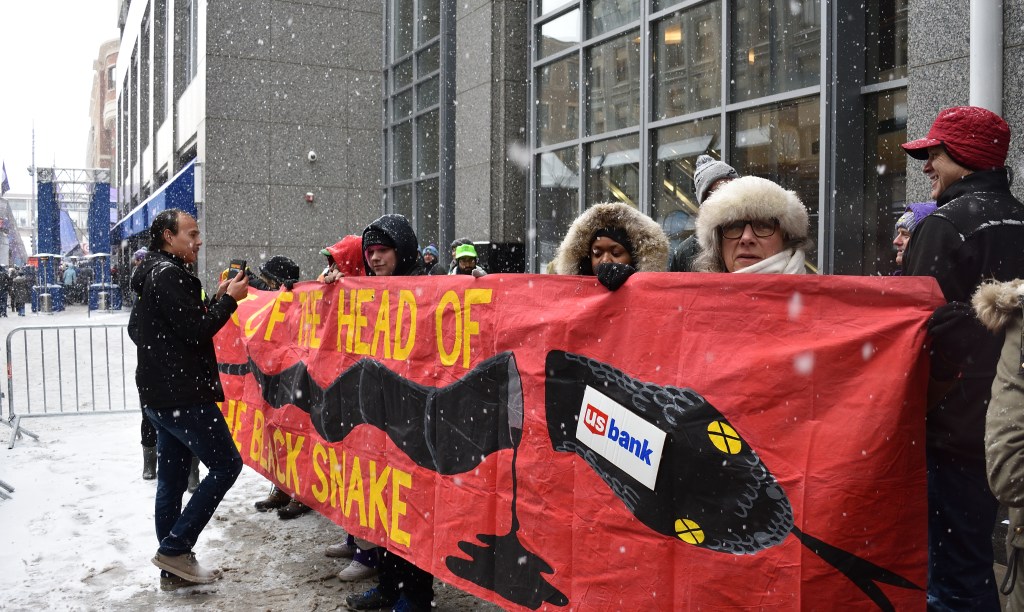
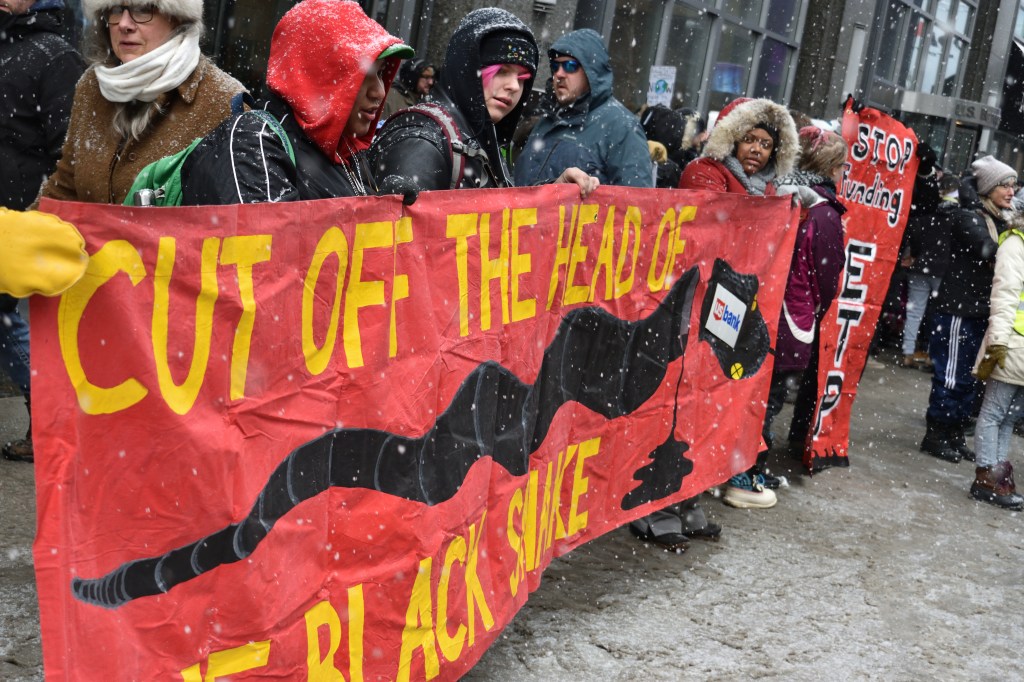
There is an ancient Lakota prophecy about a black snake that would slither across the land, desecrating the sacred sites and poisoning the water before destroying the Earth. 

For many Indigenous people gathered near the Standing Rock Sioux reservation, that snake has a name — the Dakota Access pipeline.

‘We must kill the black snake’: Prophecy and prayer motivate Standing Rock movement. Indigenous leaders say effort to oppose Dakota Access pipeline rooted in power of prayer by Karen Pauls, CBC.CA, Dec 11, 2016

This reflection on the prophecy of the black snake was prompted by another story in today’s Des Moines Register about a proposed new carbon capture pipeline.

I should not have been surprised by the following story in the Des Moines Register, Company wants to build a carbon sequestration pipeline in 30 Iowa counties, but I was. It was predictable that unrealistic ideas would be put forth as the reality of deepening environmental chaos can no longer be ignored. As just today we are seeing the devastation of the aftermath of Hurricane Ida.

I hope the news about this pipeline might provide a teachable moment to illustrate why we need Indigenous leadership now. There are all kinds of reasons why a carbon capture pipeline should not be built. There is a matter of scale, ie what percentage of all the carbon emitted would be captured? How much energy is consumed by the capture process and to move the liquid through the pipeline? Can the liquid be safely stored for hundreds of years? How much more fertile farm ground will be destroyed by the pipeline construction? How much water is used? How many more relatives will be missing or murdered? How much profit will be generated, and for who?

I think this provides a clear example of why Indigenous liberation is the only hope for Mother Earth. Carbon capture pipelines are typical projects funded by banks, fossil fuel companies and white legislators and businessmen. Even though it is clear that continuing fossil fuel driven capitalism will only lead to increasingly dire environmental chaos. An existential threat. Our only hope is to stop spewing tons of fossil fuel emissions into the air.

Today’s Register story includes remarks made by my friends Lee Tesdell (my Scattergood School classmate) and Ed Fallon of Bold Iowa, about the company, Summit, who plans to build the carbon capture pipeline.

Summit hired Branstad, who was the U.S. ambassador to China under President Donald Trump, in March as a senior policy adviser to provide “oversight, leadership and guidance on public policy matters affecting stakeholders” in what the company says will be the world’s largest carbon capture and storage project.

At a Sept. 13 meeting in Ames, Lee Tesdell, a central Iowa farmland owner, asked whether any of the Iowa Utilities Board members were appointed by Branstad and whether they would recuse themselves from making a decision about whether Summit should receive a permit to build nearly 710 miles of pipeline across Iowa.

TesdelI, whose central Iowa farm is not in the pipeline’s pathway, said he believes board members Branstad appointed have a conflict of interest. “Either Branstad should resign from the Midwest Carbon Express team or they (board members) should recuse themselves,” he said.


In 2017, Lozier recused himself from the controversial Dakota Access oil pipeline case because he had represented a pro-pipeline lobby group in court as a private attorney before joining the utilities board.

Ed Fallon, a former state representative and vocal Dakota Access pipeline opponent, said he believes the Iowa Utilities Board members should recuse themselves. “Given their high-salary positions, they’re beholden to Branstad, and that gives the impression that they would be inclined to vote his way,” Fallon said.

Board members are required to spend their “whole time” on state utility issues. Huser earned a base salary of $128,890 last year, and Lozier, $122,428, according to the state employee salary book. No salary was recorded for Byrnes last year.

Critics of $4.5 billion carbon capture pipeline say Branstad appointees have conflict, should recuse themselves by Donnelle Eller, Des Moines Register, Sept 20, 2021

“I, Chief Arvol Looking Horse, of the Lakota, Dakota, and Nakota Nations, ask you to understand an Indigenous perspective on what has happened in America, what we call “Turtle Island.” My words seek to unite the global community through a message from our sacred ceremonies to unite spiritually, each in our own ways of beliefs in the Creator.”

“There needs to be a fast move toward other forms of energy that are safe for all nations upon Mother Earth. We need to understand the types of minds that are continuing to destroy the spirit of our whole global community. Unless we do this, the powers of destruction will overwhelm us.”

“To us, as caretakers of the heart of Mother Earth, falls the responsibility of turning back the powers of destruction. You yourself are the one who must decide.”

“You alone – and only you – can make this crucial choice, to walk in honor or to dishonor your relatives. On your decision depends the fate of the entire World.”

Important Message from Keeper of Sacred White Buffalo Calf Pipe. I, Chief Arvol Looking Horse ask you to understand an Indigenous perspective on what has happened in America, what we call “Turtle Island.” by CHIEF ARVOL LOOKING HORSE, Indian Country Today, Sept 7, 2017

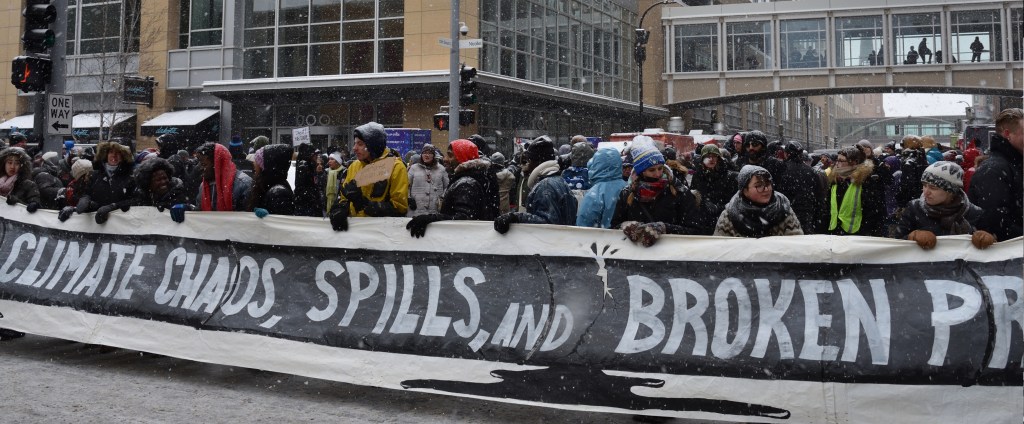
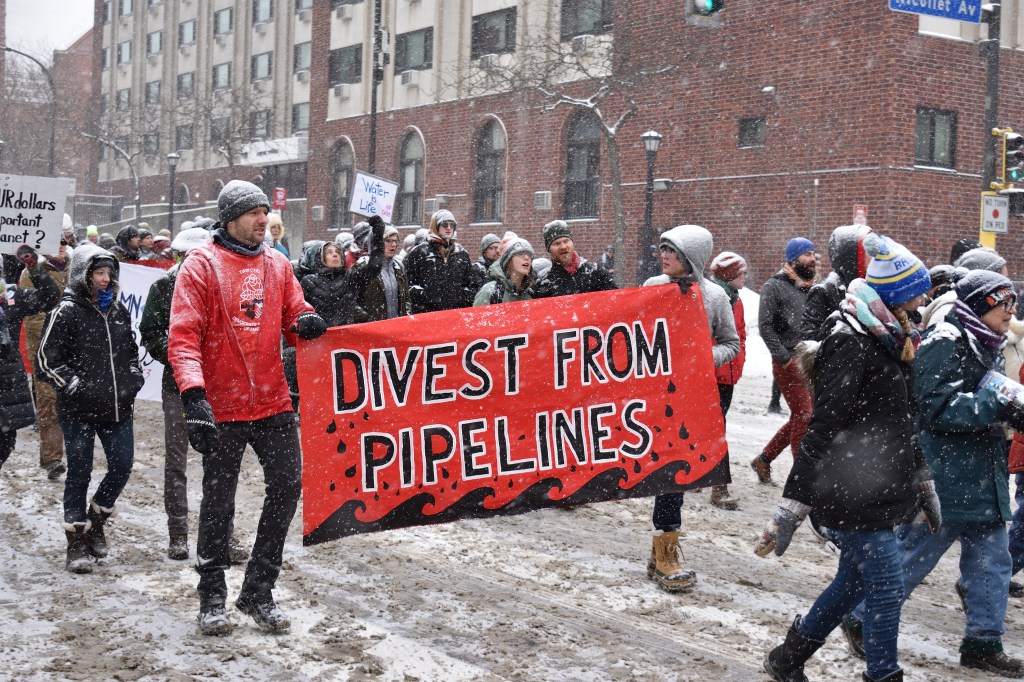
These are photos from the day a van full of us went to Minneapolis for a rally related to USBank’s funding of fossil fuel projects. Minneapolis is the headquarters of USBank.

What You Get into Will Change You

Recently a series of things happened that provoked some reflection. I saw the quote, “what you get into will change you. Sometimes in life you just don’t know what you’re getting into”, which prompted me to write the following.

A lot happened to me since retiring and returning to Iowa four years ago. I hadn’t given a lot of thought to what would happen when I returned to Iowa. I had stayed connected with Iowa Quakers and involved with them as much as I could from a distance. So, there were already some relationships to build on.

In Indianapolis I was blessed to have made many friends as we worked to protect water and oppose the Keystone XL and Dakota Access pipelines. I was also most fortunate to become involved with the Kheprw Institute (KI), a youth mentoring and empowerment community. And North Meadow Circle of Friends Quaker meeting. It was hard to leave but I stay in touch.

What follows are stories of my justice experiences since returning to Iowa. They are offered in case they might be helpful for you and your own work.

I’m frustrated more people don’t engage in justice work. Why are we here if not to grow and engage with family and our communities? Most people either don’t know how to engage or don’t want to. I’m frustrated because there is so much work to be done. We are experiencing environmental catastrophes that will only worsen and occur more frequently. We need masses of people to prepare now for the evolving chaos.

Also, these experiences will be good for you. I know from experience “what you get into will change you”. https://www.dailygood.org/story/2795/what-you-get-into-will-change-you-phyllis-cole-dai/

It is important to recognize “sometimes in life you just don’t know what you’re getting into.” Those can be times of great opportunity. I encourage you to get involved in opportunities like this, as long as doing so is relevant to what you are called to do.

What you get into will change you. Sometimes in life you just don’t know what you’re getting into.

Phyllis Cole-Dai

The most important step is to figure out what you should do. There are so many problems. Many people get burned out by trying to do too many things. People of faith rely on faith to help us figure this out. Keep what you are led to do in mind. You must be vigilant as you look for opportunities to get involved with justice work. And just as vigilant to decline to get involved in things not related to what you are called to do. Maintaining this focus is crucial for success.

First Nation-Farmer Climate Unity

I had long wanted to get to know some Indigenous people for numerous reasons, such as spirituality and sustainable living. Fortunately, an ideal opportunity to do so was to walk and camp along the path of the Dakota Access pipeline with a small group of native and nonnative people. The intention was for those in the group to get to know each other as we walked 10-15 miles/day, put up our tents, and have meals together.

During the First Nation-Farmer Climate Unity March (Sept. 1 – 8, 2018) Manape said we were on a sacred journey. During the March, Donnielle said we are a tribe. This morning I’m realizing the following stories about the past are part of my sacred journey. Also thinking of the many new friends found as part of this journey. I’m thinking how much I would have missed if I didn’t recognize and take advantage of this amazing opportunity.

Wet’suwet’en

Last Saturday morning began by watching a new video (see below) from the Wet’suwet’en people in British Columbia. Gidimt’en Checkpoint spokesperson Sleydo’ (Molly Wickham) and Elder Janet Williams found a film crew trespassing on Gidimt’en territory, making a commercial to promote Coastal Gaslink’s plans to tunnel beneath the sacred headwaters.

I first learned about the Wet’suwet’en’s struggles in January, 2020, when I saw a remarkable video of Sleydo’ evicting the Coastal GasLink workers from Wet’suwet’en territory. “All CGL workers have now been peacefully evicted from Unist’ot’en and Gidimt’en territories. Under the authority of Anuk nu’at’en (Wet’suwet’en law), and with support of the Wet’suwet’en hereditary chiefs of all five clans, the Wet’suwet’en are standing up for the last of our lands and we need you to stand with us. We will honour the instructions of our ancestors, and continue to protect our lands from trespassers.”

I began to follow what was happening with the Wet’suwet’en, especially when they started asking people to write about what was happening, since the mainstream media was not. A few of us, who had worked together on some Indigenous related events, organized a vigil in support of the Wet’suwet’en:

We didn’t expect anyone to join us. Fortunately, Ronnie James did. In the photo are Peter Clay, Linda Lemons and Ronnie James. Ronnie is an Indigenous organizer with many years of experience and interested to see who organized and attended our vigil. After he left, I realized I didn’t have a way to contact him. Fortunately, he accepted my Facebook Friend request. We began to have numerous conversations (via social media), where he patiently taught me a great deal about organizing, Indigenous thought, and Mutual Aid. (See: https://landbackfriends.com/mutual-aid/)


Peter Clay, Linda Lemons and Ronnie James
Mutual Aid

Meeting and becoming great fiends with Ronnie changed the course of my life. I eventually joined the work of Des Moines Mutual Aid (DMMA). Every Saturday morning, I participate in the free food distribution program. About a dozen of us put together sixty boxes of food, that we then put in the cars of those who need it. It is amazing this food distribution has been in existence in Des Moines since the Black Panthers organized the free breakfast program for school kids in the 1970’s.

Putting together the boxes of food, we move as a well-oiled machine. There is a little visiting as we pass each other when putting the food into boxes. I learn a lot about the justice work people are doing in central Iowa, since my Mutual Aid friends are also involved in many such projects.

Saturday there was a lull while waiting for another food delivery that provided a chance to talk with Ronnie. I mentioned the story below about the continued oppression of the Wet’suwet’en peoples and reminded him that we had met at the vigil for the Wet’suwet’en mentioned above. I told him that was something he taught me about organizing. Going to justice events to meet people. I said I wouldn’t have known about Mutual Aid if not for him attending that Wet’suwet’en vigil. He replied I probably would have learned about Mutual Aid because it had been in the news a lot recently.

Ronnie mentioned that was the first time he had been at Friends House, where the Wet’suwet’en vigil was held. Des Moines Mutual Aid has its offices in Friends House now. I had just spoken with Jon Krieg who works with the American Friends Service Committee (AFSC), whose offices had been in Friends House. Recently AFSC had moved out and Jon mentioned he missed visiting with Ronnie.

Des Moines Valley Friends meeting, which meets in a meetinghouse attached to Friends House, has been allowing another Mutual Aid group to use their kitchen to cook meals that are taken to the houseless camps.

Another set of connections relates to the Great Plains Action Society (GPAS), founded by my friend Christine Nobiss, who was also on the First Nation-Farmer Climate Unity March. Ronnie’s Mutual Aid work is supported by GPAS.

Prairie Awakening/Prairie Awoke

Saturday was also the day of the annual Prairie Awakening/Prairie Awoke ceremony, an annual event sponsored by the Dallas County Conservation Board. The ceremony is held in the Kuehn Conservation Area. My Quaker meeting, Bear Creek, has been involved with the ceremony for over ten years. A number of Friends attended.

While there, I was able to talk with my friend Rodger Routh, who grew up in the Earlham, Iowa (where Bear Creek meeting is) community. Rodger is a photographer/videographer and justice advocate, who is often at the same events I attend. Jon Krieg (AFSC, mentioned above) is also a photographer. It is common for the three of us to be at the justice related events.

LANDBACK

One of the principles of justice work is to follow the leadership of the communities affected by injustice. In Indianapolis, the Kheprw Institute would let us (Quakers in this case) know what we could do for them.

Recently I had a chance to ask Christine how nonnative people could best support her and her work now. She told me to learn and teach others about the concepts of LANDBACK. So, I created a website named LANDBACK Friends, where I’ve been sharing what I am learning about LANDBACK. https://landbackfriends.com/

Maintaining connections

As the completion of a circle, I was so glad to be contacted by my friends at the Kheprw Institute (KI) in Indianapolis. Aghilah contacted me because KI is interested to learn more about LANDBACK. Evidently, they have been following my blog since I left Indianapolis and reading what I’ve been writing about LANDBACK.

Quakers for Abolition Network

My blog also made it possible for one of my new friends, Jed Walsh, to contact me about the work he and Mackenzie Barton-Rowledge are doing related to abolition of police and prisons. I wrote a little in their article that was just published by the Western Friend, https://westernfriend.org/article/quakers-abolition-network.

Conclusion

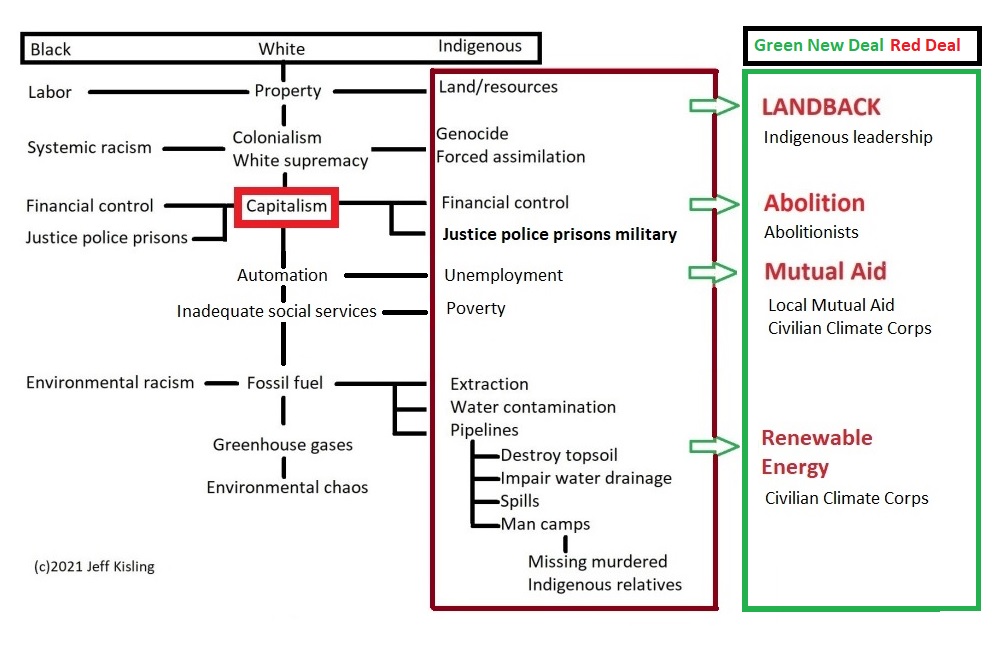
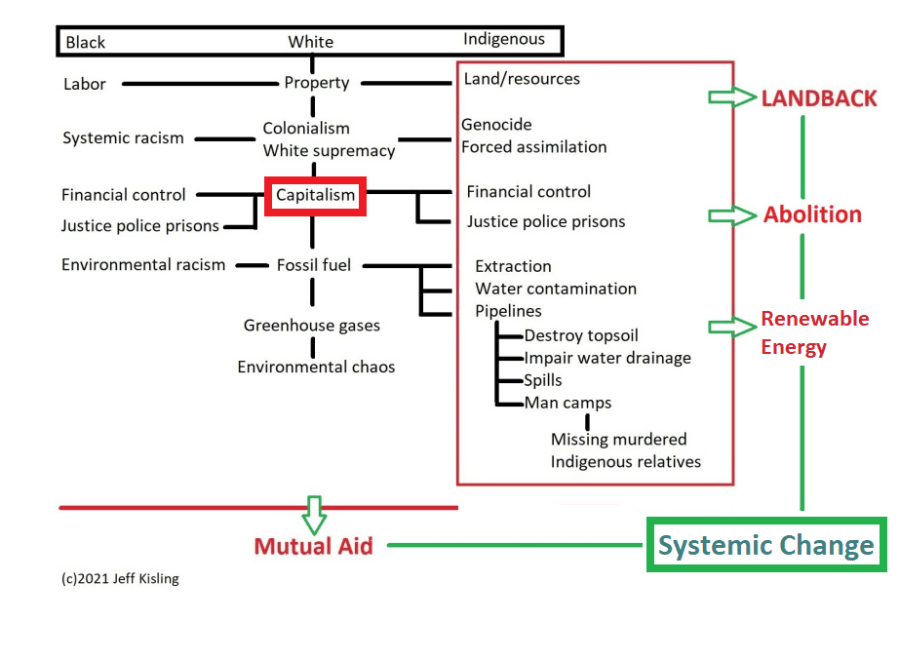
We are moving more deeply into collapse. Fueled by the consequences of environmental chaos, our economic and political systems are failing. We must work now to build ways to deal with this collapse. I’ve been working on this diagram to illustrate how people are building such systems. It is important to build Mutual Aid communities. And embrace the principles of LANDBACK. “What you get into will change you”.


This document has a lot more information about Quakers, the Wet’suwet’en peoples, and LANDBACK. Scroll down to move through the document.


#LANDBACK

Civilian Climate Corps and Mutual Aid

Senate Democrats have included a Civilian Climate Corp in the reconciliation bill currently being debated. Yesterday’s article was an introduction to the idea of a Civilian Climate Corps (CCC) and included a link for you to send letters to your representatives asking them to vote for it.

I’m really excited about the possibility of a CCC because that could be the final piece for a plan to address many social ills and make real progress to mitigate the environmental chaos that will continue and worsen. I’ve updated this diagram to include how a CCC could fit in.

I’ve been working with Des Moines Mutual Aid for over a year, which has taught me a great deal by seeing this concept in action.
https://landbackfriends.com/mutual-aid/

Mutual Aid works because Mutual Aid groups are made up of the people living in the neighborhood. Mutual Aid results in people getting to know and trust each other because it is about action, not meetings and plans for the future. And the work is to address the needs of the community, like food and shelter. Those involved get the satisfaction of making change happen immediately.

Mutual Aid should be integrated into the Civilian Climate Corps idea!

Key to the success of Mutual Aid is working to maintain a horizontal hierarchy, where everyone has a voice. Attention is paid to avoid vertical hierarchy from forming. Everyone is treated with respect, because we know circumstances might change where we need the help of Mutual Aid ourselves.

Because of these experiences, I wanted to find ways for Mutual Aid to be embraced by more communities. We need vast numbers of people to join in this work.

But how? Just talking to people doesn’t really demonstrate how Mutual Aid works.

Mutual Aid should be integrated into the Civilian Climate Corps idea!

That is how colonial capitalism can be replaced. That is how we can rapidly transition from fossil fuels. That is how we can rebuild caring communities.

Militarism and LANDBACK

What triggered this blog post was learning Congress is working to require women to register for the Selective Service System (“draft”). Men have been required to do so for decades.

As I began to write about that, I had to decide whether to post this article on my blog Quakers, social justice and revolution where it would fit with what that blog is about.

Or whether it might fit with the posts on this blog that I recently started about LANDBACK. I’ve been learning about LANDBACK, and wonder how militarism fits into this idea.
(For an introduction to LANDBACK see: https://landbackfriends.com/2021/07/29/landback-movement/)

LANDBACK is about breaking away from white supremacy, the capitalist economic system and the structures that enforce them. So I updated this diagram I’ve been working on to add the military to the justice, police and prison systems that enforce colonial/corporate capitalism.

A growing number of us are working for the abolition of police and prisons. The military enforces white supremacy and capitalism beyond our borders. Thus, I think, abolition of the military, military bases and the use of weaponized drones could be considered part of LANDBACK.

Thinking about LANDBACK as an antiwar framework is intriguing. Mutual Aid is part of the LANDBACK idea. I was very interested to learn Des Moines Mutual Aid’s first public appearance was at an antiwar march:

One year ago today (2020) Des Moines Mutual Aid participated in a march protesting the potential for war or increased hostilities with Iran that followed the fallout of the assassination of Qassem Soleimani by drone strike in Baghdad.

Ronnie James

The immediate collapse of the Afghan government when U.S. troops left Afghanistan after twenty years of war has a great many of people wondering about militarism and war.

Most Quakers, such as myself, have opposed the draft in many ways, for many years. The issue resulted in a group of Quakers leaving the country called the United States and establishing a thriving community in Costa Rica, a country that does not even have a military. Numerous Quaker men either registered as conscientious objectors, or refused to cooperate with the Selective Service System. Some were sentenced to prison. This is a link to stories about Quaker men and the miltary: Young Quaker Men Face War and Conscription.

Senators on the Armed Services Committee recently approved a revision to military draft laws that would require women to register for the Selective Service System (SSS).

Proponents of the measure, which was included as part of the annual National Defense Authorization Act (NDAA), see it as a matter of gender equality. This argument misses the point: Congress should be focused on abolishing the draft entirely, not expanding it.

As laid out in a coalition letter we supported to members of the Senate Armed Services Committee, this legislation “does not represent a move forward for women; it represents a move backward, imposing on young women a burden that young men have had to bear unjustly for decades – a burden that no young person should have to bear at all.”

Congress Should Abolish the Selective Service System, Not Expand It by Alex Frandsen, Friends Committee on National Legislation (FCNL), August 12, 2021

Mutual Aid and Hurricane Ida

It is difficult to not feel discouraged and helpless in the face of devastation from Hurricane Ida, severe drought and ferocious wildfires in the West, Coronavirus pandemic, mass incarceration, domestic terrorism, and subversion of our political and judicial systems. Clearly environmental chaos is rapidly evolving and these disasters will continue to grow in frequency and extent.

Cause for hope are mutual aid responses to Ida’s damage. “This is how we’ll forge the good, just and beloved community,” Akuno says. “We’ve got to organize that into existence.”

(Kali) Akuno explained that he advocates for rational and democratic planning, decision making and resource sharing, in opposition to the laissez-faire approach of governments, which basically say, “Y’all have to fend for yourselves and good luck.” Mobilizing people and helping them gain the political confidence to demand better systems takes time and relationship-building, Akuno says, and in his decades-long experience as a community organizer he has come to know of an essential first step: “It’s important for people to know that there are other people who actually give a shit. You have to show them that you do.”

On Thursday, a van full of Cooperation Jackson’s members will embark on a mutual aid effort to distribute generators, solar-powered device chargers, potable water and canned food to people in Biloxi and Gulfport, Mississippi, as well as in New Orleans.

In addition to meeting people’s immediate needs, the group is delivering a message: It doesn’t have to be this way. Activists are communicating that in order to make sure that the rebuild is controlled on the ground as much as possible, it’s essential to build relationships, stay in touch and let each other know how we can support each other as we move through this crisis. They’re also emphasizing that mutual aid efforts can be paired with fights against the powerful systems that are hard to overcome, but that must be overcome.

“This is how we’ll forge the good, just and beloved community,” Akuno says. “We’ve got to organize that into existence. [Global] warming is already beating most of the models. We weren’t supposed to be at this point for another 20-25 years, but we’re already here. We have to come up with a survival plan based on what people think it will take, and what they’re willing to do.”

To that end, the petition, which integrates the United Nations principles for Internally Displaced People (IDPs), sets forth demands and guiding principles meant to be a moral compass to make sure that sweeping changes aren’t enacted without the people’s voice being central to the process. The petition asks for a plan of return: “If you’re going to evacuate people, how are they going to get home?” Bradberry asks. It further demands that any evacuation plan must adhere to the UN’s guidance for IDPs — for example, people must be evacuated as close to home as possible and families must not be separated.

Louisiana Activists Mobilize to Prevent “Shock Doctrine” Policies in Wake of Ida by Frances Madeson, Truthout, Sept 2, 2021

Organizers and activists in Louisiana and Mississippi are regionally coordinating their relief response in the wake of Hurricane Ida, and linking the immediate survival needs of people with a coherent set of political demands expressed in a petition to lawmakers including President Biden, calling for a humanitarian approach to evacuation and evacuees. Both initiatives draw on lessons learned from past disasters like Hurricane Katrina in 2005.

Hurricane Ida has been another devastating blow to the New Orleans region and we would like to make sure that a just and equitable recovery is implemented. In the rush for basic needs, there are many important things that can get overlooked in the rush. We must TAKE ACTION NOW to ensure that the recovery efforts support the people in the region.

There are many organizations in Louisiana that were developed due to the failure of the government to act during Katrina. It is our goal to facilitate collaborative efforts and not attempt to override or minimize them.

Here are some things that will get lost in the rush to help. But these are no less important than clothes, food, etc.

  • Utilize United Nations Human Rights Commission Regulations Governing Internally Displaced Persons: Guiding Principles on Internal Displacement
  • Establish a communications network for messaging in and out 
  • ***Establish a network for collection and disbursement of medication, Insulin, etc***
  • Engage the support of local, state & national organizations
  • Mandate alterations for Insurance Code & Conduct after the disaster to motivate assistance over bureaucratic delay
  • Enforce 1st source hiring
  • Enforce prevailing wages in recovery
  • Simplify the process for reimbursing churches and individuals housing evacuees
  • Pass Gulf Coast Civic Works like legislation to fund the rebuilding of coast following storm
  • Uphold universal voting rights – UN
  • Moratorium on rent, utilities, etc 
  • Evacuation, use models provided by National & International Allies
  • Evacuation response and procedures must be humanitarian and not militaristic
  • MUST include a plan for citizens to return – unlike Katrina plan
  • Evacuation must be in line with United Nations principles for IDP
  • People should be evacuated as close to home as possible
  • Must have access to participate in processes governing the recovery/return home
  • Establish governing rules to maintain families connections (no breaking up of families)

For more information contact:  Stephen Bradberry, info@bennuadvisory.com
Stephen Bradberry is a founder of Bennu Advisory Group, http://bennuadvisory.com, and is a New Orleans-based advocate and organizer. He is a recipient of the RFK Human Rights Award in recognition of his work in the Gulf Coast post-Katrina and Rita.

Louisiana Activists Mobilize to Prevent “Shock Doctrine” Policies in Wake of Ida by Frances Madeson, Truthout, Sept 2, 2021

Even as President Joe Biden and Louisiana Governor John Bel Edwards continue to send federal aid relief to the southeastern states, grassroots organizations have taken up the mantle to secure resources and offer localized help to those affected by the storm. As we’ve seen during the Covid-19 pandemic and in the wake of last year’s George Floyd protests, mutual aid groups and other local organizations are able to directly respond to the needs of their communities in times of crisis, thanks to volunteer efforts and donations. Here are just a few of those groups assisting in the relief efforts for Hurricane Ida.

This non-profit consortium of indigenous tribes in Louisiana has provided regular storm updates for Ida on their Facebook page and set up a Relief and Recovery Fund for local tribe members. Other tribal groups in the Delta area with Ida relief funds include the Point au Chien Tribe, United Houma Nation, Grand Caillou/Dulac Band of Biloxi-Chitimacha-Choctaw, and the Atakapa Ishak Nation. A longer list and map of tribes who were affected by the hurricane, along with their individual aid efforts, can be found at Bvlbancha Public Access’s Ida Relief Doc.

Hurricane Ida: How to Help Louisiana, Other Areas Hit Hardest by the Storm. Mutual aid funds are helping communities in the southeast that were devastated by the storm — and they need our help by Claire Shaffer, Rolling Stone, Sept 2, 2021

This article discusses three groups using mutual aid for disaster response.

As climate change continues to produce more intense hurricane seasons, many communities have stopped relying on federal money, which is slow to arrive, and started looking to their neighbors for hurricane relief. Here are three groups using mutual aid as a tool for natural disaster response.

Hurricane Relief Through Mutual Aid. Three groups using mutual aid as a tool for natural disaster response by Isabella Garcia, yes!, Nov 3, 2020

Cannot depend on traditional power sources

Powerful hurricane Ida which gained strength from the hot Gulf waters (from global warming) destroyed square miles of buildings as it came ashore. Then caused massive flooding as it moved through the country.

The entire electrical grid failed in New Orleans! It will be weeks or months before full power returns.

In February this year the power grid for the entire state of Texas failed.

Each hurricane also renews calls to find new ways to produce and distribute energy in the face of climate change, which experts say is leading to more frequent and more devastating storms. In New Orleans, advocates have tried to push Entergy to invest more in renewable energy sources, such as solar and wind, and technologies that provide electricity to the area where it is produced.

Those concerns, along with worries about pollution in residential neighborhoods, fueled resistance to Entergy’s plan to build the new natural gas-powered plant in New Orleans East. Even after the company admitted to playing a role in the hiring of actors to support the project at public meetings, the council approved the plant. Groups that opposed the plan sued, and the case made it to the Louisiana Supreme Court, which upheld the council’s vote.

“​​Over and over we have tried to say we need not only climate action for renewables, but also we need to be adaptive to what is coming, because the traditional system to move power isn’t going to be able to help us weather these storms,” said Logan Atkinson Burke, executive director of the Alliance for Affordable Energy. “We’ve been ignored by utilities and regulators, and we are concerned that now, yet again, we will have this system rebuilt the same way we’ve done it and it will do us no good the next time.”

Slow return of power raises questions about a New Orleans plant that was supposed to deliver electricity after hurricanes. Calls for an investigation of Entergy’s power outages follow a wave of complaints about the company by Jon Schuppe, NBC News, Sept 1, 2021

Hurricane Ida thoroughly wrecked New Orleans’ power supply, preying on vulnerabilities that are only likely to get worse in the future as storms like Ida become more fierce. The storm knocked out all eight transmission lines that bring power into New Orleans, plunging the city into darkness. The damage was so intense that a new gas-fired power plant — sold as something that could keep the lights on after big storms — took days to bring power to the nearest neighborhood.

To keep the lights on in the future, leaders need to abandon old strategies and build up different kinds of energy infrastructure, experts say. The fallout from Ida is yet another reminder of how fragile the country’s existing energy infrastructure is, especially as climate change brings on more extreme weather.

“We’ve been saying, you know, we can’t depend on the traditional system,” says Logan Atkinson Burke, executive director of the local consumer advocacy group Alliance for Affordable Energy. “We need to be planning for the kind of climate impacts that we know are coming, and here they are. Having not planned for them, we’re experiencing the kinds of problems we expected.”

NEW ORLEANS NEEDS A BETTER BACKUP PLAN FOR BLACKOUTS. A new gas plant still isn’t enough to solve the city’s power problems by Justine Calma, Sep 1, 2021

This is what LANDBACK is about, restoring Indigenous ways.

“How about phasing out fossil fuels and quit acting like addicts? Let’s have a new green revolution. Let’s take the green path.” Winona Laduke (in video below). Winona was arrested while protecting the water from Line 3. Honor the Earth says that the “charge of the colonial world is in conflict with the Anishinaabeg,” citing a 2019 White Earth Nation tribal law which requires the White Earth Nation to stand up for and protect the rights of wild rice and other sacred food.

#TreatiesNotTarSands

#LANDBACK

Indigenous led Green New Deal

The book The Red Deal is about an Indigenous led Green New Deal (GND).

The Sunrise Movement was launched as a national campaign for a Green New Deal (GND) in 2017. From the beginning I heard my native friends talk about the importance of a green new deal to be Indigenous led but didn’t have a clear idea of what that meant. In 2019 Sunrise’s Green New Deal tour included a stop in Des Moines. There my friends Trisha Cax-Sep-Gu-Wiga Etringer and Lakasha Yooxot Likipt spoke about Indigenous leadership as part of the GND.

So I’m glad to be reading the recently published book, The Red Deal: Indigenous Action to Save Our Earth by the Red Nation.

The Red Nation is a coalition of Native and non-Native activists, educators, students, and community organizers advocating Native liberation that formed to address the marginalization and invisibility of Native struggles within mainstream social justice organizing, and to foreground the targeted destruction and violence towards Native life and land.”

Inspired by the appeals to divest from the financial institutions funding oil pipelines during the Standing Rock uprising and the Movement for Black Lives’ divest-invest strategy, the Red Deal also targets the institutions of the military, police, and prisons for divestment. Imagine divesting from these institutions and opening up $1 trillion to accomplish the task of saving this Earth for everyone.

In 2018, Winona LaDuke pushed for an Indigenous-led GND. The former Green Party vice-presidential candidate inspired us to think about how divesting from fossil fuel infrastructure—such as billion-dollar oil pipelines—could be reinvested into building wind and solar farms and sustainable agriculture on reservations. Indeed, the most radical appraisals of the GND come from Indigenous people. According to the Indigenous Environmental Network (IEN), the GND, as is, “will leave incentives by industries and governments to continue causing harms to Indigenous communities.” Before endorsing the GND, IEN called for a clear commitment to keep fossil fuels in the ground; reject carbon pricing schemes; strengthen language on Indigenous peoples and uphold Indigenous rights; and stop, not prolong, our current exploitative and abusive economic and political systems.

Nation, The Red. The Red Deal (pp. 18-19). Common Notions. Kindle Edition.

… what if the question all water protectors and land defenders asked was, why don’t we just overturn the system that makes development a threat in the first place? This system, again, is capitalism. Rather than taking an explicitly conservationist approach, the Red Deal instead proposes a comprehensive, full-scale assault on capitalism, using Indigenous knowledge and tried-and-true methods of mass mobilization as its ammunition. In this way, it addresses what are commonly thought of as single issues like the protection of sacred sites—which often manifest in specific uprisings or insurrections—as structural in nature, which therefore require a structural (i.e., non-reformist reform) response that has the abolition of capitalism via revolution as its central goal. We must be straightforward about what is necessary. If we want to survive, there are no incremental or “non-disruptive” ways to reduce emissions. Reconciliation with the ruling classes is out of the question. Market-based solutions must be abandoned. We have until 2050 to reach net-zero carbon emissions. That’s it. Thirty years. The struggle for a carbon-free future can either lead to revolutionary transformation or much worse than what Marx and Engels imagined in 1848, when they forewarned that “the common ruin of the contending classes” was a likely scenario if the capitalist class was not overthrown. The common ruin of entire peoples, species, landscapes, grasslands, waterways, oceans, and forests—which has been well underway for centuries—has intensified more in the last three decades than in all of human existence.

Nation, The Red. The Red Deal (pp. 21-22). Common Notions. Kindle Edition.

I’m of the firm opinion that a system that was built by stolen bodies on stolen land for the benefit of a few is a system that is not repairable. It is operating as designed, and small changes (which are the result of huge efforts) to lessen the blow on those it was not designed for are merely half measures that can’t ever fully succeed.

So the question is now, where do we go from here? Do we continue to make incremental changes while the wealthy hoard more wealth and the climate crisis deepens, or do we do something drastic that has never been done before? Can we envision and create a world where a class war from above isn’t a reality anymore?”

Ronnie James, Des Moines Mutual Aid, Great Plains Action Society

Abolition and racial capitalism

It has taken a while to adjust to thinking of abolition as the elimination of prisons instead of the historical context of abolition of the institution of enslavement. Not surprisingly the concept of prison abolition comes up in any discussion of capitalism and building a just future. Police are the enforcers of capitalism.

I am part of a new group of Friends who are interested in abolishing police and prisons called the Quakers for Abolition Network (QAN).

The following is from an article Jed Walsh and Mackenzie Barton-Rowledge, who helped start QAN, wrote for Western Friend.

Mackenzie: Let’s start with: What does being a police and prison abolitionist mean to you?

Jed: The way I think about abolition is first, rejecting the idea that anyone belongs in prison and that police make us safe. The second, and larger, part of abolition is the process of figuring out how to build a society that doesn’t require police or prisons.

M: Yes! The next layer of complexity, in my opinion, is looking at systems of control and oppression. Who ends up in jail and prison? Under what circumstances do the police use violence?

As you start exploring these questions, it becomes painfully clear that police and prisons exist to maintain the white supremacist, heteronormative, capitalist status quo.

Abolish the Police by Mackenzie Barton-Rowledge and Jed Walsh, Western Friend, November December, 2020

This diagram shows abolition, along with LANDBACK and Mutual Aid, as pieces of changes to transition away from systems of capitalism and white supremacy.

I’ve been reading The Red Deal by the Red Nation, which is about empowering Indigenous peoples, in part to help guide us through environmental chaos. What follows are some interesting perspectives on prison abolition.

Austerity is enforced scarcity. The neoliberal policy of the last forty years has been a tax strike of the super wealthy, who have refused to pay their share of taxes and have locked away the world’s wealth in tax havens and offshore accounts. These are resources that should go towards providing services—education, housing, healthcare, public transportation, infrastructure, and environmental restoration—to those who actually produce the wealth: the Indigenous, Black, migrants, women, and children who are the workers of the world. This strike is worth crushing quickly and with prejudice. Direct action alone won’t reallocate wealth if it is not backed by popular mass movements and enforced by state apparatuses wrested away from the elite and powerful.

Prison abolition and an end to border imperialism are key aspects of the Red Deal, for good reason. The GND calls for the creation of millions of “green” jobs, as well as a policy of “just transition” for poor and working-class families and communities that currently depend on resource extraction for basic income and needs, and which will suffer greatly when the extractive industry is shut down. In the United States today, however, about seventy million people—nearly one-third of adults—have some kind of criminal conviction—whether or not they’ve served time—that prevents them from holding certain kinds of jobs. If we add this number of people to the approximately eight million undocumented migrants, the sum is about half the US workforce, two-thirds of whom are not white. Half of the workforce faces employment discrimination because of mass criminalization and incarceration.

The terrorization of Black, Indigenous, Brown, migrant, and poor communities by border enforcement agencies and the police drives down wages and disciplines poor people—whether or not they are working—by keeping them in a state of perpetual uncertainty and precarity. As extreme weather and imperialist interventions continue to fuel migration, especially from Central America, the policies of punishment—such as walls, detention camps, and increased border security—continue to feed capital with cheap, throwaway lives. The question of citizenship—colonizing settler nations have no right to say who does and doesn’t belong—is something that will have to be thoroughly challenged as a “legal” privilege to life chances. Equitable access to employment and social care must break down imperial borders, not reproduce them.

The Red Deal by The Red Nation (pp. 22-23). Common Notions. Kindle Edition.

Calls for abolition of the prison system have expanded in the wake of widespread police violence. Abolition is part of the work of our Mutual Aid community.

Prison abolition and an end to border imperialism are key aspects of the Red Deal

The Red Nation

This same war of conquest is currently using the mass incarceration machine to instill fear in the populace, warehouse cheap labor, and destabilize communities that dare to defy a system that would rather see you dead than noncompliant. This is the same war where it’s soldiers will kill a black or brown body, basically instinctively, because our very existence reminds them of all that they have stolen and the possibility of a revolution that can create a new world where conquest is a shameful memory.

What we have is each other. We can and need to take care of each other. We may have limited power on the political stage, a stage they built, but we have the power of numbers.

Those numbers represent unlimited amounts of talents and skills each community can utilize to replace the systems that fail us.  The recent past shows us that mutual aid is not only a tool of survival, but also a tool of revolution. The more we take care of each other, the less they can fracture a community with their ways of war.

Ronnie James, The Police State and Why We Must Resist

Policing in the United States is a force of racist violence that is entangled at the core of the capitalist system. As Robin D.G. Kelley pointed out on Intercepted With Jeremy Scahill, capitalism and racism are not distinct from one another: “If you think of capitalism as racial capitalism, then the outcome is you cannot eliminate capitalism, overthrow it, without the complete destruction of white supremacy, of the racial regime under which it’s built.”

Police in the United States act with impunity in targeted neighborhoods, public schools, college campuses, hospitals, and almost every other public sphere. Not only do the police view protesters, Black and Indigenous people, and undocumented immigrants as antagonists to be controlled, they are also armed with military-grade weapons. This police militarization is a process that dates at least as far back as President Lyndon Johnson when he initiated the 1965 Law Enforcement Assistance Act, which supplied local police forces with weapons used in the Vietnam War. The public is now regarded as dangerous and suspect; moreover, as the police are given more military technologies and weapons of war, a culture of punishment, resentment and racism intensifies as Black people, in particular, are viewed as a threat to law and order. Unfortunately, employing militarized responses to routine police practices has become normalized. One consequence is that the federal government has continued to arm the police through the Defense Logistics Agency’s 1033 Program, which allows the Defense Department to transfer military equipment free of charge to local enforcement agencies.

TO END RACIAL CAPITALISM, WE WILL NEED TO TAKE ON POLICING By Henry A. Giroux, Truthout, June 20, 2021