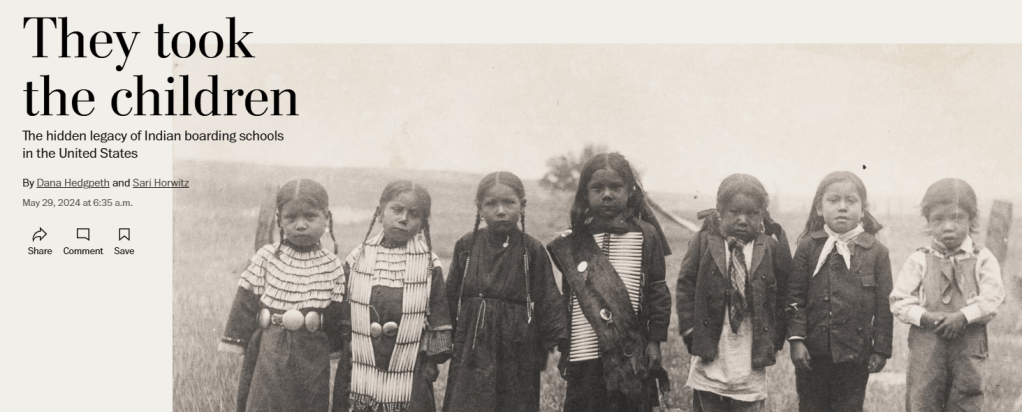
The first Washington Post article is an interactive presentation of their investigation into sexual abuse in Native American boarding schools. ‘In the Name of God’ by Sari Horwitz, Dana Hedgpeth, Emmanuel Martinez, Scott Higham and Salwan Georges, The Washington Post, May 29, 2024
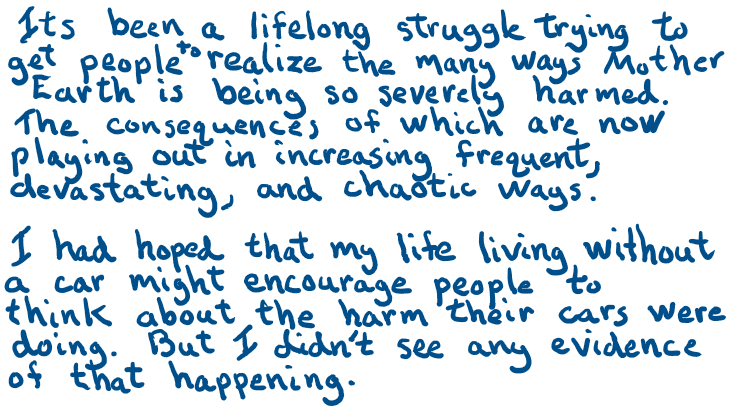
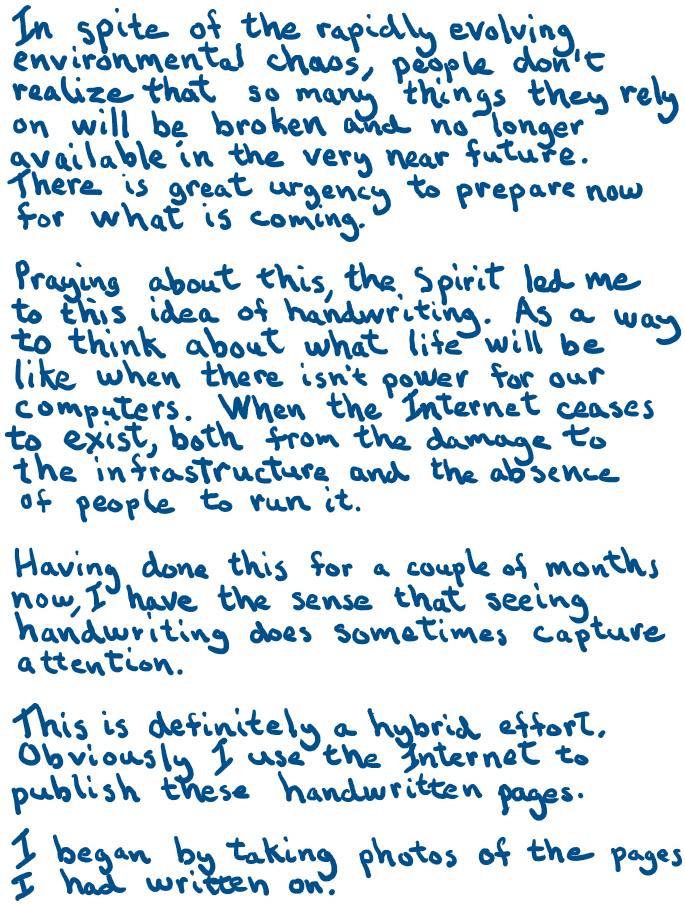
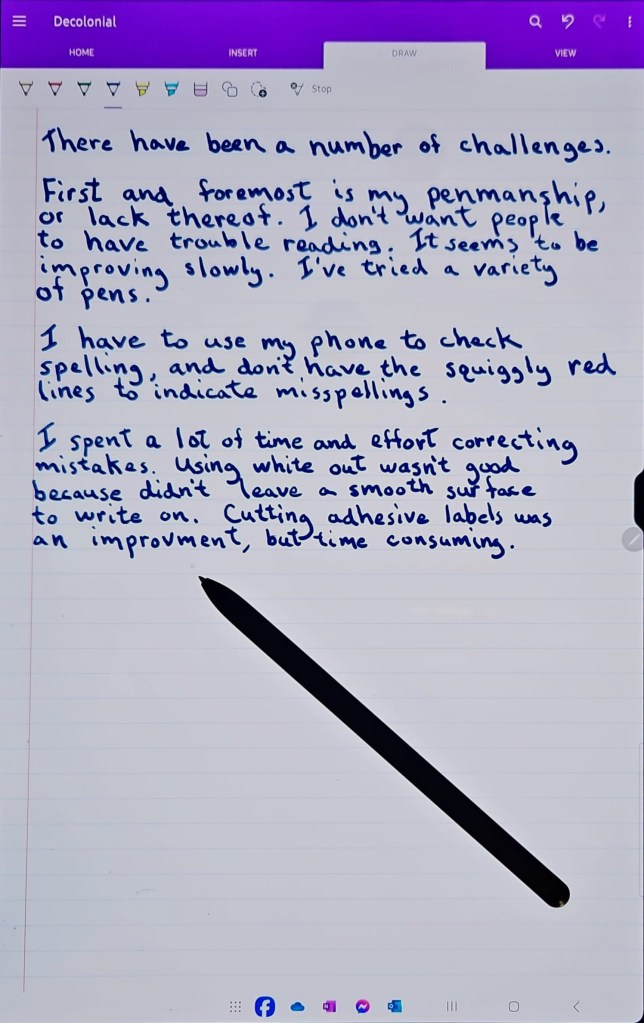
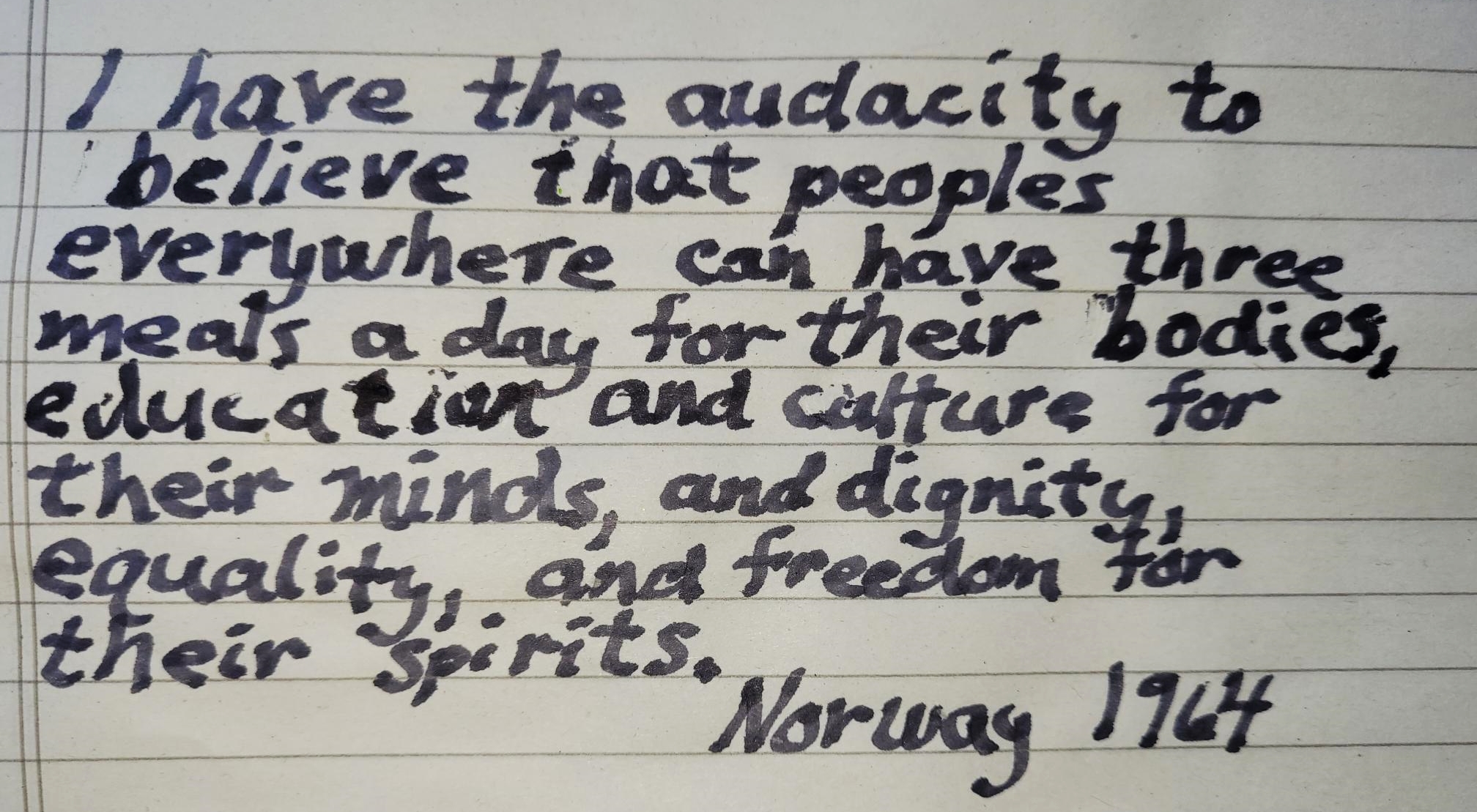
There are several reasons why I have begun handwriting and why the Spirit led me to this. My intention is to try another way to get people’s attention, another approach to express the urgency of the need to prepare for the chaos that is already happening and rapidly accelerating. Handwriting is a symbolic way to show that we won’t have the Internet, for example, very shortly. I don’t know how many months or years some of these systems can continue to struggle to maintain themselves. What I do know is we are already seeing collapse occur. We can either be proactive or not change and be at the mercy of what is coming.
complete trust or confidence in someone or something.
strong belief in God or in the doctrines of a religion, based on spiritual apprehension rather than proof.
I wasn’t familiar with the use of apprehension above. I found one definition is “understanding or grasp”.
I spent a lot of time praying (faith) and thinking about the discussion we were going have at my Quaker meeting, Bear Creek (some of us via ZOOM) related to Mutual Aid. I’ve been deeply involved in Des Moines Mutual Aid (DMMA) for two years, writing nearly daily to share what I’ve been learning. It can be difficult to express lived experiences to those who haven’t had those experiences. Many Friends have had experiences that could be called Mutual Aid in their peace and justice work.
I made mistakes over the years because I had conflicts with the meeting related to the use of fossil fuels. (Meeting refers to my local meeting, Bear Creek.) I didn’t do a good job of inviting the meeting to engage with me about that. Although I understood there are major obstacles to reducing use of fossil fuels where there is no mass transportation, I have been humbled to face that problem myself since I moved to Iowa from Indianapolis several years ago.
One Friend from the meeting had a suggestion that helped us work together on fossil fuel issues. That resulted in the approval of the following Minute by our Yearly Meeting.
Radically reducing fossil fuel use has long been a concern of Iowa Yearly Meeting (Conservative). A previously approved Minute urged us to reduce our use of personal automobiles. We have continued to be challenged by the design of our communities that makes this difficult. This is even more challenging in rural areas. But our environmental crisis means we must find ways to address this issue quickly.
Friends are encouraged to challenge themselves and to simplify their lives in ways that can enhance their spiritual environmental integrity. One of our meetings uses the term “ethical transportation,” which is a helpful way to be mindful of this.
Long term, we need to encourage ways to make our communities “walkable”, and to expand public transportation systems. These will require major changes in infrastructure and urban planning.
Carpooling and community shared vehicles would help. We can develop ways to coordinate neighbors needing to travel to shop for food, attend meetings, visit doctors, etc. We could explore using existing school buses or shared vehicles to provide intercity transportation.
One immediately available step would be to promote the use of bicycles as a visible witness for non-fossil fuel transportation. Friends may forget how easy and fun it can be to travel miles on bicycles. Neighbors seeing families riding their bicycles to Quaker meetings would have an impact on community awareness. This is a way for our children to be involved in this shared witness. We should encourage the expansion of bicycle lanes and paths. We can repair and recycle unused bicycles and make them available to those who have the need.
Iowa Yearly Meeting (Conservative) 2017
That experience has helped me have more faith in the work of our meeting, in the sense of trust in the meeting. And helped me be a better listener.
We had the discussion about Mutual Aid at Bear Creek yesterday and I was very pleased. Friends had interesting and helpful questions and ideas. I was happy to hear what Friends had been doing in their communities related to Mutual Aid.
One of the most thought-provoking questions related to hierarchies. That any group would have differences, such as educational level or class, for example. I didn’t have a good answer at the time. The following video by Dean Spade explains this well. Of course, we all have different experiences and skills. Mutual Aid communities appreciate and encourage the use of community building skills. And helping people build new skills is encouraged.
Vertical versus horizontal hierarchies are related to decision making.
Two of the queries (questions) we considered yesterday relating to hierarchies were:
Do we recognize that vertical hierarchies are about power, supremacy and privilege? What are Quaker hierarchies?
Do we work to prevent vertical hierarchies in our peace and justice work?
Dean Spade wrote the best book I’m aware of about Mutual Aid. Mutual Aid, Building Solidarity during this Crisis (and the next) by Dean Spade, Verso, 2020
He teaches courses about Mutual Aid and has produced videos related to the subject. The following is a good discussion of horizontal group structures.
These workshops are about building mutual aid groups that can make decisions together, that include everybody, that can prevent and weather conflict, that can sustain work and sustain engagement, that can bring lots of new people into the work and so that it’s well resourced by people power. And that can be a bridge for people towards deeper and bolder movement engagement.
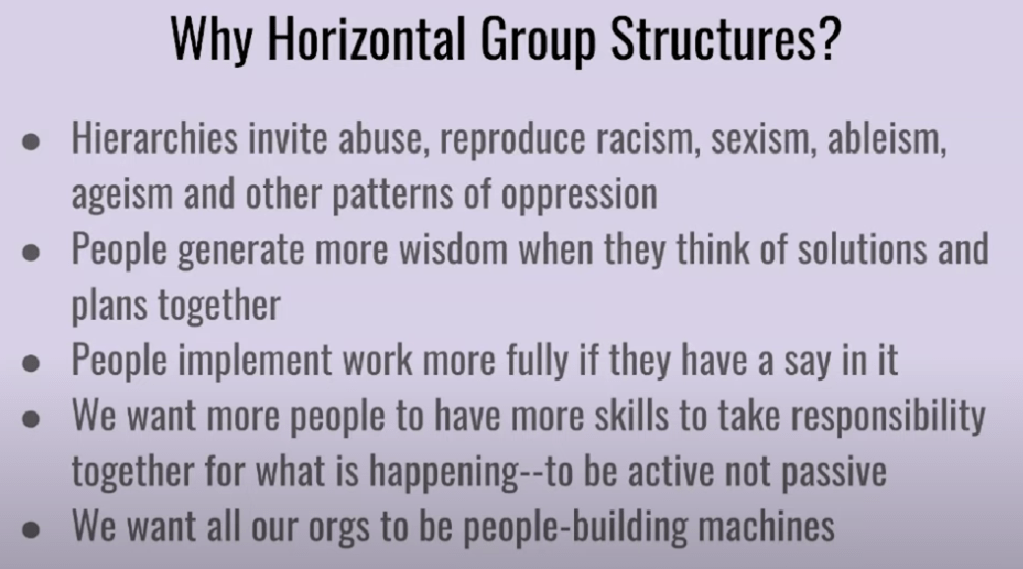
I strongly believe that horizontal group structures, meaning group structures where there’s no boss or executive director or main decider are the way to get there, for a number of reasons, and I want to share those in case that’s new for people.
One big reason is that hierarchies invite abuse and reproduce systems like racism, sexism, ableism, ageism, et cetera. I mean, we see it all the time. It’s like when you set something up as a hierarchy, oftentimes it’s men or white people bossing people around or old people bossing young people around or whatever.
And the bossing around can include worse forms of exploitation and abuse, also. I think that is inherent to hierarchy.
So we’ve seen forever in social justice movements, people set up hierarchical groups and then the same stuff plays out that they were trying to fight.
I think that’s worse, and it’s not as if it can’t happen in horizontal groups. We still have the dynamics. We still have that unlearning to do, but I think that hierarchy invites it.
Dean Spade: Horizontal Group Structures in Mutual Aid Work
I’m concerned to see little progress toward solutions for the myriad of problems we face. Especially with accelerating environmental chaos. We’re paralyzed in the face of so many complex problems. Disheartened because nothing makes progress.
I contend that is because, as Albert Einstein said, “we cannot solve our problems with the same thinking we used when we created them.”
I am proposing we implement new ways to approach our justice work. And will ask our peace and social concerns committee to explore how to change our work from a committee structure to a Mutual Aid group. I’m interested to see how faith can be part of Mutual Aid.
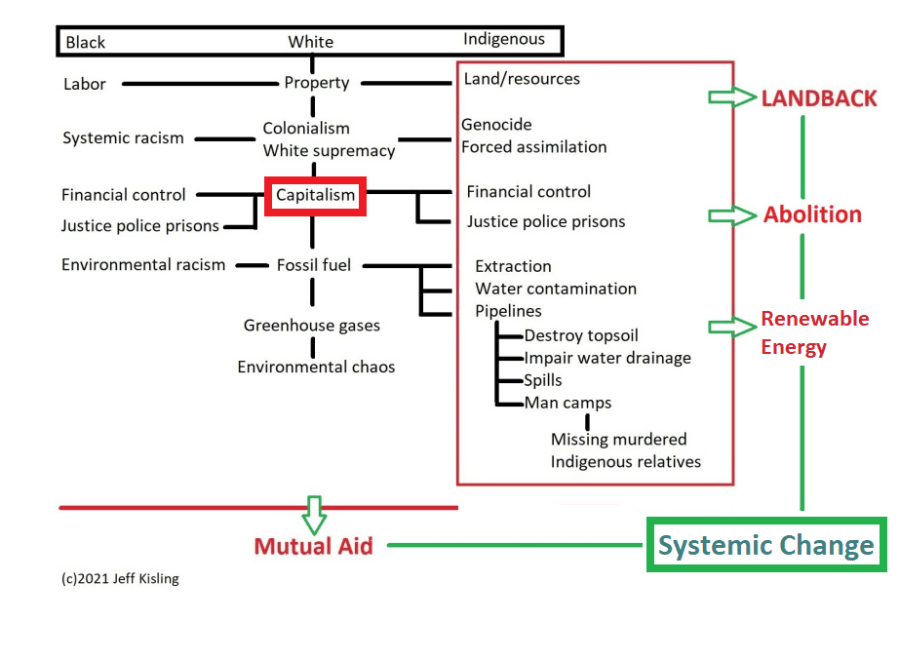
This diagram lists problems and solutions. LANDBACK, Abolition of police and prisons, Mutual Aid, resource conservation and spirituality. Adapted from the more detailed diagram at the end of this.
Peace and Social Concerns Committee Report 2021 Iowa Yearly Meeting (Conservative)
This has been a year of great upheaval locally, nationally, and globally. The work of our monthly meetings has been impacted by the COVID-19 pandemic. Yet we have found ways to continue our peace and justice work. And had more time for prayer and reflection.
Global chaos from rapidly accelerating environmental devastation is highly likely to occur, breaking down our economic, social, and political systems. As air and water temperatures increase, water supplies are drying up. Widening areas and severity of drought are decreasing crop production and forcing people to flee. Rising oceans are creating more climate refugees. The trend of increasing numbers of more ferocious wildfires, hurricanes and other storms are expected to accelerate. All kinds of infrastructure will likely be destroyed, creating more climate refugees, many migrating to the Midwest. How can we prepare our own communities for these disasters, and plan for the arrival of climate refugees?
Justice work by White Friends has changed in recent years. An important concept of justice work is to follow the leadership of oppressed communities, who are working tirelessly for their liberation. Those who consider themselves White Friends are learning how to step back. Be supporters and allies.
Many injustices today trace their roots to the arrival of white Europeans on this continent. These include a whole history of enslavement as well as genocide of Indigenous peoples. It is important for white Quakers to know we are not expected to feel guilt or blame for injustices that occurred in the past. But knowing what we know now, it is up to us to learn more about those wrongs, and work toward repair and healing. This will be a primary focus of this committee’s work in the coming year.
As a society we have been forced to face systemic racism. For example, public murders by police have generated sustained protests regarding police brutality, with calls to limit police powers and change or abolish prisons.
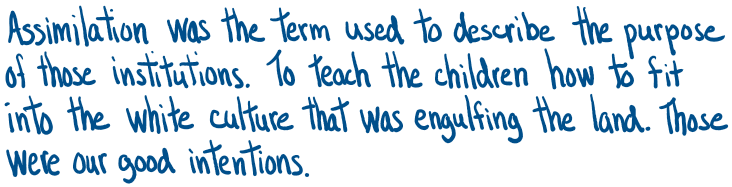
Also dating back to the arrival of white Europeans is the genocide of Indigenous peoples. The theft of Native lands. And the atrocities of Native children taken from their families to institutions of forced assimilation, often far away. Places where attempts were made to the erase their culture. Many subjected to physical or sexual abuse. Thousands of Native children died. This intentional cruelty broke the resistance of Native peoples who were trying to hold onto their lands.
The recent validation of the remains of Native children on the grounds of those institutions is having devastating effects in Native communities and those who care about them. Searching the grounds of the institutions in this country is about to begin. Secretary of the Interior, Deb Haaland, has launched a federal investigation into these institutions of forced assimilation in the US,
A number of Catholic churches, who ran those institutions in Canada, have been burned or vandalized.
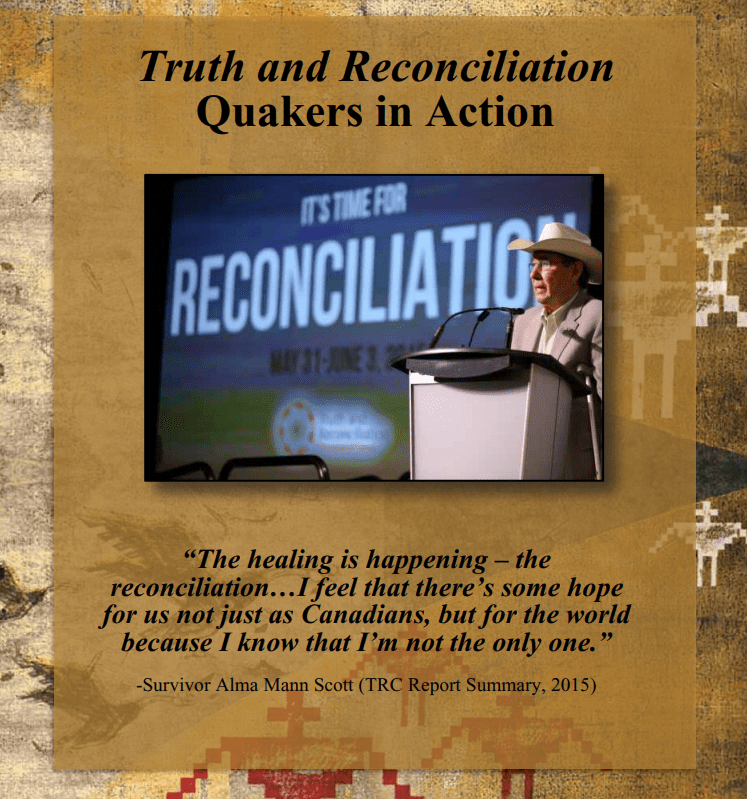
There are renewed calls for truth and reconciliation. Canadian Yearly Meeting has done a great deal of work on this.
These injustices are some of the effects of systems of white supremacy. The concept of Mutual Aid is becoming an increasingly used model for communities working for justice. The idea is to have a horizontal hierarchy, where everyone has a voice. And work to ensure a vertical hierarchy does not develop. Without a vertical hierarchy, there can, by definition, be no superiority. Several of our meetings are supporting existing Mutual Aid communities or considering creating their own. These are opportunities to begin to disengage from the colonial capitalist system and white supremacy. Ways we can model justice in our own meetings and communities.
We can show up for Black Lives Matter and other racial justice events. We can support those who meet with local, state, and Federal government officials. We can show up in the streets to support agitation for change, train in nonviolent civil disobedience, or accompany arrested activists through the justice system.
We can show up, when appropriate, at events of Native peoples, such as the Prairie Awakening ceremony. We can share Indigenous news on social media platforms, so others are aware of these things.
Indigenous leaders in the Midwest have asked us to learn about and find ways to engage in the concepts of Land Back. The website LANDBack Friends has been created and will be updated as our work continues. https://landbackfriends.com/ We pray for guidance for how our committee might work together at the intersection of our responsibilities and those of Ministry and Counsel.
We will continue to seek spiritual guidance, both for what we are called to do, and ways to offer spiritual support for those who are not Friends. There is great spiritual poverty in many communities. Spiritual support will be needed by those who suffer the consequences of environmental and other disasters. And those responding to these disasters.
It is important to understand this work depends on us all working together, in the community. Outside our meetinghouses. Developing friendships in the local community. We encourage more engagement with our youth. They can teach us about justice. We and our meetings will be revitalized.
Many monthly meetings are adapting to these changing ways of doing peace and justice work. Building relationships with communities of black, Indigenous, and other people of color. Exploring ways to be in right relationship with these communities. All of us learning from each other. Sharing our stories. Deepening spiritual connections.
Following are legislative updates for October from Portia K. Skenandore-Wheelock, Congressional Advocate, Native American Advocacy Program, Friends Committee on National Legislation (FCNL). This is a link to information from FCNL related to Native Americans. On that page you can sign up to receive these legislative updates. https://www.fcnl.org/issues/native-americans
The Friends Committee on National Legislation is a national, nonpartisan Quaker organization that lobbies Congress and the administration to advance peace, justice, and environmental stewardship. https://www.fcnl.org/about
“It is long overdue for the United States to acknowledge the historic trauma of the Indian boarding school era. In the 19th and early 20th centuries, Christian churches collaborated with the government to create hundreds of boarding schools for Native American children. The conditions at these schools, some of them Quaker-run, were unspeakable. Now we must work with tribal nations to advance congressional efforts to establish a federal commission to formally investigate boarding school policy and develop recommendations for the government to take further action. Although the wrongs committed at these institutions can never be made right, we can start the truth, healing, and reconciliation process for the families and communities affected as we work to right relationship with tribal nations. Remind your members of Congress of their responsibility to tribal nations and urge them to support the Truth and Healing Commission on Indian Boarding School Policies in the United States Act (S. 2907/H.R. 5444).”
As a constituent and person of faith, I welcome the introduction of the Truth and Healing Commission on Indian Boarding School Policies Act (S. 2907/H.R. 5444) and urge you to support this important legislation.
From the 1860s through the 1960s, U.S. federal boarding school policy sought to assimilate more than 100,000 Native children into white American culture at 367 boarding and day schools operated by 14 different denominations. The traumatic separation of Native children from their families, identity, traditions, and spiritual beliefs was often coupled with psychological and physical abuse administered at these institutions. Heartbreakingly, many of these children never returned home.
The faith community has begun acknowledging our complicity in the historic trauma of the boarding school era and is committed to locating, cataloguing, and sharing boarding school records with the commission and the public as part of the truth-telling process. Given the scale of this effort and the government’s central role in boarding school policy, I call on you to join this important work and establish a federal commission to formally investigate boarding school policy and develop recommendations for the government to take further action.
The intergenerational impact of federal boarding school policy is still felt today. Loss of indigenous languages and cultures, injury to tribal governance and sovereignty, and high poverty, poor health, and growing suicide rates continue to harm tribal communities across the country. The establishment of the commission is an important first step in starting the truth, healing, and reconciliation process for all of us.
I urge you to co-sponsor this vital legislation and make a public statement in support of it and ask that you encourage your colleagues in Congress to do the same.
Washington, DC – The Friends Committee on National Legislation (FCNL) welcomed late last week’s introduction of important legislation to investigate and address the atrocities committed at Indian boarding schools throughout the United States in the 19th and 20th centuries.
Contact Tim McHugh: media@fcnl.org, 202-903-2515
“For far too long, the truth of cultural genocide led by European-Americans at Indian boarding schools has remained hidden in secrecy and ignored. Christian churches, including Quakers, carry this burden of transgression against indigenous people. It is necessary and important for our government to investigate, acknowledge, and report the truth to help us move toward healing the injustice against American Indians, Alaska Natives and Native Hawaiians,” said Diane Randall, FCNL’s general secretary.
“History cannot be undone. But it also can’t be ignored. The faith community must acknowledge our complicity in the historic trauma of the boarding school era and work in solidarity with tribal nations to advance congressional efforts to establish a truth, reconciliation, and healing process for the families and communities affected,” Randall concluded.
Senator Elizabeth Warren (MA), Representative Sharice Davids (KS), and Representative Tom Cole (OK) introduced the Truth and Healing Commission on Indian Boarding School Policies in the United States Act to establish the first formal commission in US history to investigate and document the attempted termination of cultures and languages of Indigenous peoples, assimilation practices, and human rights violations that occurred against American Indians, Alaska Natives, and Native Hawaiians through Indian Boarding School policies. A final report will be due within five years of the commission’s creation.
“This bill is a positive first step toward addressing not only the crimes of the boarding school era but centuries of abuse, maltreatment, and genocide of Native people at the hands of the federal government. Acknowledging the truths tribal communities have always known is an important part of the healing and reconciliation process for all of us,” said Portia Kay^nthos Skenandore-Wheelock, FCNL’s Native American Advocacy Program Congressional Advocate.
“Our work must also continue beyond the Commission in supporting the Indigenous languages, cultures, and peoples these policies were intended to destroy and erase. Only then can we create a future where all our children are safe, loved, and proud of who they are.”
Bill Advances to Protect Native American Cultural Heritage
On Oct. 13, the House Committee on Natural Resources advanced the Safeguard Tribal Objects of Patrimony (STOP) Act of 2021 (H.R. 2930) by unanimous consent. This bipartisan bill would prohibit the export of Native American cultural items that were illegally obtained, provide for the return of items, and double criminal penalties for individuals convicted of selling or purchasing human remains or illegally obtained cultural items.
“Throughout history, Native American cultural items such as human remains, sacred objects, and objects of cultural patrimony have been looted and sold to collectors in our country and abroad,” said Rep. Leger Fernández (NM-3) during an earlier hearing on the bill. “The STOP Act gives Tribes, Pueblos, and Nations a tool to close the door on the illegal exportation of cultural objects.”
Similar legislation (S. 1471) has been approved by the Senate Indian Affairs Committee and is awaiting action by the full Senate.
As we bear witness and lobby in solidarity with Native Americans, we also honor the Nacotchtank tribe on whose ancestral land the FCNL, FCNL Education Fund, and Friends Place on Capitol Hill buildings stand. They are also known as the Anacostans, the Indigenous people who lived along the banks of the Anacostia River, including in several villages on Capitol Hill and what is now Washington, D.C. By the 1700s, the Nacotchtank tribe had merged with other tribes like the Pamunkey and the Piscataway, both of which still exist today.
I find it increasingly difficult to make sense of what is going on today. All the terrible things I had anticipated for the future are suddenly happening now. And things I never imagined, like the assaults on truth and science, come at a time when they are desperately needed.
There are all kinds of ways to divide/categorize the American public: there’s the urban/rural divide, the differences between Republicans and Democrats, people who are college educated versus those who are not…One distinction that is rarely highlighted but incredibly important doesn’t even have a descriptive term–it’s the difference between people who recognize and respect evidence and those who don’t.
Think of it as the difference between people who accept the Enlightenment emphasis on empirical reality and those who are “faith-based.” Being faith-based, at least as I am using the term, doesn’t necessarily mean “religious.” It means preferring an ideological commitment–something taken on faith– to demonstrable reality, and a number of people–many of them highly educated–fall into that category.
There’s nothing wrong with theory, but it’s a framework for empirical exploration, not a substitute. In the end, real world evidence is what matters.
One of the first lessons I learned as I began my career in medical research, was to make sure I wasn’t trying to make evidence fit into my preconception of what the results should be. And I was impressed to discover further research sometimes made sense of a piece of the puzzle we discovered previously that had not fit my expectations.
Or new data might provide further evidence that my preconceptions were wrong. That strengthened my faith, that there is much beyond what we think we know. Mysteries to unravel.
Kennedy states faith-based, as she is using the term, “means preferring an ideological commitment–something taken on faith– to demonstrable reality.” A choice to hold onto beliefs even when the evidence refutes those beliefs.
The question is whether it is possible to continue to believe something when evidence shows that to be false? My answer is no, because I believe the framework of science, a system of verifiable evidence, is part of creation.
But others profess to believe the opposite. People who are told to not believe what they see. Which leaves them open to being manipulated. And not open to persuasion, even when shown evidence contradicting their belief.
It has been common in western thought, from ancient times up until the present, to view reality as divided between an ideal world of spirituality and perfectedness, and a counterpart world of material and practical reality which is fallen and corrupted. This concept began with Plato and was given a theological overlay by Christianity. It invites the idea that truth and beauty are attractive but insubstantial, and that they are impossible of realization, while the demands of practical reality inevitably require various violent and ugly compromises, and radical departures from ideal concepts of purity and goodness.
Quaker spirituality, as well as other minority streams of Christian mysticism, and most eastern spiritualities, reject this dualistic view of reality. They affirm a true understanding of our situation, which is that the mundane and the divine are one. What so many mistakenly see as realms separate and apart are, in truth, so interdependent that one cannot be understood, or even spoken of, without the other.
Peace or Justice: Which Has Precedence? A Quaker Perspective on the Papal Encyclical Letter Pacem in Terris Issued by Pope John XXIII on April 11, 1963 By Daniel A. Seeger
To me, faith-based includes truth supported by evidence in science. But it also includes beliefs that are part of a spiritual framework. There is so much in our world that cannot be proven with scientific evidence.
I was raised and continue to be part of a faith community, the Religious Society of Friends, or Quakers. I attend Sunday meetings for worship, where we sit together in silence, trying to hear what God, or the spirit, or the Creator, or Inner Light is saying to us. Sometimes someone discerns a spiritual message they share with the meeting, speaking out of the silence. We believe the Spirit continues to be active in the world, in our lives, today.
These days, as remains of thousands of children who attended the Native residential schools continue to be located, the question is how this could happen? Especially since those institutions of forced assimilation were run by various religious groups, including Quakers.
I don’t know. Such a terrible history does make me question what I thought I was being led, by the Spirit, to do, that might be causing harm today. I’m praying to be shown what I might do now related to this tragedy.
My grandmother, Lorene Standing, said the will of God is often revealed in a series of small steps. I thought that meant a series of spiritual messages and that has been my experience.
But also, looking back over our lives, the series of actions we took, the decisions we made, map the path traveled. Spiritual guidance can help us stay on the path, might tell us what action to take. Each step gives us experience needed to continue on the path. We stray from the path at times. But learn by making mistakes.
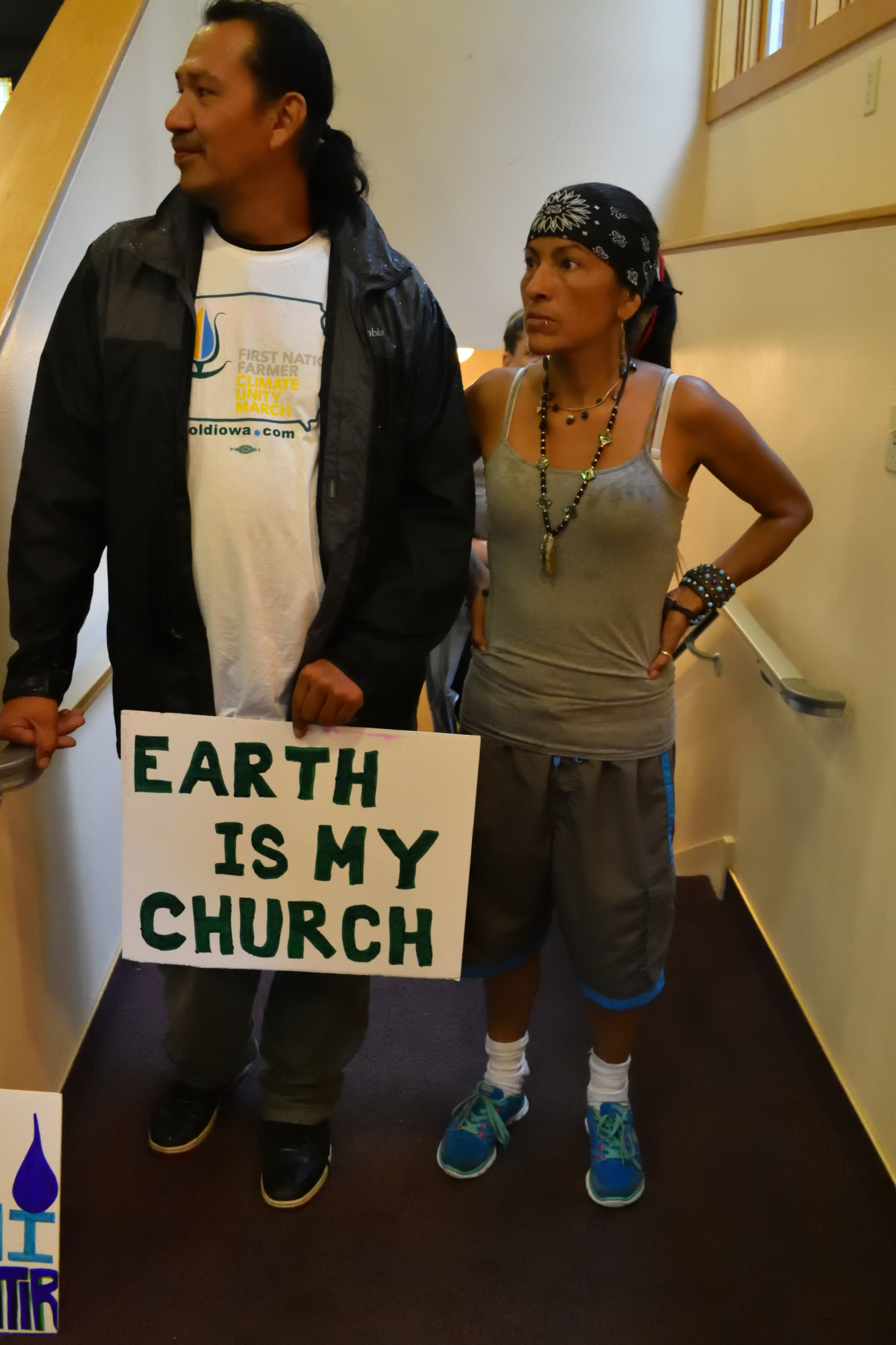
This is the third anniversary of the First Nation-Farmer Climate Unity March (described below). When I learned about the March, I immediately felt a leading from the Creator this was something I should do. The experiences during the March were transformational for me.
The Spirit was important in numerous ways. One of the reasons I wanted to join the March was to learn more about Indigenous spirituality, and I did.
The article below describes how my Quaker community supported us spiritually during the March.
The Spirit created the opportunity for me to talk with my new friend, Matthew Lone Bear, about Quaker involvement with the native residential schools. And for him to share a story of the impact of those schools on his own family. (These stories are found on the First Nation-Farmer Climate Unity March website https://firstnationfarmer.com/ )
Our experiences on the March have made it possible for us, native and nonnative people, to work together in many ways since.
Here is a link to the First Nation-Farmer website, where there are many stories, photos and videos from the March. And a link to the website LANDBACKFriends which is about work going on now related to the concepts of LANDBACK.
These are perilous times. Ferocious wildfires, melting glaciers and permafrost, severe drought, and devastating storms show rapidly evolving environmental chaos. Political, economic and social systems are breaking down.
There is also hope as we work together to address these challenges. Mutual Aid works because it is based upon people working and being together in their local communities, solving local problems. And LANDBACK is a framework for Indigenous peoples to teach us how to work to repair our relationships with Mother Earth and each other. It is because of the friendships that formed during the March that many of us are working together on Mutual Aid and LANDBACK.
Following is an article, written shortly after the March, published in On Creation, the publication of Quaker Earthcare Witness. The article is no longer online.
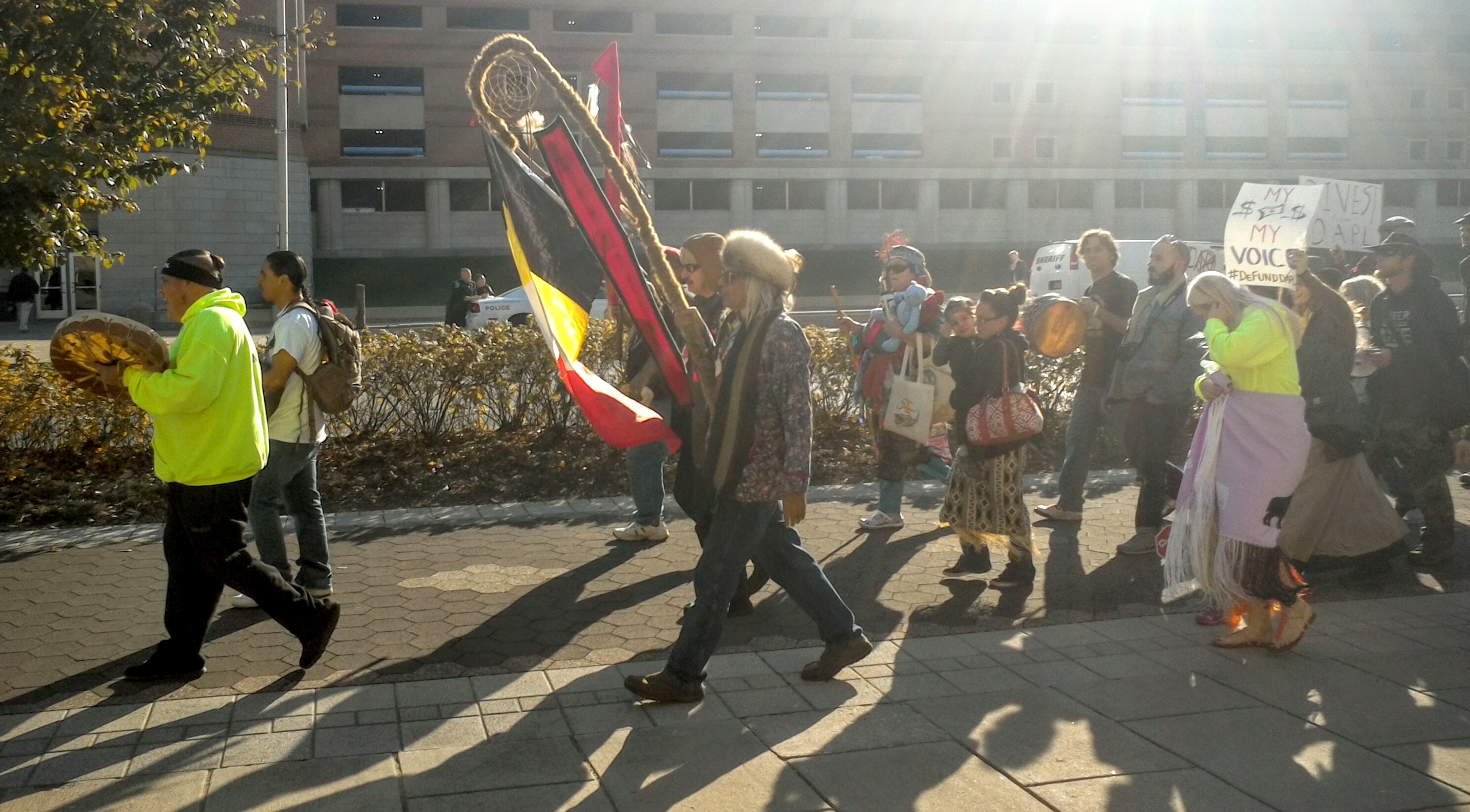
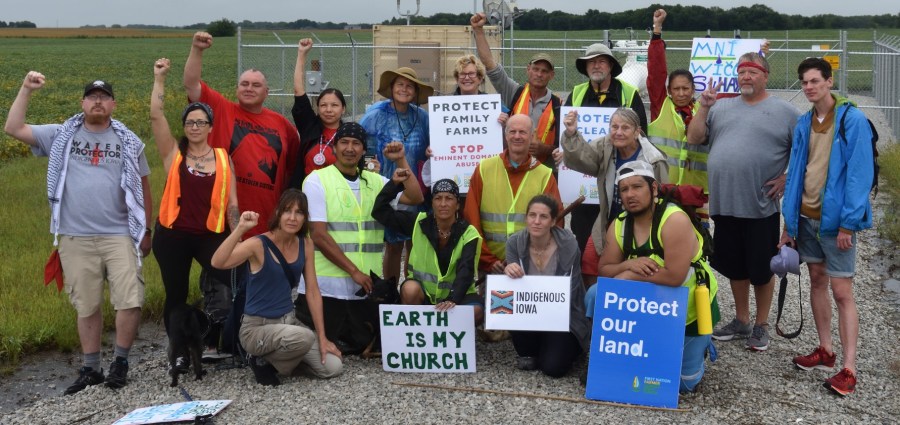
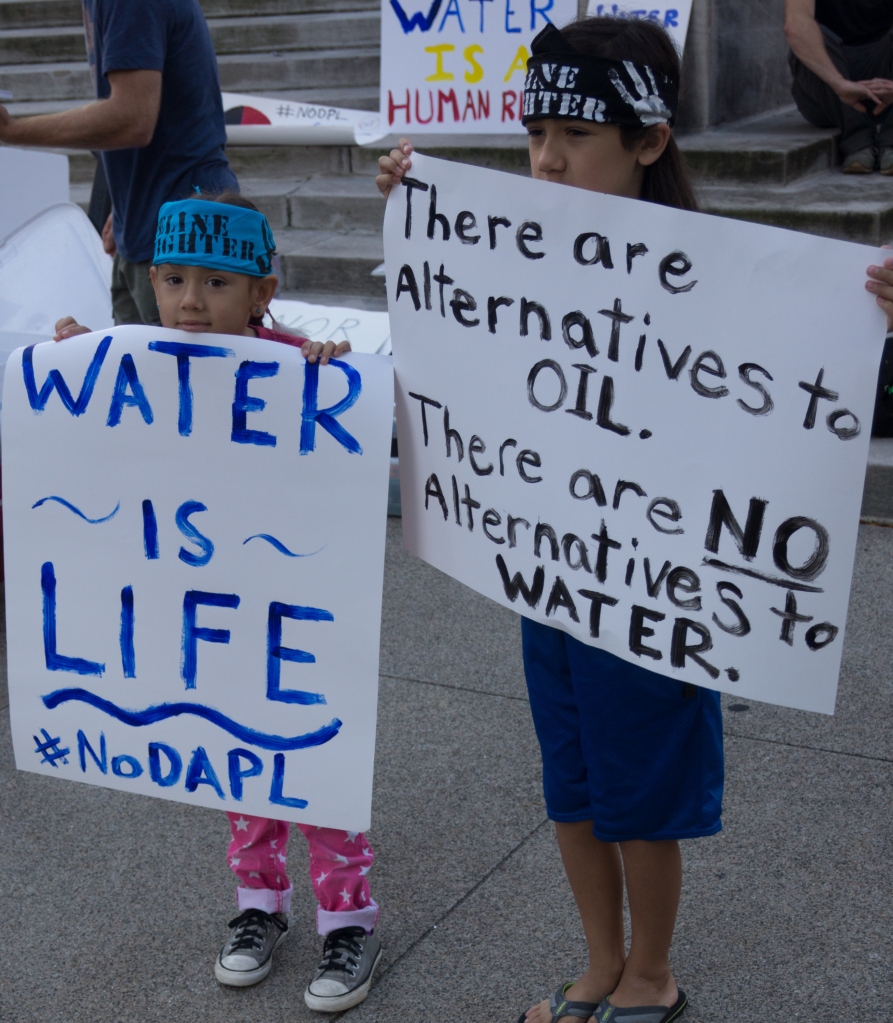
Iowa Yearly Meeting (Conservative) Friends Peter Clay and I recently walked on the First Nation-Farmer Climate Unity March. A group of about thirty that included nearly a dozen Native Americans walked 94 miles along the route of the Dakota Access Pipeline from September 1 – 8, 2018. One of the goals of the March was to bring attention to a case before the Iowa Supreme Court about the improper use of eminent domain to force Iowa farmers to allow construction of the pipeline on their land.
After walking between 9 and 15 miles, most evenings a community forum was held to discuss topics such as farming practices, or the consequences of the pipeline construction. One evening my Scattergood Friends School classmate Lee Tesdell discussed some of his progressive farming practices. Christine Nobiss discussed ways Native farming practices are better for the earth and water. This was an example of how this March helped us come together. As Manape LaMere, one of the headsmen from Standing Rock said, the purpose of the March was to make it possible for us to work together in the future. To do so, we needed to trust each other, and to trust each other we needed to understand each other.
During this March, Quakers in my local meeting, Bear Creek, often sent email messages of encouragement, and held us in their prayers. One of my Quaker friends, Liz Oppenheimer, invited people to offer spiritual support for our March in a couple of ways. One was via a telephone conference call every morning we were marching, from 8:30 to 9:00 am.
The other way Liz created for others to support us was by creating a Facebook group called “Meeting for Worship: Iowa’s Climate Unity March”. Following are a few of the messages shared on that Facebook page:
I see that Jeff has posted some of his recent writing about the march and its issues. My request is that we return to Jeff’s initial questions— sharing our reactions to the idea behind this march, as well as to the issues of pipelines, indigenous rights, misuse of eminent domain, etc.
As we share our own wonderings, questions, and struggle, I hope we can better accompany Jeff, Peter Clay, and other marchers.
George Fox suggested to us that if we answer that of god in others that we can then walk cheerfully over the earth. As I think about Jeff and Peter and the new sisters and brothers they will meet as they march, I realize that this sentiment works the other way also. As they walk over the earth they will then be able to answer to that of god in others.
This morning on the conference call for worship, we heard a vocal prayer of gratitude to Peter Clay, Jeff Kisling, and the other marchers and organizers of the march. We also heard the joyous hymn “Trees of the Field.”
After other Friends had left the call, and literally as my finger was about to hit the Hang Up button on my phone just past 9:00 am, another Friend joined the call. It was Jeff!!
He wants us to know that the marchers and organizers know we are holding them all in prayer and they are very appreciative of our support in this way. When I replied “It’s such a small thing we do,” Jeff reminded me “No, no it’s not.”
We are so blessed to be connected this way, no matter what form our march and our journey takes. And to those of you who are carving out time each day to hold the Climate Unity March in prayer, regardless of when, where, or how, all of us thank you.
Each morning of the March we gathered in a circle to hear about the day’s route and address any questions. The first morning I shared this Quaker support with my fellow marchers during our circle gathering, who expressed appreciation for this.
Some of the most powerful experiences I had during the March were times when prayers were offered. We stopped for prayers every time we crossed the route of the Dakota Access Pipeline. I was honored to be given the opportunity to give prayers at the pipeline crossing just before we reached Pilot Mound. I briefly described Quaker worship, then our circle, holding hands, worshiped in silence for a while.
Apocalyptical scenes of floods and huge, ferocious fires dominate the news. Hundreds of square miles destroyed. Huge clouds of smoke stretch across the country. We feel hopeless, not only to control the devastation, but realizing this environmental chaos will only worsen.
Many long to return to normal, to leave this trauma behind. But those of us who live near to the land, who can feel its pulse, hear its secrets whispered in the trees, know that this is just another dream, that “normal” is now lost, a nostalgic memory. The pandemic has taught us about uncertainty, and the need to listen even more closely to the Earth, to sense her present imbalance. Despite all our computer models and plans for a future of green economic growth, we do not know where we are headed (or heading). Here on the coast there is no plan for living with the wildfires, except a prayer and a bag packed.
Meanwhile, in East Africa, the Somali pastoralists have already moved on, after watching their animals die in the years of drought. They’ve left the land they’d walked for centuries, moving into camps. They know that climate change brings hunger and migration, as they suffer the effects of our use of fossil fuels. They did not put carbon into the atmosphere. They are too poor to pollute. But they are among the first to suffer. Here our lives appear the same, food lines may grow, poverty increase, but for most of us our lives are not yet broken. But we can feel how something essential has changed, a barrier passed. Do we feel the tipping point first in our souls, before the fires and smoke turn the air red?
Will the fires and floods finally awaken us, turn our attention back to the living Earth? Or have we lost that connection, that place of belonging? How long before we are forced to wake from this nightmare of alienation? I used to imagine how Spring would come after the hard Winter of materialism, after all those years when we put profit before people, before the more-than-human world. Now, even amidst all the colors and sweetness, I know that this is not the real Spring I was waiting for, but just a moment of wonder, of magic, before the land becomes too dry. Before climate crisis creates a bleaker world. Before we too begin to be broken.
Fire Season by Llewellyn Vaughan-Lee, syndicated from Parabola, Aug 19, 2021
The fires of suffering become the light of consciousness.
Eckhart Tolle
But it is not hopeless.
People often mistake hope for a feeling, but it’s not. It’s a mental discipline, an attentional practice that you can learn. Like any such discipline, it’s work that takes time, which you fail at, succeed, improve, fail at again, and build over years inside yourself.
Hope isn’t just looking at the positive things in this world, or expecting the best. That’s a fragile kind of cheerfulness, something that breaks under the weight of a normal human life. To practice hope is to face hard truths, harder truths than you can face without the practice of hope. You can’t navigate dark places without a light, and hope is that light for humanity’s dark places. Hope lets you study environmental destruction, war, genocide, exploitative relations between peoples. It lets you look into the darkest parts of human history, and even the callous entropy of a universe hell bent on heat death no matter what we do. When you are disciplined in hope, you can face these things because you have learned to put them in context, you have learned to swallow joy and grief together, and wait for peace.
It is not hopeless as long as we have the wisdom, faith, courage to face hard truths. Sadly this wisdom is difficult to find today. As long as we try to hide from hard truths, we will be living in, paralyzed by fear.
The following is from the movie After Earth.
“Fear is not real. The only place that fear can exist is in our thoughts of the future. It is a product of our imagination, causing us to fear things that do not at present and may not ever exist. That is near insanity. Do not misunderstand me, danger is very real, but fear is a choice.”
I’m of the firm opinion that a system that was built by stolen bodies on stolen land for the benefit of a few is a system that is not repairable. It is operating as designed, and small changes (which are the result of huge efforts) to lessen the blow on those it was not designed for are merely half measures that can’t ever fully succeed.
So the question is now, where do we go from here? Do we continue to make incremental changes while the wealthy hoard more wealth and the climate crisis deepens, or do we do something drastic that has never been done before? Can we envision and create a world where a class war from above isn’t a reality anymore?”
Ronnie James
Can we envision and create a world where a class war from above isn’t a reality anymore? That quote from my friend Ronnie James captures what Mutual Aid is about. Rejecting vertical hierarchies of control and instead embracing a flat structure where everyone has a voice. Where we are learning, together, to vanquish fear and create a new world. Becoming dragon slayers.
The following quote has captured my imagination. That dragons represent fear. Fear is what we need to slay. To practice hope is to slay the dragons, to confront fear and move beyond it.
At Yearly Meeting 2015 Friends approved Minute 2015.08.33 calling on individual Friends to read the Report of the Truth and Reconciliation Commission (TRC) and the Calls to Action. The Minute asks Friends to listen expectantly to the Spirit for guidance on what steps they may be personally led to take. It also asks Monthly Meetings and Worship Groups to engage with the materials shared by the Indigenous Rights committee of Canadian Friends Service Committee (CFSC) and prayerfully consider what actions they may take in working for reconciliation in their communities. We committed to minute our progress for the year at this Yearly Meeting.
Much has happened since our last Yearly Meeting (2015):
• We now have a new federal government that has stated it accepts all of the TRC’s Calls to Action and that it will implement the United Nations Declaration on the Rights of Indigenous Peoples. This has changed the dynamic and the tone of public discourse on Indigenous Peoples’ rights in Canada.
• CYM and CFSC jointly issued a Quaker Response in March 2016 to Call to Action 48, and we submitted this to the TRC. We affirmed in our statement that we have “endorsed, celebrated and committed to implement the UN Declaration on the Rights of Indigenous Peoples” as stated in previous minutes (2010.08.50, 2009.08.70). We received a warm reply from Justice Murray Sinclair, Chair of the TRC, thanking us for our work. He particularly liked that we had committed to an annual review of our progress.
• CYM and CFSC also collaborated with other faith bodies, some of which were church parties to the Indian Residential Schools Settlement Agreement and some of which were not, in issuing a joint ecumenical statement on Call to Action 48. CFSC’s Indigenous Rights coordinator participated in drafting. This was a worthwhile process in working to find common ground amongst faith bodies regarding their role in the reconciliation process.
• CFSC’s Indigenous Rights committee educated Friends on such critical issues as free, prior, and informed consent; genocide; and intergenerational trauma.
• Meetings and Worship Groups have visited nearby Indigenous communities; organized discussion groups in partnership with local Indigenous Peoples; are attending educational events such as workshops and film screenings; are learning about and honouring Friends’ role as Treaty partners; and are placing the UN Declaration in poster and booklet form in their Meetinghouses.
• Some individual Friends have been led to stand alongside Indigenous Peoples in defending their traditional territories, including civil disobedience resulting in arrest.
During the year, CFSC has explored the work of Reconciliation with many Meetings, Worship Groups and Half Yearly Meetings. As Friends engage in the work of reconciliation, we are committed to grounding our actions in our Spiritual practices, particularly of speaking to that of the Creator in everyone. Let Friends first listen to the concerns of Indigenous Peoples. We know it is not sufficient to be well-intentioned and make assumptions about what is best for Indigenous Peoples without asking what it is they want and need. All actions require the guidance of the Indigenous Peoples involved and need to be done with respect, cooperation and ongoing consultation.
We, as Friends, also need to be open to being challenged in our assumptions about the many destructive facets of colonial legacies and continuing racist practices and policies that constitute Canada’s historical and contemporary realities. We acknowledge that part of our journey is to decolonize our own thinking and sit in the discomfort and pain of confronting where we need to deepen our understanding, bear witness, and transform our behaviour.
While Friends corporately have often been on the forefront of advocating for Indigenous Peoples’ human rights, it is now time to prioritize this work and take it to the next level. Friends recognize that reconciliation requires us to continue to learn, grow, and establish and nurture relationships with Indigenous partners. We are a Society of Friends, and friendship entails a relationship greater than simply understanding our colonial history.
As Friends, we commit to walking the path of friendship, following these instructive words:
I think about what I want for my children and grandchildren. What I want for them is to be loved and love other people in this country. Not to tolerate them, not to go to our respective corners and stop hurting each other, but to be wrapped up and engaged in each other’s lives.
Douglas White, Kwulasultun (Coast Salish name), Tliishin (Nuu-chah-nulth name), Director of the Centre for Pre-Confederation Treaties and Reconciliation (VIU), former Chief of Snuneymuxw First Nation
For Canada to grow and heal we must be active participants in a paradigm shift, moving from colonialism to a new reality based on respect for Indigenous Peoples’ Human Rights. We are reminded that we have CFSC’s Indigenous Rights committee to assist us and provide resources for this work.
We ask monthly meetings and worship groups:
• To continue to educate themselves, including children and youth, about the doctrine of discovery, the ongoing effects of colonialism, the UN Declaration, residential schools and their legacy (including the TRC Report), the history of the land on which they live, and reconciliation efforts. • To formally acknowledge the traditional territories where their Meetings are located and engage in processes of reflection on the meaning of this. Acknowledgments can be accomplished through signage, statements during the close of Meeting, and inclusion in information provided to any community groups who use Meeting House space. • To find out about current concerns of Indigenous Peoples from those territories, including land appropriation or resource development, with which the Meeting could be engaged. • To investigate projects of cultural revitalization that Indigenous Peoples are involved in and discern if there is an appropriate role (including funding) that Friends can play. • To uphold and support individual Friends involved with grassroots Indigenous rights work and provide spiritual support to Friends led to this work. This might include offering committees of care and approving minutes of support. • To report back annually through the Indigenous Rights committee of CFSC on actions taken. We ask CFSC to collate such information in their CYM report.
In these increasingly troubled times I find myself thinking about the concept of sensemaking, the action or process of making sense of or giving meaning to something, especially new developments and experiences.
It is increasingly difficult to make sense of all that is going on today. All the bad things I had anticipated for the future are suddenly happening now. And things I never imagined, like the assaults on truth and science, come at a time when they are desperately needed.
At the collective level, a loss of sensemaking erodes shared cultural and value structures and renders us incapable of generating the collective wisdom necessary to solve complex societal problems like those described above. When that happens the centre cannot hold.
Threats to sensemaking are manifold. Among the most readily observable sources are the excesses of identity politics, the rapid polarisation of the long-running culture war, the steep and widespread decline in trust in mainstream media and other public institutions, and the rise of mass disinformation technologies, e.g. fake news working in tandem with social media algorithms designed to hijack our limbic systems and erode our cognitive capacities. If these things can confound and divide us both within and between cultures, then we have little hope of generating the coherent dialogue, let alone the collective resolve, that is required to overcome the formidable global-scale problems converging before us.
sensemaking the action or process of making sense of or giving meaning to something, especially new developments and experiences
Celebrants have an important part to play in the legacy humanity caries into the future. I suggest that our responsibility as ceremonialists, as humans who help other humans meaningfully connect with the web of life, is to find ways now to help people connect with the story of this world’s beauty, even as the world we love recedes. I believe there is a gift we can bring to our communities, to help people learn the art of losing. To help us all to meet the rising tides.
I believe faith communities and Indigenous ways need to play a crucial role in helping us move through the oncoming, increasingly severe chaos. Faith can provide sensemaking for those who have no framework for making sense of our broken systems.
People of faith can be celebrants. Indigenous peoples are celebrants, their cultures based upon a timeless connection to Mother Earth.
The problems before us are emergent phenomena with a life of their own, and the causes requiring treatment are obscure. They are what systems scientists call wicked problems: problems that harbour so many complex non-linear interdependencies that they not only seem impossible to understand and solve, but tend to resist our attempts to do so. For such wicked problems, our conventional toolkits — advocacy, activism, conscientious consumerism, and ballot casting — are grossly inadequate and their primary utility may be the self-soothing effect it has on the well-meaning souls who use them.
If we are to find a new kind of good life amid the catastrophes these myths have spawned, then we need to radically rethink the stories we tell ourselves. We need to dig deep into old stories and reveal their wisdom, as well as lovingly nurture the emergence of new stories into being.
How do we rethink the stories we tell ourselves? We need to let go of the stories we have discovered to be untrue. Learn about, and embrace stories of other cultures. Seek, and really listen for, Spiritual guidance. Then actually implement that guidance.
One idea is to share stories from earlier times. “We need to dig deep into old stories and reveal their wisdom.” The Quaker Stories Project is an example. https://quakerstories.wordpress.com/
We need to re-think those stories. To consider what they say about our world today. To see if they represent something we have lost. Something it might be good to return to. The past leading into the future.
Seeking out new people and experiences are ways we can create new stories. For more than a year I have been learning new stories from my friends in the Mutual Aid community. We have been learning, together, how to live and work together in ways without a vertical hierarchy. Where decisions no longer come from leaders who try to wield power without consent. As my friend Ronnie James, who is my Mutual Aid mentor says:
I’m of the firm opinion that a system that was built by stolen bodies on stolen land for the benefit of a few is a system that is not repairable. It is operating as designed, and small changes (which are the result of huge efforts) to lessen the blow on those it was not designed for are merely half measures that can’t ever fully succeed.
So the question is now, where do we go from here? Do we continue to make incremental changes while the wealthy hoard more wealth and the climate crisis deepens, or do we do something drastic that has never been done before? Can we envision and create a world where a class war from above isn’t a reality anymore?”
Ronnie James
Our ancestors are ashamed of us, my friends. We are the people who disgraced the past, to create a myth called “the future.” That myth failed because there was no soul in it, no depth, no humanity. It was a vision of power, control, slavery, and violence, if we strip the gloss away
It all comes down to what type of ancestor I want to be for my descendants. Do I want to be a regular nobody that did nothing to protect our planet or do I want to be like Crazy Horse who fought and died for the little bit of land that we have left to protect? We have that chance right now to make that decision. This kind of resistance runs through all of our blood because we are the Indigenous Peoples of these lands. It’s at vital choice for the survival of humankind.
























 LANDBACK Friends