How to watch and listen to National Day for Truth and Reconciliation on CBC

Tune into a day of special programming across all CBC platforms to honor the first National Day for Truth and Reconciliation on September 30

CBC is marking the first National Day for Truth and Reconciliation with a full day of programming and content showcasing First Nations, Métis and Inuit perspectives and experiences across CBC TV, CBC News Network, CBC.ca, CBC Kids, CBC Radio One and CBC Music including a commercial-free, primetime broadcast special, National Day for Truth and Reconciliation.

How to watch and listen

All Day:

An Indigenous-led team of journalists will deliver timely news features and special reports throughout the day from the CBC News investigating Residential Schools on THE NATIONALCBC NEWS NETWORKWORLD REPORTTHE WORLD AT SIX and CBC.ca/Indigenous

Thursday, September 30 at 8 p.m. local time (9 p.m. AT, 9:30 p.m. NT)

NATIONAL DAY FOR TRUTH AND RECONCILIATION – In recognition of the new federal statutory holiday, also known as Orange Shirt Day, this unique one-hour, commercial-free primetime special — hosted by JUNO Award-winning artist Elisapie — honours the stories and perspectives of Indigenous Peoples affected by the tragedies of the residential school system in Canada, with musical tributes and ceremonies in Indigenous communities across the land. The broadcast special is conceived and created by The National Centre for Truth and Reconciliation (NCTR) hosted by the University of Manitoba and produced by NCTR in collaboration with Insight Productions, in association with CBC/Radio-Canada and APTN. The one-hour national special will broadcast on CBC TV, CBC Gem, CBC Radio One and CBC Listen.

WATCH: Thursday, September 30 at 9 p.m. on CBC and CBC Gem

WE KNOW THE TRUTH: STORIES TO INSPIRE RECONCILIATION – A CBC Manitoba documentary that recasts Canada’s history and future through the empowerment of Indigenous Peoples. Meet the people who are challenging the history of Canada and residential schools, and creating change on their own terms. Reflect with residential school survivors and be inspired by those who are working hard to keep their culture and languages alive.

LISTEN: Saturday, September 25 at 4 p.m. and Tuesday, September 28 at 1 p.m. on CBC Radio One

UNRESERVED – Join Rosanna Deerchild on Unreserved for a revealing, poignant and emotional conversation with the Honorable Justice Murray Sinclair, former Senator and Lead Commissioner of the Truth and Reconciliation Commission. In this intimate, hour-long interview they discuss reconciliation⁠ — how far we’ve come, how far we have left to go and who is responsible for taking the journey.

LISTEN: Thursday, September 30 at 10 a.m. on CBC Radio One

Q – Tom Power speaks with Alanis Obomsawin, one of the most accomplished documentary filmmakers in Canada, and one of the most acclaimed Indigenous filmmakers in the world. She is the winner of the Glenn Gould Prize, the prestigious award given for a unique lifetime contribution that has enriched the human condition through the arts. She was also honoured at this year’s Toronto International Film Festival with a career retrospective of her work called ‘Celebrating Alanis Obomsawin’. The video interview with Alanis Obomsawin will be available on cbc.ca/q.

LISTEN: Thursday, September 30 at 12 p.m. noon on CBC Radio One

ANSWERING THE CALL: Stories of resistance, reclamation and resilience on Canada’s National Day for Truth and Reconciliation – Host Rosanna Deerchild explores how Canada is doing on the Truth and Reconciliation Commission’s calls to action and how First Nations across Canada are demolishing, redeveloping, and reclaiming former residential school sites. JUNO Award-winning musician William Prince will discuss the role artists play and share how his family is marking the day. Finally, retired senator Murray Sinclair, who chaired the Truth and Reconciliation Commission, offers his thoughts on the future of reconciliation in Canada.

WATCH and LISTEN: MASHKAWI-MANIDOO BIMAADIZIWIN SPIRIT TO SOAR – Available to stream in Anishinaabemowin on CBC Gem, and premiering in English on CBC TV and CBC Gem on The Passionate Eye, 9 p.m. (9:30 NT) Friday, September 24, with an encore broadcast on September 30 (2:30 p.m./ 6:30 p.m. NT)

Directed by Tanya Talaga and Michelle Derosier, MASHKAWI-MANIDOO BIMAADIZIWIN SPIRIT TO SOAR examines the hard truths around the deaths of First Nations students in Thunder Bay, truths Canada continues to ignore: racism kills, especially when it presents as indifference. It’s a look at how families and communities struggle to carry on while pursuing justice for their loved ones and equity for their people, and it follows Tanya Talaga’s personal journey as she explores her own Indigenous identity.

Also now streaming on the CBC Listen app is a companion podcast to this documentary, SPIRIT TO SOAR: WHERE WE COME FROM, a four-part podcast about four disruptions to Indigenous life, and ways to move forward together. The story is told first in Anishinaabemowin by Elder Sam Achneepineskum and then in English by Jolene Banning.

CBC Gem

THE TRUTH & RECONCILIATION COLLECTION will be available starting Sept 24 on the free CBC Gem streaming service with more than 20 documentaries and films honouring the history, heritage and diversity of First Nations, Inuit and Métis Peoples, including THE SECRET PATH, Gord Downie’s animated film that tells the true story of Chanie Wenjack and INENDI, Sarain Fox’s journey to preserve her cultural legacy by collecting stories from her family’s Matriarch.

CBC Music

Throughout the day on September 30, CBC Music will feature Indigenous artists and composers from 6 a.m. to midnight. CBCMusic.ca will offer stories in the lead up to September 30 include a feature on where Indigenous musicians have experienced moments of truth and reconciliation, an exploration of the art within protests and a collection of songs and lyrics about reconciliation.

CBC Books

Visit CBC.ca/thisplace for the CBC Books podcast, THIS PLACE. The original series, adapted from the award-winning graphic novel, explores 150 years of Indigenous resistance and resilience. Learn more with additional CBC Books content covering the 20 authors and illustrators who made the graphic novel, a cast roundup of the Indigenous actors who voiced the dramatizations and a list of some of the Indigenous heroes we meet in the series.

CBC Kids and CBC Kids News

CBC Kids News will feature an “Ask an Indigenous person anything” segment where four Indigenous people (First Nation, Inuit and Métis) under 30 meet and chat with kid contributor Isabel DeRoy-Olson to discuss reconciliation and take questions from kids across Canada. Additionally, CBC Kids News will feature two segments for a tween audience outlining what reconciliation is and why it is needed, and how to be a better ally.

CBC Kids is recognizing Sept. 30th with an hour-long special from the award-winning animated series MOLLY OF DENALI plus original content from Studio K all about Indigenous Heritage and Culture.

CBC Arts

For National Truth and Reconciliation Day, CBC Arts will be doing a special edition of the “Poetic License” video series featuring four poets including Kahsenniyo Williams from the Mohawk Nation Wolf Clan, who will be doing a piece called Decolonial Love. Also available that day, CBC Arts has a written feature that asks Indigenous curators, cultural programmers and artists to highlight a piece of art that speaks to the ideas behind Truth and Reconciliation, including contributions from writer Alicia Elliott and visual artist Adrian Stimson.

CBC Sports

CBC Sports will feature interviews and opinion pieces by and with Indigenous athletes including Hunter Lang, Michael Linklater and Kali Reis.

Click here for the link


____________________________________________________________
Questions about the titleandrightsalliance list?  Contact eneel@ubcic.bc.ca

Follow us http://twitter.com/UBCIC
Ethnic studies so history will not be erased

It is a paradox that education is crucial for healing, in this case healing from the intergenerational traumas suffered by Indigenous peoples in the lands called the United States and Canada. And yet, who will teach these subjects? Care must be taken to avoid triggering that might occur for Indigenous educators.

The following quote references Alberta’s Teacher Qualifications Standard that I wrote about yesterday.

As the National Day for Truth and Reconciliation approaches, we can expect Canadian teachers are thinking about how they can better weave Indigenous perspectives into their lesson planning.

In the past, events like this rarely made it as national news, staying inside our Indigenous communities where the pain remained hidden from the rest of Canada. Now, teachers are talking about them with their students — how history and society influence individual situations of race-motivated violence and cultural genocide. It’s our responsibility to make sure they are equipped to teach the truth and acknowledge the important role schools play in reconciliation.

But how do we do that when many of our educators were not taught about residential schools when they were students?

This question does not have one answer. In 2016, the Hon. Justice Murray Sinclair, former chair of the Truth and Reconciliation Commission, said, “Education got us into this mess and education will get us out of it.” After generations of miseducation, it will take generations of real truth-sharing and knowledge-building within our provincial education systems to achieve reconciliation.

We owe it to Indigenous educators who are triggered and challenged to deliver education around a topic like residential schools that have impacted them. Educators like me, who when viewing the images of children with their plain clothes, short hair, and empty eyes — identities stripped — still struggle to separate the pain we hold from lesson planning.

We also owe it to non-Indigenous educators who lack confidence in teaching because they weren’t taught the truth about the atrocities of the residential school system. This is a significant blocker to the successful integration of truth-telling in our classrooms, which can be solved by supporting educators in their journey of learning.

We must ensure the materials passed down to educators are written accurately by authentic voices. We need ongoing government funding and access to professional learning programs. Alberta is one province that does this well. Its Teacher Qualifications Standard requires educators to take courses in foundational knowledge of Indigenous history.

We owe it to all students to bring truth and drive reconciliation in classrooms by Linda Isaac & John Estabillo, National Observer, September 16, 2021

Education got us into this mess and education will get us out of it.

Hon. Justice Murray Sinclair

Last year, as a massive uprising against systemic racism swept across the worldactivists fighting for Black liberation and racial justice put radical demands against institutional racism on the table, such as abolishing and defunding the police. Another key step toward challenging institutional racism is the push for ethnic studies and teaching about systemic racism in U.S. schools. I am part of that fight in California.

Racism has been in the United States for over 400 years, stemming from slavery and genocide. However, Trump’s emboldening of white nationalism and last year’s protests against police violence have raised the level of urgency to fight against systemic racism. In this crucial moment, the push for ethnic studies is an important fight because accurate, anti-racist, multicultural educational curricula are vital to creating a better, more just society.

I was one of the very few African American men to graduate from Pittsburg High School and attend Stanford University, where I earned my bachelor’s in International Relations. In my decade-long teaching and writing career post-Stanford, I’ve seen how the education system is a site of institutional racism that directly impacts non-white students. I’ve also written about other forms of systemic racism, such as the police and gentrification. Ethnic studies, an educational discipline that teaches non-white students their own history and empowers them to be agents of their own destiny, is crucial to challenging institutional racism within the education system.

As ethnic studies programs grow around the country, right-wing pushback is also mounting — overlapping with efforts to ban the teaching of critical race theory in U.S. schools. Critical race theory and ethnic studies are not the same: Critical race theory is a highly academic, and rather esoteric, legal theory that analyzes the manifestations of racism in U.S. law; it is mostly taught in law schools, not in K-12 public education. Meanwhile, ethnic studies focuses on the histories, cultures and struggles of marginalized racial/ethnic groups, especially as they relate to the overall history of the United States.

I’M FIGHTING FOR ETHNIC STUDIES SO MY HISTORY WON’T BE ERASED By Adam Hudson, Truthout, September 22, 2021

Teaching Quality Standard

It is difficult to realize how close we have come to the erasure of Indigenous peoples in the lands called the United States and Canada. This is changing as Indigenous peoples are leading the struggles to protect Mother Earth.

There is also focus on Indigenous peoples as the remains of thousands of native children on the grounds of institutions of forced assimilation are found. The point of forced assimilation was the erasure of the children’s Indigenous identities and ways of living. The ultimate erasure was the death of a child.

The first step in healing is education. Education of all students. Education for ourselves. This comes at a time when powerful forces are determined to maintain this erasure of Indigenous peoples’ history and culture.

It is crucial for non-native people to learn this history, to know how this country developed, so we can all begin to heal. We can’t do that as long as we remain within the boundaries of whitewashed colonial stories. This is important context for dealing with rapidly evolving environmental chaos. Because a return to Indigenous practices and relationships with Mother Earth and all our relations is, I believe, the way to adapt to continuing, deepening collapse.

An earlier blog post was about anti-racism education in Iowa. https://landbackfriends.com/2021/09/15/unban-anti-racism-education-in-iowa/
The Great Plains Action Society youth organizers and experts across Iowa weigh in on white supremacy and the ban on Critical Race Theory. The bans on Critical Race Theory across the country are one of many examples of efforts to whitewash the truth.


The following story was just published:

PIERRE, S.D. — Facing bipartisan pressure and calls for her resignation by the South Dakota Education Equity Coalition, South Dakota Gov. Kristi Noem told the state Department of Education to postpone controversial changes to its social studies standards for up to one year to allow for more public input.

Tribes from across South Dakota voiced their ire last month after officials from Noem’s South Dakota Department of Education scrubbed more than a dozen Indigenous-centered learning objectives from the department’s new social studies standards before releasing the document to the public.

The American Indian leaders, educators and community members called the removal of the objectives “Native erasure.”

“Our children were stolen from us in past generation, forcefully assimilated or secretly buried in boarding schools under the ‘kill the Indian and save the Man’ ideologies, and it would seem that the task to erase them has not ended under Governor Kristi Noem’s administration and leadership,” Cheyenne River Sioux Tribe Chairman Harold Frazier said in August.

Under Pressure, S.D. Gov. Noem Delays Social Studies Standards That Erase Native History by Levi Rickert, Native News Online, Sept 22, 2021

Following are two sections of the Alberta Teaching Standard that relate to First Nations, Métis and Inuit peoples.

Quality teaching occurs when the teacher’s ongoing analysis of the context, and the teacher’s decisions about which pedagogical knowledge and abilities to apply, result in optimum learning for all students.

The professional practice of all Alberta teachers is guided by the Teaching Quality Standard (TQS). This standard is the basis for certification of all Alberta teachers and holds them accountable to the profession and to the Minister of Education.

Establishing Inclusive Learning Environments

A teacher establishes, promotes and sustains inclusive learning environments where diversity is embraced and every student is welcomed, cared for, respected and safe.

Achievement of this competency is demonstrated by indicators such as:

a. fostering equality and respect with regard to rights as provided for in the Alberta Human Rights Act and the Canadian Charter of Rights and Freedoms;
b. using appropriate universal and targeted strategies and supports to address students’ strengths, learning challenges and areas for growth;
c. communicating a philosophy of education affirming that every student can learn and be successful;
d. being aware of and facilitating responses to the emotional and mental health needs of students;
e. recognizing and responding to specific learning needs of individual or small groups of students and, when needed, collaborating with service providers and other specialists to design and provide targeted and specialized supports to enable achievement of the learning outcomes;
f. employing classroom management strategies that promote positive, engaging learning environments;
g. incorporating students’ personal and cultural strengths into teaching and learning; and
h. providing opportunities for student leadership

Applying Foundational Knowledge about First Nations, Métis and Inuit

A teacher demonstrates an understanding of and adherence to the legal frameworks and policies that provide the foundations for the Alberta education system.

Achievement of this competency is demonstrated by indicators such as:

a. understanding the historical, social, economic and political implications of:
• treaties and agreements with First Nations;
• legislation and agreements negotiated with Métis; and
• residential schools and their legacy;
b. supporting student achievement by engaging in collaborative, whole school approaches to capacity building in First Nations, Métis and Inuit education;
c. using the programs of study to provide opportunities for all students to develop a knowledge and understanding of, and respect for, the histories, cultures, languages, contributions, perspectives, experiences and contemporary contexts of First Nations, Métis and Inuit; and
d. supporting the learning experiences of all students by using resources that accurately reflect and demonstrate the strength and diversity of First Nations, Métis and Inuit.

Alberta Teaching Standard


For its part, NABSHC—an organization that has been at the helm of increasing public awareness on boarding schools since its founding nearly a decade ago—in 2020 released its first ever Truth and Healing Curriculum. The curriculum, available for free online, is made up of four lessons on Indian Boarding Schools focusing on history, impacts, stories, and healing.

Lakota Nation vs. the United States

Art can be a powerful tool for justice and activism. Can reach the heart when the mind is closed.

Following is an announcement about a documentary film that is being produced, Lakota Nation vs. the United States. The announcement helps explain why the Black Hills are a focus of #LANDBACK.

LOS ANGELES — Documentary film studio XTR announced on Tuesday it is making Lakota Nation vs. the United States, a feature-length documentary chronicling the Lakota Indians’ present-day quest to reclaim the Black Hills.

XTR is partnering with actor Mark Ruffalo and actress/author/activist and Emmy Award-winner Sarah Eagle Heart (Oglala Sioux) as executive producers on the documentary. Oglala Sioux Jesse Short Bull is directing the documentary alongside Laura Tomaselli. Benjamin Hedin is producing.

The Black Hills are considered sacred to the Lakota people, who say the land was stolen in violation of treaty agreements.

The film, which is currently in production, is the first documentary to amplify the tragic history of the land claim. Lakota Nation vs. the United States features interviews with a number of Indigenous citizens who are central to the effort to regain control of the Black Hills land that stretches across South Dakota, Wyoming and Montana. Adding to the team’s formidable strength are co-director Tomaselli and producer Hedin, the duo behind Sam Pollard’s critically acclaimed 2020 documentary, MLK/FBI.

“This is a timely story with powerful voices on screen and behind the scenes, driving essential change,” Ruffalo said. “The fight for Black Hills is far from over, and our intention is to support the Lakota people by raising awareness for the injustices they face in present-day America. The perception in many Americans’ minds is this is only historical, this ‘happened.’ What they don’t understand is that it is happening now. It is today, it is immediate and mostly hidden from your eye. This is a current issue.”

The testimony of the interviewees is complemented by a vibrant photographic aesthetic that depicts the sweeping immensity of the land as well as the reverence it inspires. The film also applies the subject of reparations within the context of the history of land theft and genocide, the U.S. government’s brutalist policy of extermination, for which no redress has been made to Indigenous nations.

“It is my life’s work to use powerful storytelling to share deep perspectives to implore social, environmental and Indigenous justice,” said Eagle Heart. “Knowledge and understanding are essential elements needed for advocacy and impactful change. The multilayered approach of this project helps accurately represent the Lakota people as we are now to allow healing and redressing.”

Highlighted in the film are Nick Tilsen, who was arrested protesting President Trump’s visit to Mount Rushmore in July 2020, and activist Krystal Two Bulls.

This story is placed in the present movement to return the Black Hills to its rightful caretakers and spiritual ancestors is as meaningful as any conversation we are having about race and justice in America today. 

Mark Ruffalo, Sarah Eagle Heart Co-producing Film on Present-Day Fight for Black Hills by Native News Online staff, Sept 21, 2021

This story is placed in the present movement to return the Black Hills to its rightful caretakers and spiritual ancestors is as meaningful as any conversation we are having about race and justice in America today.

But (Nick) Tilsen said he wants to use the monument as a way to teach truth — in a way that uncovers the country’s flawed history. He wants Mount Rushmore closed, then reopened under tribal control and with a new name — the Six Grandfathers Tribal Park, for the Lakota name of the rock formation where the monument is carved.

“What ends up happening at Mount Rushmore, we actually tell the true history of this land,” he said. “We tell the history of the treaties, we tell the history of these men that are on the mountain and what their policies were like,” adding that could spark conversations about how the history is connected to current issues among Native American communities, including high rates of poverty and incarceration.

Lakota activist: Mount Rushmore key in move to regain land. When then-President Donald Trump visited Mount Rushmore last year for a fireworks display, Lakota activist Nick Tilsen saw an opportunity to advance the Land Back Movement by STEPHEN GROVES Associated Press, March 24, 2021

Here are links to what I wrote about last year’s protests at Mount Rushmore, which two of my friends attended.
https://jeffkisling.com/2020/07/02/mount-rushmore-anti-trump-rally/
https://jeffkisling.com/2020/07/03/the-declaration-of-independence-for-white-males/
https://jeffkisling.com/2020/07/03/actions-at-mount-rushmore-7-3-2020/

LANDBACK is a movement that has existed for generations with a long legacy of organizing and sacrifice to get Indigenous Lands back into Indigenous hands. Currently, there are LANDBACK battles being fought all across Turtle Island, to the north and the South. 

As NDN Collective, we are stepping into this legacy with the launch of the LANDBACK Campaign as a mechanism to connect, coordinate, resource and amplify this movement and the communities that are fighting for LANDBACK. The closure of Mount Rushmore, return of that land and all public lands in the Black Hills, South Dakota is our cornerstone battle, from which we will build out this campaign. Not only does Mount Rushmore sit in the heart of the sacred Black Hills, but it is an international symbol of white supremacy and colonization. To truly dismantle white supremacy and systems of oppression, we have to go back to the roots. Which, for us, is putting Indigneous Lands back in Indigenous hands. 

LANDBACK Manifesto

Defend ICWA

It is difficult enough to learn about the removal, often by force, of native children from their families. And about the terrible things done to the children at the institutions of forced assimilation. The remains of thousands of children are being found on the grounds of many of those institutions. The numbers found are rapidly increasing with the use of ground penetrating radar. Indigenous peoples say these findings confirm what they already know. Thousands of children never returned to their families.

The explanation given was the children were being taught how to fit into white culture. It wasn’t until recently that I realized the intentional cruelty was the point. To break the resistance of tribes to removal from their lands. The cruelty worked.

As those institutions were eventually closed, children continued to be removed by state welfare systems. Often to be placed with non-native families.

The era of assimilative U.S. Indian boarding schools started to wane and eventually came to a close after government reports like the Meriam Report (1928) and the Kennedy Report (1969) found mistreatment and abuse to be rampant at the costly institutions. During this time, the federal government shifted its assimilative methods, using the Indian Adoption Project to transfer Native children from their homes and place them directly with white adoptive and foster families.

In full swing in the 1960s and 1970s, the adoption era saw (usually white) social workers deem huge proportions of Native families unfit for children. In fact, by 1978, as many as one-quarter to one-third of children were taken by social workers or other coercive means and either adopted out of the tribe or placed in the non-tribal foster care system. Although the Indian Child Welfare Act of 1978 (ICWA) was designed to address this form of cultural genocide, Native families continue to face very high levels of child removal. For example, in Alaska, where Native children make up 20% of the general child population, they represent 50.9% of children in Foster Care. In Nebraska, Native children make up just 1% of the general child population, but 9% of the children in foster care. (National Indian Child Welfare Association and The Pew Charitable Trusts, 2007).

 In 1978, the Indian Child Welfare Act (ICWA) was passed to re-establish tribal authority over Native children, due to high rates of state removal of children. In spite of ICWA’s passing, Native children were placed into foster care at high rates in Maine. Concerns about the contemporary relationship between the state welfare system and the tribes, as well as the lasting effects of foster care trauma on tribal communities, brought about the Maine Wabanaki-State Child Welfare Truth and Reconciliation Commission, the first Truth and Reconciliation Commission between Native peoples and child welfare.

The Maine Wabanaki-State TRC: Healing from historic trauma to create a better future By Genevieve Beck-Roe, American Friends Service Committee, Jan 27, 2016

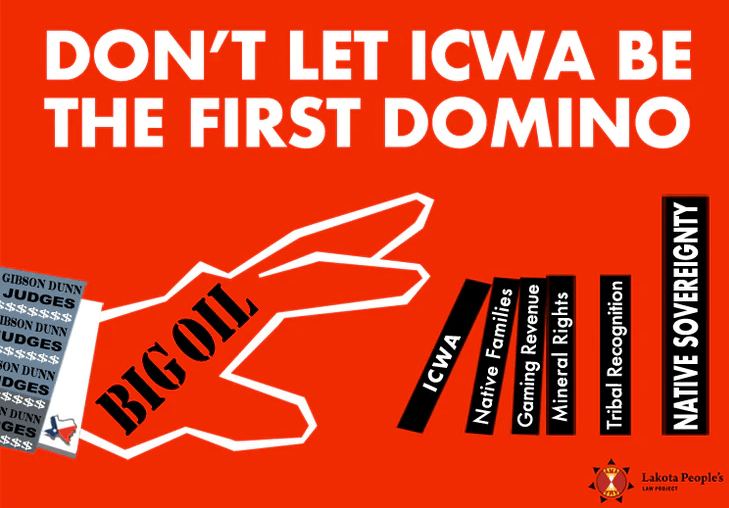
Native children and U.S. Secretary of the Interior Deb Haaland are under legal attack in Brackeen v. Haaland. The powerful people behind the lawsuit include both Big Oil and the State of Texas. If their attempt to have a conservative-majority Supreme Court overturn the Indian Child Welfare Act is successful, the door will be open to the total elimination of tribal sovereignty. Take action now to stop this horrific attack on Native rights! (see petition below).
Lakota People’s Law Project

Texas, Big Oil Lawyers Target Native Children in a Bid to End Tribal Sovereignty

The Threat Summarized

If the Supreme Court overturns the Indian Child Welfare Act (ICWA) — a federal law that keeps Native children with Native families — tribal sovereignty could soon be a thing of the past in the U.S. Should the justices rule in the plaintiffs’ favor in the case of Brackeen v. Haaland, we could quickly see a return to blatant, pre-1978 genocidal practices — when Native babies were legally stripped of their families, culture, and identities.

It’s critical that every one of us take immediate action. Before you do anything else today, sign our petition telling President Biden and the Department of Justice to defend ICWA, Secretary Haaland, and tribal sovereignty with every available means.

In this landmark case, the Brackeens — the white, adoptive parents of a Diné child in Texas — seek to overturn ICWA by claiming reverse racism. Joined by co-defendants including the states of Texas, Ohio, Louisiana, and Indiana, they’re being represented pro bono by Gibson Dunn, a high-powered law firm which also counts oil companies Energy Transfer and Enbridge, responsible for the Dakota Access and Line 3 pipelines, among its clients. This lawsuit is the latest attempt by pro-fossil fuel forces to eliminate federal oversight of racist state policies, continue the centuries-long genocide of America’s Native populations, and make outrageous sums of money for energy magnates, gaming speculators, and fossil fuel lawyers. The story below may seem unbelievable, but it is 100 percent true.

Key Points to Take Away

  • Big Oil’s lawyers, Texas, and three other states with very few Native inhabitants are attacking the Indian Child Welfare Act (ICWA).
  • The Texas Attorney General is asking the Supreme Court to declare ICWA unconstitutional.
  • The Plaintiffs argue that tribal affiliations should be considered racial, rather than political, designations.
  • Overturning ICWA could be the first legal domino in a broader attack on tribal rights and sovereignty.

The Indian Child Welfare Act Protects Native Kids, Cultures, and Sovereignty

The Indian Child Welfare Act (ICWA) is the federal law that prioritizes Native care for Native children, which is critical to maintaining cultural connections, family ties, and kinship practices that have been intact for thousands of years. ICWA, signed into law in 1978, was conceived as a means of slowing the genocidal policies enacted by the United States and Canada, which included the forced placement of Indigenous children in Indian boarding schools for more than a century.

These schools were cruel institutions designed to enact genocide by separating the children from their cultural identities and severing ties with their families and communities. Thousands of Native and First Nations children died at these schools, where physical, mental, and sexual abuse were commonplace. After the era of boarding schools, during the Sixties Scoop, it became common practice for child welfare workers — hiding behind state law — to kidnap Native children and place them with white, Christian families as adoptees. This lasted well past the 1960s, and ICWA was ultimately passed to protect Native children and keep them with their kin.

Today, the State of Texas (among other plaintiffs) is suing the federal government in an attempt to overturn ICWA. If the plaintiffs are successful, this case will strike down the federal law that prioritizes Native care for Native children. But that’s not even the worst of it. The case would also open a door for the destruction of tribal sovereignty in the United States. The case — Brackeen v. Haaland — is slated to go before a conservative Supreme Court soon, should the justices accept it. It specifically names the defendant as U.S. Secretary of the Interior Deb Haaland — a Laguna Pueblo woman and the first Native person to hold a Cabinet secretary position in U.S. history.

The plaintiffs are essentially alleging racism against white people, arguing that ICWA violates the U.S. Constitution’s Equal Protection Clause. Tribal nations — backed by a prior Supreme Court decision — say that Native status is not a racial designation, but a political one.

This case poses an extreme and imminent danger to Native Peoples across the U.S. If the high court accepts the plaintiffs’ argument that tribal political designations should not count in custody cases, “Native” and “Indian” designations could then be dissolved entirely. That decision would position ICWA as the first domino to fall, potentially leading to the erosion — or total erasure — of Native rights in the only homelands Indigenous North Americans have ever known.

Lakota People’s Law Project
https://lakotalaw.org/news/2021-09-17/icwa-sovereignty


Petition to protect the Indian Child Welfare Act

Dear President Biden and attorneys for the Department of Justice,

As the Supreme Court decides on whether to render judgment in the case of Brackeen v. Haaland, I write today to ask you to do everything in your power to protect the Indian Child Welfare Act and defend Secretary Deb Haaland. We need strong federal protection of Native families and tribal sovereignty.

Please file every available motion, prepare every legal argument judiciously, and do everything else you can to stop this attack on tribal citizens. The plaintiffs will not be easily stopped. Should the Supreme Court accept this case and validate the plaintiffs’ argument that tribes do not have the power to place their own enrolled children in tribal kinship care, we will have crossed a rubicon into dangerous legal territory that could ultimately lead to the disbanding of tribal nations — and the loss of tribal lands, gaming revenues, and mineral rights.

It’s no coincidence that the same attorneys — Gibson Dunn — representing the plaintiffs in this case also have deep ties to fossil fuel interests such as Enbridge and TC Energy (the oil conglomerates responsible for attacking tribal interests through the Line 3 and Dakota Access pipelines, respectively).

The Indigenous peoples of this land have always deserved better. The few gains made over centuries littered with oppression, and in the face of overwhelming systemic racism, must not be lost now. Please fight hard to protect original Americans. Please do everything possible to stop this attack on children, families, and sovereignty.

You can sign this petition here:
https://action.lakotalaw.org/action/protect-icwa

Prophecy about black snake

When I first heard the Lakota prophecy about the black snake, I thought it was amazing that a sacred message from so long ago was coming true. What that said about Indigenous spirituality.

I thought the image of the black snake was so powerful. A symbol of the evils of the wanton disregard for Mother Earth and balance and what that means for future generations. I thought of one of the most powerful symbols in my life, the image of my beloved Rocky Mountains hidden in clouds of pollution.

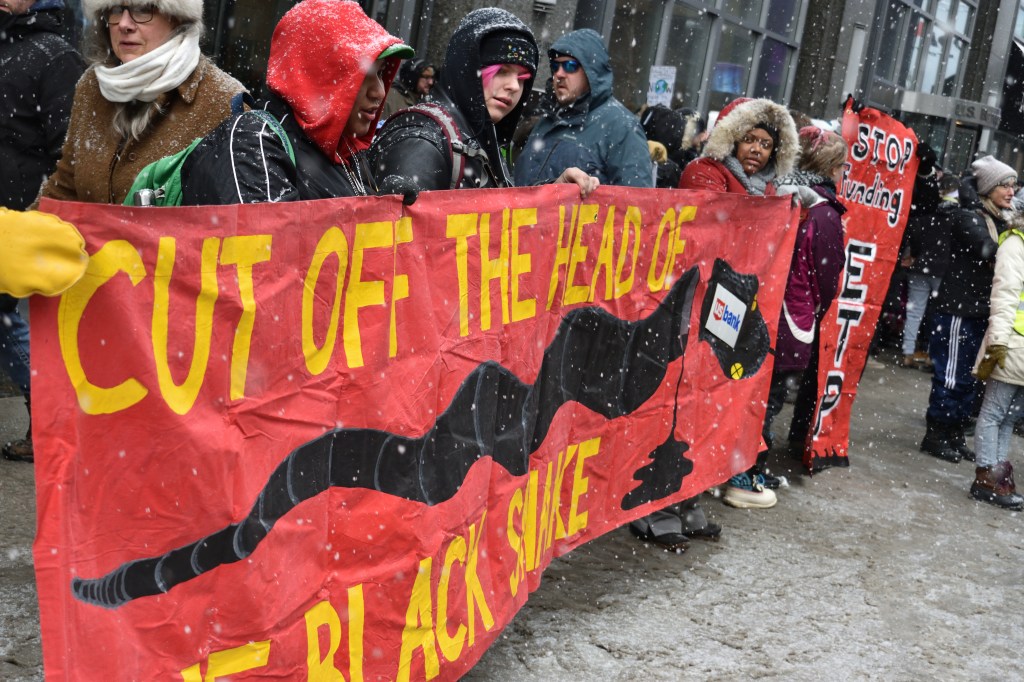
There is an ancient Lakota prophecy about a black snake that would slither across the land, desecrating the sacred sites and poisoning the water before destroying the Earth. 

For many Indigenous people gathered near the Standing Rock Sioux reservation, that snake has a name — the Dakota Access pipeline.

‘We must kill the black snake’: Prophecy and prayer motivate Standing Rock movement. Indigenous leaders say effort to oppose Dakota Access pipeline rooted in power of prayer by Karen Pauls, CBC.CA, Dec 11, 2016

This reflection on the prophecy of the black snake was prompted by another story in today’s Des Moines Register about a proposed new carbon capture pipeline.

I should not have been surprised by the following story in the Des Moines Register, Company wants to build a carbon sequestration pipeline in 30 Iowa counties, but I was. It was predictable that unrealistic ideas would be put forth as the reality of deepening environmental chaos can no longer be ignored. As just today we are seeing the devastation of the aftermath of Hurricane Ida.

I hope the news about this pipeline might provide a teachable moment to illustrate why we need Indigenous leadership now. There are all kinds of reasons why a carbon capture pipeline should not be built. There is a matter of scale, ie what percentage of all the carbon emitted would be captured? How much energy is consumed by the capture process and to move the liquid through the pipeline? Can the liquid be safely stored for hundreds of years? How much more fertile farm ground will be destroyed by the pipeline construction? How much water is used? How many more relatives will be missing or murdered? How much profit will be generated, and for who?

I think this provides a clear example of why Indigenous liberation is the only hope for Mother Earth. Carbon capture pipelines are typical projects funded by banks, fossil fuel companies and white legislators and businessmen. Even though it is clear that continuing fossil fuel driven capitalism will only lead to increasingly dire environmental chaos. An existential threat. Our only hope is to stop spewing tons of fossil fuel emissions into the air.

Today’s Register story includes remarks made by my friends Lee Tesdell (my Scattergood School classmate) and Ed Fallon of Bold Iowa, about the company, Summit, who plans to build the carbon capture pipeline.

Summit hired Branstad, who was the U.S. ambassador to China under President Donald Trump, in March as a senior policy adviser to provide “oversight, leadership and guidance on public policy matters affecting stakeholders” in what the company says will be the world’s largest carbon capture and storage project.

At a Sept. 13 meeting in Ames, Lee Tesdell, a central Iowa farmland owner, asked whether any of the Iowa Utilities Board members were appointed by Branstad and whether they would recuse themselves from making a decision about whether Summit should receive a permit to build nearly 710 miles of pipeline across Iowa.

TesdelI, whose central Iowa farm is not in the pipeline’s pathway, said he believes board members Branstad appointed have a conflict of interest. “Either Branstad should resign from the Midwest Carbon Express team or they (board members) should recuse themselves,” he said.


In 2017, Lozier recused himself from the controversial Dakota Access oil pipeline case because he had represented a pro-pipeline lobby group in court as a private attorney before joining the utilities board.

Ed Fallon, a former state representative and vocal Dakota Access pipeline opponent, said he believes the Iowa Utilities Board members should recuse themselves. “Given their high-salary positions, they’re beholden to Branstad, and that gives the impression that they would be inclined to vote his way,” Fallon said.

Board members are required to spend their “whole time” on state utility issues. Huser earned a base salary of $128,890 last year, and Lozier, $122,428, according to the state employee salary book. No salary was recorded for Byrnes last year.

Critics of $4.5 billion carbon capture pipeline say Branstad appointees have conflict, should recuse themselves by Donnelle Eller, Des Moines Register, Sept 20, 2021

“I, Chief Arvol Looking Horse, of the Lakota, Dakota, and Nakota Nations, ask you to understand an Indigenous perspective on what has happened in America, what we call “Turtle Island.” My words seek to unite the global community through a message from our sacred ceremonies to unite spiritually, each in our own ways of beliefs in the Creator.”

“There needs to be a fast move toward other forms of energy that are safe for all nations upon Mother Earth. We need to understand the types of minds that are continuing to destroy the spirit of our whole global community. Unless we do this, the powers of destruction will overwhelm us.”

“To us, as caretakers of the heart of Mother Earth, falls the responsibility of turning back the powers of destruction. You yourself are the one who must decide.”

“You alone – and only you – can make this crucial choice, to walk in honor or to dishonor your relatives. On your decision depends the fate of the entire World.”

Important Message from Keeper of Sacred White Buffalo Calf Pipe. I, Chief Arvol Looking Horse ask you to understand an Indigenous perspective on what has happened in America, what we call “Turtle Island.” by CHIEF ARVOL LOOKING HORSE, Indian Country Today, Sept 7, 2017

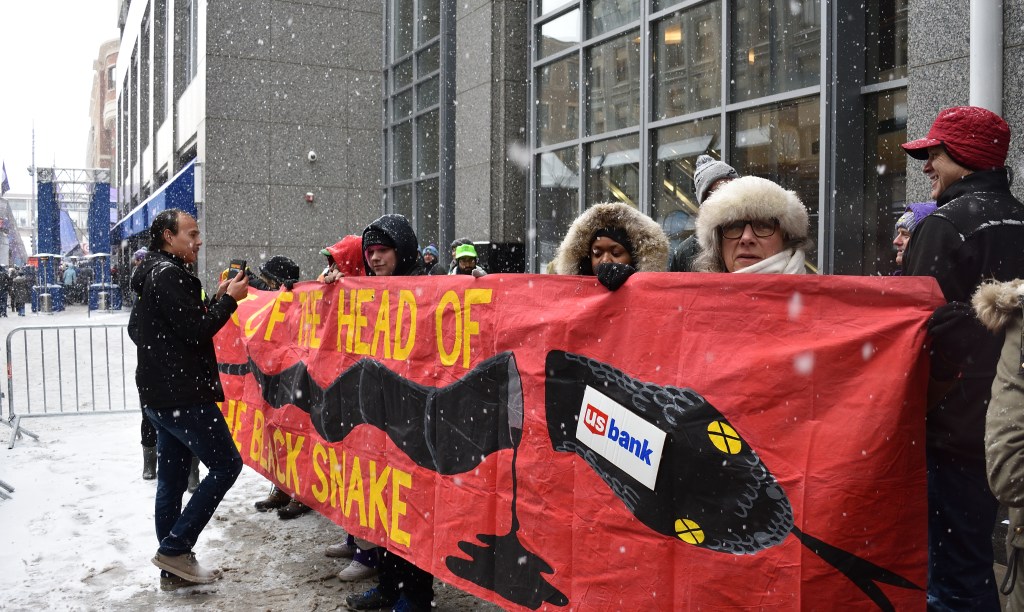
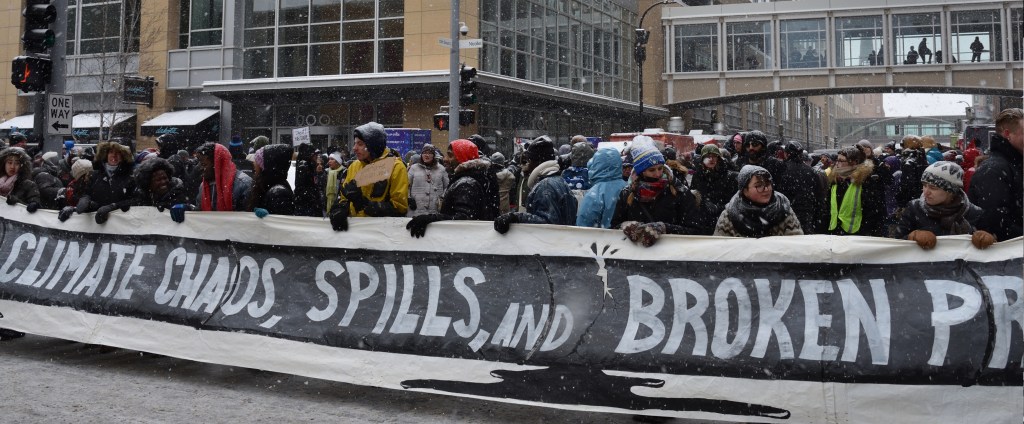
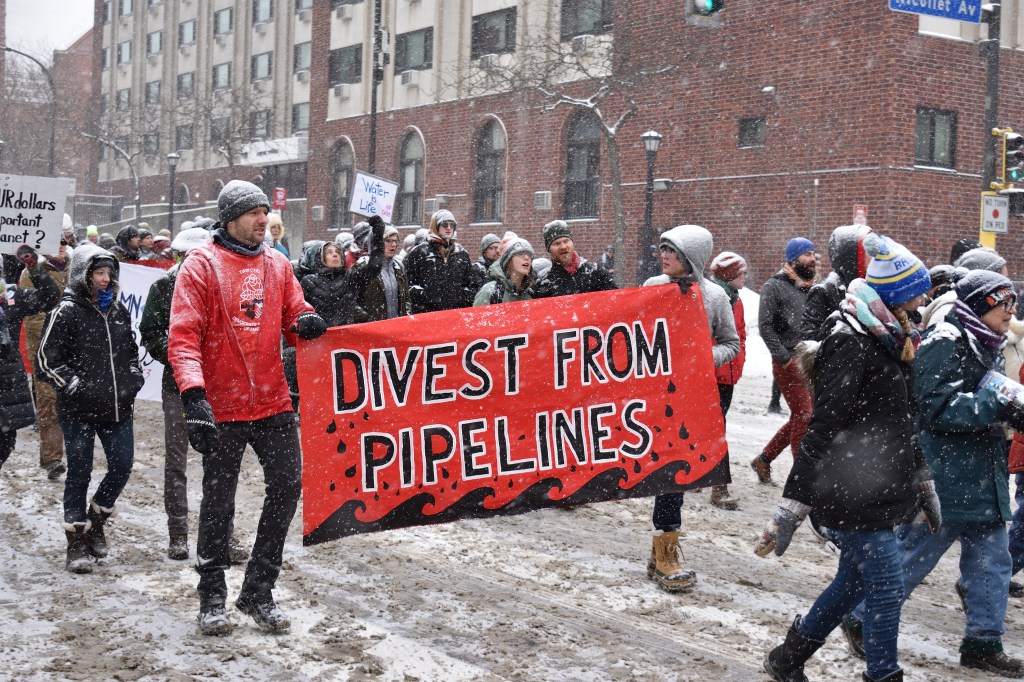
These are photos from the day a van full of us went to Minneapolis for a rally related to USBank’s funding of fossil fuel projects. Minneapolis is the headquarters of USBank.

Truth and Healing Curriculum

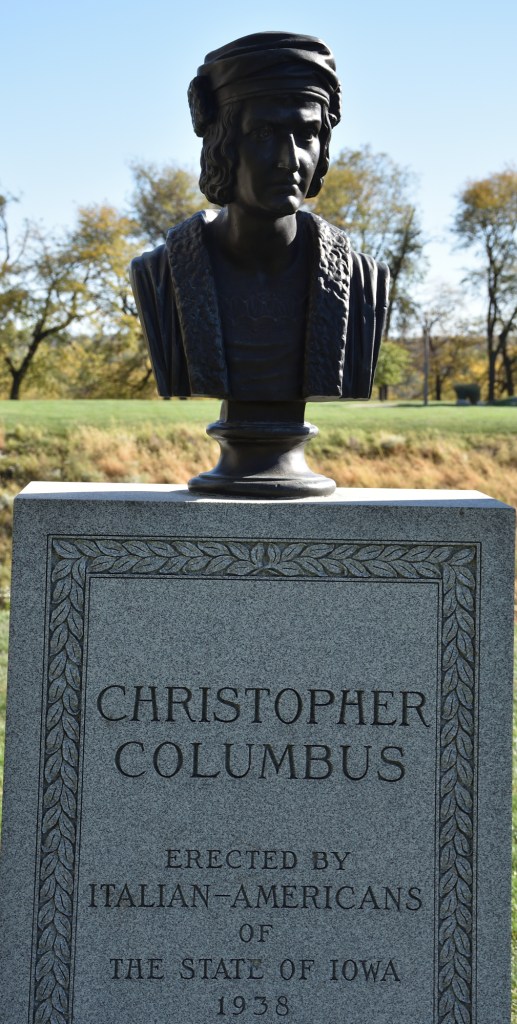
As the horror stories of the institutions of forced assimilation of Indigenous children continue to emerge, it is clear the erasure of this history almost succeeded. I remember being taught very little beyond Columbus ‘discovering America’, the colonial version of ‘Thanksgiving’, and not much related to the settler colonists and Indigenous peoples.

It is crucial for non-native people to learn this history, to know how this country developed, so we can all begin to heal. We can’t do that as long as we remain within the boundaries of whitewashed colonial stories. This is important for the context for dealing with rapidly evolving environmental chaos. Because a return to Indigenous practices and relationships with Mother Earth and all our relations is, I believe, the way to adapt to the coming collapse.

In the last blog post I wrote about sixth grader Alden Nobiss’ idea of having students teach each other about anti-racism and an accurate history of this country known as the United States.

Alden’s mother, Christine Nobiss (Sikowis) says, “he basically thinks that if teachers can’t teach critical race theory, then why can’t students do it? So that’s his idea. He thinks that students can teach each other in their spare time. During recess, during lunch time, and that’s something that he’s going to try to do. So, we have a book that he’s going to share called 500 Years After Columbus, which is a curriculum guide for teaching better indigenous studies for k-12. So, he’s already taking a look at that.”


It has been a long-running goal of many Native people to have more about their history and culture taught in grade schools. New requirements have been adopted in Connecticut, North Dakota and Oregon and advocates say their efforts have gained some momentum with the nation’s reckoning over racial injustice since the killing of George Floyd.

The legislation affecting schools has advanced alongside new bans on Native mascots for sports teams and states celebrating Indigenous Peoples Day in place of Christopher Columbus Day.

The push for curriculum requirements has not been without challenges, with some legislatures deeming new laws unnecessary because Native American history already is reflected in school curriculum. There also have been some steps in the opposite direction amid battles over how topics related to race and racism are taught in classrooms.

In South Dakota, a group of teachers and citizens charged with crafting new state social studies standards said last month that Gov. Kristi Noem’s administration deleted from their draft recommendations many elements intended to bolster students’ understanding of Native American history and culture. They said changes made to the draft gave it a political edge they had tried to avoid, aligning it instead with the Republican governor’s rhetoric on what she calls patriotic education.

Push for Indigenous Curriculum Makes Gains by Susan Haigh, Indian Country Today, Sept 15, 2021

Without the political will to ensure accountability and to guide implementation, what is observed rather in mainstream American education is the ongoing erasure of Indigenous people. Sam Torres

Only five states mentioned Indian boarding schools in their state content standards, which is “unimaginable,” said Sam Torres of The Native American Boarding School Healing Coalition. “It’s obviously a representation and reflection of what is being valued in educational and curricular context.”

As the United States federal government gears up to assess the genocide it perpetuated against Native communities for nearly a century, Native leaders and academics say there is one glaring method for accessing truth and healing: education.

Roughly fifty four percent of public schools across the United States make no mention of Native Americans in their K-12 curriculum, and 87 percent of state history standards don’t discuss Native American history after 1900, according to a study conducted in 2019.

For its part, NABSHC—an organization that has been at the helm of increasing public awareness on boarding schools since its founding nearly a decade ago—in 2020 released its first ever Truth and Healing Curriculum. The curriculum, available for free online, is made up of four lessons on Indian Boarding Schools focusing on history, impacts, stories, and healing.

“We were hearing a lot of feedback from community members asking for materials for their students,” Torres said. In developing the curriculum— sectioned into primary, middle and upper grades learning levels—Torres said he and staff members focused on the pillars that mimic a Native approach to collective education.

Other nonprofit institutions, such as The Ziibiwing Center of Anishinabe Culture & Lifeways in Michigan and the Heard Museum in Arizona have also developed their own supplemental Indian Boarding School curriculum. But without a state mandate on the specific curriculum, or enough educators aware of or comfortable enough with the content, the material reaches only a tiny fraction of students.

NABSHC’s Truth and Healing curriculum has been downloaded over one thousand times, Torres said, as the organization sets its sight on training educators in decolonizing knowledge. 

“Rigorous meaningful curricular materials have and continue to be developed by Native people,” Torres said. “Yet without the political will to ensure accountability and to guide implementation, what is observed rather in mainstream American education is the ongoing erasure of Indigenous people.”

The vast majority of Americans don’t learn about Indian boarding schools growing up. These Native leaders and educators want to change that by Jenna Kunze, Native New Online, Sept 13, 2021

The National Native American Boarding School Healing Coalition has developed a curriculum on U.S. Indian Boarding Schools for teachers and parents to use with their students and children.

The Truth and Healing Curriculum is comprised of four (4) robust lessons on Indian boarding schools covering History, Impacts, Stories, and Healing, and is appropriately sectioned into three (3) learning levels: primary, middle, and upper grades.

NABS understands that educational resources such as these are greatly needed for a variety of important reasons. As a response to requests from teachers and parents, we developed the Truth and Healing Curriculum to support distance learning during the COVID-19 pandemic.

Download a package that includes all curriculum.

Download Curriculum


Students teaching students

Yesterday I saw the great presentation, Online Pushback:UnBan Anti-Racism Education in Iowa, a forum by Indigenous youth of the Great Plains Action Society related to Iowa’s ban on teaching Critical Race Theory or Anti-Racism Education (video below).

Indigenous Youth Organizers, Alexandrea Walker and Keely Driscoll, have started a youth-led movement to demand that the current Iowa Administration unban Anti-Racism Education, aka, Critical Race Theory. For the sake of health and safety for all, it is imperative that Kim Reynolds reverse the overtly white supremacist decision to ban anti-racism education plus diversity, equity, and inclusion programming in the classroom and in all state-funded institutions

At the 12:15 mark in the video above, my friend Sikowis Nobiss introduces her son Alden who is in sixth grade. With the ban against teachers teaching about anti-racism, he spoke about his idea of students teaching each other as an alternative.

Sikowis: Hello everybody. I am here with my son today and his name is Alden and he’s in sixth grade. And he’s being affected by the ban on critical race theory or as we like to call it anti-racism education, decolonization work, diversity equity inclusion. Those are better terms for it because critical race theory is a term that they’re using to manipulate the situation, to make it sound like it’s critical, you know that it’s being like overtly hard on something when really it means how like you know analyzing something specifically or properly.
So, Alden is in grade six and you know he’s got some interesting thoughts about this, and I wanted to ask him like what does he think, what do you think about the ban on critical race theory?
Alden: It’s not that good.
Sikowis: How come?
Alden: I mean people should know that what happened in the past or else the history is just going to repeat itself. Just the same thing that happens over and over right? Seems like it isn’t going to stop if people don’t take action and more people like Reynolds is going to ban stuff.
Sikowis: And you had an interesting idea, you had said that teachers can’t teach critical race theory right? But students can. Can you tell us more about that?
Alden: The governor only said that teachers couldn’t say stuff like that and they couldn’t teach stuff like that, but that doesn’t mean schools can’t just be used to teach inside like only teachers.
Sikowis: So, who would teach like you want?
Alden: Kids to teach each other. Yeah the more educated kids that are like me I guess that know about what happened in the past.
Sikowis: Very good thank you so much Alden. We appreciate you making those remarks. That took a lot of bravery for him. I’m very proud of that.
I hope you guys could hear that. He basically thinks that if teachers can’t teach critical race theory then why can’t students do it? So that’s his idea. He thinks that students can teach each other in their spare time. During recess during, lunch time and that’s something that he’s going to try to do. So, we have a book that he’s going to share called 500 Years After Columbus, which is a curriculum guide for teaching better indigenous studies for k-12. So, he’s already taking a look at that.


Just as the final report from the National Inquiry into Missing and Murdered Indigenous Women and Girls triggered shock waves across the country, bringing conversations about violence against Indigenous people into the classroom, so did the discovery of 215 children’s remains at the Kamloops Indian Residential School earlier this year.

As the National Day for Truth and Reconciliation approaches, we can expect Canadian teachers are thinking about how they can better weave Indigenous perspectives into their lesson planning.

In the past, events like this rarely made it as national news, staying inside our Indigenous communities where the pain remained hidden from the rest of Canada. Now, teachers are talking about them with their students — how history and society influence individual situations of race-motivated violence and cultural genocide. It’s our responsibility to make sure they are equipped to teach the truth and acknowledge the important role schools play in reconciliation.

We owe it to all students to bring truth and drive reconciliation in classrooms by Linda Isaac & John Estabillo, National Observer, September 16th, 2021.

For specific teachings on Indian Boarding Schools and the United States assimilation policies—a history educators say is central in contextualizing present day culture for Native and non-Native youth alike— statistics are even bleeker.

“Over the course of the last couple of years, we’ve identified five states—only five states— that have even mentioned Indian boarding schools in their content in their state content standards, which is unimaginable,” said Sam Torres, director of research and programs at The Native American Boarding School Healing Coalition. Those states, surveyed by NABSHC in 2015, are: Arizona, Washington, Kansas, Oklahoma, and North Dakota. 

“It’s obviously a representation and reflection of what is being valued in educational and curricular context,” Torres said. 

For its part, NABSHC—an organization that has been at the helm of increasing public awareness on boarding schools since its founding nearly a decade ago—in 2020 released its first ever Truth and Healing Curriculum. The curriculum, available for free online, is made up of four lessons on Indian Boarding Schools focusing on history, impacts, stories, and healing.

The vast majority of Americans don’t learn about Indian boarding schools growing up. These Native leaders and educators want to change that by JENNA KUNZE, Native News Online, SEPTEMBER 13, 2021

We owe it to Indigenous educators who are triggered and challenged to deliver education around a topic like residential schools that have impacted them. Educators like me, who when viewing the images of children with their plain clothes, short hair, and empty eyes — identities stripped — still struggle to separate the pain we hold from lesson planning.

We also owe it to non-Indigenous educators who lack confidence in teaching because they weren’t taught the truth about the atrocities of the residential school system. This is a significant blocker to the successful integration of truth-telling in our classrooms, which can be solved by supporting educators in their journey of learning.

We must ensure the materials passed down to educators are written accurately by authentic voices. We need ongoing government funding and access to professional learning programs. Alberta is one province that does this well. Its Teacher Qualifications Standard requires educators to take courses in foundational knowledge of Indigenous history.

We owe it to all students to bring truth and drive reconciliation in classrooms by Linda Isaac & John Estabillo, National Observer, September 16th, 2021.

Unban Anti-racism Education in Iowa

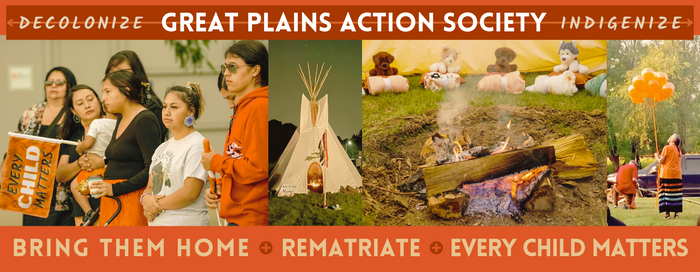
The Great Plains Action Society youth organizers and experts across Iowa weigh in on white supremacy and the ban on Critical Race Theory. The bans on Critical Race Theory across the country are one of many examples of efforts to whitewash the truth.

Online Pushback: UnBan Anti-Racism Education in Iowa
May be an image of 2 people and text that says 'ONLINE PUSHBACK FORUM UNBAN ANTI-RACISM EDUCATION IN IOWA Hosted by Great Plains Action Society Youth Organizers Alexandrea Walker, Ho-Chunk Keely Driscoll, Meskwaki Youth and experts across lowa weigh in on white supremacy and the ban on Critical Race Theory September 15, 2021 @ 6:30 PM CST @ bit.ly/teachtruthforum'

YouTube Link youtube.com/watch?v=tIlz26X7T-U

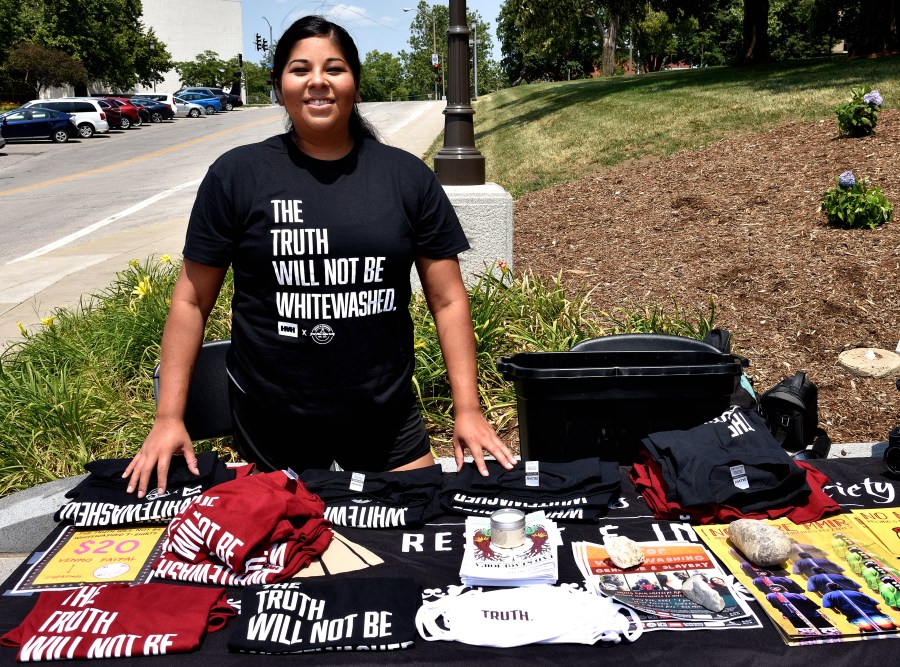
The Truth Will Not Be Whitewashed!

Indigenous Youth Organizers, Alexandrea Walker and Keely Driscoll, have started a youth-led movement to demand that the current Iowa Administration unban Anti-Racism Education, aka, Critical Race Theory. For the sake of health and safety for all, it is imperative that Kim Reynolds reverse the overtly white supremacist decision to ban anti-racism education plus diversity, equity, and inclusion programming in the classroom and in all state-funded institutions. Join Alex and Keely as they host a forum for youth and experts throughout Iowa to weigh in on this pressing issue. Guests TBA.

The Truth Will Not Be Whitewashed is a campaign founded by Great Plains Action Society and Humanize My Hoodie. We encourage others to join this effort. Please contact us if you are interested in joining our growing coalition.

Great Plains Action Society (You can send a message from this link)


This reminds me of the work of Lynne Howard and Des Moines Valley Friends’ (Quakers) to get draft counseling into the Des Moines public schools in 1970. They were successful! Resisting draft counseling was an effort to whitewash the truth about participating in the military.


PROPOSAL FOR DRAFT COUNSELING IN THE DES MOINES PUBLIC HIGH SCHOOLS

STATEMENT OF BELIEF:

We believe that all young men in the Des Moines Public High Schools should have access to adequate counseling by qualified counselors in regard to the Selective Service and its alternatives.  Qualified counselors are those persons who:

  1. Have received special draft counseling training
  2. Have a detailed knowledge and experience of the Selective Service Law and the administration thereof
  3. Are sensitive to the moral and spiritual implication of war and peace and individual conscience
  4. Have knowledge of where to refer students if they want counseling on a specific aspect of the Selective Service alternatives and options

We further believe that such counseling should be made available during school hours, similar to other available guidance counseling.

IMPLEMENTATION:

There in light of the above purpose we recommend that one of the following plans be used to implement this counseling program:

  1. That each high school in Des Moines provide adequate training of all guidance counselors in order that they be familiar with the Selective Service Law and its alternatives
  2. That each high school select one guidance counselor who would be specially trained (see above) to counsel and answer questions concerning the draft and its alternatives.  Other guidance counselors in the school could refer their students to this specially trained counselor, if this type of counseling is needed
  3. That each trained counselor would refer persons who need more intensive and specific counseling to appropriate groups.  (Particular religious groups, various branches of the Service, etc.)

The Peace Testimony Remains by Lynne Howard. September 15, 1970

What You Get into Will Change You

Recently a series of things happened that provoked some reflection. I saw the quote, “what you get into will change you. Sometimes in life you just don’t know what you’re getting into”, which prompted me to write the following.

A lot happened to me since retiring and returning to Iowa four years ago. I hadn’t given a lot of thought to what would happen when I returned to Iowa. I had stayed connected with Iowa Quakers and involved with them as much as I could from a distance. So, there were already some relationships to build on.

In Indianapolis I was blessed to have made many friends as we worked to protect water and oppose the Keystone XL and Dakota Access pipelines. I was also most fortunate to become involved with the Kheprw Institute (KI), a youth mentoring and empowerment community. And North Meadow Circle of Friends Quaker meeting. It was hard to leave but I stay in touch.

What follows are stories of my justice experiences since returning to Iowa. They are offered in case they might be helpful for you and your own work.

I’m frustrated more people don’t engage in justice work. Why are we here if not to grow and engage with family and our communities? Most people either don’t know how to engage or don’t want to. I’m frustrated because there is so much work to be done. We are experiencing environmental catastrophes that will only worsen and occur more frequently. We need masses of people to prepare now for the evolving chaos.

Also, these experiences will be good for you. I know from experience “what you get into will change you”. https://www.dailygood.org/story/2795/what-you-get-into-will-change-you-phyllis-cole-dai/

It is important to recognize “sometimes in life you just don’t know what you’re getting into.” Those can be times of great opportunity. I encourage you to get involved in opportunities like this, as long as doing so is relevant to what you are called to do.

What you get into will change you. Sometimes in life you just don’t know what you’re getting into.

Phyllis Cole-Dai

The most important step is to figure out what you should do. There are so many problems. Many people get burned out by trying to do too many things. People of faith rely on faith to help us figure this out. Keep what you are led to do in mind. You must be vigilant as you look for opportunities to get involved with justice work. And just as vigilant to decline to get involved in things not related to what you are called to do. Maintaining this focus is crucial for success.

First Nation-Farmer Climate Unity

I had long wanted to get to know some Indigenous people for numerous reasons, such as spirituality and sustainable living. Fortunately, an ideal opportunity to do so was to walk and camp along the path of the Dakota Access pipeline with a small group of native and nonnative people. The intention was for those in the group to get to know each other as we walked 10-15 miles/day, put up our tents, and have meals together.

During the First Nation-Farmer Climate Unity March (Sept. 1 – 8, 2018) Manape said we were on a sacred journey. During the March, Donnielle said we are a tribe. This morning I’m realizing the following stories about the past are part of my sacred journey. Also thinking of the many new friends found as part of this journey. I’m thinking how much I would have missed if I didn’t recognize and take advantage of this amazing opportunity.

Wet’suwet’en

Last Saturday morning began by watching a new video (see below) from the Wet’suwet’en people in British Columbia. Gidimt’en Checkpoint spokesperson Sleydo’ (Molly Wickham) and Elder Janet Williams found a film crew trespassing on Gidimt’en territory, making a commercial to promote Coastal Gaslink’s plans to tunnel beneath the sacred headwaters.

I first learned about the Wet’suwet’en’s struggles in January, 2020, when I saw a remarkable video of Sleydo’ evicting the Coastal GasLink workers from Wet’suwet’en territory. “All CGL workers have now been peacefully evicted from Unist’ot’en and Gidimt’en territories. Under the authority of Anuk nu’at’en (Wet’suwet’en law), and with support of the Wet’suwet’en hereditary chiefs of all five clans, the Wet’suwet’en are standing up for the last of our lands and we need you to stand with us. We will honour the instructions of our ancestors, and continue to protect our lands from trespassers.”

I began to follow what was happening with the Wet’suwet’en, especially when they started asking people to write about what was happening, since the mainstream media was not. A few of us, who had worked together on some Indigenous related events, organized a vigil in support of the Wet’suwet’en:

We didn’t expect anyone to join us. Fortunately, Ronnie James did. In the photo are Peter Clay, Linda Lemons and Ronnie James. Ronnie is an Indigenous organizer with many years of experience and interested to see who organized and attended our vigil. After he left, I realized I didn’t have a way to contact him. Fortunately, he accepted my Facebook Friend request. We began to have numerous conversations (via social media), where he patiently taught me a great deal about organizing, Indigenous thought, and Mutual Aid. (See: https://landbackfriends.com/mutual-aid/)


Peter Clay, Linda Lemons and Ronnie James
Mutual Aid

Meeting and becoming great fiends with Ronnie changed the course of my life. I eventually joined the work of Des Moines Mutual Aid (DMMA). Every Saturday morning, I participate in the free food distribution program. About a dozen of us put together sixty boxes of food, that we then put in the cars of those who need it. It is amazing this food distribution has been in existence in Des Moines since the Black Panthers organized the free breakfast program for school kids in the 1970’s.

Putting together the boxes of food, we move as a well-oiled machine. There is a little visiting as we pass each other when putting the food into boxes. I learn a lot about the justice work people are doing in central Iowa, since my Mutual Aid friends are also involved in many such projects.

Saturday there was a lull while waiting for another food delivery that provided a chance to talk with Ronnie. I mentioned the story below about the continued oppression of the Wet’suwet’en peoples and reminded him that we had met at the vigil for the Wet’suwet’en mentioned above. I told him that was something he taught me about organizing. Going to justice events to meet people. I said I wouldn’t have known about Mutual Aid if not for him attending that Wet’suwet’en vigil. He replied I probably would have learned about Mutual Aid because it had been in the news a lot recently.

Ronnie mentioned that was the first time he had been at Friends House, where the Wet’suwet’en vigil was held. Des Moines Mutual Aid has its offices in Friends House now. I had just spoken with Jon Krieg who works with the American Friends Service Committee (AFSC), whose offices had been in Friends House. Recently AFSC had moved out and Jon mentioned he missed visiting with Ronnie.

Des Moines Valley Friends meeting, which meets in a meetinghouse attached to Friends House, has been allowing another Mutual Aid group to use their kitchen to cook meals that are taken to the houseless camps.

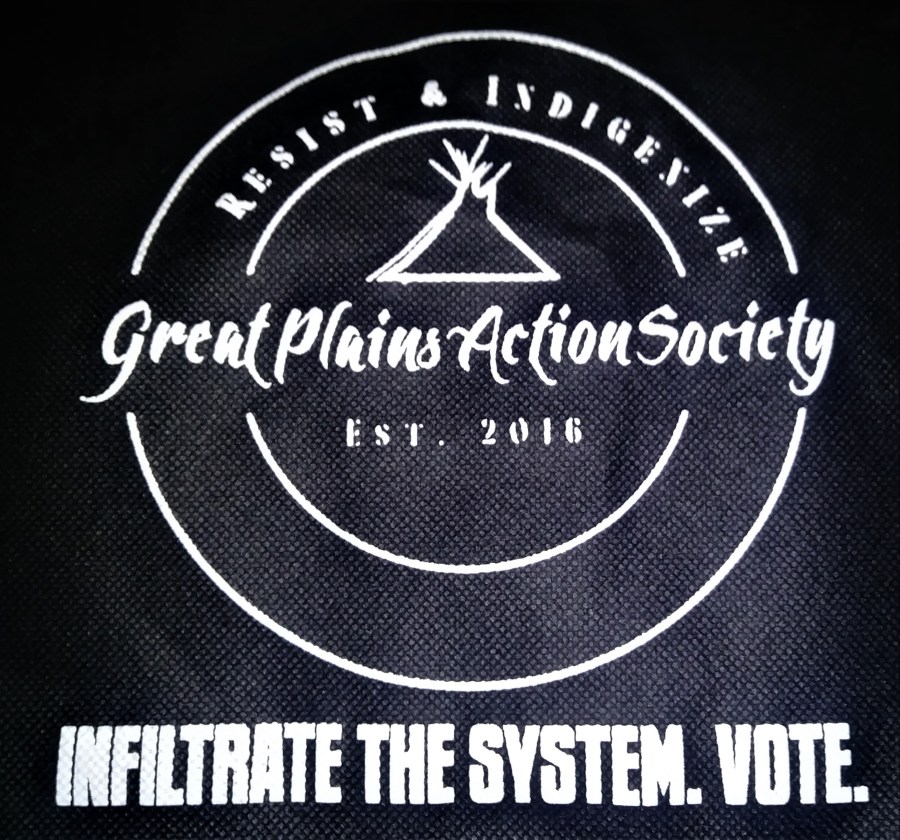
Another set of connections relates to the Great Plains Action Society (GPAS), founded by my friend Christine Nobiss, who was also on the First Nation-Farmer Climate Unity March. Ronnie’s Mutual Aid work is supported by GPAS.

Prairie Awakening/Prairie Awoke

Saturday was also the day of the annual Prairie Awakening/Prairie Awoke ceremony, an annual event sponsored by the Dallas County Conservation Board. The ceremony is held in the Kuehn Conservation Area. My Quaker meeting, Bear Creek, has been involved with the ceremony for over ten years. A number of Friends attended.

While there, I was able to talk with my friend Rodger Routh, who grew up in the Earlham, Iowa (where Bear Creek meeting is) community. Rodger is a photographer/videographer and justice advocate, who is often at the same events I attend. Jon Krieg (AFSC, mentioned above) is also a photographer. It is common for the three of us to be at the justice related events.

LANDBACK

One of the principles of justice work is to follow the leadership of the communities affected by injustice. In Indianapolis, the Kheprw Institute would let us (Quakers in this case) know what we could do for them.

Recently I had a chance to ask Christine how nonnative people could best support her and her work now. She told me to learn and teach others about the concepts of LANDBACK. So, I created a website named LANDBACK Friends, where I’ve been sharing what I am learning about LANDBACK. https://landbackfriends.com/

Maintaining connections

As the completion of a circle, I was so glad to be contacted by my friends at the Kheprw Institute (KI) in Indianapolis. Aghilah contacted me because KI is interested to learn more about LANDBACK. Evidently, they have been following my blog since I left Indianapolis and reading what I’ve been writing about LANDBACK.

Quakers for Abolition Network

My blog also made it possible for one of my new friends, Jed Walsh, to contact me about the work he and Mackenzie Barton-Rowledge are doing related to abolition of police and prisons. I wrote a little in their article that was just published by the Western Friend, https://westernfriend.org/article/quakers-abolition-network.

Conclusion

We are moving more deeply into collapse. Fueled by the consequences of environmental chaos, our economic and political systems are failing. We must work now to build ways to deal with this collapse. I’ve been working on this diagram to illustrate how people are building such systems. It is important to build Mutual Aid communities. And embrace the principles of LANDBACK. “What you get into will change you”.


This document has a lot more information about Quakers, the Wet’suwet’en peoples, and LANDBACK. Scroll down to move through the document.


#LANDBACK