The eyes of the future are looking back at us


There is a native concept of considering what the effects of decisions made today will be on seven generations into the future.

The following quotation makes a two-way connection between us and future generations. Looking at each other over the generations.

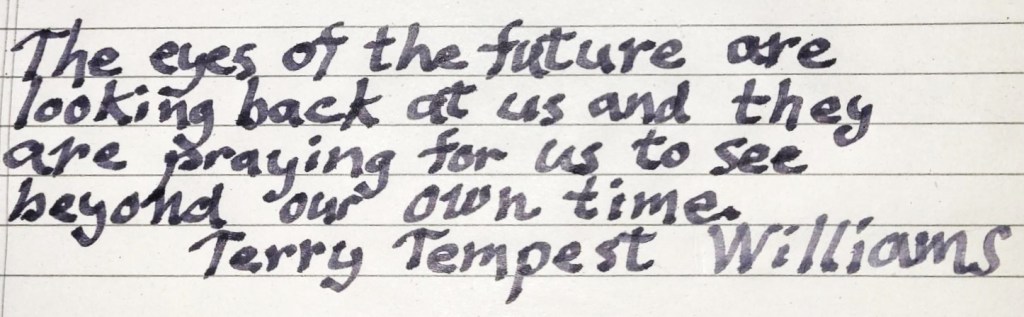
The eyes of the future are looking back at us and they are praying for us to see beyond our own time. They are kneeling with hands clasped that we might act with restraint, that we might leave room for the life that is destined to come. To protect what is wild is to protect what is gentle. Perhaps the wilderness we fear is the pause between our own heartbeats, the silent space that says we live only by grace. Wilderness lives by this same grace. Wild mercy is in our hands.

― Terry Tempest Williams, Refuge: An Unnatural History of Family and Place

Similarly, can we not look back at our ancestors? We are our ancestors’ future generation looking back.

I think about this a lot these days. As stories of the remains of native children on the grounds of the institutions of forced assimilation continue. Thousands of children never returned home.

I’ve been praying about what we are doing now and how much harm this is doing to future generations. My Spirit recoils from the likelihood there probably will not be a seventh, or sixth, or fifth generation because of the accelerating rate of environmental collapse.

What have we done?

What will we do?
As we work for change, we are admonished that we need to tell new stories. This morning I found this story Nico Santos tells, from the movie Dragon Rider.

“Wings”

Oh, I’ve been lost in the darkness
I heard your voice from afar
You weren’t my callin’
Whenever the night was starless
And I couldn’t see anymore
You showed me the mornin’

So I-I-I wanna let you know
When life has got you low

I’ll be your wings to fly
When there’s trouble on your mind
Whenever you’re ’bout to fall
There’s nothin’ I won’t try
‘Cause I’ll be your wings to fly
When you’re sufferin’ inside
Come hell or high water
Got you covered all my life
Let these wings take you
High, high
There’s nothin’ I won’t try

We built our own kinda fortress
Nothing can break us apart
Walls won’t be fallin’
These walls won’t be fallin’
I wouldn’t be if it wasn’t for you
I wouldn’t speak if it wasn’t the truth
You are my callin’
You are my callin’

So I-I-I wanna let you know
When life has got you low

I’ll be your wings to fly
When there’s trouble on your mind
Whenever you’re ’bout to fall
There’s nothin’ I won’t try
‘Cause I’ll be your wings to fly
When you’re sufferin’ inside
Come hell or high water
Got you covered all my life
Let these wings take you
High, high
There’s nothin’ I won’t try

You were my eyes, oh, when I couldn’t see
Were my voice, oh, when I couldn’t speak
Can I give it back to you?
Let me give it back to you
You were my legs, oh, when I couldn’t run
Were my heart when my own went numb
I’ll do what I have to do
Everything to get you through

I’ll be your wings to fly
When there’s trouble on your mind
Whenever you’re ’bout to fall
There’s nothin’ I won’t try
‘Cause I’ll be your wings to fly
When you’re sufferin’ inside
Come hell or high water
Got you covered all my life
Let these wings take you
High, high
There’s nothin’ I won’t try
Let these wings take you
High, high
There’s nothin’ I won’t try
Let these wings take you high

Nico Santos, WINGS from the movie Dragon Rider

CALLIGRAPHY – A Sacred Tradition

What an extraordinary way the reed pen has of drinking darkness and pouring out light!

– Abu Hafs Ibn Burd Al-Asghar –

As usual, I had no idea what I would be writing about this morning. I most often write about injustice, activism, and/or faith. These days are filled with so much injustice and disaster it’s nearly overwhelming. I appreciate the Spirit telling me the topic of the day.

There are two meanings for writing. To compose, or to put pen to paper. When I talk about writing I mean to compose. Calligraphy is about putting pen to paper, of course.

Calligraphy is a real surprise for today’s subject. But a welcome relief from the usual subjects. Art can be a more effective way to speak of injustice than writing about it, I think.

Maybe I should stop writing (composing). Or start writing (calligraphy). Or use calligraphy to record what I compose.

There are calligraphy fonts, but to use them almost seems dishonest. I’m just realizing typing in a calligraphy font would provide an example to copy, learn to write that way.

Calligraphy is one of those things that interest me, but I haven’t gotten around to doing/learning. I got as far as putting the calligraphy pen to paper and watching the thickness of the line change.

The quote above, and the title of the article, Calligraphy-A Sacred Tradition, caught my attention this morning. Ann Hechle, the distinguished calligrapher, talks to Barbara Vellacott about her work and her lifelong quest to understand the underlying unity of the world.

Calligraphy is more than fine writing

Calligraphy in the East, the Middle East and the West has always been a spiritual discipline, deeply embodied in the gestures of the body, the pressure of the pen and flow of the ink onto the open space of the page. It requires a quality of attention that is meditative. The demands of the words – both as letterforms and as meanings – can bring the wandering mind back to the moment, and when this kind of focus is found, the writing flows. The meditative practice involved is emphasised particularly in Buddhism, though it is present as an important strand in all spiritual traditions.

The role of calligraphers is often distinct from that of other visual artists, as they are frequently called upon to engage with significant events in human life where words are wanted to express deeply felt experience and emotion – birth, death, friendship, to enshrine memory, to celebrate achievements. The words chosen are full of meaning, and in contemplating and expressing them in writing, the calligrapher is performing a spiritual service to the community. A truthful engagement with words is absolutely required; it is said that “good writing makes the truth stand out” (a saying attributed to the Prophet Muhammad).

Calligraphy-A Sacred Tradition

the calligrapher is performing a spiritual service to the community

Barbara Vellacott

Getting started with calligraphy this morning was frustrating. I found the calligraphy set and then found the paper. Thank goodness for YouTube to help me get started. Loading the pen with ink wasn’t what I was used to with cartridge filled pens in the past.

Then there was the frustration I remembered from the past of getting the ink to flow. Lots of pounding my wrist that was holding the pen. And the flow was intermittent. As it says below, calligraphy requires a quality of attention that is meditative. Frustration won out over mediation this morning. I plan to work on that. Here’s what I was able to do as a beginner.

Mutual Aid stories

For the past week I’ve been thinking and praying a lot about Mutual Aid in preparation for a discussion we plan to have at my Quaker meeting tomorrow.

As I have nearly every Saturday for the last year, I was with my Mutual Aid friends this morning for our weekly food distribution. Here are a few stories triggered from what happened this morning.

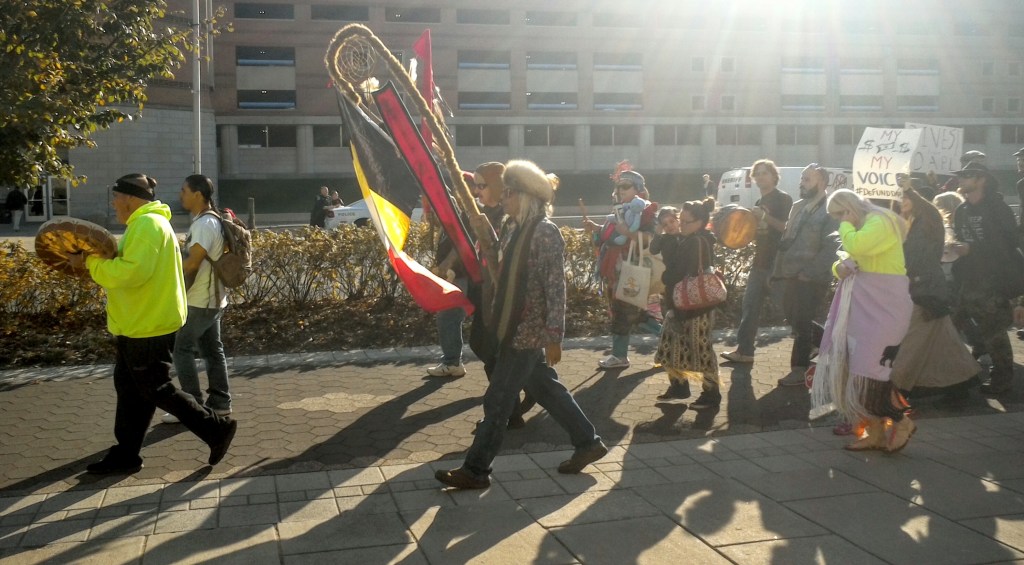
I had a clear spiritual leading to become involved in Des Moines Mutual Aid. For the sake of brevity, I’ll begin with my return to Iowa in 2017. I was looking for justice activists and soon had the opportunity to walk on the First Nation-Farmer Climate Unity March. A group of about ten native and ten non-native people walked and camped together for ninety-four miles, over eight days, along the path of the Dakota Access pipeline. The intention was for us to get to know each other as we shared stories, and that worked amazingly well. I got to know Sikowis Nobiss, Trisha Etringer, Matthew Lone Bear, Alton and Foxy Onefeather, and Donnielle Wanatee, among others. Various combinations of us worked together since then on things like racist monuments and mascots, Indigenous Peoples’ Day, and an Indigenous led Green New Deal.

There are a lot of photos and blog posts related to this sacred journey here: https://firstnationfarmer.com/ Part of the story relates to the support we received from Friends.

The summer of 2019 Peter Clay, Jim Glasson, Linda Lemons, and I helped arrange for Paula Palmer to have several sessions in the Midwest related to her ministry regarding Quakers and Indigenous peoples.

We wanted to continue this work. On February 7, 2020, we planned to meet at Friends House in Des Moines.

At that time, the Royal Canadian Mounted Police were attacking the Wet’suwet’en peoples in British Columbia. They were clearing the way for the construction of the Coastal GasLink pipeline through Wet’suwet’en territory. There was nothing about that in the mainstream press.

I learned about this when I saw the title of a YouTube video about the eviction of Coastal GasLink personnel from Wet’suwet’en territory. For many years I worked on the Keystone and Dakota Access pipelines resistance when I was in Indianapolis. I remember how shocked I was to see pipeline construction personnel evicted! I’m sure the Spirit led me to learn about the Wet’suwet’en. This struggle has become one of my primary areas of justice work since.

Returning to the February 7 meeting, we thought we would hold a rally in support of the Wet’suwet’en before the meeting we had already planned. I created a Facebook event in case anyone else might want to join us.

As the Spirit would have it though, Ronnie James saw that and joined us. I learned Ronnie has had over 20 years of experience as an Indigenous organizer. He was surprised anyone else in the Midwest knew about the Wet’suwet’en and came to check us out. A great organizing technique.

Peter Clay, Linda Lemons and Ronnie James

Over the subsequent two years Ronnie has become one of my closest friends, as well as my Mutual Aid mentor.

The Des Moines Mutual Aid project I’ve been involved in is the weekly food distribution project. There are many stories related to that but I’ll just tell about things that happened this morning.

About sixty boxes of food are put together in the basement of a church in Des Moines. Then they are taken outside and put on four tables, from which they are loaded into cars as they pull up. People know by word of mouth to park in the parking lot at 10 am. Then one of us directs them to drive up to the tables of food.

I learned those four long tables were donated to the church years ago from a mental health facility that my Quaker meeting, Bear Creek did a lot of work on.

This morning we could only find two of the tables. We looked all over and when we couldn’t find them, we carried a few smaller tables down from the third floor of the church. Shortly after though, when the bread that had been piled on some tables was put in the food boxes, we discovered the tables we were looking for had been hidden by the bread. We had a good laugh about that. Ronnie told me I’d have to write about that on my blog. This is a small example of how we all get to know each other as we work together.

The institutions of forced assimilation are often on my mind. Some Quakers had been involved in those institutions. Ronnie and I had a discussion about that.

I enjoyed hearing him talk about his son. Ronnie said, “he makes me happy (most of the time)”. I remember when Ronnie introduced me to him. He rarely says anything, but his voice sounds just like Ronnie’s. This morning I heard him say “dad”. When I left this morning, he was the only person in the basement. I said, “see you later” and he said, “see you later”. (It feels like I should not write his name. So many of those involved in Mutual Aid have had experiences with the police.)

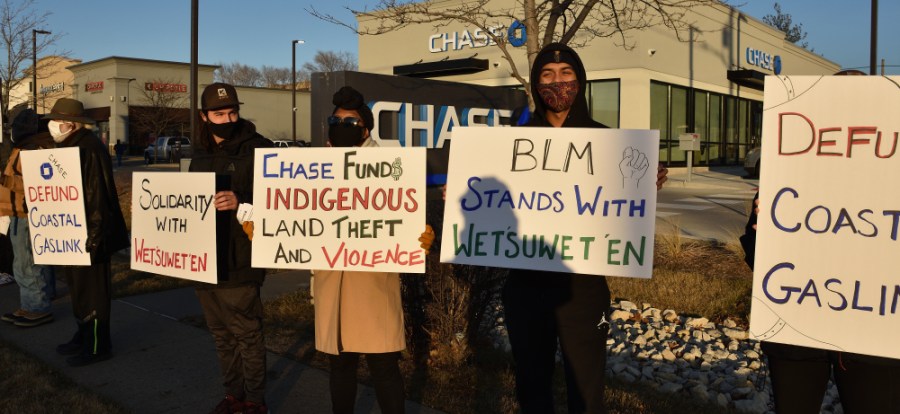
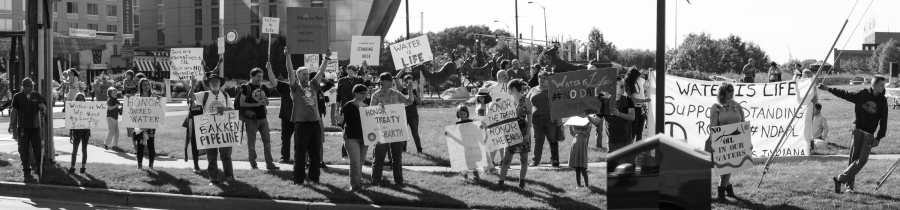
I will finish by returning to the Wet’suwet’en peoples, who are yet again being threatened by the RCMP. When these latest threats began again in November, Ronnie and I talked about whether to do something in support. We decided to invite whoever wanted to hold signs in support after our Mutual Aid work was finished. It was like completing a circle from our initial meeting related to the Wet’suwet’en.

I don’t get opportunities to take photos when with my Mutual Aid friends, again because of concerns related to police. But this time it was OK because of the masks and each person had given permission. When people were lining up, someone said, “across the street”. I thought they meant to move across the street, but what was meant was to line up across the street. And after the first few shots someone said, “wait, am I the only one with a fist up?”

You might notice the sign on the far right. A 5-year-old attends every Saturday, the life of the party. I knew he liked to draw, so I brought markers and a blank sheet for him.

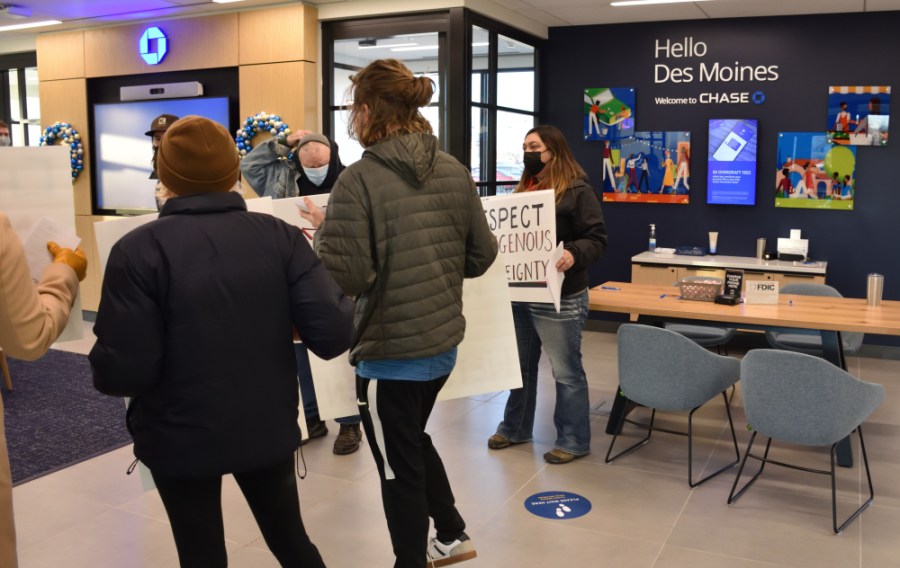
In December, the Wet’suwet’en called on supporters for solidarity actions. Chase bank funds the Coastal GasLink pipeline. A solidarity event was organized at a Chase bank in Des Moines. People were there from Mutual Aid, and Jon Krieg of the American Friends Service Committee (AFSC) and his partner Patti. You will also see one of the leaders of Des Moines Black Liberation there in support of the Wet’suwet’en.

Wet’suwet’en solidarity in Iowa

There will be a gathering in solidarity with the Wet’suwet’en peoples this Wednesday, December 22, at 4:00 PM. at the Chase Bank, 3621 Merle Hay Rd, Des Moines, IA 50310.

Chase is one of the major institutions funding fossil fuel projects, including the Coastal GasLink pipeline being built on Wet’suwet’en lands. Pressuring financial institutions to divest funds from fossil fuel projects has been a tactic for many years. Gatherings like this can encourage the bank to consider divesting from fossil fuel projects. They can also provide a public way for individuals to divest their funds from these banks.

Chase Bank, 3621 Merle Hay Rd, Des Moines

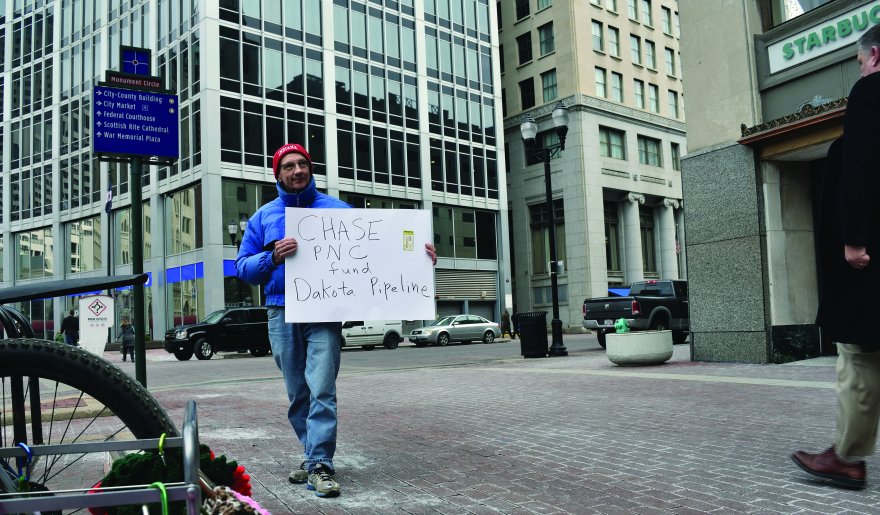
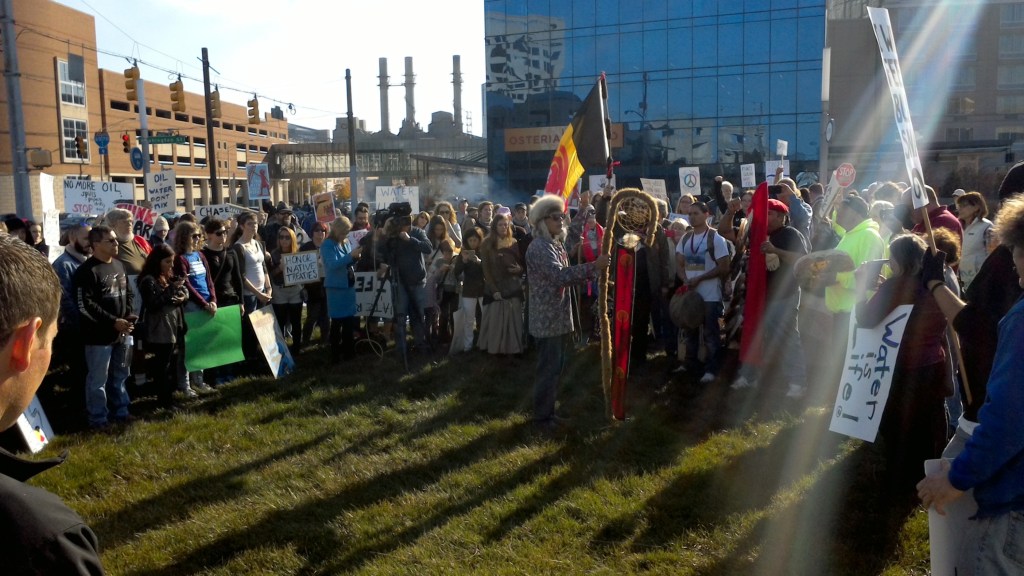
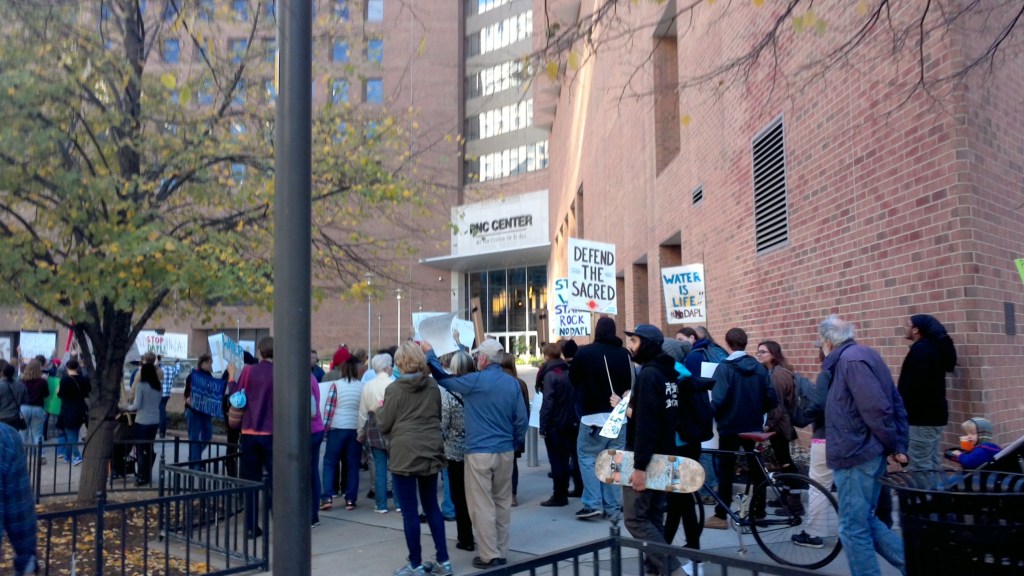
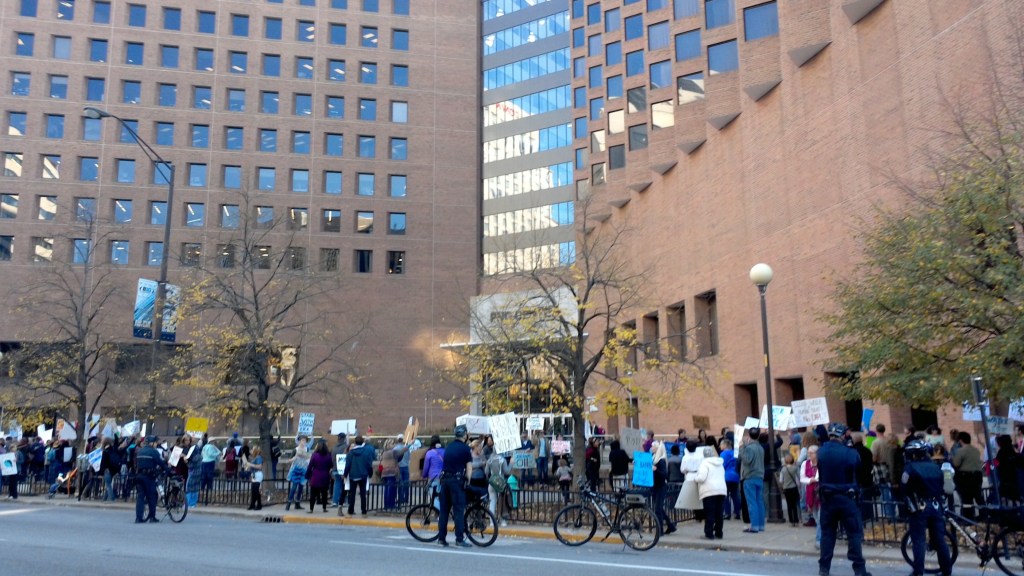
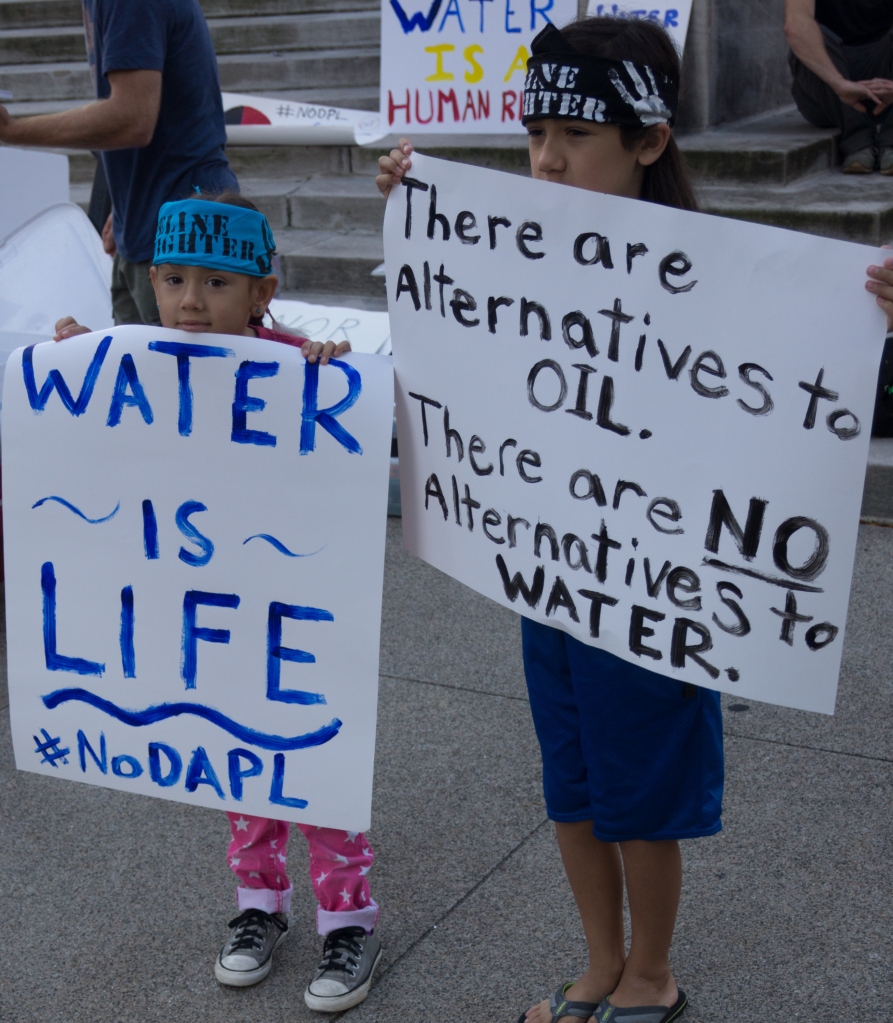
My first experience with divestment occurred in Indianapolis in 2016, where we targeted both Chase and PNC, who were funding the Dakota Access pipeline. Below are some photos from the day we went to those banks, where those who had accounts there closed them.

I had an account at Chase but had not set up an account at another bank, so I couldn’t withdraw my funds that day. The following is what happened when I was ready to close my Chase account.

My own experience in closing my Chase account

In Indianapolis we had been working on defunding the Dakota Access Pipeline (DAPL) for several months. On November 15, 2016, a crowd of about two hundred of us marched through downtown Indianapolis with our signs about defunding the pipeline. We stopped in front of two of the banks involved with funding the pipeline, Chase, and PNC. The crowd stood in silence as people went in to close their accounts. That day the group withdrew $110,000 dollars.


My own effort to close my account was more difficult than I thought it would be. 

First, I had trouble getting the forms from the University to change my paycheck to direct deposit at a different bank. It took time to set up paying bills. I also realized that I had initially chosen Chase bank because they had the most ATM locations. This was important because I don’t own a car. There can be inconveniences from defunding.

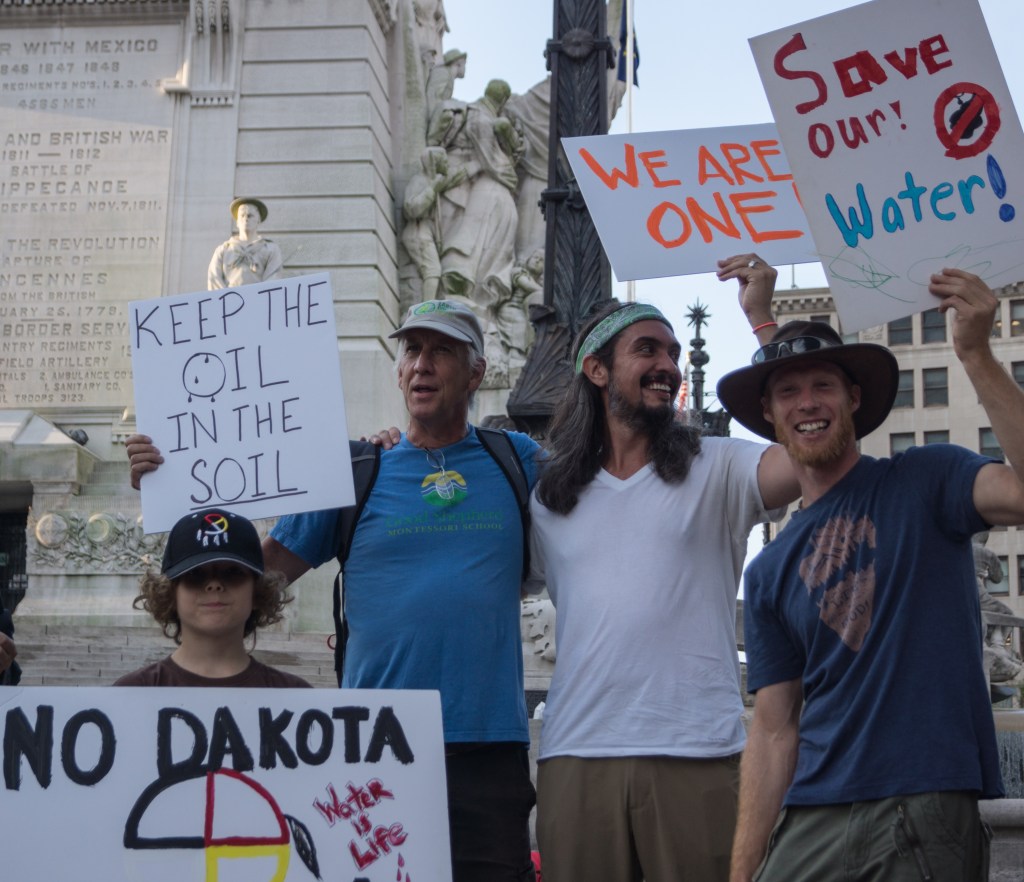
I went to the Circle in the center of downtown Indianapolis where the Chase Tower dominates the Indianapolis skyline. I spent about an hour walking around the Circle with my sign, looking to see if anyone else had shown up from my local group. It is a little nerve wracking to be walking around by yourself like that, but no one looks directly at you or engages you.

I was also hoping to get a photo of the sign in front of Chase bank (this was requested as part of the national campaign).  When I walked past Bridget, who sits on the Circle every day, crocheting, she asked me what the sign said, and we had a conversation about the importance of protecting our environment.   She graciously took several photos for me, including the one above.

I had finally worked up the courage to enter the Chase Bank Tower to close my account.  I had no idea what the reaction to entering with my sign would be. I just placed it next to my chair as I waited.  The bank officer greeted me with a smile and said someone would be with me shortly. He came back after about ten minutes to say he appreciated my patience—it was a busy time.

Mostly people coming into the bank ignored me, but there were a few glances in my direction. You can tell when you’re making people uncomfortable. I’ve had a lot of practice with that.

When I was shown into the banker’s office, she saw my sign, smiled, put her hands together, bowed to me, and said, “we are on the same page with this.” She put her finger to her lips with a smile indicating she shouldn’t be saying that. She was very pleasant and helpful. When I left, she took my hand in both of hers.

As I was walking past the lobby officer when I left, I reached out my hand, which he took in both of his hands, giving me a big smile and a little bow as well. I told him I appreciated his patience with my freedom of speech, and he smiled and said, “Of course.”

My little bit was added to the total amount of money divested so far: $72,944,005.39 dollars according to defunddapl.org.

I felt goodwill between me and those in the bank to such an extent that I returned later in the week to drop off copies of the blog article I had written describing how well they had treated me and the whole defunding process. When the banker I had dealt with previously glanced up, she gave me a big smile and waved me in. She got up and again took my hand in hers and asked what she could do for me. She told me she and her husband had talked about our visit and the pipeline.

During meeting for business in February at North Meadow Circle of Friends (Quaker), the meeting approved closing its Chase Bank account in solidarity with the #noDAPL movement.   

This is how our stories spread.

I know I sometimes repeat parts of stories like this from my past. I’ve heard we need to return to and retell our stories. Stories are important to affect change. Often in the retelling I learn something new from today’s perspective.

Envelope drawings

There is a long history of connection between Bear Creek Friends Meeting in rural Iowa, and Monteverde Friends School in Costa Rica. Wolf and Lucky Guindon and my parents, Burt and Birdie Kisling, had a double wedding at the Bear Creek Meetinghouse in 1950. Shortly afterward, the Guidon’s were among a small group of Quakers who left this country because of increasing militarism and settled in Costa Rica. Lucky and Wolf are on the right.

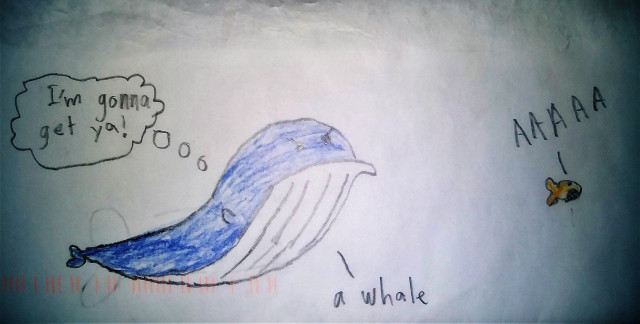
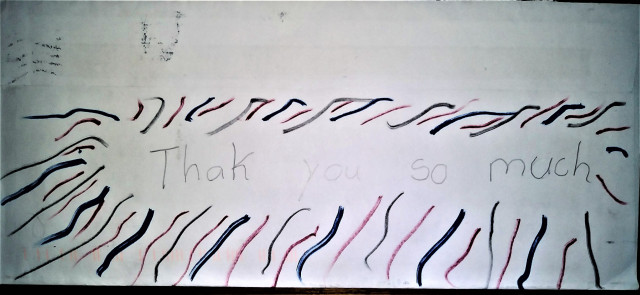
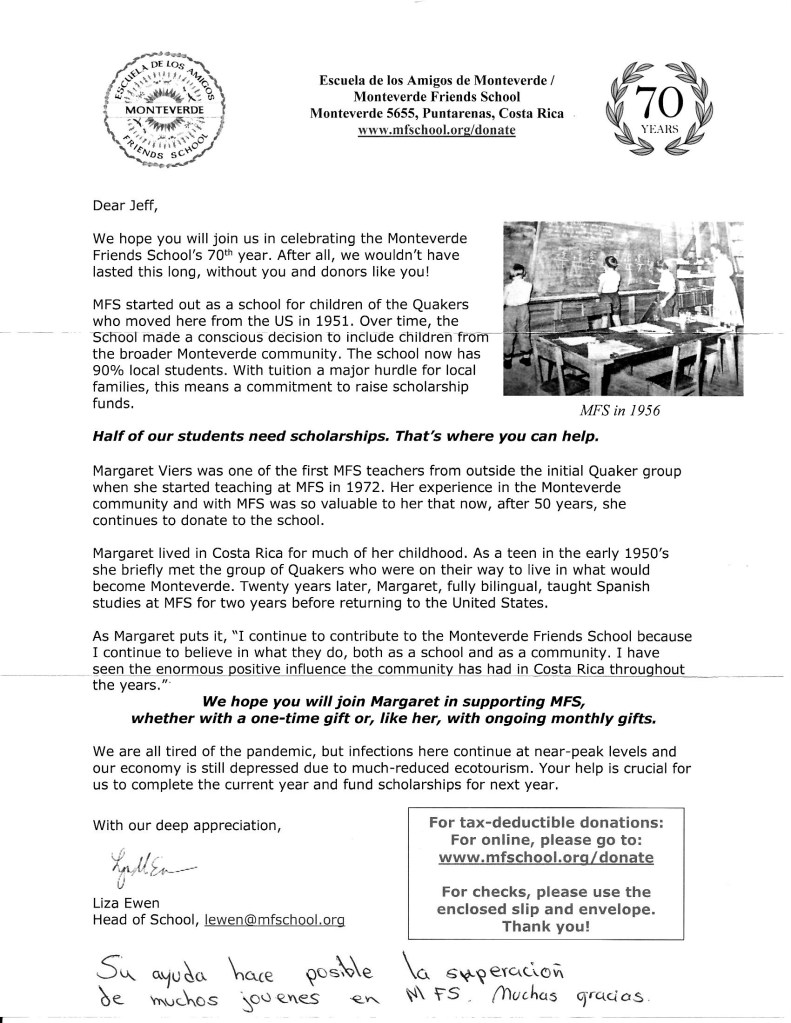
In 2018 I received a letter from the school in this envelope with a drawing of a whale. The clerk of Bear Creek Meeting received the other envelope below.

Envelopes from Monteverde Friends School (2018)

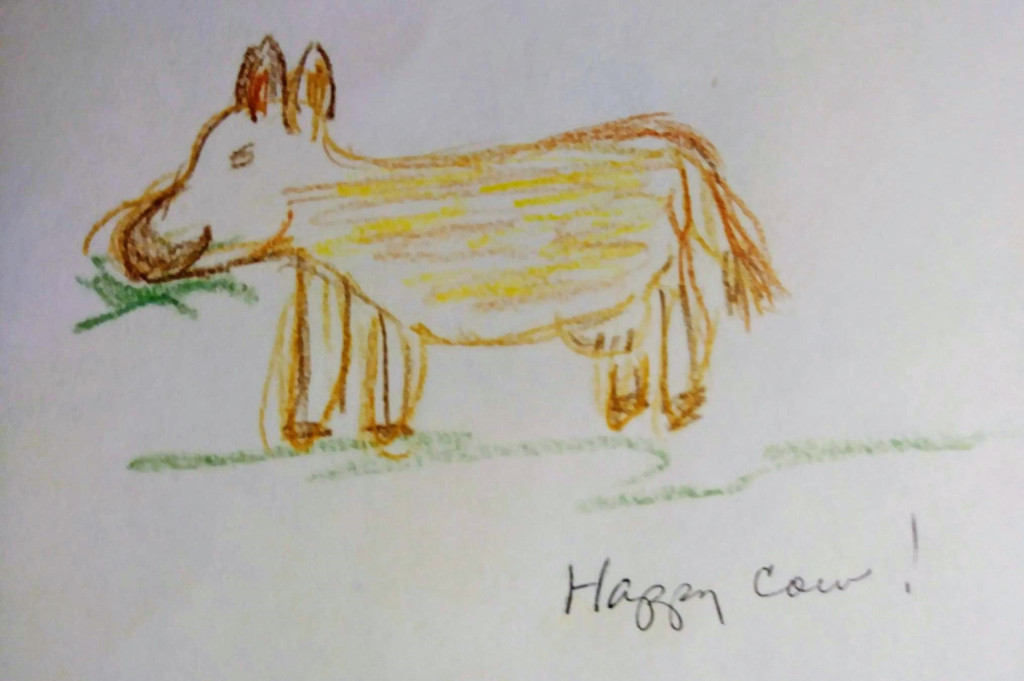
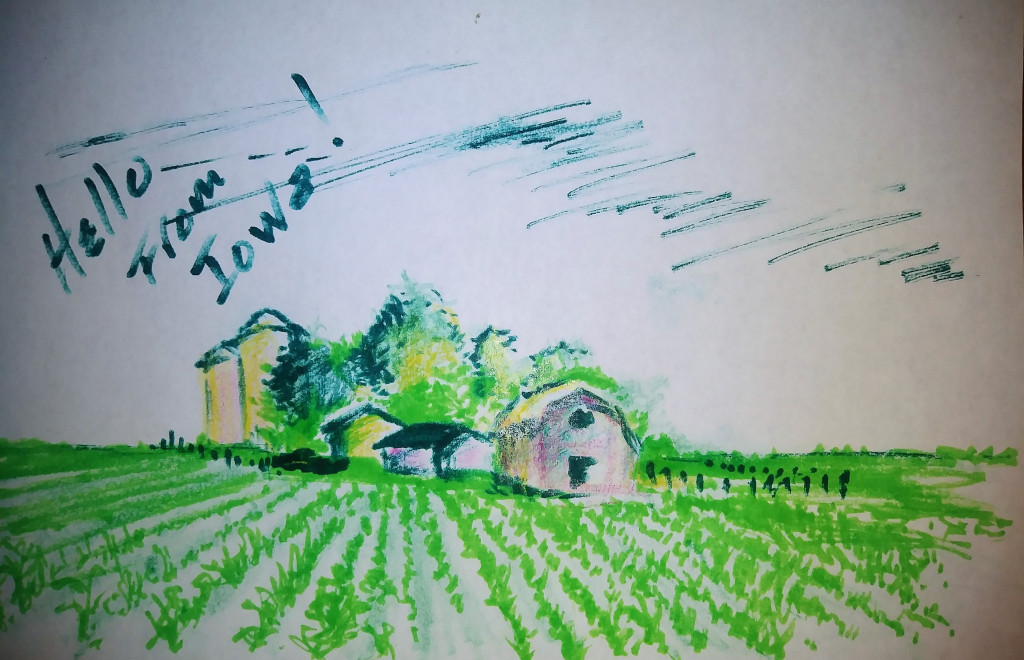
When we shared the pictures at Bear Creek Meeting, we spent a lot of time sharing stories about our connections with Monteverde Friends. Some present had visited Montverde. Others know people who have lived or continue to live there. As we shared these stories, we thought it would be nice to reply to the drawings from the children at Monteverde, by sending back drawings from us. The school told us the student artists were thrilled that we appreciated their artwork.

Drawings from Bear Creek to Monteverde.

In 2011 some of our family traveled to Monteverde for a reunion with Wolf and Lucky. Lucky on left, Wolf on the right.

Lucky, Birdie, Burt and Wolf

Recently we received more envelopes from Monteverde.


EPSON MFP image

Unban Anti-racism Education in Iowa

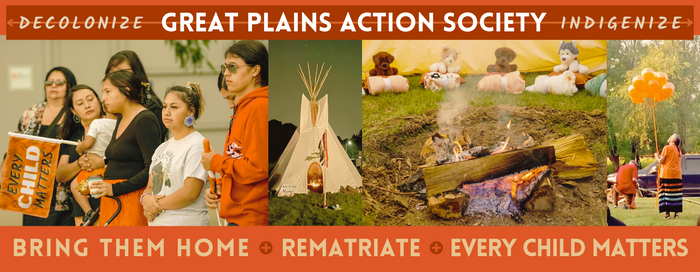
The Great Plains Action Society youth organizers and experts across Iowa weigh in on white supremacy and the ban on Critical Race Theory. The bans on Critical Race Theory across the country are one of many examples of efforts to whitewash the truth.

Online Pushback: UnBan Anti-Racism Education in Iowa
May be an image of 2 people and text that says 'ONLINE PUSHBACK FORUM UNBAN ANTI-RACISM EDUCATION IN IOWA Hosted by Great Plains Action Society Youth Organizers Alexandrea Walker, Ho-Chunk Keely Driscoll, Meskwaki Youth and experts across lowa weigh in on white supremacy and the ban on Critical Race Theory September 15, 2021 @ 6:30 PM CST @ bit.ly/teachtruthforum'

YouTube Link youtube.com/watch?v=tIlz26X7T-U

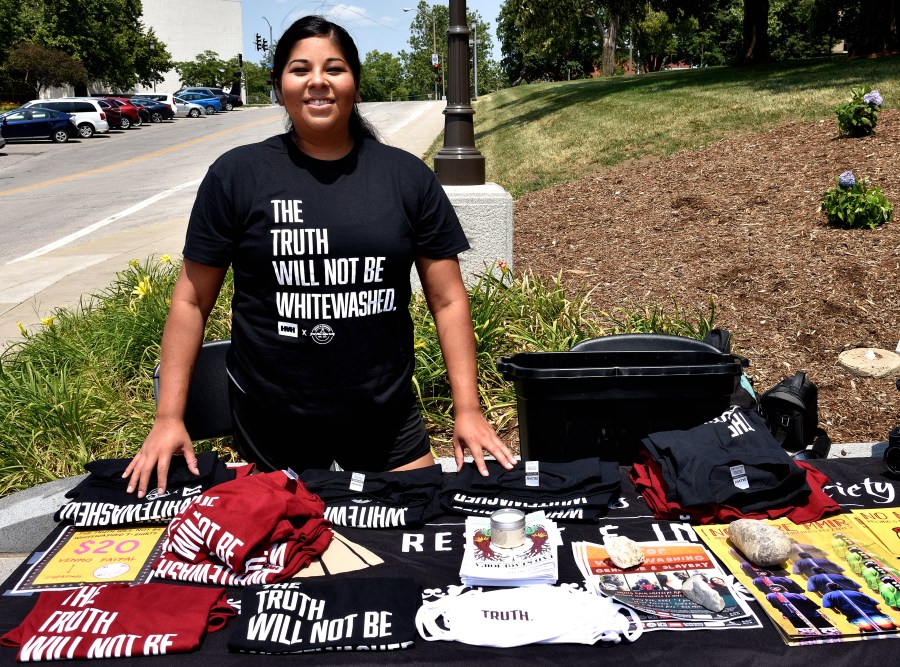
The Truth Will Not Be Whitewashed!

Indigenous Youth Organizers, Alexandrea Walker and Keely Driscoll, have started a youth-led movement to demand that the current Iowa Administration unban Anti-Racism Education, aka, Critical Race Theory. For the sake of health and safety for all, it is imperative that Kim Reynolds reverse the overtly white supremacist decision to ban anti-racism education plus diversity, equity, and inclusion programming in the classroom and in all state-funded institutions. Join Alex and Keely as they host a forum for youth and experts throughout Iowa to weigh in on this pressing issue. Guests TBA.

The Truth Will Not Be Whitewashed is a campaign founded by Great Plains Action Society and Humanize My Hoodie. We encourage others to join this effort. Please contact us if you are interested in joining our growing coalition.

Great Plains Action Society (You can send a message from this link)


This reminds me of the work of Lynne Howard and Des Moines Valley Friends’ (Quakers) to get draft counseling into the Des Moines public schools in 1970. They were successful! Resisting draft counseling was an effort to whitewash the truth about participating in the military.


PROPOSAL FOR DRAFT COUNSELING IN THE DES MOINES PUBLIC HIGH SCHOOLS

STATEMENT OF BELIEF:

We believe that all young men in the Des Moines Public High Schools should have access to adequate counseling by qualified counselors in regard to the Selective Service and its alternatives.  Qualified counselors are those persons who:

  1. Have received special draft counseling training
  2. Have a detailed knowledge and experience of the Selective Service Law and the administration thereof
  3. Are sensitive to the moral and spiritual implication of war and peace and individual conscience
  4. Have knowledge of where to refer students if they want counseling on a specific aspect of the Selective Service alternatives and options

We further believe that such counseling should be made available during school hours, similar to other available guidance counseling.

IMPLEMENTATION:

There in light of the above purpose we recommend that one of the following plans be used to implement this counseling program:

  1. That each high school in Des Moines provide adequate training of all guidance counselors in order that they be familiar with the Selective Service Law and its alternatives
  2. That each high school select one guidance counselor who would be specially trained (see above) to counsel and answer questions concerning the draft and its alternatives.  Other guidance counselors in the school could refer their students to this specially trained counselor, if this type of counseling is needed
  3. That each trained counselor would refer persons who need more intensive and specific counseling to appropriate groups.  (Particular religious groups, various branches of the Service, etc.)

The Peace Testimony Remains by Lynne Howard. September 15, 1970

First Nation-Farmer Climate Unity March Anniversary

My grandmother, Lorene Standing, said the will of God is often revealed in a series of small steps. I thought that meant a series of spiritual messages and that has been my experience.

But also, looking back over our lives, the series of actions we took, the decisions we made, map the path traveled. Spiritual guidance can help us stay on the path, might tell us what action to take. Each step gives us experience needed to continue on the path. We stray from the path at times. But learn by making mistakes.

This is the third anniversary of the First Nation-Farmer Climate Unity March (described below). When I learned about the March, I immediately felt a leading from the Creator this was something I should do. The experiences during the March were transformational for me.

The Spirit was important in numerous ways. One of the reasons I wanted to join the March was to learn more about Indigenous spirituality, and I did.

The article below describes how my Quaker community supported us spiritually during the March.

The Spirit created the opportunity for me to talk with my new friend, Matthew Lone Bear, about Quaker involvement with the native residential schools. And for him to share a story of the impact of those schools on his own family. (These stories are found on the First Nation-Farmer Climate Unity March website https://firstnationfarmer.com/ )

Our experiences on the March have made it possible for us, native and nonnative people, to work together in many ways since.

Here is a link to the First Nation-Farmer website, where there are many stories, photos and videos from the March. And a link to the website LANDBACKFriends which is about work going on now related to the concepts of LANDBACK.

First Nation-Farmer Climate Unity Marchhttps://firstnationfarmer.com/
LANDBACK Friendshttps://landbackfriends.com/

These are perilous times. Ferocious wildfires, melting glaciers and permafrost, severe drought, and devastating storms show rapidly evolving environmental chaos. Political, economic and social systems are breaking down.

There is also hope as we work together to address these challenges. Mutual Aid works because it is based upon people working and being together in their local communities, solving local problems. And LANDBACK is a framework for Indigenous peoples to teach us how to work to repair our relationships with Mother Earth and each other. It is because of the friendships that formed during the March that many of us are working together on Mutual Aid and LANDBACK.

Following is an article, written shortly after the March, published in On Creation, the publication of Quaker Earthcare Witness. The article is no longer online.

https://firstnationfarmer.com/

Iowa Yearly Meeting (Conservative) Friends Peter Clay and I recently walked on the First Nation-Farmer Climate Unity March. A group of about thirty that included nearly a dozen Native Americans walked 94 miles along the route of the Dakota Access Pipeline from September 1 – 8, 2018. One of the goals of the March was to bring attention to a case before the Iowa Supreme Court about the improper use of eminent domain to force Iowa farmers to allow construction of the pipeline on their land.

After walking between 9 and 15 miles, most evenings a community forum was held to discuss topics such as farming practices, or the consequences of the pipeline construction. One evening my Scattergood Friends School classmate Lee Tesdell discussed some of his progressive farming practices. Christine Nobiss discussed ways Native farming practices are better for the earth and water. This was an example of how this March helped us come together. As Manape LaMere, one of the headsmen from Standing Rock said, the purpose of the March was to make it possible for us to work together in the future. To do so, we needed to trust each other, and to trust each other we needed to understand each other.

During this March, Quakers in my local meeting, Bear Creek, often sent email messages of encouragement, and held us in their prayers. One of my Quaker friends, Liz Oppenheimer, invited people to offer spiritual support for our March in a couple of ways. One was via a telephone conference call every morning we were marching, from 8:30 to 9:00 am.

The other way Liz created for others to support us was by creating a Facebook group called “Meeting for Worship: Iowa’s Climate Unity March”. Following are a few of the messages shared on that Facebook page:

I see that Jeff has posted some of his recent writing about the march and its issues. My request is that we return to Jeff’s initial questions— sharing our reactions to the idea behind this march, as well as to the issues of pipelines, indigenous rights, misuse of eminent domain, etc.

As we share our own wonderings, questions, and struggle, I hope we can better accompany Jeff, Peter Clay, and other marchers.

George Fox suggested to us that if we answer that of god in others that we can then walk cheerfully over the earth. As I think about Jeff and Peter and the new sisters and brothers they will meet as they march, I realize that this sentiment works the other way also. As they walk over the earth they will then be able to answer to that of god in others.

This morning on the conference call for worship, we heard a vocal prayer of gratitude to Peter Clay, Jeff Kisling, and the other marchers and organizers of the march. We also heard the joyous hymn “Trees of the Field.”

After other Friends had left the call, and literally as my finger was about to hit the Hang Up button on my phone just past 9:00 am, another Friend joined the call. It was Jeff!!

He wants us to know that the marchers and organizers know we are holding them all in prayer and they are very appreciative of our support in this way. When I replied “It’s such a small thing we do,” Jeff reminded me “No, no it’s not.”

We are so blessed to be connected this way, no matter what form our march and our journey takes. And to those of you who are carving out time each day to hold the Climate Unity March in prayer, regardless of when, where, or how, all of us thank you.

Each morning of the March we gathered in a circle to hear about the day’s route and address any questions. The first morning I shared this Quaker support with my fellow marchers during our circle gathering, who expressed appreciation for this.

Some of the most powerful experiences I had during the March were times when prayers were offered. We stopped for prayers every time we crossed the route of the Dakota Access Pipeline. I was honored to be given the opportunity to give prayers at the pipeline crossing just before we reached Pilot Mound. I briefly described Quaker worship, then our circle, holding hands, worshiped in silence for a while.

Mutual Aid Case study 1

Things at our weekly Mutual Aid free food project didn’t go as usual. Which is a good illustration of how and why Mutual Aid works so well.

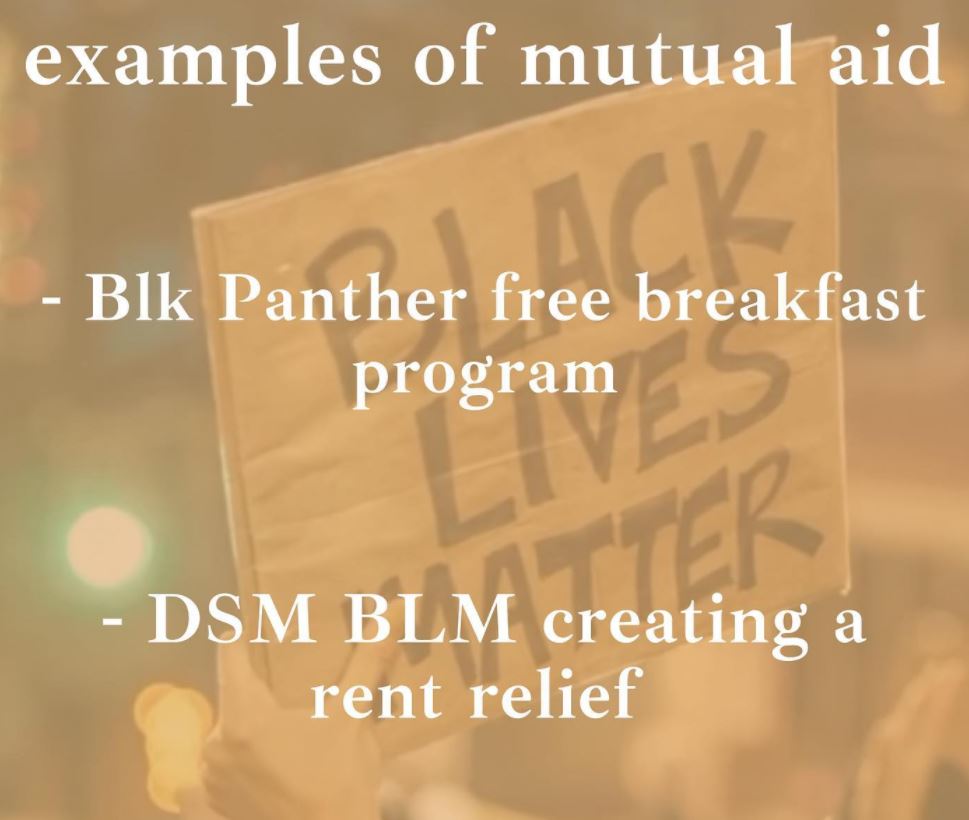
Every Saturday morning my Des Moines Mutual Aid group comes to Trinity Las Américas United Methodist Church in downtown Des Moines, Iowa. There we continue the free food program that was started by the Black Panthers in the 1960’s. see: Feeding the hungry

When I arrived, there were a number of people already in the basement, none of whom I knew. And the tables were set up differently. Someone asked me if I was with Des Moines Mutual Aid, introducing himself as Alejandro Alfaro-Santiz, pastor of the church. Several months ago Ronnie James asked if I knew Alejandro, saying he was an amazing organizer (which was something coming from someone who is a great organizer himself).

Alejandro told me they were running a COVID vaccine clinic this morning. And that he had spoken to Ronnie about the change. Just then Ronnie arrived and said Alejandro was going to show him where to find the tables for us to use.

Now this is a small thing but illustrates the flat hierarchy that is the basis of Mutual Aid. Rather than Ronnie telling me to come with him, he started up the steps with Alejandro. It was up to me to decide if I should go along. I went with them to the THIRD floor where the tables were. We began to fold up the legs and carry the tables down. Others joined us as we went back up for more. They laughed when I said we were getting our cardio workout.

We set these tables up in the yard of the public school across the street from the church, eventually setting up about 25 of them. Although it had rained earlier we were blessed the rain held off for the rest of the morning.

It’s kind of magical how the food boxes are created. When we begin there might be about a dozen empty boxes. So we put the food that will eventually end up in a box in piles on the table itself. Then as each box of food to be distributed is emptied, that becomes a box to fill with one of the piles of food sitting on the table. Eventually there are usually enough boxes for all the piles of food. In the rare times that hasn’t worked out, plastic bags are used for the remainder.

There are often a few minutes of rest between the arrival of food to be distributed from various sources. We share our stories, getting to know each other better. We’re all wearing masks, so it can take a second to figure out who you’re talking to. You have to be careful about what you share on social media because law enforcement scans for that kind of information.

I met person 1 four or five months ago. He had been otherwise occupied and hadn’t been at the church for some time. But I read about the work he was doing for Iowa Citizens for Community Improvement. And I’d seen him “like” my photos sometimes. This morning he said he enjoyed the photos of the deer I posted on Facebook yesterday. He introduced me to a young person who wanted to become involved in Mutual Aid. I later heard from someone else, who themselves (person 2) had been arrested at a Des Moines City Council meeting, that person 1 had been arrested, also. And that he had been hurt in the process.

Person 2 said the police were much rougher than they needed to be. She was targeted for arrest because she was videotaping what was going on. When I asked if they took her phone, she told me she had arranged for another person to take it if it looked like she was going to be arrested. So the police didn’t get her phone. Good to plan ahead.

Despite the fact that we needed to totally rearrange our process, we were ready for the cars to come down the line to pick up the food at the designated time of 10 o’clock.

While the food was being distributed, some of us began to clean and fold up the tables, and carry them back up to the third floor of the church.

As I was getting ready to leave, Ronnie asked if the tables had gotten back to their original locations. Just checking that we all had done our part in cleaning up.

I hope this shows how we stay connected through multiple means.

This is how Mutual Aid works. Being able to adapt. Taking your own initiative. Maintaining a flat hierarchy. Sharing stories. Sharing the joy.


What kind of ancestor do you want to be?

In these increasingly troubled times I find myself thinking about the concept of sensemakingthe action or process of making sense of or giving meaning to something, especially new developments and experiences. 

It is increasingly difficult to make sense of all that is going on today. All the bad things I had anticipated for the future are suddenly happening now. And things I never imagined, like the assaults on truth and science, come at a time when they are desperately needed.

At the collective level, a loss of sensemaking erodes shared cultural and value structures and renders us incapable of generating the collective wisdom necessary to solve complex societal problems like those described above. When that happens the centre cannot hold.

Threats to sensemaking are manifold. Among the most readily observable sources are the excesses of identity politics, the rapid polarisation of the long-running culture war, the steep and widespread decline in trust in mainstream media and other public institutions, and the rise of mass disinformation technologies, e.g. fake news working in tandem with social media algorithms designed to hijack our limbic systems and erode our cognitive capacities. If these things can confound and divide us both within and between cultures, then we have little hope of generating the coherent dialogue, let alone the collective resolve, that is required to overcome the formidable global-scale problems converging before us.

Pontoon Archipelago or: How I Learned to Stop Worrying and Love Collapse. By James Allen, originally published by Medium
June 18, 2019

sensemaking the action or process of making sense of or giving meaning to something, especially new developments and experiences

Celebrants have an important part to play in the legacy humanity caries into the future. I suggest that our responsibility as ceremonialists, as humans who help other humans meaningfully connect with the web of life, is to find ways now to help people connect with the story of this world’s beauty, even as the world we love recedes. I believe there is a gift we can bring to our communities, to help people learn the art of losing. To help us all to meet the rising tides.

Celebrants & Ceremony in Response to Climate Grieving, Dina Stander, July 26, 2019

I believe faith communities and Indigenous ways need to play a crucial role in helping us move through the oncoming, increasingly severe chaos. Faith can provide sensemaking for those who have no framework for making sense of our broken systems.

People of faith can be celebrants. Indigenous peoples are celebrants, their cultures based upon a timeless connection to Mother Earth.

The problems before us are emergent phenomena with a life of their own, and the causes requiring treatment are obscure. They are what systems scientists call wicked problems: problems that harbour so many complex non-linear interdependencies that they not only seem impossible to understand and solve, but tend to resist our attempts to do so. For such wicked problems, our conventional toolkits — advocacy, activism, conscientious consumerism, and ballot casting — are grossly inadequate and their primary utility may be the self-soothing effect it has on the well-meaning souls who use them.

If we are to find a new kind of good life amid the catastrophes these myths have spawned, then we need to radically rethink the stories we tell ourselves. We need to dig deep into old stories and reveal their wisdom, as well as lovingly nurture the emergence of new stories into being.

Pontoon Archipelago or: How I Learned to Stop Worrying and Love Collapse. By James Allen, originally published by Medium
June 18, 2019

How do we rethink the stories we tell ourselves? We need to let go of the stories we have discovered to be untrue. Learn about, and embrace stories of other cultures. Seek, and really listen for, Spiritual guidance. Then actually implement that guidance.

One idea is to share stories from earlier times. “We need to dig deep into old stories and reveal their wisdom.” The Quaker Stories Project is an example. https://quakerstories.wordpress.com/

We need to re-think those stories. To consider what they say about our world today. To see if they represent something we have lost. Something it might be good to return to. The past leading into the future.

Seeking out new people and experiences are ways we can create new stories. For more than a year I have been learning new stories from my friends in the Mutual Aid community. We have been learning, together, how to live and work together in ways without a vertical hierarchy. Where decisions no longer come from leaders who try to wield power without consent. As my friend Ronnie James, who is my Mutual Aid mentor says:

I’m of the firm opinion that a system that was built by stolen bodies on stolen land for the benefit of a few is a system that is not repairable. It is operating as designed, and small changes (which are the result of huge efforts) to lessen the blow on those it was not designed for are merely half measures that can’t ever fully succeed.

So the question is now, where do we go from here? Do we continue to make incremental changes while the wealthy hoard more wealth and the climate crisis deepens, or do we do something drastic that has never been done before? Can we envision and create a world where a class war from above isn’t a reality anymore?”

Ronnie James

Our ancestors are ashamed of us, my friends. We are the people who disgraced the past, to create a myth called “the future.” That myth failed because there was no soul in it, no depth, no humanity. It was a vision of power, control, slavery, and violence, if we strip the gloss away

We’re Losing the Battle for the Future | by umair haque | Jul, 2021 | Eudaimonia and Co (eand.co)

It all comes down to what type of ancestor I want to be for my descendants. Do I want to be a regular nobody that did nothing to protect our planet or do I want to be like Crazy Horse who fought and died for the little bit of land that we have left to protect? We have that chance right now to make that decision. This kind of resistance runs through all of our blood because we are the Indigenous Peoples of these lands. It’s at vital choice for the survival of humankind.

What Kind of Ancestor Do you Want to Be? Why I Fight the KXL by TaSina Sapa Win, February 28, 2019