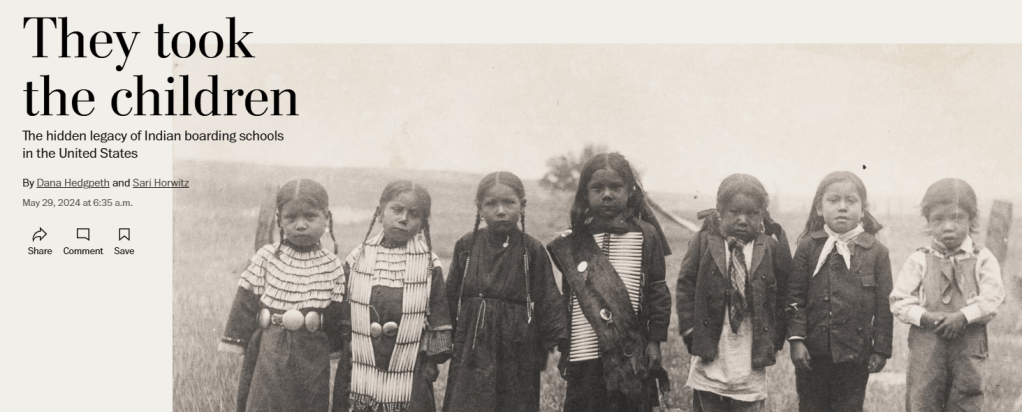
The first Washington Post article is an interactive presentation of their investigation into sexual abuse in Native American boarding schools. ‘In the Name of God’ by Sari Horwitz, Dana Hedgpeth, Emmanuel Martinez, Scott Higham and Salwan Georges, The Washington Post, May 29, 2024
Quaker Paula Palmer has been working on her ministry related to Friends and Indigenous Peoples for many years. You can find out about her work on the Friends Peace Teams site, Toward Right Relationship with Indigenous Peoples. https://friendspeaceteams.org/trr/
I’m grateful I had the opportunity to get to know Paula when she came to the Midwest to talk about and lead workshops related to the forced assimilation of native children.
Land Return
Yesterday I received this email from her.
Friends, I spoke about this at today’s QIBS meeting but want to pass the information on to all of you. The Sierra Friends Center property in the northern California mountains (home of the former Woolman School) is being sold to the Nisenan tribe, through their non-profit organization California Heritage: Indigenous Research Project (CHIRP). The sale is supported by the Indigenous Concerns subcommittee of Pacific Yearly Meeting and by many California Friends. However a letter by a Berkeley Friend criticizing this sale was published in Western Friend online. Please read the letter and the information on the Sierra Friends Center site and the announcement below. Please consider whether you would like to write a letter to Western Friend supporting the sale as a conscious act of land return to Indigenous peoples.
I am a graduate of the first class of John Woolman School in Nevada City, CA, and have held the campus and its environment close to my heart and soul for sixty-odd years.
I have just sent the following letter of dismay to all of the nonprofits that I mention in it, plus to many parts of many yearly meetings, plus to Western Friend.
This letter was written in response to the sale of the property that was once John Woolman School – currently 188 acres with 9 buildings – which is being sold to a nonprofit representing the Nisenan people, who are indigenous to the land in question. The Quaker board that represents Woolman in this sale has not been up front with the larger Quaker community about the extent of the property’s debts, nor about the fair market value of the property, which I speculate could be $4 million or more. The board has suggested that the property might be sold to the Nisenan for $1.3 million.
Here is my letter of dismay, which I have distributed widely:
I find this detailed letter to be helpful in itemizing the objections some Quakers have about returning land to Indigenous peoples. I say “some” Quakers because I don’t know how many Friends object to this idea of land return.
I realize using the phrase “land return” implies the land was taken from Indigenous people. This is complicated by the concept of “property” and land ownership as viewed by most non-native people. It doesn’t mean taking back private property. It is about returning public lands to the stewardship of native peoples.
It is also about broken treaties, treaties that acknowledged native people’s rights to land.
Broken Treaties With Native American Tribes: Timeline. From 1778 to 1871, the United States signed some 368 treaties with various Indigenous people across the North American continent by Sarah Pruitt, History.com, July 12, 2023
Please consider whether you would like to write a letter to Western Friend supporting the sale as a conscious act of land return to Indigenous peoples.
There is a native concept of considering what the effects of decisions made today will be on seven generations into the future.
The following quotation makes a two-way connection between us and future generations. Looking at each other over the generations.
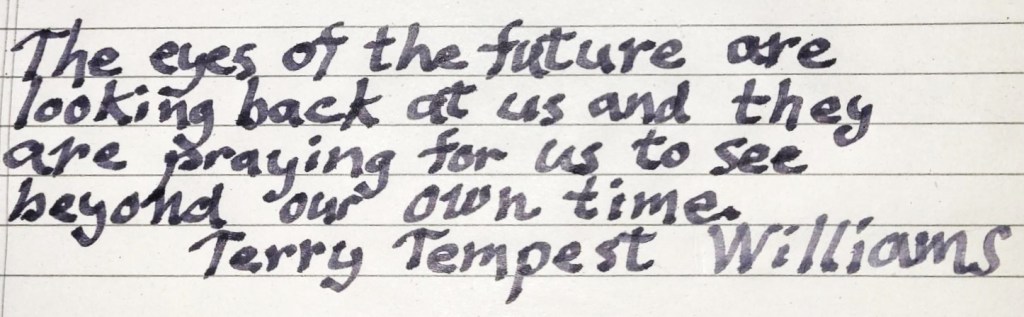
The eyes of the future are looking back at us and they are praying for us to see beyond our own time. They are kneeling with hands clasped that we might act with restraint, that we might leave room for the life that is destined to come. To protect what is wild is to protect what is gentle. Perhaps the wilderness we fear is the pause between our own heartbeats, the silent space that says we live only by grace. Wilderness lives by this same grace. Wild mercy is in our hands.
― Terry Tempest Williams, Refuge: An Unnatural History of Family and Place
Similarly, can we not look back at our ancestors? We are our ancestors’ future generation looking back.
I think about this a lot these days. As stories of the remains of native children on the grounds of the institutions of forced assimilation continue. Thousands of children never returned home.
I’ve been praying about what we are doing now and how much harm this is doing to future generations. My Spirit recoils from the likelihood there probably will not be a seventh, or sixth, or fifth generation because of the accelerating rate of environmental collapse.
What have we done?
What will we do?
As we work for change, we are admonished that we need to tell new stories. This morning I found this story Nico Santos tells, from the movie Dragon Rider.
“Wings”
Oh, I’ve been lost in the darkness I heard your voice from afar You weren’t my callin’ You weren’t my callin’ Whenever the night was starless And I couldn’t see anymore You showed me the mornin’ You showed me the mornin’
So I-I-I wanna let you know When life has got you low
I’ll be your wings to fly When there’s trouble on your mind Whenever you’re ’bout to fall There’s nothin’ I won’t try ‘Cause I’ll be your wings to fly When you’re sufferin’ inside Come hell or high water Got you covered all my life Let these wings take you High, high There’s nothin’ I won’t try
We built our own kinda fortress Nothing can break us apart Walls won’t be fallin’ These walls won’t be fallin’ I wouldn’t be if it wasn’t for you I wouldn’t speak if it wasn’t the truth You are my callin’ You are my callin’
So I-I-I wanna let you know When life has got you low
I’ll be your wings to fly When there’s trouble on your mind Whenever you’re ’bout to fall There’s nothin’ I won’t try ‘Cause I’ll be your wings to fly When you’re sufferin’ inside Come hell or high water Got you covered all my life Let these wings take you High, high There’s nothin’ I won’t try
You were my eyes, oh, when I couldn’t see Were my voice, oh, when I couldn’t speak Can I give it back to you? Let me give it back to you You were my legs, oh, when I couldn’t run Were my heart when my own went numb I’ll do what I have to do Everything to get you through
I’ll be your wings to fly When there’s trouble on your mind Whenever you’re ’bout to fall There’s nothin’ I won’t try ‘Cause I’ll be your wings to fly When you’re sufferin’ inside Come hell or high water Got you covered all my life Let these wings take you High, high There’s nothin’ I won’t try Let these wings take you High, high There’s nothin’ I won’t try Let these wings take you high
For the past week I’ve been thinking and praying a lot about Mutual Aid in preparation for a discussion we plan to have at my Quaker meeting tomorrow.
As I have nearly every Saturday for the last year, I was with my Mutual Aid friends this morning for our weekly food distribution. Here are a few stories triggered from what happened this morning.
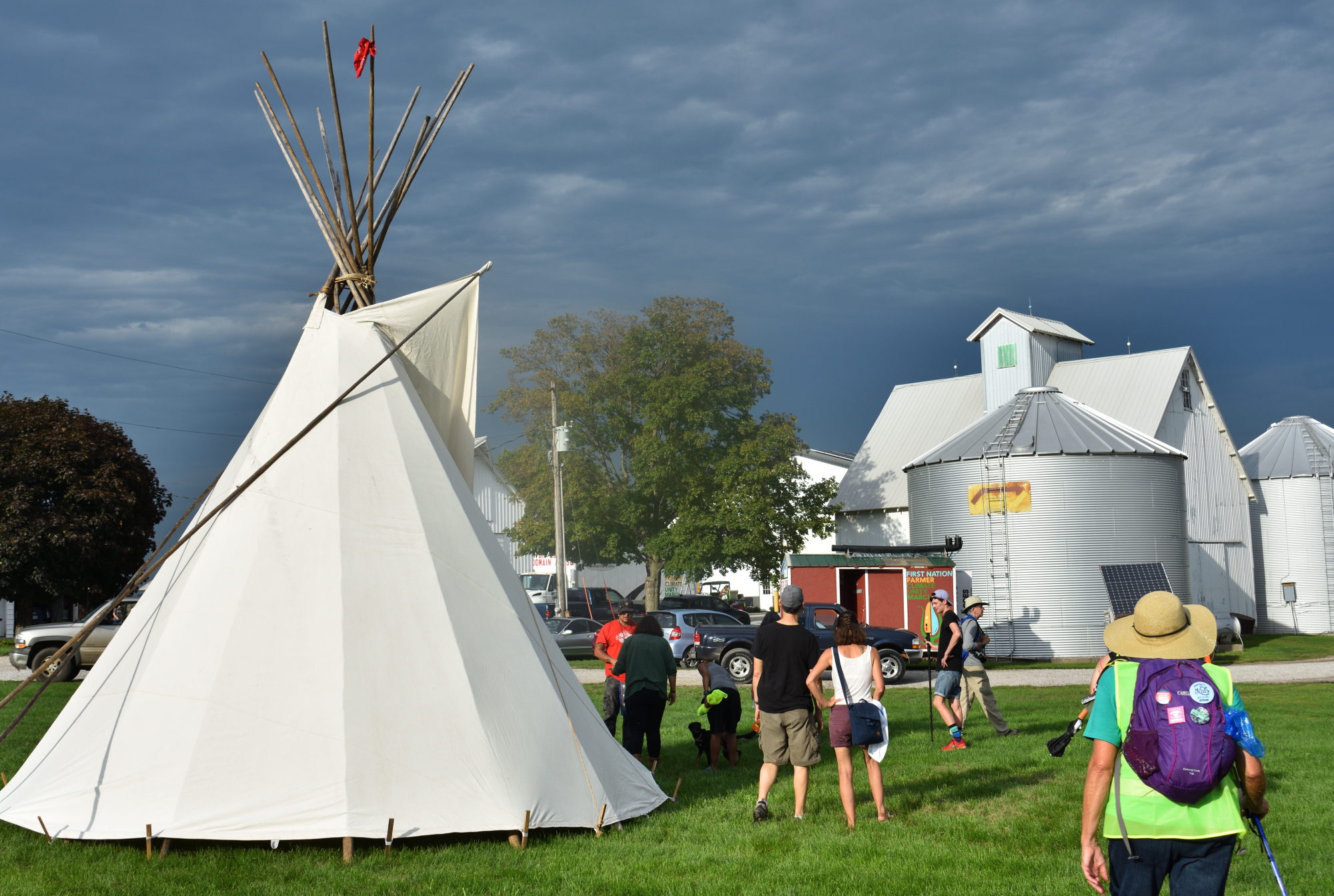
I had a clear spiritual leading to become involved in Des Moines Mutual Aid. For the sake of brevity, I’ll begin with my return to Iowa in 2017. I was looking for justice activists and soon had the opportunity to walk on the First Nation-Farmer Climate Unity March. A group of about ten native and ten non-native people walked and camped together for ninety-four miles, over eight days, along the path of the Dakota Access pipeline. The intention was for us to get to know each other as we shared stories, and that worked amazingly well. I got to know Sikowis Nobiss, Trisha Etringer, Matthew Lone Bear, Alton and Foxy Onefeather, and Donnielle Wanatee, among others. Various combinations of us worked together since then on things like racist monuments and mascots, Indigenous Peoples’ Day, and an Indigenous led Green New Deal.
There are a lot of photos and blog posts related to this sacred journey here: https://firstnationfarmer.com/ Part of the story relates to the support we received from Friends.
The summer of 2019 Peter Clay, Jim Glasson, Linda Lemons, and I helped arrange for Paula Palmer to have several sessions in the Midwest related to her ministry regarding Quakers and Indigenous peoples.
We wanted to continue this work. On February 7, 2020, we planned to meet at Friends House in Des Moines.
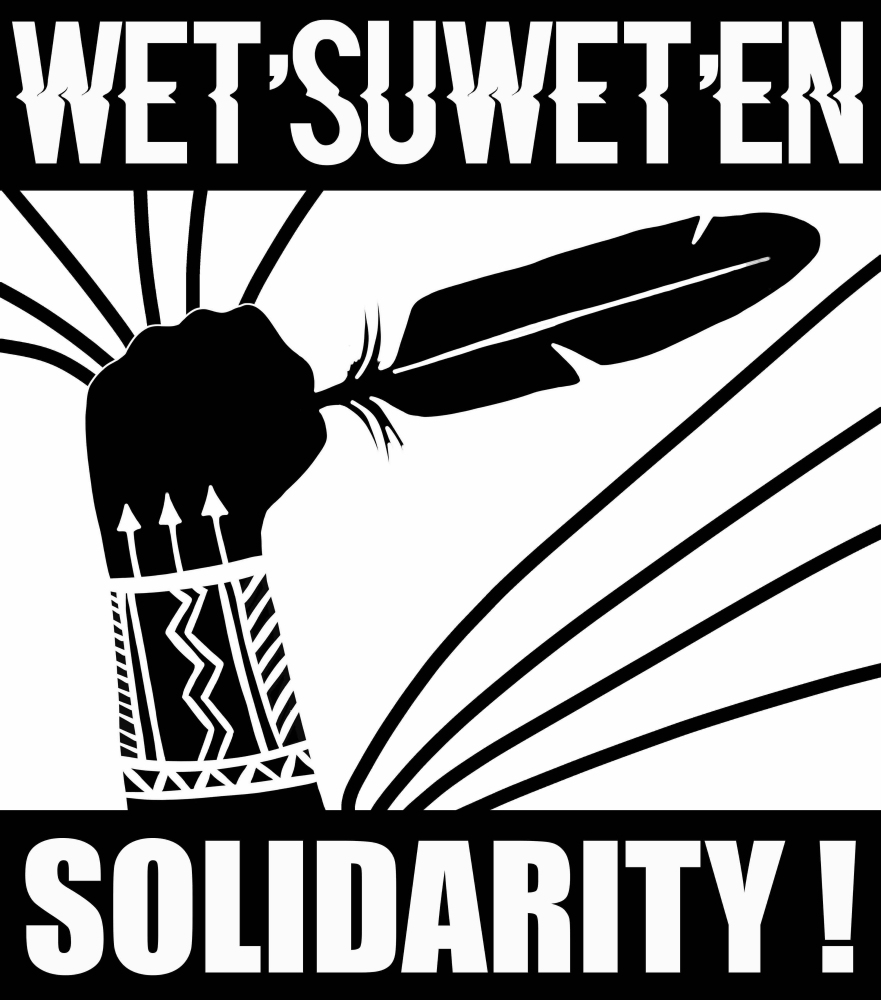
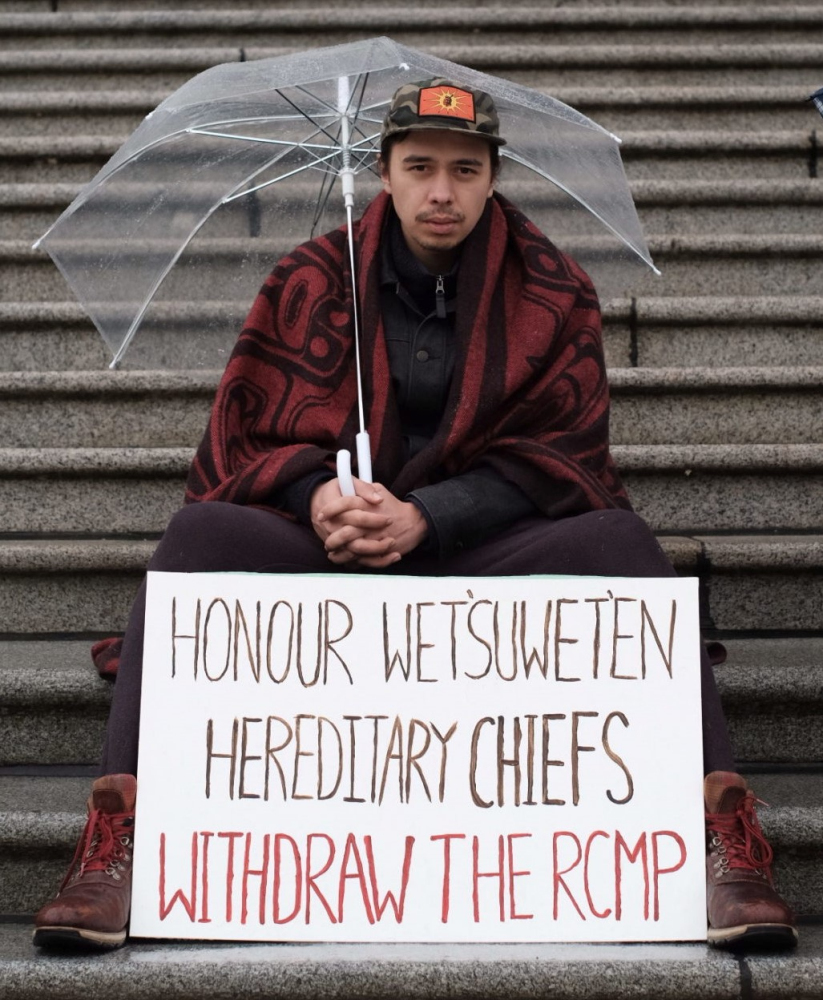
At that time, the Royal Canadian Mounted Police were attacking the Wet’suwet’en peoples in British Columbia. They were clearing the way for the construction of the Coastal GasLink pipeline through Wet’suwet’en territory. There was nothing about that in the mainstream press.
I learned about this when I saw the title of a YouTube video about the eviction of Coastal GasLink personnel from Wet’suwet’en territory. For many years I worked on the Keystone and Dakota Access pipelines resistance when I was in Indianapolis. I remember how shocked I was to see pipeline construction personnel evicted! I’m sure the Spirit led me to learn about the Wet’suwet’en. This struggle has become one of my primary areas of justice work since.
Returning to the February 7 meeting, we thought we would hold a rally in support of the Wet’suwet’en before the meeting we had already planned. I created a Facebook event in case anyone else might want to join us.
As the Spirit would have it though, Ronnie James saw that and joined us. I learned Ronnie has had over 20 years of experience as an Indigenous organizer. He was surprised anyone else in the Midwest knew about the Wet’suwet’en and came to check us out. A great organizing technique.
Peter Clay, Linda Lemons and Ronnie James
Over the subsequent two years Ronnie has become one of my closest friends, as well as my Mutual Aid mentor.
The Des Moines Mutual Aid project I’ve been involved in is the weekly food distribution project. There are many stories related to that but I’ll just tell about things that happened this morning.
About sixty boxes of food are put together in the basement of a church in Des Moines. Then they are taken outside and put on four tables, from which they are loaded into cars as they pull up. People know by word of mouth to park in the parking lot at 10 am. Then one of us directs them to drive up to the tables of food.
I learned those four long tables were donated to the church years ago from a mental health facility that my Quaker meeting, Bear Creek did a lot of work on.
This morning we could only find two of the tables. We looked all over and when we couldn’t find them, we carried a few smaller tables down from the third floor of the church. Shortly after though, when the bread that had been piled on some tables was put in the food boxes, we discovered the tables we were looking for had been hidden by the bread. We had a good laugh about that. Ronnie told me I’d have to write about that on my blog. This is a small example of how we all get to know each other as we work together.
The institutions of forced assimilation are often on my mind. Some Quakers had been involved in those institutions. Ronnie and I had a discussion about that.
I enjoyed hearing him talk about his son. Ronnie said, “he makes me happy (most of the time)”. I remember when Ronnie introduced me to him. He rarely says anything, but his voice sounds just like Ronnie’s. This morning I heard him say “dad”. When I left this morning, he was the only person in the basement. I said, “see you later” and he said, “see you later”. (It feels like I should not write his name. So many of those involved in Mutual Aid have had experiences with the police.)
I will finish by returning to the Wet’suwet’en peoples, who are yet again being threatened by the RCMP. When these latest threats began again in November, Ronnie and I talked about whether to do something in support. We decided to invite whoever wanted to hold signs in support after our Mutual Aid work was finished. It was like completing a circle from our initial meeting related to the Wet’suwet’en.
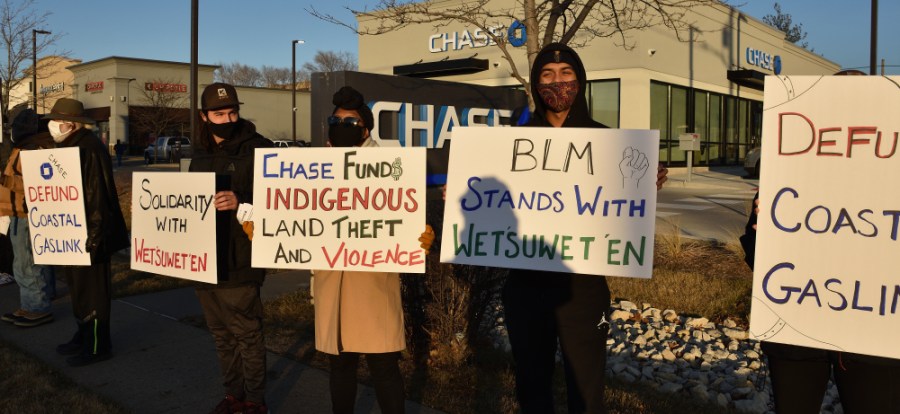
I don’t get opportunities to take photos when with my Mutual Aid friends, again because of concerns related to police. But this time it was OK because of the masks and each person had given permission. When people were lining up, someone said, “across the street”. I thought they meant to move across the street, but what was meant was to line up across the street. And after the first few shots someone said, “wait, am I the only one with a fist up?”
You might notice the sign on the far right. A 5-year-old attends every Saturday, the life of the party. I knew he liked to draw, so I brought markers and a blank sheet for him.
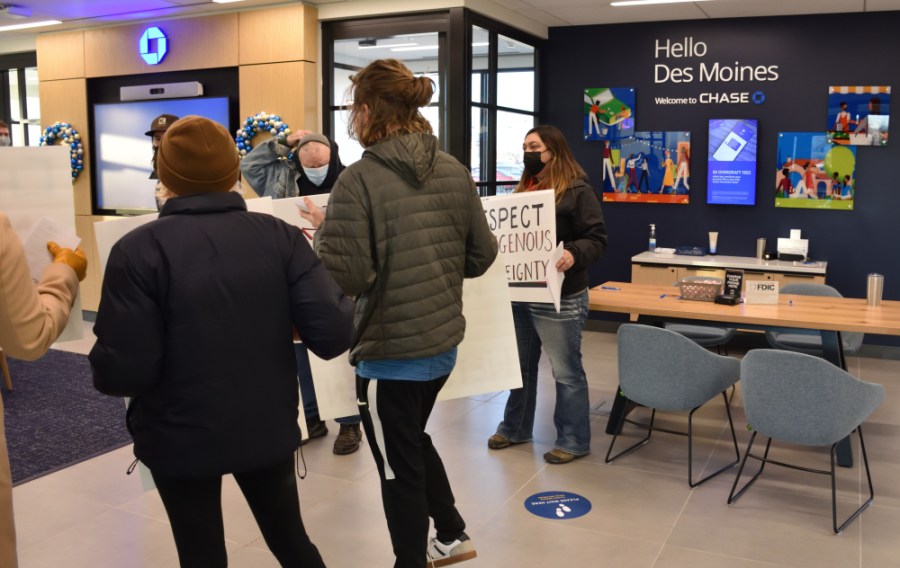
In December, the Wet’suwet’en called on supporters for solidarity actions. Chase bank funds the Coastal GasLink pipeline. A solidarity event was organized at a Chase bank in Des Moines. People were there from Mutual Aid, and Jon Krieg of the American Friends Service Committee (AFSC) and his partner Patti. You will also see one of the leaders of Des Moines Black Liberation there in support of the Wet’suwet’en.
I’ve been preparing for a discussion my Quaker meeting will have this weekend about Mutual Aid. At the end of this is a table of posts I’ve been writing to help me organize my thoughts. I am not satisfied with how this post has turned out, but these are notes, not a finished document.
Stepping back from the details, I’m reflecting on what I hope will happen as a result of this discussion. My hope is that we begin to use Mutual Aid to guide our work, both in our Quaker meeting and how we do our work in the community for peace and justice.
Mutual Aid requires a paradigm shift from a community of primarily White Quakers immersed in the capitalist economic system, white supremacy, settler colonialism and land theft, forced assimilation, foreign and domestic militarism, state sanctioned violence, punishment oriented criminal justice system, fossil fuel power, and whatever you call our political systems.
Wow!
The greatest obstacle will be to persuade Friends that we should stop participating in those systems. Although that is looking more attractive as these systems are rapidly collapsing now.
Capitalism is economic slavery. Capitalism has forced millions into poverty. Capitalism denies shelter, food, water, healthcare quality education, and the ability to build any wealth at all to millions of people.
There were White Quakers who were involved in the institution of slavery. Even those who did not claim ownership of enslaved men, women and children benefited economically. Continue to benefit.
I don’t think we have many years of civilization left. But I think a few years hence people will look back at this time in a similar way to how we look back on slavery.
Quakers also have their history of participation in the institutions of forced assimilation to atone for. This is a significant barrier between Friends and Indigenous peoples.
In December 2020, Ronnie James and I had the following email exchange:
Ronnie
I don’t know what you can do. The church is the church’s past, which is its future. It continues to see my people as obstacles in its endless conquest.
Jeff
I was not feeling worthy of participating in Mutual Aid but thanks to you, I’ve signup up again for this weekend.
Ronnie
You’re a good relative Jeff. To be blunt, there is too much damage that the church profits from and needs to protect to have any future there.
Jeff
I am afraid you are right.
Ronnie
I wish you the best. I imagine its a hard struggle.
Mutual aid work is not easy. It means forming lasting commitments to doing hard work collaborating with people even when we have conflict. And facing the heart-wrenching realities of the systems we live under. It is also deeply satisfying work that transforms us from being exasperated passive observers of the shitstorm we’re living in to inspired builders of the new world we desperately crave.
I’m concerned to see little progress toward solutions for the myriad of problems we face. Especially with accelerating environmental chaos. We’re paralyzed in the face of so many complex problems. Disheartened because nothing makes progress.
I contend that is because, as Albert Einstein said, “we cannot solve our problems with the same thinking we used when we created them.”
I am proposing we implement new ways to approach our justice work. And will ask our peace and social concerns committee to explore how to change our work from a committee structure to a Mutual Aid group. I’m interested to see how faith can be part of Mutual Aid.
This diagram lists problems and solutions. LANDBACK, Abolition of police and prisons, Mutual Aid, resource conservation and spirituality. Adapted from the more detailed diagram at the end of this.
Peace and Social Concerns Committee Report 2021 Iowa Yearly Meeting (Conservative)
This has been a year of great upheaval locally, nationally, and globally. The work of our monthly meetings has been impacted by the COVID-19 pandemic. Yet we have found ways to continue our peace and justice work. And had more time for prayer and reflection.
Global chaos from rapidly accelerating environmental devastation is highly likely to occur, breaking down our economic, social, and political systems. As air and water temperatures increase, water supplies are drying up. Widening areas and severity of drought are decreasing crop production and forcing people to flee. Rising oceans are creating more climate refugees. The trend of increasing numbers of more ferocious wildfires, hurricanes and other storms are expected to accelerate. All kinds of infrastructure will likely be destroyed, creating more climate refugees, many migrating to the Midwest. How can we prepare our own communities for these disasters, and plan for the arrival of climate refugees?
Justice work by White Friends has changed in recent years. An important concept of justice work is to follow the leadership of oppressed communities, who are working tirelessly for their liberation. Those who consider themselves White Friends are learning how to step back. Be supporters and allies.
Many injustices today trace their roots to the arrival of white Europeans on this continent. These include a whole history of enslavement as well as genocide of Indigenous peoples. It is important for white Quakers to know we are not expected to feel guilt or blame for injustices that occurred in the past. But knowing what we know now, it is up to us to learn more about those wrongs, and work toward repair and healing. This will be a primary focus of this committee’s work in the coming year.
As a society we have been forced to face systemic racism. For example, public murders by police have generated sustained protests regarding police brutality, with calls to limit police powers and change or abolish prisons.
Also dating back to the arrival of white Europeans is the genocide of Indigenous peoples. The theft of Native lands. And the atrocities of Native children taken from their families to institutions of forced assimilation, often far away. Places where attempts were made to the erase their culture. Many subjected to physical or sexual abuse. Thousands of Native children died. This intentional cruelty broke the resistance of Native peoples who were trying to hold onto their lands.
The recent validation of the remains of Native children on the grounds of those institutions is having devastating effects in Native communities and those who care about them. Searching the grounds of the institutions in this country is about to begin. Secretary of the Interior, Deb Haaland, has launched a federal investigation into these institutions of forced assimilation in the US,
A number of Catholic churches, who ran those institutions in Canada, have been burned or vandalized.
There are renewed calls for truth and reconciliation. Canadian Yearly Meeting has done a great deal of work on this.
These injustices are some of the effects of systems of white supremacy. The concept of Mutual Aid is becoming an increasingly used model for communities working for justice. The idea is to have a horizontal hierarchy, where everyone has a voice. And work to ensure a vertical hierarchy does not develop. Without a vertical hierarchy, there can, by definition, be no superiority. Several of our meetings are supporting existing Mutual Aid communities or considering creating their own. These are opportunities to begin to disengage from the colonial capitalist system and white supremacy. Ways we can model justice in our own meetings and communities.
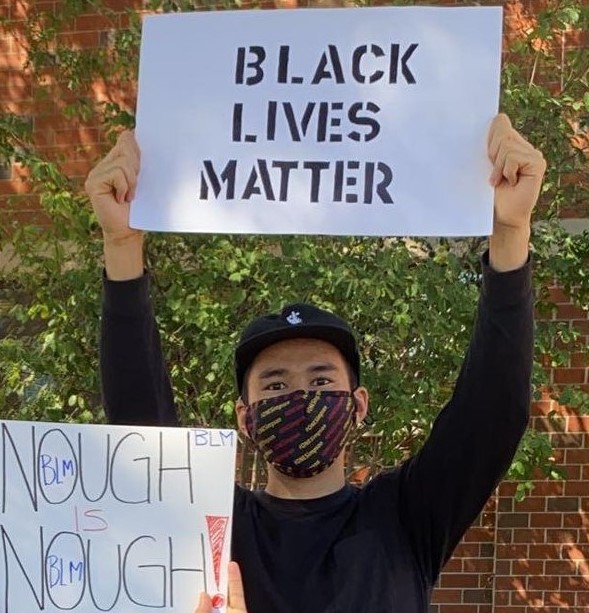
We can show up for Black Lives Matter and other racial justice events. We can support those who meet with local, state, and Federal government officials. We can show up in the streets to support agitation for change, train in nonviolent civil disobedience, or accompany arrested activists through the justice system.
We can show up, when appropriate, at events of Native peoples, such as the Prairie Awakening ceremony. We can share Indigenous news on social media platforms, so others are aware of these things.
Indigenous leaders in the Midwest have asked us to learn about and find ways to engage in the concepts of Land Back. The website LANDBack Friends has been created and will be updated as our work continues. https://landbackfriends.com/ We pray for guidance for how our committee might work together at the intersection of our responsibilities and those of Ministry and Counsel.
We will continue to seek spiritual guidance, both for what we are called to do, and ways to offer spiritual support for those who are not Friends. There is great spiritual poverty in many communities. Spiritual support will be needed by those who suffer the consequences of environmental and other disasters. And those responding to these disasters.
It is important to understand this work depends on us all working together, in the community. Outside our meetinghouses. Developing friendships in the local community. We encourage more engagement with our youth. They can teach us about justice. We and our meetings will be revitalized.
Many monthly meetings are adapting to these changing ways of doing peace and justice work. Building relationships with communities of black, Indigenous, and other people of color. Exploring ways to be in right relationship with these communities. All of us learning from each other. Sharing our stories. Deepening spiritual connections.
Logan Staats’ beautiful new song, “Deadman” is another example of the power of art to call attention to injustice. The track comes alongside a visual accompaniment partially shot at the site of a former residential school.
Logan was beaten and arrested by the RCMP while supporting the Wet’suwet’en peoples. I was only peacefully singing our water song and hugging/protecting a 70-year-old matriarch.I was free’d and remain steadfast and committed to defending the land from sea to sea all across Turtle Island.
Mohawk singer-songwriter Logan Staats makes his return with the new single “Deadman,” which signals the storyteller and activist’s debut release under the Indigenous-owned label, Red Music Rising.
“I wrote ‘Deadman’ while in rehab. It’s not about a girl; the culture is the love that I’m asking for,” he revealed in a press release.
The love Staats pleads for in the song is not romantic but rather a demand for something cherished, stolen by settler colonialism. “The love for myself that was stolen from me — by the government, the crown, the church. When I sing ‘Give back my love,’ I’m speaking about my culture, my pride and my love for myself.”
As a descendent of residential school survivors, Staats delivers the single alongside a video partially shot on the property of the Mohawk Institute — a former residential school in Brantford, ON — and at Land Back Lane, where Six Nations land defenders have been fighting development on unceded Six Nations territory.
In a statement, Staats recalled fighting for land sovereignty alongside the land defenders in Wet’suwet’en territory:
Recently I’ve been spending a lot of time on the West Coast in Wet’suwet’en territory after answering the call of the Hereditary Chiefs there and standing in solidarity with the land defenders on their sovereign ground. After serving an eviction notice to Coastal Gas Link, a for-profit corporation conducting illegal activities on Wet’suwet’en territory, heavily armed RCMP officers were flown in and conducted a raid on the traditional lands or ‘Yin’tah’. During that raid I was punched in the ear, my head was slammed into the frozen pavement by my braids, and I was kneed in my spine and held down while I was handcuffed and bleeding… all after I was only peacefully singing our water song and hugging/protecting a 70-year-old matriarch. I was hauled off to jail along with my sister Layla Black, several other land defenders, elders; along with members of the press. With the support of my community and people rallying across nations, I was free’d and remain steadfast and committed to defending the land from sea to sea all across Turtle Island.
Logan Staats Announces Red Music Rising Debut with New Single “Deadman”. The track comes alongside a visual accompaniment partially shot at the site of a former residential school by Haley Bentham, exclaim.ca, Nov 25, 2021
Our Haudenosaunee relative has been standing with us defending Wedzin Kwa and dedicated to upholding Wet’suwet’en law. Support all Indigenous artists! ✊🏽🔥❤️ https://t.co/PB3JNWiYjR
And Movement Memos calls attention to Mutual Aid efforts, like those in Des Moines, Iowa, that I work with.
Movement Memos
An ongoing call to action for movement work and mutual aid efforts around the country. Kelly Hayes connects with activists, journalists and others on the front lines to break down what’s happening in various struggles and what listeners can do to help.
I’ve followed the work of Chase Iron Eyes and the Lakota People’s Law Project for years. He was involved in the Dakota Access pipeline struggle at Standing Rock, including begin arrested there. In the video below, he and his daughter, Tokata, talk about why everything discussed at COOP26 isn’t nearly enough.
As we near the end of COP26 — the United Nations’ most recent climate conference in Glasgow, Scotland — we have reason for concern. Because, while nations the world over have again come together to talk about addressing the climate emergency, activists — including a host of Indigenous People and organizations — are watching closely and sending a strong message from the frontlines: everything being discussed and promised at COP26 isn’t nearly enough. This past week, my daughter, Tokata, and I appeared on Christiane Amanpour’s show, broadcast on both PBS and CNN, to talk about COP26, our anti-pipeline stands, and the future of Indigenous and climate justice.
As Tokata’s friend, Greta Thunberg, put it in Glasgow, “It is not a secret that COP26 is a failure. It should be obvious that we cannot solve the crisis with the same methods that got us into it in the first place.”
I suspect you’ll agree with Greta, Tokata, and me when we say solving global warming isn’t going to be easy. It will demand sacrifices on the part of individuals and nations and a willingness to embrace a diversity of perspectives — from the latest climate science to the wisdom of Indigenous peoples. Our voices matter, because we have long practiced living in harmony with Unci Maka, our Grandmother Earth, and all the other species who inhabit her.
In the video he says the human species is at a very vulnerable, but teachable moment. Our social contract is broken and requires social, economic, and racial justice. That solutions to our environmental crisis depend on Indigenous liberation. And yet, he is hopeful because Standing Rock raised global consciousness and once progress is made, there is no turning back.
There was an emotional part of the video, when Tokata was asked how she felt about the remains of native children being uncovered on the grounds of the institutions of forced assimilation. About learning of these atrocities while she is in school herself, a tool of the genocide of her people. She said she gives thanks for those children. And feeling she is carrying on their legacy.
The video ends with Chase talking about their work building bridges with non-Indigenous people. Let’s come together.
This morning my Quaker meeting will continue to discuss our work for peace and justice. In preparation, I’ve been praying about the spiritual basis of justice work.
Quakers have a long history of work related to Indigenous peoples, including participation in the institutions of forced assimilation (sometimes referred to as boarding or residential schools).
In the following, Paula Palmer writes about her spiritual leading that led to a ministry related to Quakers and Native peoples. She writes, “from our twenty-first-century vantage point, we know (or can learn) how Native people suffered and continue to suffer the consequences of actions that Friends committed 150 ago with the best of intentions. Can we hold those good intentions tenderly in one hand, and in the other hold the anguish, fear, loss, alienation, and despair borne by generations of Native Americans?”
What happened at those institutions is generating attention these days as the remains of thousands of children are being uncovered on the grounds of these institutions.
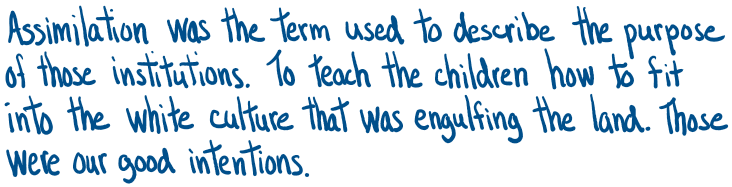
What I’ve been praying about for years is how Quakers could have become involved in those institutions? Not to judge what individual Friends might have done but wondering how the Spirit could have guided them to participate. This is a clear example of white supremacy and dominance. Those involved thought the Native children should be forced to learn the ways of the white society that was engulfing them.
This has led me to pray about:
How can Friends work spiritually toward truth and reconciliation?
What things might we be doing now that are not spiritually grounded?
How can we challenge and support each other to seek a spiritual basis for our work now?
As Paula Palmer writes, “who are Friends today? Knowing what we know now, will Quakers join us in honest dialogue? Will they acknowledge the harm that was done? Will they seek ways to contribute toward healing processes that are desperately needed in Native communities?”
Last year I responded to a call that came from two sources: from Spirit, in the manner of Friends experiencing leadings, and from a coalition of Native American organizations that is working to bring about healing for Native people who still carry wounds from the Indian boarding schools.
My leading started with a nudge four years ago and grew into a ministry called Toward Right Relationship with Native Peoples. This ministry has grown in depth and breadth under the loving care of the Boulder (Colo.) Meeting. Working in partnership with Native American educators, I learned about their efforts to bring healing to the Native people, families, and communities that continue to suffer illness, despair, suicide, violence, and many forms of dysfunction that they trace to the Indian boarding school experience.
The National Native American Boarding School Healing Coalition says that for healing to occur, the full truth about the boarding schools and the policy of forced assimilation must come to light in our country, as it has in Canada. The first step in a truth, reconciliation, and healing process, they say, is truth telling. A significant piece of the truth about the boarding schools is held by the Christian churches that collaborated with the federal government’s policy of forced assimilation. Quakers were among the strongest promoters of this policy and managed over 30 schools for Indian children, most of them boarding schools, during the nineteenth and early twentieth centuries. The coalition is urging the churches to research our roles during the boarding school era, contribute this research to the truth and reconciliation process, and ask ourselves what this history means to us today.
Native organizations are not asking us to judge our Quaker ancestors. They are asking, “Who are Friends today? Knowing what we know now, will Quakers join us in honest dialogue? Will they acknowledge the harm that was done? Will they seek ways to contribute toward healing processes that are desperately needed in Native communities?” These are my questions, too.
The country known as Canada went through a year’s long process of truth and reconciliation. The document referenced below is about what was learned in that process. A similar process is beginning in the land called the United States. See: https://landbackfriends.com/2021/10/26/native-american-legislative-update/
It is due to the courage and determination of former students—the Survivors of Canada’s residential school system—that the Truth and Reconciliation Commission of Canada (TRC) was established. They worked for decades to place the issue of the abusive treatment that students were subjected to at residential schools on the national agenda. Their perseverance led to the reaching of the historic Indian Residential Schools Settlement Agreement. All Canadians must now demonstrate the same level of courage and determination, as we commit to an ongoing process of reconciliation. By establishing a new and respectful relationship between Aboriginal and non-Aboriginal Canadians, we will restore what must be restored, repair what must be repaired, and return what must be returned.
Minute approved by Iowa Yearly Meeting (Conservative)
To this day we have not come to grips with fundamental injustices our country was built on, the cultural genocide and theft of land from Native Americans, the enslavement of African Americans and the legal justifications of bestowing rights and privileges on white land-owning men. The consequences of these injustices continue to plague our society today. And will continue to impact us until we do what is necessary to bring these injustices to light and find ways to heal these wounds.
Several Friends recently assisted Boulder Meeting Friend, Paula Palmer, to lead workshops and discussions as part of her ministry “toward right relationships with Native people.” Part of the tragedy of the theft of Native land is that some Native people don’t have the concept of land as property, belonging to a landowner. Rather they have a spiritual connection to Mother Earth, that the land is sacred and not something that can be claimed as property by anyone. Being forced to leave their land broke their spiritual bonds with the land.
Native people have asked us to begin work toward reconciliation and healing. The first step needed is truth telling, recognizing that injury or harm has taken place. One of the important parts of holding “right relationship” workshops is to determine which Native nations were on the land before white settlers arrived.
How can the atrocities of the Native residential institutions of forced assimilation, continue to be ignored by the mainstream media, governments, and the public? (These institutions should not be referred to as “schools”. )
How can faith communities, some of whom were involved with these institutions, not advocate to have the truth revealed, and work toward reconciliation?
Some of the following might be traumatic for those who have had experiences related to forced assimilation.
The Facebook group, Every Child Matters, documents the progress in locating the remains of children on the grounds of some of these institutions. And stories of those who have been affected. Searches continue in the lands called the United States and Canada.
A community to provide educational resources, generate awareness, share events and actions and work together to create a world our 7 generations yet to come can feel proud to be a part of.
“Every person will do their work in their own way as we move forward.
Some will take direct action and take action. That is important. Some will write policy. That is important. Some will do ceremony. That is important. Some will share stories. That is important. Some will build relationships and understanding. That is important. Some will teach. That is important. If we all do what we know how to do, with what we know, it will be good.
Everyone and everything has purpose. Keep your ears and minds and hearts open. Try to listen to each other without forming an opinion. Listen to things as information. You don’t have to agree with it. But you can validate it as someone’s experiences, feelings and ways of healing. ”
As it says on that Facebook page, “Every person will do their work in their own way as we move forward… If we all do what we know how to do, with what we know, it will be good.”
Try to imagine how an Indigenous person feels as hundreds more remains of children continue to be uncovered. And seeing almost nothing is done to acknowledge that. To witness the continued erasure.
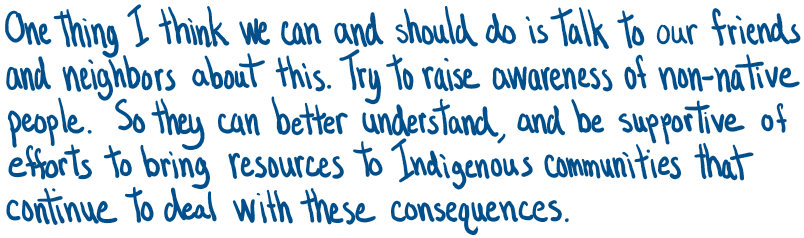
What work will we choose to do? The concept of truth and reconciliation begins with finding and sharing the truth. One thing I’ve been called to do is share what I’m learning on this website. https://landbackfriends.com/
Try to imagine how an Indigenous person feels as hundreds more remains of children continue to be uncovered. And seeing almost nothing is done to acknowledge that. To witness the continued erasure.
The following explains why orange is used as a theme for some of what is written and shared.
Both the National Day for Truth and Reconciliation and Orange Shirt Day take place on September 30.
Orange Shirt Day is an Indigenous-led grassroots commemorative day that honours the children who survived residential schools and remembers those who did not. This day relates to the experience of Phyllis Webstad, a Northern Secwepemc (Shuswap) from the Stswecem’c Xgat’tem First Nation, on her first day of school, where she arrived dressed in a new orange shirt, which was taken from her. It is now a symbol of the stripping away of culture, freedom and self-esteem experienced by Indigenous children over generations.
On September 30, we encourage all Canadians to wear orange to raise awareness of the very tragic legacy of residential schools, and to honour the thousands of Survivors.




















 LANDBACK Friends