Corrosive of the human spirit

I am broken, trying to make sense of Quakers’ involvement with the institutions of forced assimilation, the Native residential schools. In the news now because of the verification of the remains of hundreds, soon to be thousands, of children on the grounds of those institutions in both the US and Canada. Verified because Native peoples have known they were there, because thousands of children never returned home.

I can not imagine the trauma. The children forcibly removed from their families. The community not knowing if the children would ever return. Their future was stolen. Those who did return often no longer fit into the community. I only recently learned this intentional cruelty was meant to break the resistance of those Native peoples that did not want to give up their land.

I’ve read that we aren’t to feel guilt or blame for what happened in the past. But we are called to learn about the wrongs, learn the truth. Then begin to work for reconciliation and healing. Canada went through such a process, involving the government and the entire country, several years ago. Secretary of the Interior, Deb Haaland, has initiated a Federal investigation of forced assimilation in this country.

From our twenty‐first‐century vantage point, we know (or can learn) how Native people suffered and continue to suffer the consequences of actions that Friends committed 150 ago with the best of intentions. Can we hold those good intentions tenderly in one hand, and in the other hold the anguish, fear, loss, alienation, and despair borne by generations of Native Americans?

Native organizations are not asking us to judge our Quaker ancestors. They are asking, “Who are Friends today? Knowing what we know now, will Quakers join us in honest dialogue? Will they acknowledge the harm that was done? Will they seek ways to contribute toward healing processes that are desperately needed in Native communities?” These are my questions, too.

Quaker Indian Boarding Schools. Facing Our History and Ourselves by Paula Palmer, Friends Journal, October 1, 2016

Although I believe we should not feel guilt, I have not yet been able to to get past my own sense of that. My head and my heart are out of synch. For a time I’ve felt I needed to distance myself from my Quaker communities. I struggle to discern if this was a spiritual leading, or just an emotional reaction. I’m still not sure. I know I continue to feel guilt. And projected this same guilt toward Friends in general. I know that is wrong and am working hard, praying to find my out of this.

Unearthing the truth was necessary not only for the victims to heal, but for the perpetrators as well. Guilt, even unacknowledged guilt, has a negative effect on the guilty. One day it will come out in some form or another. We must be radical. We must go to the root, remove that which is festering, cleanse and cauterize, and then a new beginning is possible.

Forgiveness gives us the capacity to make a new start. That is the power, the rationale, of confession and forgiveness. It is to say, “I have fallen but I am not going to remain there. Please forgive me.” And forgiveness is the grace by which you enable the other person to get up, and get up with dignity, to begin anew. Not to forgive leads to bitterness and hatred, which, just like self-hatred and self-contempt, gnaw away at the vitals of one’s being. Whether hatred is projected out or projected in, it is always corrosive of the human spirit.

Truth and Reconciliation BY DESMOND TUTU, Greater Good Magazine, SEPTEMBER 1, 2004

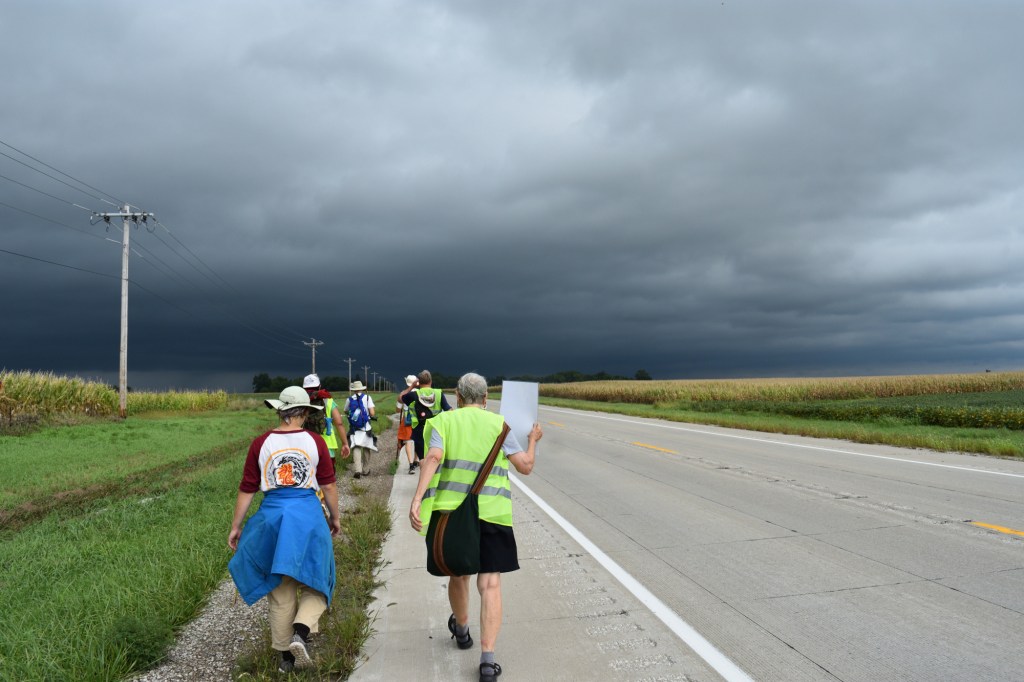
If has been tremendously helpful to have become friends with Native people I began to know as we walked and camped together for 94 miles along the path of the Dakota Access pipeline in 2018. The main intention of that sacred journey was to create a community of native and non-native people who began to know and trust each other so we could work together. That intention was achieved.

And yet, in another way, I have more of a sense of the trauma of assimilation from seeing the terrible effects on my friends.

As Paula Palmer wrote above, “Will they [Quakers] seek ways to contribute toward healing processes that are desperately needed in Native communities?” These are my questions, too.

I need to deal with my guilt before I can contribute to the healing processes.

I am deeply grateful for the acceptance and generosity of my Des Moines Mutual Aid community, which includes Native people. That is helping me move away from this destructive guilt.

I have faith I will be led to a better place.
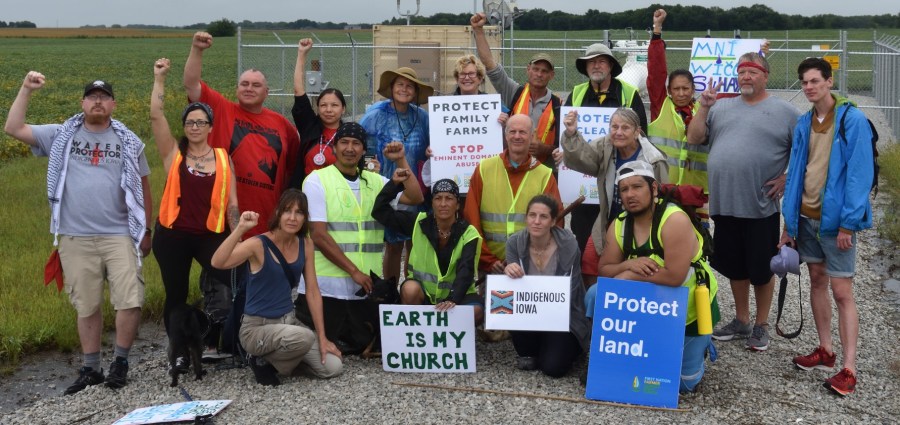
First Nation-Farmer Climate Unity March September 2018

Great Plains Action Society-Residential Schools

Hi Friend, 

Thank you for being a supporter of Great Plains Actions Society and all our work on behalf of the Indigenous and Native communities.

We recently supported our community through an awful tragedy that I will talk more about below. We need your help to keep fighting for our equality and basic human rights. Please consider donating $25, $50, $100 or whatever you can spare today here today: https://secure.actblue.com/donate/residentialschools

I want to talk to you about an issue that has been devastating and traumatizing our communities. It has affected us for hundreds of years, yet has only gained national traction recently. In both Canada and the United States, the churches and government have stolen and assimilated Indigenous children through residential schools. In these schools, children were neglected, raped, tortured and murdered. You can listen to me interview experts on my radio show, 8 O’Clock Buzz on Wort 89.9 FM here.

Recently, over 1,500 unmarked graves have been uncovered on the grounds of just eight residential schools in Canada. There were over 489 residential schools between the United States and Canada. The darkest part of this discovery, the graves that were uncovered were mostly children. The New York Times reported on this last month and while we are thankful for the coverage, it doesn’t nearly represent the pain and suffering this is causing our community. 


Great Plains Action Society has felt this pain firsthand and we are rising to meet the needs of our communities, whom we are already helping through the Missing and Murdered Indigenous Relatives crisis. We have been working to support families directly impacted by these residential schools through meals, community gatherings and covering ceremonial expenses. Great Plains Action Society is also continuing all of our other work, including mutual aid, political engagement action and environmental activism. We are dedicated to providing whatever our community needs to grow, survive, and thrive.

This is why we NEED your help. We can’t continue our work without support from people like you. Please consider donating $25, $50, $100 or whatever you can spare today. You can click here to give: https://secure.actblue.com/donate/residentialschools

Ay hai kitatamihin,

Sikowis (Fierce), aka, Christine Nobiss – She/Her They/Them

Plains Cree-Saulteaux, George Gordon First Nation

Founder and Decolonizer, Great Plains Action Society

sikowis@greatplainsaction.org

Web – greatplainsaction.org

FB – @GreatPlainsActionSociety

IG – @greatplainsactionsociety

Tw – @PlainsAction

There is so much to say about the murdered Indigenous children and the support Great Plains Action Society is giving to the community and families affected. Please read below for more details about the event we hosted in Sioux City to welcome the return of nine children from Carlisle Indian Boarding School back to the Sicangu Oyate Nation (Rosebud Nation).

On July 15-16, we organized and hosted an event in Sioux City to welcome the return of nine children from Carlisle Indian Boarding School back to the Sicangu Oyate Nation (Rosebud Nation) as they passed through. We hosted a community meal and prayer on the 15th for 415 folks and served traditional foods. There were family members of the children in attendance and we were honored to offer them some support. In the evening the large caravan carrying the children arrived and we lit a fire in a tipi set up with nine seats, toys and blankets. This event was held at War Eagle Park in Sioux City Iowa, a place that local Natives are taking back. 

On the 16th, early in the morning, we saw the Caravan off with refreshments, a press conference and more prayer. We had over ten media sources provide coverage of our event, including the Des Moines RegisterAl Jazeera,  MPR NewsIndianz.com, and Keloland.com.

Great Plains Action Society spent over $4,000 to set up and host this one event, and there are more than 480 residential schools in the US and Canada that have not been searched. Our work has just begun.

Water protectors and state sanctioned violence

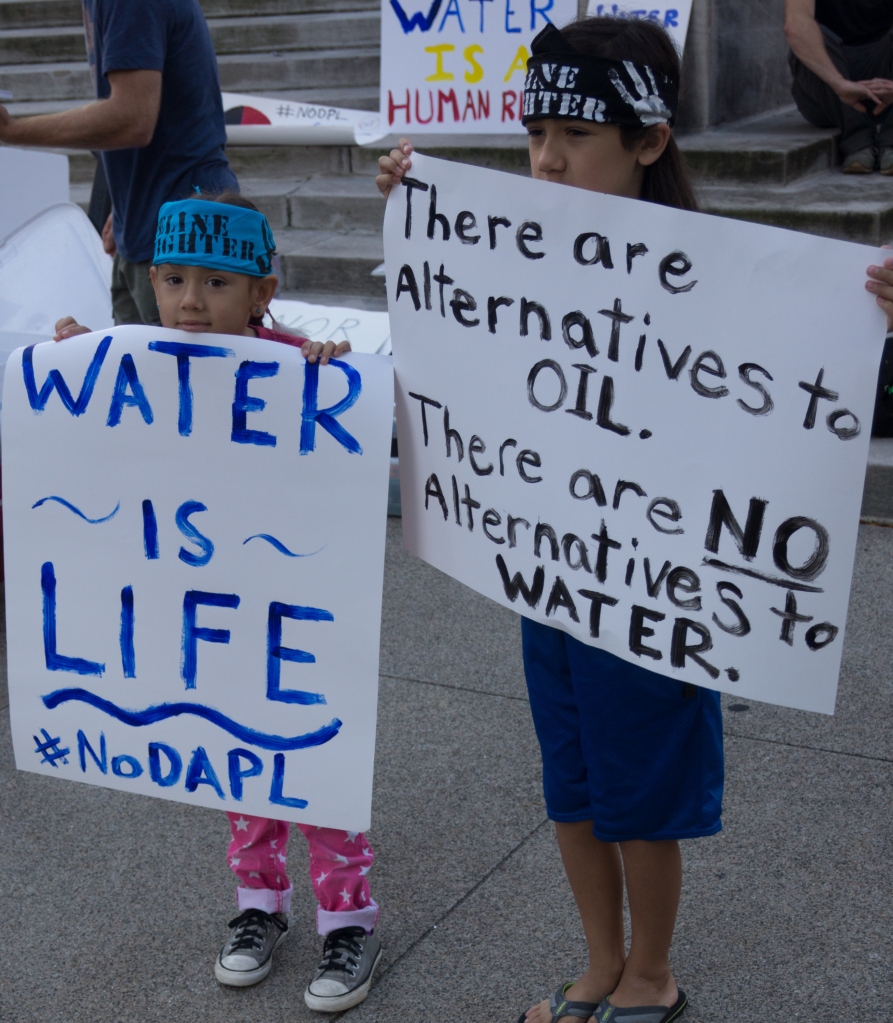
Protecting water from fossil fuel pipeline projects is an example of #LANDBACK. There is the devastation to the earth during extraction of fossil fuels, during pipeline construction, and when the pipelines leak. The tons of carbon dioxide that will be added to our atmosphere when that fuel is burned. The acidification of the oceans as the water attempts to absorb some of the carbon dioxide from the air.

The routes of pipelines are an example of blatant environmental racism. As just one example, the Dakota Access pipeline (DAPL) was originally going to be built upstream of Bismarck, North Dakota. When there was an uproar from the people there who were concerned about contamination of their water, it was moved to cross the Missouri River just a mile upriver from the Standing Rock Sioux reservation.
(see: Bismarck residents got the Dakota Access Pipeline moved without a fight)

The world saw the despicable display of heavily militarized law enforcement personnel and their equipment attacking Indigenous people who were praying to protect the water.

And silence, never been so loud
And the violence, never been so proud of our people.
Nahko

So many times Indigenous treaty rights were and continue to be violated.

I’m sharing some of my own experiences with fossil fuel pipelines to show how widespread this work to protect the water has been, and continues to be. In Indianapolis in 2013 I was trained to organize and lead nonviolent direct actions as part of the Keystone Pledge of Resistance. Eight years later Enbridge Energy has cancelled the Keystone pipeline project.

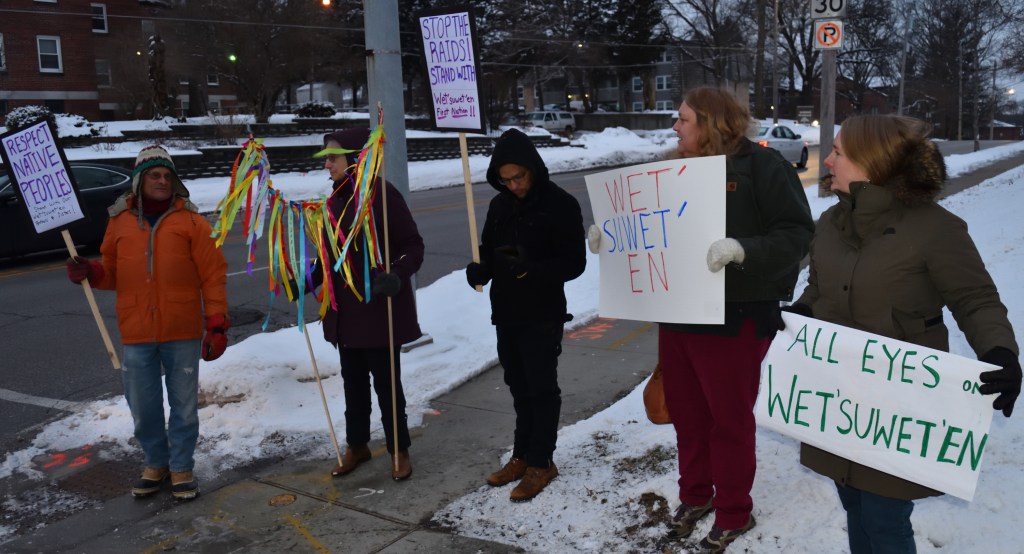
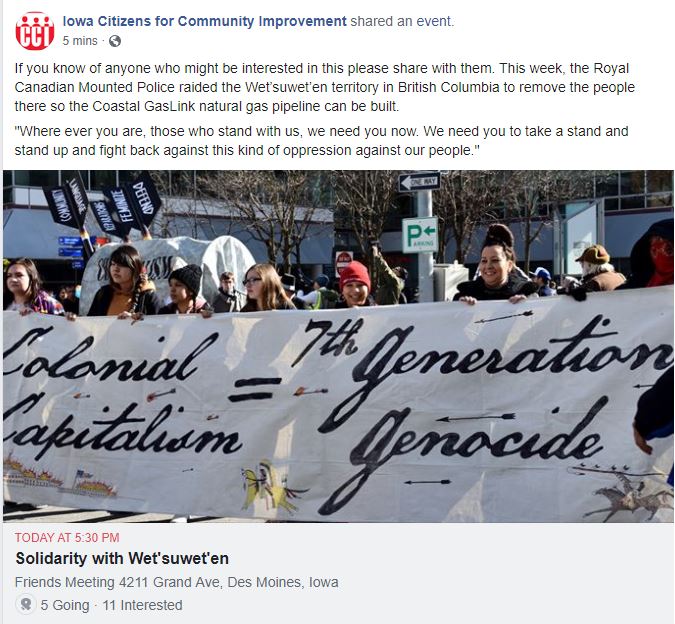
I supported the Wet’suwet’en peoples in British Columbia as they struggled to prevent the construction of the Coastal GasLink natural gas pipeline through their beautiful lands. Multiple times militarized Royal Canadian Mounted Police attacked the First Nations people.

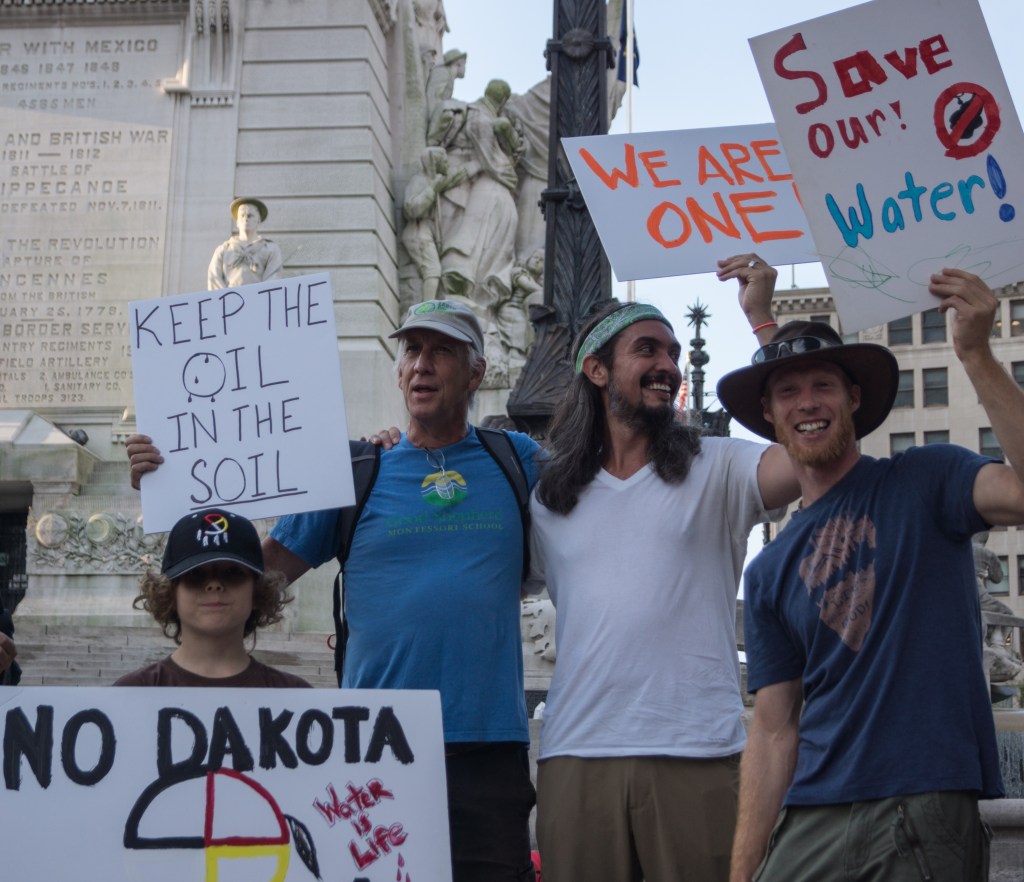
I participated in gatherings to protect the water from the Dakota Access Pipeline in Indianapolis, Iowa and Minnesota. Numerous water protectors were arrested by the state.

I haven’t been involved with the current work against the Line 3 pipeline. (see: Stop Line 3 ). But I am writing about recent events there because there is good news about stopping, at least temporarily, state sanctioned violence against water protectors at Line 3.

In a development progressives called a “huge legal win in the fight against Line 3,” a Minnesota court on Friday ordered police in Hubbard County to stop impeding access to the Giniw Collective’s camp, where anti-pipeline activists have been organizing opposition to Enbridge’s multibillion-dollar tar sands project.

Last month, (county sheriff) Aukes unlawfully blockaded a 90-year-old driveway that serves as the only means of entry and exit to the Giniw Collective’s camp, which is a convergence point for Indigenous-led protests against the expansion of the Line 3 pipeline. Police officers also cited and arrested individuals who attempted to use the driveway to travel to and from the camp.

COURT STOPS POLICE FROM BLOCKADING LINE 3 PROTESTER CAMP by Kenny Stancil, Common Dreams, July 25, 2021

Under the pretext that the small portion of the driveway extending from the Camp’s private property onto Hubbard County property is now suddenly a “trail” and not designated for vehicular traffic local sheriffs have either physically blocked access, at times by forming a line of over twenty officers, several armed with clubs, or issued citations to water protectors who have driven vehicles on the driveway, even when delivering food, water, or other necessary supplies.

Court Orders Police to Cease Illegal Blockade of Indigenous-led Water Protectors Camp at Line 3 Issues Restraining Order Against Sheriff Aukes and Hubbard County

From Apology to Action

Truth and Reconciliation Commission – From Apology to Action
CFSC (Quakers) Indigenous Rights Icon Small

In 2007 the Truth and Reconciliation Commission of Canada (TRC) was established as part of the legal settlement of the largest class-action lawsuit in Canadian history. The TRC’s mandate was:

to learn the truth about what happened in the residential schools and to inform all Canadians about what happened in the schools. The Commission will document the truth of what happened by relying on records held by those who operated and funded the schools, testimony from officials of the institutions that operated the schools, and experiences reported by survivors, their families, communities and anyone personally affected by the residential school experience and its subsequent impacts.

In 2015 the TRC released its report including 94 Calls to Action which we urge all Canadians to read and strive towards in the ongoing process of reconciliation.

At Canadian Yearly Meeting in 2011 Canadian Friends approved this minute:

We are being invited by the Indigenous peoples of Canada as represented by the Indian Residential School Survivors, through the Indian Residential School Survivors Settlement Agreement, to enter a journey of truth finding and reconciliation. We encourage all Friends, in their Meetings for Worship and Monthly and Regional Meetings, boldly to accept this invitation and to engage locally, regionally and nationally, actively seeking ways to open ourselves to this process.

CFSC was honoured to witness and participate in the closing events of the Truth and Reconciliation Commission of Canada. Watch a clip from this powerful and important closing below:

We welcomed the report and Calls to Action of the TRC as deeply important for genuine reconciliation. Together with our partners we’ve also called on the Government of Canada to follow the lead of the Truth and Reconciliation Commission.

CFSC has produced a resource for Quakers and others who wish to engage with the TRC Calls to Action.

https://quakerservice.ca/TRCGuide
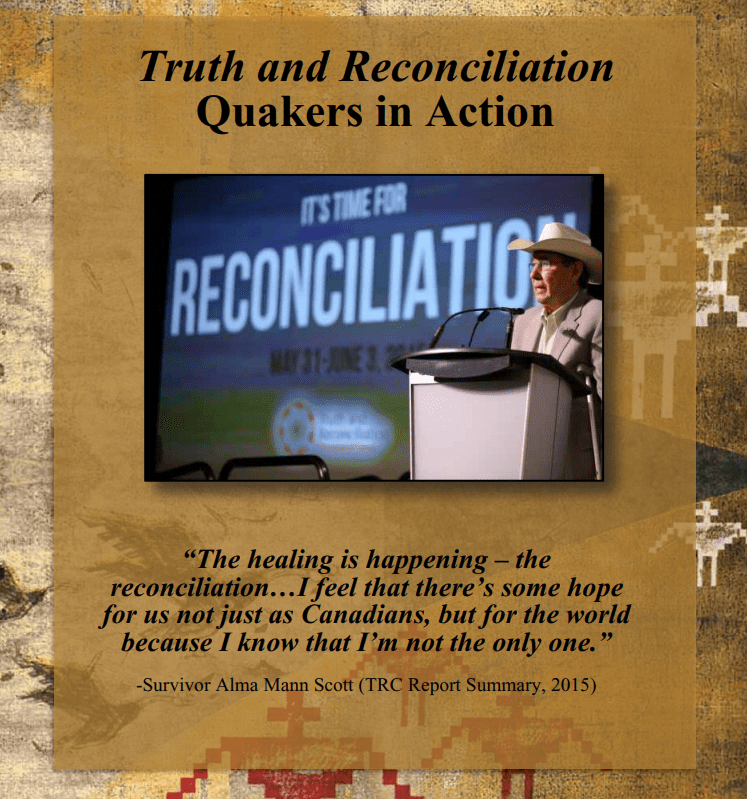
Truth and Reconciliation: Quakers in Action. (PDF)

We encourage you to make use of this resource and are happy to help, so feel free to contact us!

Prayers offered in Sioux City as remains of Native children return to their native lands

A national Indian Residential School Crisis Line has been set up to provide support for residential school survivors and others affected. People can access emotional and crisis referral services by calling the 24-hour national crisis line: 1-866-925-4419.

Prayers were offered at the War Eagle Park in Sioux City this morning as the nine children of the Sicangu Oyate continue on their journey home from the Carlisle Boarding School in the land called Pennsylvania. They arrived around 1:30 am.

My friend Sikowis (Christine Nobiss) thanked those who helped and those who were bringing the children home.

Then Manape LaMere spoke. He mentioned how triggering the findings of the remains of many Native children at residential/boarding schools have been and continue to be. He mentioned having a family member who was a survivor one of those schools. Someone in the crowd was a family member of one of the nine children. Manape thanked his young nephew who sang the flag song yesterday. He traces many behaviors today back to the traumas of the residential schools. At the end he asked the cameras to be stilled as he sang the four directions song.

SIOUX CITY — After more than 140 years, the remains of nine Rosebud Sioux children are nearly home.

A caravan carrying the remains of the children, who died at Pennsylvania boarding school, left Sioux City Friday morning after a ceremony at the Tyson Events Center parking lot. The caravan was scheduled to arrive later Friday at the Rosebud Sioux reservation in western South Dakota.

“This is a very emotional time,” Trisha Etringer, of the Winnebago Tribe of Nebraska, said Friday at the Tyson parking lot. “We are sad that it took so long for our Native children to return. But we are happy that their journey is nearly over.”

All together, ten Native children — nine from the Rosebud Sioux tribe and one from the Alaskan Aleut Tribe — were recently disinterred from a cemetery on the grounds of the Carlisle Barracks, which was also home to the U.S. Army War college. 

The Rosebud Sioux Tribe, also known as Sicangu Lakota, had spent the past six years negotiating the reparation of the children’s remains.

Prayers offered in Sioux City as remains of Native children return to their native lands by Earl Horlyk, Sioux City Journal, Jul 16, 2021

Meskwaki Nation

In 1879 many children from the Rosebud Sioux Nation and many others were taken from their families and forced to attend the Carlisle Boarding School in what is known as the state of Pennsylvania today. For over 140 years all efforts on behalf of the Tribe to reclaim the remains of 9 of their children have been denied. This week these children are finally being brought home to rest following recent efforts led by 11 Rosebud Sioux youth council members supported by their Tribe.

On July 15th, 2021 the Meskwaki Nation welcomed these youth and members from the Rosebud Sioux Nation with a meal, song, and prayers to take with them on their journey home. Our Great Plains Action Society collective is extremely grateful for the actions of these youth and the Rosebud Sioux Tribe that have led to the widespread recognition of the atrocities committed at boarding schools across the United States. While repatriations have been taking place across Canada, many investigations have yet to take place here in the United States. Now, Deb Halaand (Secretary of the Interior) is launching a Federal Boarding School Initiative here in the US.

The strength and actions of the Rosebud Sioux Nation and their youth today will allow for numerous other Tribal Nations around the country to soon reunited with their loved ones who were lost at these assimilation schools. “…when one rises, we all rise” – Christopher Eagle Bear, Rosebud Sioux youth

Repatriation of Rosebud Sioux Tribe Children at Carlisle Indian Industrial School

No photo description available.

CARLISLE, Pa. — Twenty-three-year-old Christopher Eagle Bear from the Rosebud Sioux tribe in South Dakota has been growing out his hair since he visited the site of the former Carlisle Indian Industrial School six years ago. 

The trip, made by the Rosebud Sioux youth council in 2015, sparked a group of young tribal members to initiate a tribe-backed resolution to bring home their nine ancestors who died at the school as children some 140 years ago. 

Six years after his initial visit, Eagle Bear’s hair falls down below the waist of his traditional regalia. He is back in Carlisle this week to bring his relatives home. 

It’s a Circle

Five of the deceased children set to return home were among the first group of 84 Lakota children from the Rosebud and Pine Ridge Agencies that rolled into the Carlisle train station on Oct. 6, 1879, according to Pratt’s archived documents.

Their names were: Rose Long Face (Little Hawk), Dennis Strikes First (Blue Tomahawk), Maud Little Girl (Swift Bear), Alvan (Kills Seven Horses) and Dora Her Pipe (Brave Bull). Within the next four years, Friend Hollow Horn BearWarren Painter (Bear Paints Dirt), Lucy Take the Tail (Pretty Eagle), and Ernest Knocks Off (White Thunder) also arrived.

Russell Eagle Bear, tribal council member, addresses the youth after the press conference. “We’re really proud of you,” he said. “I’m really glad you’re speaking from your heart.”

After learning of their children’s deaths, Chiefs White Thunder and Swift Bear— the respective parents of Ernest and Maud— wrote to Pratt on Dec. 29, 1880. In their letter, they requested the bodies of their children be returned for burial, according to the original document archived by the Carlisle Indian School Digital Research Center. It is not known if Pratt ever responded, but the children were never returned.

“The letter should have been answered,” said Robert Becker, 67, Maud’s closest descendant who traveled with the tribe to Carlisle to bring his great grandmother back home. Becker said that although he felt disheartened by the apparent mistreatment of his ancestors at Carlisle, he would leave feeling “fully content” with the youth council’s work to bring their children home.

“It’s a circle,” he said. “It began with them, it’s going to end with them.”

The journey home from Carlisle, the tribe said, will symbolize the beginning of the healing ahead of them.

“Healing for me is uncovering trauma, whether you experience it or your parents or your grandparents experienced it,” Rachel Janis, 22, said on Tuesday. “When I was younger, I didn’t understand what I was going through. When we first came to Carlisle, although I never experienced boarding schools, I think that was another stem of where that might have come from. We got a lot of, ‘Oh this happened long ago. You weren’t even born when this happened.’

“But why can’t I sit with my grandma (and) have a conversation with her in Lakota? It’s a fear where they don’t want you to talk in Lakota or wear your traditional attire … They’re afraid because of what they went through at boarding schools.”

Rosebud Sioux Youth Council Returns to Carlisle Indian School to Bring Their Relatives Home BY JENNA KUNZE, Native News Online, JULY 14, 2021

From the video above:

We all must put down our ignorance and accidental racism of not addressing the truth that this country had with Indigenous people. We are not asking for pity. We are asking for understanding.

See also: The return of children from Carlisle boarding school – LANDBACK Friends

May be an image of 1 person and text that says 'Community Meal & Prayer for the Sičangu Relatives July 15th- 8pm War Eagle Park 4000 War Eagle Dr. Sioux City, IA Morning Morning Prayer/Departure July 16th- 7:30am Tyson Events Center Parking Lot Departure at 8am Bhid Them Home Matters'

Indigenous children stolen to open the West

I’ve been praying and writing a great deal about the atrocities of forced assimilation of Indigenous children. Studied the history of these atrocities. Heard my Native friends’ stories.

All of this is just horrendous. I didn’t think it could be any worse. Thought this was an extremely misguided attempt to help Native children, wrong as that was. I don’t know how I could not have seen that made no sense.

Several months ago I began to find reports that this was a policy of intentional cruelty. A way to force Native peoples who were resisting, to give up their lands.

The following quotes are from the article cited below which I highly recommend. It goes into great detail about this travesty. Information about forced assimilation and other subjects related to Land Back can be found on my website LANDBACK Friends

Nearly 200 Native children lie buried at the entrance of the Carlisle Barracks in the “Indian Cemetery” — the first thing you see when entering one of the United States’ oldest military installations. It is a grisly monument to the country’s most infamous boarding school, the Carlisle Indian Industrial School, which opened in 1879 in Carlisle, Pennsylvania, and closed in 1918. Chiseled onto the white granite headstones, arranged in the uniform rows typical of veterans’ cemeteries in the U.S., are the names and tribal affiliations of children who came to Carlisle but never left. Thirteen gravestones list neither name nor tribe; they simply read “UNKNOWN.”

Carlisle, and boarding schools like it, are remembered as a dark chapter in the history of the ill-conceived assimilation policies designed to strip Native people of their cultures and languages by indoctrinating them with U.S. patriotism. But child removal is a longstanding practice, ultimately created to take away Native land. Although Carlisle is located in the East, it played a key role in pressuring the West’s most intransigent tribes to cede and sell land by taking their children hostage. 

A century after its closing, however, unanswered questions surround the Carlisle Indian School’s brutal legacy. Secrets once thought buried — why did so many children die there? — are coming to light. And the descendants of those interred are demanding more than just the return of their stolen ancestors.

“The past of Carlisle is really about justice,” says Ben Rhodd, the Rosebud Sioux Tribe’s tribal historic preservation officer. Since April 2016, his office has been pursuing the return of 11 children buried at the Carlisle Indian Cemetery. Even in death, Rhodd explains, Rosebud’s children remain “prisoners of war,” held at a military base and unable to return to their home on the Rosebud Reservation, children who were “hostages taken to pacify the leadership of tribes that would dare stand against U.S. expansion and Manifest Destiny.”

The U.S. stole generations of Indigenous children to open the West (Severed Ties). Indian boarding schools held Native American youth hostage in exchange for land cessions by Nick Estes, High Country News, Oct. 14, 2019

BY 1889, A DECADE INTO THE CARLISLE EXPERIMENT, Lakota parents were heartbroken. Up until then, the Lakota leadership had put up a united front opposing the 1887 Dawes Act, which proposed to allot reservation lands by parceling out individual plots to individual Lakota families and selling off “surplus” lands to white settlers. Given the forced starvation already occurring on reservations and the loss of the Black Hills, the horror of the unexplained deaths of boarding-school children was just too much to bear.

During a congressional hearing in Washington, D.C., in December 1889, Lakota and Dakota leadership discussed the loss of their children in regard to their decision to finally accept allotment. Coupled with the slashing of food rations, the taking of their children was “like cutting our heads off,” American Horse from Pine Ridge told the commission. White Swan from Cheyenne River explained, “It seems as though (our children) learned how to die instead of reading and writing.” The delegation had been lured to the East not only to sign over their lands but to also see their children. “Pine Ridge and Rosebud have their children at Carlisle mostly, so wherever their children are, they would like to go that way on their road home and see their children, and then go right home. That’s all,” Chief John Grass from Standing Rock pleaded before the delegation departed.

The U.S. stole generations of Indigenous children to open the West (Severed Ties). Indian boarding schools held Native American youth hostage in exchange for land cessions by Nick Estes, High Country News, Oct. 14, 2019

Nick Estes (Lower Brule Sioux Tribe) is an assistant professor of American studies at the University of New Mexico and the author of Our History is the Future: Standing Rock Versus the Dakota Access Pipeline, and the Long Tradition of Indigenous Resistance (Verso, 2019).

Intertwined threads

Writing is a spiritual practice for me. Sitting at the computer, I try to quiet my mind to hear what I should write. In times past a writer would sit in front of a blank page. This morning there are intertwined threads.

There are many reasons news of the remains of Native children profoundly affects me.

My career began with five years in neonatal intensive care. The rest doing research at that children’s hospital. I was blessed to be immersed with children everyday. I attempt to retain childlike qualities. Children are my heroes. I love the idea of children as sacred beings.

In almost every indigenous language of what is now known as the Americas there is a word for children that translates to English as sacred beings. Acknowledging in thoughts, words and actions that our children are sacred beings provides not only the necessary healthy intention and consciousness that will benefit our children; this acknowledgement reminds us as parents to once again be open with our own hearts.

Knowing children as sacred beings brings forth a healthy and healing strength of humility from within us as parents and adults. The youth are our teachers with a profound message for this world. When we as parents and adults acknowledge the Sacredness within ourselves it becomes difficult to not acknowledge this within others – especially our children. We have all been manifested as sacred beings, and although we are able to forget, we are unable to change the truth of what we have been created as, and always will be.

For parents who struggle to see themselves as sacred beings, simply allow your children to remind you of what you’ve forgotten. At birth through their newborn cries the children sing a song to their parents and the world. At this very moment hundreds of sacred beings, answered prayers, messengers of light are manifesting in all cultures and languages. They’re all entering this world singing a song of a sacred contract that can never be broken, only temporarily forgotten. The children’s song is reminding us. Listen…

Raising Sacred Beings,  by Anthony Goulet, The Good Men Project. August 29, 2014

One of this morning’s threads relates to brutal honesty. I’ve often thought of the following quote. I haven’t always been but will try to be brutally honest in what follows.

Being brutally honest does not necessarily mean you are correct.

Well, I have to tell you something, and you may not like to hear it. But if you struggle with the art of being frank, you need to hear this. It will make you a better person, a better communicator and a better blogger.
So here it is …
You’re a coward.
If you can’t be brutally honest with people, especially when you know it’s in their best interest, you’re a coward.
You’re not doing anyone a favor by withholding a truth from them, even if it’s difficult for them to hear.
The only person you’re protecting is yourself. Because you’re afraid of the consequences to you.
But it’s not about you.
Being honest is about making sure your audience has the information they need to make good decisions. That includes information they may not like.

THE BRUTALLY HONEST GUIDE TO BEING BRUTALLY HONEST by Josh Tucker, SmartBlogger,Jan 30, 2019

I’ve stepped away from the Quaker community that has supported my spiritual life, my whole life. I’m not certain this is not just an emotional response to the atrocities of forced assimilation. I continue to pray to see if this is a true spiritual leading.

I wonder if I can remain a Quaker.

For the past several years I have been led to opportunities to become friends with a number of Native people. It takes much more than attending conferences or powwows or serving on committees to accomplish this. One opportunity was walking and camping for 94 miles along the path of the Dakota Access pipeline with a small group of native and non-native people. Through experiences like that, I’ve been blessed to come to some understandings through a gentle process of integration. But I am just at the beginning of this journey.

The word En’owkin in the Okanagan language elicits the metaphorical image of liquid being absorbed drop by single drop through the head (mind). It refers to coming to understanding through a gentle process of integration.

Jeanette Armstrong

What follows are generalities. But my understanding, expressed as brutally honestly as I can. When I refer to Quakers I mean white Quakers in the lands called the United States and Canada. That distinction is necessary because much relates to white supremacy.

  • Indigenous peoples have always lived in balance with nature.
  • Quakers are not and should immediately do everything possible to stop using fossil fuels.
  • We should immediately ramp up installation of local renewable energy sources.
  • Environmental chaos will only worsen. Extremely rapidly.
  • Indigenous ways are the only way to slow down the impending chaos.
  • I have grown spiritually from my experiences with Indigenous peoples. In ways I hadn’t as a Quaker.
  • White Quakers are too integrated into the culture of white supremacy and capitalism.
  • Friends need to understand how white culture continues to oppress and interfere with our relationships with black, Indigenous and other people of color (BIPOC).
  • Friends should be physically present in BIPOC communities so healing and reconciliation can occur.  To understanding through a gentle process of integration.
  • Friends should literally be on the front lines of BIPOC actions for justice.
  • Quakers should reject vertical hierarchies of power. Vertical hierarchies are the only way White supremacy can exist.
  • An alternative is Mutual Aid which is based upon a flat hierarchy. Quakers should participate in, and create Mutual Aid communities.
  • Quakers should learn about and participate in Land Back. The model for returning to Indigenous practices for community and stewardship of the land.
  • Hundreds of thousands of Native children were forcibly taken from their families to institutions of assimilation.
  • Thousands of children died in those schools, or during their escape.
  • Quakers were involved in various ways in forced assimilation.
  • Quakers should discern a response and act on it now. This is urgent. Rapidly increasing numbers of children found is devastating Indigenous communities. Should be devastating to Quakers.

In our way we are always told not to ask for anything. We are always told in our community, as a practice, that when we have to start asking for something, that’s when we’re agreeing that people be irresponsible. Irresponsible in not understanding what we’re needing, irresponsible in not seeing what’s needed, and irresponsible in not having moved our resources and our actions to make sure that need isn’t there, because this is the responsibility that we, and the people that surround us, mutually bear. So in our community we cannot go to a person and say, “I want you to do this for me.” All we can do is clarify for them what is happening and what the consequences are for our family, or for our community, or for the land. We must clarify for them what needs to be done and how it needs to be done, and then it is up to them and if they fall short of that responsibility, at some point they will face the same need themselves.

Indigenous Knowledge and Gift Giving by Jeanette Armstrong, syndicated from gift-economy.com, Jul 13, 2021

The website LANDBack Friends has many resources to help Quakers learn more about, and how to do these things. https://landbackfriends.com/

I have tried to clarify for Quakers what needs to be done and how it needs to be done, and then it is up to them and if they fall short of that responsibility, at some point they will face the same need themselves.

I thought of this photo I took yesterday when I read coming to understanding through a gentle process of integration in the quote above. The image was basically black, but by the gentle process of editing, the shapes and rainbows of colors emerged.


Gentile process of integration. Jeff Kisling

Conflict Resolution for Holy Beings 2

Yesterday I wrote of my conflicts with Quakers, which stem from lack of response to atrocities of institutions of forced assimilation. Which Quakers had been involved with.

Native organizations are not asking us to judge our Quaker ancestors. They are asking, “Who are Friends today? Knowing what we know now, will Quakers join us in honest dialogue? Will they acknowledge the harm that was done? Will they seek ways to contribute toward healing processes that are desperately needed in Native communities?”

Paula Palmer

Will Quakers join us in honest dialogue?

Yesterday’s post included conflict resolution ground rules from Conflict Resolution for Holy Beings: Poems by Joy Harjo. Following she discusses skills to enhance mutual trust and respect.

2. USE EFFECTIVE COMMUNICATION SKILLS THAT DISPLAY AND ENHANCE MUTUAL TRUST AND RESPECT:

  • If you sign this paper we will become brothers. We will no longer fight. We will give you this land and these waters “as long as the grass shall grow and the rivers run.”
  • The lands and waters they gave us did not belong to them to give. Under false pretenses we signed. After drugging by drink, we signed. With a mass of gunpower pointed at us, we signed. With a flotilla of war ships at our shores, we signed. We are still signing. We have found no peace in this act of signing.
  • A casino was raised up over the gravesite of our ancestors. Our own distant cousins pulled up the bones of grandparents, parents, and grandchildren from their last sleeping place. They had forgotten how to be human beings. Restless winds emerged from the earth when the graves were open and the winds went looking for justice.
  • If you raise this white flag of peace, we will honor it.
  • At Sand Creek several hundred women, children, and men were slaughtered in an unspeakable massacre, after a white flag was raised. The American soldiers trampled the white flag in the blood of the peacemakers.
  • There is a suicide epidemic among native children. It is triple the rate of the rest of America. “It feels like wartime,” said a child welfare worker in South Dakota.
  • If you send your children to our schools we will train them to get along in this changing world. We will educate them.
  • We had no choice. They took our children. Some ran away and froze to death. If they were found they were dragged back to the school and punished. They cut their hair, took away their language, until they became as strangers to themselves even as they became strangers to us.
  • If you sign this paper we will become brothers. We will no longer fight. We will give you this land and these waters in exchange “as long as the grass shall grow and the rivers run.”
  • Put your hand on this bible, this blade, this pen, this oil derrick, this gun and you will gain trust and respect with us. Now we can speak together as one.
  • We say, put down your papers, your tools of coercion, your false promises, your posture of superiority and sit with us before the fire. We will share food, songs, and stories. We will gather beneath starlight and dance, and rise together at sunrise.
  • White House, or Chogo Hvtke, means the house of the peacekeeper, the keepers of justice. We have crossed this river to speak to the white leader for peace many times since these settlers first arrived in our territory and made this their place of governance.
  • These streets are our old trails, curved to fit around trees.

Harjo, Joy. Conflict Resolution for Holy Beings: Poems. W. W. Norton & Company. Kindle Edition.

That is the opposite of mutual trust and respect. Particularly related to the remains of thousands of Native children on the grounds of institutions of forced assimilation.

Quakers should support Indigenous leadership. Show up. Follow Native social media sites. Attend events posted there.

I follow the Great Plains Action Society. And am part of Des Moines Mutual Aid, which is supported by Great Plains Action Society, including involvement of my friend Ronnie James, an Indigenous organizer.

The website LANDBack Friends has information about these things, including An Epistle to Friends Regarding Community, Mutual Aid and LANDBACK

Friends should not add to the burden of Indigenous peoples. Instead find events such as the above, and show up for support. But do NOT try to offer suggestions, etc.

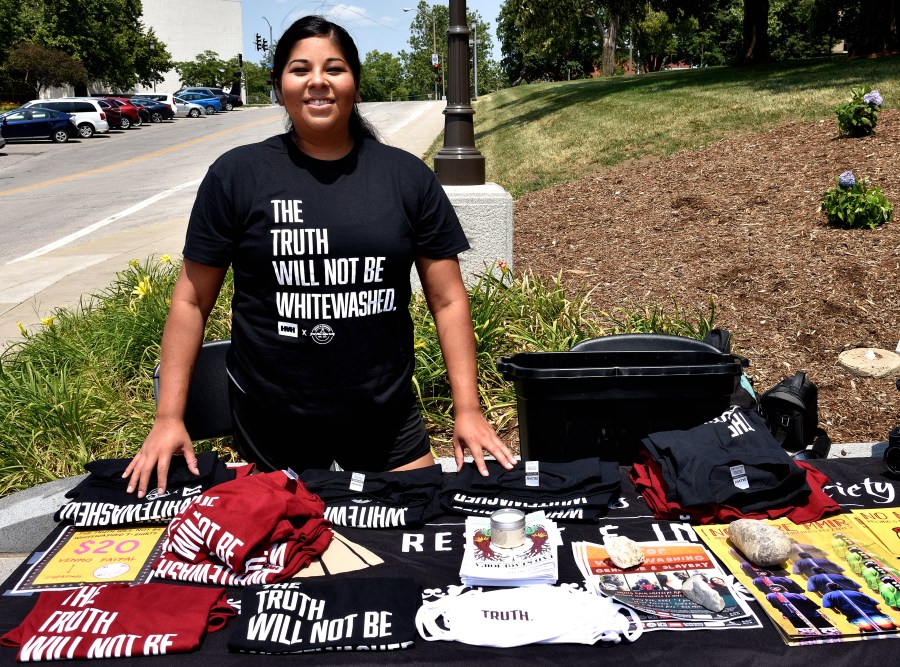
A focus of Great Plains Action Society is stop whitewashing the truth.