Wet’suwet’en struggle continues

It is tragic that at the same time the concepts of #LANDBACK are being embraced, resource extractive companies continue to take land, without free and prior consent. And it is ironic that this conflict is going on at a time when Canada will celebrate the first National Day for Truth and Reconciliation on September 30.

This is a link to the story of my experiences with the Wet’suwet’en struggles, LANDBACK Case Study: Wet’suwet’en and Quakers.
Now an archeological site has just been destroyed.

Gidimt’en Checkpoint

September 23 at 2:32 PM 
PRESS RELEASE
COASTAL GASLINK DESTROYS ARCHEOLOGICAL SITE ON CAS YIKH TERRITORY
September 23, 2021
FOR IMMEDIATE RELEASE

SMITHERS, BC: On September 22, 2021, after days of conflict between Gidimt’en/Cas Yikh Chiefs and members, Coastal GasLink and the RCMP, contractors completely cleared an archaeological site which has been destroyed with heavy machinery for the construction of a methane gas pipeline.

Gidimt’en chiefs and supporters have been defending a number of culturally significant archeological sites from destruction on unceded Cas Yikh (Grizzly House) territory belonging to the Gitdimt’en clan of the Wet’suwet’en people. The Coastal GasLink pipeline company has obtained a Site Alteration Permit (SAP) from the BC Oil and Gas Commission (OGC) through a flawed and ineffective consultation process and without the Free, Prior and Informed Consent of the Wet’suwet’en Hereditary Chiefs. The Wet’suwet’en have argued for years that the pipeline route endangers critical species, cultural use and heritage sites, and is not supported by Wet’suwet’en land use plans, particularly around the development of climate change policies. This archaeological site in particular, is significant to the Wet’suwet’en in the protection of our cultural heritage for future generations and for protecting our oral histories and heritage values for ongoing rights and title negotiations.

The company continues to violate their own regulations and conditions set forward by governing bodies such as the OGC and their own Environmental Assessment Certificates. Neither CGL nor the BCOGC undertook consultation with Cas Yikh or the Office of the Wet’suwet’en for the permit. The consultation process and the permitting system is deeply flawed and acts merely as a rubber stamp process to allow industry to continue. For example, files sent to the Office of the Wet’suwet’en were password protected and unable to be opened. Thus the information contained inside was never able to be reviewed, let alone consented to. Silence does not equal consent and to push forward with destroying a culturally significant heritage site is deeply disturbing and violent.

An archeologist working with Cas Yikh recently stated, about the cultural site that CGL is now threatening:

A site alteration permit was granted for the purpose of clearing GbSs-8 to make way for the Coastal GasLink pipeline, but no information on the proposed work/clearing activities has been shared with OW, Wo’os, Cas Yikh, or this report’s author. What is known about the archaeology of Ts’elkay Kwe Ceek is dismal. This is especially concerning given the sheer intensity with which the landscape was inhabited and used (according to oral and written testimonies) and the concentration of habitation and use sites (lithics, trails, and cultural depressions). As a result, any destruction to archaeological heritage in Ts’elkay Kwe Ceek should be seen as a gross miscalculation on behalf of the proponent and their archaeologists. Indeed, given that no consultation or consent was granted for the site alteration permit, the course of site destruction is highly irregular and likely illegal.

Many measures were taken to prevent the destruction of this site, including a Cease and Desist letter sent to all parties, including provincial ministers in charge of lands and forests, in which hereditary chief Dini ze’ Woos stated:

To be clear, we do not authorize or consent to the removal of, or any “alteration” or impacts to, our archaeological heritage. According to the United Nations Declaration of the Rights of Indigenous Peoples — a declaration implemented by the BC Government under Bill C41, which states:

4. Article 11 (1). Indigenous peoples have the right to practise and revitalize their cultural traditions and customs. This includes the right to maintain, protect and develop the past, present and future manifestations of their cultures, such as archaeological and historical sites, artefacts, designs, ceremonies, technologies and visual and performing arts and literature. (2). States shall provide redress through effective mechanisms, which may include restitution, developed in conjunction with indigenous peoples, with respect to their cultural, intellectual, religious and spiritual property taken without their free, prior and informed consent or in violation of their laws, traditions and customs. (Emphasis added).

The work that is continuing just hundreds of meters from Gidimt’en Checkpoint, a reoccupation site belonging to Cas Yikh, is in violation of the provincially legislated DRIPA. It is happening without the consent of Cas Yikh and therefore we demand that the permit be revoked and a proper consultation process begin.

For further information please go to: yintahaccess.com

#WetsuwetenStrong #NoTrespass #WedzinKwa #CGLofftheYintah #Sovereignty #Solidarity #DefendTheYintah #WeAreAllOne #IndigenousSovereignty #TraditionalGovernance #StandUpFightBack #RematriatetheLand

Originally tweeted by Gidimt’en Checkpoint (@Gidimten) on September 25, 2021.

Gidimt’en Matriarch Confronts CGL and RCMP

A few days ago (9/22/2021) Coastal GasLink contractors came in and cleared trees and brush at our ancient site along Ts’elkay Kwe. They came escorted by RCMP. There was still no archaeologist on site, they also refused to show any permits, but continued to clear brush and fall trees in the valley as a Gidimt’en matriarch requested a pause to consult with Cas Yikh’s chiefs, wing chiefs, matriarchs and members.

They said that work will be continuing throughout the week. We need boots on the ground and feet in the street. We will never give up. We will never back down. Join us.

CW: Aggressive security block and intimidate Indigenous woman.

On September 22, Gidimt’en Checkpoint spokesperson Sleydo’ attempted to monitor the destruction of an ancestral site, as it was destroyed by Coastal GasLink pipeline workers. She was met with physically aggressive and intimidating CGL security guards.

For the past week, Coastal Gaslink has fallen trees and used excavators to destroy Ts’elkay Kwe, an ancient village site that they call GbSs-8.

CGL security (https://forsythesecurity.ca) counselled the archeologists from Ecofor not to discuss the work or accept the Cease and Desist letter that was previously emailed to the company via Stacey McConnell (stacey.mcconnell@ecofor.ca). They blocked access to Sleydo’ which is a direct violation of their Environmental Assessment Certificate (eao.compliance@gov.bc.ca).

The work continues today as we hear constant chain saw work and extended helicopter flights taking place over the archeological site.

Our ancestors are under attack. Our people are under attack. Once they have completed this devastating work they will move to drill under our sacred headwaters, Wedzin Kwa.

How to watch and listen to National Day for Truth and Reconciliation on CBC

Tune into a day of special programming across all CBC platforms to honor the first National Day for Truth and Reconciliation on September 30

CBC is marking the first National Day for Truth and Reconciliation with a full day of programming and content showcasing First Nations, Métis and Inuit perspectives and experiences across CBC TV, CBC News Network, CBC.ca, CBC Kids, CBC Radio One and CBC Music including a commercial-free, primetime broadcast special, National Day for Truth and Reconciliation.

How to watch and listen

All Day:

An Indigenous-led team of journalists will deliver timely news features and special reports throughout the day from the CBC News investigating Residential Schools on THE NATIONALCBC NEWS NETWORKWORLD REPORTTHE WORLD AT SIX and CBC.ca/Indigenous

Thursday, September 30 at 8 p.m. local time (9 p.m. AT, 9:30 p.m. NT)

NATIONAL DAY FOR TRUTH AND RECONCILIATION – In recognition of the new federal statutory holiday, also known as Orange Shirt Day, this unique one-hour, commercial-free primetime special — hosted by JUNO Award-winning artist Elisapie — honours the stories and perspectives of Indigenous Peoples affected by the tragedies of the residential school system in Canada, with musical tributes and ceremonies in Indigenous communities across the land. The broadcast special is conceived and created by The National Centre for Truth and Reconciliation (NCTR) hosted by the University of Manitoba and produced by NCTR in collaboration with Insight Productions, in association with CBC/Radio-Canada and APTN. The one-hour national special will broadcast on CBC TV, CBC Gem, CBC Radio One and CBC Listen.

WATCH: Thursday, September 30 at 9 p.m. on CBC and CBC Gem

WE KNOW THE TRUTH: STORIES TO INSPIRE RECONCILIATION – A CBC Manitoba documentary that recasts Canada’s history and future through the empowerment of Indigenous Peoples. Meet the people who are challenging the history of Canada and residential schools, and creating change on their own terms. Reflect with residential school survivors and be inspired by those who are working hard to keep their culture and languages alive.

LISTEN: Saturday, September 25 at 4 p.m. and Tuesday, September 28 at 1 p.m. on CBC Radio One

UNRESERVED – Join Rosanna Deerchild on Unreserved for a revealing, poignant and emotional conversation with the Honorable Justice Murray Sinclair, former Senator and Lead Commissioner of the Truth and Reconciliation Commission. In this intimate, hour-long interview they discuss reconciliation⁠ — how far we’ve come, how far we have left to go and who is responsible for taking the journey.

LISTEN: Thursday, September 30 at 10 a.m. on CBC Radio One

Q – Tom Power speaks with Alanis Obomsawin, one of the most accomplished documentary filmmakers in Canada, and one of the most acclaimed Indigenous filmmakers in the world. She is the winner of the Glenn Gould Prize, the prestigious award given for a unique lifetime contribution that has enriched the human condition through the arts. She was also honoured at this year’s Toronto International Film Festival with a career retrospective of her work called ‘Celebrating Alanis Obomsawin’. The video interview with Alanis Obomsawin will be available on cbc.ca/q.

LISTEN: Thursday, September 30 at 12 p.m. noon on CBC Radio One

ANSWERING THE CALL: Stories of resistance, reclamation and resilience on Canada’s National Day for Truth and Reconciliation – Host Rosanna Deerchild explores how Canada is doing on the Truth and Reconciliation Commission’s calls to action and how First Nations across Canada are demolishing, redeveloping, and reclaiming former residential school sites. JUNO Award-winning musician William Prince will discuss the role artists play and share how his family is marking the day. Finally, retired senator Murray Sinclair, who chaired the Truth and Reconciliation Commission, offers his thoughts on the future of reconciliation in Canada.

WATCH and LISTEN: MASHKAWI-MANIDOO BIMAADIZIWIN SPIRIT TO SOAR – Available to stream in Anishinaabemowin on CBC Gem, and premiering in English on CBC TV and CBC Gem on The Passionate Eye, 9 p.m. (9:30 NT) Friday, September 24, with an encore broadcast on September 30 (2:30 p.m./ 6:30 p.m. NT)

Directed by Tanya Talaga and Michelle Derosier, MASHKAWI-MANIDOO BIMAADIZIWIN SPIRIT TO SOAR examines the hard truths around the deaths of First Nations students in Thunder Bay, truths Canada continues to ignore: racism kills, especially when it presents as indifference. It’s a look at how families and communities struggle to carry on while pursuing justice for their loved ones and equity for their people, and it follows Tanya Talaga’s personal journey as she explores her own Indigenous identity.

Also now streaming on the CBC Listen app is a companion podcast to this documentary, SPIRIT TO SOAR: WHERE WE COME FROM, a four-part podcast about four disruptions to Indigenous life, and ways to move forward together. The story is told first in Anishinaabemowin by Elder Sam Achneepineskum and then in English by Jolene Banning.

CBC Gem

THE TRUTH & RECONCILIATION COLLECTION will be available starting Sept 24 on the free CBC Gem streaming service with more than 20 documentaries and films honouring the history, heritage and diversity of First Nations, Inuit and Métis Peoples, including THE SECRET PATH, Gord Downie’s animated film that tells the true story of Chanie Wenjack and INENDI, Sarain Fox’s journey to preserve her cultural legacy by collecting stories from her family’s Matriarch.

CBC Music

Throughout the day on September 30, CBC Music will feature Indigenous artists and composers from 6 a.m. to midnight. CBCMusic.ca will offer stories in the lead up to September 30 include a feature on where Indigenous musicians have experienced moments of truth and reconciliation, an exploration of the art within protests and a collection of songs and lyrics about reconciliation.

CBC Books

Visit CBC.ca/thisplace for the CBC Books podcast, THIS PLACE. The original series, adapted from the award-winning graphic novel, explores 150 years of Indigenous resistance and resilience. Learn more with additional CBC Books content covering the 20 authors and illustrators who made the graphic novel, a cast roundup of the Indigenous actors who voiced the dramatizations and a list of some of the Indigenous heroes we meet in the series.

CBC Kids and CBC Kids News

CBC Kids News will feature an “Ask an Indigenous person anything” segment where four Indigenous people (First Nation, Inuit and Métis) under 30 meet and chat with kid contributor Isabel DeRoy-Olson to discuss reconciliation and take questions from kids across Canada. Additionally, CBC Kids News will feature two segments for a tween audience outlining what reconciliation is and why it is needed, and how to be a better ally.

CBC Kids is recognizing Sept. 30th with an hour-long special from the award-winning animated series MOLLY OF DENALI plus original content from Studio K all about Indigenous Heritage and Culture.

CBC Arts

For National Truth and Reconciliation Day, CBC Arts will be doing a special edition of the “Poetic License” video series featuring four poets including Kahsenniyo Williams from the Mohawk Nation Wolf Clan, who will be doing a piece called Decolonial Love. Also available that day, CBC Arts has a written feature that asks Indigenous curators, cultural programmers and artists to highlight a piece of art that speaks to the ideas behind Truth and Reconciliation, including contributions from writer Alicia Elliott and visual artist Adrian Stimson.

CBC Sports

CBC Sports will feature interviews and opinion pieces by and with Indigenous athletes including Hunter Lang, Michael Linklater and Kali Reis.

Click here for the link


____________________________________________________________
Questions about the titleandrightsalliance list?  Contact eneel@ubcic.bc.ca

Follow us http://twitter.com/UBCIC

Lakota Nation vs. the United States

Art can be a powerful tool for justice and activism. Can reach the heart when the mind is closed.

Following is an announcement about a documentary film that is being produced, Lakota Nation vs. the United States. The announcement helps explain why the Black Hills are a focus of #LANDBACK.

LOS ANGELES — Documentary film studio XTR announced on Tuesday it is making Lakota Nation vs. the United States, a feature-length documentary chronicling the Lakota Indians’ present-day quest to reclaim the Black Hills.

XTR is partnering with actor Mark Ruffalo and actress/author/activist and Emmy Award-winner Sarah Eagle Heart (Oglala Sioux) as executive producers on the documentary. Oglala Sioux Jesse Short Bull is directing the documentary alongside Laura Tomaselli. Benjamin Hedin is producing.

The Black Hills are considered sacred to the Lakota people, who say the land was stolen in violation of treaty agreements.

The film, which is currently in production, is the first documentary to amplify the tragic history of the land claim. Lakota Nation vs. the United States features interviews with a number of Indigenous citizens who are central to the effort to regain control of the Black Hills land that stretches across South Dakota, Wyoming and Montana. Adding to the team’s formidable strength are co-director Tomaselli and producer Hedin, the duo behind Sam Pollard’s critically acclaimed 2020 documentary, MLK/FBI.

“This is a timely story with powerful voices on screen and behind the scenes, driving essential change,” Ruffalo said. “The fight for Black Hills is far from over, and our intention is to support the Lakota people by raising awareness for the injustices they face in present-day America. The perception in many Americans’ minds is this is only historical, this ‘happened.’ What they don’t understand is that it is happening now. It is today, it is immediate and mostly hidden from your eye. This is a current issue.”

The testimony of the interviewees is complemented by a vibrant photographic aesthetic that depicts the sweeping immensity of the land as well as the reverence it inspires. The film also applies the subject of reparations within the context of the history of land theft and genocide, the U.S. government’s brutalist policy of extermination, for which no redress has been made to Indigenous nations.

“It is my life’s work to use powerful storytelling to share deep perspectives to implore social, environmental and Indigenous justice,” said Eagle Heart. “Knowledge and understanding are essential elements needed for advocacy and impactful change. The multilayered approach of this project helps accurately represent the Lakota people as we are now to allow healing and redressing.”

Highlighted in the film are Nick Tilsen, who was arrested protesting President Trump’s visit to Mount Rushmore in July 2020, and activist Krystal Two Bulls.

This story is placed in the present movement to return the Black Hills to its rightful caretakers and spiritual ancestors is as meaningful as any conversation we are having about race and justice in America today. 

Mark Ruffalo, Sarah Eagle Heart Co-producing Film on Present-Day Fight for Black Hills by Native News Online staff, Sept 21, 2021

This story is placed in the present movement to return the Black Hills to its rightful caretakers and spiritual ancestors is as meaningful as any conversation we are having about race and justice in America today.

But (Nick) Tilsen said he wants to use the monument as a way to teach truth — in a way that uncovers the country’s flawed history. He wants Mount Rushmore closed, then reopened under tribal control and with a new name — the Six Grandfathers Tribal Park, for the Lakota name of the rock formation where the monument is carved.

“What ends up happening at Mount Rushmore, we actually tell the true history of this land,” he said. “We tell the history of the treaties, we tell the history of these men that are on the mountain and what their policies were like,” adding that could spark conversations about how the history is connected to current issues among Native American communities, including high rates of poverty and incarceration.

Lakota activist: Mount Rushmore key in move to regain land. When then-President Donald Trump visited Mount Rushmore last year for a fireworks display, Lakota activist Nick Tilsen saw an opportunity to advance the Land Back Movement by STEPHEN GROVES Associated Press, March 24, 2021

Here are links to what I wrote about last year’s protests at Mount Rushmore, which two of my friends attended.
https://jeffkisling.com/2020/07/02/mount-rushmore-anti-trump-rally/
https://jeffkisling.com/2020/07/03/the-declaration-of-independence-for-white-males/
https://jeffkisling.com/2020/07/03/actions-at-mount-rushmore-7-3-2020/

LANDBACK is a movement that has existed for generations with a long legacy of organizing and sacrifice to get Indigenous Lands back into Indigenous hands. Currently, there are LANDBACK battles being fought all across Turtle Island, to the north and the South. 

As NDN Collective, we are stepping into this legacy with the launch of the LANDBACK Campaign as a mechanism to connect, coordinate, resource and amplify this movement and the communities that are fighting for LANDBACK. The closure of Mount Rushmore, return of that land and all public lands in the Black Hills, South Dakota is our cornerstone battle, from which we will build out this campaign. Not only does Mount Rushmore sit in the heart of the sacred Black Hills, but it is an international symbol of white supremacy and colonization. To truly dismantle white supremacy and systems of oppression, we have to go back to the roots. Which, for us, is putting Indigneous Lands back in Indigenous hands. 

LANDBACK Manifesto

Defend ICWA

It is difficult enough to learn about the removal, often by force, of native children from their families. And about the terrible things done to the children at the institutions of forced assimilation. The remains of thousands of children are being found on the grounds of many of those institutions. The numbers found are rapidly increasing with the use of ground penetrating radar. Indigenous peoples say these findings confirm what they already know. Thousands of children never returned to their families.

The explanation given was the children were being taught how to fit into white culture. It wasn’t until recently that I realized the intentional cruelty was the point. To break the resistance of tribes to removal from their lands. The cruelty worked.

As those institutions were eventually closed, children continued to be removed by state welfare systems. Often to be placed with non-native families.

The era of assimilative U.S. Indian boarding schools started to wane and eventually came to a close after government reports like the Meriam Report (1928) and the Kennedy Report (1969) found mistreatment and abuse to be rampant at the costly institutions. During this time, the federal government shifted its assimilative methods, using the Indian Adoption Project to transfer Native children from their homes and place them directly with white adoptive and foster families.

In full swing in the 1960s and 1970s, the adoption era saw (usually white) social workers deem huge proportions of Native families unfit for children. In fact, by 1978, as many as one-quarter to one-third of children were taken by social workers or other coercive means and either adopted out of the tribe or placed in the non-tribal foster care system. Although the Indian Child Welfare Act of 1978 (ICWA) was designed to address this form of cultural genocide, Native families continue to face very high levels of child removal. For example, in Alaska, where Native children make up 20% of the general child population, they represent 50.9% of children in Foster Care. In Nebraska, Native children make up just 1% of the general child population, but 9% of the children in foster care. (National Indian Child Welfare Association and The Pew Charitable Trusts, 2007).

 In 1978, the Indian Child Welfare Act (ICWA) was passed to re-establish tribal authority over Native children, due to high rates of state removal of children. In spite of ICWA’s passing, Native children were placed into foster care at high rates in Maine. Concerns about the contemporary relationship between the state welfare system and the tribes, as well as the lasting effects of foster care trauma on tribal communities, brought about the Maine Wabanaki-State Child Welfare Truth and Reconciliation Commission, the first Truth and Reconciliation Commission between Native peoples and child welfare.

The Maine Wabanaki-State TRC: Healing from historic trauma to create a better future By Genevieve Beck-Roe, American Friends Service Committee, Jan 27, 2016

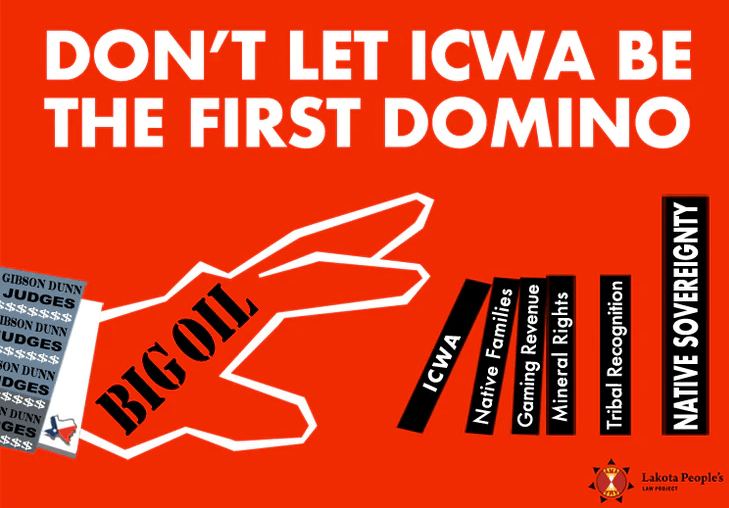
Native children and U.S. Secretary of the Interior Deb Haaland are under legal attack in Brackeen v. Haaland. The powerful people behind the lawsuit include both Big Oil and the State of Texas. If their attempt to have a conservative-majority Supreme Court overturn the Indian Child Welfare Act is successful, the door will be open to the total elimination of tribal sovereignty. Take action now to stop this horrific attack on Native rights! (see petition below).
Lakota People’s Law Project

Texas, Big Oil Lawyers Target Native Children in a Bid to End Tribal Sovereignty

The Threat Summarized

If the Supreme Court overturns the Indian Child Welfare Act (ICWA) — a federal law that keeps Native children with Native families — tribal sovereignty could soon be a thing of the past in the U.S. Should the justices rule in the plaintiffs’ favor in the case of Brackeen v. Haaland, we could quickly see a return to blatant, pre-1978 genocidal practices — when Native babies were legally stripped of their families, culture, and identities.

It’s critical that every one of us take immediate action. Before you do anything else today, sign our petition telling President Biden and the Department of Justice to defend ICWA, Secretary Haaland, and tribal sovereignty with every available means.

In this landmark case, the Brackeens — the white, adoptive parents of a Diné child in Texas — seek to overturn ICWA by claiming reverse racism. Joined by co-defendants including the states of Texas, Ohio, Louisiana, and Indiana, they’re being represented pro bono by Gibson Dunn, a high-powered law firm which also counts oil companies Energy Transfer and Enbridge, responsible for the Dakota Access and Line 3 pipelines, among its clients. This lawsuit is the latest attempt by pro-fossil fuel forces to eliminate federal oversight of racist state policies, continue the centuries-long genocide of America’s Native populations, and make outrageous sums of money for energy magnates, gaming speculators, and fossil fuel lawyers. The story below may seem unbelievable, but it is 100 percent true.

Key Points to Take Away

  • Big Oil’s lawyers, Texas, and three other states with very few Native inhabitants are attacking the Indian Child Welfare Act (ICWA).
  • The Texas Attorney General is asking the Supreme Court to declare ICWA unconstitutional.
  • The Plaintiffs argue that tribal affiliations should be considered racial, rather than political, designations.
  • Overturning ICWA could be the first legal domino in a broader attack on tribal rights and sovereignty.

The Indian Child Welfare Act Protects Native Kids, Cultures, and Sovereignty

The Indian Child Welfare Act (ICWA) is the federal law that prioritizes Native care for Native children, which is critical to maintaining cultural connections, family ties, and kinship practices that have been intact for thousands of years. ICWA, signed into law in 1978, was conceived as a means of slowing the genocidal policies enacted by the United States and Canada, which included the forced placement of Indigenous children in Indian boarding schools for more than a century.

These schools were cruel institutions designed to enact genocide by separating the children from their cultural identities and severing ties with their families and communities. Thousands of Native and First Nations children died at these schools, where physical, mental, and sexual abuse were commonplace. After the era of boarding schools, during the Sixties Scoop, it became common practice for child welfare workers — hiding behind state law — to kidnap Native children and place them with white, Christian families as adoptees. This lasted well past the 1960s, and ICWA was ultimately passed to protect Native children and keep them with their kin.

Today, the State of Texas (among other plaintiffs) is suing the federal government in an attempt to overturn ICWA. If the plaintiffs are successful, this case will strike down the federal law that prioritizes Native care for Native children. But that’s not even the worst of it. The case would also open a door for the destruction of tribal sovereignty in the United States. The case — Brackeen v. Haaland — is slated to go before a conservative Supreme Court soon, should the justices accept it. It specifically names the defendant as U.S. Secretary of the Interior Deb Haaland — a Laguna Pueblo woman and the first Native person to hold a Cabinet secretary position in U.S. history.

The plaintiffs are essentially alleging racism against white people, arguing that ICWA violates the U.S. Constitution’s Equal Protection Clause. Tribal nations — backed by a prior Supreme Court decision — say that Native status is not a racial designation, but a political one.

This case poses an extreme and imminent danger to Native Peoples across the U.S. If the high court accepts the plaintiffs’ argument that tribal political designations should not count in custody cases, “Native” and “Indian” designations could then be dissolved entirely. That decision would position ICWA as the first domino to fall, potentially leading to the erosion — or total erasure — of Native rights in the only homelands Indigenous North Americans have ever known.

Lakota People’s Law Project
https://lakotalaw.org/news/2021-09-17/icwa-sovereignty


Petition to protect the Indian Child Welfare Act

Dear President Biden and attorneys for the Department of Justice,

As the Supreme Court decides on whether to render judgment in the case of Brackeen v. Haaland, I write today to ask you to do everything in your power to protect the Indian Child Welfare Act and defend Secretary Deb Haaland. We need strong federal protection of Native families and tribal sovereignty.

Please file every available motion, prepare every legal argument judiciously, and do everything else you can to stop this attack on tribal citizens. The plaintiffs will not be easily stopped. Should the Supreme Court accept this case and validate the plaintiffs’ argument that tribes do not have the power to place their own enrolled children in tribal kinship care, we will have crossed a rubicon into dangerous legal territory that could ultimately lead to the disbanding of tribal nations — and the loss of tribal lands, gaming revenues, and mineral rights.

It’s no coincidence that the same attorneys — Gibson Dunn — representing the plaintiffs in this case also have deep ties to fossil fuel interests such as Enbridge and TC Energy (the oil conglomerates responsible for attacking tribal interests through the Line 3 and Dakota Access pipelines, respectively).

The Indigenous peoples of this land have always deserved better. The few gains made over centuries littered with oppression, and in the face of overwhelming systemic racism, must not be lost now. Please fight hard to protect original Americans. Please do everything possible to stop this attack on children, families, and sovereignty.

You can sign this petition here:
https://action.lakotalaw.org/action/protect-icwa

What You Get into Will Change You

Recently a series of things happened that provoked some reflection. I saw the quote, “what you get into will change you. Sometimes in life you just don’t know what you’re getting into”, which prompted me to write the following.

A lot happened to me since retiring and returning to Iowa four years ago. I hadn’t given a lot of thought to what would happen when I returned to Iowa. I had stayed connected with Iowa Quakers and involved with them as much as I could from a distance. So, there were already some relationships to build on.
In Indianapolis I was blessed to have made many friends as we worked to protect water and oppose the Keystone XL and Dakota Access pipelines. I was also most fortunate to become involved with the Kheprw Institute (KI), a youth mentoring and empowerment community. And North Meadow Circle of Friends Quaker meeting. It was hard to leave but I stay in touch.

What follows are stories of my justice experiences since returning to Iowa. They are offered in case they might be helpful for you and your own work.

I’m frustrated more people don’t engage in justice work. Why are we here if not to grow and engage with family and our communities? Most people either don’t know how to engage or don’t want to. I’m frustrated because there is so much work to be done. We are experiencing environmental catastrophes that will only worsen and occur more frequently. We need masses of people to prepare now for the evolving chaos.

Also, these experiences will be good for you. I know from experience “what you get into will change you”. https://www.dailygood.org/story/2795/what-you-get-into-will-change-you-phyllis-cole-dai/

It is important to recognize “sometimes in life you just don’t know what you’re getting into.” Those can be times of great opportunity. I encourage you to get involved in opportunities like this, as long as doing so is relevant to what you are called to do.

What you get into will change you. Sometimes in life you just don’t know what you’re getting into.

Phyllis Cole-Dai

The most important step is to figure out what you should do. There are so many problems. Many people get burned out by trying to do too many things. People of faith rely on faith to help us figure this out. Keep what you are led to do in mind. You must be vigilant as you look for opportunities to get involved with justice work. And just as vigilant to decline to get involved in things not related to what you are called to do. Maintaining this focus is crucial for success.

First Nation-Farmer Climate Unity

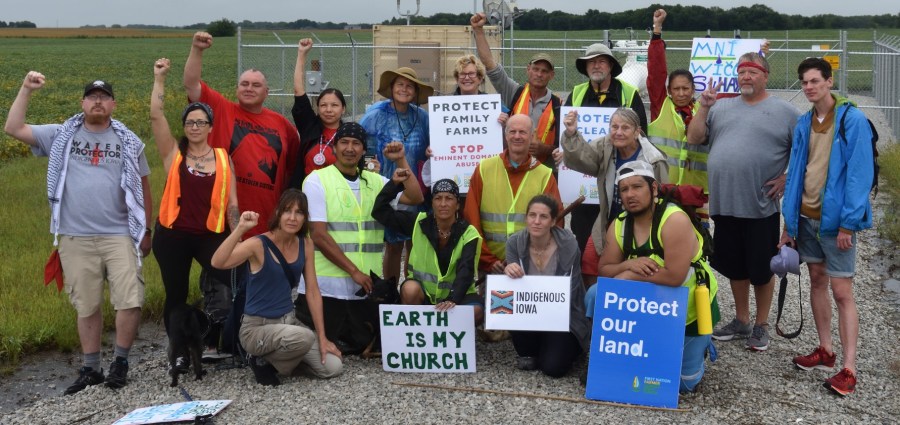
I had long wanted to get to know some Indigenous people for numerous reasons, such as spirituality and sustainable living. Fortunately, an ideal opportunity to do so was to walk and camp along the path of the Dakota Access pipeline with a small group of native and nonnative people. The intention was for those in the group to get to know each other as we walked 10-15 miles/day, put up our tents, and have meals together.

During the First Nation-Farmer Climate Unity March (Sept. 1 – 8, 2018) Manape said we were on a sacred journey. During the March, Donnielle said we are a tribe. This morning I’m realizing the following stories about the past are part of my sacred journey. Also thinking of the many new friends found as part of this journey. I’m thinking how much I would have missed if I didn’t recognize and take advantage of this amazing opportunity.

Wet’suwet’en

Last Saturday morning began by watching a new video (see below) from the Wet’suwet’en people in British Columbia. Gidimt’en Checkpoint spokesperson Sleydo’ (Molly Wickham) and Elder Janet Williams found a film crew trespassing on Gidimt’en territory, making a commercial to promote Coastal Gaslink’s plans to tunnel beneath the sacred headwaters.

I first learned about the Wet’suwet’en’s struggles in January, 2020, when I saw a remarkable video of Sleydo’ evicting the Coastal GasLink workers from Wet’suwet’en territory. “All CGL workers have now been peacefully evicted from Unist’ot’en and Gidimt’en territories. Under the authority of Anuk nu’at’en (Wet’suwet’en law), and with support of the Wet’suwet’en hereditary chiefs of all five clans, the Wet’suwet’en are standing up for the last of our lands and we need you to stand with us. We will honour the instructions of our ancestors, and continue to protect our lands from trespassers.”

I began to follow what was happening with the Wet’suwet’en, especially when they started asking people to write about what was happening, since the mainstream media was not. A few of us, who had worked together on some Indigenous related events, organized a vigil in support of the Wet’suwet’en:

We didn’t expect anyone to join us. Fortunately, Ronnie James did. In the photo are Peter Clay, Linda Lemons and Ronnie James. Ronnie is an Indigenous organizer with many years of experience and interested to see who organized and attended our vigil. After he left, I realized I didn’t have a way to contact him. Fortunately, he accepted my Facebook Friend request. We began to have numerous conversations (via social media), where he patiently taught me a great deal about organizing, Indigenous thought, and Mutual Aid. (See: https://landbackfriends.com/mutual-aid/)


Peter Clay, Linda Lemons and Ronnie James
Mutual Aid

Meeting and becoming great fiends with Ronnie changed the course of my life. I eventually joined the work of Des Moines Mutual Aid (DMMA). Every Saturday morning, I participate in the free food distribution program. About a dozen of us put together sixty boxes of food, that we then put in the cars of those who need it. It is amazing this food distribution has been in existence in Des Moines since the Black Panthers organized the free breakfast program for school kids in the 1970’s.

Putting together the boxes of food, we move as a well-oiled machine. There is a little visiting as we pass each other when putting the food into boxes. I learn a lot about the justice work people are doing in central Iowa, since my Mutual Aid friends are also involved in many such projects.

Saturday there was a lull while waiting for another food delivery that provided a chance to talk with Ronnie. I mentioned the story below about the continued oppression of the Wet’suwet’en peoples and reminded him that we had met at the vigil for the Wet’suwet’en mentioned above. I told him that was something he taught me about organizing. Going to justice events to meet people. I said I wouldn’t have known about Mutual Aid if not for him attending that Wet’suwet’en vigil. He replied I probably would have learned about Mutual Aid because it had been in the news a lot recently.

Ronnie mentioned that was the first time he had been at Friends House, where the Wet’suwet’en vigil was held. Des Moines Mutual Aid has its offices in Friends House now. I had just spoken with Jon Krieg who works with the American Friends Service Committee (AFSC), whose offices had been in Friends House. Recently AFSC had moved out and Jon mentioned he missed visiting with Ronnie.

Des Moines Valley Friends meeting, which meets in a meetinghouse attached to Friends House, has been allowing another Mutual Aid group to use their kitchen to cook meals that are taken to the houseless camps.

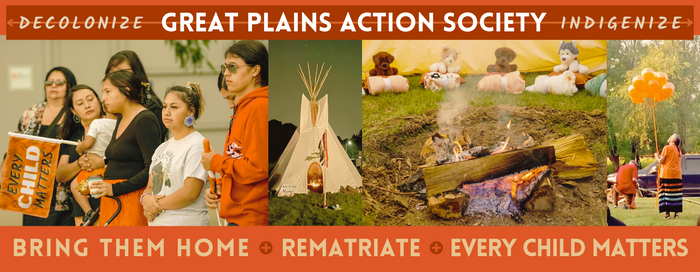
Another set of connections relates to the Great Plains Action Society (GPAS), founded by my friend Christine Nobiss, who was also on the First Nation-Farmer Climate Unity March. Ronnie’s Mutual Aid work is supported by GPAS.

Prairie Awakening/Prairie Awoke

Saturday was also the day of the annual Prairie Awakening/Prairie Awoke ceremony, an annual event sponsored by the Dallas County Conservation Board. The ceremony is held in the Kuehn Conservation Area. My Quaker meeting, Bear Creek, has been involved with the ceremony for over ten years. A number of Friends attended.

While there, I was able to talk with my friend Rodger Routh, who grew up in the Earlham, Iowa (where Bear Creek meeting is) community. Rodger is a photographer/videographer and justice advocate, who is often at the same events I attend. Jon Krieg (AFSC, mentioned above) is also a photographer. It is common for the three of us to be at the justice related events.

LANDBACK

One of the principles of justice work is to follow the leadership of the communities affected by injustice. In Indianapolis, the Kheprw Institute would let us (Quakers in this case) know what we could do for them.

Recently I had a chance to ask Christine how nonnative people could best support her and her work now. She told me to learn and teach others about the concepts of LANDBACK. So, I created a website named LANDBACK Friends, where I’ve been sharing what I am learning about LANDBACK. https://landbackfriends.com/

Maintaining connections

As the completion of a circle, I was so glad to be contacted by my friends at the Kheprw Institute (KI) in Indianapolis. Aghilah contacted me because KI is interested to learn more about LANDBACK. Evidently, they have been following my blog since I left Indianapolis and reading what I’ve been writing about LANDBACK.

Quakers for Abolition Network

My blog also made it possible for one of my new friends, Jed Walsh, to contact me about the work he and Mackenzie Barton-Rowledge are doing related to abolition of police and prisons. I wrote a little in their article that was just published by the Western Friend, https://westernfriend.org/article/quakers-abolition-network.

Conclusion

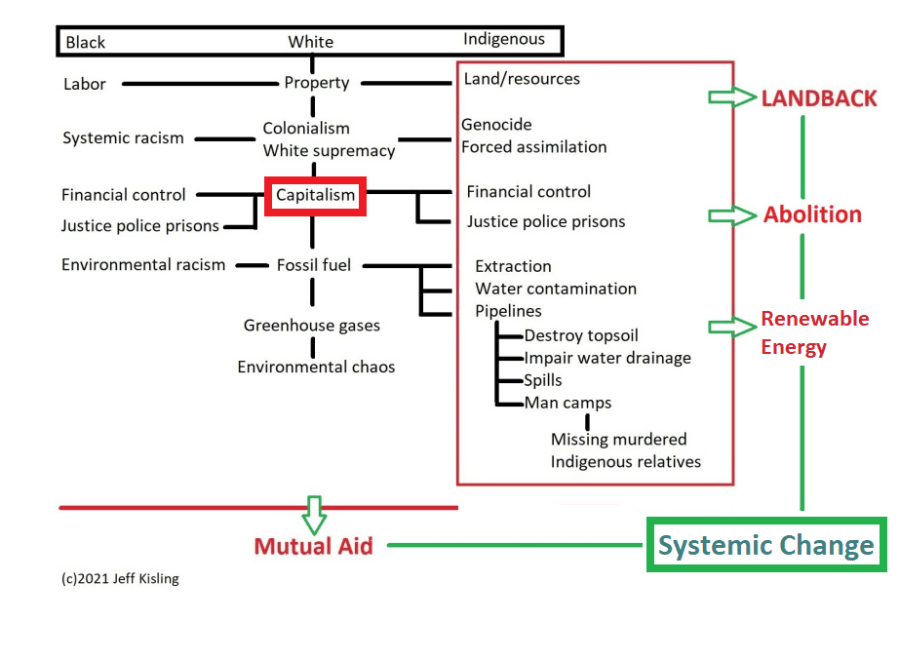
We are moving more deeply into collapse. Fueled by the consequences of environmental chaos, our economic and political systems are failing. We must work now to build ways to deal with this collapse. I’ve been working on this diagram to illustrate how people are building such systems. It is important to build Mutual Aid communities. And embrace the principles of LANDBACK. “What you get into will change you”.


This document has a lot more information about Quakers, the Wet’suwet’en peoples, and LANDBACK. Scroll down to move through the document.


#LANDBACK

Cannot depend on traditional power sources

Powerful hurricane Ida which gained strength from the hot Gulf waters (from global warming) destroyed square miles of buildings as it came ashore. Then caused massive flooding as it moved through the country.

The entire electrical grid failed in New Orleans! It will be weeks or months before full power returns.

In February this year the power grid for the entire state of Texas failed.

Each hurricane also renews calls to find new ways to produce and distribute energy in the face of climate change, which experts say is leading to more frequent and more devastating storms. In New Orleans, advocates have tried to push Entergy to invest more in renewable energy sources, such as solar and wind, and technologies that provide electricity to the area where it is produced.

Those concerns, along with worries about pollution in residential neighborhoods, fueled resistance to Entergy’s plan to build the new natural gas-powered plant in New Orleans East. Even after the company admitted to playing a role in the hiring of actors to support the project at public meetings, the council approved the plant. Groups that opposed the plan sued, and the case made it to the Louisiana Supreme Court, which upheld the council’s vote.

“​​Over and over we have tried to say we need not only climate action for renewables, but also we need to be adaptive to what is coming, because the traditional system to move power isn’t going to be able to help us weather these storms,” said Logan Atkinson Burke, executive director of the Alliance for Affordable Energy. “We’ve been ignored by utilities and regulators, and we are concerned that now, yet again, we will have this system rebuilt the same way we’ve done it and it will do us no good the next time.”

Slow return of power raises questions about a New Orleans plant that was supposed to deliver electricity after hurricanes. Calls for an investigation of Entergy’s power outages follow a wave of complaints about the company by Jon Schuppe, NBC News, Sept 1, 2021

Hurricane Ida thoroughly wrecked New Orleans’ power supply, preying on vulnerabilities that are only likely to get worse in the future as storms like Ida become more fierce. The storm knocked out all eight transmission lines that bring power into New Orleans, plunging the city into darkness. The damage was so intense that a new gas-fired power plant — sold as something that could keep the lights on after big storms — took days to bring power to the nearest neighborhood.

To keep the lights on in the future, leaders need to abandon old strategies and build up different kinds of energy infrastructure, experts say. The fallout from Ida is yet another reminder of how fragile the country’s existing energy infrastructure is, especially as climate change brings on more extreme weather.

“We’ve been saying, you know, we can’t depend on the traditional system,” says Logan Atkinson Burke, executive director of the local consumer advocacy group Alliance for Affordable Energy. “We need to be planning for the kind of climate impacts that we know are coming, and here they are. Having not planned for them, we’re experiencing the kinds of problems we expected.”

NEW ORLEANS NEEDS A BETTER BACKUP PLAN FOR BLACKOUTS. A new gas plant still isn’t enough to solve the city’s power problems by Justine Calma, Sep 1, 2021

This is what LANDBACK is about, restoring Indigenous ways.

“How about phasing out fossil fuels and quit acting like addicts? Let’s have a new green revolution. Let’s take the green path.” Winona Laduke (in video below). Winona was arrested while protecting the water from Line 3. Honor the Earth says that the “charge of the colonial world is in conflict with the Anishinaabeg,” citing a 2019 White Earth Nation tribal law which requires the White Earth Nation to stand up for and protect the rights of wild rice and other sacred food.

#TreatiesNotTarSands

#LANDBACK

It’s decolonization or extinction. And that starts with land back.

I’ve often written about my inability to convince people why we need to reject the systems of capitalism and endless economic growth. Emblematic of that is nearly fifty years I’ve lived without a car, hoping others might give up theirs, too. I’ve prayed and written so much about protecting Mother Earth for years, with little or no success. Either I was going about this wrong, or no one was listening, or both.

For the past year I’ve been blessed to become part of a local Mutual Aid community. And learning much about the concepts of LANDBACK. I’ve been putting what I’ve been learning on my website, LANDBack Friends, because my native friends tell me teaching white people about those concepts is one of the best ways for white allies to help them. https://landbackfriends.com/

The following statement applies to the land called the United States, as well as Canada.

Canada maintains the same antiquated, paternalistic attitude towards our peoples that sanctioned residential schools and the pass system—they act as if they know what’s best for us. Our rights, our knowledge and values are not included or taken seriously and we are a mere afterthought when our lands are on fire, our communities are evacuating, and as we watch our futures going up in smoke.

Indigenous rights are a counterforce to the climate crisis. Colonialism caused climate change. Indigenous rights are a solution by Eriel Deranger, The Breach, July 30, 2021

As heat and severe weather records are broken again and again, it should be clear by now that there is no limit for capital. There will be no scientific warning or dire catastrophe that leads to a political breakthrough. No huge wildfire, terrible drought or great flood will make governments and corporations change course. To carry on as they are means extinction. And yet they still carry on: more fossil fuels and fewer trees, more pollution and fewer species.

Recognition that there is no way out of this crisis without far-reaching, social upheaval animates the proposals put forward in The Red Deal: Indigenous Action to Save Our EarthThe short book was authored by activists from The Red Nation, a coalition devoted to Indigenous liberation and made up of Native and non-native revolutionaries based mainly in North America.

The authors make clear that they believe the campaign to halt climate change and repair ecological destruction is bound up with the fate of the world’s Indigenous peoples. They say bluntly that “there is no hope for restoring the planet’s fragile and dying ecosystems without Indigenous liberation” and that “it’s decolonization or extinction.”

No Hope for Earth without Indigenous Liberation by Simon Butler, originally published by Climate and Capitalism
August 27, 2021

there is no hope for restoring the planet’s fragile and dying ecosystems without Indigenous liberation

The Red Nation

For us, it’s a larger social problem of underdevelopment. Colonialism has deprived Indigenous people, and all people who are affected by it, of the means to develop according to our needs, principles, and values. It begins with the land. We have been made “Indians” only because we have the most precious commodity to the settler states: land. Vigilante, cop, and soldier often stand between us, our connections to the land, and justice. “Land back” strikes fear in the heart of the settler. But as we show here, it’s the soundest environmental policy for a planet teetering on the brink of total ecological collapse. The path forward is simple: it’s decolonization or extinction. And that starts with land back.

Each movement rises against colonial and corporate extractive projects. But what’s often downplayed is the revolutionary potency of what Indigenous resistance stands for: caretaking and creating just relations between human and other-than-human worlds on a planet thoroughly devastated by capitalism. The image of the water protector and the slogan “Water is Life!” are catalysts of this generation’s climate justice movement. Both are political positions grounded in decolonization—a project that isn’t exclusively about the Indigenous. Anyone who walked through the gates of prayer camps at Standing Rock, regardless of whether they were Indigenous or not, became a water protector. Each carried the embers of that revolutionary potential back to their home communities. Water protectors were on the frontlines of distributing mutual aid to communities in need throughout the pandemic. Water protectors were in the streets of Seattle, Portland, Minneapolis, Albuquerque, and many other cities in the summer of 2020 as police stations burned and monuments to genocide collapsed. The state responds to water protectors—those who care for and defend life—with an endless barrage of batons, felonies, shackles, and chemical weapons. If they weren’t before, our eyes are now open: the police and the military, driven by settler and imperialist rage, are holding back the climate justice movement.

The Red Deal: Indigenous Action to Save Our Earth by The Red Nation

But what’s often downplayed is the revolutionary potency of what Indigenous resistance stands for: caretaking and creating just relations between human and other-than-human worlds on a planet thoroughly devastated by capitalism

The Red Nation

I’ve been working on this diagram for over a year. It’s changed a great deal from the original. I’ve been learning about the concepts of Mutual Aid and LandBack by spending each Saturday morning putting together boxes of food for those in need. It takes awhile to adapt to working with a flat hierarchy of interactions. Nearly every structure we use in the capitalist system is based upon vertical hierarchies. Someone above telling us what to do.

As I’ve learned more about these concepts, it becomes increasingly clear capitalism is a root cause of our environmental chaos. And Mutual Aid and Indigenous leadership are ways to mitigate the increasing damages that are undoubtedly coming.

It’s decolonization or extinction. And that starts with land back.

May these steps be steps of prayer

Recent posts have been about “Treaties not Tar Sands” and the Treaty People Walk for Water. Walkers arrived at the Minnesota Capitol grounds Wednesday, ending a 256 mile walk from the Mississippi headwaters, an effort to draw attention to the state-approved Enbridge Line 3 pipeline.

Camp Migizi leader and Fon Du Lac Band member Taysha Martineau and Standing Rock Elder Sonny Wonase address 2,000 pipeline opponents gathered for the “Treaties not Tar Sands” rally at the Minnesota State Capitol on Aug. 25th, 2021.

It is time that all the people of the earth come together and every step that you walk on this earth, may these steps be steps of prayer. Steps of prayer put feet on the ground, put prayer with every step you take. The fight isn’t over yet.

Sonny Wonase

Police presence was as strong as ever, including a fence meant to wall state officials off from our prayerful ceremony and pleas for justice. As you can probably guess, that didn’t deter water protectors. At the end of the rally, my fellow organizers read a statement of demands criticizing Governor Tim Walz’s support of the pipeline and militarized response. We also continued to call on President Joe Biden to intervene.

Until we’re heard and acknowledged, we will not be silent. We will not stop taking direct action to end this invasion of our sacred lands and protect our water and manoomin (wild rice). We are carrying forward the tradition of Indigenous activism begun by the American Indian Movement in the 1960s and renewed at Standing Rock five years ago. I express my gratitude to Standing Rock for standing with us now — and to you for holding space with us and Mother Earth. If we come together across our traditional boundaries, if we act with a unified voice and spirit, we can win this fight.

Taysha Martineau

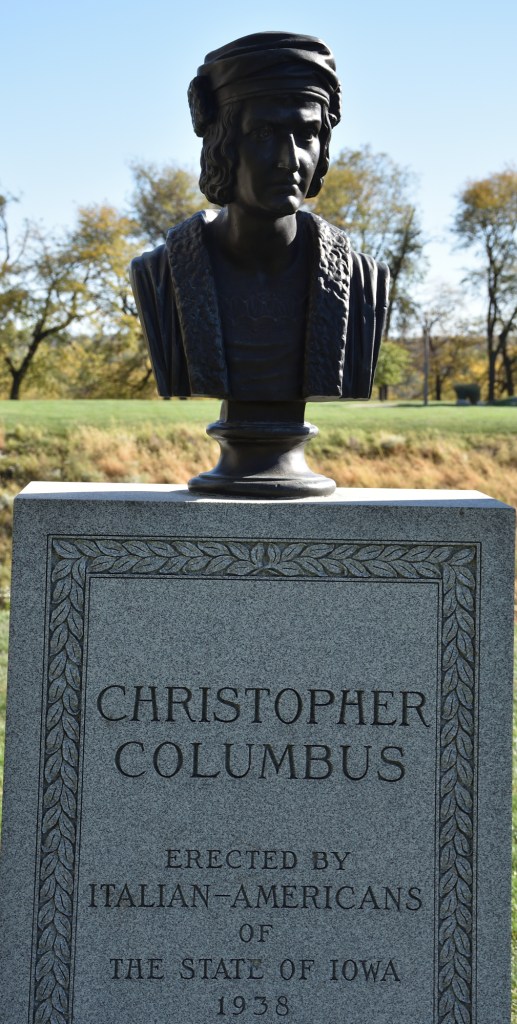
Yesterday’s post was about the heavy police presence at the Capitol. According to Native News Online, “in anticipation of the demonstration, Minnesota State troopers barricaded all roadways into the Capitol grounds. Fearing damage to monuments near the capitol, as when a Christopher Columbus statue was taken down by protesters last summer, all statues were fenced in and guarded by law enforcement.”

In the evening, demonstrators announced they will occupy the Minnesota Capitol grounds overnight and began pitching tents on the lawn. However, Minnesota State Troopers ordered demonstrators to remove the tents and allowed people to occupy the permitted tipis on the lawn.

‘Treaties Not Tar Sands’ Rally Convenes at Minnesota State Capitol, by Darren Thompson, Native News Online, August 26, 2021
https://youtu.be/YIkTBCvpToM

This is a powerful livestream video of the Water Walkers, in silence, arriving at the Minnesota State Capitol Wednesday.

I can’t help but reflect on how different this peaceful, prayerful walk compares to the insurrection at the U.S. Capitol on January 6, 2021.

#StopLine3
#HonorTheTreaties
#WaterIsLife

State of Intimidation

Yesterday’s article was about ‘Treaties Not Tar Sands’ which summarized the Treaty People Walk for Water. Walkers arrived at the Minnesota Capitol grounds yesterday, ending a 200+ mile walk from the Mississippi headwaters, an effort to draw attention to the state-approved Enbridge Line 3 pipeline. Isn’t it ironic that Enbridge says Line 3 is needed to replace the old pipeline because it isn’t safe any longer?

It is disheartening but unsurprising to hear about the large police response to the peaceful gathering of water protectors. Despite their unconstitutionality, many laws have been passed to criminalize protest. Felony penalties for damage to ‘critical infrastructure’ such as pipelines.

In Iowa last year several activists were banned from the grounds of the Iowa State Capitol because of their participation in rallies against police violence, ironically. That ban was later declared illegal.

Renee Keezer speaks to the crowd at Wednesday’s ‘Treaties Not Tar Sands’ rally.

What’s wrong with this picture? It implies a significant and violent threat where there was none.

The ‘Treaties Not Tar Sands’ rally at the Capitol Wednesday drew 1,000 to 2,000 people. It was a beautiful and powerful event. I will write more about it in the coming days. It deserves more attention.

Tonight, I’m focusing on law enforcement’s massive and intimidating response — and how rally-goers responded.

At one point I counted 33 officers on or near the front steps of the Capitol. And there were many others spread out around the Capitol complex.

The question is: Why is it when large numbers of black and brown people show up for some event, law enforcement feels compelled to use a show of force?

Given all the racial tensions around policing, law enforcement had to know this approach was bad optics. It did it anyway. That means law enforcement either had little concern about making people feel unwelcome, scared, and/or angry, or in fact that was the intention.

Arriving at the Capitol on Tuesday, I was surprised to see two law enforcement officers guarding the Capitol’s west wing. It was barricaded and fenced. No one was anywhere near this entrance. Yet there they were.

Later Tuesday, law enforcement brought in more concrete barricades. I’m curious what those barricades accomplished, as they are easy to hop over. Was law enforcement worried people would try to drive their cars or pick-up trucks up the stairs? The streets already were blocked.

That concrete represents a lot of fear.

Water protectors are used to dealing with police who view them as criminals. Law enforcement was present at Enbridge construction sites up north because Enbridge was paying them to be there as private security.

This ubiquitous police presence is a form of violence. It intimidates. It undermines people’s sense of safety and belonging. It sends the message that law enforcement thinks you’re dangerous.

State of Intimidation: Minnesota law enforcement’s in-your-face approach to ‘Treaties Not Tar Sands’ rally, Healing Minnesota Stories, August 26, 2021

#TreatiesNotTarSands

Treaties Not Tar Sands

Protecting water from fossil fuel pipeline projects is an example of #LANDBACK. There is the devastation of the earth and water during extraction of fossil fuels, pipeline construction, and when the pipelines leak. The tons of carbon dioxide that will be added to our atmosphere when that fuel is burned. The acidification of the oceans as the water attempts to absorb some of the carbon dioxide from the air.

There is growing recognition among white people that Native peoples should lead efforts to protect Mother Earth. Indigenous peoples world wide have lived in sustainable ways for centuries. And Indigenous peoples have treaty rights to preserve many of their connections to the lands, including access for fishing and growing rice. Treaties that have all been broken, but remain in effect.

Now, helping to lead opposition to the Line 3 pipeline extension in Minnesota, (Tara) Houska says she’s become a firm believer in a “holistic approach to land protection.”

“I’ve also become more firm in my position that as the holders of the last remaining biodiversity on planet Earth, the need to center and uphold tribal sovereignty and indigenous rights, specifically indigenous land rights, is absolutely critical towards any sort of solution there could be involving climate,” she told The Hill in a phone interview from the frontlines of the protests.

Battles over pipelines, she said, are representative of larger tribal environmental struggles, but are a particularly salient issue because of “the immediate localized harms of both spills and degradation to ecosystems through the construction, and harms to the people in the communities by way of manned camps and the influx of out-of-state workers into an area.”

‘The land is us’ — Tribal activist turns from Keystone XL to Line 3 by Zack Budryk, The Hill, 8/1/2021
Water Walkers Headed to Minnesota Capitol
Water Walkers headed for the Capitol: Why They Walk

From Monday, August 23 through Thursday, August 26, water protectors will hold space at the Minnesota State Capitol — with a great big gathering (all welcome!) on Wednesday the 25th to welcome the Treaty People Walk for Water as they reach the end of their 256 mile journey.

Enbridge is racing to complete Line 3, and aims to finish construction and have oil flowing by the end of the year. Our governor and state agencies have failed us — and we need President Biden to step up and ensure that treaties are upheld. Starting on Monday the 23rd, Indigenous grandmothers from White Earth plan to hold ceremony space on the Capitol lawn, along with a powerful visual display of resistance by artist Rory Wakemup. Everyone is welcome to come by between the 10am opening to 5pm closing of the ceremony space each day. Join for lunch and stay for morning and afternoon talking circles to deepen knowledge and build community.

ON AUGUST 25, ALL ARE INVITED TO GATHER for a huge day of ceremony, solidarity, and action to stop Line 3! Since August 7, water protectors have been traveling on foot 256 miles from Line 3’s upstream Mississippi River crossing to St. Paul. They will arrive on the 25th and we need to be there to welcome them! Along with elected officials and community leaders, we will call for action and make ourselves heard. Some may choose to hold space for as long as it takes — if this is you, come with what you need to stay, such as a tent.

SCHEDULE:- Aug 23-26: ceremony, talking circles; opening 10am and closing 5pm daily. Come learn, share, build community.
– August 25 at 12pm: Folks are welcome to join the walkers outside the Martin Luther King Rec Center between noon and 1:00pm on Aug 25th (where they will be having lunch), then to walk with them for the last 1.5 miles to the capitol (arriving around 2)
– Aug 25 at 2pm: big welcome gathering for walkers w/ rally & speakers & food! Some people may choose to hold space past 5pm in the evening and into the 26th.Our state leaders have had years to take action but have sat back — and worse, Gov. Walz has directed state agencies to expedite construction. Principles of free, prior, and informed consent with the Anishinaabe have not been upheld. Given their unwillingness to stop the pipeline, we need President Biden to step in and direct the Army Corps to cancel this pipeline’s permits. This pipeline directly violates treaties, preventing Anishinaabe communities from exercising their guaranteed rights to hunt, fish and engage in cultural practices. It’s also a climate disaster and a carbon bomb, threatening to release as much greenhouse gas emissions as 50 coal plants at a time when the newest IPCC report shows we don’t have time to spare. Multiple pending legal cases against the project deserve to be heard. It’s time to act.

We will have more details to come, and encourage you to keep checking back for information! The time is now to #StopLine3.RSVP on our website – treatiesnottarsands.com

Minnesota is the Land of 10,000 contradictions around racial equity.

Gov. Tim Walz issued an executive order in 2019 committing the state to meaningful consultation with Native Nations. He followed that up by allowing Enbridge to build its Line 3 tar sands pipeline over strong tribal opposition with little or no consultation.

The Minnesota Pollution Control Agency (MPCA) has touted its racial justice framework. When the agency approved permits for Enbridge Line 3, a majority of its Environmental Justice Working Group resigned, writing: “… we cannot continue to legitimize and provide cover for the MPCA’s war on black and brown people.”

Native grandmothers, water protectors, and their allies are not letting up. They have set up camp on the Capitol lawn as a sign both of their ongoing resistance to Line 3 and their long-standing commitment to uphold treaty rights.

The state has responded with fear: erecting fencing around the Capitol and sending a heavy police presence.

The ‘Treaties Not Tar Sands’ encampment will remain until Thursday. Organizers are planning a ceremony for 10 a.m. Tuesday, with talking circles in the afternoon.

The major event is Wednesday at 2 p.m. when walkers arrive on the Capitol grounds, ending a 200+ mile walk from the Mississippi headwaters to the Capitol, an effort to draw attention to the travesty that is the state-approved Enbridge Line 3 pipeline.

Four-day ‘Treaties Not Tar Sands’ Encampment opens on the State Capitol Mall, Healing Minnesota Stories, August 24, 2021

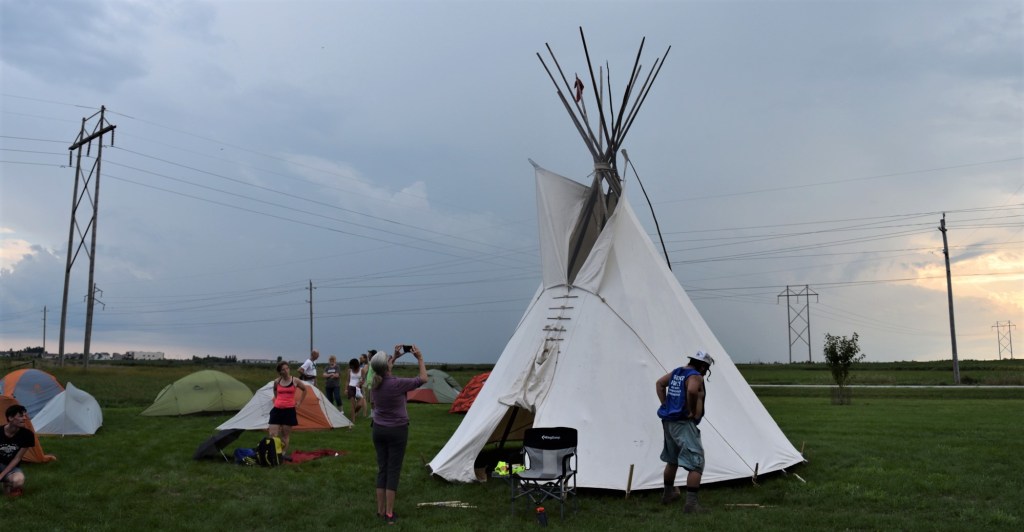
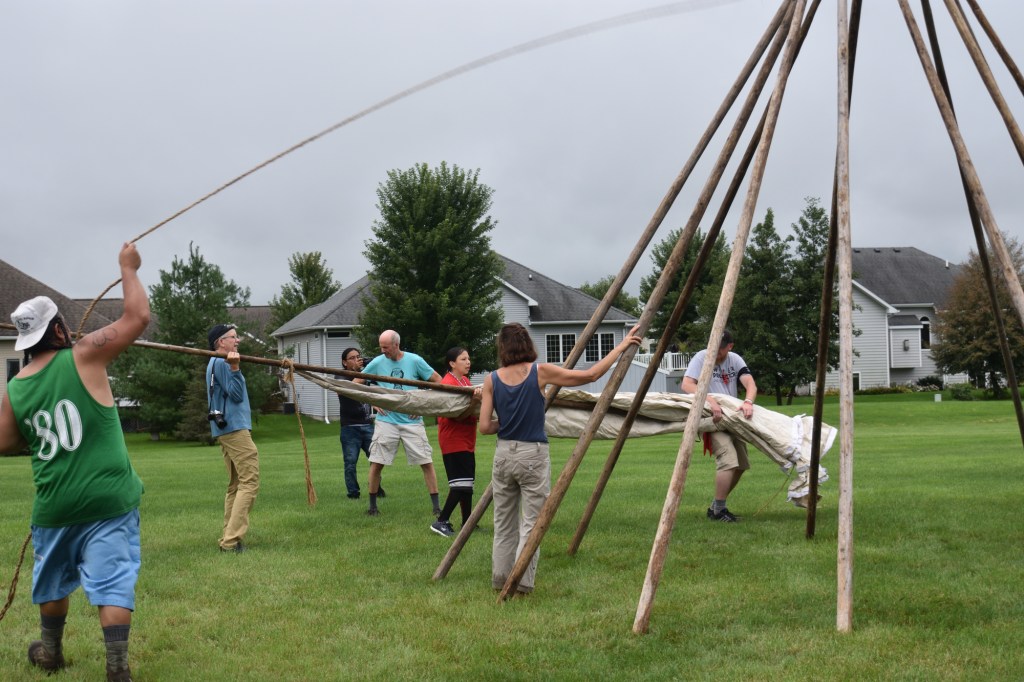
Included in the article above is a photo essay about the tepees that have been erected at the state capitol. Showing volunteers learning how to put up tepees.

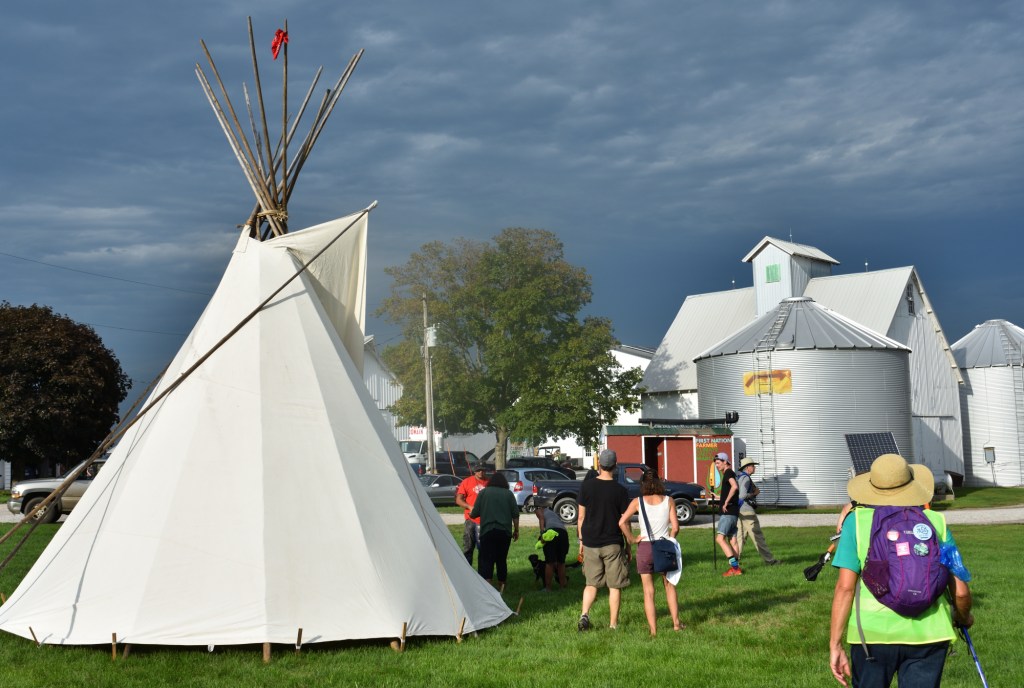
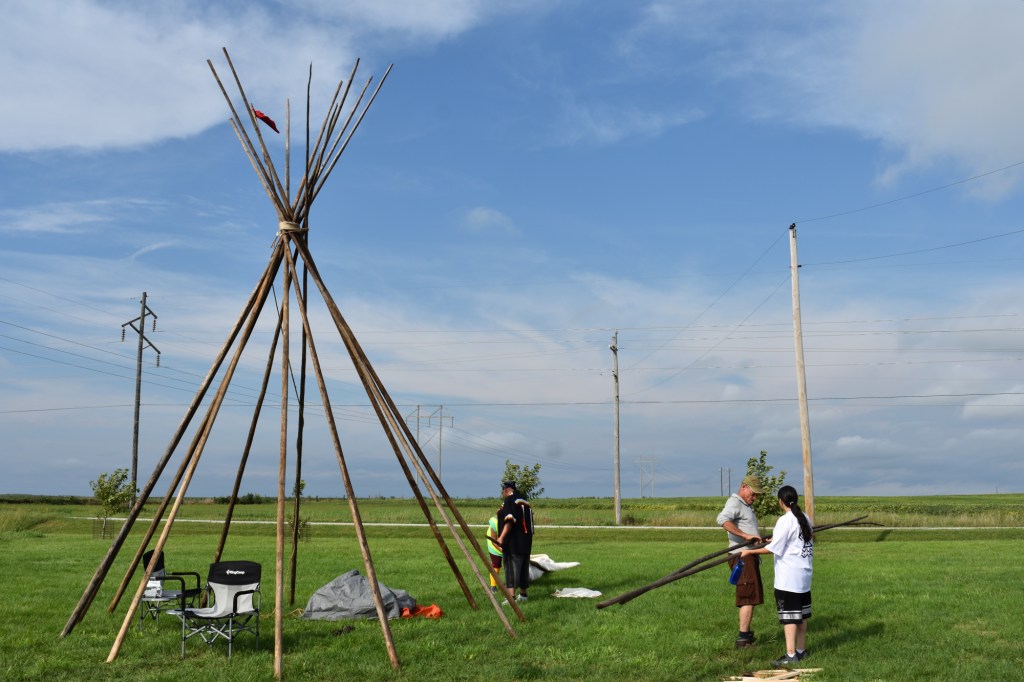
During the First Nation-Farmer Climate Unity March in 2018, a tepee was put up at most of our daily destinations. This video shows how the tepee was set up when we arrived in Ames, Iowa.