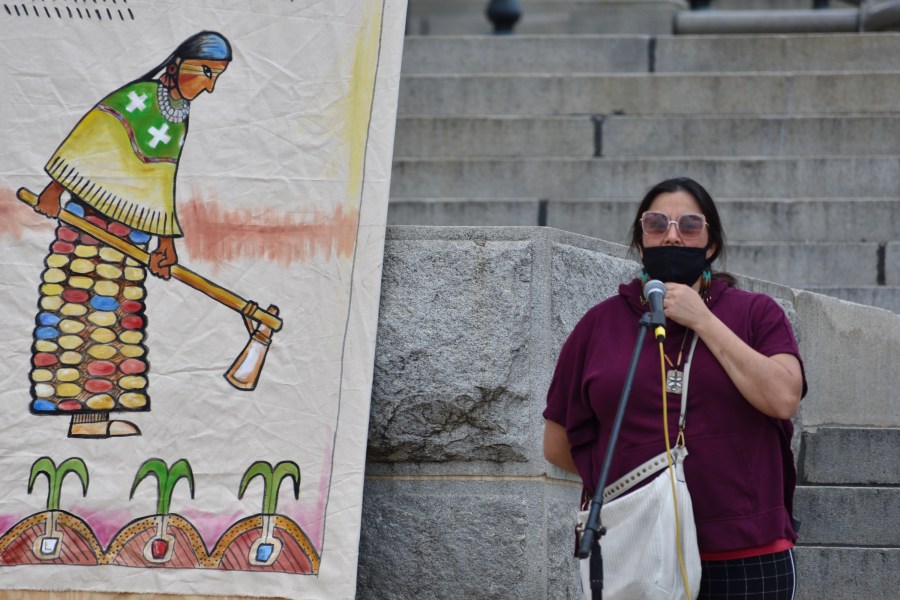
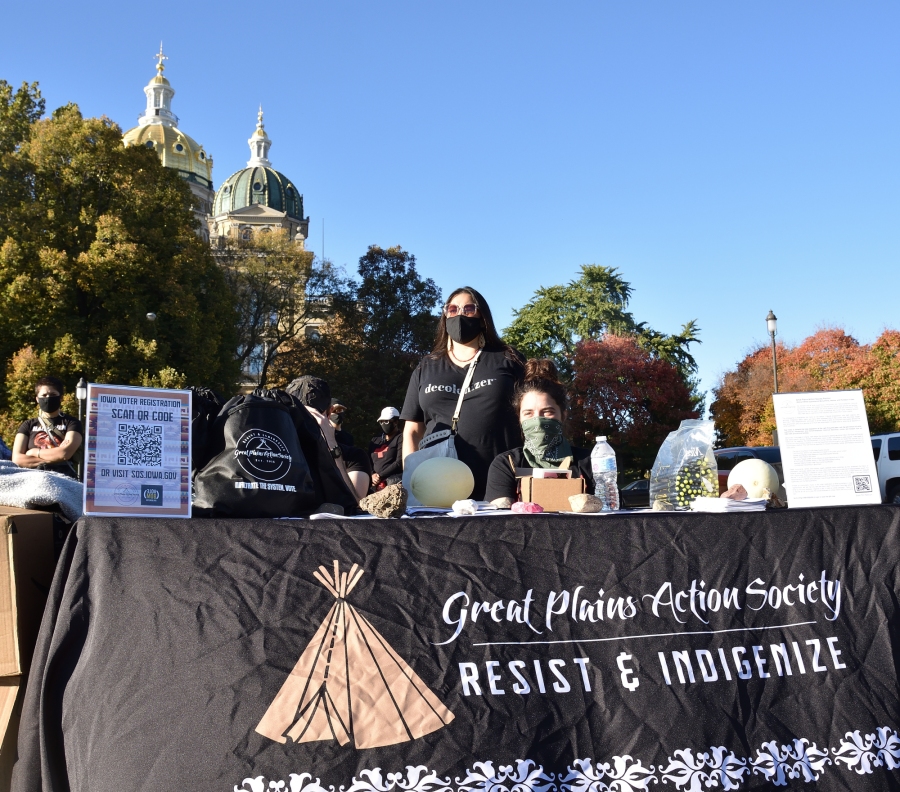
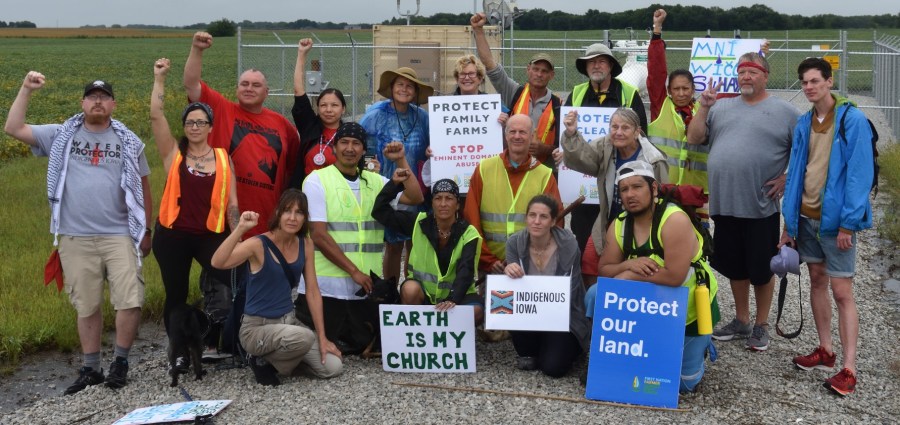
Completing a circle

I first learned about the Wet’suwet’en peoples in British Columbia when I saw this YouTube video, Coastal Gaslink Evicted from Unist’ot’en Territory, January 5, 2020. Having worked so hard to protect water from the Keystone XL and Dakota Access pipelines, I was amazed to see this peaceful eviction of a pipeline company.

From that day I closely followed any news I could find about the Wet’suwet’en peoples. Not surprisingly there was almost nothing in the mainstream news. As a result, people involved in the conflicts continually asked us to use social media to spread the news of what was happening there. I try to do that as much as I can. I was in contact with those at the scene to send them news of what we were doing in Iowa. And validate what I was hearing from other sources.

February 8, 2020
“We need you.”

All eyes needed! One of the most important Indigenous movements is under attack right now for attempting to protect their land from a gas pipeline.
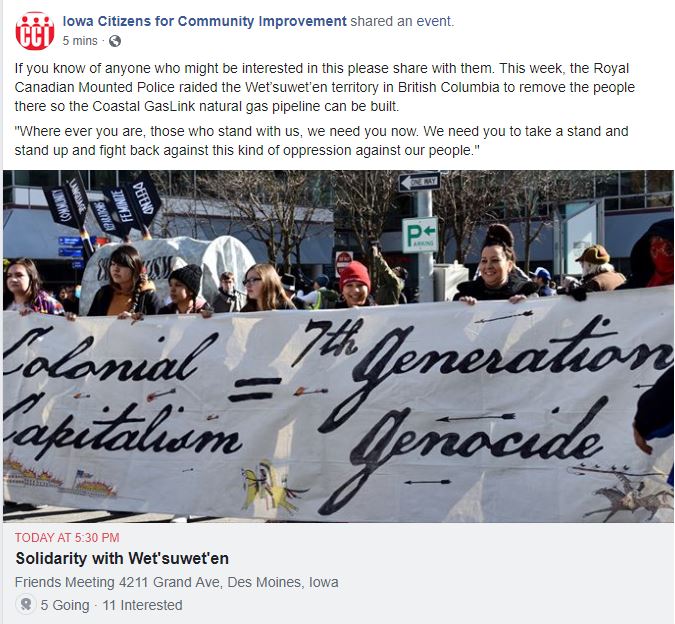
With the second day of heavily armed Royal Canadian Mounted Police raids underway at #Wetsuweten watch camps in Nothern British Columbia, thousands of people across so-called Canada are throwing down right now.
This international human rights violation must be stopped. Stand in solidarity with the Wet’suwet’en.  http://unistoten.camp/supportertoolkit2020/?

“We make conscious decisions to either sit back and watch or stand up and be heard. We make choices as to whether protect our future generations, or we allow for a destitute future for them. We make choices as to enter the uncomfortable place of change & movement, or we continue on this downward spiral. What will your choice be? Will you sit back and allow for human rights violations to occur, or will you #RiseUp with us?” Wet’suwete’n Access Point at Gidemt’en 

My Quaker meeting is in the countryside near Earlham, Iowa, and approved this statement. We also sent a letter in support of the Wet’suwet’en to British Columbia Premier, John Horgan.

We are concerned about the tensions involving the Wet’suwet’en Peoples, who are working to protect their water and lands in British Columbia. Most recently they are working to prevent the construction of several pipelines through their territory. Such construction would do severe damage to the land, water, and living beings. Bear Creek Friends Meeting

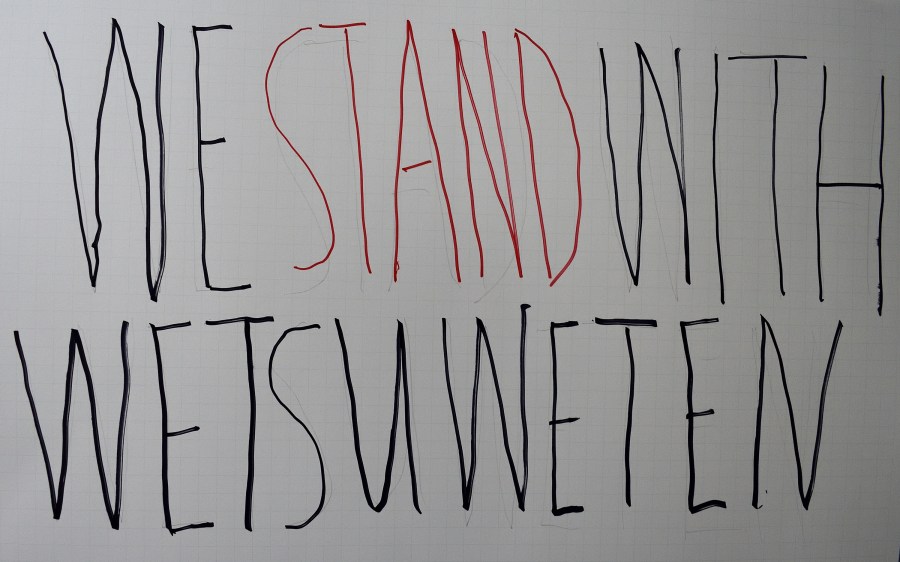
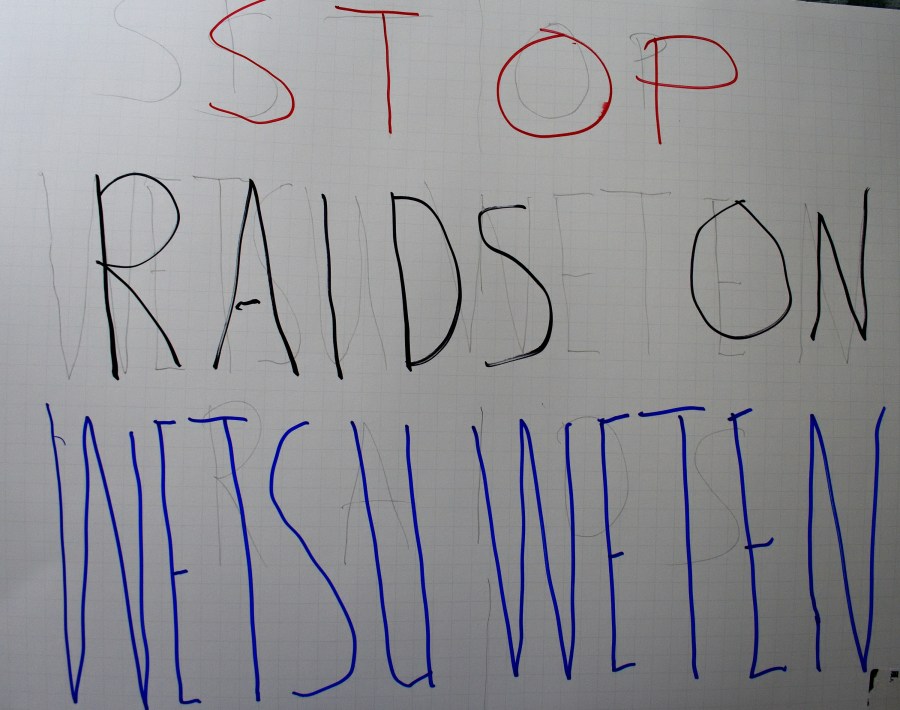
Several of us gathered in Des Moines, Iowa, for a vigil in solidarity with the Wet’suwet’en peoples. Our friends at Bold Iowa and Iowa Citizens for Community Improvement (ICCI) helped notify people about our vigil. We didn’t think many people would join us. But we know it is not the number of people, just that there are people publicly supporting the Wet’suwet’en. You never know what the people driving past might think or do. A sign displaying simply “Wet’suwet’en” might make some curious enough to look into this. Raising awareness and supporting each other is good. Each of us at the vigil drew strength from each other. As it says above, “what will your choice be?” Will you gather with a few friends and your signs to stand on a street corner in your town?

Fortunately, Ronnie James, who has become a good friend, came to the vigil. I learned Ronnie had years of experience as an Indigenous organizer. He is part of the Great Plains Action Society, and his focus is on Mutual Aid. One of the organizing skills he taught me was to attend events related to our work to meet new people to work with. I believe this was a spirit led connection. Not only would I have missed getting to know Ronnie and those he works with, but I might not have learned about Mutual Aid.

Ronnie has patiently taught me about his work and Mutual Aid since that meeting. I learned about the free food distribution project, which I was surprised to learn had been in operation since the Panther’s Free school breakfast program began in the early 1970’s.

So I work with a dope crew called Des Moines Mutual Aid, and on Saturday mornings we do a food giveaway program that was started by the Panthers as their free breakfast program and has carried on to this day. Anyways, brag, brag, blah, blah.

So I get to work and I need to call my boss, who is also a very good old friend, because there is network issues. He remembers and asks about the food giveaway which is cool and I tell him blah blah it went really well. And then he’s like, “hey, if no one tells you, I’m very proud of what you do for the community” and I’m like “hold on hold on. Just realize that everything I do is to further the replacing of the state and destroying western civilization and any remnants of it for future generations.” He says “I know and love that. Carry on.”

Ronnie James

I was fascinated with this work. Not only the projects themselves, but how the Mutual Aid model was used. One of the key aspects of Mutual Aid is working to ensure a horizontal or flat hierarchy, where each person has a voice, is maintained. As opposed to the vertical hierarchies that organize the vast majority of organizations. If there is no vertical hierarchy, there can be no superiority.

There are significantly increasing tensions now between the Wet’suwet’en peoples and the Royal Canadian Mounted Police. All signs indicate another invasion of the Wet’suwet’en territory by the RCMP. The Wet’suwet’en people are asking for our support now. (CGL is Coastal GasLink pipeline).

Gidimt’en Occupation of CGL Drill Site Continues! Callout for Week of Action 10/9-10/15

Cas Yikh of the Gidimt’en Clan are counting on supporters to go ALL OUT in a mobilization for the biggest battle yet to protect our sacred headwaters, Wedzin Kwa. We have remained steadfast in our fight for self-determination, and we are still unceded, undefeated, sovereign and victorious.

We are humbled by the power of our allies, friends and supporters. We have love, respect, and gratitude for those that stood their ground beside us on the yintah to defend Wedzin Kwa. We vow to reciprocate the solidarity from everyone that followed, all our allies/relatives and supporters that put their feet in the street defending Indigenous sovereignty.

Now, we need you to rise up again.

October 9th-15th 2021, go #AllOutForWedzinKwa.

Learning of these new tensions, I thought we should have another vigil in support of the Wet’suwet’en. I know Ronnie is extremely busy now, but I asked him whether those of us who gather every Saturday morning for the Mutual Aid food project might show public support, as he and I did in early 2020.

He agreed he was busy, but he would meet to support the Wet’suwet’en peoples again if I was willing to organize it. He said I could ask the others at the food project if they would be interested.

This is an example of how Mutual Aid works. Without a vertical hierarchy, there wasn’t a ‘leader’ who needed to approve such a gathering. It was up to me to organize and invite others.

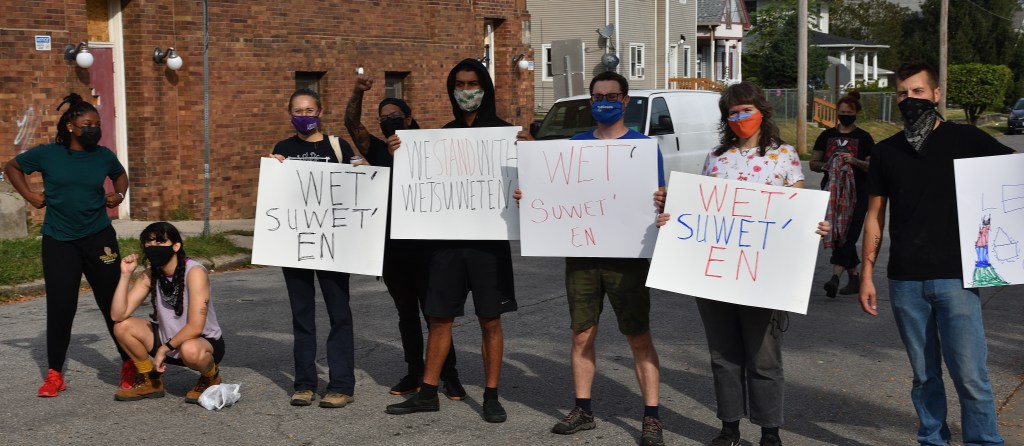
When I arrived at Mutual Aid yesterday morning, Ronnie asked if I had brought the Wet’suwet’en signs that we had made for the 2020 vigil, and I had. Then as distributing the food was winding down, he suggested I tell the others about the Wet’suwet’en and invite those willing to stay so we could get a photo showing our support. Again, he didn’t tell me what to do, but offered the suggestion. So, I announced the photo shoot and asked anyone interested to stay for that. I was grateful to those who did.

My friends avoid photos because their activism sometimes brings police attention. As usually happens, activists are involved in many different issues. There were arrests last year during the unrest related to George Floyd and police violence. But we have not stopped having our own mask mandate, so that worked out well for the photos.

I brought poster boards and markers because Jack, five years old, nearly always comes to the food project with his mother. And is the life of the party! I know he really likes to draw. So I ask Jack (and his mother) if he wanted to make a sign, which you can see on the far right in the photos.

This is the completion of a circle that began with signs and meeting Ronnie in early 2020, and comes around to using the same signs, with Ronnie and others, yesterday. With a lot of work in between. I believe we will continue to move along the circle.

#AllOutForWedzinKwa
#wetsuwetenstrong

Listen…to the story

Many tragic stories were told yesterday, the first National Day for Truth and Reconciliation in the land called Canada. Although rooted in tragedy, it felt like the time has come to begin to bring these stories into the light. A sense of relief, in a way, that these deeply buried traumas are being told. Yet also triggering grief as these memories are revisited. Telling and listening to these stories are the truth part of truth and reconciliation.

People can be transformed by being open and human. We believe that people have a need to be heard, but how they are heard really matters – if they take the risk of telling their story, it needs to make a difference.

Denise Altvater

And yesterday was Orange Shirt Day. The following is from my friends of the Great Plains Action Society.


My friend Lucy Duncan wrote the following years ago, on the occasion of the seating of the Maine-Wabanaki Truth and Reconciliation Commission.

Listen…to the story

All they knew was the reservation
The bit of land that wasn’t stolen
They lived surrounded by the sea
The few that had survived
They were poor, but this was home

One day, the state came
No one said where they were going
They rode in a car for the first time
Taken from all they knew, and from those they loved
To strange homes and ways
Where some were cared for, others beaten and broken
But either way, they longed for home, for the places they belonged
Taken far from who they were, far from their heart mother
Into places that would demand that they forget
But the heart keeps beating like a drum

Hard won, the journey home has begun
With each story told of the pain of separation, of loss, of hurt
With each story held lovingly
And carried with tenderness by those who listen
They are slowly coming home
Home to look each other in the eye and say, “I see you.”
Home to family lost
Home to ways of being that rest on their limbs like skin

As each story is told, another story rises
A mother tells of being taken
A son tells how her hurts were passed on to him
How he passed them on to his children
Recognition comes, the hurts so deep begin to heal
The children waiting to be born will learn the story
But not carry this deep weight of pain

The stories together
Tell the whole truth
The truth that stings as it heals
And maybe, just maybe, if all of us can hear
In our bones, in our being
Even those descended from the ones who plotted decimation
We will remember
To honor the mother, all mothers
To honor the land, all land
To honor the Spirit, rising

Shh…. listen….

Lucy Duncan

The journey home: a prayer for healing by Lucy Duncan, American Friends Service Committee, Feb 7, 2013

Teaching Quality Standard

It is difficult to realize how close we have come to the erasure of Indigenous peoples in the lands called the United States and Canada. This is changing as Indigenous peoples are leading the struggles to protect Mother Earth.

There is also focus on Indigenous peoples as the remains of thousands of native children on the grounds of institutions of forced assimilation are found. The point of forced assimilation was the erasure of the children’s Indigenous identities and ways of living. The ultimate erasure was the death of a child.

The first step in healing is education. Education of all students. Education for ourselves. This comes at a time when powerful forces are determined to maintain this erasure of Indigenous peoples’ history and culture.

It is crucial for non-native people to learn this history, to know how this country developed, so we can all begin to heal. We can’t do that as long as we remain within the boundaries of whitewashed colonial stories. This is important context for dealing with rapidly evolving environmental chaos. Because a return to Indigenous practices and relationships with Mother Earth and all our relations is, I believe, the way to adapt to continuing, deepening collapse.
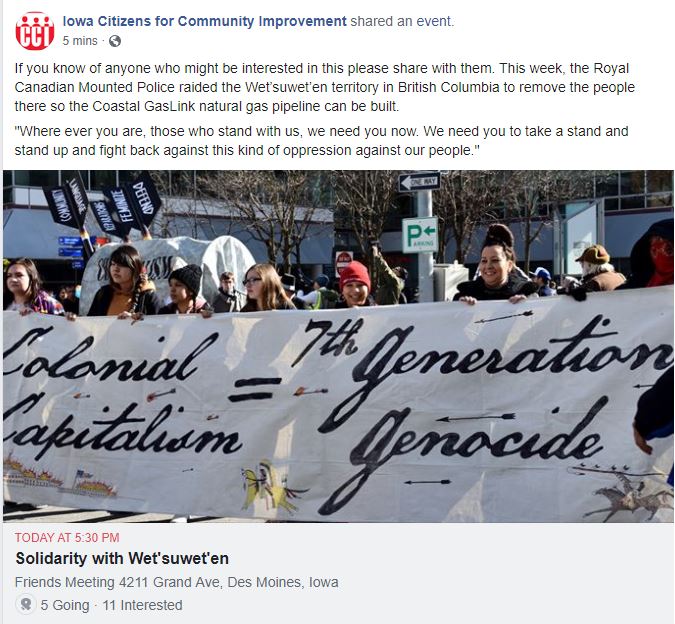
An earlier blog post was about anti-racism education in Iowa. https://landbackfriends.com/2021/09/15/unban-anti-racism-education-in-iowa/
The Great Plains Action Society youth organizers and experts across Iowa weigh in on white supremacy and the ban on Critical Race Theory. The bans on Critical Race Theory across the country are one of many examples of efforts to whitewash the truth.


The following story was just published:

PIERRE, S.D. — Facing bipartisan pressure and calls for her resignation by the South Dakota Education Equity Coalition, South Dakota Gov. Kristi Noem told the state Department of Education to postpone controversial changes to its social studies standards for up to one year to allow for more public input.

Tribes from across South Dakota voiced their ire last month after officials from Noem’s South Dakota Department of Education scrubbed more than a dozen Indigenous-centered learning objectives from the department’s new social studies standards before releasing the document to the public.

The American Indian leaders, educators and community members called the removal of the objectives “Native erasure.”

“Our children were stolen from us in past generation, forcefully assimilated or secretly buried in boarding schools under the ‘kill the Indian and save the Man’ ideologies, and it would seem that the task to erase them has not ended under Governor Kristi Noem’s administration and leadership,” Cheyenne River Sioux Tribe Chairman Harold Frazier said in August.

Under Pressure, S.D. Gov. Noem Delays Social Studies Standards That Erase Native History by Levi Rickert, Native News Online, Sept 22, 2021

Following are two sections of the Alberta Teaching Standard that relate to First Nations, Métis and Inuit peoples.

Quality teaching occurs when the teacher’s ongoing analysis of the context, and the teacher’s decisions about which pedagogical knowledge and abilities to apply, result in optimum learning for all students.

The professional practice of all Alberta teachers is guided by the Teaching Quality Standard (TQS). This standard is the basis for certification of all Alberta teachers and holds them accountable to the profession and to the Minister of Education.

Establishing Inclusive Learning Environments

A teacher establishes, promotes and sustains inclusive learning environments where diversity is embraced and every student is welcomed, cared for, respected and safe.

Achievement of this competency is demonstrated by indicators such as:

a. fostering equality and respect with regard to rights as provided for in the Alberta Human Rights Act and the Canadian Charter of Rights and Freedoms;
b. using appropriate universal and targeted strategies and supports to address students’ strengths, learning challenges and areas for growth;
c. communicating a philosophy of education affirming that every student can learn and be successful;
d. being aware of and facilitating responses to the emotional and mental health needs of students;
e. recognizing and responding to specific learning needs of individual or small groups of students and, when needed, collaborating with service providers and other specialists to design and provide targeted and specialized supports to enable achievement of the learning outcomes;
f. employing classroom management strategies that promote positive, engaging learning environments;
g. incorporating students’ personal and cultural strengths into teaching and learning; and
h. providing opportunities for student leadership

Applying Foundational Knowledge about First Nations, Métis and Inuit

A teacher demonstrates an understanding of and adherence to the legal frameworks and policies that provide the foundations for the Alberta education system.

Achievement of this competency is demonstrated by indicators such as:

a. understanding the historical, social, economic and political implications of:
• treaties and agreements with First Nations;
• legislation and agreements negotiated with Métis; and
• residential schools and their legacy;
b. supporting student achievement by engaging in collaborative, whole school approaches to capacity building in First Nations, Métis and Inuit education;
c. using the programs of study to provide opportunities for all students to develop a knowledge and understanding of, and respect for, the histories, cultures, languages, contributions, perspectives, experiences and contemporary contexts of First Nations, Métis and Inuit; and
d. supporting the learning experiences of all students by using resources that accurately reflect and demonstrate the strength and diversity of First Nations, Métis and Inuit.

Alberta Teaching Standard


For its part, NABSHC—an organization that has been at the helm of increasing public awareness on boarding schools since its founding nearly a decade ago—in 2020 released its first ever Truth and Healing Curriculum. The curriculum, available for free online, is made up of four lessons on Indian Boarding Schools focusing on history, impacts, stories, and healing.

Truth and Healing Curriculum

As the horror stories of the institutions of forced assimilation of Indigenous children continue to emerge, it is clear the erasure of this history almost succeeded. I remember being taught very little beyond Columbus ‘discovering America’, the colonial version of ‘Thanksgiving’, and not much related to the settler colonists and Indigenous peoples.

It is crucial for non-native people to learn this history, to know how this country developed, so we can all begin to heal. We can’t do that as long as we remain within the boundaries of whitewashed colonial stories. This is important for the context for dealing with rapidly evolving environmental chaos. Because a return to Indigenous practices and relationships with Mother Earth and all our relations is, I believe, the way to adapt to the coming collapse.

In the last blog post I wrote about sixth grader Alden Nobiss’ idea of having students teach each other about anti-racism and an accurate history of this country known as the United States.

Alden’s mother, Christine Nobiss (Sikowis) says, “he basically thinks that if teachers can’t teach critical race theory, then why can’t students do it? So that’s his idea. He thinks that students can teach each other in their spare time. During recess, during lunch time, and that’s something that he’s going to try to do. So, we have a book that he’s going to share called 500 Years After Columbus, which is a curriculum guide for teaching better indigenous studies for k-12. So, he’s already taking a look at that.”


It has been a long-running goal of many Native people to have more about their history and culture taught in grade schools. New requirements have been adopted in Connecticut, North Dakota and Oregon and advocates say their efforts have gained some momentum with the nation’s reckoning over racial injustice since the killing of George Floyd.

The legislation affecting schools has advanced alongside new bans on Native mascots for sports teams and states celebrating Indigenous Peoples Day in place of Christopher Columbus Day.

The push for curriculum requirements has not been without challenges, with some legislatures deeming new laws unnecessary because Native American history already is reflected in school curriculum. There also have been some steps in the opposite direction amid battles over how topics related to race and racism are taught in classrooms.

In South Dakota, a group of teachers and citizens charged with crafting new state social studies standards said last month that Gov. Kristi Noem’s administration deleted from their draft recommendations many elements intended to bolster students’ understanding of Native American history and culture. They said changes made to the draft gave it a political edge they had tried to avoid, aligning it instead with the Republican governor’s rhetoric on what she calls patriotic education.

Push for Indigenous Curriculum Makes Gains by Susan Haigh, Indian Country Today, Sept 15, 2021

Without the political will to ensure accountability and to guide implementation, what is observed rather in mainstream American education is the ongoing erasure of Indigenous people. Sam Torres

Only five states mentioned Indian boarding schools in their state content standards, which is “unimaginable,” said Sam Torres of The Native American Boarding School Healing Coalition. “It’s obviously a representation and reflection of what is being valued in educational and curricular context.”

As the United States federal government gears up to assess the genocide it perpetuated against Native communities for nearly a century, Native leaders and academics say there is one glaring method for accessing truth and healing: education.

Roughly fifty four percent of public schools across the United States make no mention of Native Americans in their K-12 curriculum, and 87 percent of state history standards don’t discuss Native American history after 1900, according to a study conducted in 2019.

For its part, NABSHC—an organization that has been at the helm of increasing public awareness on boarding schools since its founding nearly a decade ago—in 2020 released its first ever Truth and Healing Curriculum. The curriculum, available for free online, is made up of four lessons on Indian Boarding Schools focusing on history, impacts, stories, and healing.

“We were hearing a lot of feedback from community members asking for materials for their students,” Torres said. In developing the curriculum— sectioned into primary, middle and upper grades learning levels—Torres said he and staff members focused on the pillars that mimic a Native approach to collective education.

Other nonprofit institutions, such as The Ziibiwing Center of Anishinabe Culture & Lifeways in Michigan and the Heard Museum in Arizona have also developed their own supplemental Indian Boarding School curriculum. But without a state mandate on the specific curriculum, or enough educators aware of or comfortable enough with the content, the material reaches only a tiny fraction of students.

NABSHC’s Truth and Healing curriculum has been downloaded over one thousand times, Torres said, as the organization sets its sight on training educators in decolonizing knowledge. 

“Rigorous meaningful curricular materials have and continue to be developed by Native people,” Torres said. “Yet without the political will to ensure accountability and to guide implementation, what is observed rather in mainstream American education is the ongoing erasure of Indigenous people.”

The vast majority of Americans don’t learn about Indian boarding schools growing up. These Native leaders and educators want to change that by Jenna Kunze, Native New Online, Sept 13, 2021

The National Native American Boarding School Healing Coalition has developed a curriculum on U.S. Indian Boarding Schools for teachers and parents to use with their students and children.

The Truth and Healing Curriculum is comprised of four (4) robust lessons on Indian boarding schools covering History, Impacts, Stories, and Healing, and is appropriately sectioned into three (3) learning levels: primary, middle, and upper grades.

NABS understands that educational resources such as these are greatly needed for a variety of important reasons. As a response to requests from teachers and parents, we developed the Truth and Healing Curriculum to support distance learning during the COVID-19 pandemic.

Download a package that includes all curriculum.

Download Curriculum


Students teaching students

Yesterday I saw the great presentation, Online Pushback:UnBan Anti-Racism Education in Iowa, a forum by Indigenous youth of the Great Plains Action Society related to Iowa’s ban on teaching Critical Race Theory or Anti-Racism Education (video below).

Indigenous Youth Organizers, Alexandrea Walker and Keely Driscoll, have started a youth-led movement to demand that the current Iowa Administration unban Anti-Racism Education, aka, Critical Race Theory. For the sake of health and safety for all, it is imperative that Kim Reynolds reverse the overtly white supremacist decision to ban anti-racism education plus diversity, equity, and inclusion programming in the classroom and in all state-funded institutions

At the 12:15 mark in the video above, my friend Sikowis Nobiss introduces her son Alden who is in sixth grade. With the ban against teachers teaching about anti-racism, he spoke about his idea of students teaching each other as an alternative.

Sikowis: Hello everybody. I am here with my son today and his name is Alden and he’s in sixth grade. And he’s being affected by the ban on critical race theory or as we like to call it anti-racism education, decolonization work, diversity equity inclusion. Those are better terms for it because critical race theory is a term that they’re using to manipulate the situation, to make it sound like it’s critical, you know that it’s being like overtly hard on something when really it means how like you know analyzing something specifically or properly.
So, Alden is in grade six and you know he’s got some interesting thoughts about this, and I wanted to ask him like what does he think, what do you think about the ban on critical race theory?
Alden: It’s not that good.
Sikowis: How come?
Alden: I mean people should know that what happened in the past or else the history is just going to repeat itself. Just the same thing that happens over and over right? Seems like it isn’t going to stop if people don’t take action and more people like Reynolds is going to ban stuff.
Sikowis: And you had an interesting idea, you had said that teachers can’t teach critical race theory right? But students can. Can you tell us more about that?
Alden: The governor only said that teachers couldn’t say stuff like that and they couldn’t teach stuff like that, but that doesn’t mean schools can’t just be used to teach inside like only teachers.
Sikowis: So, who would teach like you want?
Alden: Kids to teach each other. Yeah the more educated kids that are like me I guess that know about what happened in the past.
Sikowis: Very good thank you so much Alden. We appreciate you making those remarks. That took a lot of bravery for him. I’m very proud of that.
I hope you guys could hear that. He basically thinks that if teachers can’t teach critical race theory then why can’t students do it? So that’s his idea. He thinks that students can teach each other in their spare time. During recess during, lunch time and that’s something that he’s going to try to do. So, we have a book that he’s going to share called 500 Years After Columbus, which is a curriculum guide for teaching better indigenous studies for k-12. So, he’s already taking a look at that.


Just as the final report from the National Inquiry into Missing and Murdered Indigenous Women and Girls triggered shock waves across the country, bringing conversations about violence against Indigenous people into the classroom, so did the discovery of 215 children’s remains at the Kamloops Indian Residential School earlier this year.

As the National Day for Truth and Reconciliation approaches, we can expect Canadian teachers are thinking about how they can better weave Indigenous perspectives into their lesson planning.

In the past, events like this rarely made it as national news, staying inside our Indigenous communities where the pain remained hidden from the rest of Canada. Now, teachers are talking about them with their students — how history and society influence individual situations of race-motivated violence and cultural genocide. It’s our responsibility to make sure they are equipped to teach the truth and acknowledge the important role schools play in reconciliation.

We owe it to all students to bring truth and drive reconciliation in classrooms by Linda Isaac & John Estabillo, National Observer, September 16th, 2021.

For specific teachings on Indian Boarding Schools and the United States assimilation policies—a history educators say is central in contextualizing present day culture for Native and non-Native youth alike— statistics are even bleeker.

“Over the course of the last couple of years, we’ve identified five states—only five states— that have even mentioned Indian boarding schools in their content in their state content standards, which is unimaginable,” said Sam Torres, director of research and programs at The Native American Boarding School Healing Coalition. Those states, surveyed by NABSHC in 2015, are: Arizona, Washington, Kansas, Oklahoma, and North Dakota. 

“It’s obviously a representation and reflection of what is being valued in educational and curricular context,” Torres said. 

For its part, NABSHC—an organization that has been at the helm of increasing public awareness on boarding schools since its founding nearly a decade ago—in 2020 released its first ever Truth and Healing Curriculum. The curriculum, available for free online, is made up of four lessons on Indian Boarding Schools focusing on history, impacts, stories, and healing.

The vast majority of Americans don’t learn about Indian boarding schools growing up. These Native leaders and educators want to change that by JENNA KUNZE, Native News Online, SEPTEMBER 13, 2021

We owe it to Indigenous educators who are triggered and challenged to deliver education around a topic like residential schools that have impacted them. Educators like me, who when viewing the images of children with their plain clothes, short hair, and empty eyes — identities stripped — still struggle to separate the pain we hold from lesson planning.

We also owe it to non-Indigenous educators who lack confidence in teaching because they weren’t taught the truth about the atrocities of the residential school system. This is a significant blocker to the successful integration of truth-telling in our classrooms, which can be solved by supporting educators in their journey of learning.

We must ensure the materials passed down to educators are written accurately by authentic voices. We need ongoing government funding and access to professional learning programs. Alberta is one province that does this well. Its Teacher Qualifications Standard requires educators to take courses in foundational knowledge of Indigenous history.

We owe it to all students to bring truth and drive reconciliation in classrooms by Linda Isaac & John Estabillo, National Observer, September 16th, 2021.

Unban Anti-racism Education in Iowa

The Great Plains Action Society youth organizers and experts across Iowa weigh in on white supremacy and the ban on Critical Race Theory. The bans on Critical Race Theory across the country are one of many examples of efforts to whitewash the truth.

Online Pushback: UnBan Anti-Racism Education in Iowa
May be an image of 2 people and text that says 'ONLINE PUSHBACK FORUM UNBAN ANTI-RACISM EDUCATION IN IOWA Hosted by Great Plains Action Society Youth Organizers Alexandrea Walker, Ho-Chunk Keely Driscoll, Meskwaki Youth and experts across lowa weigh in on white supremacy and the ban on Critical Race Theory September 15, 2021 @ 6:30 PM CST @ bit.ly/teachtruthforum'

YouTube Link youtube.com/watch?v=tIlz26X7T-U

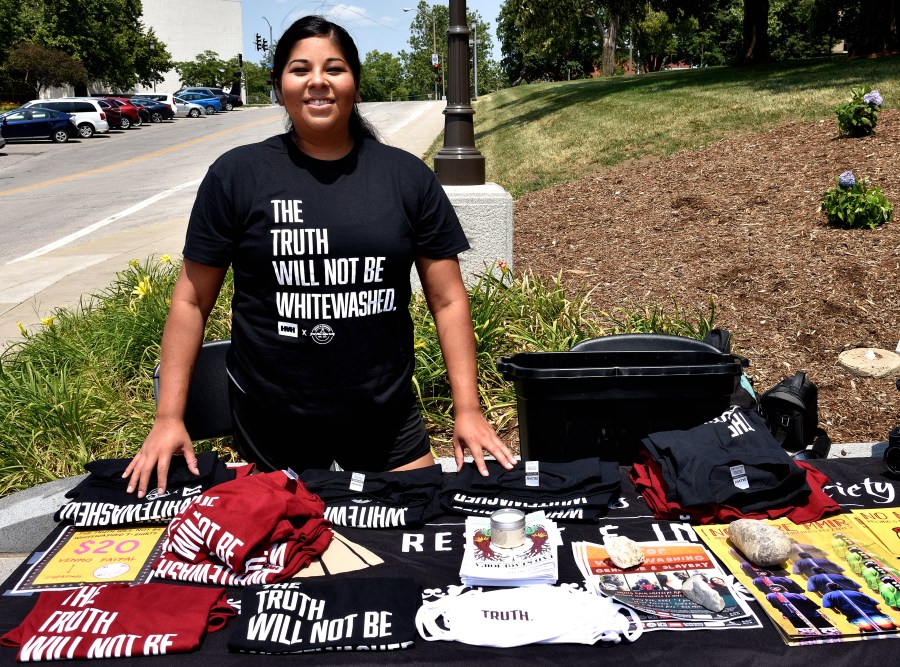
The Truth Will Not Be Whitewashed!

Indigenous Youth Organizers, Alexandrea Walker and Keely Driscoll, have started a youth-led movement to demand that the current Iowa Administration unban Anti-Racism Education, aka, Critical Race Theory. For the sake of health and safety for all, it is imperative that Kim Reynolds reverse the overtly white supremacist decision to ban anti-racism education plus diversity, equity, and inclusion programming in the classroom and in all state-funded institutions. Join Alex and Keely as they host a forum for youth and experts throughout Iowa to weigh in on this pressing issue. Guests TBA.

The Truth Will Not Be Whitewashed is a campaign founded by Great Plains Action Society and Humanize My Hoodie. We encourage others to join this effort. Please contact us if you are interested in joining our growing coalition.

Great Plains Action Society (You can send a message from this link)


This reminds me of the work of Lynne Howard and Des Moines Valley Friends’ (Quakers) to get draft counseling into the Des Moines public schools in 1970. They were successful! Resisting draft counseling was an effort to whitewash the truth about participating in the military.


PROPOSAL FOR DRAFT COUNSELING IN THE DES MOINES PUBLIC HIGH SCHOOLS

STATEMENT OF BELIEF:

We believe that all young men in the Des Moines Public High Schools should have access to adequate counseling by qualified counselors in regard to the Selective Service and its alternatives.  Qualified counselors are those persons who:

  1. Have received special draft counseling training
  2. Have a detailed knowledge and experience of the Selective Service Law and the administration thereof
  3. Are sensitive to the moral and spiritual implication of war and peace and individual conscience
  4. Have knowledge of where to refer students if they want counseling on a specific aspect of the Selective Service alternatives and options

We further believe that such counseling should be made available during school hours, similar to other available guidance counseling.

IMPLEMENTATION:

There in light of the above purpose we recommend that one of the following plans be used to implement this counseling program:

  1. That each high school in Des Moines provide adequate training of all guidance counselors in order that they be familiar with the Selective Service Law and its alternatives
  2. That each high school select one guidance counselor who would be specially trained (see above) to counsel and answer questions concerning the draft and its alternatives.  Other guidance counselors in the school could refer their students to this specially trained counselor, if this type of counseling is needed
  3. That each trained counselor would refer persons who need more intensive and specific counseling to appropriate groups.  (Particular religious groups, various branches of the Service, etc.)

The Peace Testimony Remains by Lynne Howard. September 15, 1970

What You Get into Will Change You

Recently a series of things happened that provoked some reflection. I saw the quote, “what you get into will change you. Sometimes in life you just don’t know what you’re getting into”, which prompted me to write the following.

A lot happened to me since retiring and returning to Iowa four years ago. I hadn’t given a lot of thought to what would happen when I returned to Iowa. I had stayed connected with Iowa Quakers and involved with them as much as I could from a distance. So, there were already some relationships to build on.

In Indianapolis I was blessed to have made many friends as we worked to protect water and oppose the Keystone XL and Dakota Access pipelines. I was also most fortunate to become involved with the Kheprw Institute (KI), a youth mentoring and empowerment community. And North Meadow Circle of Friends Quaker meeting. It was hard to leave but I stay in touch.

What follows are stories of my justice experiences since returning to Iowa. They are offered in case they might be helpful for you and your own work.

I’m frustrated more people don’t engage in justice work. Why are we here if not to grow and engage with family and our communities? Most people either don’t know how to engage or don’t want to. I’m frustrated because there is so much work to be done. We are experiencing environmental catastrophes that will only worsen and occur more frequently. We need masses of people to prepare now for the evolving chaos.

Also, these experiences will be good for you. I know from experience “what you get into will change you”. https://www.dailygood.org/story/2795/what-you-get-into-will-change-you-phyllis-cole-dai/

It is important to recognize “sometimes in life you just don’t know what you’re getting into.” Those can be times of great opportunity. I encourage you to get involved in opportunities like this, as long as doing so is relevant to what you are called to do.

What you get into will change you. Sometimes in life you just don’t know what you’re getting into.

Phyllis Cole-Dai

The most important step is to figure out what you should do. There are so many problems. Many people get burned out by trying to do too many things. People of faith rely on faith to help us figure this out. Keep what you are led to do in mind. You must be vigilant as you look for opportunities to get involved with justice work. And just as vigilant to decline to get involved in things not related to what you are called to do. Maintaining this focus is crucial for success.

First Nation-Farmer Climate Unity

I had long wanted to get to know some Indigenous people for numerous reasons, such as spirituality and sustainable living. Fortunately, an ideal opportunity to do so was to walk and camp along the path of the Dakota Access pipeline with a small group of native and nonnative people. The intention was for those in the group to get to know each other as we walked 10-15 miles/day, put up our tents, and have meals together.

During the First Nation-Farmer Climate Unity March (Sept. 1 – 8, 2018) Manape said we were on a sacred journey. During the March, Donnielle said we are a tribe. This morning I’m realizing the following stories about the past are part of my sacred journey. Also thinking of the many new friends found as part of this journey. I’m thinking how much I would have missed if I didn’t recognize and take advantage of this amazing opportunity.

Wet’suwet’en

Last Saturday morning began by watching a new video (see below) from the Wet’suwet’en people in British Columbia. Gidimt’en Checkpoint spokesperson Sleydo’ (Molly Wickham) and Elder Janet Williams found a film crew trespassing on Gidimt’en territory, making a commercial to promote Coastal Gaslink’s plans to tunnel beneath the sacred headwaters.

I first learned about the Wet’suwet’en’s struggles in January, 2020, when I saw a remarkable video of Sleydo’ evicting the Coastal GasLink workers from Wet’suwet’en territory. “All CGL workers have now been peacefully evicted from Unist’ot’en and Gidimt’en territories. Under the authority of Anuk nu’at’en (Wet’suwet’en law), and with support of the Wet’suwet’en hereditary chiefs of all five clans, the Wet’suwet’en are standing up for the last of our lands and we need you to stand with us. We will honour the instructions of our ancestors, and continue to protect our lands from trespassers.”

I began to follow what was happening with the Wet’suwet’en, especially when they started asking people to write about what was happening, since the mainstream media was not. A few of us, who had worked together on some Indigenous related events, organized a vigil in support of the Wet’suwet’en:

We didn’t expect anyone to join us. Fortunately, Ronnie James did. In the photo are Peter Clay, Linda Lemons and Ronnie James. Ronnie is an Indigenous organizer with many years of experience and interested to see who organized and attended our vigil. After he left, I realized I didn’t have a way to contact him. Fortunately, he accepted my Facebook Friend request. We began to have numerous conversations (via social media), where he patiently taught me a great deal about organizing, Indigenous thought, and Mutual Aid. (See: https://landbackfriends.com/mutual-aid/)


Peter Clay, Linda Lemons and Ronnie James
Mutual Aid

Meeting and becoming great fiends with Ronnie changed the course of my life. I eventually joined the work of Des Moines Mutual Aid (DMMA). Every Saturday morning, I participate in the free food distribution program. About a dozen of us put together sixty boxes of food, that we then put in the cars of those who need it. It is amazing this food distribution has been in existence in Des Moines since the Black Panthers organized the free breakfast program for school kids in the 1970’s.

Putting together the boxes of food, we move as a well-oiled machine. There is a little visiting as we pass each other when putting the food into boxes. I learn a lot about the justice work people are doing in central Iowa, since my Mutual Aid friends are also involved in many such projects.

Saturday there was a lull while waiting for another food delivery that provided a chance to talk with Ronnie. I mentioned the story below about the continued oppression of the Wet’suwet’en peoples and reminded him that we had met at the vigil for the Wet’suwet’en mentioned above. I told him that was something he taught me about organizing. Going to justice events to meet people. I said I wouldn’t have known about Mutual Aid if not for him attending that Wet’suwet’en vigil. He replied I probably would have learned about Mutual Aid because it had been in the news a lot recently.

Ronnie mentioned that was the first time he had been at Friends House, where the Wet’suwet’en vigil was held. Des Moines Mutual Aid has its offices in Friends House now. I had just spoken with Jon Krieg who works with the American Friends Service Committee (AFSC), whose offices had been in Friends House. Recently AFSC had moved out and Jon mentioned he missed visiting with Ronnie.

Des Moines Valley Friends meeting, which meets in a meetinghouse attached to Friends House, has been allowing another Mutual Aid group to use their kitchen to cook meals that are taken to the houseless camps.

Another set of connections relates to the Great Plains Action Society (GPAS), founded by my friend Christine Nobiss, who was also on the First Nation-Farmer Climate Unity March. Ronnie’s Mutual Aid work is supported by GPAS.

Prairie Awakening/Prairie Awoke

Saturday was also the day of the annual Prairie Awakening/Prairie Awoke ceremony, an annual event sponsored by the Dallas County Conservation Board. The ceremony is held in the Kuehn Conservation Area. My Quaker meeting, Bear Creek, has been involved with the ceremony for over ten years. A number of Friends attended.

While there, I was able to talk with my friend Rodger Routh, who grew up in the Earlham, Iowa (where Bear Creek meeting is) community. Rodger is a photographer/videographer and justice advocate, who is often at the same events I attend. Jon Krieg (AFSC, mentioned above) is also a photographer. It is common for the three of us to be at the justice related events.

LANDBACK

One of the principles of justice work is to follow the leadership of the communities affected by injustice. In Indianapolis, the Kheprw Institute would let us (Quakers in this case) know what we could do for them.

Recently I had a chance to ask Christine how nonnative people could best support her and her work now. She told me to learn and teach others about the concepts of LANDBACK. So, I created a website named LANDBACK Friends, where I’ve been sharing what I am learning about LANDBACK. https://landbackfriends.com/

Maintaining connections

As the completion of a circle, I was so glad to be contacted by my friends at the Kheprw Institute (KI) in Indianapolis. Aghilah contacted me because KI is interested to learn more about LANDBACK. Evidently, they have been following my blog since I left Indianapolis and reading what I’ve been writing about LANDBACK.

Quakers for Abolition Network

My blog also made it possible for one of my new friends, Jed Walsh, to contact me about the work he and Mackenzie Barton-Rowledge are doing related to abolition of police and prisons. I wrote a little in their article that was just published by the Western Friend, https://westernfriend.org/article/quakers-abolition-network.

Conclusion

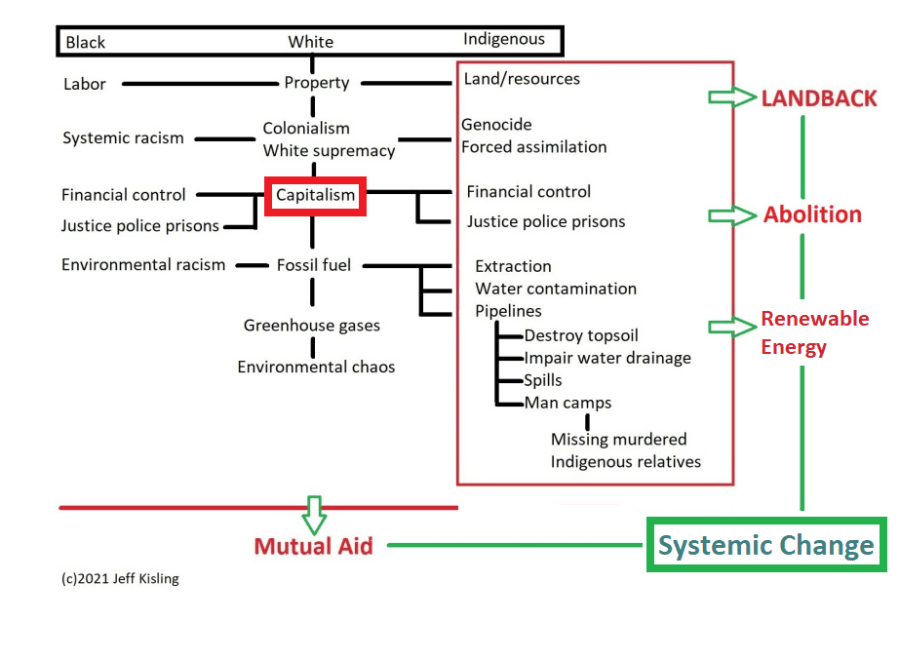
We are moving more deeply into collapse. Fueled by the consequences of environmental chaos, our economic and political systems are failing. We must work now to build ways to deal with this collapse. I’ve been working on this diagram to illustrate how people are building such systems. It is important to build Mutual Aid communities. And embrace the principles of LANDBACK. “What you get into will change you”.


This document has a lot more information about Quakers, the Wet’suwet’en peoples, and LANDBACK. Scroll down to move through the document.


#LANDBACK

even Quakers if you can believe that

even Quakers if you can believe that“. I heard this from an Indigenous friend during a presentation about institutions of forced assimilation. This is damning for us Quakers. A jarring dichotomy of being viewed as leaders in the work for peace and justice and yet to have participated, continue to participate in the cultural genocide of Native peoples. Cultural genocide and oppression continue today.

A great deal has been said about white people making the best of a bad situation when native lands and peoples were overwhelmed by the flood of white settler colonists moving across the land. Saying it was in the best interest of the native children to be educated about the white world. When instead this intentional cruelty was intended to break the resistance of Native peoples who did not want to give up their lands. And it was successful.

Unless there is documentation, or oral history, we don’t know what a given individual, perhaps one of our ancestors, might have done in these institutions. Additionally, there are so many ways we ourselves have failed our children and future generations. The extinction of millions of species will eventually include human beings.

But none of that excuses the idea that white people are somehow superior. That is diametrically opposed to the idea that there is that of God in every person and thing. A shameful legacy of oppression of black, Indigenous and other people of color (BIPOC) that continues.

My friend Sikowis and her cousin Janna Pratt gave a Zoom presentation about Native American Boarding School Violence & Whitewashed History as part of the Women’s International League for Peace and Freedom 34th Triennial Congress.

Janna Pratt and Sikowis Nobiss are cousins and both citizens of the George Gordon First Nation and will discuss the rape, torture, and murder of Indigenous children in Canada and the US due to boarding school / residential school policy in the US and Canada and the silence behind the Indigenous genocide on Turtle Island. Janna lives in Saskatchewan, Canada and Sikowis lives in Iowa, USA. They will also delve into the work they are doing to overcome historical trauma and combat the erasure of this crisis by white supremacist governments.

She (Sikowis )is also a speaker, writer, and artist and believes that environmental and social justice work are inextricably linked and change will only happen when we dismantle corrupt colonial-capitalist systems and rebuild them with a decolonized worldview.

With the recent discoveries of children who perished while attending Indian residential schools, her (Janna) sights are now set on finding the children. Janna is a 4th generation residential school survivor and has lived through the decimation of culture these schools forced upon children, built under a policy enforced by the Canadian government to inflict cultural genocide. Janna is currently working on an archive that will gather information on residential schools, Missing and Murdered Indigenous Peoples, and veteran information to build resources for Indigenous communities. She hopes to inspire other projects with this knowledge and create Indigenous virtual reality experiences that are accessible no matter the distance.

They made the connections between Native children violently removed from their families, many times never to return, to the current epidemic of violence against Native women, to Missing and murdered Indigenous relatives (MMIR). The forced removal of Native children continues to this day, by social service agencies.

One of the topics of the presentation was the silence behind the Indigenous genocide on Turtle Island. Will we break this silence?

As Sikowis says, change will only happen when we dismantle corrupt colonial-capitalist systems and rebuild them with a decolonized worldview.

This means we must move away from the colonial capitalist system. Seriously! The concepts of LANDBACK are about how to do that. For the past several months I’ve been building the website LANDBACK Friends to help with education about these ideas. https://landbackfriends.com/

I hope you will join us, to find ways to break the silence behind Indigenous genocide.

https://landbackfriends.com/

One of the topics of the presentation was the silence behind the Indigenous genocide on Turtle Island. Will we break this silence?

Cultural erasure continues.

Before the South Dakota Department of Education released a draft of new social studies standards last week, department officials took out more than a dozen references to education on the Oceti Sakowin.

“Oceti Sakowin” refers collectively to the Lakota, Dakota and Nakota people who are indigenous to South Dakota and surrounding states.

Several of the standards on Oceti Sakowin were removed completely, including:

  • In kindergarten civics, discussing the meaning of kinship to the Oceti Sakowin Oyate.
  • In kindergarten geography, discussing the tribal nations of the Oceti Sakowin Oyate.
  • In first grade civics, identifying symbols of the Oceti Sakowin Oyate, including but not limited to star quilt, buffalo and medicine wheels.
  • In first grade geography, recognizing the nine contemporary reservations of the Oceti Sakowin Oyate on a South Dakota map.
  • In second grade civics, exploring the concepts of the Oceti Sakowin Oyate, including but not limited to tribal flags, celebrations (powwows), beadwork, dreamcatchers, music and artwork.
  • In second grade geography, identifying names and locations of Oceti Sakowin Oyate tribes within our communities and state.
  • In third grade civics, learning how to describe tribal organizational structures (council, chairman, etc.)
  • In third grade geography, researching the nine tribes in South Dakota
  • In fifth grade, standards for learning about tribal sovereignty in civics class and how natural resources and migration affected the lives and culture of the Oceti Sakowin were both removed completely.
  • In eighth grade history, examining major cultural traits and resiliency of the Oceti Sakowin Oyate throughout history
  • In eighth grade history, critiquing significant primary sources, including Oceti Sakowin Oyate treaties, and their impact on events of this time period.

In eighth grade civics, two grade-level standards on Indigenous topics were removed completely, including evaluating changing federal policy toward Indigenous Native Americans, and comparing and contrasting the structure of the U.S. government and sovereign tribal governments.

South Dakota DOE removed Indigenous topics from social studies standards before final draft by Morgan Matzen, Sioux Falls Argus Leader, August 10, 2021


Native American Boarding School Violence and Whitewashed History

I have been blessed to get to know and become friends with Sikowis (Christine Nobiss). Four years ago I heard her speak about building bridges with native peoples during Iowa Yearly Meeting (Conservative)’s annual sessions. In 2018 we walked and camped together for 94 miles, eight days, along the path of the Dakota Access pipeline in central Iowa. And have done many things together since.

Sikowis is a leading organizer on issues of Indigenous concern in the Midwest and nationally. This presentation will be an excellent opportunity to learn what she and Janna Pratt have to say about the atrocities of forced assimilation of native children.

wilpfus.org/34thcongress 11 am PDT

Sikowis (Christine Nobiss) is Plains Cree/Saulteaux of the George Gordon First Nation in Saskatchewan, Canada, and grew up in Winnipeg, Manitoba, Canada. At 19, she began her life’s work of uplifting Indigenous voices when she got her first job at the New Brunswick Aboriginal Peoples Council in Fredericton, Canada and now she is the Founder and Executive Director of Great Plains Action Society—a 100% Indigenous organization working towards climate and social justice. She is also a speaker, writer, and artist and believes that environmental and social justice work are inextricably linked and change will only happen when we dismantle corrupt colonial-capitalist systems and rebuild them with a decolonized worldview. Sikowis graduated from the University of Iowa with an MA in Religious Studies (with a focus on Native American Religion and Culture) and a Graduate Minor in American Indian Native Studies.

May be an image of 2 people and text that says 'WOMEN'SNTENTNAL LEAGUE FOR PEACE AND FREEDOM 34TH TRIENNIAL CONGRESS NATIVE AMERICAN BOARDING SCHOOL VIOLENCE & WHITEWASHED HISTORY Sikowis Nobiss George Gordon First Nation Great Plains Action Society Janna Pratt George Gordon First Nation MUSHOM Project SUNDAY, AUGUST 22 AT 11 AM PDT GO TO: WILPFUS.ORG/34THCONGRESS @GreatPlainsActionSociety MUSHOM Project'
wilpfus.org/34thcongress

Join Janna Pratt and Sikowis (Christine Nobiss) this Sunday, August 22 at 11 AM PDT for a presentation on Native American Bordering School Violence & Whitewashed History as part of the Women’s International LEAGUE for Peace and Freedom
34th Triennial Congress.

Janna Pratt and Sikowis Nobiss are cousins and both citizens of the George Gordon First Nation and will discuss the rape, torture, and murder of Indigenous children in Canada and the US due to boarding school / residential school policy in the US and Canada and the silence behind the Indigenous genocide on Turtle Island. Janna lives in Saskatchewan, Canada and Sikowis lives in Iowa, USA. They will also delve into the work they are doing to overcome historical trauma and combat the erasure of this crisis by white supremacist governments.

#everychildmatters
#WILPF
#greatplainsactionsociety
#MUSHOMproject

#everychildmatters
#WILPF
#greatplainsactionsociety
#MUSHOMproject

Great Plains Action Society-Residential Schools

Hi Friend, 

Thank you for being a supporter of Great Plains Actions Society and all our work on behalf of the Indigenous and Native communities.

We recently supported our community through an awful tragedy that I will talk more about below. We need your help to keep fighting for our equality and basic human rights. Please consider donating $25, $50, $100 or whatever you can spare today here today: https://secure.actblue.com/donate/residentialschools

I want to talk to you about an issue that has been devastating and traumatizing our communities. It has affected us for hundreds of years, yet has only gained national traction recently. In both Canada and the United States, the churches and government have stolen and assimilated Indigenous children through residential schools. In these schools, children were neglected, raped, tortured and murdered. You can listen to me interview experts on my radio show, 8 O’Clock Buzz on Wort 89.9 FM here.

Recently, over 1,500 unmarked graves have been uncovered on the grounds of just eight residential schools in Canada. There were over 489 residential schools between the United States and Canada. The darkest part of this discovery, the graves that were uncovered were mostly children. The New York Times reported on this last month and while we are thankful for the coverage, it doesn’t nearly represent the pain and suffering this is causing our community. 


Great Plains Action Society has felt this pain firsthand and we are rising to meet the needs of our communities, whom we are already helping through the Missing and Murdered Indigenous Relatives crisis. We have been working to support families directly impacted by these residential schools through meals, community gatherings and covering ceremonial expenses. Great Plains Action Society is also continuing all of our other work, including mutual aid, political engagement action and environmental activism. We are dedicated to providing whatever our community needs to grow, survive, and thrive.

This is why we NEED your help. We can’t continue our work without support from people like you. Please consider donating $25, $50, $100 or whatever you can spare today. You can click here to give: https://secure.actblue.com/donate/residentialschools

Ay hai kitatamihin,

Sikowis (Fierce), aka, Christine Nobiss – She/Her They/Them

Plains Cree-Saulteaux, George Gordon First Nation

Founder and Decolonizer, Great Plains Action Society

sikowis@greatplainsaction.org

Web – greatplainsaction.org

FB – @GreatPlainsActionSociety

IG – @greatplainsactionsociety

Tw – @PlainsAction

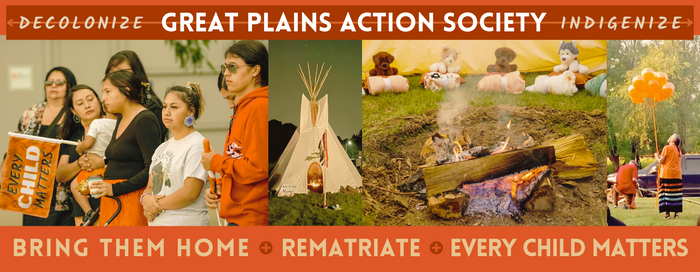
There is so much to say about the murdered Indigenous children and the support Great Plains Action Society is giving to the community and families affected. Please read below for more details about the event we hosted in Sioux City to welcome the return of nine children from Carlisle Indian Boarding School back to the Sicangu Oyate Nation (Rosebud Nation).

On July 15-16, we organized and hosted an event in Sioux City to welcome the return of nine children from Carlisle Indian Boarding School back to the Sicangu Oyate Nation (Rosebud Nation) as they passed through. We hosted a community meal and prayer on the 15th for 415 folks and served traditional foods. There were family members of the children in attendance and we were honored to offer them some support. In the evening the large caravan carrying the children arrived and we lit a fire in a tipi set up with nine seats, toys and blankets. This event was held at War Eagle Park in Sioux City Iowa, a place that local Natives are taking back. 

On the 16th, early in the morning, we saw the Caravan off with refreshments, a press conference and more prayer. We had over ten media sources provide coverage of our event, including the Des Moines RegisterAl Jazeera,  MPR NewsIndianz.com, and Keloland.com.

Great Plains Action Society spent over $4,000 to set up and host this one event, and there are more than 480 residential schools in the US and Canada that have not been searched. Our work has just begun.