Meeting for worship with attention to photography

Sometimes when people compliment a photo I’ve taken, I’ll say the Creator deserves the credit. Then they would often say I had a role in how the beauty was captured.

I usually wouldn’t say anything further, but there is much more to my relationship with the Spirit and photography.

Years ago I began to noticed I was having conversations with the Creator. ‘I love the majesty of these mountains’. ‘Wow, this is a beautiful flower you created’. ‘These mountains humble me’. ‘You know what I’m trying to do here. Could you help me out?’. I asked that last question often, because I intentionally challenge myself and the Spirit to capture difficult images.

There is a connection between the image, the camera, my eyes, the Spirit and the image. A full circle. The Spirit refining how the image is seen.

As I walk with my camera, my eyes scan from side to side, up and down. But very often my attention is drawn by a force beyond me, or within me. By the Spirit. Or Inner Light, which is an interesting juxtaposition with light and photography. I walk slowly, in silence, so I can hear where I should look. If there is a complex scene before me, I stop and wait. Usually, after some time, the image within the scene will emerge. These are sacred times. In some ways making me much more present in the moment. And in other ways taking me to a different space.

There is a connection between the image, the camera, my eyes, the Spirit and the image. A full circle. The Spirit refining how the image is seen.

Prior to digital photography I developed film negatives and printed photos in darkrooms, first as a student at Scattergood Friends School and then as yearbook staff at Earlham College. Doing darkroom work was very popular with the kids I worked with as part of the Friends Volunteer Service Mission in the early 1970’s. I can still see their expressions (via the orange darkroom light) as the images magically formed on the paper in the developer solution.

The process of developing the negatives and prints is technically challenging. And rolls of film would have room for a limited number of photos so you had to make each shot count.

Prior to the advent of digital photography I don’t believe there was automatic control of focus or exposure settings for shutter speed and lens aperture. I think some cameras had built in light meters.

Digital photography was revolutionary. Besides automating focus and exposure, you can actually preview how the photo will look. Eliminating the problems of the darkroom, and allowing as many images as the memory card could hold. Which could be erased and used over and over again. I like the sustainability that reuse represents. I was bothered by all the silver that was used to make the emulsion for photographic film.

The camera became an amazing teacher, giving me the freedom to take as many shots, with as many variations as I wanted. The last time I visited the mountains I wasn’t sure if I would return. So I took 1,093 photos during those four days, most of which you can see here: Colorado 2017.

Although I was raised on farms and had a deep connection with nature, being in the Rocky Mountains was spiritually transformative. Changed my life in many ways. I’m so blessed our family would often spend summer vacations camping in Rocky Mountain National Park, Colorado.

I felt closer to God when we were deep in the quiet of the forests or high on the mountainside. Having grown up in Quaker communities, I was used to worshiping in silence so we can hear the whisper of the Spirit. Being enveloped in the silence of the mountains was a natural relation to Quaker worship. Or as I think of this now, Quaker worship is a natural extension of the silence of the mountains. Silence in the sense of quiet, but at times loud with the voice of the Spirit.

Quakers often refer to our business meetings as meeting for worship with attention to business. Emphasizing the spiritual basis of what would be discussed. I began to think of the quiet I moved through with my camera, even in the city, as meeting for worship with attention to photography.

On those rare occasions when I didn’t have my camera with me I would still be recording images in my head. Once my good friend Diop Adisa and I were talking about photography. I was surprised to learn he also took mental photos when without a camera. We called that Zen photography. I remember how we laughed at those shared observations.

This is a photo I took of Long’s Peak in the early 1970’s. I printed it in the darkroom and kept it near me, a reminder of the mountains. Looking forward to returning.
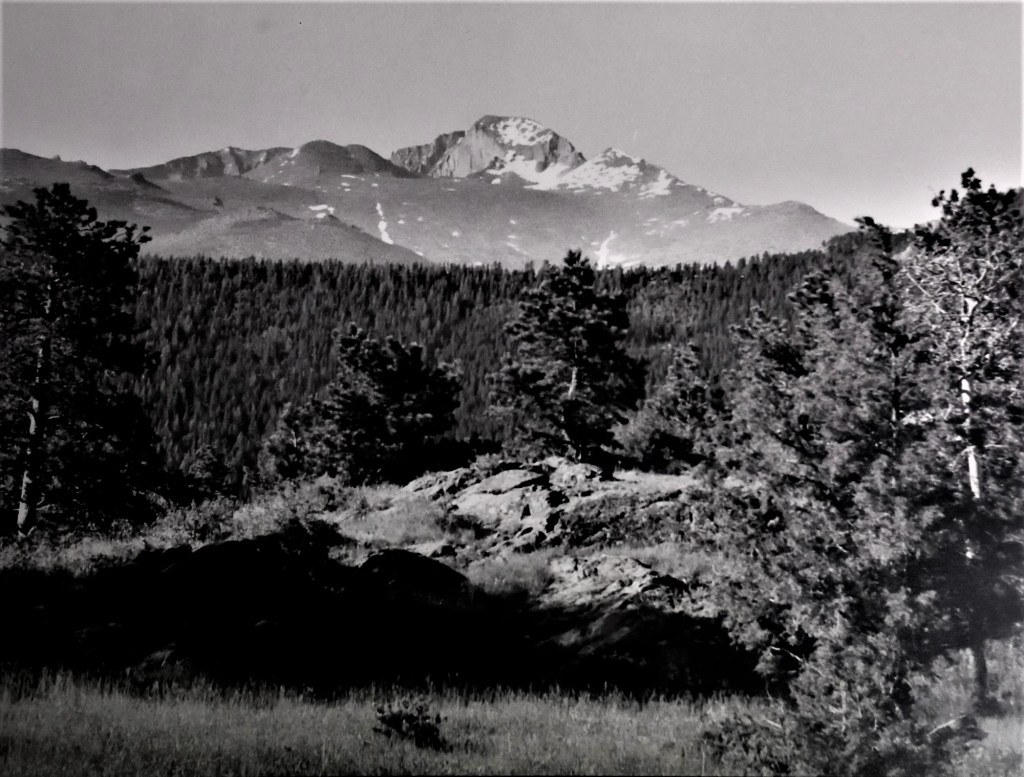
Long’s Peak, Rocky Mountain National Park, Colorado

When I moved to Indianapolis in 1971, I was just shocked by the clouds of noxious smog. That was before catalytic converters. I could not, and still can not understand how people could continue to drive when they were destroying our environment. Even today with “Code Red” reports on our environment people don’t make the connection to the years of fossil fuel emissions from automobiles. Or at least don’t feel a sense of accountability themselves. Can not conceive of life without a car. It is too late for that. I can not bear to hear the clamor to fix Mother Earth now, when what needed to be done decades ago was completely ignored.

I kept seeing an image of my beloved mountains obscured by smog. I would look at the photo above, and imagine not being able to see that in the future. That was incomprehensible and devastating, and led me to refuse to have a car for the rest of my life.

Although not having a car made many things more difficult there were many positive consequences. Besides turning me into an avid runner, for transportation and enjoyment, perhaps the most significant was related to my photography and the spiritual aspects of that.

I selected places where I lived to be within three miles of the hospital where I worked. Although when I first began running home from work I lived seven miles away. I’d either take a bus, or walk to work so a shower wouldn’t be needed. Then run home. Wearing scrubs at the hospital was great because I didn’t have to bring clothes that were bulky or needed not to be wrinkled. When I moved from one apartment to another, the criteria included being on a bus route and within walking distance of a grocery store and the hospital.

Running in the Indianapolis Mini Marathon which I did 23 years in a row

Walking or running outdoors everyday allowed me to look more closely and see the beauty around me. As I became more aware of my surroundings I began to take my camera with me every day. And not just when going to work. I had to start out earlier than usual to compensate for the time I spent looking for and taking photos. I lose track of time.

At first people would comment on the constant presence of my camera. But it wasn’t long before people would instead ask where my camera was if I did not have it with me.

I admired photographers like Ansel Adams, not only for their amazing images, but how they used their skill to try to make others see the importance of protecting these beautiful lands.

I never thought I’d see the vast destruction of nature from air, water and soil pollution. From oil pipeline construction and spills. Millions of acres laid to waste from mining tar sands. The intentional destruction of vast forests. The death of coral reefs. The removal of entire mountaintops! The severe, ongoing drought of the entire West. Devastating fires and violent storms. Fires in Rocky Mountain National Park. Experience temperatures from heat domes which are reaching the point of being not survivable.

Or witness my long ago nightmare of mountain beauty obscured. Now not by smog, but by the smoke from huge and ferocious wildfires hundreds of miles away.

I never thought my images might be records of the beauty of Mother Earth as it was before all this destruction. Beauty that will never be restored. Beauty of all kinds rapidly disappearing. I’ve written profusely about all these things. But I get the sense that my photos have more of an impact. Speaking for Mother Earth in ways words can not. Thinking perhaps I should just stop writing and capture and share images instead. Before more beauty disappears.


to save a wilderness… one must reach deep into one’s heart and find what is there, then speak it plainly and without shame.

Robert Leonard reid

How could we convince lawmakers to pass laws to protect wilderness? (Barry) Lopez argued that wilderness activists will never achieve the success they seek until they can go before a panel of legislators and testify that a certain river or butterfly or mountain or tree must be saved, not because of its economic importance, not because it has recreational or historical or scientific value, but because it is so beautiful.

I left the room a changed person, one who suddenly knew exactly what he wanted to do and how to do it. I had known that love is a powerful weapon, but until that moment I had not understood how to use it. What I learned on that long-ago evening, and what I have counted on ever since, is that to save a wilderness, or to be a writer or a cab driver or a homemaker—to live one’s life—one must reach deep into one’s heart and find what is there, then speak it plainly and without shame.

Reid, Robert Leonard. Because It Is So Beautiful: Unraveling the Mystique of the American West . Counterpoint. Kindle Edition

The eyes of the future are looking back at us

There is a native concept of considering what the effects of decisions made today will be on seven generations into the future.

The following quotation makes a two way connection between us and future generations. Looking at each other over the generations.

The eyes of the future are looking back at us and they are praying for us to see beyond our own time. They are kneeling with hands clasped that we might act with restraint, that we might leave room for the life that is destined to come. To protect what is wild is to protect what is gentle. Perhaps the wilderness we fear is the pause between our own heartbeats, the silent space that says we live only by grace. Wilderness lives by this same grace. Wild mercy is in our hands.

― Terry Tempest Williams, Refuge: An Unnatural History of Family and Place

Similarly, can we not look back at our ancestors? We are our ancestors’ future generation looking back.

I think about this a lot these days. As stories of the remains of native children on the grounds of the institutions of forced assimilation continue. Thousands of children never returned home.

I’ve been praying about what we are doing now that future generations will see as wrong. My Spirit recoils from the likelihood there probably will not be a seventh, or sixth, or fifth generation because of the accelerating rate of environmental collapse.

What have we done?

What will we do?

What kind of ancestor do you want to be?

In these increasingly troubled times I find myself thinking about the concept of sensemakingthe action or process of making sense of or giving meaning to something, especially new developments and experiences. 

It is increasingly difficult to make sense of all that is going on today. All the bad things I had anticipated for the future are suddenly happening now. And things I never imagined, like the assaults on truth and science, come at a time when they are desperately needed.

At the collective level, a loss of sensemaking erodes shared cultural and value structures and renders us incapable of generating the collective wisdom necessary to solve complex societal problems like those described above. When that happens the centre cannot hold.

Threats to sensemaking are manifold. Among the most readily observable sources are the excesses of identity politics, the rapid polarisation of the long-running culture war, the steep and widespread decline in trust in mainstream media and other public institutions, and the rise of mass disinformation technologies, e.g. fake news working in tandem with social media algorithms designed to hijack our limbic systems and erode our cognitive capacities. If these things can confound and divide us both within and between cultures, then we have little hope of generating the coherent dialogue, let alone the collective resolve, that is required to overcome the formidable global-scale problems converging before us.

Pontoon Archipelago or: How I Learned to Stop Worrying and Love Collapse. By James Allen, originally published by Medium
June 18, 2019

sensemaking the action or process of making sense of or giving meaning to something, especially new developments and experiences

Celebrants have an important part to play in the legacy humanity caries into the future. I suggest that our responsibility as ceremonialists, as humans who help other humans meaningfully connect with the web of life, is to find ways now to help people connect with the story of this world’s beauty, even as the world we love recedes. I believe there is a gift we can bring to our communities, to help people learn the art of losing. To help us all to meet the rising tides.

Celebrants & Ceremony in Response to Climate Grieving, Dina Stander, July 26, 2019

I believe faith communities and Indigenous ways need to play a crucial role in helping us move through the oncoming, increasingly severe chaos. Faith can provide sensemaking for those who have no framework for making sense of our broken systems.

People of faith can be celebrants. Indigenous peoples are celebrants, their cultures based upon a timeless connection to Mother Earth.

The problems before us are emergent phenomena with a life of their own, and the causes requiring treatment are obscure. They are what systems scientists call wicked problems: problems that harbour so many complex non-linear interdependencies that they not only seem impossible to understand and solve, but tend to resist our attempts to do so. For such wicked problems, our conventional toolkits — advocacy, activism, conscientious consumerism, and ballot casting — are grossly inadequate and their primary utility may be the self-soothing effect it has on the well-meaning souls who use them.

If we are to find a new kind of good life amid the catastrophes these myths have spawned, then we need to radically rethink the stories we tell ourselves. We need to dig deep into old stories and reveal their wisdom, as well as lovingly nurture the emergence of new stories into being.

Pontoon Archipelago or: How I Learned to Stop Worrying and Love Collapse. By James Allen, originally published by Medium
June 18, 2019

How do we rethink the stories we tell ourselves? We need to let go of the stories we have discovered to be untrue. Learn about, and embrace stories of other cultures. Seek, and really listen for, Spiritual guidance. Then actually implement that guidance.

One idea is to share stories from earlier times. “We need to dig deep into old stories and reveal their wisdom.” The Quaker Stories Project is an example. https://quakerstories.wordpress.com/

We need to re-think those stories. To consider what they say about our world today. To see if they represent something we have lost. Something it might be good to return to. The past leading into the future.

Seeking out new people and experiences are ways we can create new stories. For more than a year I have been learning new stories from my friends in the Mutual Aid community. We have been learning, together, how to live and work together in ways without a vertical hierarchy. Where decisions no longer come from leaders who try to wield power without consent. As my friend Ronnie James, who is my Mutual Aid mentor says:

I’m of the firm opinion that a system that was built by stolen bodies on stolen land for the benefit of a few is a system that is not repairable. It is operating as designed, and small changes (which are the result of huge efforts) to lessen the blow on those it was not designed for are merely half measures that can’t ever fully succeed.

So the question is now, where do we go from here? Do we continue to make incremental changes while the wealthy hoard more wealth and the climate crisis deepens, or do we do something drastic that has never been done before? Can we envision and create a world where a class war from above isn’t a reality anymore?”

Ronnie James

Our ancestors are ashamed of us, my friends. We are the people who disgraced the past, to create a myth called “the future.” That myth failed because there was no soul in it, no depth, no humanity. It was a vision of power, control, slavery, and violence, if we strip the gloss away

We’re Losing the Battle for the Future | by umair haque | Jul, 2021 | Eudaimonia and Co (eand.co)

It all comes down to what type of ancestor I want to be for my descendants. Do I want to be a regular nobody that did nothing to protect our planet or do I want to be like Crazy Horse who fought and died for the little bit of land that we have left to protect? We have that chance right now to make that decision. This kind of resistance runs through all of our blood because we are the Indigenous Peoples of these lands. It’s at vital choice for the survival of humankind.

What Kind of Ancestor Do you Want to Be? Why I Fight the KXL by TaSina Sapa Win, February 28, 2019

We’re Losing the Battle for the Future continued

Yesterday I wrote about umair haque’s article We’re Losing the Battle for the Future because I believe he accurately lays out where we are at this moment. And, more importantly, has some suggestions about what we can do. As does the excerpt below from the report of the Peace and Social Concerns Committee of Iowa Yearly Meeting (Conservative).

It’s true that the past was backwards. Our civilisation’s was. Slavery, empire, Inquisition. But there is a healthy respect, too, for a deeper past. The way that indigenous peoples have far more sophisticated ethical notions than ours, ones of interdependence with nature. Or the way that their societies were often far more consensual and nonviolent than ours, too.

We need to go back, probably, to go forward. The future isn’t a thing we can make with machines. Our mistake, our undoing. The future needs to carry forward what’s good in the past, what’s true, what’s beautiful, and keep on doing it. We didn’t do that. We gave up the old ways — the really old ones. The ones which would have said that taking a life, even a little one, without thanking it, without grieving for it, brings shame. Or the ones which would have been repelled and sickened in their souls by the idea of ripping down a forest or polluting an ocean.

Our ancestors are ashamed of us, my friends. We are the people who disgraced the past, to create a myth called “the future.” That myth failed because there was no soul in it, no depth, no humanity. It was a vision of power, control, slavery, and violence, if we strip the gloss away. Machines — or subhumans — doing the work we didn’t want to do, so we could gorge ourselves into oblivion, instead of grappling with the big, beautiful, dangerous questions of being alive, existing, feeling, being connected, here, now on a tiny ball of dust, spinning through the darkness. The meaning and purpose and truth and beauty of it all. What kind of creepy way of life is that? Is that even living much at all?

We’re Losing the Battle for the Future | by umair haque | Jul, 2021 | Eudaimonia and Co (eand.co)

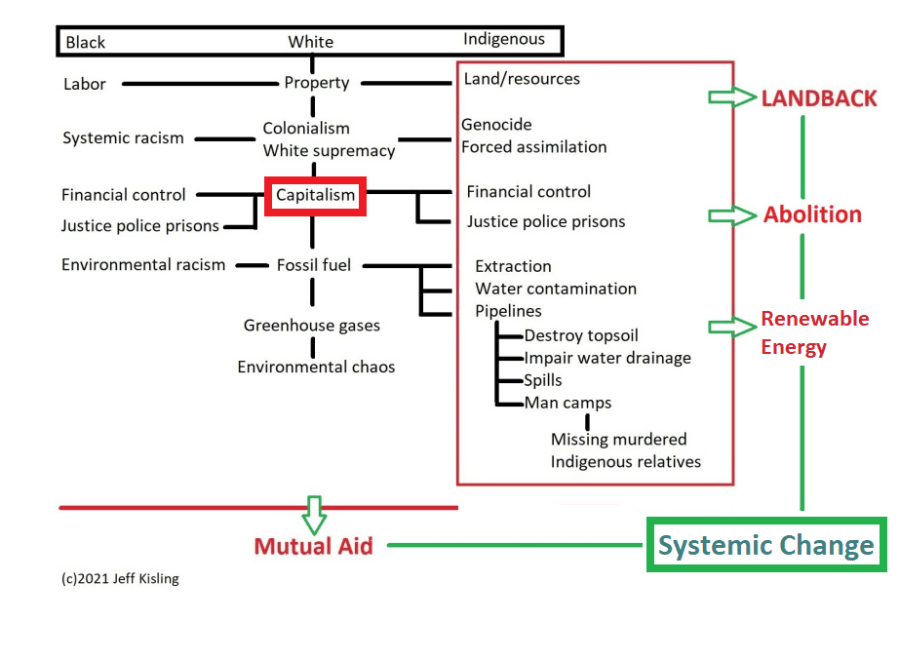
These injustices are some of the effects of systems of white supremacy. The concept of Mutual Aid is becoming an increasingly used model for communities working for justice. The idea is to have a horizontal hierarchy, where everyone has a voice. And work to ensure a vertical hierarchy does not develop. Without a vertical hierarchy, there can, by definition, be no superiority. Several of our meetings are supporting existing Mutual Aid communities or considering creating their own. These are opportunities to begin to disengage from the colonial capitalist system and white supremacy. Ways we can model justice in our own meetings and communities.

We can show up for Black Lives Matter and other racial justice events. We can support those who meet with local, state, and Federal government officials. We can show up in the streets to support agitation for change, train in nonviolent civil disobedience, or accompany arrested activists through the justice system.

We can show up, when appropriate, at events of Native peoples, such as the Prairie Awakening ceremony. We can share Indigenous news on social media platforms, so others are aware of these things.

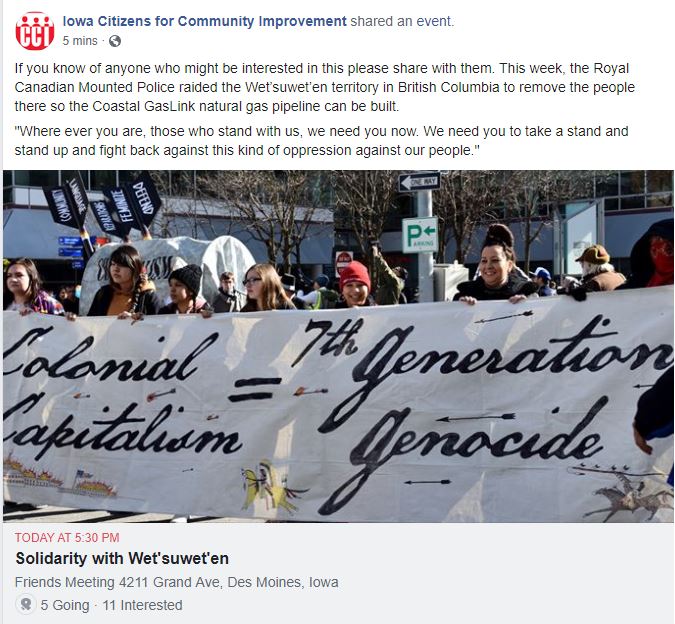
Indigenous leaders in the Midwest have asked us to learn about and find ways to engage in the concepts of Land Back. The website LANDBack Friends has been created and will be updated as our work continues.  https://landbackfriends.com/

Peace and Social Concerns, Iowa Yearly Meeting (Conservative) 2021

We’re Losing the Battle for the Future

Yesterday I shared the Story of umair haque and Eudaimonia. His recent article elucidates many of the concerns related to environmental disaster and climate refugees I’ve been writing about for a long time (so he must to be right ! )

The following is from the Peace and Social Concerns Committee of Iowa Yearly Meeting (Conservative) that was approved yesterday.

Global chaos from rapidly accelerating environmental devastation is highly likely to occur, breaking down our economic, social, and political systems. As air and water temperatures increase, water supplies are drying up. Widening areas and severity of drought are decreasing crop production and forcing people to flee. Rising oceans are creating more climate refugees. The trend of increasing numbers of more ferocious wildfires, hurricanes and other storms are expected to accelerate. All kinds of infrastructure will likely be destroyed, creating more climate refugees, many migrating to the Midwest. How can we prepare our own communities for these disasters, and plan for the arrival of climate refugees?

Peace and Social Concerns, Iowa Yearly Meeting (Conservative) 2021

So if the future isn’t “the future” — if the myth of constant growth, progress, and expansion, driven by miraculous labour-saving technology — anymore, then, well, what’s in store for us? The answer to that’s pretty simple. Regress is.

What does a world crossing the threshold of runaway global warming have in store for it? You might imagine that people will unite in some kind of grand, noble revolution to save the planet, but unfortunately, that’s not going to happen. Instead, the opposite is.

People will flee from Fire and Flood and Plague Belts. As they do, entire economies will begin to collapse, and societies implode. Think about a Napa Valley that can’t make wine. Factories that can’t produce things, homes which can’t be insured, basic infrastructure systems — transport, food, water, energy — which no longer work. Bang. Game over. Entire regions and cities just wink out. As they do, economies grow depressed, while prices skyrocket. If you have a sense that that’s beginning to happen already, you’re precisely correct.

As huge waves of “human capital flight” — read mass migration — ensue, the political result will be, sadly, that today’s nationalism becomes tomorrow’s fascism. Look at how fast Britain — once the envy of the world, gentle, kind, friendly, expansive — fell into a catastrophic nationalism that utterly wrecked its future. Depressed economies need scapegoats. Demagogues arise to point the finger at anyone remotely foreign, different, other. The future looks ultra-fascist, at least to those who’ve studied history.

Do you think any nation will be happy to welcome, say, a million climate refugees? When it’s own systems are already buckling, because the planet’s boiling? When it’s own regions are flooding or burning or both? Of course not. It’ll be fodder for demagogues, who’ll blame the migrants for the woes of the pure and true.

Meanwhile, living on a burning planet is going to continue basically driving much of the human race verifiably insane. Take a look at how fast and hard bizarre delusions spread. It’s not just Facebook — that’s just the mechanism. It’s that life is incredibly stressful, to the point that many of us can’t cope. We need the delusions, just to make through another day. Much easier to hate someone slightly different from you than work together to solve real problems. Much easier to descend into superstition and fanaticism and fundamentalism than think through the plight we’re in these days.

Faith in the future is one of the linchpins which held our civilisation together. The myths of technological progress, economic growth, and living standards rising in tandem forever — eternally — are what sold the thing known as “the global economy” to the world. Only now they appear to have been proven badly wrong. The people dismissed as “pessimists” and “alarmists” in the 70s and 80s and 90s — ecologists, climate scientists, economists — appear to have been exactly right.

We’re Losing the Battle for the Future | by umair haque | Jul, 2021 | Eudaimonia and Co (eand.co)

umair haque

For a long time I’ve admired the thinking and writing of umair haque. Recently he has written a series of articles about environmental chaos that provide insight to our unfolding catastrophe in ways I haven’t found elsewhere. This morning I decided to learn more about him and was surprised to find he established the website he articles appear on, Eudaimonia. He says, ” you can think of it as a lab, consultancy, thinktank — what it really is is an invitation.”

September 14, 2017, he published The Story. Life, the World, Now, You, and Me, that tells how he came to create Eudaimonia.

Hi. I’m Umair. I want to tell you a little story about life, death, meaning, purpose, happiness, you, me, the world, and why I founded Eudaimonia & Co.

A couple of years ago, right at the peak of it all, jetting around the globe, writing books, giving speeches, invulnerable as a rock, I got sick. Keeling-over-losing-fifty-pounds-in-a-month-sick. The doctors told me I had months to live. And after the heart-stopping panic subsided, a funny thing happened: I was happy, thinking and writing about the meaning of it all, in a way I’d never really been discussing economics, leadership, and society.

Dying young — or at least thinking you’re going to — is like climbing the Mount Everest of inner clarity. You think about life. Not in a mournful way. Maybe you haven’t lived enough for that yet. Just in an appreciative one. Life is a funny thing. Unique, singular, strange. Camus famously called it absurd. It’s the only thing in a lonely, clockwork universe that struggles. Rivers flow, clouds dissipate, oceans ebb. But only life undertakes an improbable, uncertain, difficult quest for self-realization. A tree stretches into the sun. A little bird builds a nest. You strive mightily all your days long for happiness, meaning, purpose, grace, defiance, rebellion, truth, knowledge, beauty, love. That quest is what makes life so strikingly different from dust, fire, mud, air.

The economic paradigm of human organization doesn’t care. About life. Yours, mine, our grandkids, our planet’s. In any of it’s three aspects: not it’s potential, nor it’s possibility, nor it’s reality — life a beautiful and universal quest for self-realization. It’s sole end is maximizing immediate income.

And that’s the hidden thread that connects today’s four Massive Existential Problems. Climate change happens when the planet’s well-being is used up to maximize immediate income. Stagnation happens when people’s well-being is used up to maximize immediate income. Inequality happens when a society’s well-being is used up to maximize immediate income. And extremism is a result of all that ripping yesterday’s stable and prosperous social contracts to shreds. Today’s great global problems are just surface manifestations of the same underlying breakdown — a badly, fatally, irreparably broken paradigm of human organization.

The paradigm is the problem. A solely, paradigmatically, one-dimensional economic approach to human organization. That old, rusting, busted, industrial-age, economic paradigm is what’s created the Massive Existential Threats the world faces today. The single-minded pursuit of maximizing short-term income (versus, for example, optimizing long-run well-being) is what’s ignited inequality, stagnation, climate change, and extremism — and the later problems that are likely to stem from them.

So. How can we begin crafting that better paradigm?

I call it moving from an economic paradigm to a eudaimonic paradigm of human organization. It has new ends for organizations: five new goals that elevate and expand life, versus blindly maximizing income. And it has new means: design principles with which to build organizations that can accomplish those ends. Together, those ends and means make up a little framework that I call “eudaimonics”. It’s meant to help us build organizations that are better at creating wealth, well-being, and human possibility, not just maximizing income, because life itself is the true measure of the success any and every organization, from a family to a company to a city to a country to the world itself.

So. A brief summary. Human organizations have become treadmills. But they should be gardens. In which lives flourish, grow, fruit, and flower. The great challenge of this age isn’t single-mindedly maximizing one-dimensional income as the sole end and purpose of human existence, but elevating and expanding life’s possibility. Whether mine, yours, our grandkids’ or our planet’s. That noble, beautiful, improbable quest for self-realization — eudaimonia — is the reason we’re all here, each and every one.

Remember me? There I was, happily dying. And then the fates did what fates do. Pulled the rug out from under me. I didn’t die. The old world did. And the new world isn’t yet born. We’re going to have to create it, give painful birth to it, drag it out of ourselves, kicking and screaming, with love and grace. Even those of us, like me, who thought they’d be content watching the sun set.

Hence, this little organization. You can think of it as a lab, consultancy, thinktank — what it really is is an invitation. So if you’d like to join me on this quest, consider all this yours.

The Story. Life, the World, Now, You, and Me by umair haque, Eudaimonia, Sept 14, 2017.

Jeff Kisling

#umairhaque