Truth and Healing Curriculum

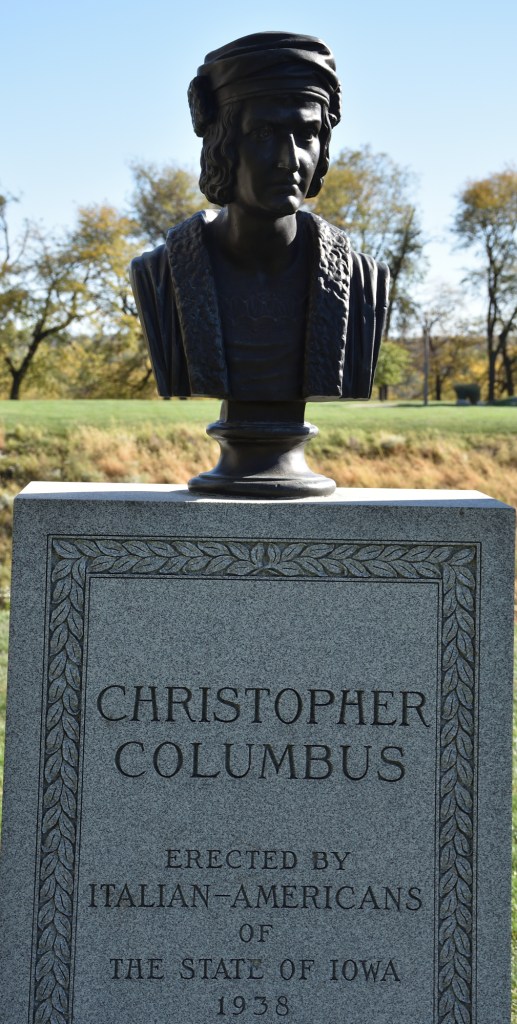
As the horror stories of the institutions of forced assimilation of Indigenous children continue to emerge, it is clear the erasure of this history almost succeeded. I remember being taught very little beyond Columbus ‘discovering America’, the colonial version of ‘Thanksgiving’, and not much related to the settler colonists and Indigenous peoples.

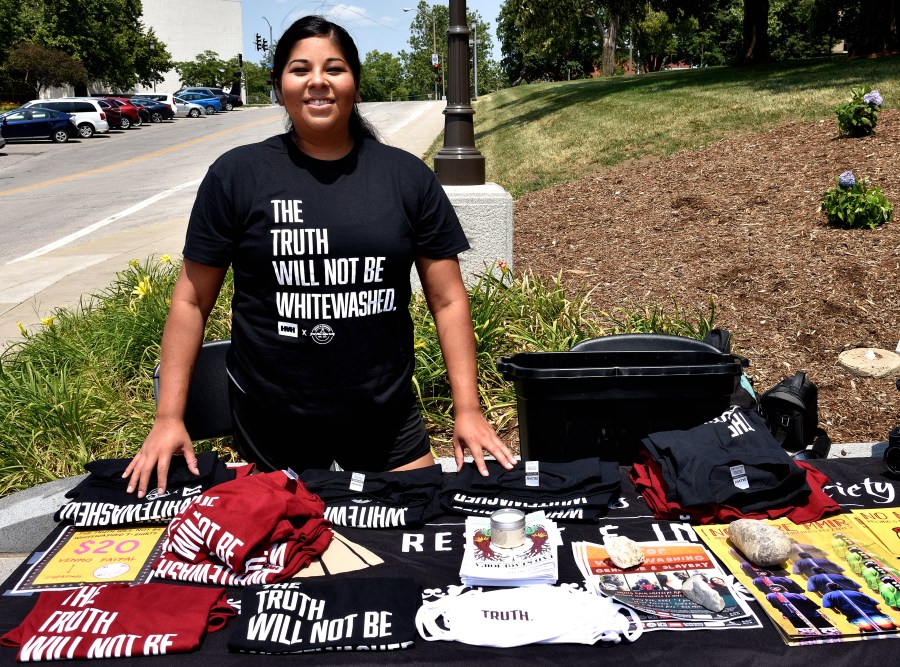
It is crucial for non-native people to learn this history, to know how this country developed, so we can all begin to heal. We can’t do that as long as we remain within the boundaries of whitewashed colonial stories. This is important for the context for dealing with rapidly evolving environmental chaos. Because a return to Indigenous practices and relationships with Mother Earth and all our relations is, I believe, the way to adapt to the coming collapse.

In the last blog post I wrote about sixth grader Alden Nobiss’ idea of having students teach each other about anti-racism and an accurate history of this country known as the United States.

Alden’s mother, Christine Nobiss (Sikowis) says, “he basically thinks that if teachers can’t teach critical race theory, then why can’t students do it? So that’s his idea. He thinks that students can teach each other in their spare time. During recess, during lunch time, and that’s something that he’s going to try to do. So, we have a book that he’s going to share called 500 Years After Columbus, which is a curriculum guide for teaching better indigenous studies for k-12. So, he’s already taking a look at that.”


It has been a long-running goal of many Native people to have more about their history and culture taught in grade schools. New requirements have been adopted in Connecticut, North Dakota and Oregon and advocates say their efforts have gained some momentum with the nation’s reckoning over racial injustice since the killing of George Floyd.

The legislation affecting schools has advanced alongside new bans on Native mascots for sports teams and states celebrating Indigenous Peoples Day in place of Christopher Columbus Day.

The push for curriculum requirements has not been without challenges, with some legislatures deeming new laws unnecessary because Native American history already is reflected in school curriculum. There also have been some steps in the opposite direction amid battles over how topics related to race and racism are taught in classrooms.

In South Dakota, a group of teachers and citizens charged with crafting new state social studies standards said last month that Gov. Kristi Noem’s administration deleted from their draft recommendations many elements intended to bolster students’ understanding of Native American history and culture. They said changes made to the draft gave it a political edge they had tried to avoid, aligning it instead with the Republican governor’s rhetoric on what she calls patriotic education.

Push for Indigenous Curriculum Makes Gains by Susan Haigh, Indian Country Today, Sept 15, 2021

Without the political will to ensure accountability and to guide implementation, what is observed rather in mainstream American education is the ongoing erasure of Indigenous people. Sam Torres

Only five states mentioned Indian boarding schools in their state content standards, which is “unimaginable,” said Sam Torres of The Native American Boarding School Healing Coalition. “It’s obviously a representation and reflection of what is being valued in educational and curricular context.”

As the United States federal government gears up to assess the genocide it perpetuated against Native communities for nearly a century, Native leaders and academics say there is one glaring method for accessing truth and healing: education.

Roughly fifty four percent of public schools across the United States make no mention of Native Americans in their K-12 curriculum, and 87 percent of state history standards don’t discuss Native American history after 1900, according to a study conducted in 2019.

For its part, NABSHC—an organization that has been at the helm of increasing public awareness on boarding schools since its founding nearly a decade ago—in 2020 released its first ever Truth and Healing Curriculum. The curriculum, available for free online, is made up of four lessons on Indian Boarding Schools focusing on history, impacts, stories, and healing.

“We were hearing a lot of feedback from community members asking for materials for their students,” Torres said. In developing the curriculum— sectioned into primary, middle and upper grades learning levels—Torres said he and staff members focused on the pillars that mimic a Native approach to collective education.

Other nonprofit institutions, such as The Ziibiwing Center of Anishinabe Culture & Lifeways in Michigan and the Heard Museum in Arizona have also developed their own supplemental Indian Boarding School curriculum. But without a state mandate on the specific curriculum, or enough educators aware of or comfortable enough with the content, the material reaches only a tiny fraction of students.

NABSHC’s Truth and Healing curriculum has been downloaded over one thousand times, Torres said, as the organization sets its sight on training educators in decolonizing knowledge. 

“Rigorous meaningful curricular materials have and continue to be developed by Native people,” Torres said. “Yet without the political will to ensure accountability and to guide implementation, what is observed rather in mainstream American education is the ongoing erasure of Indigenous people.”

The vast majority of Americans don’t learn about Indian boarding schools growing up. These Native leaders and educators want to change that by Jenna Kunze, Native New Online, Sept 13, 2021

The National Native American Boarding School Healing Coalition has developed a curriculum on U.S. Indian Boarding Schools for teachers and parents to use with their students and children.

The Truth and Healing Curriculum is comprised of four (4) robust lessons on Indian boarding schools covering History, Impacts, Stories, and Healing, and is appropriately sectioned into three (3) learning levels: primary, middle, and upper grades.

NABS understands that educational resources such as these are greatly needed for a variety of important reasons. As a response to requests from teachers and parents, we developed the Truth and Healing Curriculum to support distance learning during the COVID-19 pandemic.

Download a package that includes all curriculum.

Download Curriculum


even Quakers if you can believe that

even Quakers if you can believe that“. I heard this from an Indigenous friend during a presentation about institutions of forced assimilation. This is damning for us Quakers. A jarring dichotomy of being viewed as leaders in the work for peace and justice and yet to have participated, continue to participate in the cultural genocide of Native peoples. Cultural genocide and oppression continue today.

A great deal has been said about white people making the best of a bad situation when native lands and peoples were overwhelmed by the flood of white settler colonists moving across the land. Saying it was in the best interest of the native children to be educated about the white world. When instead this intentional cruelty was intended to break the resistance of Native peoples who did not want to give up their lands. And it was successful.

Unless there is documentation, or oral history, we don’t know what a given individual, perhaps one of our ancestors, might have done in these institutions. Additionally, there are so many ways we ourselves have failed our children and future generations. The extinction of millions of species will eventually include human beings.

But none of that excuses the idea that white people are somehow superior. That is diametrically opposed to the idea that there is that of God in every person and thing. A shameful legacy of oppression of black, Indigenous and other people of color (BIPOC) that continues.

My friend Sikowis and her cousin Janna Pratt gave a Zoom presentation about Native American Boarding School Violence & Whitewashed History as part of the Women’s International League for Peace and Freedom 34th Triennial Congress.

Janna Pratt and Sikowis Nobiss are cousins and both citizens of the George Gordon First Nation and will discuss the rape, torture, and murder of Indigenous children in Canada and the US due to boarding school / residential school policy in the US and Canada and the silence behind the Indigenous genocide on Turtle Island. Janna lives in Saskatchewan, Canada and Sikowis lives in Iowa, USA. They will also delve into the work they are doing to overcome historical trauma and combat the erasure of this crisis by white supremacist governments.

She (Sikowis )is also a speaker, writer, and artist and believes that environmental and social justice work are inextricably linked and change will only happen when we dismantle corrupt colonial-capitalist systems and rebuild them with a decolonized worldview.

With the recent discoveries of children who perished while attending Indian residential schools, her (Janna) sights are now set on finding the children. Janna is a 4th generation residential school survivor and has lived through the decimation of culture these schools forced upon children, built under a policy enforced by the Canadian government to inflict cultural genocide. Janna is currently working on an archive that will gather information on residential schools, Missing and Murdered Indigenous Peoples, and veteran information to build resources for Indigenous communities. She hopes to inspire other projects with this knowledge and create Indigenous virtual reality experiences that are accessible no matter the distance.

They made the connections between Native children violently removed from their families, many times never to return, to the current epidemic of violence against Native women, to Missing and murdered Indigenous relatives (MMIR). The forced removal of Native children continues to this day, by social service agencies.

One of the topics of the presentation was the silence behind the Indigenous genocide on Turtle Island. Will we break this silence?

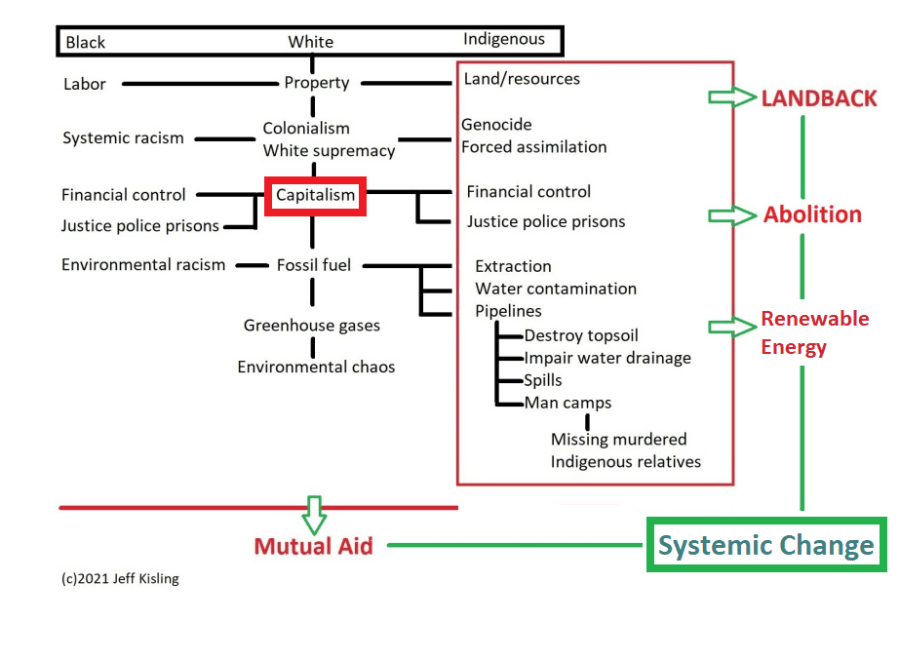
As Sikowis says, change will only happen when we dismantle corrupt colonial-capitalist systems and rebuild them with a decolonized worldview.

This means we must move away from the colonial capitalist system. Seriously! The concepts of LANDBACK are about how to do that. For the past several months I’ve been building the website LANDBACK Friends to help with education about these ideas. https://landbackfriends.com/

I hope you will join us, to find ways to break the silence behind Indigenous genocide.

https://landbackfriends.com/

One of the topics of the presentation was the silence behind the Indigenous genocide on Turtle Island. Will we break this silence?

Cultural erasure continues.

Before the South Dakota Department of Education released a draft of new social studies standards last week, department officials took out more than a dozen references to education on the Oceti Sakowin.

“Oceti Sakowin” refers collectively to the Lakota, Dakota and Nakota people who are indigenous to South Dakota and surrounding states.

Several of the standards on Oceti Sakowin were removed completely, including:

  • In kindergarten civics, discussing the meaning of kinship to the Oceti Sakowin Oyate.
  • In kindergarten geography, discussing the tribal nations of the Oceti Sakowin Oyate.
  • In first grade civics, identifying symbols of the Oceti Sakowin Oyate, including but not limited to star quilt, buffalo and medicine wheels.
  • In first grade geography, recognizing the nine contemporary reservations of the Oceti Sakowin Oyate on a South Dakota map.
  • In second grade civics, exploring the concepts of the Oceti Sakowin Oyate, including but not limited to tribal flags, celebrations (powwows), beadwork, dreamcatchers, music and artwork.
  • In second grade geography, identifying names and locations of Oceti Sakowin Oyate tribes within our communities and state.
  • In third grade civics, learning how to describe tribal organizational structures (council, chairman, etc.)
  • In third grade geography, researching the nine tribes in South Dakota
  • In fifth grade, standards for learning about tribal sovereignty in civics class and how natural resources and migration affected the lives and culture of the Oceti Sakowin were both removed completely.
  • In eighth grade history, examining major cultural traits and resiliency of the Oceti Sakowin Oyate throughout history
  • In eighth grade history, critiquing significant primary sources, including Oceti Sakowin Oyate treaties, and their impact on events of this time period.

In eighth grade civics, two grade-level standards on Indigenous topics were removed completely, including evaluating changing federal policy toward Indigenous Native Americans, and comparing and contrasting the structure of the U.S. government and sovereign tribal governments.

South Dakota DOE removed Indigenous topics from social studies standards before final draft by Morgan Matzen, Sioux Falls Argus Leader, August 10, 2021


Native American Boarding School Violence and Whitewashed History

I have been blessed to get to know and become friends with Sikowis (Christine Nobiss). Four years ago I heard her speak about building bridges with native peoples during Iowa Yearly Meeting (Conservative)’s annual sessions. In 2018 we walked and camped together for 94 miles, eight days, along the path of the Dakota Access pipeline in central Iowa. And have done many things together since.

Sikowis is a leading organizer on issues of Indigenous concern in the Midwest and nationally. This presentation will be an excellent opportunity to learn what she and Janna Pratt have to say about the atrocities of forced assimilation of native children.

wilpfus.org/34thcongress 11 am PDT

Sikowis (Christine Nobiss) is Plains Cree/Saulteaux of the George Gordon First Nation in Saskatchewan, Canada, and grew up in Winnipeg, Manitoba, Canada. At 19, she began her life’s work of uplifting Indigenous voices when she got her first job at the New Brunswick Aboriginal Peoples Council in Fredericton, Canada and now she is the Founder and Executive Director of Great Plains Action Society—a 100% Indigenous organization working towards climate and social justice. She is also a speaker, writer, and artist and believes that environmental and social justice work are inextricably linked and change will only happen when we dismantle corrupt colonial-capitalist systems and rebuild them with a decolonized worldview. Sikowis graduated from the University of Iowa with an MA in Religious Studies (with a focus on Native American Religion and Culture) and a Graduate Minor in American Indian Native Studies.

May be an image of 2 people and text that says 'WOMEN'SNTENTNAL LEAGUE FOR PEACE AND FREEDOM 34TH TRIENNIAL CONGRESS NATIVE AMERICAN BOARDING SCHOOL VIOLENCE & WHITEWASHED HISTORY Sikowis Nobiss George Gordon First Nation Great Plains Action Society Janna Pratt George Gordon First Nation MUSHOM Project SUNDAY, AUGUST 22 AT 11 AM PDT GO TO: WILPFUS.ORG/34THCONGRESS @GreatPlainsActionSociety MUSHOM Project'
wilpfus.org/34thcongress

Join Janna Pratt and Sikowis (Christine Nobiss) this Sunday, August 22 at 11 AM PDT for a presentation on Native American Bordering School Violence & Whitewashed History as part of the Women’s International LEAGUE for Peace and Freedom
34th Triennial Congress.

Janna Pratt and Sikowis Nobiss are cousins and both citizens of the George Gordon First Nation and will discuss the rape, torture, and murder of Indigenous children in Canada and the US due to boarding school / residential school policy in the US and Canada and the silence behind the Indigenous genocide on Turtle Island. Janna lives in Saskatchewan, Canada and Sikowis lives in Iowa, USA. They will also delve into the work they are doing to overcome historical trauma and combat the erasure of this crisis by white supremacist governments.

#everychildmatters
#WILPF
#greatplainsactionsociety
#MUSHOMproject

#everychildmatters
#WILPF
#greatplainsactionsociety
#MUSHOMproject

Ku Stevens’ Remembrance Run

Stories continue to emerge related to the remains of native children on the grounds of institutions of forced assimilation. Over 1,000 have been found on the grounds of several institutions in Canada so far. Searches are beginning in the land called the United States. Just last month nine children from the Carlisle boarding school in Pennsylvania were returned home. A number of my friends were involved in powerful ceremonies as the children’s’ caravan stopped in Sioux City, Iowa.

Following are stories related to forced assimilation and the Stewart Indian School in Nevada.

Stewart Indian School

First opened in 1890, Stewart Indian School was operated by the federal government for 90 years before it closed in 1980. Stewart and other boarding schools across the nation, were initially set up to forcefully educate Native American children in the late 1800s. This assimilation policy impacted thousands of Native students not only from the Great Basin tribal nations, but over 200 tribes over the school’s 90-year history.

Nevada Indian Commission

At the old (Stewart) school cemetery adjacent to the 240-acre campus, southwest of central Carson City, there are more than 170 marked graves. Those range in time from 1880, a year before the school existed, to the early 2000s. The marked gravesites include many with weathered, nearly-illegible headstones as well as easily-read marble markers and well-tended family plots. The wind-swept site on tribal land, protected by a fence and ringed with gnarled sagebrush, also encompasses an estimated 200 unmarked plots, whose occupants and dates of interment are a mystery.

Stewart Indian School’s 200 unmarked graves. ILLNESSES, ACCIDENTS AND EPIDEMICS TOOK THEIR TOLL ON NATIVE STUDENTS by Frank X. Mullen, Reno News and Review, August 15, 2021
Ku Stevens

When news broke of the mass graves found in Canada at residential schools earlier this year, one young cross country runner in Nevada thought of his own family.

Ku Stevens, Yerington Paiute Tribe, is 17, and a runner. His great grandfather Frank Quinn attended the Stewart Indian School in 1913. Quinn ran away three times.

He says he even felt his ancestors on his feet and he knows what he would say to his great grandfather if he was here today.

“Thanks for getting me this far because without him and the decisions he would have made to even run away from here, if he didn’t, I couldn’t possibly be here. Thanks for being a good man and wanting to be with your family and wanting to support them anyway you could. (Because) that’s family, you know, you would do anything for them,” Stevens said.

Retracing his ancestor’s boarding school escape. 17-year-old Ku Stevens honored his great-grandfather recently as part of a ‘Remembrance Run’ INDIAN COUNTRY TODAY, August 17, 2021

It’s about healing and bringing people together

Ku Stevens
Ku Stevens’ Remembrance Run

The discovery of hundreds of unmarked graves at tribal schools in Canada inspired a Native American teenager from Northern Nevada to recreate his great-grandfather’s escape from a similar school near Carson City.

Yerington Paiute tribal member Ku Stevens, one of the top prep cross-country runners in the state, plans to retrace the steps of his great-grandfather, Frank Quinn. He ran away from the Stewart Indian School three times, starting when he was 8.

Stevens had heard families stories about his great-grandfather his whole life but has grown to appreciate his courage.

“As of recently, I’ve kind of really understood the weight of what he had to do,” Stevens told State of Nevada, “and that’s why we’re trying to do this right now.”

The Yerington High School senior will honor his great-grandfather next month with a 50-mile run to bring awareness to the history of children being taken from families under a policy of forced assimilation of native peoples.

Teen Honors Great-Grandfather’s Escape From Tribal School by Bert Johnson, Nevada Public Radio, July 29, 2021
Ku Stevens, right, and his father Delmar Stevens, visit the Stewart Indian School in Carson City. The younger Stevens plans to run from the campus to Yerrington, recreating his great-grandfather’s efforts to escape the tribal school.

Thanks for getting me this far because without him and the decisions he would have made to even run away from here, if he didn’t, I couldn’t possibly be here. Thanks for being a good man and wanting to be with your family and wanting to support them anyway you could

Ku Stevens

Ku Stevens will not let history be forgotten.

Later this summer, the senior-to-be at Yerington High School plans to retrace his great-grandfather’s journey in escaping from the Stewart Indian School in Carson City.

He’s calling it: “The Remembrance Run.”

Stevens told the Reno Gazette Journal he was inspired earlier this year by the discovery of 215 children’s graves in Canada. The remains of the children were found on the grounds of the former Kamloops Indian Residential School.

The Stewart Indian School, which operated from about 1890 to 1980, was one of about 200 military-style boarding schools for native students nationwide.

Stevens’ great-grandfather, Frank Quinn, escaped from the Stewart Indian School and ran 50 miles when he was 8 years old to try to get back to his family home on the Yerington Paiute tribal reservation.

His route home went across the desert between Carson City and Yerington. He was returned to the school and escaped, again, three times in all.

Stevens’ great-grandmother Hazel, also a Paiute tribe member, was hidden by her family, who denied her existence when government officials came looking for her.

“It’s about remembering and education,” Stevens said. “Anybody can come out and run. It doesn’t matter what race you are. It’s about healing and bringing people together. It’s not just about remembering the segregation and the bad things of the past.”

Yerington teen to retrace escape from Stewart Indian School, Nevada Appeal, July 5, 2021
Stewart Indian School In Carson City To Be Included In Federal Probe

After nearly 1,000 unmarked graves were found at former Indian boarding schools in Canada, U.S. Interior Secretary Deb Haaland announced an initiative to study Indian schools here, including one just outside Carson City.

The former Stewart Indian School is now a state-run museum, but about half of the former campus, including its cemetery, was returned to the Washoe Tribe of Nevada and California. Officials with the Nevada Indian Commission announced earlier this month they were collecting information about the school so they would be ready to participate in the federal review.

Stacey Montooth, director of the commission, said the investigation is welcome but will touch a nerve in the state’s tribal community.

“To prepare for any questions that Secretary Haaland might have, I’ve met with elders and the burial committee from the Washoe Nation to try to get a sense of what they would like to see,” she said. “With permission from their leadership, I was able to go to the cemetery and we’re dealing with upwards of 200 unmarked graves.”

“The boarding schools were so impactful,” she told State of Nevada. “We had families that have never really ever been able to return to their traditional structure, nor have they been able to embrace modern-day America.”

Stewart Indian School In Carson City To Be Included In Federal Probe by Bert Johnson, Nevada Public Radio, July 14, 2021

The eyes of the future are looking back at us

There is a native concept of considering what the effects of decisions made today will be on seven generations into the future.

The following quotation makes a two way connection between us and future generations. Looking at each other over the generations.

The eyes of the future are looking back at us and they are praying for us to see beyond our own time. They are kneeling with hands clasped that we might act with restraint, that we might leave room for the life that is destined to come. To protect what is wild is to protect what is gentle. Perhaps the wilderness we fear is the pause between our own heartbeats, the silent space that says we live only by grace. Wilderness lives by this same grace. Wild mercy is in our hands.

― Terry Tempest Williams, Refuge: An Unnatural History of Family and Place

Similarly, can we not look back at our ancestors? We are our ancestors’ future generation looking back.

I think about this a lot these days. As stories of the remains of native children on the grounds of the institutions of forced assimilation continue. Thousands of children never returned home.

I’ve been praying about what we are doing now that future generations will see as wrong. My Spirit recoils from the likelihood there probably will not be a seventh, or sixth, or fifth generation because of the accelerating rate of environmental collapse.

What have we done?

What will we do?

Practicing Hope

Most white people in what is called North America were ignorant of the history of forced assimilation. But many are learning about it now, shocked to hear about the Native residential schools from news reports about the remains of hundreds of children on the grounds of those institutions. Are learning about the cultural genocide, the physical, emotional and sexual abuse and deaths that occurred there.

Yesterday I wrote about my struggle with guilt and blame regarding Quakers’ involvement with forced assimilation of Native children. As is often the case, I write to try to understand things better myself. And hope some of that might be useful to others. On this subject I sense many Friends share my feelings of guilt. I recognized I had a problem when I wrote we should not feel guilt about what happened in the past, that we didn’t do ourselves. And yet I felt guilty. I’m working on that.

When you are disciplined in hope, you can face these things because you have learned to put them in context, you have learned to swallow joy and grief together, and wait for peace.

Quinn Norton

I often sign messages “practicing hope” which relates to the following quotation. Hope is a mental discipline that helps you put things in context. While we should not feel guilt about the past, it is very important to face hard truths now. This takes time and attention. Cycles of failure and success. Waiting for peace.

People often mistake hope for a feeling, but it’s not. It’s a mental discipline, an attentional practice that you can learn. Like any such discipline, it’s work that takes time, which you fail at, succeed, improve, fail at again, and build over years inside yourself.

Hope isn’t just looking at the positive things in this world, or expecting the best. That’s a fragile kind of cheerfulness, something that breaks under the weight of a normal human life. To practice hope is to face hard truths, harder truths than you can face without the practice of hope. You can’t navigate dark places without a light, and hope is that light for humanity’s dark places. Hope lets you study environmental destruction, war, genocide, exploitative relations between peoples. It lets you look into the darkest parts of human history, and even the callous entropy of a universe hell bent on heat death no matter what we do. When you are disciplined in hope, you can face these things because you have learned to put them in context, you have learned to swallow joy and grief together, and wait for peace.

IT IS BITTER TEA THAT INVOLVES YOU SO: A SERMON ON HOPE by Quinn Norton, April 30, 2018
Standing Family 1900

Corrosive of the human spirit

I am broken, trying to make sense of Quakers’ involvement with the institutions of forced assimilation, the Native residential schools. In the news now because of the verification of the remains of hundreds, soon to be thousands, of children on the grounds of those institutions in both the US and Canada. Verified because Native peoples have known they were there, because thousands of children never returned home.

I can not imagine the trauma. The children forcibly removed from their families. The community not knowing if the children would ever return. Their future was stolen. Those who did return often no longer fit into the community. I only recently learned this intentional cruelty was meant to break the resistance of those Native peoples that did not want to give up their land.

I’ve read that we aren’t to feel guilt or blame for what happened in the past. But we are called to learn about the wrongs, learn the truth. Then begin to work for reconciliation and healing. Canada went through such a process, involving the government and the entire country, several years ago. Secretary of the Interior, Deb Haaland, has initiated a Federal investigation of forced assimilation in this country.

From our twenty‐first‐century vantage point, we know (or can learn) how Native people suffered and continue to suffer the consequences of actions that Friends committed 150 ago with the best of intentions. Can we hold those good intentions tenderly in one hand, and in the other hold the anguish, fear, loss, alienation, and despair borne by generations of Native Americans?

Native organizations are not asking us to judge our Quaker ancestors. They are asking, “Who are Friends today? Knowing what we know now, will Quakers join us in honest dialogue? Will they acknowledge the harm that was done? Will they seek ways to contribute toward healing processes that are desperately needed in Native communities?” These are my questions, too.

Quaker Indian Boarding Schools. Facing Our History and Ourselves by Paula Palmer, Friends Journal, October 1, 2016

Although I believe we should not feel guilt, I have not yet been able to to get past my own sense of that. My head and my heart are out of synch. For a time I’ve felt I needed to distance myself from my Quaker communities. I struggle to discern if this was a spiritual leading, or just an emotional reaction. I’m still not sure. I know I continue to feel guilt. And projected this same guilt toward Friends in general. I know that is wrong and am working hard, praying to find my out of this.

Unearthing the truth was necessary not only for the victims to heal, but for the perpetrators as well. Guilt, even unacknowledged guilt, has a negative effect on the guilty. One day it will come out in some form or another. We must be radical. We must go to the root, remove that which is festering, cleanse and cauterize, and then a new beginning is possible.

Forgiveness gives us the capacity to make a new start. That is the power, the rationale, of confession and forgiveness. It is to say, “I have fallen but I am not going to remain there. Please forgive me.” And forgiveness is the grace by which you enable the other person to get up, and get up with dignity, to begin anew. Not to forgive leads to bitterness and hatred, which, just like self-hatred and self-contempt, gnaw away at the vitals of one’s being. Whether hatred is projected out or projected in, it is always corrosive of the human spirit.

Truth and Reconciliation BY DESMOND TUTU, Greater Good Magazine, SEPTEMBER 1, 2004

If has been tremendously helpful to have become friends with Native people I began to know as we walked and camped together for 94 miles along the path of the Dakota Access pipeline in 2018. The main intention of that sacred journey was to create a community of native and non-native people who began to know and trust each other so we could work together. That intention was achieved.

And yet, in another way, I have more of a sense of the trauma of assimilation from seeing the terrible effects on my friends.

As Paula Palmer wrote above, “Will they [Quakers] seek ways to contribute toward healing processes that are desperately needed in Native communities?” These are my questions, too.

I need to deal with my guilt before I can contribute to the healing processes.

I am deeply grateful for the acceptance and generosity of my Des Moines Mutual Aid community, which includes Native people. That is helping me move away from this destructive guilt.

I have faith I will be led to a better place.

First Nation-Farmer Climate Unity March September 2018

Minute from Canadian Yearly Meeting (CYM) 2016

Truth and Reconciliation 16-08-30

At Yearly Meeting 2015 Friends approved Minute 2015.08.33 calling on individual
Friends to read the Report of the Truth and Reconciliation Commission (TRC) and the Calls to Action. The Minute asks Friends to listen expectantly to the Spirit for guidance on what steps they may be personally led to take. It also asks Monthly Meetings and Worship Groups to engage with the materials shared by the Indigenous Rights committee of Canadian Friends Service Committee (CFSC) and prayerfully consider what actions they may take in working for reconciliation in their communities. We committed to minute our progress for the year at this Yearly Meeting.

Much has happened since our last Yearly Meeting (2015):

• We now have a new federal government that has stated it accepts all of the TRC’s
Calls to Action and that it will implement the United Nations Declaration on the
Rights of Indigenous Peoples. This has changed the dynamic and the tone of public
discourse on Indigenous Peoples’ rights in Canada.

• CYM and CFSC jointly issued a Quaker Response in March 2016 to Call to Action
48, and we submitted this to the TRC. We affirmed in our statement that we have
“endorsed, celebrated and committed to implement the UN Declaration on the
Rights of Indigenous Peoples” as stated in previous minutes (2010.08.50,
2009.08.70). We received a warm reply from Justice Murray Sinclair, Chair of the
TRC, thanking us for our work. He particularly liked that we had committed to an
annual review of our progress.

• CYM and CFSC also collaborated with other faith bodies, some of which were
church parties to the Indian Residential Schools Settlement Agreement and some
of which were not, in issuing a joint ecumenical statement on Call to Action 48.
CFSC’s Indigenous Rights coordinator participated in drafting. This was a
worthwhile process in working to find common ground amongst faith bodies
regarding their role in the reconciliation process.

• CFSC’s Indigenous Rights committee educated Friends on such critical issues as
free, prior, and informed consent; genocide; and intergenerational trauma.

• Meetings and Worship Groups have visited nearby Indigenous communities;
organized discussion groups in partnership with local Indigenous Peoples; are
attending educational events such as workshops and film screenings; are learning
about and honouring Friends’ role as Treaty partners; and are placing the UN
Declaration in poster and booklet form in their Meetinghouses.

• Some individual Friends have been led to stand alongside Indigenous Peoples in
defending their traditional territories, including civil disobedience resulting in
arrest.

During the year, CFSC has explored the work of Reconciliation with many Meetings,
Worship Groups and Half Yearly Meetings. As Friends engage in the work of
reconciliation, we are committed to grounding our actions in our Spiritual practices,
particularly of speaking to that of the Creator in everyone. Let Friends first listen to the concerns of Indigenous Peoples. We know it is not sufficient to be well-intentioned and make assumptions about what is best for Indigenous Peoples without asking what it is they want and need. All actions require the guidance of the Indigenous Peoples involved and need to be done with respect, cooperation and ongoing consultation.


We, as Friends, also need to be open to being challenged in our assumptions about the many destructive facets of colonial legacies and continuing racist practices and policies that constitute Canada’s historical and contemporary realities. We acknowledge that part of our journey is to decolonize our own thinking and sit in the discomfort and pain of confronting where we need to deepen our understanding, bear witness, and transform our behaviour.


While Friends corporately have often been on the forefront of advocating for Indigenous Peoples’ human rights, it is now time to prioritize this work and take it to the next level. Friends recognize that reconciliation requires us to continue to learn, grow, and establish and nurture relationships with Indigenous partners. We are a Society of Friends, and friendship entails a relationship greater than simply understanding our colonial history.

As Friends, we commit to walking the path of friendship, following these instructive
words:

I think about what I want for my children and grandchildren. What I want
for them is to be loved and love other people in this country. Not to tolerate
them, not to go to our respective corners and stop hurting each other, but
to be wrapped up and engaged in each other’s lives.

Douglas White, Kwulasultun (Coast Salish name), Tliishin (Nuu-chah-nulth name), Director of the Centre for Pre-Confederation Treaties and Reconciliation (VIU), former Chief of Snuneymuxw First Nation

For Canada to grow and heal we must be active participants in a paradigm shift, moving from colonialism to a new reality based on respect for Indigenous Peoples’ Human Rights. We are reminded that we have CFSC’s Indigenous Rights committee to assist us and provide resources for this work.

We ask monthly meetings and worship groups:

• To continue to educate themselves, including children and youth, about the
doctrine of discovery, the ongoing effects of colonialism, the UN Declaration, residential schools and their legacy (including the TRC Report), the history of
the land on which they live, and reconciliation efforts.
• To formally acknowledge the traditional territories where their Meetings are
located and engage in processes of reflection on the meaning of this.
Acknowledgments can be accomplished through signage, statements during the
close of Meeting, and inclusion in information provided to any community
groups who use Meeting House space.
• To find out about current concerns of Indigenous Peoples from those
territories, including land appropriation or resource development, with which the
Meeting could be engaged.
• To investigate projects of cultural revitalization that Indigenous Peoples are
involved in and discern if there is an appropriate role (including funding) that
Friends can play.
• To uphold and support individual Friends involved with grassroots
Indigenous rights work and provide spiritual support to Friends led to this
work. This might include offering committees of care and approving minutes of
support.
• To report back annually through the Indigenous Rights committee of CFSC on
actions taken. We ask CFSC to collate such information in their CYM report.

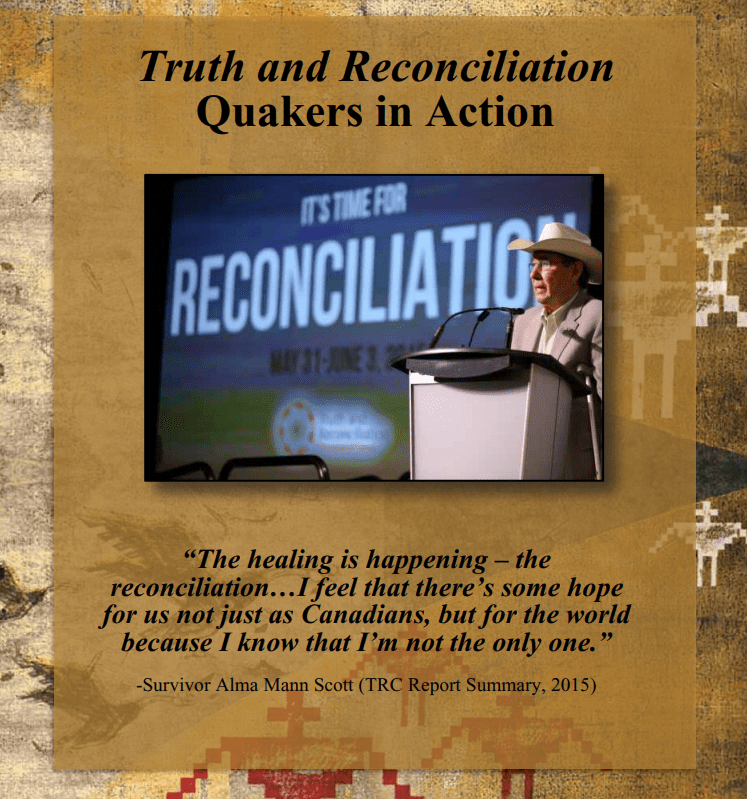
Minute from Canadian Yearly Meeting (CYM) 2016. Truth and Reconciliation 16-08-30 Truth and Reconciliation, Quakers in Action

https://quakerservice.ca/wp-content/uploads/2019/02/TRC-Resource-Book.pdf

Great Plains Action Society-Residential Schools

Hi Friend, 

Thank you for being a supporter of Great Plains Actions Society and all our work on behalf of the Indigenous and Native communities.

We recently supported our community through an awful tragedy that I will talk more about below. We need your help to keep fighting for our equality and basic human rights. Please consider donating $25, $50, $100 or whatever you can spare today here today: https://secure.actblue.com/donate/residentialschools

I want to talk to you about an issue that has been devastating and traumatizing our communities. It has affected us for hundreds of years, yet has only gained national traction recently. In both Canada and the United States, the churches and government have stolen and assimilated Indigenous children through residential schools. In these schools, children were neglected, raped, tortured and murdered. You can listen to me interview experts on my radio show, 8 O’Clock Buzz on Wort 89.9 FM here.

Recently, over 1,500 unmarked graves have been uncovered on the grounds of just eight residential schools in Canada. There were over 489 residential schools between the United States and Canada. The darkest part of this discovery, the graves that were uncovered were mostly children. The New York Times reported on this last month and while we are thankful for the coverage, it doesn’t nearly represent the pain and suffering this is causing our community. 


Great Plains Action Society has felt this pain firsthand and we are rising to meet the needs of our communities, whom we are already helping through the Missing and Murdered Indigenous Relatives crisis. We have been working to support families directly impacted by these residential schools through meals, community gatherings and covering ceremonial expenses. Great Plains Action Society is also continuing all of our other work, including mutual aid, political engagement action and environmental activism. We are dedicated to providing whatever our community needs to grow, survive, and thrive.

This is why we NEED your help. We can’t continue our work without support from people like you. Please consider donating $25, $50, $100 or whatever you can spare today. You can click here to give: https://secure.actblue.com/donate/residentialschools

Ay hai kitatamihin,

Sikowis (Fierce), aka, Christine Nobiss – She/Her They/Them

Plains Cree-Saulteaux, George Gordon First Nation

Founder and Decolonizer, Great Plains Action Society

sikowis@greatplainsaction.org

Web – greatplainsaction.org

FB – @GreatPlainsActionSociety

IG – @greatplainsactionsociety

Tw – @PlainsAction

There is so much to say about the murdered Indigenous children and the support Great Plains Action Society is giving to the community and families affected. Please read below for more details about the event we hosted in Sioux City to welcome the return of nine children from Carlisle Indian Boarding School back to the Sicangu Oyate Nation (Rosebud Nation).

On July 15-16, we organized and hosted an event in Sioux City to welcome the return of nine children from Carlisle Indian Boarding School back to the Sicangu Oyate Nation (Rosebud Nation) as they passed through. We hosted a community meal and prayer on the 15th for 415 folks and served traditional foods. There were family members of the children in attendance and we were honored to offer them some support. In the evening the large caravan carrying the children arrived and we lit a fire in a tipi set up with nine seats, toys and blankets. This event was held at War Eagle Park in Sioux City Iowa, a place that local Natives are taking back. 

On the 16th, early in the morning, we saw the Caravan off with refreshments, a press conference and more prayer. We had over ten media sources provide coverage of our event, including the Des Moines RegisterAl Jazeera,  MPR NewsIndianz.com, and Keloland.com.

Great Plains Action Society spent over $4,000 to set up and host this one event, and there are more than 480 residential schools in the US and Canada that have not been searched. Our work has just begun.

From Apology to Action

Truth and Reconciliation Commission – From Apology to Action
CFSC (Quakers) Indigenous Rights Icon Small

In 2007 the Truth and Reconciliation Commission of Canada (TRC) was established as part of the legal settlement of the largest class-action lawsuit in Canadian history. The TRC’s mandate was:

to learn the truth about what happened in the residential schools and to inform all Canadians about what happened in the schools. The Commission will document the truth of what happened by relying on records held by those who operated and funded the schools, testimony from officials of the institutions that operated the schools, and experiences reported by survivors, their families, communities and anyone personally affected by the residential school experience and its subsequent impacts.

In 2015 the TRC released its report including 94 Calls to Action which we urge all Canadians to read and strive towards in the ongoing process of reconciliation.

At Canadian Yearly Meeting in 2011 Canadian Friends approved this minute:

We are being invited by the Indigenous peoples of Canada as represented by the Indian Residential School Survivors, through the Indian Residential School Survivors Settlement Agreement, to enter a journey of truth finding and reconciliation. We encourage all Friends, in their Meetings for Worship and Monthly and Regional Meetings, boldly to accept this invitation and to engage locally, regionally and nationally, actively seeking ways to open ourselves to this process.

CFSC was honoured to witness and participate in the closing events of the Truth and Reconciliation Commission of Canada. Watch a clip from this powerful and important closing below:

We welcomed the report and Calls to Action of the TRC as deeply important for genuine reconciliation. Together with our partners we’ve also called on the Government of Canada to follow the lead of the Truth and Reconciliation Commission.

CFSC has produced a resource for Quakers and others who wish to engage with the TRC Calls to Action.

https://quakerservice.ca/TRCGuide
Truth and Reconciliation: Quakers in Action. (PDF)

We encourage you to make use of this resource and are happy to help, so feel free to contact us!