‘In the Name of God’


The first Washington Post article is an interactive presentation of their investigation into sexual abuse in Native American boarding schools.
‘In the Name of God’ by Sari Horwitz, Dana Hedgpeth, Emmanuel Martinez, Scott Higham and Salwan Georges, The Washington Post, May 29, 2024

https://www.washingtonpost.com/investigations/interactive/2024/sexual-abuse-native-american-boarding-schools/

The second is an interactive presentation of their investigation into the history of those boarding schools.
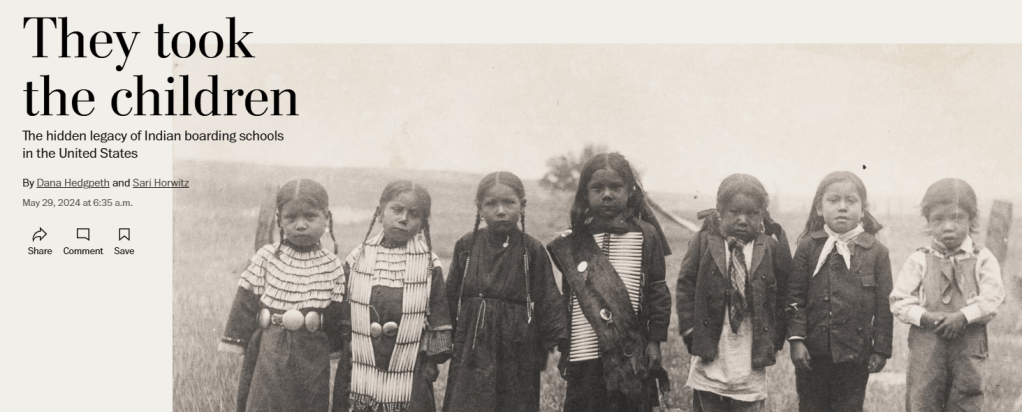
They took the children, The hidden legacy of Indian boarding schools in the United States by Dana Hedgpeth and Sari Horwitz, The Washington Post, May 29, 2024

https://www.washingtonpost.com/investigations/interactive/2024/american-indian-boarding-schools-history-legacy

The eyes of the future are looking back at us


There is a native concept of considering what the effects of decisions made today will be on seven generations into the future.

The following quotation makes a two-way connection between us and future generations. Looking at each other over the generations.

The eyes of the future are looking back at us and they are praying for us to see beyond our own time. They are kneeling with hands clasped that we might act with restraint, that we might leave room for the life that is destined to come. To protect what is wild is to protect what is gentle. Perhaps the wilderness we fear is the pause between our own heartbeats, the silent space that says we live only by grace. Wilderness lives by this same grace. Wild mercy is in our hands.

― Terry Tempest Williams, Refuge: An Unnatural History of Family and Place

Similarly, can we not look back at our ancestors? We are our ancestors’ future generation looking back.

I think about this a lot these days. As stories of the remains of native children on the grounds of the institutions of forced assimilation continue. Thousands of children never returned home.

I’ve been praying about what we are doing now and how much harm this is doing to future generations. My Spirit recoils from the likelihood there probably will not be a seventh, or sixth, or fifth generation because of the accelerating rate of environmental collapse.

What have we done?

What will we do?

As we work for change, we are admonished that we need to tell new stories. This morning I found this story Nico Santos tells, from the movie Dragon Rider.

“Wings”

Oh, I’ve been lost in the darkness
I heard your voice from afar
You weren’t my callin’
Whenever the night was starless
And I couldn’t see anymore
You showed me the mornin’

So I-I-I wanna let you know
When life has got you low

I’ll be your wings to fly
When there’s trouble on your mind
Whenever you’re ’bout to fall
There’s nothin’ I won’t try
‘Cause I’ll be your wings to fly
When you’re sufferin’ inside
Come hell or high water
Got you covered all my life
Let these wings take you
High, high
There’s nothin’ I won’t try

We built our own kinda fortress
Nothing can break us apart
Walls won’t be fallin’
These walls won’t be fallin’
I wouldn’t be if it wasn’t for you
I wouldn’t speak if it wasn’t the truth
You are my callin’
You are my callin’

So I-I-I wanna let you know
When life has got you low

I’ll be your wings to fly
When there’s trouble on your mind
Whenever you’re ’bout to fall
There’s nothin’ I won’t try
‘Cause I’ll be your wings to fly
When you’re sufferin’ inside
Come hell or high water
Got you covered all my life
Let these wings take you
High, high
There’s nothin’ I won’t try

You were my eyes, oh, when I couldn’t see
Were my voice, oh, when I couldn’t speak
Can I give it back to you?
Let me give it back to you
You were my legs, oh, when I couldn’t run
Were my heart when my own went numb
I’ll do what I have to do
Everything to get you through

I’ll be your wings to fly
When there’s trouble on your mind
Whenever you’re ’bout to fall
There’s nothin’ I won’t try
‘Cause I’ll be your wings to fly
When you’re sufferin’ inside
Come hell or high water
Got you covered all my life
Let these wings take you
High, high
There’s nothin’ I won’t try
Let these wings take you
High, high
There’s nothin’ I won’t try
Let these wings take you high

Nico Santos, WINGS from the movie Dragon Rider

More notes on Mutual Aid

I’ve been preparing for a discussion my Quaker meeting will have this weekend about Mutual Aid. At the end of this is a table of posts I’ve been writing to help me organize my thoughts. I am not satisfied with how this post has turned out, but these are notes, not a finished document.

Stepping back from the details, I’m reflecting on what I hope will happen as a result of this discussion. My hope is that we begin to use Mutual Aid to guide our work, both in our Quaker meeting and how we do our work in the community for peace and justice.

Mutual Aid requires a paradigm shift from a community of primarily White Quakers immersed in the capitalist economic system, white supremacy, settler colonialism and land theft, forced assimilation, foreign and domestic militarism, state sanctioned violence, punishment oriented criminal justice system, fossil fuel power, and whatever you call our political systems.

Wow!

The greatest obstacle will be to persuade Friends that we should stop participating in those systems. Although that is looking more attractive as these systems are rapidly collapsing now.

Capitalism is economic slavery. Capitalism has forced millions into poverty. Capitalism denies shelter, food, water, healthcare quality education, and the ability to build any wealth at all to millions of people.

There were White Quakers who were involved in the institution of slavery. Even those who did not claim ownership of enslaved men, women and children benefited economically. Continue to benefit.

I don’t think we have many years of civilization left. But I think a few years hence people will look back at this time in a similar way to how we look back on slavery.

Quakers also have their history of participation in the institutions of forced assimilation to atone for. This is a significant barrier between Friends and Indigenous peoples.

In December 2020, Ronnie James and I had the following email exchange:

RonnieI don’t know what you can do. The church is the church’s past, which is its future. It continues to see my people as obstacles in its endless conquest.
JeffI was not feeling worthy of participating in Mutual Aid but thanks to you, I’ve signup up again for this weekend.
RonnieYou’re a good relative Jeff. To be blunt, there is too much damage that the church profits from and needs to protect to have any future there.
JeffI am afraid you are right.
RonnieI wish you the best. I imagine its a hard struggle.

Mutual aid work is not easy. It means forming lasting commitments to doing hard work collaborating with people even when we have conflict. And facing the heart-wrenching realities of the systems we live under. It is also deeply satisfying work that transforms us from being exasperated passive observers of the shitstorm we’re living in to inspired builders of the new world we desperately crave.

Dr Stuart Jeanne Bramhall
DateBlog posts related to Mutual Aid discussion
Mutual Aid in the Midwest
12/31/2021A Call for Quakers to Embrace Mutual Aid
1/2/2022What I Don’t Know About Mutual Aid
1/3/2022Notes to Myself
1/4/2022Notes to Myself Continued
1/5/2022Spirituality and Mutual Aid

COP26 Not Nearly Enough

I’ve followed the work of Chase Iron Eyes and the Lakota People’s Law Project for years. He was involved in the Dakota Access pipeline struggle at Standing Rock, including begin arrested there. In the video below, he and his daughter, Tokata, talk about why everything discussed at COOP26 isn’t nearly enough.

As we near the end of COP26 — the United Nations’ most recent climate conference in Glasgow, Scotland — we have reason for concern. Because, while nations the world over have again come together to talk about addressing the climate emergency, activists — including a host of Indigenous People and organizations — are watching closely and sending a strong message from the frontlines: everything being discussed and promised at COP26 isn’t nearly enough. This past week, my daughter, Tokata, and I appeared on Christiane Amanpour’s show, broadcast on both PBS and CNN, to talk about COP26, our anti-pipeline stands, and the future of Indigenous and climate justice.

As Tokata’s friend, Greta Thunberg, put it in Glasgow, “It is not a secret that COP26 is a failure. It should be obvious that we cannot solve the crisis with the same methods that got us into it in the first place.”

I suspect you’ll agree with Greta, Tokata, and me when we say solving global warming isn’t going to be easy. It will demand sacrifices on the part of individuals and nations and a willingness to embrace a diversity of perspectives — from the latest climate science to the wisdom of Indigenous peoples. Our voices matter, because we have long practiced living in harmony with Unci Maka, our Grandmother Earth, and all the other species who inhabit her.

Chase Iron Eyes

In the video he says the human species is at a very vulnerable, but teachable moment. Our social contract is broken and requires social, economic, and racial justice. That solutions to our environmental crisis depend on Indigenous liberation. And yet, he is hopeful because Standing Rock raised global consciousness and once progress is made, there is no turning back.

There was an emotional part of the video, when Tokata was asked how she felt about the remains of native children being uncovered on the grounds of the institutions of forced assimilation. About learning of these atrocities while she is in school herself, a tool of the genocide of her people. She said she gives thanks for those children. And feeling she is carrying on their legacy.

The video ends with Chase talking about their work building bridges with non-Indigenous people. Let’s come together.

Truth and healing coalition

Yesterday at my Quaker meeting, Bear Creek Friends near Earlham, Iowa, we continued discussions related to Quakers and our relations with Native peoples generally, and those we know personally. There was deep sharing related to what we were learning about the institutions of forced assimilation. Like me, others indicated they had not understood the depths of the tragedies of forced assimilation. We have little specific information about the role of some of our ancestors. While it is not appropriate to share what was said without the permission of those present during the meeting’s discussion, I think it is important to state that we are engaged in the process of learning more, i.e. truth telling, and what we might do. There was discussion about healing.

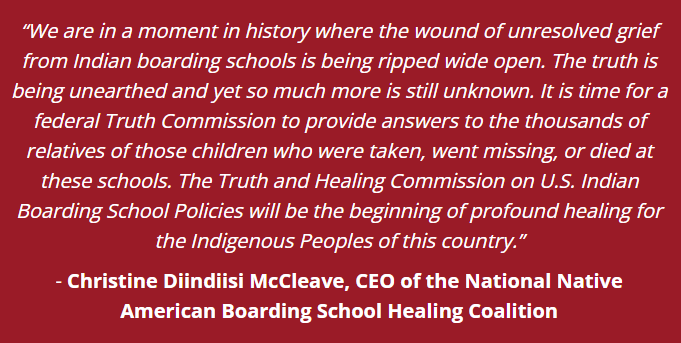
The National Native American Boarding School Healing Coalition (NABS) has many excellent resources. One of their excellent publications is Healing Voices Volume 1: A Primer on American Indian and Alaska Native Boarding Schools in the U.S.

NABS was formed in 2012, in part to advocate for the establishment of a federal commission on U.S. Indian Boarding Schools, similar to the Truth and Reconciliation Commission on Canada’s Residential Schools. For years, NABS has been part of a grassroots movement of Native academics, researchers, tribal leaders, and boarding school survivors and descendants who are seeking truth, justice, and healing. The work to introduce a congressional commission has been underway for almost a decade.

The announcement by U.S. Interior Secretary Debra Haaland of the Department of the Interior’s Federal Indian Boarding School Truth Initiative in June this year is an important first step in the federal government taking accountability for revealing the truth, but we believe a Congressional Commission is the most comprehensive approach to developing a complete picture of the ongoing impact Indian boarding schools have had on generations of American Indian, Alaska Native, and Native Hawaiian people. This is critical to providing a path toward healing for individuals, families and Tribal communities that have endured the devastating consequences of Indian boarding school policies.

TRUTH AND HEALING COMMISSION ON INDIAN BOARDING SCHOOL POLICIES IN THE U.S.

Here is a link a fact sheet related to the National Native American Boarding School Healing Coalition.

Why a Truth and Healing Commission

We have a right to know the truth of what happened in Indian boarding schools in the United States.

Over the course of a century, hundreds of thousands of our children were taken or coerced away from our families and Tribes and forced to attend government-sanctioned Indian boarding schools. These schools were tools of assimilation and cultural genocide, resulting in the loss of language and culture and the permanent separation of children from their families. To date, there has never been an accounting of:

  • the number of children forced to attend these schools;
  • the number of children who were abused, died, or went missing while at these schools; and
  • the long-term impacts on the children and the families of children forced to attend Indian boarding schools.
Key Provisions of the Bill
  • Examines the location of children
  • Documents ongoing impacts from boarding schools
  • Locates church and government records
  • Holds culturally-appropriate public hearings to collect testimony from survivors and descendants.
  • Institutional knowledge gathering from subject matter experts
  • Shares findings publicly
  • Provides a final report with a list of recommendations for justice and healing

TRUTH AND HEALING COMMISSION ON INDIAN BOARDING SCHOOL POLICIES IN THE U.S.

This is a link to articles on this website related to the institutions of forced assimilation. https://landbackfriends.com/forced-assimilation/

Spiritual basis of justice work

This morning my Quaker meeting will continue to discuss our work for peace and justice. In preparation, I’ve been praying about the spiritual basis of justice work.

Quakers have a long history of work related to Indigenous peoples, including participation in the institutions of forced assimilation (sometimes referred to as boarding or residential schools).

In the following, Paula Palmer writes about her spiritual leading that led to a ministry related to Quakers and Native peoples. She writes, “from our twenty-first-century vantage point, we know (or can learn) how Native people suffered and continue to suffer the consequences of actions that Friends committed 150 ago with the best of intentions. Can we hold those good intentions tenderly in one hand, and in the other hold the anguish, fear, loss, alienation, and despair borne by generations of Native Americans?”

What happened at those institutions is generating attention these days as the remains of thousands of children are being uncovered on the grounds of these institutions.

What I’ve been praying about for years is how Quakers could have become involved in those institutions? Not to judge what individual Friends might have done but wondering how the Spirit could have guided them to participate. This is a clear example of white supremacy and dominance. Those involved thought the Native children should be forced to learn the ways of the white society that was engulfing them.

This has led me to pray about:

  • How can Friends work spiritually toward truth and reconciliation?
  • What things might we be doing now that are not spiritually grounded?
  • How can we challenge and support each other to seek a spiritual basis for our work now?

As Paula Palmer writes, “who are Friends today? Knowing what we know now, will Quakers join us in honest dialogue? Will they acknowledge the harm that was done? Will they seek ways to contribute toward healing processes that are desperately needed in Native communities?”

Last year I responded to a call that came from two sources: from Spirit, in the manner of Friends experiencing leadings, and from a coalition of Native American organizations that is working to bring about healing for Native people who still carry wounds from the Indian boarding schools.

My leading started with a nudge four years ago and grew into a ministry called Toward Right Relationship with Native Peoples. This ministry has grown in depth and breadth under the loving care of the Boulder (Colo.) Meeting. Working in partnership with Native American educators, I learned about their efforts to bring healing to the Native people, families, and communities that continue to suffer illness, despair, suicide, violence, and many forms of dysfunction that they trace to the Indian boarding school experience.

The National Native American Boarding School Healing Coalition says that for healing to occur, the full truth about the boarding schools and the policy of forced assimilation must come to light in our country, as it has in Canada. The first step in a truth, reconciliation, and healing process, they say, is truth telling. A significant piece of the truth about the boarding schools is held by the Christian churches that collaborated with the federal government’s policy of forced assimilation. Quakers were among the strongest promoters of this policy and managed over 30 schools for Indian children, most of them boarding schools, during the nineteenth and early twentieth centuries. The coalition is urging the churches to research our roles during the boarding school era, contribute this research to the truth and reconciliation process, and ask ourselves what this history means to us today.

Native organizations are not asking us to judge our Quaker ancestors. They are asking, “Who are Friends today? Knowing what we know now, will Quakers join us in honest dialogue? Will they acknowledge the harm that was done? Will they seek ways to contribute toward healing processes that are desperately needed in Native communities?” These are my questions, too.

Quaker Indian Boarding Schools. Facing Our History and Ourselves by Paula Palmer, Friends Journal, Oct 1, 2016


The country known as Canada went through a year’s long process of truth and reconciliation. The document referenced below is about what was learned in that process. A similar process is beginning in the land called the United States.
See: https://landbackfriends.com/2021/10/26/native-american-legislative-update/


It is due to the courage and determination of former students—the Survivors of Canada’s residential school system—that the Truth and Reconciliation Commission of Canada (TRC) was established. They worked for decades to place the issue of the abusive treatment that students were subjected to at residential schools on the national agenda. Their perseverance led to the reaching of the historic Indian Residential Schools Settlement Agreement.
All Canadians must now demonstrate the same level of courage and determination,
as we commit to an ongoing process of reconciliation. By establishing a new and respectful relationship between Aboriginal and non-Aboriginal Canadians, we will restore what must be restored, repair what must be repaired, and return what must be returned.

What We Have Learned. Principles of Truth and Reconciliation. The Truth and Reconciliation Commission of Canada

Minute approved by Iowa Yearly Meeting (Conservative)

To this day we have not come to grips with fundamental injustices our country was built on, the cultural genocide and theft of land from Native Americans, the enslavement of African Americans and the legal justifications of bestowing rights and privileges on white land-owning men. The consequences of these injustices continue to plague our society today. And will continue to impact us until we do what is necessary to bring these injustices to light and find ways to heal these wounds.

Several Friends recently assisted Boulder Meeting Friend, Paula Palmer, to lead workshops and discussions as part of her ministry “toward right relationships with Native people.” Part of the tragedy of the theft of Native land is that some Native people don’t have the concept of land as property, belonging to a landowner. Rather they have a spiritual connection to Mother Earth, that the land is sacred and not something that can be claimed as property by anyone. Being forced to leave their land broke their spiritual bonds with the land.

Native people have asked us to begin work toward reconciliation and healing. The first step needed is truth telling, recognizing that injury or harm has taken place. One of the important parts of holding “right relationship” workshops is to determine which Native nations were on the land before white settlers arrived.

Iowa Yearly Meeting (Conservative) 2019

Continued erasure of Indigenous peoples

How can the atrocities of the Native residential institutions of forced assimilation, continue to be ignored by the mainstream media, governments, and the public? (These institutions should not be referred to as “schools”. )

How can faith communities, some of whom were involved with these institutions, not advocate to have the truth revealed, and work toward reconciliation?

Some of the following might be traumatic for those who have had experiences related to forced assimilation.

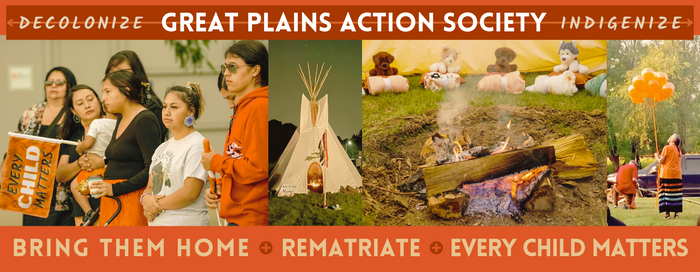
The Facebook group, Every Child Matters, documents the progress in locating the remains of children on the grounds of some of these institutions. And stories of those who have been affected. Searches continue in the lands called the United States and Canada.

https://www.facebook.com/groups/125050373031500/permalink/217155080487695/

A community to provide educational resources, generate awareness, share events and actions and work together to create a world our 7 generations yet to come can feel proud to be a part of.

“Every person will do their work in their own way as we move forward.

Some will take direct action and take action. That is important. Some will write policy. That is important. Some will do ceremony. That is important. Some will share stories. That is important. Some will build relationships and understanding. That is important. Some will teach. That is important. If we all do what we know how to do, with what we know, it will be good.

Everyone and everything has purpose. Keep your ears and minds and hearts open. Try to listen to each other without forming an opinion. Listen to things as information. You don’t have to agree with it. But you can validate it as someone’s experiences, feelings and ways of healing. ” 

Every Child Matters

As it says on that Facebook page, “Every person will do their work in their own way as we move forward… If we all do what we know how to do, with what we know, it will be good.”

Try to imagine how an Indigenous person feels as hundreds more remains of children continue to be uncovered. And seeing almost nothing is done to acknowledge that. To witness the continued erasure.

What work will we choose to do? The concept of truth and reconciliation begins with finding and sharing the truth. One thing I’ve been called to do is share what I’m learning on this website. https://landbackfriends.com/

Try to imagine how an Indigenous person feels as hundreds more remains of children continue to be uncovered. And seeing almost nothing is done to acknowledge that. To witness the continued erasure.

The following explains why orange is used as a theme for some of what is written and shared.

Both the National Day for Truth and Reconciliation and Orange Shirt Day take place on September 30.

Orange Shirt Day is an Indigenous-led grassroots commemorative day that honours the children who survived residential schools and remembers those who did not. This day relates to the experience of Phyllis Webstad, a Northern Secwepemc (Shuswap) from the Stswecem’c Xgat’tem First Nation, on her first day of school, where she arrived dressed in a new orange shirt, which was taken from her. It is now a symbol of the stripping away of culture, freedom and self-esteem experienced by Indigenous children over generations.

On September 30, we encourage all Canadians to wear orange to raise awareness of the very tragic legacy of residential schools, and to honour the thousands of Survivors.

National Day for Truth and Reconciliation

Canadian Residential School History

Earth’s Bloodstains

I awoke wondering how to bring more attention to the horrors of the institutions of forced assimilation in the lands called the United States and Canada. The atrocities hidden for many years are finally beginning to be exposed as the remains of THOUSANDS of children are being located on the grounds of those institutions.

Even as this history is beginning to show up on social media and websites there is continued silence from mainstream media. Although there is news about a story Anderson Cooper is working on for 60 Minutes (below).

Where is the outrage? As it is sometimes framed, there would be a radically different response if the remains were of white children. Instead, the ongoing silence is the continued erasure of Indigenous peoples.

What really happened and what is still happening today are not what are published in the mainstream media. If you desire truth, you will have to dig for it yourself.

Earth’s bloodstains

One way I discover websites related to my concerns is when I’m notified when one of my blog posts has been re-blogged. Which was how I learned about the website with the provocative title Earth’s Bloodstains that re-blogged my blog post “We don’t give up“.

Welcome … this site is about exposing our sanitized histories, revealing truth, uncovering earth’s carefully concealed blood stains, exposing the criminals, both past and present who continue to deprive their fellow human beings of the right to a decent existence on planet earth. After twelve years of researching our histories I can only conclude we have been fed layer upon layer of lies. What really happened & what is still happening today are not what are published in the mainstream media. If you desire truth, you will have to dig for it yourself.*

*Please note,  I don’t claim to speak for any group/s of people regarding their own histories. In order for those histories to be known however, I am simply publishing here, histories that have been recorded by non-mainstream indigenous/historians/authors/researchers that we weren’t told, including our own (Aotearoa / New Zealand). So conditioned was I to mainstream versions of history, it was not until I learned about the true history of our own Parihaka in the Taranaki that I woke up to the lies by omission. The official histories taught us in school, were frequently a layer of whitewash, as described by Dr Hirini Moko Mead, the final myth-making phase of colonization. For it is the victors who wrote our histories. I want to expose them. Please contact me if there is anything you know to be incorrect or if you can point me to histories I’ve missed. I am relying on published truth but am aware there are oral histories that likely aren’t in print. 

Earth’s Bloodstains

Exposing the lies of the powerful who mercilessly drive people off lands they’ve inhabited for centuries, who greedily shore up land for themselves alone, shutting out the people, all the while under the cover of ‘law’, a law they carefully craft themselves, for their own ends, and under the guise of ‘economic development’, ‘progress’, ‘civilization’, ‘sustainability’, the great lie that there is not room enough for all on planet earth, all this  in the name of greed, avarice and profit.

Remembering those who sought justice and found none, the many millions who are still being mercilessly slaughtered with swords, poison, fire, lynching, bombs, warfare, guns, drowning, starvation, enslavement, exile, torture, exposure and disease, suffering unspeakable agonies, driven from their homes, incarcerated, raped, abused and enslaved, shipped to the four corners of the earth, enduring trauma that will continue to haunt them and their descendants all their days, visiting the terror upon succeeding generations, driving them in their sadness to suicide, addiction and death even, far from the comfort of hearth and kin, the innocents whose only ‘crime’ was to require a share of the Creator’s earth to live on …

Earth’s Bloodstains


#LANDBACK

Evidence and faith

I find it increasingly difficult to make sense of what is going on today. All the terrible things I had anticipated for the future are suddenly happening now. And things I never imagined, like the assaults on truth and science, come at a time when they are desperately needed.

There are all kinds of ways to divide/categorize the American public: there’s the urban/rural divide, the differences between Republicans and Democrats, people who are college educated versus those who are not…One distinction that is rarely highlighted but incredibly important doesn’t even have a descriptive term–it’s the difference between people who recognize and respect evidence and those who don’t.

Think of it as the difference between people who accept the Enlightenment emphasis on empirical reality and those who are “faith-based.” Being faith-based, at least as I am using the term, doesn’t necessarily mean “religious.” It means preferring an ideological commitment–something taken on faith– to demonstrable reality, and a number of people–many of them highly educated–fall into that category.

There’s nothing wrong with theory, but it’s a framework for empirical exploration, not a substitute. In the end, real world evidence is what matters.

Prize for Evidence, Sheila Kennedy, 10/17/2021

One of the first lessons I learned as I began my career in medical research, was to make sure I wasn’t trying to make evidence fit into my preconception of what the results should be. And I was impressed to discover further research sometimes made sense of a piece of the puzzle we discovered previously that had not fit my expectations.

Or new data might provide further evidence that my preconceptions were wrong. That strengthened my faith, that there is much beyond what we think we know. Mysteries to unravel.

Kennedy states faith-based, as she is using the term, “means preferring an ideological commitment–something taken on faith– to demonstrable reality.” A choice to hold onto beliefs even when the evidence refutes those beliefs.

The question is whether it is possible to continue to believe something when evidence shows that to be false? My answer is no, because I believe the framework of science, a system of verifiable evidence, is part of creation.

But others profess to believe the opposite. People who are told to not believe what they see. Which leaves them open to being manipulated. And not open to persuasion, even when shown evidence contradicting their belief.

It has been common in western thought, from ancient times up until the present, to view reality as divided between an ideal world of spirituality and perfectedness, and a counterpart world of material and practical reality which is fallen and corrupted. This concept began with Plato and was given a theological overlay by Christianity.  It invites the idea that truth and beauty are attractive but insubstantial, and that they are impossible of realization, while the demands of practical reality inevitably require various violent and ugly compromises, and radical departures from ideal concepts of purity and goodness.

Quaker spirituality, as well as other minority streams of Christian mysticism, and most eastern spiritualities, reject this dualistic view of reality.  They affirm a true understanding of our situation, which is that the mundane and the divine are one.  What so many mistakenly see as realms separate and apart are, in truth, so interdependent that one cannot be understood, or even spoken of, without the other.

Peace or Justice: Which Has Precedence? A Quaker Perspective on the Papal Encyclical Letter Pacem in Terris Issued by Pope John XXIII on April 11, 1963
By Daniel A. Seeger

To me, faith-based includes truth supported by evidence in science. But it also includes beliefs that are part of a spiritual framework. There is so much in our world that cannot be proven with scientific evidence.

I was raised and continue to be part of a faith community, the Religious Society of Friends, or Quakers. I attend Sunday meetings for worship, where we sit together in silence, trying to hear what God, or the spirit, or the Creator, or Inner Light is saying to us. Sometimes someone discerns a spiritual message they share with the meeting, speaking out of the silence. We believe the Spirit continues to be active in the world, in our lives, today.


These days, as remains of thousands of children who attended the Native residential schools continue to be located, the question is how this could happen? Especially since those institutions of forced assimilation were run by various religious groups, including Quakers.

I don’t know. Such a terrible history does make me question what I thought I was being led, by the Spirit, to do, that might be causing harm today. I’m praying to be shown what I might do now related to this tragedy.


We fight for our children

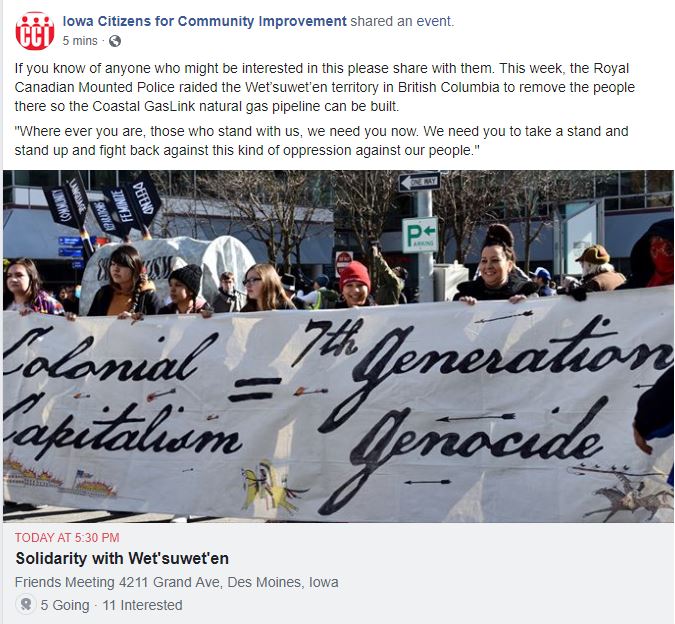
I avoid too many quotations and media from other sources in these blog posts. But there are stories that need to be told by those most affected, those doing the work for truth and justice. The stories here are by and about the Wet’suwet’en peoples who have been working for years to protect their lands in British Columbia from the Coastal GasLink pipeline. Who continue to face harassment and arrest by the Royal Canadian Mounted Police.

This is a clear example of the struggle for LANDBACK. “Many did not return and those who survived have fought for our right to all that we had been robbed of – land, language, culture, pride.

I wrote this case study to give an example of the implementation of the ideas related to LANDBACK. This is a link to the PDF version of the LANDBACK case study, Wet’suwet’en and Quakers.

A healing center has been built. And in the last few days the newest addition of homes in Lhudis Bin yintah is now set up at the drill pad site near Wedzin Kwa. (Video below).

We Fight for Our Children
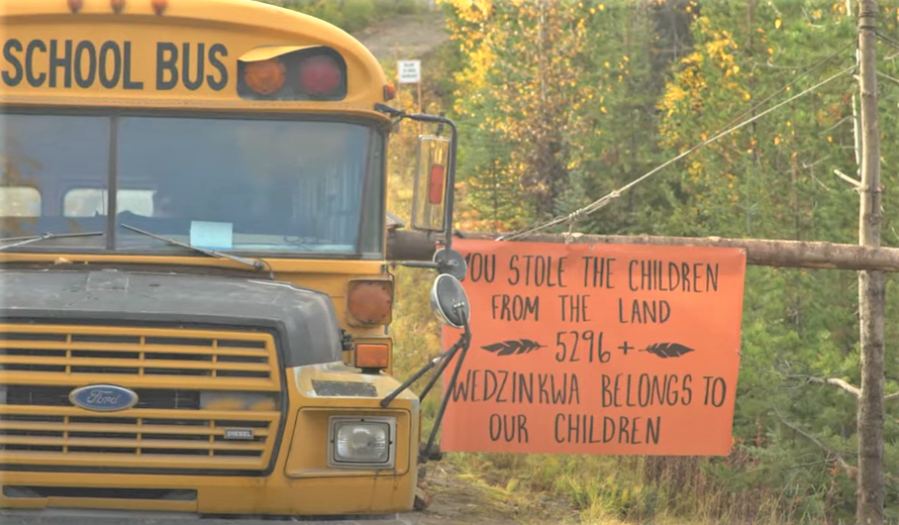
Wedzin Kwa belongs to our children.
For over 50 years, Wet’suwet’en children were taken from the land, from their families, and from Wedzin Kwa to attend residential schools. These “schools” were not to empower us, but to take the Indian, to take the Wet’suwet’en, out of the child. Many did not return and those who survived have fought for our right to all that we had been robbed of – land, language, culture, pride. Today, we continue to face state violence from governments and industry who still want our land to themselves. Their plans to eradicate us however, have failed and we are still here!
Every day we remember. We carry that pain, that strength, and we work to rebuild our pride, to rebuild our nations and reconnect with our lands.
On September 30th, we came together in a day of remembrance to honour the children, to remind ourselves that we will never give up/be defeated.

Many did not return and those who survived have fought for our right to all that we had been robbed of – land, language, culture, pride.

“I’ve always said there are two types of people on Sept. 30,” said Métis NDP MP Blake Desjarlais. “Those who’ve been robbed of their children, their culture, their language, and those who’ve been robbed of the truth. Sometimes you’re both.

“We can’t truly have reconciliation until we have that truth,” he said.

The National Day for Truth and Reconciliation coincides with Orange Shirt Day, which honours the story of Phyllis Webstad, a young girl whose new orange shirt was stripped from her on her first day at St. Joseph’s Residential School in 1973. On Sept. 30, 2013, Webstad spoke publicly about her experience, and Orange Shirt Day was born.

The federal statutory holiday was established after ground-penetrating radar uncovered the remains of 215 children at the former Kamloops Indian Residential School, confirming what Indigenous people have known for decades.

“The amount of pain in the Indigenous community is massive, we’re only scratching the surface,” said Desjarlais, the newly elected MP for Edmonton-Greisbach and the first two-spirit person to sit in the House of Commons.

We can’t truly have reconciliation until we have that truth By Natasha Bulowski, National Observer, October 4th, 2021