New Year 2022

I’m concerned to see little progress toward solutions for the myriad of problems we face. Especially with accelerating environmental chaos. We’re paralyzed in the face of so many complex problems. Disheartened because nothing makes progress.

I contend that is because, as Albert Einstein said, “we cannot solve our problems with the same thinking we used when we created them.”

I am proposing we implement new ways to approach our justice work. And will ask our peace and social concerns committee to explore how to change our work from a committee structure to a Mutual Aid group. I’m interested to see how faith can be part of Mutual Aid.

This year’s Peace and Social Concerns Committee Report from my Quaker yearly meeting is included below. And this is a link to An Epistle to Friends Regarding Community, Mutual Aid and LANDBACK.

This diagram lists problems and solutions. LANDBACK, Abolition of police and prisons, Mutual Aid, resource conservation and spirituality. Adapted from the more detailed diagram at the end of this.


Peace and Social Concerns Committee Report 2021
Iowa Yearly Meeting (Conservative)

This has been a year of great upheaval locally, nationally, and globally. The work of our
monthly meetings has been impacted by the COVID-19 pandemic. Yet we have found
ways to continue our peace and justice work. And had more time for prayer and
reflection.

Global chaos from rapidly accelerating environmental devastation is highly likely to
occur, breaking down our economic, social, and political systems. As air and water
temperatures increase, water supplies are drying up. Widening areas and severity of
drought are decreasing crop production and forcing people to flee. Rising oceans are
creating more climate refugees. The trend of increasing numbers of more ferocious
wildfires, hurricanes and other storms are expected to accelerate. All kinds of
infrastructure will likely be destroyed, creating more climate refugees, many migrating to
the Midwest. How can we prepare our own communities for these disasters, and plan
for the arrival of climate refugees?

Justice work by White Friends has changed in recent years. An important concept of
justice work is to follow the leadership of oppressed communities, who are working
tirelessly for their liberation. Those who consider themselves White Friends are learning
how to step back. Be supporters and allies.

Many injustices today trace their roots to the arrival of white Europeans on this
continent. These include a whole history of enslavement as well as genocide of
Indigenous peoples. It is important for white Quakers to know we are not expected to
feel guilt or blame for injustices that occurred in the past. But knowing what we know
now, it is up to us to learn more about those wrongs, and work toward repair and
healing. This will be a primary focus of this committee’s work in the coming year.

As a society we have been forced to face systemic racism. For example, public murders
by police have generated sustained protests regarding police brutality, with calls to limit
police powers and change or abolish prisons.

Also dating back to the arrival of white Europeans is the genocide of Indigenous
peoples. The theft of Native lands. And the atrocities of Native children taken from their
families to institutions of forced assimilation, often far away. Places where attempts
were made to the erase their culture. Many subjected to physical or sexual abuse.
Thousands of Native children died. This intentional cruelty broke the resistance of
Native peoples who were trying to hold onto their lands.

The recent validation of the remains of Native children on the grounds of those
institutions is having devastating effects in Native communities and those who care
about them. Searching the grounds of the institutions in this country is about to begin.
Secretary of the Interior, Deb Haaland, has launched a federal investigation into these
institutions of forced assimilation in the US,

A number of Catholic churches, who ran those institutions in Canada, have been
burned or vandalized.

There are renewed calls for truth and reconciliation. Canadian Yearly Meeting has done a
great deal of work on this.

These injustices are some of the effects of systems of white supremacy. The concept of
Mutual Aid is becoming an increasingly used model for communities working for justice.
The idea is to have a horizontal hierarchy, where everyone has a voice. And work to
ensure a vertical hierarchy does not develop. Without a vertical hierarchy, there can, by
definition, be no superiority. Several of our meetings are supporting existing Mutual Aid
communities or considering creating their own. These are opportunities to begin to
disengage from the colonial capitalist system and white supremacy. Ways we can model
justice in our own meetings and communities.

We can show up for Black Lives Matter and other racial justice events. We can support
those who meet with local, state, and Federal government officials. We can show up in
the streets to support agitation for change, train in nonviolent civil disobedience, or
accompany arrested activists through the justice system.

We can show up, when appropriate, at events of Native peoples, such as the Prairie
Awakening ceremony. We can share Indigenous news on social media platforms, so
others are aware of these things.

Indigenous leaders in the Midwest have asked us to learn about and find ways to
engage in the concepts of Land Back. The website LANDBack Friends has been
created and will be updated as our work continues. https://landbackfriends.com/
We pray for guidance for how our committee might work together at the intersection of
our responsibilities and those of Ministry and Counsel.

We will continue to seek spiritual guidance, both for what we are called to do, and ways
to offer spiritual support for those who are not Friends. There is great spiritual poverty in
many communities. Spiritual support will be needed by those who suffer the
consequences of environmental and other disasters. And those responding to these
disasters.

It is important to understand this work depends on us all working together, in the
community. Outside our meetinghouses. Developing friendships in the local community.
We encourage more engagement with our youth. They can teach us about justice. We
and our meetings will be revitalized.

Many monthly meetings are adapting to these changing ways of doing peace and
justice work. Building relationships with communities of black, Indigenous, and other
people of color. Exploring ways to be in right relationship with these communities. All of
us learning from each other. Sharing our stories. Deepening spiritual connections.

Peace and Social Concerns Committee 2021
Iowa Yearly Meeting (Conservative)


An Epistle to Friends Regarding Community, Mutual Aid and LANDBACK


National Day for Truth and Reconciliation

The first National Day for Truth and Reconciliation in Canada will be September 30. A schedule of events can be found here.

With the attention on the deaths of children in the native residential schools in the land called the United States, we are learning more about these atrocities here. Secretary of the Interior, Deb Haaland, has initiated an investigation of the institutions of forced assimilation in the U.S.

Canada went through an eight-year process to learn what happened in the residential schools there, the Truth and Reconciliation Commission of Canada (TRC). Quakers of the Canadian Yearly Meeting have been very involved in that process and ongoing work for reconciliation.

In 2007 the Truth and Reconciliation Commission of Canada (TRC) was established “to learn the truth about what happened in the residential schools and to inform all Canadians about what happened in the schools.”

In 2015 the Truth and Reconciliation Commission released its Final Report and 94 Calls to Action. TRC Chief Commissioner Murray Sinclair said, “We have described for you a mountain, we have shown you the path to the top. We call upon you to do the climbing.”

In 2011, Canadian Yearly Meeting, the national body of Canadian Quakers, had called on Quakers to actively engage in reconciliation efforts:

We are being invited by the Indigenous peoples of Canada as represented by the Indian Residential School Survivors, through the Indian Residential School Survivors Settlement Agreement, to enter a journey of truth finding and reconciliation. We encourage all Friends, in their Meetings for Worship and Monthly and Regional Meetings, boldly to accept this invitation and to engage locally, regionally, and nationally, actively seeking ways to open ourselves to this process…”

Truth and Reconciliation, Canadian Friends Yearly Meeting.

Truth and Reconciliation Commission of Canada

The Truth and Reconciliation Commission (TRC) provided those directly or indirectly affected by the legacy of the Indian Residential Schools system with an opportunity to share their stories and experiences.

About the Truth and Reconciliation Commission

The Indian Residential Schools Settlement Agreement, the largest class-action settlement in Canadian history, began to be implemented in 2007. One of the elements of the agreement was the establishment of the Truth and Reconciliation Commission of Canada to facilitate reconciliation among former students, their families, their communities and all Canadians.

The official mandate (PDF) of the TRC is found in Schedule “N” of the Settlement Agreement which includes the principles that guided the commission in its important work.

Between 2007 and 2015, the Government of Canada provided about $72 million to support the TRC’s work. The TRC spent 6 years travelling to all parts of Canada and heard from more than 6,500 witnesses. The TRC also hosted 7 national events across Canada to engage the Canadian public, educate people about the history and legacy of the residential schools system, and share and honour the experiences of former students and their families.

The TRC created a historical record of the residential schools system. As part of this process, the Government of Canada provided over 5 million records to the TRC. The National Centre for Truth and Reconciliation at the University of Manitoba now houses all of the documents collected by the TRC.

In June 2015, the TRC held its closing event in Ottawa and presented the executive summary of the findings contained in its multi-volume final report, including 94 “calls to action” (or recommendations) to further reconciliation between Canadians and Indigenous peoples.

In December 2015, the TRC released its entire 6-volume final report. All Canadians are encouraged to read the summary or the final report to learn more about the terrible history of Indian Residential Schools and its sad legacy.

To read the reports, please visit the National Centre for Truth and Reconciliation website.

What does reconciliation mean to Collin?

Many settlers wish they could ask Indigenous people questions about reconciliation without appearing foolish or rude. Canadian Friends Service Committee knows that not every settler has the opportunity to have open dialogue with Indigenous friends and neighbours. This is why we want to give you a chance to hear the answers to some important questions from some of our Indigenous partners, people that we work closely with and trust to give us honest responses, and who trust us enough to engage with this project!

Collin Orchyk is from Treaty 1, Peguis First Nation, Manitoba. Collin is a student in the Indigenous education program at the University of British Columbia and a former Youth Reconciliation Leader for Canadian Roots Exchange. He is also a singer/songwriter and has provided all background music for the videos in the Indigenous Voices on Reconciliation Series. Learn more at quakerservice.ca/reconciliation

More Indigenous voices on reconciliation

Quaker Paula Palmer and Friends Peace Teams have done years of work related to Right Relationship with Native Americans.
https://friendspeaceteams.org/trr/

A young Tohono Oʼodham man said in one of our workshops, “No one here today made these things happen, but we are the ones who are living now. And we’re all in this together.” And I think that’s what we need to hear. No one here today made all of these things happen, but we are the ones who are living now. So what are our opportunities to work with indigenous peoples, to engage them, to ask them, “What would right relationship look like?” Paula Palmer

Minute from Canadian Yearly Meeting (CYM) 2016

Truth and Reconciliation 16-08-30

At Yearly Meeting 2015 Friends approved Minute 2015.08.33 calling on individual
Friends to read the Report of the Truth and Reconciliation Commission (TRC) and the Calls to Action. The Minute asks Friends to listen expectantly to the Spirit for guidance on what steps they may be personally led to take. It also asks Monthly Meetings and Worship Groups to engage with the materials shared by the Indigenous Rights committee of Canadian Friends Service Committee (CFSC) and prayerfully consider what actions they may take in working for reconciliation in their communities. We committed to minute our progress for the year at this Yearly Meeting.

Much has happened since our last Yearly Meeting (2015):

• We now have a new federal government that has stated it accepts all of the TRC’s
Calls to Action and that it will implement the United Nations Declaration on the
Rights of Indigenous Peoples. This has changed the dynamic and the tone of public
discourse on Indigenous Peoples’ rights in Canada.

• CYM and CFSC jointly issued a Quaker Response in March 2016 to Call to Action
48, and we submitted this to the TRC. We affirmed in our statement that we have
“endorsed, celebrated and committed to implement the UN Declaration on the
Rights of Indigenous Peoples” as stated in previous minutes (2010.08.50,
2009.08.70). We received a warm reply from Justice Murray Sinclair, Chair of the
TRC, thanking us for our work. He particularly liked that we had committed to an
annual review of our progress.

• CYM and CFSC also collaborated with other faith bodies, some of which were
church parties to the Indian Residential Schools Settlement Agreement and some
of which were not, in issuing a joint ecumenical statement on Call to Action 48.
CFSC’s Indigenous Rights coordinator participated in drafting. This was a
worthwhile process in working to find common ground amongst faith bodies
regarding their role in the reconciliation process.

• CFSC’s Indigenous Rights committee educated Friends on such critical issues as
free, prior, and informed consent; genocide; and intergenerational trauma.

• Meetings and Worship Groups have visited nearby Indigenous communities;
organized discussion groups in partnership with local Indigenous Peoples; are
attending educational events such as workshops and film screenings; are learning
about and honouring Friends’ role as Treaty partners; and are placing the UN
Declaration in poster and booklet form in their Meetinghouses.

• Some individual Friends have been led to stand alongside Indigenous Peoples in
defending their traditional territories, including civil disobedience resulting in
arrest.

During the year, CFSC has explored the work of Reconciliation with many Meetings,
Worship Groups and Half Yearly Meetings. As Friends engage in the work of
reconciliation, we are committed to grounding our actions in our Spiritual practices,
particularly of speaking to that of the Creator in everyone. Let Friends first listen to the concerns of Indigenous Peoples. We know it is not sufficient to be well-intentioned and make assumptions about what is best for Indigenous Peoples without asking what it is they want and need. All actions require the guidance of the Indigenous Peoples involved and need to be done with respect, cooperation and ongoing consultation.


We, as Friends, also need to be open to being challenged in our assumptions about the many destructive facets of colonial legacies and continuing racist practices and policies that constitute Canada’s historical and contemporary realities. We acknowledge that part of our journey is to decolonize our own thinking and sit in the discomfort and pain of confronting where we need to deepen our understanding, bear witness, and transform our behaviour.


While Friends corporately have often been on the forefront of advocating for Indigenous Peoples’ human rights, it is now time to prioritize this work and take it to the next level. Friends recognize that reconciliation requires us to continue to learn, grow, and establish and nurture relationships with Indigenous partners. We are a Society of Friends, and friendship entails a relationship greater than simply understanding our colonial history.

As Friends, we commit to walking the path of friendship, following these instructive
words:

I think about what I want for my children and grandchildren. What I want
for them is to be loved and love other people in this country. Not to tolerate
them, not to go to our respective corners and stop hurting each other, but
to be wrapped up and engaged in each other’s lives.

Douglas White, Kwulasultun (Coast Salish name), Tliishin (Nuu-chah-nulth name), Director of the Centre for Pre-Confederation Treaties and Reconciliation (VIU), former Chief of Snuneymuxw First Nation

For Canada to grow and heal we must be active participants in a paradigm shift, moving from colonialism to a new reality based on respect for Indigenous Peoples’ Human Rights. We are reminded that we have CFSC’s Indigenous Rights committee to assist us and provide resources for this work.

We ask monthly meetings and worship groups:

• To continue to educate themselves, including children and youth, about the
doctrine of discovery, the ongoing effects of colonialism, the UN Declaration, residential schools and their legacy (including the TRC Report), the history of
the land on which they live, and reconciliation efforts.
• To formally acknowledge the traditional territories where their Meetings are
located and engage in processes of reflection on the meaning of this.
Acknowledgments can be accomplished through signage, statements during the
close of Meeting, and inclusion in information provided to any community
groups who use Meeting House space.
• To find out about current concerns of Indigenous Peoples from those
territories, including land appropriation or resource development, with which the
Meeting could be engaged.
• To investigate projects of cultural revitalization that Indigenous Peoples are
involved in and discern if there is an appropriate role (including funding) that
Friends can play.
• To uphold and support individual Friends involved with grassroots
Indigenous rights work and provide spiritual support to Friends led to this
work. This might include offering committees of care and approving minutes of
support.
• To report back annually through the Indigenous Rights committee of CFSC on
actions taken. We ask CFSC to collate such information in their CYM report.

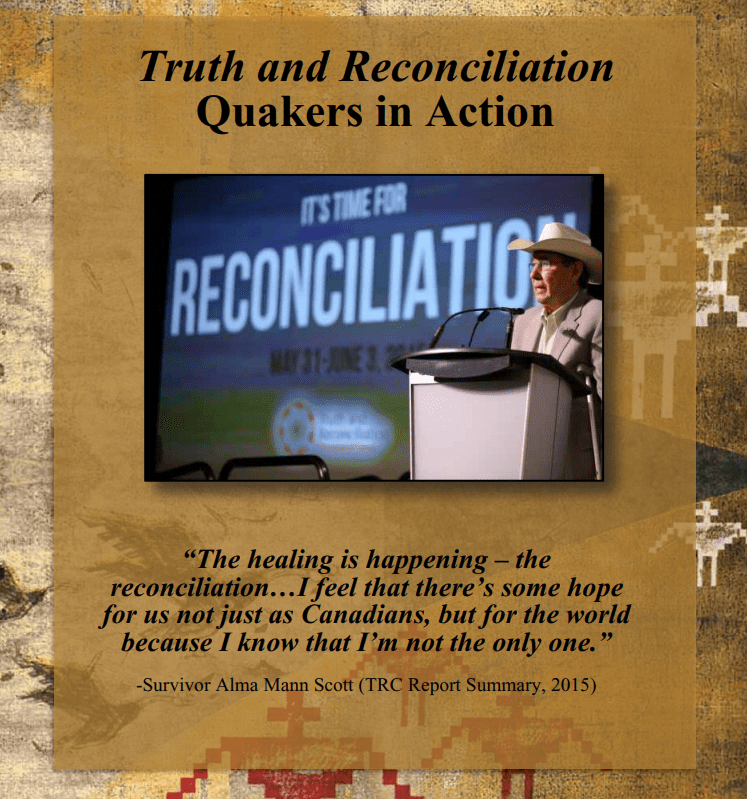
Minute from Canadian Yearly Meeting (CYM) 2016. Truth and Reconciliation 16-08-30 Truth and Reconciliation, Quakers in Action

https://quakerservice.ca/wp-content/uploads/2019/02/TRC-Resource-Book.pdf

From Apology to Action

Truth and Reconciliation Commission – From Apology to Action
CFSC (Quakers) Indigenous Rights Icon Small

In 2007 the Truth and Reconciliation Commission of Canada (TRC) was established as part of the legal settlement of the largest class-action lawsuit in Canadian history. The TRC’s mandate was:

to learn the truth about what happened in the residential schools and to inform all Canadians about what happened in the schools. The Commission will document the truth of what happened by relying on records held by those who operated and funded the schools, testimony from officials of the institutions that operated the schools, and experiences reported by survivors, their families, communities and anyone personally affected by the residential school experience and its subsequent impacts.

In 2015 the TRC released its report including 94 Calls to Action which we urge all Canadians to read and strive towards in the ongoing process of reconciliation.

At Canadian Yearly Meeting in 2011 Canadian Friends approved this minute:

We are being invited by the Indigenous peoples of Canada as represented by the Indian Residential School Survivors, through the Indian Residential School Survivors Settlement Agreement, to enter a journey of truth finding and reconciliation. We encourage all Friends, in their Meetings for Worship and Monthly and Regional Meetings, boldly to accept this invitation and to engage locally, regionally and nationally, actively seeking ways to open ourselves to this process.

CFSC was honoured to witness and participate in the closing events of the Truth and Reconciliation Commission of Canada. Watch a clip from this powerful and important closing below:

We welcomed the report and Calls to Action of the TRC as deeply important for genuine reconciliation. Together with our partners we’ve also called on the Government of Canada to follow the lead of the Truth and Reconciliation Commission.

CFSC has produced a resource for Quakers and others who wish to engage with the TRC Calls to Action.

https://quakerservice.ca/TRCGuide
Truth and Reconciliation: Quakers in Action. (PDF)

We encourage you to make use of this resource and are happy to help, so feel free to contact us!