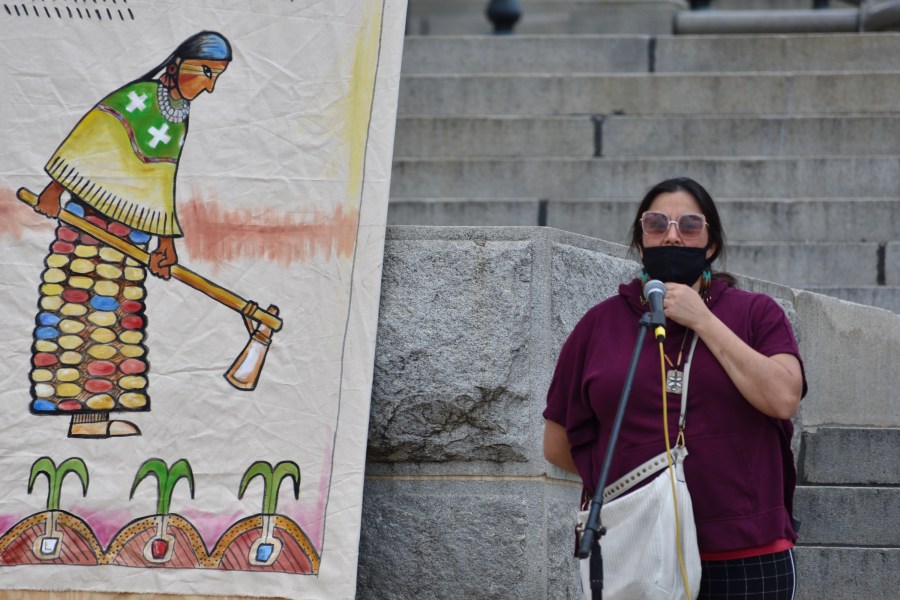
National holidays, Indigenous leadership and buried children

I’ve been writing about the event that was going to be held at the Iowa State Capitol “stop whitewashing genocide and slavery”. I urged people I know to attend. Support the BIPOC struggle in Iowa – LANDBACK Friends Organizers asked for a show of support. I was disappointed to see only a few people I know.

The same calls to remove monuments to white supremacy was held last year. Monuments to White Supremacy July 4, 2020 – LANDBACK Friends

Canada Day, July 1, and July 4 in the land called the United States, celebrate one view of the history of these two countries. Celebrations of white colonialism and the reign of capitalism. My Native friends refer to these as KKKCanada Day or Cancel Canada Day, and “The 4th of he lies”.

The remains of hundreds of children on the grounds of residential schools in Canada was a focus of the event here in Des Moines, and in Canada described below. The number will be in the thousands.

In Canada, monuments have been vandalized or destroyed and churches defaced. Four burned to the ground.

The search for remains in the United States has not yet begun. What does this mean for religious organizations involved with these schools here?

While There Had Been Anti-Canada Day Marches In The Past, This Year’s Especially Large Turnout Was Spurred In Part By The Discovery Of Over 1,100 Bodies At Former Residential Schools Over The Past Few Months.

On July 1, several thousand Indigenous people and settler and immigrant allies answered the call of organizations like Idle No More to protest the celebration of Canada Day and the ongoing genocide of Indigenous peoples. Cancel Canada Day actions took place across the land occupied by the Canadian state, from St. John’s, Newfoundland, in the east, to Victoria, B.C., including a march of thousands to parliament in Ottawa.

Uniting under the slogan “No Pride in Genocide,” these rallies put forward a panoply of demands. At the forefront was that Canada Day be replaced with a day to honor those whose lives have been lost to the Canadian state, whether Indigenous, Black, POC, women, or LGBTQ+. This was accompanied by demands for the end of settler encroachment and return of Indigenous land, Indigenous sovereignty, a real response to the disappearance and murder of Indigenous women, the end of police brutalization of Indigenous people, that the church take responsibility and offer compensation for the residential schools, and the end of celebration of the settler-colonial state.

At the same time, settler-colonial symbols have been vandalized and destroyed, including a statue of Captain James Cook in Victoria and statues of Queen Victoria and Elizabeth II in Manitoba. In addition, many churches have been defaced, and four in BC have been burned to the ground. All this reflects Indigenous consciousness—the awareness that we live under the boot of a settler-colonial state that demands our elimination, and that this fundamental reality needs to change.

However, changing this reality is impossible under capitalism. Indigenous oppression, expropriation, and elimination are carried out in order to remove us as an obstacle to capitalist expansion and exploitation of the land. While victories can be won in the short term, this oppression cannot end while capitalism remains in place. As a result, we must do all we can to unite the class struggle of the non-Indigenous working class with the decolonial struggles of Indigenous peoples, if we are to eliminate the capitalist system that oppresses and exploits both.

THOUSANDS MARCH IN CANCEL CANADA DAY ACTIONS By Taytyn Badger, Left Voice, July 4, 2021

Following is a graphic I’ve been working on, indicating the central role of capitalism.
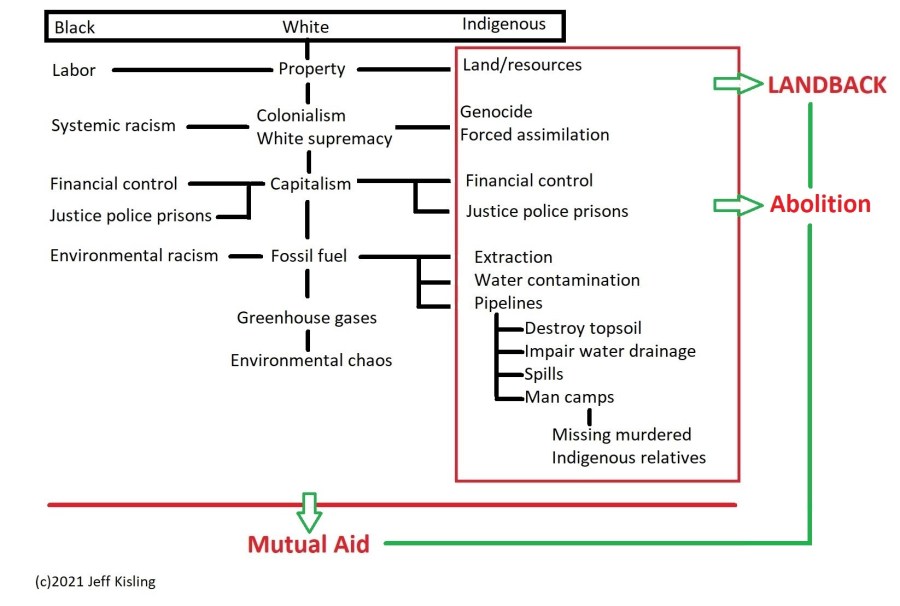
capitalism has violated the communities of marginalized folks. capitalism is about the value of people, property and the people who own property. those who have wealth and property control the decisions that are made. the government comes second to capitalism when it comes to power.

in the name of liberation, capitalism must be reversed and dismantled. meaning that capitalistic practices must be reprogrammed with mutual aid practices.

Des Moines Black Liberation

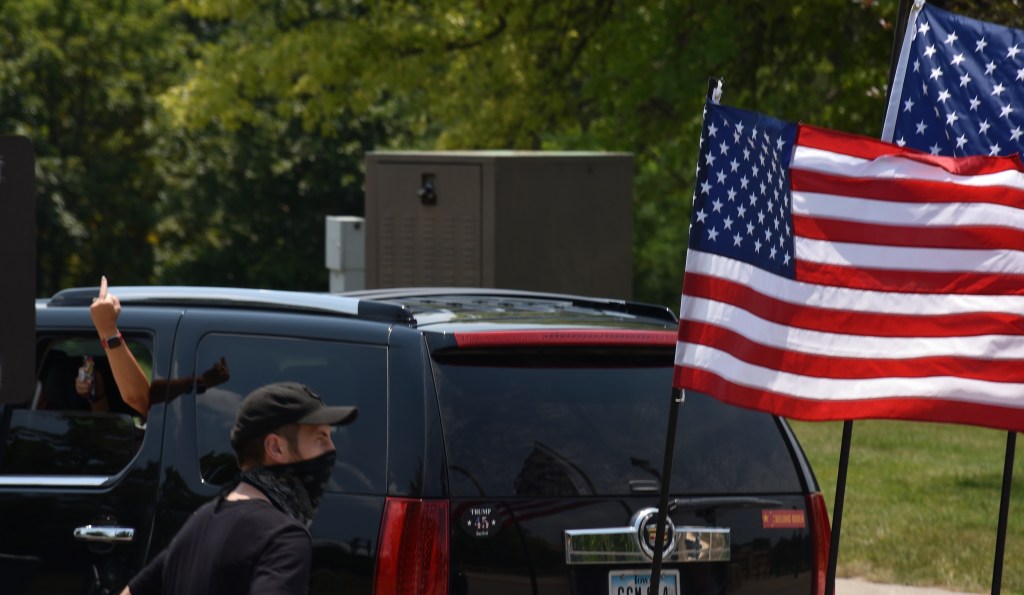
A caravan of Trump supporters tried to disrupt the ceremonies. Some of the flags were pulled off as they passed by. I was astonished at the quick reaction of some in our crowd. They have seen this thing before. There was an immediate increase in tension. After the caravan left, Iowa State Patrol cars closed off the street.

Trump supporters

July 4 Nexus

nexus a connection or series of connections linking two or more things

There are so many concepts and much history related to July 4th.

I’ve come a long way from what I, a white person, was taught in school. About the heroes and battles that brought independence from the British. And just a sentence or so about taking over Indigenous lands, and the slave trade. All whitewashed and presented as acceptable. Even referred to as “Manifest Destiny”.

“He has excited domestic insurrections amongst us, and has endeavoured to bring on the inhabitants of our frontiers, the merciless Indian Savages, whose known rule of warfare, is an undistinguished destruction of all ages, sexes and conditions.”

— Declaration of Independence

The crown and the colonists were both determined to seize lands from native peoples and to continue enslavement.

THE TERRIBLE ORIGINS OF JULY 4TH By Margaret Kimberley, Black Agenda Report.
July 3, 2021

The crown and the colonists were both determined to seize lands from native peoples and to continue enslavement. But their interests were also hostile to one another and war was the inevitable result. White settlers wanted full independence for themselves and no control over their actions at all.

The indigenous populations were nearly eradicated in the decades long quest for conquest. Expanding slavery was an integral part of those efforts against native peoples. Genocide could not be carried out completely nor could any accommodation be made with European nations in the quest to control land from sea to shining sea. That is why the settlers declared their independence.

The process of decolonizing ourselves is a difficult one. We have been cut off from our history and we don’t know where or how our people played a part. As we try to educate ourselves we may find it difficult to give up traditions that we have claimed as our own. Regardless of personal choices made on July 4th, the causes of the Declaration of Independence must be known and acknowledged. That is the beginning of true independence for Black people.

THE TERRIBLE ORIGINS OF JULY 4TH By Margaret Kimberley, Black Agenda Report.
July 3, 2021

The news reminds us of the political rally of the previous guy at Mount Rushmore, July 4, 2020. A perfect example of LANDBACK. Native people blocked the highway to Mount Rushmore because the monument is on Native land. Several of my friends were there. In 1980 the Supreme Court confirmed the land belongs to the Sioux. Compensation of $2 million dollars was offered. But never taken.

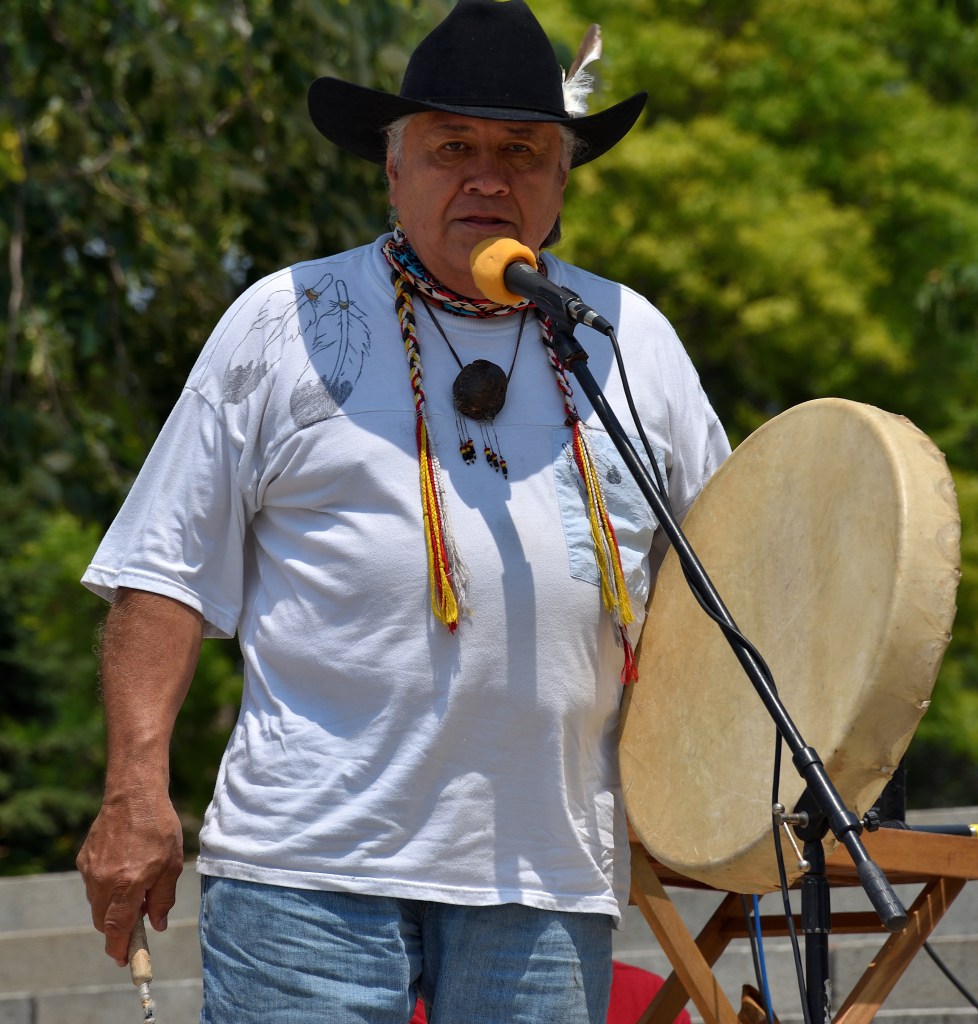
“What Mount Rushmore has always represented is a system of power and oppression and white supremacy, because they take a sacred place and carved the faces of white men who are responsible for our colonization and our demise,” (Lakota activist) Nick Tilsen said.

Lakota activist: Mount Rushmore key in move to regain land. When then-President Donald Trump visited Mount Rushmore last year for a fireworks display, Lakota activist Nick Tilsen saw an opportunity to advance the Land Back Movement By STEPHEN GROVES Associated Press, March 24, 2021

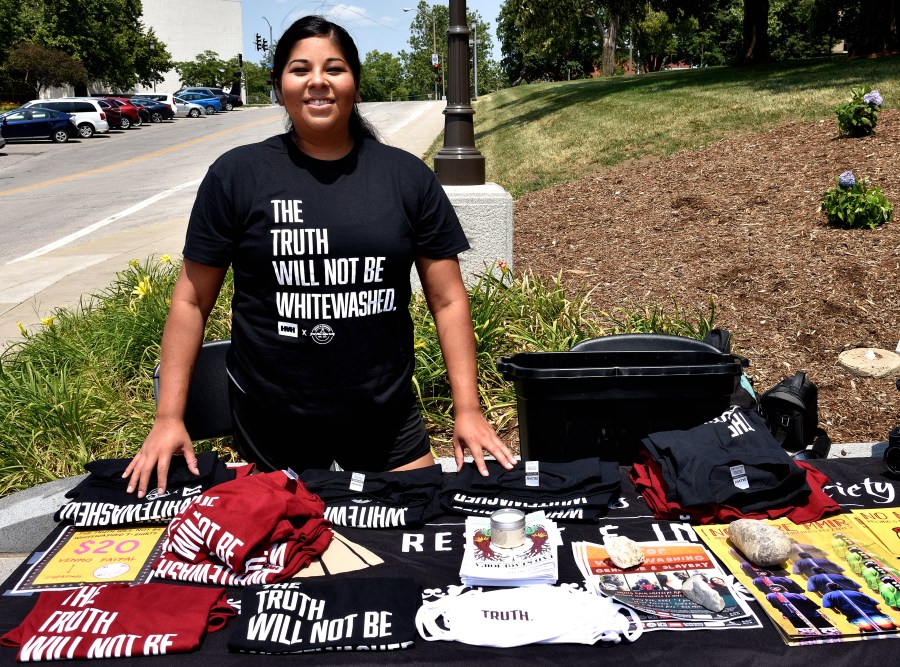
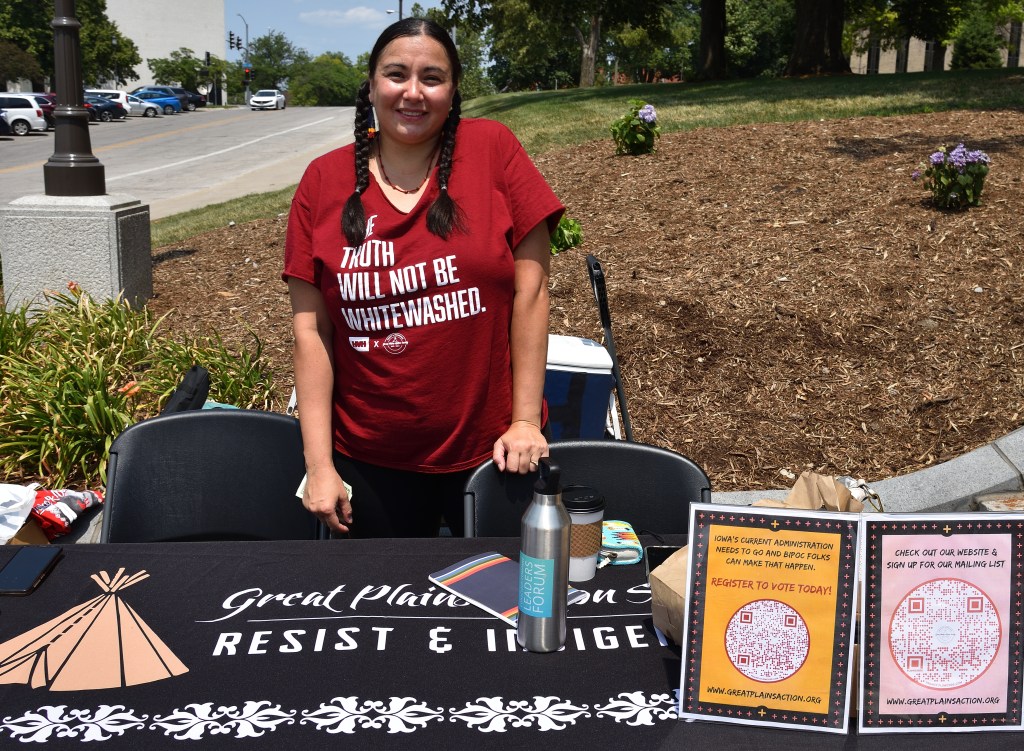
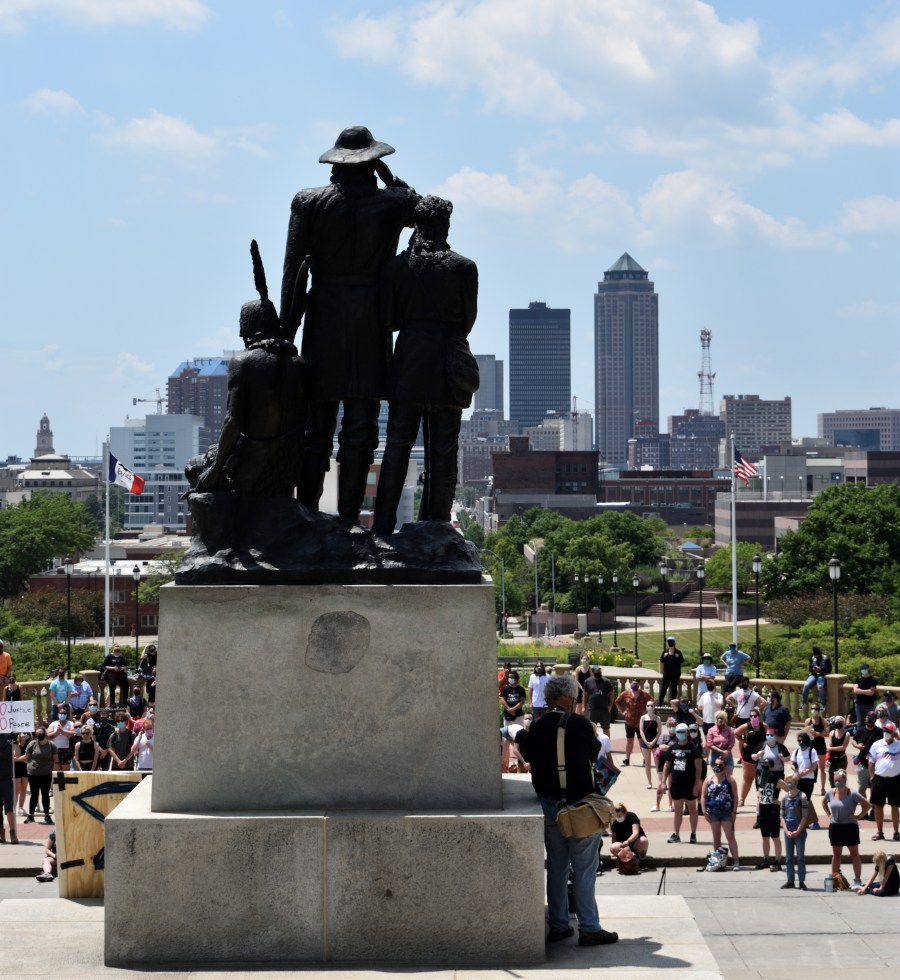
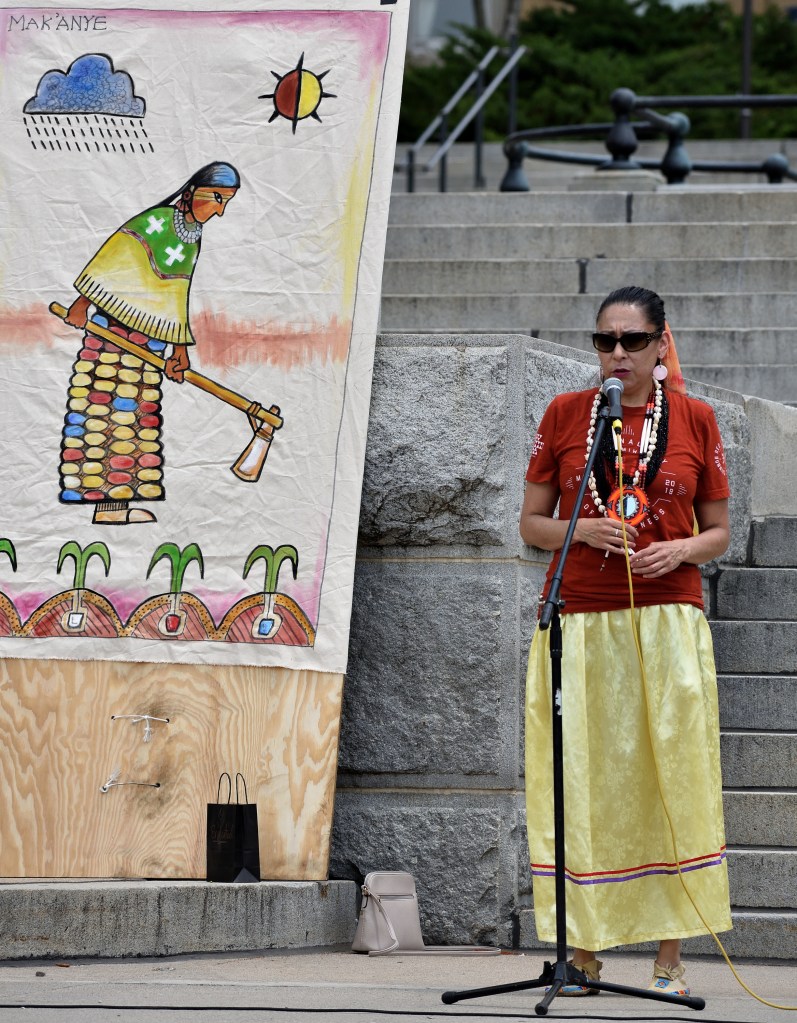
The above are connected to a gathering at the Iowa State Capitol this afternoon from 1 – 3 pm, Stop Whitewashing Genocide and Slavery. Bring Back Critical Race Theory & Remove Monuments to White Supremacy!

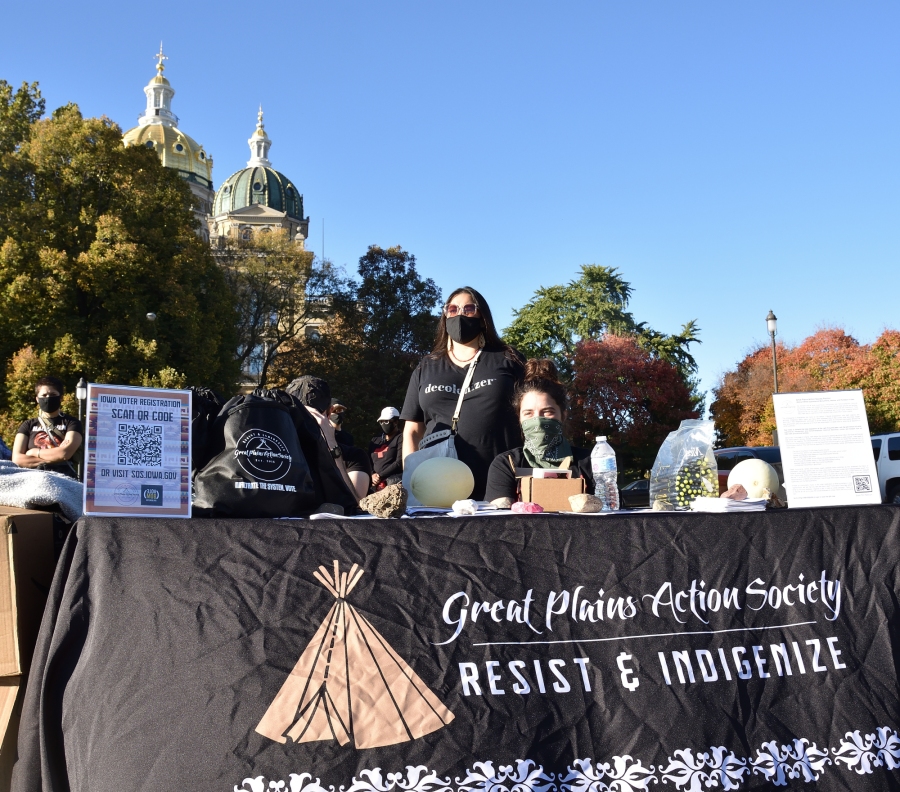
Indigenous Led | Great Plains Action Society I United States

On July 4th, stand with Great Plains Action Society, Iowa Citizens for Community Improvement, Ní Btháska Stand Collective, Des Moines Black Liberation Movement, Humanize My Hoodie, Revolutionary Action Party, Quad Cities Interfaith, Iowa Coalition for Collective Change, and Des Moines Mutual Aid!

Join us on “Fourth of He Lies” to demand that the Iowa legislators remove whitewashed monuments to white supremacy in Iowa. Organizers will present a petition demanding that all racist, misogynistic, homo/transphobic, whitewashed historical depictions be removed from all state grounds and facilities. These monuments fall into the realm of hate propaganda and make folks feel unwelcome in public spaces. So, we need legislation that removes all monuments, murals, and depictions of white supremacist persons, acts, and ideologies from all Iowa state grounds and state-funded institutions.

Support the BIPOC struggle in Iowa

People ask me how they can support local oppressed communities. Showing up tomorrow is a great way to do so. Organizers “would love to see a mass turnout to support the BIPOC struggle in Iowa”.

Tomorrow, July 4, 1-3 pm, an event I previously wrote about will take place at the Iowa State Capitol. Stop Whitewashing Genocide & Slavery!!!

Additional organizations are supporting the event, including my Des Moines Mutual Aid group. Again this morning I helped with the food giveaway. A friend and I talked a little about this event as we put together boxes of food.

On July 4th, stand with Great Plains Action Society, Iowa Citizens for Community Improvement, Ní Btháska Stand Collective, Des Moines Black Liberation Movement, Humanize My Hoodie, Revolutionary Action Party, Quad Cities Interfaith, Iowa Coalition for Collective Change, and Des Moines Mutual Aid!

Indigenous Led | Great Plains Action Society I United States

Bring Back Critical Race Theory & Remove Monuments to White Supremacy!

Some additional topics have come up related to new legislation.

Demand that the new law, House File 802, which goes into effect July 1 be repealed. The legislation targets teaching critical race theory and other concepts in government diversity training and classroom curriculum.

Demand that Iowa legislators do their job and follow their own laws by abolishing monuments to white supremacy, which depict hate speech and promote discrimination. Kim Reynolds herself has stated that “Critical Race Theory is about labels and stereotypes, not education. It teaches kids that we should judge others based on race, gender, or sexual identity, rather than the content of someone’s character.” If this is the case, then statues depicting friendly “westward expansion”, busts of Columbus, and murals depicting manifest destiny are stereotyping European setter invaders and not depicting the true nature of their character. Columbus was a genocidal, rapist, slave trader, and Indians were forced to give up their land–it was not friendly.

Can’t stop, won’t stop.
Don’t be a bystander to white supremacy.
#SmashWhiteSupremacy

Organizers would love to see a mass turnout to support the BIPOC struggle in Iowa

Join us on “Fourth of He Lies” to demand that the Iowa legislators remove whitewashed monuments to white supremacy in Iowa. Organizers will present a petition demanding that all racist, misogynistic, homo/transphobic, whitewashed historical depictions be removed from all state grounds and facilities. These monuments fall into the realm of hate propaganda and make folks feel unwelcome in public spaces. So, we need legislation that removes all monuments, murals, and depictions of white supremacist persons, acts, and ideologies from all Iowa state grounds and state-funded institutions.

In response to police brutality and racial injustice, monuments to white supremacy are being removed all over the country but People of the World Majority are being forced to put their safety on the line to carry out this long-overdue purge. Folks have been shot, arrested, and targeted. We are an Indigenous-led coalition who do not want any more People of the World Majority to put their bodies on the line so this is a permitted event with the intent of making the state–the colonizers–do their job.

To start, we insist that the following statues and mural be removed from the Iowa State Capitol Building and grounds.

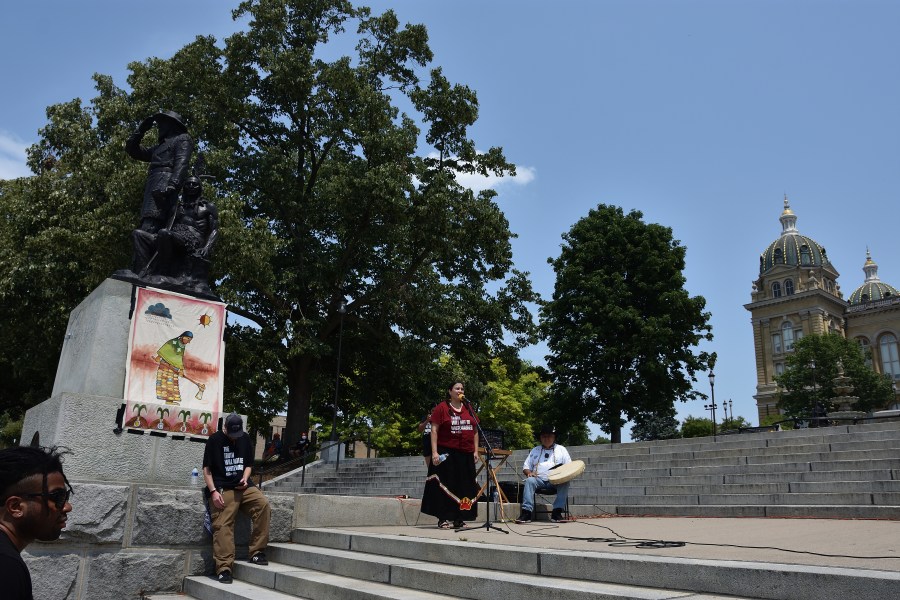
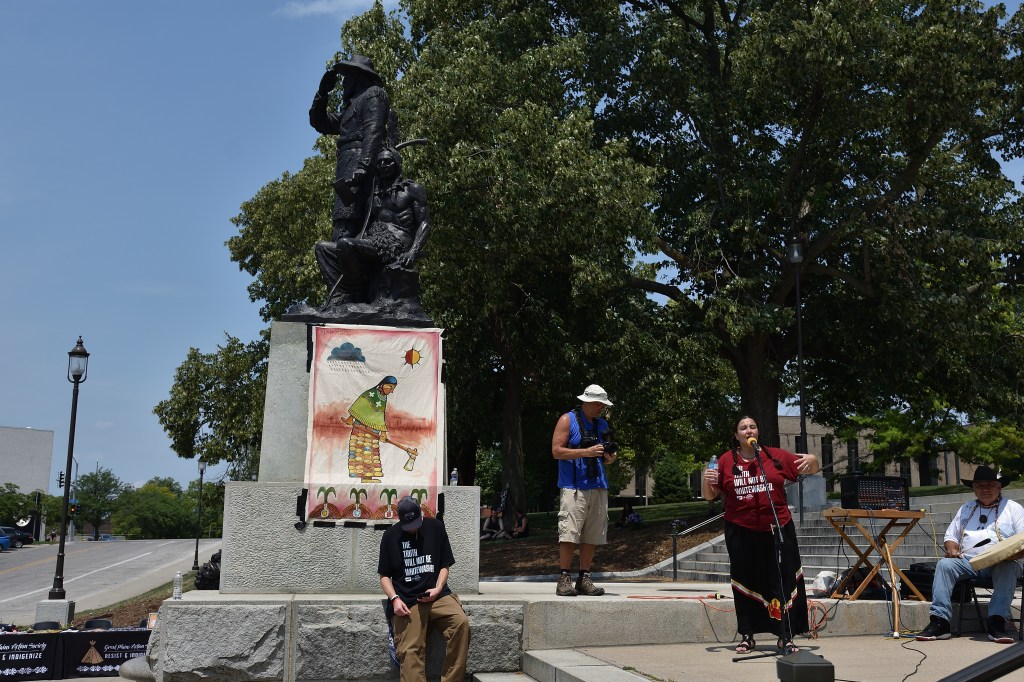
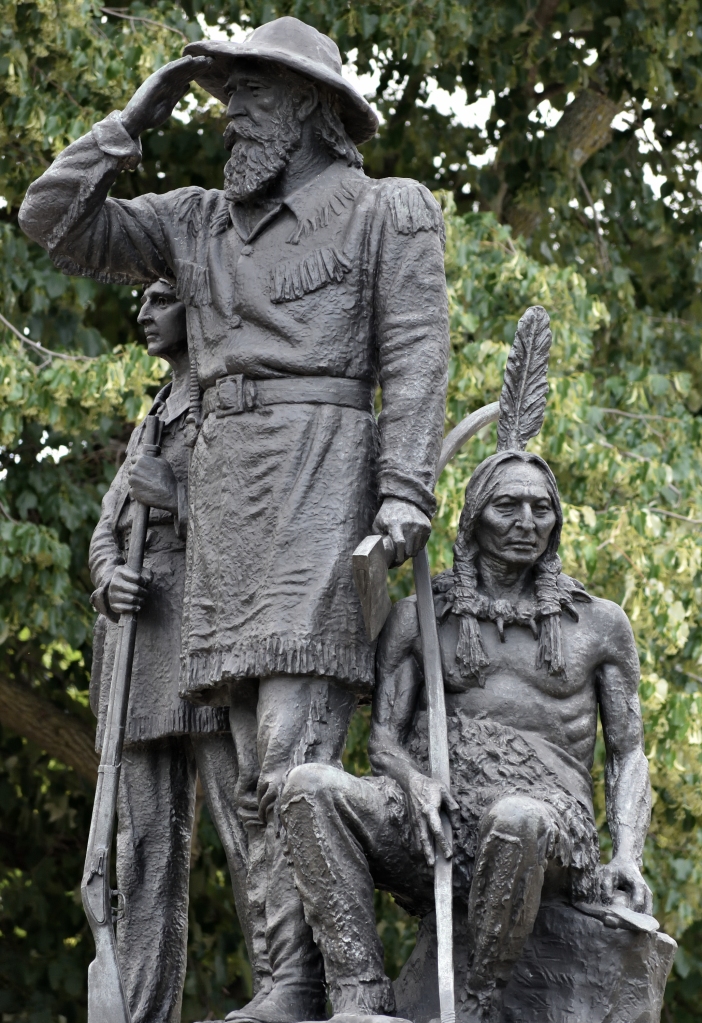
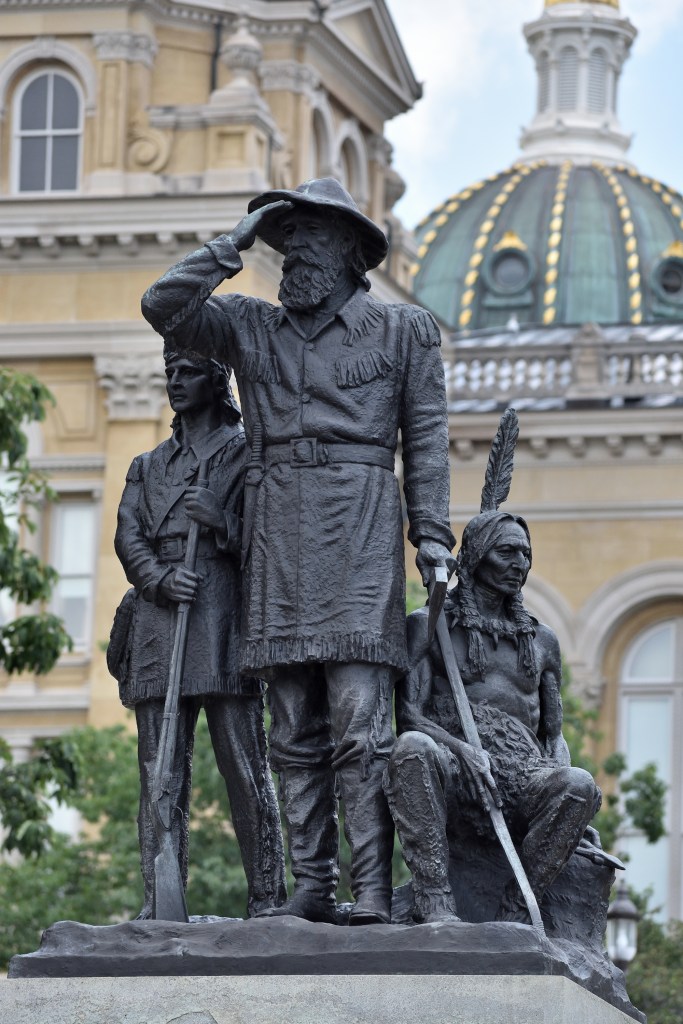
On the West Lawn, there is a 15-foot bronze statue on a large pedestal that stands in front of the Iowa State Capitol Building. According to the Iowa State Government website, the statue depicts “The Pioneer of the former territory, a group consisting of father and son guided by a friendly Indian in search of a home. The pioneer depicted was to be hardy, capable of overcoming the hardships of territorial days to make Iowa his home.” The father and son settler invaders are standing tall and proud, looking west, as the “friendly Indian” sits behind them in a less powerful, dejected position.

Inside the capitol is a piece that overwhelmingly encompasses this sentiment called the Westward Mural, which covers a massive wall. The artist writes that “The main idea of the picture is symbolical presentation of the Pioneers led by the spirits of Civilization and Enlightenment to the conquest by cultivation of the Great West.” He also speaks about overcoming the wilderness with plowed fields–as if the current Indigenous inhabitants, such as the Ioway and the Meskwaki, had not already created capable and efficient land management systems.

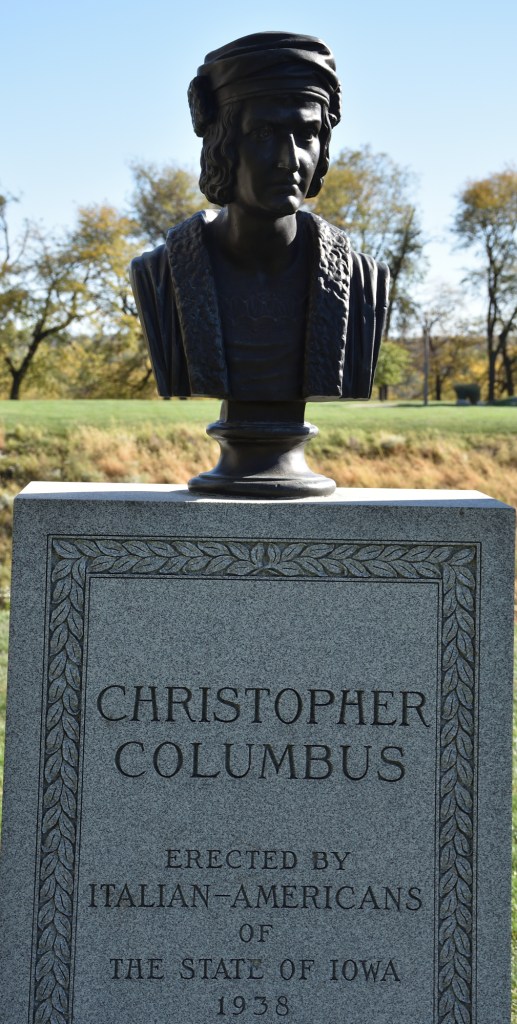
On the South Lawn, there is a Christopher Columbus Monument that was celebrated in 1938 by five thousand people who showed up for the dedication of the statue on Columbus Day. The statue was put up just a couple years after the Columbus Club of Iowa successfully lobbied to have Walker Park renamed to Columbus Park and have a Columbus monument placed there.

*This is a peaceful event led by Indigenous Folx. Please do not take actions that will put Brown and Black folx in jeopardy

Prefab Communities

The recent days of triple digit temperatures and their effects are showing what the future will look like. That future is now, actually. People are beginning to panic. Systems of all types are failing.

Climate refugees will be forced to flee areas of drought, rising sea levels, devastation from severe storms. Migrants will be desperate for food and water. A desperation that will lead to violence. I don’t know how we can prepare for that.

What follows are parts of posts I’ve written over the past five years. I am less hopeful we can find ways to deal with climate refugees, as we have seen increasing polarization and violence across many divisions.

And yet, in some ways I’m more hopeful as I’ve been learning about, participating in Mutual Aid communities.

Building small communities in rural areas, or around urban farming, will give people fulfilling work to do, food to eat, shelter, and a caring community to belong to, restoring their dignity. These communities can work without requiring money in exchange for these things. Friends in Iowa City have experience with intentional community. And the Maharishi community in Fairfield, Iowa.

The most important consideration is water supply. Without water nothing else works. We will continue to see spreading and worsening droughts.

Following is a draft for creating new communities, not only for ourselves, but with the intention of creating a model that can be rapidly replicated. So the flood of climate refugees have a template to build their own self sufficient communities when they are forced to migrate. The UN Refugee Agency estimates that by 2050, up to 250 million people will be displaced by climate change.

Urgency

  • Environmental disasters
    • Weather extremes
      • Widespread and persistent drought, rising seas and more intense storms and fires
        • Destroyed homes, cities, land
        • Deadly air temperatures
        • Destroyed infrastructure
        • Water, food and energy scarcity
        • Resource wars
        • Collapsing social/political order
        • Climate refugees
    • Militarism and police states
    • Decreasing availability of complex health care and medications
    • Spiritual poverty

The Midwest

Here in the Midwest we are faced with two broad problems. How to adapt our own lives to deal with these changes, and what to do about the flood of people who will be migrating to the Midwest.

“Along America’s most fragile shorelines, [thousands] will embark on a great migration inland as their homes disappear beneath the water’s surface.” LA Times, Victoria Herrmann Jan 25, 2016

Since we will soon not be able to depend on municipal water and power, transport of food from distances, schools and hospitals, many will be forced to move to rural areas or create urban gardens and farms, where they can live and grow their own food.

The Choice

  1. One choice is to narrowly focus on the best we can do to prepare ourselves and immediate community to adapt to the coming changes.
  2. The other is to also work on ways we can help the many climate refugees who will likely be migrating to the Midwest. Help them learn to adapt and thrive. Although these days violence rather than cooperation seems more likely.

Building Communities-The Vision

We need to model how to build sustainable communities. There have been numerous such experiments in intentional community. But the model needed now must be created with the intention of being replicated many times over with minimal complexity, using locally available materials—a prefab community.

Prefab Community

  • Community hub with housing and other structures
    • Simple housing
      • Straw bale houses
      • Passive solar and solar panels
      • No kitchens or bathrooms (community ones instead)
    • Store, school, meetinghouse
    • Central kitchen and bathrooms
  • Surrounding fields for food and straw
  • Water supply
    • Wells, cisterns and/or rain barrels
  • Power
    • Solar, wind, hydro, horse
  • Manufacturing
    • 3 D printing
    • Pottery
    • Sawmill
  • Communication
    • Radio, local networks
  • Transportation
    • Bicycles
    • Electric vehicles
    • Horses
    • Pedal powered vehicles
  • Medical
    • Stockpile common medications
    • Essential diagnostic and treatment equipment
    • Medical personnel adapt to work in community
  • Spiritual
    • Meeting for worship
    • Meeting for business
    • Religious education

Mobil homes, buses and cars can be repurposed for shelter.

If/when local water supplies dry up in these new communities, people will be forced to move again.

Replanning Human Life

A common theme of my thinking, praying and writing, is the fundamental injustice, evil, of capitalism. What is the alternative?

My experiences with the Kheprw Institute (KI) in Indianapolis showed me how a community can not only exist, but thrive, with practically no money. I saw this as an example of Beloved community. With my current work in Mutual Aid, I can now see KI is also a Mutual Aid community.

I now see the First Nation-Farmer Climate Unity March I was blessed to be part of could be seen as creating a Mutual Aid community. We walked, camped and shared stories for the eight days it took for our sacred journey. Other than buying food prior to the start of the March, we didn’t need money for anything. Being together, often in trying circumstances like rain and heat, began the process of getting to know and trust each other. Which is the foundation of Mutual Aid. Although we separated geographically after that journey, we have worked together in many ways since.

I’m excited to be part of the Des Moines Mutual Aid community for many reasons. It is a Beloved community. I’ve made many good friends, and they are teaching me about Mutual Aid.

Now I understand Mutual Aid is what should replace capitalism. But that has led to some frustration. I tell anyone who will listen Mutual Aid is the path forward. I’m having trouble convincing those living in the capitalist system why they should work for alternatives. To build Mutual Aid communities where they are.

Mutual Aid is premised on people in the community being together, physically. It is not a difficult process. The hurdle is getting people to decide they want to do this, then begin. I was fortunate to find a Mutual Aid community already in existence.

Another part of the process is learning how to live in a community with a flat, or horizontal structure. Not the vertical hierarch we are used to living in.

Finding and building alternatives to capitalism will soon no longer be a choice. The system is already breaking down.

I’m glad to have found the article cited below, based on the work of Jeremy Rifkin, an American economist, social theorist, and activist.

Rifkin’s latest book is “The Green New Deal: Why the Fossil Fuel Civilization Will Collapse by 2028, and the Bold Economic Plan to Save Life on Earth.” After predicting the collapse of the current fossil-fuel regime, he formulates a new economic model and guides readers in the construction of a post-carbon world.

But, where to begin? Great economic paradigm shifts in history can point us in the right direction when replanning human life on Earth.

Three defining technologies have emerged and converged simultaneously, changing the way society manages, powers, and moves its socioeconomic life.

The first is communication, which helps us bring our species together and organize ourselves.
The second is energy, which powers our social life, allowing us to continue living together on this planet.
And the last is mobility, which offers us a way of logistically organizing ourselves.

Together, these three pillars form our infrastructure, functioning much like cells in a living organism.

What Comes After Capitalism? Forget communism, socialism, and capitalism — the days ahead are green by Vitoria Nunes, medium.com, June 8, 2021

Rifkin says there have been two industrial revolutions that demonstrate these ideas. The first was led by the British. Two new methods of communication were steam powered printing and the telegraph system. Coal was the energy source, and steam driven locomotives for mobility.

The second industrial revolution took place in the United States. The telephone, radio and television became forms of communication. Texas oil the energy source. And Henry Ford revolutionized transportation with the internal combustion engine.

Incidentally, these paradigm shifts alter our economic model, and that’s how capitalism took center stage. Previous industrial revolutions centered around fossil fuels, the most expensive to extract, ship, and refine (along with uranium). Pre-existing monarchic systems wouldn’t have been able to finance these processes. Enter the capitalist stockholder corporation, characterized by wealthy players’ investments in coal, gas, and oil.

From the start, industrialization was engineered to be a centralized, top-down system. And other industries followed, bolstering the absurd levels of wealth concentration we can all witness these days.

Vitoria Nunes

A third revolution is emerging now.

Engineered differently from the first two, a third industrial revolution is on the rise. A new era of enlightenment is upon us, as more people begin to realize that together we are much more agile than the vertical organizations that have been seeking world domination.

Digital communication, energy, and mobility are converging to form yet another paradigm shift, a true internet of things. Millions of people — in the form of SMEs (small- and medium-sized enterprises), communities, farm associations, and cooperatives — are already consuming energy from the wind and sun and sharing it on a renewable energy internet. Solar- and wind-powered vehicles are emerging on a digitized mobility internet and are predicted to be autonomous in the next decade.

The same digital technology we use for communicating with each other will become the cornerstone of how we power and move our social life in just a few years. And it will change our economic system, allowing for the emergence of one that is compatible with a new infrastructure.

As marginal costs drop, thanks to more efficient, costless energy consumption, the sharing economy will gain new strength, taking us into a world that is in equilibrium with the finite natural resources the Earth has to offer.

None of this is sci-fi; the cost of solar and wind power just dipped below the cost of every other energy we use (nuclear, coal, and oil), giving power to the people.

Vitoria Nunes

The first two industrial revolutions were built with centralized, top down systems.

This third revolution will be built with Mutual Aid concepts. Local communities fight climate change locally.

Central governments don’t have the capacity to handle a task of this magnitude. Power originates from local regions; with every community taking responsibility for its biosphere.

By recruiting everyone — from large institutions and universities to high schools and local businesses— to join in, we can come up with the roadmap to scale up our local infrastructure. We must step to the floor and get this done. We must be fearless, turn to our communities, run for political assemblies, and create the infrastructure to make it happen. There’s no other way of getting it done.

Vitoria Nunes

This article was based on a conference Jeremy Rifkin held at Sciences Po in October 2019. To view the full lecture, click here.

Sioux City Native Youth Camp

May be an image of 3 people, child, people standing, outdoors and text that says 'PROTECT THE SACRED JULY 10 SIOUX CITY NATIVE YOUTH CAMP 11, RIVERSIDE PARK FOR YOUTH AGES 5-19 BUT BRING THE WHOLE FAMILY! FREE TO ALL! FREE FOOD! FREE T-SHIRTS! TWO DAYS OF CULTURE, GAMES, PHYSICAL FUN AND LEARNING! IMPORTANT!!! Pre-Register at bit.ly/ptsyouthcamp'

Event by Great Plains Action Society

Riverside Park Shelter #4 Sioux City, IA 51109

Price: Free · Duration: 1 day

Public  · Anyone on or off FacebookProtect

The Sacred Native Youth Camp

July 10, 2021 8am – 4pm
July 11, 2021 8am – 5pmRiverside Park, Shelter #4
1301 Riverside Blvd
Sioux City, Iowa

For youth ages 5-19
Pre-Registration at bit.ly/ptsyouthcamp

ABSOLUTELY FREE EVENT! WE WILL PROVIDE TWO SNACKS AND A LUNCH. YOUTH/FAMILIES WILL RECEIVE A FREE T-SHIRT IF THEY ATTEND BOTH DAYS.OPEN FOR ALL FAMILIES TO COME AND PARTICIPATE!

Indigenous youth often face added challenges throughout their childhood and adolescence. Some may have a strong support system while others may not. It is highly important that each and every Native youth feels empowered and inspired to reach their full potential. This is exactly what Protect The Sacred Native Youth Camp is all about. We are encouraging Native youth to participate in cultural and physical activities such as lacrosse, drumming, and dancing (to name a few). Our mission is to engage the Native youth in physical activities to promote healthier habits while learning about local tribes within the region. Knowledge is power and our hope is to help Native youth build a stronger Indigenous identity in order to stand up against abuse and injustice that they may face in their lifetime. Empowered and educated youth will help put an end to the Missing and Murdered Indigenous Relatives crisis, which is our long term goal.

A REGISTRATION BOOTH WILL BE SET UP ALL DAY FOR THE TWO DAYS.

Great Plains Action Society will be extending other activities after the daily sponsored event. We anticipate to have sweat each night and families are encouraged to stay overnight in our tipi’s that will be set up at Riverside Park near Shelter #4 if they wish to.

This event is a collaboration between Great Plains Action Society, Indian Youth of America, Mount Marty, UNO, and SD BRIN. 

Wellness

Link to Riverside Park, Sioux City Google Maps

https://www.google.com/maps/@42.5021221,-96.4653259,15.5z

Judy Plank

My friend and fellow Quaker, Judy Plank, has given me permission to share some of her stories.

I’ve written about the background of my grandchildren whose mother’s came from Dakota and Lakota nations in my book. Even as a child I was attracted to what I supposed was the life and culture of the tribes that had thrived in our area before the white colonists arrived. I thought our lives were so boring and unimaginative compared to the lives they lived.

That aside, my experiences with those inlaws and my deep deep love for my grandchildren has drawn me even further into knowledge to the near irrepairable damage done to their lives and culture. I love all my grandchildren with all my heart.

I had a chance meeting at our Le Mars Dairy Queen the fall before the pandemic, with a young native man with a logo on his T-shirt that I was attracted to. He was there with his two children, as their mother was working there. I got into a conversation with him, and he shared that he had attended the Flandreau Indian School, where decades before my grandson’s mother had lived and his other grandmother had been a cook. This young man seemed to have had a very good experience there (the school is still in operation, I believe). From that short conversation, I don’t know how connected he was with his culture and what the school was now teaching, if anything, to continue or revive their culture. He was living in Le Mars, where native people are really scarce.

It’s a miracle that any part of the various native cultures still survive given the relentless violence to wipe it out completely. Yet, reviving some of that culture and reverence for the earth that gives us life as these people traditionally practiced, may well be what saves us from destroying ourselves. I attended a talking circle some years ago facilitated by a man I greatly respect from the Yankton nation, who lived in Sioux City. He referred to all people, creatures and things as our relatives. I try to consistently remember to treat all as relatives in my own life. He’s currently in the process of moving to Sioux Falls, but I communicate with him via Facebook.
I’m very happy that finally a native is in charge of the Dept. of Interior. I hope that will change the culture of that department for the better. Other than that, I don’t have much to offer about how to repair the damage done. It will take generations, I fear, before the wrong can be wiped clean.


As I see it, the reason the past boarding schools era is still relevant is the repercussions still today of that trauma of taking children from their families and unthinkable disruption to the culture, language, and family life for the tribal people is still affecting the people to this day. We can be unaware of the entire episode, but they still live with that trauma. What we can do now, is recognize the hurt, listen and learn from the learned history of the tribes as to how to treat the land we live on, and to return as best we can land and lives of these people. How that can best be done, I’m not sure, but many ways must be tried to repair the damage.


 I was horrified to read about the treatment in Pipestone. I was just in Pipestone this past Friday. My grandson and I visited my daughter’s grave in the Catholic cemetery there while we were in Pipestone. The Catholic cemetery overlooks the National Monument to the east. Nick and I spent time driving through the other two cemeteries next to the Catholic one. I found an area that had a couple rows of maybe 50 or so unmarked stones that really interested me. I still wonder if those were graves, and if so, who was buried there. If I had the energy, I’d try to find out the answer, especially after reading this story about the Pipestone school,

LANDBACK and Quakers. A case study

The idea of “landback” — returning land to the stewardship of Indigenous peoples — has existed in different forms since colonial governments seized it in the first place. “Any time an Indigenous person or nation has pushed back against the oppressive state, they are exercising some form of landback,” says Nickita Longman, a community organizer from George Gordon First Nation in Saskatchewan, Canada.

The movement goes beyond the transfer of deeds to include respecting Indigenous rights, preserving languages and traditions, and ensuring food sovereignty, housing, and clean air and water. Above all, it is a rallying cry for dismantling white supremacy and the harms of capitalism. Although these goals are herculean, the landback movement has seen recent successes, including the removal of dams along the Klamath River in Oregon following a long campaign by the Yurok Tribe and other activists, and the return of 1,200 acres in Big Sur, California, to the formerly landless Esselen Tribe.

Returning the Land. Four Indigenous leaders share insights about the growing landback movement and what it means for the planet, by Claire Elise Thompson, Grist, February 25, 2020

There are several reasons I’ve been praying, studying, and writing about LANDBACK. Most importantly my Native friends have told me the best way to support them is by doing so. Those who work for justice often hear we need to follow the leadership of the communities impacted by injustice. It is often not clear how to go about doing that.

I’ve been a bit apprehensive about trying to get Friends involved with LANDBACK because many Friends have trouble dealing with the history of Quakers’ involvement with the forced assimilation of Native children. Many white Friends have trouble dealing with Quakers’ history related to enslavement. Many white Friends are uncomfortable with their white privileges today.

So I was very grateful to receive a response to something I’d written about LANDBACK from my friend and fellow Quaker, Marshall Massey, which you can read here: Marshall Massey on LANDBACK – LANDBACK Friends

I wrote the following case study, hoping to give an example of the implementation of the ideas related to LANDBACK.

This is a link to the PDF version of the LANDBACK case study, Wet’suwet’en and Quakers.

Iowa Yearly Meeting (Conservative) Minute 2019

To this day we have not come to grips with fundamental injustices our country was built on, the cultural genocide and theft of land from Native Americans, the enslavement of African Americans and the legal justifications of bestowing rights and privileges on white land-owning men. The consequences of these injustices continue to plague our society today. And will continue to impact us until we do what is necessary to bring these injustices to light and find ways to heal these wounds.

Several Friends recently assisted Boulder Meeting Friend, Paula Palmer, to lead workshops and discussions as part of her ministry “toward right relationships with Native people.” Part of the tragedy of the theft of Native land is that some Native people don’t have the concept of land as property, belonging to a landowner. Rather they have a spiritual connection to Mother Earth, that the land is sacred and not something that can be claimed as property by anyone. Being forced to leave their land broke their spiritual bonds with the land.

Native people have asked us to begin work toward reconciliation and healing. The first step needed is truth telling, recognizing that injury or harm has taken place. One of the important parts of holding “right relationship” workshops is to determine which Native nations were on the land before white settlers arrived.

–Iowa Yearly Meeting (Conservative) 2019