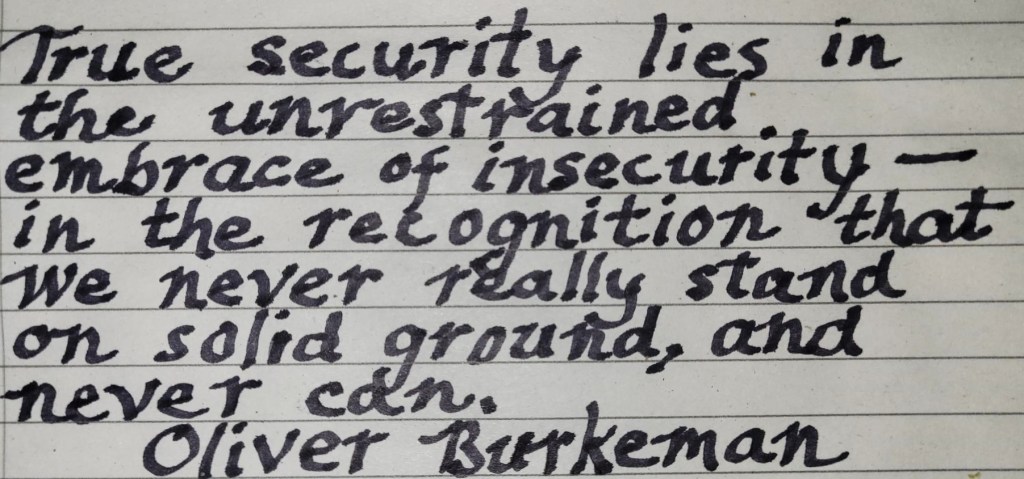
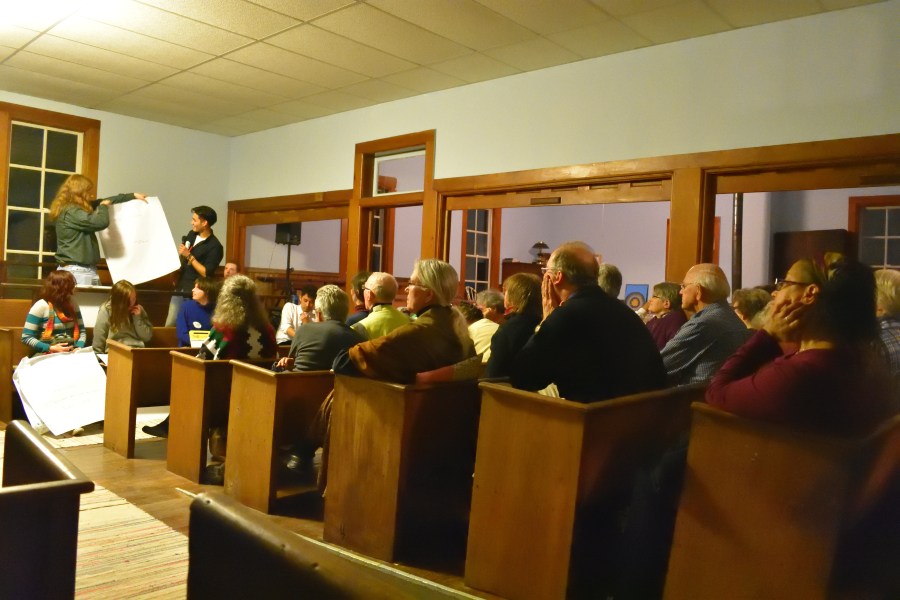
The eyes of the future are looking back at us


There is a native concept of considering what the effects of decisions made today will be on seven generations into the future.

The following quotation makes a two-way connection between us and future generations. Looking at each other over the generations.

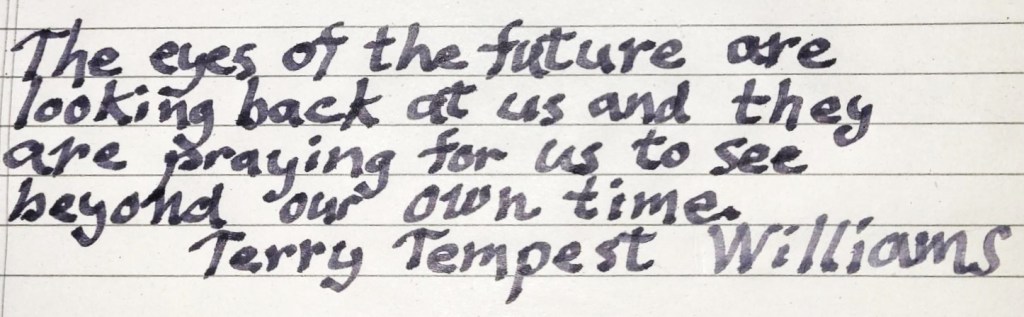
The eyes of the future are looking back at us and they are praying for us to see beyond our own time. They are kneeling with hands clasped that we might act with restraint, that we might leave room for the life that is destined to come. To protect what is wild is to protect what is gentle. Perhaps the wilderness we fear is the pause between our own heartbeats, the silent space that says we live only by grace. Wilderness lives by this same grace. Wild mercy is in our hands.

― Terry Tempest Williams, Refuge: An Unnatural History of Family and Place

Similarly, can we not look back at our ancestors? We are our ancestors’ future generation looking back.

I think about this a lot these days. As stories of the remains of native children on the grounds of the institutions of forced assimilation continue. Thousands of children never returned home.

I’ve been praying about what we are doing now and how much harm this is doing to future generations. My Spirit recoils from the likelihood there probably will not be a seventh, or sixth, or fifth generation because of the accelerating rate of environmental collapse.

What have we done?

What will we do?
As we work for change, we are admonished that we need to tell new stories. This morning I found this story Nico Santos tells, from the movie Dragon Rider.

“Wings”

Oh, I’ve been lost in the darkness
I heard your voice from afar
You weren’t my callin’
Whenever the night was starless
And I couldn’t see anymore
You showed me the mornin’

So I-I-I wanna let you know
When life has got you low

I’ll be your wings to fly
When there’s trouble on your mind
Whenever you’re ’bout to fall
There’s nothin’ I won’t try
‘Cause I’ll be your wings to fly
When you’re sufferin’ inside
Come hell or high water
Got you covered all my life
Let these wings take you
High, high
There’s nothin’ I won’t try

We built our own kinda fortress
Nothing can break us apart
Walls won’t be fallin’
These walls won’t be fallin’
I wouldn’t be if it wasn’t for you
I wouldn’t speak if it wasn’t the truth
You are my callin’
You are my callin’

So I-I-I wanna let you know
When life has got you low

I’ll be your wings to fly
When there’s trouble on your mind
Whenever you’re ’bout to fall
There’s nothin’ I won’t try
‘Cause I’ll be your wings to fly
When you’re sufferin’ inside
Come hell or high water
Got you covered all my life
Let these wings take you
High, high
There’s nothin’ I won’t try

You were my eyes, oh, when I couldn’t see
Were my voice, oh, when I couldn’t speak
Can I give it back to you?
Let me give it back to you
You were my legs, oh, when I couldn’t run
Were my heart when my own went numb
I’ll do what I have to do
Everything to get you through

I’ll be your wings to fly
When there’s trouble on your mind
Whenever you’re ’bout to fall
There’s nothin’ I won’t try
‘Cause I’ll be your wings to fly
When you’re sufferin’ inside
Come hell or high water
Got you covered all my life
Let these wings take you
High, high
There’s nothin’ I won’t try
Let these wings take you
High, high
There’s nothin’ I won’t try
Let these wings take you high

Nico Santos, WINGS from the movie Dragon Rider

Not Only Food

I would normally be going to Des Moines this morning to help put together boxes of food with my Des Moines Mutual Aid friends. I won’t because predictions for heavy snow overnight would make travel hazardous. The predictions were accurate. And my brother is visiting.

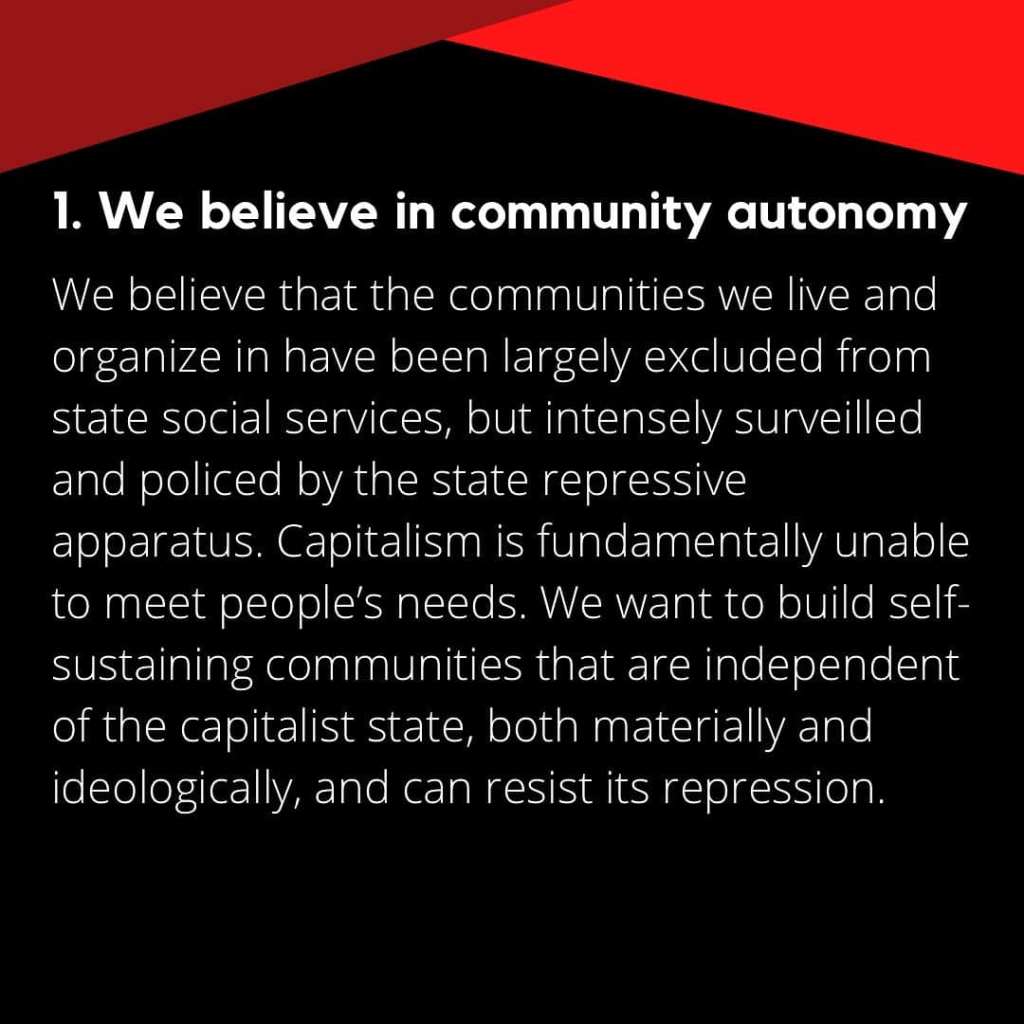
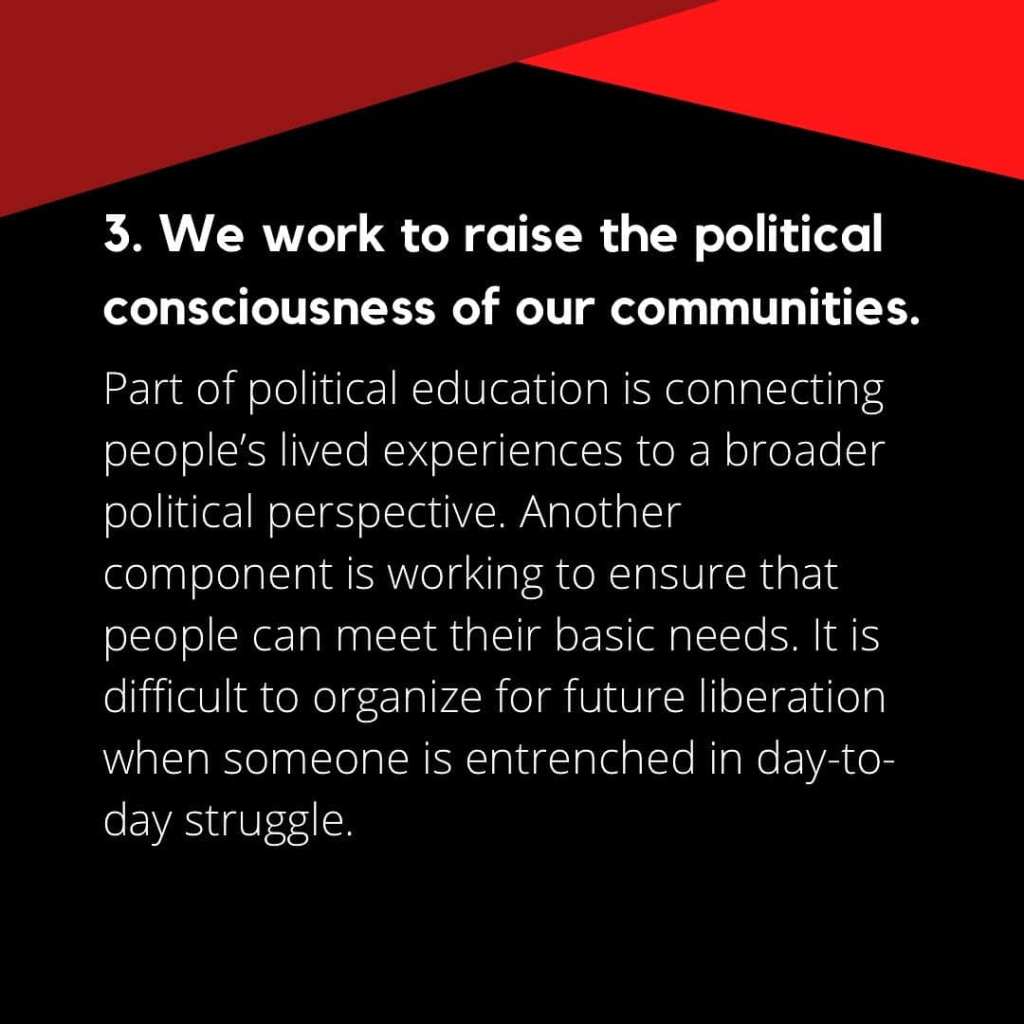
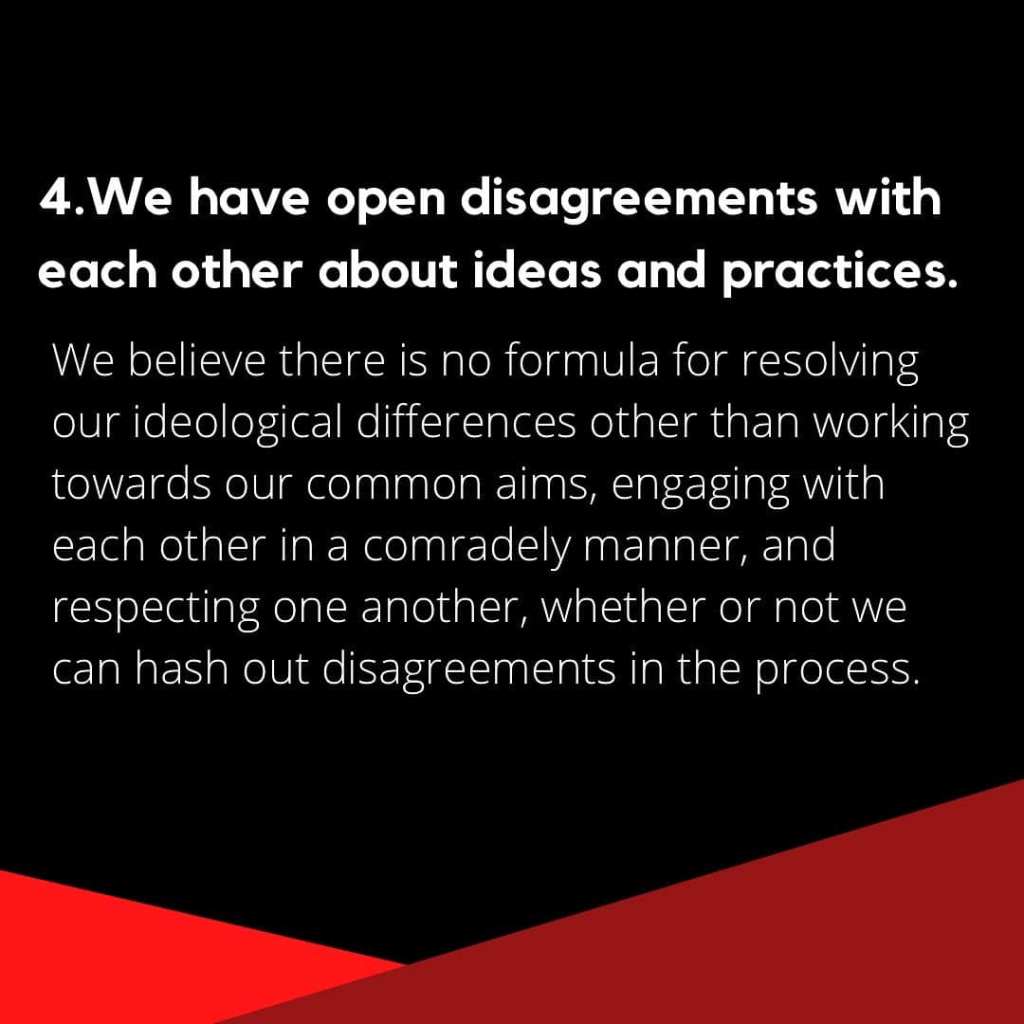
The Des Moines Mutual Aid’s (DMMA) Points of Unity expresses what Mutual Aid is about. DMMA has several projects. One is the free food distribution, which the following describes. This continues the Black Panther Party school breakfast program.

A principle of Mutual Aid is to invite others into the work, mobilizing people and building movements. The statement above is given to those who come to us for food, inviting anyone to join.

One of my Mutual Aid friends asked how I became involved (long story). Then she told me she used to come because she needed food. Now she is happy she can join in the work of distributing the food.

There are three key elements of Mutual Aid.

  1. Mutual aid projects work to meet survival needs and build shared understanding about why people do not have what they need.
  2. Mutual aid projects mobilize people, expand solidarity, and build movements.
  3. Mutual Aid projects are participatory, solving problems through collective action rather than waiting for saviors.

    Mutual Aid, Building Solidarity during this Crisis (and the next) by Dean Spade, Verso, 2020

Now all of us are facing food insecurity as we see grocery stores beginning to have trouble stocking their shelves. I hope this will result in more Mutual Aid projects.

A recent article reminded me about Food Not Bombs.

Every Wednesday, a mix of New Paltz college students and locals congregate in a small workspace just outside of town. It may look like they’re just cooking and packing food to deliver to needy families, but it’s really more than that.

“Like when people say, ‘serving the community,’ well, we want to build a community,” said Katari Sisa, a volunteer for Food Not Bombs New Paltz.

Sisa, a recent graduate of SUNY New Paltz, has been involved at the organization for the last four years now. Sisa says that giving back is necessary right now, with a pandemic raging and, according to data collected by the University of Southern California, nearly 37% of Americans are dealing with food insecurity.

“This is part of a larger project, kind of like a larger vision for a community center and having a kind of consistent spot to do stuff like this from,” Sisa said.

The ultimate goal, organizers say, is to build unity between people and create a more equitable community.

FOOD NOT BOMBS AIMS TO BRING MORE THAN JUST FOOD By John Camera, Spectrum Local News, February 3, 2021

Randomly passing an accomplice on the street and throwing up a fist at each other as we go our separate ways to destroy all that is rotten in this world will never fail to give me extra energy and a single tear of gratitude for what this city is creating.

my friend Ronnie James, Des Moines Mutua Aid

The Tipping Point that will destroy the world

George Monbiot is known for his environmental and political activism. He writes a weekly column for The Guardian and is the author of a number of books. Popular culture is finally beginning to be alarmed by environmental devastation. The movie Don’t Look Up being a current example.

I’m not promoting the reference to Double Down News at the end of the video, but here is a link to that website. Double Down News, The Future of Journalism.

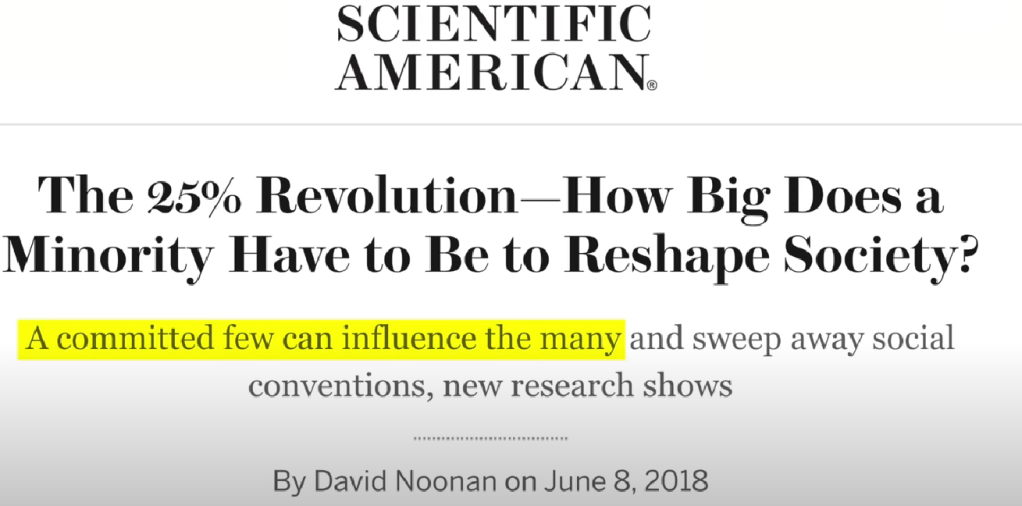
A new study about the power of committed minorities to shift conventional thinking offers some surprising possible answers. Published this week in Science, the paper describes an online experiment in which researchers sought to determine what percentage of total population a minority needs to reach the critical mass necessary to reverse a majority viewpoint. The tipping point, they found, is just 25 percent. At and slightly above that level, contrarians were able to “convert” anywhere from 72 to 100 percent of the population of their respective groups. Prior to the efforts of the minority, the population had been in 100 percent agreement about their original position.

The 25% Revolution – How big does a minority have to be to reshape society? by David Noonan, Scientific American, June 8, 2018

Many people have heard the following Margaret Mead quote. She was referring to a small percentage of people I think.

Never doubt that a small group of thoughtful, committed, citizens can change the world. Indeed, it is the only thing that ever has.

Margaret Mead

Auto-generated transcript of the video above, the tipping point that will destroy the world.

I doubt that 1% of people really understand what we’re facing here,
the prospect of systemic environmental collapse.
The collapse of the whole thing our life support systems in total.
Human beings alongside most of the life on earth today
evolved in particular environmental circumstances which is the earth
in what’s called its holocene state.
That state is kept in a sort of stable equilibrium by the ocean
the atmosphere, the biosphere which means all the life on earth,
the soil the water all of these are complex systems
which come together to create this amazingly complex system
called the earth system.
Complex systems have a set of interesting characteristics
through their self-regulating properties they can absorb
quite a lot of stress and still maintain an equilibrium state.
So if you think about your body you can run a mile
on a hot day really go for it and your body temperature remains
exactly the same as it was before you started.
You can go and have a snowball fight on a really cold day
and stay out for a couple of hours and your body temperature
is still exactly the same as when you started.
And what you’ve got is this system just constantly regulating itself,
and maintaining that body temperature.
But if you are subject to too much cold stress
or too much heat stress things spiral out of control.
And you can spiral into hypothermia
where you get colder and colder and then you die,
or into hyperthermia where you get hotter and hotter
and then you die.
We face quite a similar problem with our earth systems.
they reach a tipping point and once they pass that tipping point they collapse
into a completely different state and when you’ve collapsed when that tipping point has been crossed
there is no going back we’re trying to tell you that the entire planet is about to be destroyed
the way we know whether we are approaching a tipping point is that the outputs from a
system begin to flicker you get more and more fluctuations and what we’ve seen has been what
looks like a great global flickering these extreme weather events droughts heat domes
floods fires and the rest of it you do understand that this is an apocalyptic event i hear you
i hear you far more extreme than anything in the historical record and indeed anything in
the recent prehistorical record either this looks like the flickering which precedes
a tipping point we should be hostile to human life and indeed to most of the life on earth today
i say we sit tight and assess am i to understand correctly that after all of the information you’ve
received today the decision you’re making is to sit tight and assess if you were to take this
seriously you would be throwing at it everything we’ve got much as they did when a different
system the financial system came close to collapse in 2008. it didn’t quite pass its tipping point
but it came pretty close to that started with mortgage defaults in the u.s really quite small
but that was enough to destabilize this already quite fragile system and push the whole thing
until it came very near to total collapse when lehman brothers collapsed that nearly brought
the whole thing down and governments moved with extraordinary speed and decisiveness and poured
altogether trillions of dollars into the global financial system to try to shore it back and
push it back into its safe space into its safe equilibrium state now we can argue about whether
they did the right thing or the wrong thing and the way that they did it bailouts going
to the major criminals in the system and the rest of it we can argue about all that
but there is absolutely no doubt about the need for very rapid and decisive action if
we don’t stop the bleeding in three days half the banks in this room are out of business
in five days we’re all gone if we were to take the same attitude to the tipping point of our
earth systems that’s what we would be doing we’ll be moving in with extraordinary speed and effect
to make that decisive change right here right now rather than saying yeah let’s aim for net
zero by 2050 and we’ll reduce emissions by two percent every year it’s just not
going to work the president’s plan to save earth and make it so we can all have a home
is going to work right every single man woman and child on this planet is going to die i don’t like
him he makes me sad i’m sorry about that yeah kids listen to me you tell your parents if you’re going
to prevent a tipping point you have to push them back into their safe equilibrium state before they
reach that point if governments want things to happen they can make things happen if they choose
to but most of the time they just don’t what’s missing is not the money it’s not the technology
it’s the political will and how come they were ready to bail out the financial sector
but they’re not ready to bail out the planet is it because the planet isn’t paying them
to win the next election it’s not producing their campaign funds for them is it because
the oceans aren’t whispering into their ear is it because the forests don’t own the media
of course there’s only one story everyone’s talking about tonight
topless urgent care centers they are so hooked on the short-term interests of their corporate
sponsors or their oligarch sponsors that they’ll do whatever they want but they won’t do what it
takes to prevent the collapse of life on earth and i’m sure many of the people out there aren’t even
going to listen to what i just said because you know they have their own political ideology but
i i assure you i am not on one side or the other i i’m just telling you the [ __ ] truth now the
hopeful side of the story is this that just as earth systems are complex systems and they can tip
into a different state the same applies to human systems the same applies to society and we can
tip society into a different state and in fact there’s quite a lot of science being done on this
now both observational and experimental science once you get a committed minority of around 25
then the whole of society can tip most people most of the time side with the status quo for
good or for real very often for ill and once you reach that 25 that threshold
that seems to be where the tipping point is and then suddenly people look around and say oh things
have changed i better change with it and they tack round to catch that wind you’ve finally seen it
and that’s what we need to do that’s what we can do we just need to reach that 25
committed minority and society will change and so we need to get together in our millions
to demand the changes required to prevent systemic environmental collapse to demand
that we retain a habitable planet all effective movements are an ecosystem they
need lots of people using their different skills bringing those skills together
do what they do best the alternative media is absolutely essential it’s a crucial component
of that ecosystem of change so please support double down news become a sponsor on patreon

Notes to myself

This morning I’m seeking guidance for a way to discuss the concepts of, and my experiences with Mutual Aid in preparation for a discussion about that with my Quaker meeting.

Quakers have a long tradition of prayerfully reflecting upon a series of questions, we call queries, to facilitate our discussions of topics like education, social and economic justice, peace and nonviolence. You can see these queries here: Advices and Queries.

The brilliance of using questions stimulates each of us to engage with the topic, whether we speak aloud about our reflections or not. To facilitate reflection and prayer rather than being lectured to.

Developing queries about Mutual Aid to guide this discussion might be the best approach. So, what should the queries be?

We need to discuss:

  • What is Mutual Aid?
  • What are the pros and cons of charity?
  • Why is Mutual Aid not charity?
  • Examples of vertical and flat/horizontal hierarchy
  • What are Quaker hierarchies?
  • What is the state of our peace and social justice work now?
  • What is a beloved community?
  • Is Mutual Aid closer to being a beloved community than our current conditions?
  • Why is Mutual Aid important now?
  • What is the state of our current economic (capitalism), justice, healthcare, education, and political systems?
  • Is capitalism an unjust economic system?
  • What will we do when our community experiences environmental, economic and/or political catastrophe?
  • What will we do when our shelter, power, and sources of food and water are disrupted?
  • What should we do to prepare for the migration of climate refugees to our communities?
  • How can we provide spiritual support for our wider communities?
  • Can we build Mutual Aid groups when people are physically separated?
  • What are the potential advantages and disadvantages of Mutual Aid?

Although many on the list above are questions, they are not necessarily the best expression of the queries for the discussion. I’ll be working on that next.

Change is difficult. It is far easier to maintain the status quo. But our status quo is rapidly unraveling.

The question below, “what will your choice be?” comes from the Wet’suwet’en peoples who are trying to protect their pristine lands and water from pipeline construction. “We make choices as to enter the uncomfortable place of change & movement, or we continue on this downward spiral.” [At the present time the Royal Canadian Mounted Police are preparing to invade the Wet’suwet’en territory.]

“We make conscious decisions to either sit back and watch, or stand up and be heard.
We make choices as to whether protect our future generations, or we allow for a destitute future for them.
We make choices as to enter the uncomfortable place of change & movement, or we continue on this downward spiral.
What will your choice be?
Will you sit back and allow for human rights violations to occur, or will you #RiseUp with us?”


Wet’suwete’n Access Point at Gidemt’en Facebook Page

Embracing Mutual Aid might be uncomfortable for some. Will we have the courage to enter the uncomfortable place of change and movement?

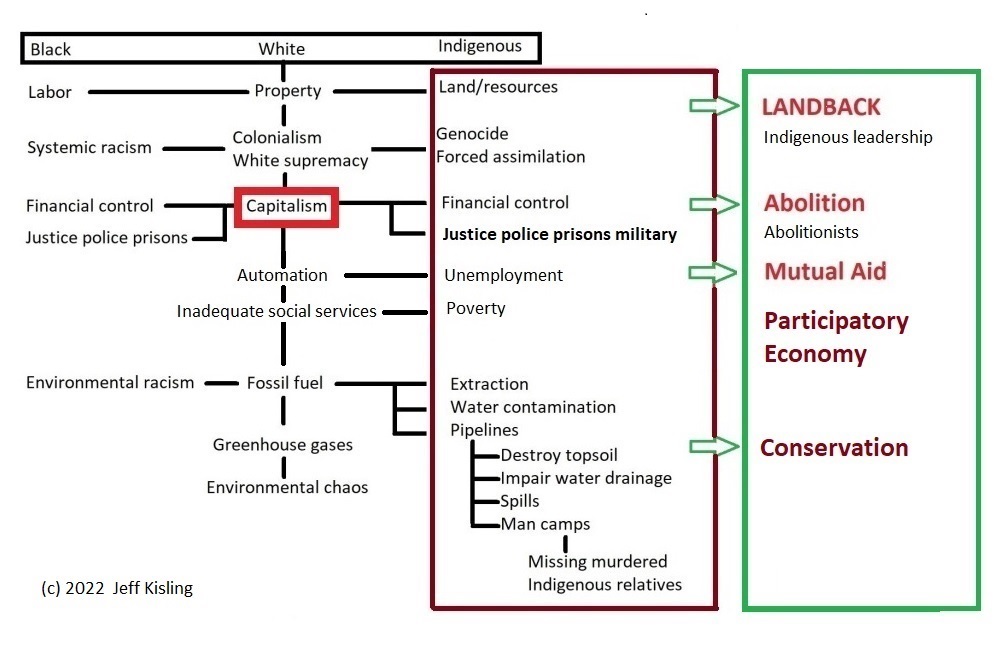
I’ve been working on this diagram to show relationships between the current situation and how Mutual Aid fits into this larger picture. I don’t think there will be time to include much of this in this Sunday’s discussion. But Mutual Aid is one piece of several changes (LANDBACK, Abolition and a better economic system) we need to make urgently.

There are three key elements of Mutual Aid.

  1. Mutual aid projects work to meet survival needs and build shared understanding about why people do not have what they need.
  2. Mutual aid projects mobilize people, expand solidarity, and build movements.
  3. Mutual Aid projects are participatory, solving problems through collective action rather than waiting for saviors.

    Mutual Aid, Building Solidarity during this Crisis (and the next) by Dean Spade, Verso, 2020

What I don’t know about Mutual Aid

Disclaimer: Before getting to that, I think I should make a disclaimer, especially since I shared the 2021 Peace and Social Concerns report of my yearly meeting, Iowa Yearly Meeting (Conservative). I included that because Mutual Aid is mentioned in the report. “These injustices are some of the effects of systems of white supremacy. The concept of Mutual Aid is becoming an increasingly used model for communities working for justice. The idea is to have a horizontal hierarchy, where everyone has a voice. And work to ensure a vertical hierarchy does not develop. Without a vertical hierarchy, there can, by definition, be no superiority. Several of our meetings are supporting existing Mutual Aid communities or considering creating their own. These are opportunities to begin to disengage from the colonial capitalist system and white supremacy. Ways we can model justice in our own meetings and communities.”

But that doesn’t mean what I’ve been writing on this blog has been approved by the Yearly Meeting.

What I do know about Mutual Aid comes from my two years of experience with Mutual Aid in Des Moines.

I met Ronnie James, and Indigenous organizer and now close friend, when he came to a vigil we held in February 2020 in support of the Wet’suwet’en people’s struggles to prevent the construction of the Coastal GasLink pipeline through their territories. He came because he wanted to know who was supporting the Wet’suwet’en, because their struggles were not being covered in the mainstream media. That was a good organizing strategy, a way to find allies.

Because of the COVID pandemic, he and I didn’t meet in person for several months. But during that time, he was very generous in teaching me about his work with Des Moines Mutual Aid (DMMA). I quickly saw there was much more to Mutual Aid than just distributing free food, or propane tanks for the houseless in winter. I could also tell the people involved in DMMA were very careful about who they associated with because they were on the police radar, so to speak. Several had been arrested, some several times, as they demonstrated to support Des Moines Black Liberation’s protests of police violence after the killing of George Floyd.

But after months of email exchanges, I felt we were getting to know each other well enough that I could ask if it would be appropriate to participate in his work. I knew it was important for allies to be careful about inviting ourselves into situations in ways that are not appropriate.

Fortunately, he said yes, and I have been participating in the food distribution part of Des Moine Mutual Aid nearly every Saturday morning since (for more than a year).

I thought I would see how this worked for a few weeks, and that might be the end of it. But I found the actual experience of being present in this community taught me so much that words written in emails could not.

When I arrived that first morning, apprehensive about what might happen, I was told this was Mutual Aid, which meant all of us were encouraged to take any food we wanted, ourselves. For many weeks I did not take any, but finally realized that was a mistake. It was like I wasn’t really buying into the mutual part of this. I realized this when one of my new friends, in a friendly manner, asked why I wasn’t taking any food. Now I do.

I also witnessed the truly uplifting way every volunteer greeted each car of people who came for the food. It was always, “hi, how are you doing? Have a great day.”

I also saw this insistence of avoiding any kind of vertical hierarchy. No one said, “do this, do that…”. When there was a problem, anyone with a solution was expected to just do it. Or when the van of food arrived, someone would say “the van is here” and whoever wasn’t doing something else would just go out and help unload the food.

Also, one of my new friends who volunteered to help with the food distribution told me she was once in the position of needing the food herself.

And I know my friends always show up. As they did yesterday, New Year’s Day, with a wind chill of -11 degrees. As we had on Christmas day the week before.

So a new person has to learn a new way of working together. Learn how to act in a situation where you aren’t told what to do by someone above you in a vertical hierarchy. To learn to be always aware of what is going on around you. See if there is something that needs to be done, then do it yourself.

Multiple times I’ve heard someone say these Saturday mornings together are the best part of their week. I feel that, too. That’s one of the important parts of Mutual Aid. We are enthusiastic about this work. It pulls people in when they are doing something that has an immediate impact.

This is one of the many reasons I’m encouraging Friends and others to learn about, create and participate in Mutual Aid. Most of the Quaker meetings I’m aware of have dwindling numbers of people attending their meetings. And we don’t attract many/any young people or Black, Indigenous and other people of color (BIPOC).

I’ve thought we should have more workcamps, as we did when I was growing up. Those were experiences people appreciated. Mutual Aid can be the answer today.

But there is a more fundamental reason to adopt Mutual Aid. We need to accept that our political and economic systems are failing. Are not meeting our needs. “We” being those of us fortunate to have had livable incomes. Those who don’t have known the failure of these systems their entire lives. We have no choice but to come up with alternatives. I believe Mutual Aid is one alternative.

Finally, we get to what I don’t know about Mutual Aid. The key to Mutual Aid is for everyone in the community to be involved in the work. But most of us live some distance from our Quaker meetings. Is it possible, or desirable, to find ways to create Mutual Aid communities if people are not physically present with each other? Is ZOOM Mutual Aid possible, or desirable?

I don’t know. If you have some ideas about this, please write them in the comments.

Thank you.

Bear Creek Friends

Resolve to be always beginning

Resolve to be always beginning — to be a beginner. –Rainer Maria Rilke

I’m hoping some Friends might consider Mutual Aid to be part of their new story this new year. Yesterday’s post was an introduction.

This is a link to a lot more information about my experiences with Mutual Aid. Mutual Aid in the Midwest

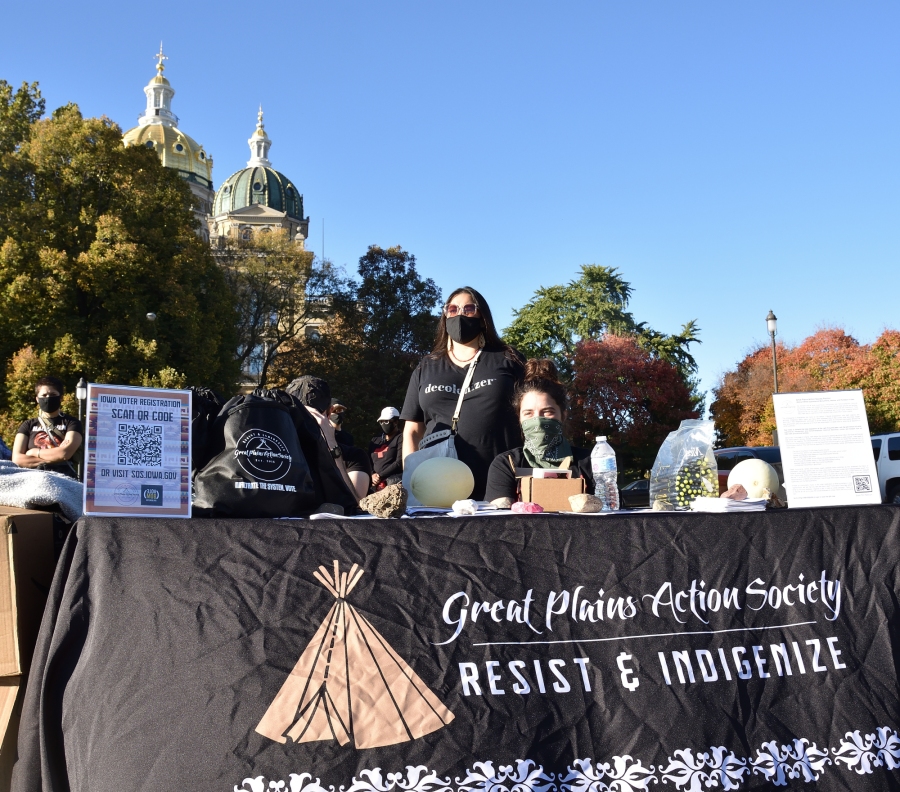
I realize I didn’t explain yesterday’s comment about friendships with native people. Indigenous peoples have always lived in ways that could be seen as Mutual Aid. And my good friend Ronnie James, an Indigenous organizer, has been my Mutual Aid mentor from the beginning of my experiences. This work is supported by the Great Plains Action Society that Ronnie is part of.

We are Indigenous Peoples of the Great Plains proactively working to resist and Indigenize colonial-capitalist institutions and behaviors. We defend the land where our ancestors lie and where the children walk. Our goal is to reclaim what has been stolen and oppressed to create a better world for us all.

Great Plains Action Society

New Year’s resolutions tend to be about wanting more of something we desire and/or less of something we do not, and while they surely have their noble side, they also often emanate from subtle and less subtle forms of perceived lack, scarcity, comparison, self-flagellation, and judgment. The “should” and “should not” messages we send ourselves when we make resolutions can be harsh and incriminating. These are qualities we may want to endeavor not to perpetuate and strengthen when we make our commitments this year.

How about making “the means more of the ends” by putting gratefulness rather than scarcity at the center of the resolutions we make this year? How about bringing a more gentle form of motivation, rooted in appreciation, celebration, and acceptance, to our goals? How about letting gratitude guide us?

Turn New Year’s Resolutions into Revelations by Kristi Nelson, syndicated from gratefulness.org, Jan 01, 2022

Why the Fundamental Challenge of the 21st Century is Community

umair haque writes a daily article on his website, Eudaimonia & Co. His December 26 article “Why the Fundamental Challenge of the 21st Century is Community” provides an interesting perspective on my recent experiences with Mutual Aid and evolving vision for what could come next.

umair says we need to expand our sense of moral community to include everything, living and inanimate. And “the way of enmity, the way of violence, dominance, hierarchy, greed, hate — it must end.”

Those are some of the reasons I’ve been led to become involved with Mutual Aid, which is about building communities and rejecting dominance and hierarchy. Reasons why I believe my Quaker faith community should embrace the concepts of Mutual Aid.

These are also reasons I believe faith communities have an especially important role to play now, to help “expand our sense of moral community”. Quakers are the Religious Society of Friends. umair writes “what is the bond between members of a moral community? Friendship.”

As my friend Ronnie James says:

As bleak as this is, there is a significant amount of resistance and hope to turn the tide we currently suffer under. We stand on the shoulders of giants that have been doing this work for centuries, and there are many lessons we can learn from.

The first, and possibly the most important, is that it was not always this way, which proves it does not have to stay this way. 

What we have is each other. We can and need to take care of each other. We may have limited power on the political stage, a stage they built, but we have the power of numbers.

Those numbers represent unlimited amounts of talents and skills each community can utilize to replace the systems that fail us.  The recent past shows us that mutual aid is not only a tool of survival, but also a tool of revolution. The more we take care of each other, the less they can fracture a community with their ways of war. Organized groups like The American Indian Movement and the Black Panther Party for Self Defense showed that we can build not only aggressive security forces for our communities, but they also built many programs that directly responded to the general wellbeing of their communities. This tradition began long before them and continues to this day. Look into the Zapatistas in Southern so-called Mexico for a current and effective example.

These people’s security forces, or the “policing of the police” not only helps to minimize the abuse and trauma they can inflict on us, but it begins to shift the power balance from them to us.

Mutual Aid programs that help our most marginalized or other events that work to maintain our spirits result in stronger communities. A strong community is less vulnerable to police intrusion. 99% of our conflicts can be solved by those affected by them, but only with the support of those around them. Anytime we call on the police to mediate our problems, we are risking ourselves or a loved one from being hurt or worse.

We each have skills and resources we can utilize towards the abolition project. Some of us can use the halls of the system to make short term change there, others have skills that produce food, provide medical care, or care for our precious youth, some are skilled in the more confrontational tactics needed. Once we envision that world our ancestors want for us, finding our role is natural.

If we are to survive, and more importantly, thrive, we know what we will have to do.

The Police State and Why We Must Resist, Ronnie James, Des Moines Mutual Aid

Now think of the next set of problems we face as a civilization. “Climate change,” aka global warming, ecological collapse, and mass extinction. They are already beginning to hit us hard. How much longer will parts of the American West or Australia be livable? How long is it until whole water systems and energy grids begin to fail? How much longer before we hit tipping points — like the ice-caps albedo, how much they reflect the sunlight, diminishes and pushes warming to runaway state?

To solve those problems, we need to expand our sense of moral community much, much more radically and dramatically. Animals have to be included in our moral community, as aware, feeling, truly living things, whose lives have intrinsic and inherent worth — not just meat to slaughter. So too do trees and rivers. So too do the icecaps and oceans.

Our moral community has to expand so radically and dramatically that we begin to see the world around us in terms that resemble the ancient world much more than the modern one. For the ancients, the world was alive — with the spirits of nature. Poseidon, the God of the Sea was a member — an elder, in fact — of the moral community in the West. You didn’t want to anger him, by, say, polluting the ocean the way we do. In other places, everything from animals to the wind itself was a member of the moral community — and treated with respect and dignity and friendship.

What is the bond between members of a moral community? Friendship. What do I miss about Europe? Friendship — like between me and the people in my neighbourhood, the way that we’ll just stop in the street and talk for half an hour, and before we know it the sun’s setting, so why don’t you come over for dinner? Friendship is what binds members of a moral community. It’s the reason I can’t order you to be an attack mob, like pundits in other places can and do. We have bonds of friendship — you and me, amongst this whole community. What we don’t have is bonds of subservience, hierarchy, dominance, sealed and reproduced by violence.

“Why the Fundamental Challenge of the 21st Century is Community” by umair haque, Eudaimonia & CO., Dec 26, 2021

Enmity is the force rising in the world. The values of the tribe are rising — hate, violence, dominance, hierarchy. That is why there is this perpetual search for scapegoats and scarecrows — that is what tribes need to go on existing, punching bags, untouchables, enemies.

But the lesson should be clear. The way of enmity only leads to disaster. Look at Britain. Look at America. Look at the way the West won’t spend pennies, literally, to end the pandemic — while it cries alligator tears that yet another wave has hit it. The way of enmity, the way of violence, dominance, hierarchy, greed, hate — it must end.

Civiliation does not have a future with those values. Humanity does not have a future with those values. There is nothing left to exploit. There is no enemy left to blame. The only enemy left is us.

Our moral community has to expand radically and dramatically. In this century. Beginning now. In the next decade or two — three, tops — it must begin to include all of life. Every tree, forest, ocean, river, icecap. Or else they will all disappear, and we will perish, in great waves of pain and despair, right along with them. Millions upon millions of us will die, in more and more extreme and terrible ways. I don’t say that to scare you, or threaten you. I say it because it shouldn’t happen.

“Why the Fundamental Challenge of the 21st Century is Community” by umair haque, Eudaimonia & CO., Dec 26, 2021

COP 26 and continued colonial capitalism

As expected, little was accomplished at the recent COP 26 meetings because countries with capitalist economic systems were in control. Industrial nations’ policies will continue to protect the capitalist economic system and the fossil fuel industry regardless of the environmental consequences.
See: https://landbackfriends.com/?s=capitalism

The Free
https://thefreeonline.wordpress.com/2021/09/29/its-decolonization-or-extinction-and-that-starts-with-land-back/

I often write about the necessity of replacing the capitalist economic system as essential to addressing our evolving environmental catastrophes. Recently The Free blog of post-capitalist transition re-blogged my post, It’s Decolonization or Extinction. And that starts with Land-Back. Many people and organizations are working toward a post-capitalist world.

And yet, even as humanity faces perhaps the greatest existential crisis in its species’ history, the public debate on climate barely mentions the underlying economic system that brought us to this point and which continues to drive us toward the precipice. Ever since its emergence in the seventeenth century, with the creation of the first limited liability shareholder-owned corporations, capitalism has been premised on viewing the planet as a resource to exploit — its overriding objective to maximize profits from that exploitation as rapidly and extensively as possible. Current mainstream strategies to resolve our twin crises of climate breakdown and ecological overshoot without changing the underlying system of growth-based global capitalism are structurally inadequate

Solving the Climate Crisis Requires the End of Capitalism by Jeremy Lent, originally published by Patterns of Meaning, October 13, 2021

Current mainstream strategies to resolve our twin crises of climate breakdown and ecological overshoot without changing the underlying system of growth-based global capitalism are structurally inadequate

Jeremy Lent

This is doubly tragic because the dominance of capitalist governments also meant Indigenous peoples didn’t have a voice at COP 26. It is Indigenous knowledge that can help repair Mother Earth.

“The Cop is a big business, a continuation of colonialism where people come not to listen to us, but to make money from our land and natural resources,” said Ita Mendoza, 46, an indigenous land defender from the Mixteca region of Oaxaca in southern Mexico, attending Cop for the first time. “What benefits does the Cop bring when more than a thousand people fighting to keep the planet alive have been killed [since Paris]?”

“It’s a testament of our resilience that even after hundreds of years of colonization and betrayal that we indigenous communities are still willing to sacrifice our lives, health and energy for this last-ditch attempt to save the planet,” said Ruth Miller, climate justice director of the Alaska-based Native Movement, a Dena’ina Athabaskan and Ashkenazi Russian Jewish woman, who is a member of the Curyung tribe.

“We’re here offering sustainable solutions to the rest of the world that require an ideological shift, not a green industry built on colonialism and repression. It’s up to them if they listen or not.”

INDIGENOUS VOICES ARE MISSING AT COP26 by Nina Lakhani, The Guardian, November 4, 2021

As the United Nations Climate Change Conference—also known as COP26—got underway in Glasgow, Scotland this week, Indigenous activists from around the world warned that failure to center their peoples’ voices and solutions would seriously hamper efforts to tackle the growing planetary emergency.

“We can develop actions based on our culture and our traditional knowledge.”

“Today, the climate is warming, the animals are disappearing, the rivers are dying and our plants don’t flower like they did before,” Txai Suruí, a law student, activist, and member of the Paiter Suruí people of northwestern Brazil, said during Sunday’s COP26 opening ceremony. “The Earth is speaking. She tells us that we have no more time.”

“Indigenous people are in the frontline of the climate emergency, and we must be at the center of the decisions happening here,” she stressed. “We have ideas to postpone the end of the world.”

Kyle Whyte, a member of the Citizen Potawatomi Nation in Oklahoma who serves on U.S. President Joe Biden’s White House Environmental Justice Advisory Council, told NBC News that “if countries don’t get on board with us, leaving out the people who steward a lot of the lands, it’s not just a moral issue anymore. It will have a devastating effect on the speed at which the rest of the world will get to sustainability.”

‘The Earth Is Speaking’: Indigenous Activists Tell COP26 There’s No Climate Solution Without Them. “Indigenous people are in the frontline of the climate emergency, and we must be at the center of the decisions happening here. We have ideas to postpone the end of the world.” by BRETT WILKINS, Common Dreams, November 1, 2021

Capitalism must be reprogrammed with mutual aid

There is a lot of attention on the COP26 climate conference in Glasgow, Scotland. I am certain little will be done that can even slow down the rapidly accelerating environmental chaos for several reasons.

Industrial nations have waited far too long to begin to seriously work to get greenhouse gas emissions under control. While every effort should be made to cut emissions, it is painfully obvious that protecting our environment is not a priority of industrialized nations, which continue to expand fossil fuel projects and to subsidize the fossil fuel industry.

Existing governments’ policies will continue to protect the capitalist economy regardless of the environmental consequences. This means we must replace the capitalist economic system. See also: Rejecting capitalism

There is a time lag between the injection of emissions into the atmosphere, and when the effects of those emissions are seen. If burning fossil fuels ended immediately, carbon dioxide levels would continue to rise.

The Alternative?

For thousands of years Indigenous peoples have lived in harmony with Mother Earth. We must follow Indigenous leadership now. See: Indigenous Led Green New Deal

Although the world’s Indigenous population continues to experience unequal access to influential forums such as COP26, they have had an outsize role in calling attention to the impacts of climate change.

Globally, Indigenous people comprise only 5 percent of the population yet manage 80 percent of the world’s biodiversity such as forests, tundra and mountains. And although they exert the smallest carbon footprint, they are among the most vulnerable to the impacts of climate change, according to research published in the academic journal, Nature Sustainability.

“Indigenous peoples are action makers, innovators, through their traditional knowledge,” wrote Hindou Oumarou, a member of the Facilitative Working Group, in the United Nations Sustainable Development Goals blog. Ibrahim is a member of the Mbororo pastoralist people in Chad and president of the Association for Indigenous Women and Peoples of Chad.

“For centuries, Indigenous peoples have protected the environment, which provides them food, medicine and so much more,” she said. “Now it’s time to protect and benefit from their unique traditional knowledge to bring concrete and natural solutions to fight climate change.”

INDIGENOUS LEADERS FACE BARRIERS TO UN CLIMATE CONFERENCE By Mary Annette Pember, Indian Country Today, September 18, 2021


… what if the question all water protectors and land defenders asked was, why don’t we just overturn the system that makes development a threat in the first place? This system, again, is capitalism. 

Rather than taking an explicitly conservationist approach, the Red Deal instead proposes a comprehensive, full-scale assault on capitalism, using Indigenous knowledge and tried-and-true methods of mass mobilization as its ammunition. In this way, it addresses what are commonly thought of as single issues like the protection of sacred sites—which often manifest in specific uprisings or insurrections—as structural in nature, which therefore require a structural (i.e., non-reformist reform) response that has the abolition of capitalism via revolution as its central goal.

We must be straightforward about what is necessary. If we want to survive, there are no incremental or “non-disruptive” ways to reduce emissions. Reconciliation with the ruling classes is out of the question. Market-based solutions must be abandoned. We have until 2050 to reach net-zero carbon emissions. That’s it. Thirty years.

The struggle for a carbon-free future can either lead to revolutionary transformation or much worse than what Marx and Engels imagined in 1848, when they forewarned that “the common ruin of the contending classes” was a likely scenario if the capitalist class was not overthrown. The common ruin of entire peoples, species, landscapes, grasslands, waterways, oceans, and forests—which has been well underway for centuries—has intensified more in the last three decades than in all of human existence.

Nation, The Red. The Red Deal (pp. 21-22). Common Notions. Kindle Edition.


Following is a diagram I’ve been working on to illustrate the dangers of capitalism, and the alternatives, LandBack, Abolition, and Mutual Aid.


I’m of the firm opinion that a system that was built by stolen bodies on stolen land for the benefit of a few is a system that is not repairable. It is operating as designed, and small changes (which are the result of huge efforts) to lessen the blow on those it was not designed for are merely half measures that can’t ever fully succeed.

So the question is now, where do we go from here? Do we continue to make incremental changes while the wealthy hoard more wealth and the climate crisis deepens, or do we do something drastic that has never been done before? Can we envision and create a world where a class war from above isn’t a reality anymore?”

Ronnie James

capitalism must be reversed and dismantled. meaning that capitalistic practices must be reprogrammed with mutual aid practices

Des Moines Black Liberation

mutual aid is the new economy. mutual aid is community. it is making sure your elderly neighbor down the street has a ride to their doctor’s appointment. mutual aid is making sure the children in your neighborhood have dinner, or a warm coat for the upcoming winter. mutual aid is planting community gardens.
capitalism has violated the communities of marginalized folks. capitalism is about the value of people, property and the people who own property. those who have wealth and property control the decisions that are made. the government comes second to capitalism when it comes to power.
in the name of liberation, capitalism must be reversed and dismantled. meaning that capitalistic practices must be reprogrammed with mutual aid practices.

Des Moines Black Liberation

Updates from the Wet’suwet’en

Following are updates related to the continuing struggles of the Wet’suwet’en peoples related to the attempted construction of the Coastal GasLink pipeline through their territories. One of the reasons I follow this work so closely is because this is a real time example of the Indigenous leadership we need now.

WET’SUWET’EN STRONG, ONE MONTH ON:
Coyote Camp Victory on the Gidimt’en Frontline

We’re celebrating over one month of Wet’suwet’en re-occupation on Cas Yikh yintah, where Coastal GasLink plans to destroy Wedzin Kwa. Our call out for allies was answered! We have boots on the ground and ongoing solidarity actions from our relatives all across so-called canada. This struggle is far from over but we will never give up. We need your support now! Join us at camp or organize where you are.
United, we will no longer endure genocide against our people!
Come to the land. yintahaccess.com/come-to-camp
Host a solidarity rally.
Pressure government, banks, and investors.
yintahaccess.com/take-action-1
Donate. http://go.rallyup.com/wetsuwetenstrong
Spread the word. #WetsuwetenStrong #AllOutForWedzinKwa #NoPipelineNovember

Gidimt’en Access Point

RBC IS KILLING ME
Oct 29th Global Day of Action
Wet’suwet’en Territories Cas Yikh Yintah

Gidimt’en Checkpoint is turning up the heat and putting pressure on the top five funders of the Coastal GasLink project, like RBC that continue to violate Wet’suwet’en Sovereignty and criminalize Wet’suwet’en title.

These projects spend millions of dollars on Royal Canadian Mounted Police (RCMP) who harass and restrict Wet’suwet’en Hereditary Chiefs and members from their territories. The RCMP’s violent raids with lethal overwatch and removing us from our own lands are in direct opposition to Indigenous constitutional rights and UNDRIP.

RBCIsKillingMe represents the irreversible destruction that this pipeline brings to the Lands, Salmon, Waters, Our People and all earths inhabitants. It is all of our responsibility to stand up and save the earth and our future generations.

RBC is the biggest funder of fossil fuels in Canada. The company has poured over $200 Billion into fossil fuel investments since the Paris climate agreement was signed. Let’s let these Investors know to Divest in projects that contribute to Climate Chaos and to STOP KILLING US!

On November 1st, the UN climate conference in Glasgow (COP26) will begin, with a focus on climate finance. This provides us with a crucial opportunity to pressure RBC into ceasing fossil fuel investment and respecting Indigenous rights.

For more info visit yintahaccess.com
#AllOutForWedzinKwa


Spiritual basis of justice work

This morning my Quaker meeting will continue to discuss our work for peace and justice. In preparation, I’ve been praying about the spiritual basis of justice work.

Quakers have a long history of work related to Indigenous peoples, including participation in the institutions of forced assimilation (sometimes referred to as boarding or residential schools).

In the following, Paula Palmer writes about her spiritual leading that led to a ministry related to Quakers and Native peoples. She writes, “from our twenty-first-century vantage point, we know (or can learn) how Native people suffered and continue to suffer the consequences of actions that Friends committed 150 ago with the best of intentions. Can we hold those good intentions tenderly in one hand, and in the other hold the anguish, fear, loss, alienation, and despair borne by generations of Native Americans?”

What happened at those institutions is generating attention these days as the remains of thousands of children are being uncovered on the grounds of these institutions.

What I’ve been praying about for years is how Quakers could have become involved in those institutions? Not to judge what individual Friends might have done but wondering how the Spirit could have guided them to participate. This is a clear example of white supremacy and dominance. Those involved thought the Native children should be forced to learn the ways of the white society that was engulfing them.

This has led me to pray about:

  • How can Friends work spiritually toward truth and reconciliation?
  • What things might we be doing now that are not spiritually grounded?
  • How can we challenge and support each other to seek a spiritual basis for our work now?

As Paula Palmer writes, “who are Friends today? Knowing what we know now, will Quakers join us in honest dialogue? Will they acknowledge the harm that was done? Will they seek ways to contribute toward healing processes that are desperately needed in Native communities?”

Last year I responded to a call that came from two sources: from Spirit, in the manner of Friends experiencing leadings, and from a coalition of Native American organizations that is working to bring about healing for Native people who still carry wounds from the Indian boarding schools.

My leading started with a nudge four years ago and grew into a ministry called Toward Right Relationship with Native Peoples. This ministry has grown in depth and breadth under the loving care of the Boulder (Colo.) Meeting. Working in partnership with Native American educators, I learned about their efforts to bring healing to the Native people, families, and communities that continue to suffer illness, despair, suicide, violence, and many forms of dysfunction that they trace to the Indian boarding school experience.

The National Native American Boarding School Healing Coalition says that for healing to occur, the full truth about the boarding schools and the policy of forced assimilation must come to light in our country, as it has in Canada. The first step in a truth, reconciliation, and healing process, they say, is truth telling. A significant piece of the truth about the boarding schools is held by the Christian churches that collaborated with the federal government’s policy of forced assimilation. Quakers were among the strongest promoters of this policy and managed over 30 schools for Indian children, most of them boarding schools, during the nineteenth and early twentieth centuries. The coalition is urging the churches to research our roles during the boarding school era, contribute this research to the truth and reconciliation process, and ask ourselves what this history means to us today.

Native organizations are not asking us to judge our Quaker ancestors. They are asking, “Who are Friends today? Knowing what we know now, will Quakers join us in honest dialogue? Will they acknowledge the harm that was done? Will they seek ways to contribute toward healing processes that are desperately needed in Native communities?” These are my questions, too.

Quaker Indian Boarding Schools. Facing Our History and Ourselves by Paula Palmer, Friends Journal, Oct 1, 2016


The country known as Canada went through a year’s long process of truth and reconciliation. The document referenced below is about what was learned in that process. A similar process is beginning in the land called the United States.
See: https://landbackfriends.com/2021/10/26/native-american-legislative-update/


It is due to the courage and determination of former students—the Survivors of Canada’s residential school system—that the Truth and Reconciliation Commission of Canada (TRC) was established. They worked for decades to place the issue of the abusive treatment that students were subjected to at residential schools on the national agenda. Their perseverance led to the reaching of the historic Indian Residential Schools Settlement Agreement.
All Canadians must now demonstrate the same level of courage and determination,
as we commit to an ongoing process of reconciliation. By establishing a new and respectful relationship between Aboriginal and non-Aboriginal Canadians, we will restore what must be restored, repair what must be repaired, and return what must be returned.

What We Have Learned. Principles of Truth and Reconciliation. The Truth and Reconciliation Commission of Canada

Minute approved by Iowa Yearly Meeting (Conservative)

To this day we have not come to grips with fundamental injustices our country was built on, the cultural genocide and theft of land from Native Americans, the enslavement of African Americans and the legal justifications of bestowing rights and privileges on white land-owning men. The consequences of these injustices continue to plague our society today. And will continue to impact us until we do what is necessary to bring these injustices to light and find ways to heal these wounds.

Several Friends recently assisted Boulder Meeting Friend, Paula Palmer, to lead workshops and discussions as part of her ministry “toward right relationships with Native people.” Part of the tragedy of the theft of Native land is that some Native people don’t have the concept of land as property, belonging to a landowner. Rather they have a spiritual connection to Mother Earth, that the land is sacred and not something that can be claimed as property by anyone. Being forced to leave their land broke their spiritual bonds with the land.

Native people have asked us to begin work toward reconciliation and healing. The first step needed is truth telling, recognizing that injury or harm has taken place. One of the important parts of holding “right relationship” workshops is to determine which Native nations were on the land before white settlers arrived.

Iowa Yearly Meeting (Conservative) 2019