Native American Legislative Update

Following are legislative updates for October from Portia K. Skenandore-Wheelock, Congressional Advocate, Native American Advocacy Program, Friends Committee on National Legislation (FCNL). This is a link to information from FCNL related to Native Americans. On that page you can sign up to receive these legislative updates. https://www.fcnl.org/issues/native-americans

The Friends Committee on National Legislation is a national, nonpartisan Quaker organization that lobbies Congress and the administration to advance peace, justice, and environmental stewardship. https://www.fcnl.org/about

This month’s action is to Support the Establishment of a Truth and Healing Commission on Indian Boarding Schools.

“It is long overdue for the United States to acknowledge the historic trauma of the Indian boarding school era. In the 19th and early 20th centuries, Christian churches collaborated with the government to create hundreds of boarding schools for Native American children. The conditions at these schools, some of them Quaker-run, were unspeakable.
Now we must work with tribal nations to advance congressional efforts to establish a federal commission to formally investigate boarding school policy and develop recommendations for the government to take further action. Although the wrongs committed at these institutions can never be made right, we can start the truth, healing, and reconciliation process for the families and communities affected as we work to right relationship with tribal nations.
Remind your members of Congress of their responsibility to tribal nations and urge them to support the Truth and Healing Commission on Indian Boarding School Policies in the United States Act (S. 2907/H.R. 5444).”

This link will help you write and send a letter of support for the establishment of a Truth and Healing Commission.

As a constituent and person of faith, I welcome the introduction of the Truth and Healing Commission on Indian Boarding School Policies Act (S. 2907/H.R. 5444) and urge you to support this important legislation.

From the 1860s through the 1960s, U.S. federal boarding school policy sought to assimilate more than 100,000 Native children into white American culture at 367 boarding and day schools operated by 14 different denominations. The traumatic separation of Native children from their families, identity, traditions, and spiritual beliefs was often coupled with psychological and physical abuse administered at these institutions. Heartbreakingly, many of these children never returned home.

The faith community has begun acknowledging our complicity in the historic trauma of the boarding school era and is committed to locating, cataloguing, and sharing boarding school records with the commission and the public as part of the truth-telling process. Given the scale of this effort and the government’s central role in boarding school policy, I call on you to join this important work and establish a federal commission to formally investigate boarding school policy and develop recommendations for the government to take further action.

The intergenerational impact of federal boarding school policy is still felt today. Loss of indigenous languages and cultures, injury to tribal governance and sovereignty, and high poverty, poor health, and growing suicide rates continue to harm tribal communities across the country. The establishment of the commission is an important first step in starting the truth, healing, and reconciliation process for all of us.

I urge you to co-sponsor this vital legislation and make a public statement in support of it and ask that you encourage your colleagues in Congress to do the same.

Quaker Lobby Backs Indian Boarding School Investigation Legislation by Timothy McHugh, FCNL, October 4, 2021

Washington, DC – The Friends Committee on National Legislation (FCNL) welcomed late last week’s introduction of important legislation to investigate and address the atrocities committed at Indian boarding schools throughout the United States in the 19th and 20th centuries.

Contact Tim McHugh: media@fcnl.org, 202-903-2515

“For far too long, the truth of cultural genocide led by European-Americans at Indian boarding schools has remained hidden in secrecy and ignored. Christian churches, including Quakers, carry this burden of transgression against indigenous people. It is necessary and important for our government to investigate, acknowledge, and report the truth to help us move toward healing the injustice against American Indians, Alaska Natives and Native Hawaiians,” said Diane Randall, FCNL’s general secretary.

“History cannot be undone. But it also can’t be ignored. The faith community must acknowledge our complicity in the historic trauma of the boarding school era and work in solidarity with tribal nations to advance congressional efforts to establish a truth, reconciliation, and healing process for the families and communities affected,” Randall concluded.

Senator Elizabeth Warren (MA), Representative Sharice Davids (KS), and Representative Tom Cole (OK) introduced the Truth and Healing Commission on Indian Boarding School Policies in the United States Act to establish the first formal commission in US history to investigate and document the attempted termination of cultures and languages of Indigenous peoples, assimilation practices, and human rights violations that occurred against American Indians, Alaska Natives, and Native Hawaiians through Indian Boarding School policies. A final report will be due within five years of the commission’s creation.

“This bill is a positive first step toward addressing not only the crimes of the boarding school era but centuries of abuse, maltreatment, and genocide of Native people at the hands of the federal government. Acknowledging the truths tribal communities have always known is an important part of the healing and reconciliation process for all of us,” said Portia Kay^nthos Skenandore-Wheelock, FCNL’s Native American Advocacy Program Congressional Advocate.

“Our work must also continue beyond the Commission in supporting the Indigenous languages, cultures, and peoples these policies were intended to destroy and erase. Only then can we create a future where all our children are safe, loved, and proud of who they are.”

Bill Advances to Protect Native American Cultural Heritage

On Oct. 13, the House Committee on Natural Resources advanced the Safeguard Tribal Objects of Patrimony (STOP) Act of 2021 (H.R. 2930) by unanimous consent. This bipartisan bill would prohibit the export of Native American cultural items that were illegally obtained, provide for the return of items, and double criminal penalties for individuals convicted of selling or purchasing human remains or illegally obtained cultural items.

“Throughout history, Native American cultural items such as human remains, sacred objects, and objects of cultural patrimony have been looted and sold to collectors in our country and abroad,” said Rep. Leger Fernández (NM-3) during an earlier hearing on the bill. “The STOP Act gives Tribes, Pueblos, and Nations a tool to close the door on the illegal exportation of cultural objects.”

Similar legislation (S. 1471) has been approved by the Senate Indian Affairs Committee and is awaiting action by the full Senate.


Indigenous Land Acknowledgement

As we bear witness and lobby in solidarity with Native Americans, we also honor the Nacotchtank tribe on whose ancestral land the FCNL, FCNL Education Fund, and Friends Place on Capitol Hill buildings stand. They are also known as the Anacostans, the Indigenous people who lived along the banks of the Anacostia River, including in several villages on Capitol Hill and what is now Washington, D.C. By the 1700s, the Nacotchtank tribe had merged with other tribes like the Pamunkey and the Piscataway, both of which still exist today.
Friends Committee on National Legislation (FCNL)

Earth’s Bloodstains

I awoke wondering how to bring more attention to the horrors of the institutions of forced assimilation in the lands called the United States and Canada. The atrocities hidden for many years are finally beginning to be exposed as the remains of THOUSANDS of children are being located on the grounds of those institutions.

Even as this history is beginning to show up on social media and websites there is continued silence from mainstream media. Although there is news about a story Anderson Cooper is working on for 60 Minutes (below).

Where is the outrage? As it is sometimes framed, there would be a radically different response if the remains were of white children. Instead, the ongoing silence is the continued erasure of Indigenous peoples.

What really happened and what is still happening today are not what are published in the mainstream media. If you desire truth, you will have to dig for it yourself.

Earth’s bloodstains

One way I discover websites related to my concerns is when I’m notified when one of my blog posts has been re-blogged. Which was how I learned about the website with the provocative title Earth’s Bloodstains that re-blogged my blog post “We don’t give up“.

Welcome … this site is about exposing our sanitized histories, revealing truth, uncovering earth’s carefully concealed blood stains, exposing the criminals, both past and present who continue to deprive their fellow human beings of the right to a decent existence on planet earth. After twelve years of researching our histories I can only conclude we have been fed layer upon layer of lies. What really happened & what is still happening today are not what are published in the mainstream media. If you desire truth, you will have to dig for it yourself.*

*Please note,  I don’t claim to speak for any group/s of people regarding their own histories. In order for those histories to be known however, I am simply publishing here, histories that have been recorded by non-mainstream indigenous/historians/authors/researchers that we weren’t told, including our own (Aotearoa / New Zealand). So conditioned was I to mainstream versions of history, it was not until I learned about the true history of our own Parihaka in the Taranaki that I woke up to the lies by omission. The official histories taught us in school, were frequently a layer of whitewash, as described by Dr Hirini Moko Mead, the final myth-making phase of colonization. For it is the victors who wrote our histories. I want to expose them. Please contact me if there is anything you know to be incorrect or if you can point me to histories I’ve missed. I am relying on published truth but am aware there are oral histories that likely aren’t in print. 

Earth’s Bloodstains

Exposing the lies of the powerful who mercilessly drive people off lands they’ve inhabited for centuries, who greedily shore up land for themselves alone, shutting out the people, all the while under the cover of ‘law’, a law they carefully craft themselves, for their own ends, and under the guise of ‘economic development’, ‘progress’, ‘civilization’, ‘sustainability’, the great lie that there is not room enough for all on planet earth, all this  in the name of greed, avarice and profit.

Remembering those who sought justice and found none, the many millions who are still being mercilessly slaughtered with swords, poison, fire, lynching, bombs, warfare, guns, drowning, starvation, enslavement, exile, torture, exposure and disease, suffering unspeakable agonies, driven from their homes, incarcerated, raped, abused and enslaved, shipped to the four corners of the earth, enduring trauma that will continue to haunt them and their descendants all their days, visiting the terror upon succeeding generations, driving them in their sadness to suicide, addiction and death even, far from the comfort of hearth and kin, the innocents whose only ‘crime’ was to require a share of the Creator’s earth to live on …

Earth’s Bloodstains


#LANDBACK

Evidence and faith

I find it increasingly difficult to make sense of what is going on today. All the terrible things I had anticipated for the future are suddenly happening now. And things I never imagined, like the assaults on truth and science, come at a time when they are desperately needed.

There are all kinds of ways to divide/categorize the American public: there’s the urban/rural divide, the differences between Republicans and Democrats, people who are college educated versus those who are not…One distinction that is rarely highlighted but incredibly important doesn’t even have a descriptive term–it’s the difference between people who recognize and respect evidence and those who don’t.

Think of it as the difference between people who accept the Enlightenment emphasis on empirical reality and those who are “faith-based.” Being faith-based, at least as I am using the term, doesn’t necessarily mean “religious.” It means preferring an ideological commitment–something taken on faith– to demonstrable reality, and a number of people–many of them highly educated–fall into that category.

There’s nothing wrong with theory, but it’s a framework for empirical exploration, not a substitute. In the end, real world evidence is what matters.

Prize for Evidence, Sheila Kennedy, 10/17/2021

One of the first lessons I learned as I began my career in medical research, was to make sure I wasn’t trying to make evidence fit into my preconception of what the results should be. And I was impressed to discover further research sometimes made sense of a piece of the puzzle we discovered previously that had not fit my expectations.

Or new data might provide further evidence that my preconceptions were wrong. That strengthened my faith, that there is much beyond what we think we know. Mysteries to unravel.

Kennedy states faith-based, as she is using the term, “means preferring an ideological commitment–something taken on faith– to demonstrable reality.” A choice to hold onto beliefs even when the evidence refutes those beliefs.

The question is whether it is possible to continue to believe something when evidence shows that to be false? My answer is no, because I believe the framework of science, a system of verifiable evidence, is part of creation.

But others profess to believe the opposite. People who are told to not believe what they see. Which leaves them open to being manipulated. And not open to persuasion, even when shown evidence contradicting their belief.

It has been common in western thought, from ancient times up until the present, to view reality as divided between an ideal world of spirituality and perfectedness, and a counterpart world of material and practical reality which is fallen and corrupted. This concept began with Plato and was given a theological overlay by Christianity.  It invites the idea that truth and beauty are attractive but insubstantial, and that they are impossible of realization, while the demands of practical reality inevitably require various violent and ugly compromises, and radical departures from ideal concepts of purity and goodness.

Quaker spirituality, as well as other minority streams of Christian mysticism, and most eastern spiritualities, reject this dualistic view of reality.  They affirm a true understanding of our situation, which is that the mundane and the divine are one.  What so many mistakenly see as realms separate and apart are, in truth, so interdependent that one cannot be understood, or even spoken of, without the other.

Peace or Justice: Which Has Precedence? A Quaker Perspective on the Papal Encyclical Letter Pacem in Terris Issued by Pope John XXIII on April 11, 1963
By Daniel A. Seeger

To me, faith-based includes truth supported by evidence in science. But it also includes beliefs that are part of a spiritual framework. There is so much in our world that cannot be proven with scientific evidence.

I was raised and continue to be part of a faith community, the Religious Society of Friends, or Quakers. I attend Sunday meetings for worship, where we sit together in silence, trying to hear what God, or the spirit, or the Creator, or Inner Light is saying to us. Sometimes someone discerns a spiritual message they share with the meeting, speaking out of the silence. We believe the Spirit continues to be active in the world, in our lives, today.


These days, as remains of thousands of children who attended the Native residential schools continue to be located, the question is how this could happen? Especially since those institutions of forced assimilation were run by various religious groups, including Quakers.

I don’t know. Such a terrible history does make me question what I thought I was being led, by the Spirit, to do, that might be causing harm today. I’m praying to be shown what I might do now related to this tragedy.


We fight for our children

I avoid too many quotations and media from other sources in these blog posts. But there are stories that need to be told by those most affected, those doing the work for truth and justice. The stories here are by and about the Wet’suwet’en peoples who have been working for years to protect their lands in British Columbia from the Coastal GasLink pipeline. Who continue to face harassment and arrest by the Royal Canadian Mounted Police.

This is a clear example of the struggle for LANDBACK. “Many did not return and those who survived have fought for our right to all that we had been robbed of – land, language, culture, pride.

I wrote this case study to give an example of the implementation of the ideas related to LANDBACK. This is a link to the PDF version of the LANDBACK case study, Wet’suwet’en and Quakers.

A healing center has been built. And in the last few days the newest addition of homes in Lhudis Bin yintah is now set up at the drill pad site near Wedzin Kwa. (Video below).

We Fight for Our Children
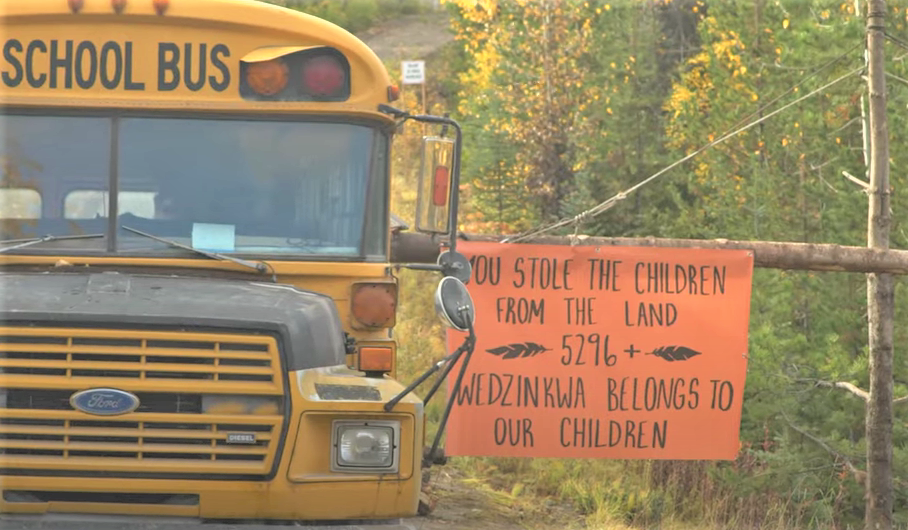
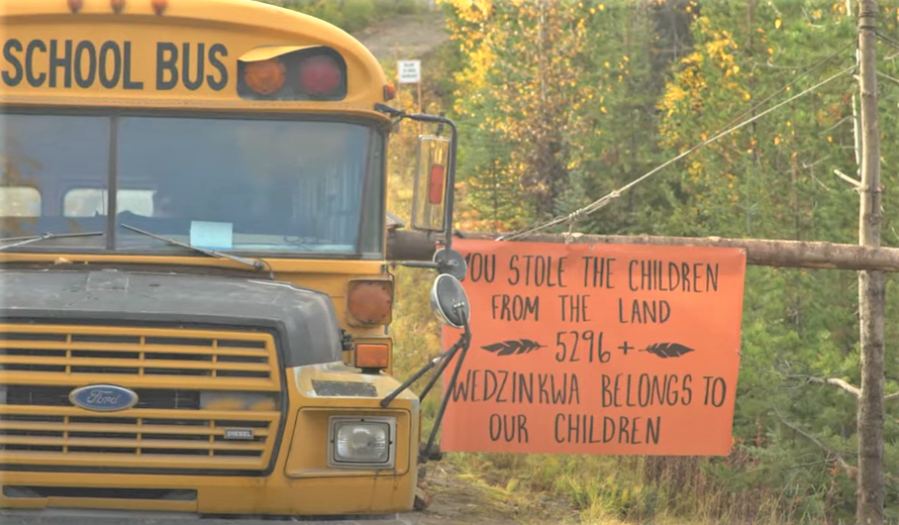
Wedzin Kwa belongs to our children.
For over 50 years, Wet’suwet’en children were taken from the land, from their families, and from Wedzin Kwa to attend residential schools. These “schools” were not to empower us, but to take the Indian, to take the Wet’suwet’en, out of the child. Many did not return and those who survived have fought for our right to all that we had been robbed of – land, language, culture, pride. Today, we continue to face state violence from governments and industry who still want our land to themselves. Their plans to eradicate us however, have failed and we are still here!
Every day we remember. We carry that pain, that strength, and we work to rebuild our pride, to rebuild our nations and reconnect with our lands.
On September 30th, we came together in a day of remembrance to honour the children, to remind ourselves that we will never give up/be defeated.

Many did not return and those who survived have fought for our right to all that we had been robbed of – land, language, culture, pride.

“I’ve always said there are two types of people on Sept. 30,” said Métis NDP MP Blake Desjarlais. “Those who’ve been robbed of their children, their culture, their language, and those who’ve been robbed of the truth. Sometimes you’re both.

“We can’t truly have reconciliation until we have that truth,” he said.

The National Day for Truth and Reconciliation coincides with Orange Shirt Day, which honours the story of Phyllis Webstad, a young girl whose new orange shirt was stripped from her on her first day at St. Joseph’s Residential School in 1973. On Sept. 30, 2013, Webstad spoke publicly about her experience, and Orange Shirt Day was born.

The federal statutory holiday was established after ground-penetrating radar uncovered the remains of 215 children at the former Kamloops Indian Residential School, confirming what Indigenous people have known for decades.

“The amount of pain in the Indigenous community is massive, we’re only scratching the surface,” said Desjarlais, the newly elected MP for Edmonton-Greisbach and the first two-spirit person to sit in the House of Commons.

We can’t truly have reconciliation until we have that truth By Natasha Bulowski, National Observer, October 4th, 2021


National Day for Truth and Reconciliation

Today, Sept 30, 2021, is the first National Day for Truth and Reconciliation in the country known as Canada. There is a lot of publicity now related to the institutions of forced assimilation. The remains of thousands of children being located by ground penetrating radar on the grounds of those institutions. Articles about the history of the residential schools, stories of those who attended, those who never returned. The suffering of those living today who are survivors of those schools. Those suffering today from the intergenerational trauma that has passed from generation to generation.

And the suffering continuing today as the Royal Canadian Mounted Police side with Coastal GasLink pipeline employees as they forced construction through Wet’suwet’en territory (video below)

These stories and events should be told by those who have been affected. People can re-traumatized. You can hear some of those stories in the following.

The National Residential School Crisis Line 1-866-925-4419

Included below are:

  • the reports from the Truth and Reconciliation Commission and its calls to action
  • the video from CBC/Radio, We Know the Truth: Stories to inspire reconciliation
  • and a video of the Royal Canadian Mounted police painfully removing a land defender locked under a bus on the Wet’suwet’en territory. There cannot be reconciliation when the government continues to enforce construction of pipelines through Indigenous lands.

National Day for Truth and Reconciliation

September 30, 2021 marks the first National Day for Truth and Reconciliation.

The day honours the lost children and Survivors of residential schools, their families and communities. Public commemoration of the tragic and painful history and ongoing impacts of residential schools is a vital component of the reconciliation process.

The creation of this federal statutory holiday was through legislative amendments made by Parliament. On June 3, 2021, Bill C-5, An Act to amend the Bills of Exchange Act, the Interpretation Act and the Canada Labour Code (National Day for Truth and Reconciliation) received Royal Assent.

Commemorating National Day for Truth and Reconciliation
Illuminating Parliament Hill

To commemorate the National Day for Truth and Reconciliation and to honour the Survivors, their families and communities, buildings across Canada will be illuminated in orange September 29 and/or September 30, from 7:00 pm to sunrise the next morning. This will include federal buildings such as the Peace Tower on Parliament Hill.

Truth and Reconciliation Week

This 5-day, bilingual educational event will include programming designed for students in grades 5 through 12 along with their teachers and feature Indigenous Elders, youth and Survivors. The event will be pre-recorded and webcasted, allowing for schools and classrooms participation from across the country and the involvement of Indigenous and non-Indigenous students.

National Day for Truth and Reconciliation Broadcast

A 1-hour bilingual primetime show in partnership with, and broadcast on, CBC/Radio-Canada and APTN will be devoted to the National Day for Truth and Reconciliation. Programming will include presentations on the importance of this day as well as cultural and artistic performances in support of healing and giving voices to Indigenous peoples.

APTN Sunrise Ceremony

APTN will present pre-taped Sunrise ceremony featuring drummers, singers, Elders and various Indigenous traditions.

Truth and Reconciliation Commission and its calls to action

There were 140 federally run Indian Residential Schools which operated in Canada between 1831 and 1998. The last school closed only 23 years ago. Survivors advocated for recognition and reparations and demanded accountability for the lasting legacy of harms caused. These efforts culminated in:

The Truth and Reconciliation Commission ran from 2008 to 2015 and provided those directly or indirectly affected by the legacy of the Indian Residential Schools policy with an opportunity to share their stories and experiences. The National Centre for Truth and Reconciliation has become the permanent archive for the statements, documents and other materials the Commission gathered, and its library and collections are the foundation for ongoing learning and research.

The Commission released its final report detailing 94 calls to action. The National Day for Truth and Reconciliation is a direct response to Call to Action 80, which called for a federal statutory day of commemoration.


On the inaugural National Day of Truth and Reconciliation, we’re introducing Canadians to Indigenous people who are flipping the conversation on reconciliation.

We Know the Truth: Stories to inspire reconciliation.

CBC/Radio is a Canadian public broadcast service.

There were also residential schools in the land called the United States. Secretary of the Interior, Deb Haaland, has initiated an investigation of these institutions of forced assimilation and the remains of the children.

Today only, Jason Eaglespeaker is making his graphic novels (there are three versions) “UNeducation, Vol 1: A Residential School Graphic Novel” available free of charge.


There cannot be reconciliation when the government continues to enforce construction of pipelines through Indigenous lands

How incredible is it that the Royal Canadian Mounted police continue to attack land defenders resisting the construction of the Coastal GasLink pipeline through the Wet’suwet’en lands in British Columbia?


Gidimt’en Access Point

On September 27th, a land defender blocking a fracked gas pipeline was tortured by police.

This is the second arrest at the drill pad site access road, where Coastal Gaslink (CGL) plans to drill under Wedzin Kwa (Morice River), the sacred headwaters on Wet’suwet’en yintah. The arrest was brutal.

The RCMP officers used “pain compliance” for an hour on the person locked under the bus in a hard lock, insisting the person just let go, which very clearly they were not able to do.

The RCMP then had CGL contractors, instead of an extraction team, come in to extract the person. The injunction very clearly states that RCMP are the only ones to enforce the injunction. This is in violation of that.

This comes on the heels of the RCMP being at fault for the injunction renewal denial for the Fairy Creek defence based on their tactics against peaceful people.

Tomorrow is the “National Day of Truth and Reconciliation” in Canada, and here we clearly see that violence and forced removal from Indigenous lands are on full display.

This is about our yintah (land). It always has been. They have been trying to steal our lands and resources since contact and they will bulldoze and torture their way through to get it, because all they care about is money. We will never give up. Join us. Yintahaccess.com

CW: VIOLENT ARREST OF LAND DEFENDER
https://youtu.be/h4gK5scLMhk

UNeducate Yourself!

I have purchased a number of books and graphic novels from Jason Eaglespeaker. https://www.eaglespeaker.com/

In honor of National Day for Truth & Reconciliation (September 30th, in Canada), Jason is offering all three versions of UNeducation, A Residential School Graphic Novel, Vol 1 for free! See where to get them below. This offer is good for September 30th only. The three versions are explained below. There is a PARENTAL ADVISORY regarding the uncut version.

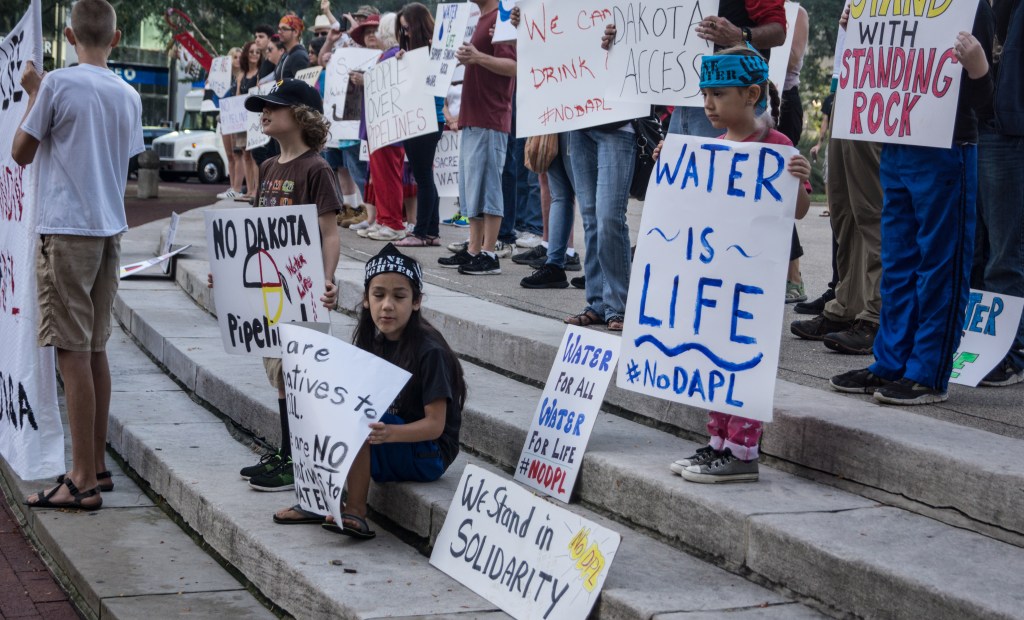
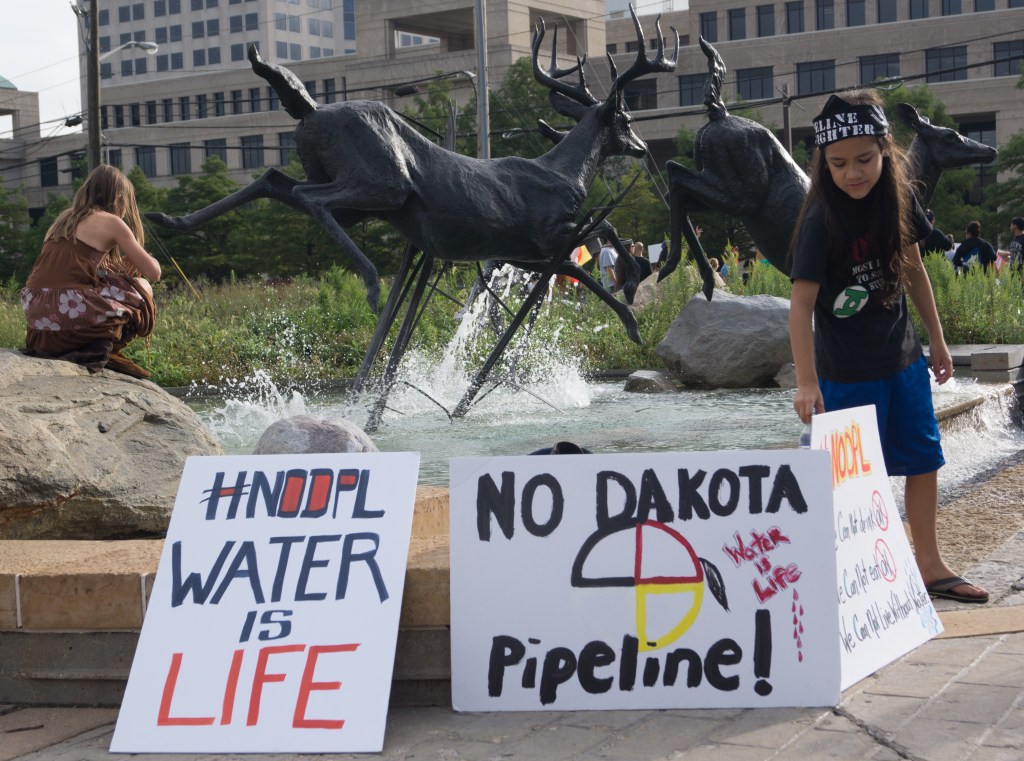
Jason and I corresponded about one of his books, Young Water Protectors, A Story About Standing Rock by Aslan Tudor. I hadn’t realized it at the time, but I got a few photos of Aslan when we were both at a gathering in Indianapolis related to the Dakota Access pipeline.

978-1723305689-backcover.jpg

This is a link to a story about Aslan and the book. New book about Standing Rock written from child’s perspective by Rhiannon Johnson, CBC News, Aug 25, 2018

You may have heard about, read about or even own the book that started it all – “UNeducation, Vol 1: A Residential School Graphic Novel”. Launched over 10 years ago, from one single handmade copy, UNeducation is now in libraries, schools, universities and retailers throughout North America and beyond.

It comes in three versions:
In honor of National Day for Truth & Reconciliation (September 30th, in Canada), you can get all three versions of UNeducation, Vol 1 for free!

Simply use the links below to head to the download pages:

UNeducation UNcut – for the mature reader
*eBook version, requires free Kindle App to read
**free download ends Sept 30th at midnight
Amazon USA
Amazon Canada

UNeducation PG – for the sensitive reader (schools choose this one)
*eBook version, requires free Kindle App to read
**free download ends Sept 30th at midnight
Amazon USA
Amazon Canada

UNeducation A Coloring Experience – for youth and adults
Download from my website  

Orange Shirt Day

I’m saddened by the disconnect between Canada’s years of work on truth and reconciliation related to institutions of forced assimilation of Indigenous children and the ongoing militarized response by the government against the Wet’suwet’en peoples (see the tweets at the end for updates).

The investigation related to the remains of Indigenous children on the grounds of residential schools in the US is beginning. And yet, as in Canada, multiple fossil fuel projects continue to be approved. There is increasing resistance to the construction of these pipelines. And a new class of pipelines related to carbon capture are proposed.

Orange Shirt Day will also be observed tomorrow in Canada.


The Orange Shirt Story began in May 2013 during the Truth and Reconciliation Hearings in Williams Lake BC. At that time Kukpi7 Fred Robbins of the Esketemc enlisted the support of the local School District, Regional Government and the Municipalities of the Cariboo, to both honour the survivors of Residential Schools and raise awareness of the Residential School system among the people of the Cariboo. This is the story of Kukpi7 Fred Robbins time at Residential School, the Commemoration events that were organized, and the hopes for the future that Kukpi7 Fred Robbins envisioned. – WARNING Sensitive Content

https://www.canada.ca/en/canadian-heritage/campaigns/national-day-truth-reconciliation.html

Leading up to September 30, the “National Day of Truth and Reconciliation” we need to send the message that things have to change and they have to change NOW.

#WetsuwetenStrong #NoTrespass #WedzinKwa #CGLofftheYintah #Sovereignty #Solidarity #DefendTheYintah #WeAreAllOne #IndigenousSovereignty #TraditionalGovernance

National Day for Truth and Reconciliation

The first National Day for Truth and Reconciliation in Canada will be September 30. A schedule of events can be found here.

With the attention on the deaths of children in the native residential schools in the land called the United States, we are learning more about these atrocities here. Secretary of the Interior, Deb Haaland, has initiated an investigation of the institutions of forced assimilation in the U.S.

Canada went through an eight-year process to learn what happened in the residential schools there, the Truth and Reconciliation Commission of Canada (TRC). Quakers of the Canadian Yearly Meeting have been very involved in that process and ongoing work for reconciliation.

In 2007 the Truth and Reconciliation Commission of Canada (TRC) was established “to learn the truth about what happened in the residential schools and to inform all Canadians about what happened in the schools.”

In 2015 the Truth and Reconciliation Commission released its Final Report and 94 Calls to Action. TRC Chief Commissioner Murray Sinclair said, “We have described for you a mountain, we have shown you the path to the top. We call upon you to do the climbing.”

In 2011, Canadian Yearly Meeting, the national body of Canadian Quakers, had called on Quakers to actively engage in reconciliation efforts:

We are being invited by the Indigenous peoples of Canada as represented by the Indian Residential School Survivors, through the Indian Residential School Survivors Settlement Agreement, to enter a journey of truth finding and reconciliation. We encourage all Friends, in their Meetings for Worship and Monthly and Regional Meetings, boldly to accept this invitation and to engage locally, regionally, and nationally, actively seeking ways to open ourselves to this process…”

Truth and Reconciliation, Canadian Friends Yearly Meeting.

Truth and Reconciliation Commission of Canada

The Truth and Reconciliation Commission (TRC) provided those directly or indirectly affected by the legacy of the Indian Residential Schools system with an opportunity to share their stories and experiences.

About the Truth and Reconciliation Commission

The Indian Residential Schools Settlement Agreement, the largest class-action settlement in Canadian history, began to be implemented in 2007. One of the elements of the agreement was the establishment of the Truth and Reconciliation Commission of Canada to facilitate reconciliation among former students, their families, their communities and all Canadians.

The official mandate (PDF) of the TRC is found in Schedule “N” of the Settlement Agreement which includes the principles that guided the commission in its important work.

Between 2007 and 2015, the Government of Canada provided about $72 million to support the TRC’s work. The TRC spent 6 years travelling to all parts of Canada and heard from more than 6,500 witnesses. The TRC also hosted 7 national events across Canada to engage the Canadian public, educate people about the history and legacy of the residential schools system, and share and honour the experiences of former students and their families.

The TRC created a historical record of the residential schools system. As part of this process, the Government of Canada provided over 5 million records to the TRC. The National Centre for Truth and Reconciliation at the University of Manitoba now houses all of the documents collected by the TRC.

In June 2015, the TRC held its closing event in Ottawa and presented the executive summary of the findings contained in its multi-volume final report, including 94 “calls to action” (or recommendations) to further reconciliation between Canadians and Indigenous peoples.

In December 2015, the TRC released its entire 6-volume final report. All Canadians are encouraged to read the summary or the final report to learn more about the terrible history of Indian Residential Schools and its sad legacy.

To read the reports, please visit the National Centre for Truth and Reconciliation website.

What does reconciliation mean to Collin?

Many settlers wish they could ask Indigenous people questions about reconciliation without appearing foolish or rude. Canadian Friends Service Committee knows that not every settler has the opportunity to have open dialogue with Indigenous friends and neighbours. This is why we want to give you a chance to hear the answers to some important questions from some of our Indigenous partners, people that we work closely with and trust to give us honest responses, and who trust us enough to engage with this project!

Collin Orchyk is from Treaty 1, Peguis First Nation, Manitoba. Collin is a student in the Indigenous education program at the University of British Columbia and a former Youth Reconciliation Leader for Canadian Roots Exchange. He is also a singer/songwriter and has provided all background music for the videos in the Indigenous Voices on Reconciliation Series. Learn more at quakerservice.ca/reconciliation

More Indigenous voices on reconciliation

Quaker Paula Palmer and Friends Peace Teams have done years of work related to Right Relationship with Native Americans.
https://friendspeaceteams.org/trr/

A young Tohono Oʼodham man said in one of our workshops, “No one here today made these things happen, but we are the ones who are living now. And we’re all in this together.” And I think that’s what we need to hear. No one here today made all of these things happen, but we are the ones who are living now. So what are our opportunities to work with indigenous peoples, to engage them, to ask them, “What would right relationship look like?” Paula Palmer

Ethnic studies so history will not be erased

It is a paradox that education is crucial for healing, in this case healing from the intergenerational traumas suffered by Indigenous peoples in the lands called the United States and Canada. And yet, who will teach these subjects? Care must be taken to avoid triggering that might occur for Indigenous educators.

The following quote references Alberta’s Teacher Qualifications Standard that I wrote about yesterday.

As the National Day for Truth and Reconciliation approaches, we can expect Canadian teachers are thinking about how they can better weave Indigenous perspectives into their lesson planning.

In the past, events like this rarely made it as national news, staying inside our Indigenous communities where the pain remained hidden from the rest of Canada. Now, teachers are talking about them with their students — how history and society influence individual situations of race-motivated violence and cultural genocide. It’s our responsibility to make sure they are equipped to teach the truth and acknowledge the important role schools play in reconciliation.

But how do we do that when many of our educators were not taught about residential schools when they were students?

This question does not have one answer. In 2016, the Hon. Justice Murray Sinclair, former chair of the Truth and Reconciliation Commission, said, “Education got us into this mess and education will get us out of it.” After generations of miseducation, it will take generations of real truth-sharing and knowledge-building within our provincial education systems to achieve reconciliation.

We owe it to Indigenous educators who are triggered and challenged to deliver education around a topic like residential schools that have impacted them. Educators like me, who when viewing the images of children with their plain clothes, short hair, and empty eyes — identities stripped — still struggle to separate the pain we hold from lesson planning.

We also owe it to non-Indigenous educators who lack confidence in teaching because they weren’t taught the truth about the atrocities of the residential school system. This is a significant blocker to the successful integration of truth-telling in our classrooms, which can be solved by supporting educators in their journey of learning.

We must ensure the materials passed down to educators are written accurately by authentic voices. We need ongoing government funding and access to professional learning programs. Alberta is one province that does this well. Its Teacher Qualifications Standard requires educators to take courses in foundational knowledge of Indigenous history.

We owe it to all students to bring truth and drive reconciliation in classrooms by Linda Isaac & John Estabillo, National Observer, September 16, 2021

Education got us into this mess and education will get us out of it.

Hon. Justice Murray Sinclair

Last year, as a massive uprising against systemic racism swept across the worldactivists fighting for Black liberation and racial justice put radical demands against institutional racism on the table, such as abolishing and defunding the police. Another key step toward challenging institutional racism is the push for ethnic studies and teaching about systemic racism in U.S. schools. I am part of that fight in California.

Racism has been in the United States for over 400 years, stemming from slavery and genocide. However, Trump’s emboldening of white nationalism and last year’s protests against police violence have raised the level of urgency to fight against systemic racism. In this crucial moment, the push for ethnic studies is an important fight because accurate, anti-racist, multicultural educational curricula are vital to creating a better, more just society.

I was one of the very few African American men to graduate from Pittsburg High School and attend Stanford University, where I earned my bachelor’s in International Relations. In my decade-long teaching and writing career post-Stanford, I’ve seen how the education system is a site of institutional racism that directly impacts non-white students. I’ve also written about other forms of systemic racism, such as the police and gentrification. Ethnic studies, an educational discipline that teaches non-white students their own history and empowers them to be agents of their own destiny, is crucial to challenging institutional racism within the education system.

As ethnic studies programs grow around the country, right-wing pushback is also mounting — overlapping with efforts to ban the teaching of critical race theory in U.S. schools. Critical race theory and ethnic studies are not the same: Critical race theory is a highly academic, and rather esoteric, legal theory that analyzes the manifestations of racism in U.S. law; it is mostly taught in law schools, not in K-12 public education. Meanwhile, ethnic studies focuses on the histories, cultures and struggles of marginalized racial/ethnic groups, especially as they relate to the overall history of the United States.

I’M FIGHTING FOR ETHNIC STUDIES SO MY HISTORY WON’T BE ERASED By Adam Hudson, Truthout, September 22, 2021

Teaching Quality Standard

It is difficult to realize how close we have come to the erasure of Indigenous peoples in the lands called the United States and Canada. This is changing as Indigenous peoples are leading the struggles to protect Mother Earth.

There is also focus on Indigenous peoples as the remains of thousands of native children on the grounds of institutions of forced assimilation are found. The point of forced assimilation was the erasure of the children’s Indigenous identities and ways of living. The ultimate erasure was the death of a child.

The first step in healing is education. Education of all students. Education for ourselves. This comes at a time when powerful forces are determined to maintain this erasure of Indigenous peoples’ history and culture.

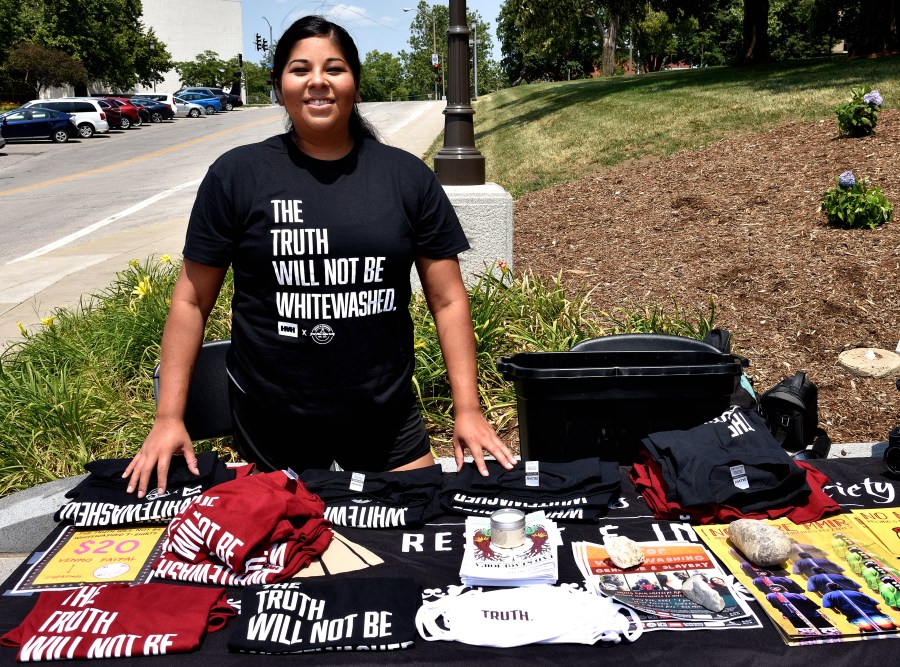
It is crucial for non-native people to learn this history, to know how this country developed, so we can all begin to heal. We can’t do that as long as we remain within the boundaries of whitewashed colonial stories. This is important context for dealing with rapidly evolving environmental chaos. Because a return to Indigenous practices and relationships with Mother Earth and all our relations is, I believe, the way to adapt to continuing, deepening collapse.

An earlier blog post was about anti-racism education in Iowa. https://landbackfriends.com/2021/09/15/unban-anti-racism-education-in-iowa/
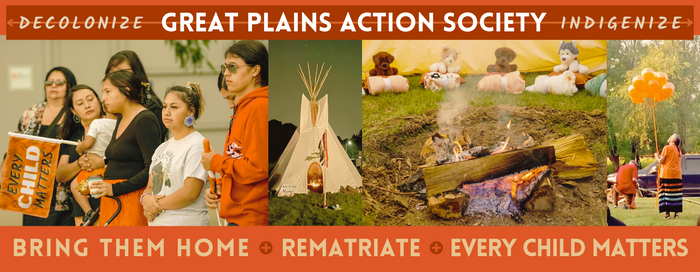
The Great Plains Action Society youth organizers and experts across Iowa weigh in on white supremacy and the ban on Critical Race Theory. The bans on Critical Race Theory across the country are one of many examples of efforts to whitewash the truth.


The following story was just published:

PIERRE, S.D. — Facing bipartisan pressure and calls for her resignation by the South Dakota Education Equity Coalition, South Dakota Gov. Kristi Noem told the state Department of Education to postpone controversial changes to its social studies standards for up to one year to allow for more public input.

Tribes from across South Dakota voiced their ire last month after officials from Noem’s South Dakota Department of Education scrubbed more than a dozen Indigenous-centered learning objectives from the department’s new social studies standards before releasing the document to the public.

The American Indian leaders, educators and community members called the removal of the objectives “Native erasure.”

“Our children were stolen from us in past generation, forcefully assimilated or secretly buried in boarding schools under the ‘kill the Indian and save the Man’ ideologies, and it would seem that the task to erase them has not ended under Governor Kristi Noem’s administration and leadership,” Cheyenne River Sioux Tribe Chairman Harold Frazier said in August.

Under Pressure, S.D. Gov. Noem Delays Social Studies Standards That Erase Native History by Levi Rickert, Native News Online, Sept 22, 2021

Following are two sections of the Alberta Teaching Standard that relate to First Nations, Métis and Inuit peoples.

Quality teaching occurs when the teacher’s ongoing analysis of the context, and the teacher’s decisions about which pedagogical knowledge and abilities to apply, result in optimum learning for all students.

The professional practice of all Alberta teachers is guided by the Teaching Quality Standard (TQS). This standard is the basis for certification of all Alberta teachers and holds them accountable to the profession and to the Minister of Education.

Establishing Inclusive Learning Environments

A teacher establishes, promotes and sustains inclusive learning environments where diversity is embraced and every student is welcomed, cared for, respected and safe.

Achievement of this competency is demonstrated by indicators such as:

a. fostering equality and respect with regard to rights as provided for in the Alberta Human Rights Act and the Canadian Charter of Rights and Freedoms;
b. using appropriate universal and targeted strategies and supports to address students’ strengths, learning challenges and areas for growth;
c. communicating a philosophy of education affirming that every student can learn and be successful;
d. being aware of and facilitating responses to the emotional and mental health needs of students;
e. recognizing and responding to specific learning needs of individual or small groups of students and, when needed, collaborating with service providers and other specialists to design and provide targeted and specialized supports to enable achievement of the learning outcomes;
f. employing classroom management strategies that promote positive, engaging learning environments;
g. incorporating students’ personal and cultural strengths into teaching and learning; and
h. providing opportunities for student leadership

Applying Foundational Knowledge about First Nations, Métis and Inuit

A teacher demonstrates an understanding of and adherence to the legal frameworks and policies that provide the foundations for the Alberta education system.

Achievement of this competency is demonstrated by indicators such as:

a. understanding the historical, social, economic and political implications of:
• treaties and agreements with First Nations;
• legislation and agreements negotiated with Métis; and
• residential schools and their legacy;
b. supporting student achievement by engaging in collaborative, whole school approaches to capacity building in First Nations, Métis and Inuit education;
c. using the programs of study to provide opportunities for all students to develop a knowledge and understanding of, and respect for, the histories, cultures, languages, contributions, perspectives, experiences and contemporary contexts of First Nations, Métis and Inuit; and
d. supporting the learning experiences of all students by using resources that accurately reflect and demonstrate the strength and diversity of First Nations, Métis and Inuit.

Alberta Teaching Standard


For its part, NABSHC—an organization that has been at the helm of increasing public awareness on boarding schools since its founding nearly a decade ago—in 2020 released its first ever Truth and Healing Curriculum. The curriculum, available for free online, is made up of four lessons on Indian Boarding Schools focusing on history, impacts, stories, and healing.