I find it increasingly difficult to make sense of what is going on today. All the terrible things I had anticipated for the future are suddenly happening now. And things I never imagined, like the assaults on truth and science, come at a time when they are desperately needed.
There are all kinds of ways to divide/categorize the American public: there’s the urban/rural divide, the differences between Republicans and Democrats, people who are college educated versus those who are not…One distinction that is rarely highlighted but incredibly important doesn’t even have a descriptive term–it’s the difference between people who recognize and respect evidence and those who don’t.
Think of it as the difference between people who accept the Enlightenment emphasis on empirical reality and those who are “faith-based.” Being faith-based, at least as I am using the term, doesn’t necessarily mean “religious.” It means preferring an ideological commitment–something taken on faith– to demonstrable reality, and a number of people–many of them highly educated–fall into that category.
There’s nothing wrong with theory, but it’s a framework for empirical exploration, not a substitute. In the end, real world evidence is what matters.
One of the first lessons I learned as I began my career in medical research, was to make sure I wasn’t trying to make evidence fit into my preconception of what the results should be. And I was impressed to discover further research sometimes made sense of a piece of the puzzle we discovered previously that had not fit my expectations.
Or new data might provide further evidence that my preconceptions were wrong. That strengthened my faith, that there is much beyond what we think we know. Mysteries to unravel.
Kennedy states faith-based, as she is using the term, “means preferring an ideological commitment–something taken on faith– to demonstrable reality.” A choice to hold onto beliefs even when the evidence refutes those beliefs.
The question is whether it is possible to continue to believe something when evidence shows that to be false? My answer is no, because I believe the framework of science, a system of verifiable evidence, is part of creation.
But others profess to believe the opposite. People who are told to not believe what they see. Which leaves them open to being manipulated. And not open to persuasion, even when shown evidence contradicting their belief.
It has been common in western thought, from ancient times up until the present, to view reality as divided between an ideal world of spirituality and perfectedness, and a counterpart world of material and practical reality which is fallen and corrupted. This concept began with Plato and was given a theological overlay by Christianity. It invites the idea that truth and beauty are attractive but insubstantial, and that they are impossible of realization, while the demands of practical reality inevitably require various violent and ugly compromises, and radical departures from ideal concepts of purity and goodness.
Quaker spirituality, as well as other minority streams of Christian mysticism, and most eastern spiritualities, reject this dualistic view of reality. They affirm a true understanding of our situation, which is that the mundane and the divine are one. What so many mistakenly see as realms separate and apart are, in truth, so interdependent that one cannot be understood, or even spoken of, without the other.
Peace or Justice: Which Has Precedence? A Quaker Perspective on the Papal Encyclical Letter Pacem in Terris Issued by Pope John XXIII on April 11, 1963 By Daniel A. Seeger
To me, faith-based includes truth supported by evidence in science. But it also includes beliefs that are part of a spiritual framework. There is so much in our world that cannot be proven with scientific evidence.
I was raised and continue to be part of a faith community, the Religious Society of Friends, or Quakers. I attend Sunday meetings for worship, where we sit together in silence, trying to hear what God, or the spirit, or the Creator, or Inner Light is saying to us. Sometimes someone discerns a spiritual message they share with the meeting, speaking out of the silence. We believe the Spirit continues to be active in the world, in our lives, today.
These days, as remains of thousands of children who attended the Native residential schools continue to be located, the question is how this could happen? Especially since those institutions of forced assimilation were run by various religious groups, including Quakers.
I don’t know. Such a terrible history does make me question what I thought I was being led, by the Spirit, to do, that might be causing harm today. I’m praying to be shown what I might do now related to this tragedy.
These past several days have brought attention to the concepts of truth and reconciliation as the land known as Canada held its first observation of the National Day for Truth and Reconciliation.
September 30th was also Orange Shirt Day, which focuses on those who were forced to attend the Indian Boarding Schools, those institutions of forced assimilation.
Orange Shirt Day is a legacy of this project. As spokesperson for the Reunion group leading up to the events, former student Phyllis (Jack) Webstad told her story of her first day at residential school when her shiny new orange shirt, bought by her grandmother, was taken from her as a six-year old girl.
The annual Orange Shirt Day on September 30th opens the door to global conversation on all aspects of Residential Schools. It is an opportunity to create meaningful discussion about the effects of Residential Schools and the legacy they have left behind. A discussion all Canadians can tune into and create bridges with each other for reconciliation. A day for survivors to be reaffirmed that they matter, and so do those that have been affected. Every Child Matters, even if they are an adult, from now on.
It all started right here in the Cariboo, and as a result, School District No. 27 was chosen by the First Nations Education Steering Committee (FNESC) to pilot curriculum changes for all Grade 5 and Grade 10 students reflecting the residential school experience, which have now been implemented province-wide.
On this day of September 30th, we call upon humanity to listen with open ears to the stories of survivors and their families, and to remember those that didn’t make it.
On this day of September 30th, we call upon humanity to listen with open ears to the stories of survivors and their families, and to remember those that didn’t make it.
What does it mean to listen with open ears? This implies that we often do not really listen. When was the last time you changed anything based upon what you were hearing? James Allen says, “we need to radically rethink the stories we tell ourselves”. As my friend Lucy Duncan says here, we white Quakers believe a number of myths. Listening with open ears requires a conscious effort to jump over the barriers of those myths we tell ourselves.
During our gatherings for Quaker meetings for worship we listen for the voice of the Creator. Are we really open to the leadings of the Spirit? Are we looking past the myths? Are we listening with open ears? And then do we have the courage to do what the Spirit is asking of us?
“We White Quakers like to revel in our myths about ourselves. These include “we were all abolitionists”; “we all worked on the Underground Railroad”; and “none of us were slaveholders.” Often there are kernels of truth in myths, but the truth is more complex. Myths exist to veil the complexity and contradictions of our history, to obfuscate the differences between who we think we are and who we really are and have been… Perhaps the revolutionary Quaker faith we imagine ourselves to inhabit has never really existed, and if we tell the whole truth and commit to the healing the truth-telling calls us to, perhaps together we can embody and create the prophetic religion we thirst for.” –Lucy Duncan, “A Quaker Call to Abolition and Creation”
Query: What myths are you facing? What truths are you embracing?
If we are to find a new kind of good life amid the catastrophes these myths have spawned, then we need to radically rethink the stories we tell ourselves. We need to dig deep into old stories and reveal their wisdom, as well as lovingly nurture the emergence of new stories into being. This will not be easy. The myths of this age are deeply rooted in our culture. The talking heads (even the green ones) echo these myths with the dogmatic fervour of zealots. They talk of “saving the planet” through transitioning to a “sustainable” future, primarily through new renewable energy technologies. They seem only able to conceive of a good life that mirrors our lives more or less as they are now, where the living standard continues to improve and rate of consumption continues to grow, yet somehow decoupled from all the pollution, destruction and guilt.
Pontoon Archipelago or: How I Learned to Stop Worrying and Love Collapse By James Allen, originally published by Medium, June 18, 2019
I think about what I want for my children and grandchildren. What I want for them is to be loved and love other people in this country. Not to tolerate them, not to go to our respective corners and stop hurting each other, but to be wrapped up and engaged in each other’s lives.
Douglas White Kwulasultun (Coast Salish name), Tliishin (Nuu-chah-nulth name), Director of the Centre for Pre-Confederation Treaties and Reconciliation (VIU), former Chief of Snuneymuxw First Nation
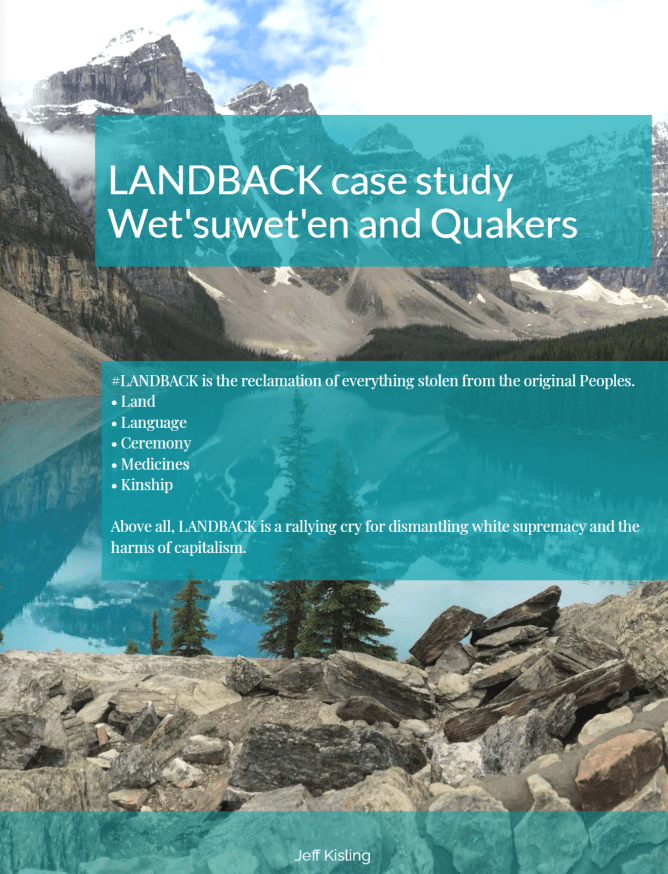
It is tragic that at the same time the concepts of #LANDBACK are being embraced, resource extractive companies continue to take land, without free and prior consent. And it is ironic that this conflict is going on at a time when Canada will celebrate the first National Day for Truth and Reconciliation on September 30.
September 23 at 2:32 PM PRESS RELEASE COASTAL GASLINK DESTROYS ARCHEOLOGICAL SITE ON CAS YIKH TERRITORY September 23, 2021 FOR IMMEDIATE RELEASE
SMITHERS, BC: On September 22, 2021, after days of conflict between Gidimt’en/Cas Yikh Chiefs and members, Coastal GasLink and the RCMP, contractors completely cleared an archaeological site which has been destroyed with heavy machinery for the construction of a methane gas pipeline.
Gidimt’en chiefs and supporters have been defending a number of culturally significant archeological sites from destruction on unceded Cas Yikh (Grizzly House) territory belonging to the Gitdimt’en clan of the Wet’suwet’en people. The Coastal GasLink pipeline company has obtained a Site Alteration Permit (SAP) from the BC Oil and Gas Commission (OGC) through a flawed and ineffective consultation process and without the Free, Prior and Informed Consent of the Wet’suwet’en Hereditary Chiefs. The Wet’suwet’en have argued for years that the pipeline route endangers critical species, cultural use and heritage sites, and is not supported by Wet’suwet’en land use plans, particularly around the development of climate change policies. This archaeological site in particular, is significant to the Wet’suwet’en in the protection of our cultural heritage for future generations and for protecting our oral histories and heritage values for ongoing rights and title negotiations.
The company continues to violate their own regulations and conditions set forward by governing bodies such as the OGC and their own Environmental Assessment Certificates. Neither CGL nor the BCOGC undertook consultation with Cas Yikh or the Office of the Wet’suwet’en for the permit. The consultation process and the permitting system is deeply flawed and acts merely as a rubber stamp process to allow industry to continue. For example, files sent to the Office of the Wet’suwet’en were password protected and unable to be opened. Thus the information contained inside was never able to be reviewed, let alone consented to. Silence does not equal consent and to push forward with destroying a culturally significant heritage site is deeply disturbing and violent.
An archeologist working with Cas Yikh recently stated, about the cultural site that CGL is now threatening:
A site alteration permit was granted for the purpose of clearing GbSs-8 to make way for the Coastal GasLink pipeline, but no information on the proposed work/clearing activities has been shared with OW, Wo’os, Cas Yikh, or this report’s author. What is known about the archaeology of Ts’elkay Kwe Ceek is dismal. This is especially concerning given the sheer intensity with which the landscape was inhabited and used (according to oral and written testimonies) and the concentration of habitation and use sites (lithics, trails, and cultural depressions). As a result, any destruction to archaeological heritage in Ts’elkay Kwe Ceek should be seen as a gross miscalculation on behalf of the proponent and their archaeologists. Indeed, given that no consultation or consent was granted for the site alteration permit, the course of site destruction is highly irregular and likely illegal.
Many measures were taken to prevent the destruction of this site, including a Cease and Desist letter sent to all parties, including provincial ministers in charge of lands and forests, in which hereditary chief Dini ze’ Woos stated:
To be clear, we do not authorize or consent to the removal of, or any “alteration” or impacts to, our archaeological heritage. According to the United Nations Declaration of the Rights of Indigenous Peoples — a declaration implemented by the BC Government under Bill C41, which states:
4. Article 11 (1). Indigenous peoples have the right to practise and revitalize their cultural traditions and customs. This includes the right to maintain, protect and develop the past, present and future manifestations of their cultures, such as archaeological and historical sites, artefacts, designs, ceremonies, technologies and visual and performing arts and literature. (2). States shall provide redress through effective mechanisms, which may include restitution, developed in conjunction with indigenous peoples, with respect to their cultural, intellectual, religious and spiritual property taken without their free, prior and informed consent or in violation of their laws, traditions and customs. (Emphasis added).
The work that is continuing just hundreds of meters from Gidimt’en Checkpoint, a reoccupation site belonging to Cas Yikh, is in violation of the provincially legislated DRIPA. It is happening without the consent of Cas Yikh and therefore we demand that the permit be revoked and a proper consultation process begin.
A few days ago (9/22/2021) Coastal GasLink contractors came in and cleared trees and brush at our ancient site along Ts’elkay Kwe. They came escorted by RCMP. There was still no archaeologist on site, they also refused to show any permits, but continued to clear brush and fall trees in the valley as a Gidimt’en matriarch requested a pause to consult with Cas Yikh’s chiefs, wing chiefs, matriarchs and members.
They said that work will be continuing throughout the week. We need boots on the ground and feet in the street. We will never give up. We will never back down. Join us.
CW: Aggressive security block and intimidate Indigenous woman.
On September 22, Gidimt’en Checkpoint spokesperson Sleydo’ attempted to monitor the destruction of an ancestral site, as it was destroyed by Coastal GasLink pipeline workers. She was met with physically aggressive and intimidating CGL security guards.
For the past week, Coastal Gaslink has fallen trees and used excavators to destroy Ts’elkay Kwe, an ancient village site that they call GbSs-8.
CGL security (https://forsythesecurity.ca) counselled the archeologists from Ecofor not to discuss the work or accept the Cease and Desist letter that was previously emailed to the company via Stacey McConnell (stacey.mcconnell@ecofor.ca). They blocked access to Sleydo’ which is a direct violation of their Environmental Assessment Certificate (eao.compliance@gov.bc.ca).
The work continues today as we hear constant chain saw work and extended helicopter flights taking place over the archeological site.
Our ancestors are under attack. Our people are under attack. Once they have completed this devastating work they will move to drill under our sacred headwaters, Wedzin Kwa.
With the attention on the deaths of children in the native residential schools in the land called the United States, we are learning more about these atrocities here. Secretary of the Interior, Deb Haaland, has initiated an investigation of the institutions of forced assimilation in the U.S.
Canada went through an eight-year process to learn what happened in the residential schools there, the Truth and Reconciliation Commission of Canada (TRC). Quakers of the Canadian Yearly Meeting have been very involved in that process and ongoing work for reconciliation.
In 2007 the Truth and Reconciliation Commission of Canada (TRC) was established “to learn the truth about what happened in the residential schools and to inform all Canadians about what happened in the schools.”
In 2015 the Truth and Reconciliation Commission released its Final Report and 94 Calls to Action. TRC Chief Commissioner Murray Sinclair said, “We have described for you a mountain, we have shown you the path to the top. We call upon you to do the climbing.”
In 2011, Canadian Yearly Meeting, the national body of Canadian Quakers, had called on Quakers to actively engage in reconciliation efforts:
We are being invited by the Indigenous peoples of Canada as represented by the Indian Residential School Survivors, through the Indian Residential School Survivors Settlement Agreement, to enter a journey of truth finding and reconciliation. We encourage all Friends, in their Meetings for Worship and Monthly and Regional Meetings, boldly to accept this invitation and to engage locally, regionally, and nationally, actively seeking ways to open ourselves to this process…”
The Truth and Reconciliation Commission (TRC) provided those directly or indirectly affected by the legacy of the Indian Residential Schools system with an opportunity to share their stories and experiences.
About the Truth and Reconciliation Commission
The Indian Residential Schools Settlement Agreement, the largest class-action settlement in Canadian history, began to be implemented in 2007. One of the elements of the agreement was the establishment of the Truth and Reconciliation Commission of Canada to facilitate reconciliation among former students, their families, their communities and all Canadians.
The official mandate (PDF) of the TRC is found in Schedule “N” of the Settlement Agreement which includes the principles that guided the commission in its important work.
Between 2007 and 2015, the Government of Canada provided about $72 million to support the TRC’s work. The TRC spent 6 years travelling to all parts of Canada and heard from more than 6,500 witnesses. The TRC also hosted 7 national events across Canada to engage the Canadian public, educate people about the history and legacy of the residential schools system, and share and honour the experiences of former students and their families.
The TRC created a historical record of the residential schools system. As part of this process, the Government of Canada provided over 5 million records to the TRC. The National Centre for Truth and Reconciliation at the University of Manitoba now houses all of the documents collected by the TRC.
In June 2015, the TRC held its closing event in Ottawa and presented the executive summary of the findings contained in its multi-volume final report, including 94 “calls to action” (or recommendations) to further reconciliation between Canadians and Indigenous peoples.
In December 2015, the TRC released its entire 6-volume final report. All Canadians are encouraged to read the summary or the final report to learn more about the terrible history of Indian Residential Schools and its sad legacy.
Many settlers wish they could ask Indigenous people questions about reconciliation without appearing foolish or rude. Canadian Friends Service Committee knows that not every settler has the opportunity to have open dialogue with Indigenous friends and neighbours. This is why we want to give you a chance to hear the answers to some important questions from some of our Indigenous partners, people that we work closely with and trust to give us honest responses, and who trust us enough to engage with this project!
Collin Orchyk is from Treaty 1, Peguis First Nation, Manitoba. Collin is a student in the Indigenous education program at the University of British Columbia and a former Youth Reconciliation Leader for Canadian Roots Exchange. He is also a singer/songwriter and has provided all background music for the videos in the Indigenous Voices on Reconciliation Series. Learn more at quakerservice.ca/reconciliation
Quaker Paula Palmer and Friends Peace Teams have done years of work related to Right Relationship with Native Americans. https://friendspeaceteams.org/trr/
A young Tohono Oʼodham man said in one of our workshops, “No one here today made these things happen, but we are the ones who are living now. And we’re all in this together.” And I think that’s what we need to hear. No one here today made all of these things happen, but we are the ones who are living now. So what are our opportunities to work with indigenous peoples, to engage them, to ask them, “What would right relationship look like?” Paula Palmer
The Great Plains Action Society youth organizers and experts across Iowa weigh in on white supremacy and the ban on Critical Race Theory. The bans on Critical Race Theory across the country are one of many examples of efforts to whitewash the truth.
Online Pushback: UnBan Anti-Racism Education in Iowa
Indigenous Youth Organizers, Alexandrea Walker and Keely Driscoll, have started a youth-led movement to demand that the current Iowa Administration unban Anti-Racism Education, aka, Critical Race Theory. For the sake of health and safety for all, it is imperative that Kim Reynolds reverse the overtly white supremacist decision to ban anti-racism education plus diversity, equity, and inclusion programming in the classroom and in all state-funded institutions. Join Alex and Keely as they host a forum for youth and experts throughout Iowa to weigh in on this pressing issue. Guests TBA.
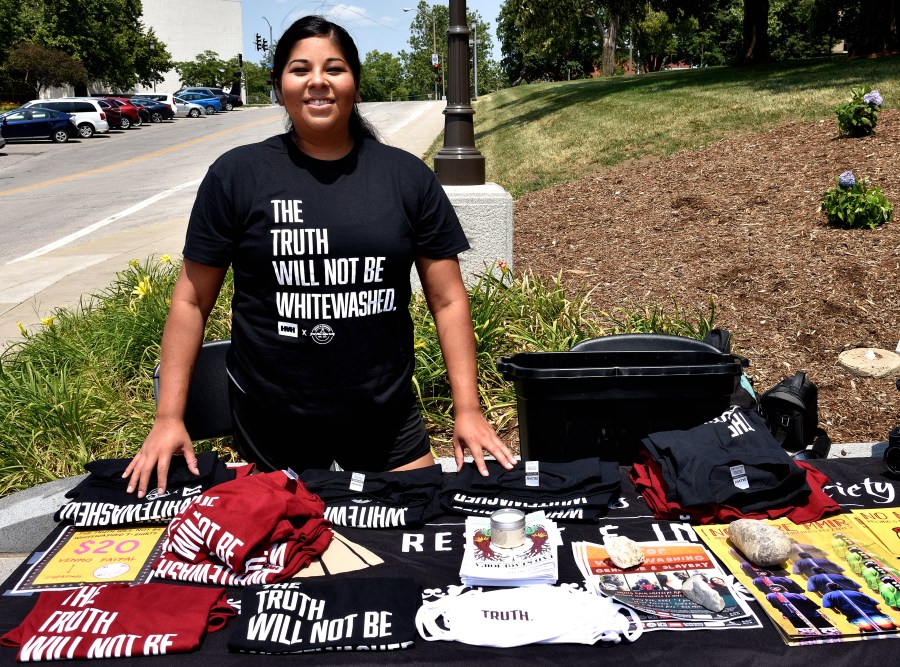
The Truth Will Not Be Whitewashed is a campaign founded by Great Plains Action Society and Humanize My Hoodie. We encourage others to join this effort. Please contact us if you are interested in joining our growing coalition.
This reminds me of the work of Lynne Howard and Des Moines Valley Friends’ (Quakers) to get draft counseling into the Des Moines public schools in 1970. They were successful! Resisting draft counseling was an effort to whitewash the truth about participating in the military.
PROPOSAL FOR DRAFT COUNSELING IN THE DES MOINES PUBLIC HIGH SCHOOLS
STATEMENT OF BELIEF:
We believe that all young men in the Des Moines Public High Schools should have access to adequate counseling by qualified counselors in regard to the Selective Service and its alternatives. Qualified counselors are those persons who:
Have received special draft counseling training
Have a detailed knowledge and experience of the Selective Service Law and the administration thereof
Are sensitive to the moral and spiritual implication of war and peace and individual conscience
Have knowledge of where to refer students if they want counseling on a specific aspect of the Selective Service alternatives and options
We further believe that such counseling should be made available during school hours, similar to other available guidance counseling.
IMPLEMENTATION:
There in light of the above purpose we recommend that one of the following plans be used to implement this counseling program:
That each high school in Des Moines provide adequate training of all guidance counselors in order that they be familiar with the Selective Service Law and its alternatives
That each high school select one guidance counselor who would be specially trained (see above) to counsel and answer questions concerning the draft and its alternatives. Other guidance counselors in the school could refer their students to this specially trained counselor, if this type of counseling is needed
That each trained counselor would refer persons who need more intensive and specific counseling to appropriate groups. (Particular religious groups, various branches of the Service, etc.)
Recently a series of things happened that provoked some reflection. I saw the quote, “what you get into will change you. Sometimes in life you just don’t know what you’re getting into”, which prompted me to write the following.
A lot happened to me since retiring and returning to Iowa four years ago. I hadn’t given a lot of thought to what would happen when I returned to Iowa. I had stayed connected with Iowa Quakers and involved with them as much as I could from a distance. So, there were already some relationships to build on.
In Indianapolis I was blessed to have made many friends as we worked to protect water and oppose the Keystone XL and Dakota Access pipelines. I was also most fortunate to become involved with the Kheprw Institute (KI), a youth mentoring and empowerment community. And North Meadow Circle of Friends Quaker meeting. It was hard to leave but I stay in touch.
What follows are stories of my justice experiences since returning to Iowa. They are offered in case they might be helpful for you and your own work.
I’m frustrated more people don’t engage in justice work. Why are we here if not to grow and engage with family and our communities? Most people either don’t know how to engage or don’t want to. I’m frustrated because there is so much work to be done. We are experiencing environmental catastrophes that will only worsen and occur more frequently. We need masses of people to prepare now for the evolving chaos.
It is important to recognize “sometimes in life you just don’t know what you’re getting into.” Those can be times of great opportunity. I encourage you to get involved in opportunities like this, as long as doing so is relevant to what you are called to do.
What you get into will change you. Sometimes in life you just don’t know what you’re getting into.
Phyllis Cole-Dai
The most important step is to figure out what you should do. There are so many problems. Many people get burned out by trying to do too many things. People of faith rely on faith to help us figure this out. Keep what you are led to do in mind. You must be vigilant as you look for opportunities to get involved with justice work. And just as vigilant to decline to get involved in things not related to what you are called to do. Maintaining this focus is crucial for success.
First Nation-Farmer Climate Unity
I had long wanted to get to know some Indigenous people for numerous reasons, such as spirituality and sustainable living. Fortunately, an ideal opportunity to do so was to walk and camp along the path of the Dakota Access pipeline with a small group of native and nonnative people. The intention was for those in the group to get to know each other as we walked 10-15 miles/day, put up our tents, and have meals together.
During the First Nation-Farmer Climate Unity March (Sept. 1 – 8, 2018) Manape said we were on a sacred journey. During the March, Donnielle said we are a tribe. This morning I’m realizing the following stories about the past are part of my sacred journey. Also thinking of the many new friends found as part of this journey. I’m thinking how much I would have missed if I didn’t recognize and take advantage of this amazing opportunity.
Wet’suwet’en
Last Saturday morning began by watching a new video (see below) from the Wet’suwet’en people in British Columbia. Gidimt’en Checkpoint spokesperson Sleydo’ (Molly Wickham) and Elder Janet Williams found a film crew trespassing on Gidimt’en territory, making a commercial to promote Coastal Gaslink’s plans to tunnel beneath the sacred headwaters.
I first learned about the Wet’suwet’en’s struggles in January, 2020, when I saw a remarkable video of Sleydo’ evicting the Coastal GasLink workers from Wet’suwet’en territory. “All CGL workers have now been peacefully evicted from Unist’ot’en and Gidimt’en territories. Under the authority of Anuk nu’at’en (Wet’suwet’en law), and with support of the Wet’suwet’en hereditary chiefs of all five clans, the Wet’suwet’en are standing up for the last of our lands and we need you to stand with us. We will honour the instructions of our ancestors, and continue to protect our lands from trespassers.”
I began to follow what was happening with the Wet’suwet’en, especially when they started asking people to write about what was happening, since the mainstream media was not. A few of us, who had worked together on some Indigenous related events, organized a vigil in support of the Wet’suwet’en:
We didn’t expect anyone to join us. Fortunately, Ronnie James did. In the photo are Peter Clay, Linda Lemons and Ronnie James. Ronnie is an Indigenous organizer with many years of experience and interested to see who organized and attended our vigil. After he left, I realized I didn’t have a way to contact him. Fortunately, he accepted my Facebook Friend request. We began to have numerous conversations (via social media), where he patiently taught me a great deal about organizing, Indigenous thought, and Mutual Aid. (See: https://landbackfriends.com/mutual-aid/)
Peter Clay, Linda Lemons and Ronnie James
Mutual Aid
Meeting and becoming great fiends with Ronnie changed the course of my life. I eventually joined the work of Des Moines Mutual Aid (DMMA). Every Saturday morning, I participate in the free food distribution program. About a dozen of us put together sixty boxes of food, that we then put in the cars of those who need it. It is amazing this food distribution has been in existence in Des Moines since the Black Panthers organized the free breakfast program for school kids in the 1970’s.
Putting together the boxes of food, we move as a well-oiled machine. There is a little visiting as we pass each other when putting the food into boxes. I learn a lot about the justice work people are doing in central Iowa, since my Mutual Aid friends are also involved in many such projects.
Saturday there was a lull while waiting for another food delivery that provided a chance to talk with Ronnie. I mentioned the story below about the continued oppression of the Wet’suwet’en peoples and reminded him that we had met at the vigil for the Wet’suwet’en mentioned above. I told him that was something he taught me about organizing. Going to justice events to meet people. I said I wouldn’t have known about Mutual Aid if not for him attending that Wet’suwet’en vigil. He replied I probably would have learned about Mutual Aid because it had been in the news a lot recently.
Ronnie mentioned that was the first time he had been at Friends House, where the Wet’suwet’en vigil was held. Des Moines Mutual Aid has its offices in Friends House now. I had just spoken with Jon Krieg who works with the American Friends Service Committee (AFSC), whose offices had been in Friends House. Recently AFSC had moved out and Jon mentioned he missed visiting with Ronnie.
Des Moines Valley Friends meeting, which meets in a meetinghouse attached to Friends House, has been allowing another Mutual Aid group to use their kitchen to cook meals that are taken to the houseless camps.
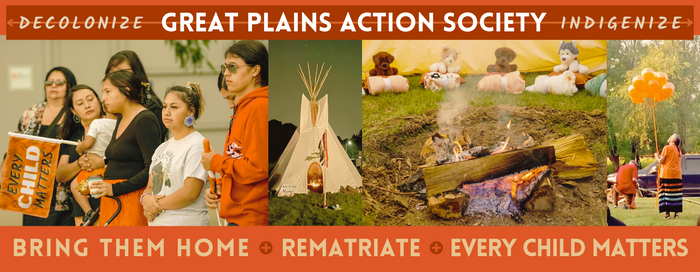
Another set of connections relates to the Great Plains Action Society (GPAS), founded by my friend Christine Nobiss, who was also on the First Nation-Farmer Climate Unity March. Ronnie’s Mutual Aid work is supported by GPAS.
Prairie Awakening/Prairie Awoke
Saturday was also the day of the annual Prairie Awakening/Prairie Awoke ceremony, an annual event sponsored by the Dallas County Conservation Board. The ceremony is held in the Kuehn Conservation Area. My Quaker meeting, Bear Creek, has been involved with the ceremony for over ten years. A number of Friends attended.
While there, I was able to talk with my friend Rodger Routh, who grew up in the Earlham, Iowa (where Bear Creek meeting is) community. Rodger is a photographer/videographer and justice advocate, who is often at the same events I attend. Jon Krieg (AFSC, mentioned above) is also a photographer. It is common for the three of us to be at the justice related events.
LANDBACK
One of the principles of justice work is to follow the leadership of the communities affected by injustice. In Indianapolis, the Kheprw Institute would let us (Quakers in this case) know what we could do for them.
Recently I had a chance to ask Christine how nonnative people could best support her and her work now. She told me to learn and teach others about the concepts of LANDBACK. So, I created a website named LANDBACK Friends, where I’ve been sharing what I am learning about LANDBACK. https://landbackfriends.com/
Maintaining connections
As the completion of a circle, I was so glad to be contacted by my friends at the Kheprw Institute (KI) in Indianapolis. Aghilah contacted me because KI is interested to learn more about LANDBACK. Evidently, they have been following my blog since I left Indianapolis and reading what I’ve been writing about LANDBACK.
Quakers for Abolition Network
My blog also made it possible for one of my new friends, Jed Walsh, to contact me about the work he and Mackenzie Barton-Rowledge are doing related to abolition of police and prisons. I wrote a little in their article that was just published by the Western Friend, https://westernfriend.org/article/quakers-abolition-network.
Conclusion
We are moving more deeply into collapse. Fueled by the consequences of environmental chaos, our economic and political systems are failing. We must work now to build ways to deal with this collapse. I’ve been working on this diagram to illustrate how people are building such systems. It is important to build Mutual Aid communities. And embrace the principles of LANDBACK. “What you get into will change you”.
This document has a lot more information about Quakers, the Wet’suwet’en peoples, and LANDBACK. Scroll down to move through the document.
This year’s Prairie Awakening/Prairie Awoke ceremony will be held Saturday, 9/11/2021 at the Kuehn Conservation Area (map below) from 11:00 am – 2:00 pm.
Last year’s ceremony was not held in person because of the COVID pandemic. The following was written about the 2020 virtual event.
Prairie Awakening/Prairie Awoke 2020
Yesterday my Quaker Meeting, Bear Creek Friends of Iowa Yearly Meeting (Conservative), discussed the meeting’s long history of connection with Prairie Awakening/Prairie Awoke. This ceremony is held annually at the Kuehn Conservation Area, just a few miles from the meetinghouse in rural Iowa.
This year, because of the COVID-19 pandemic, the Prairie Awakening ceremony occurred virtually, with a series of videos. The following table has links to those and other videos related to Prairie Awakening/Prairie Awoke, most done by my friend Rodger Routh with Chris Adkins, Dallas County Conservation’s environmental education coordinator and longtime organizer of the event, narrating.
Having lived my adult life in Indianapolis, September 2017 was the first opportunity to attend. I had just retired to Iowa and was hoping to build up enough stamina to continue to live without a car, as I had done for about 40 years in Indianapolis.
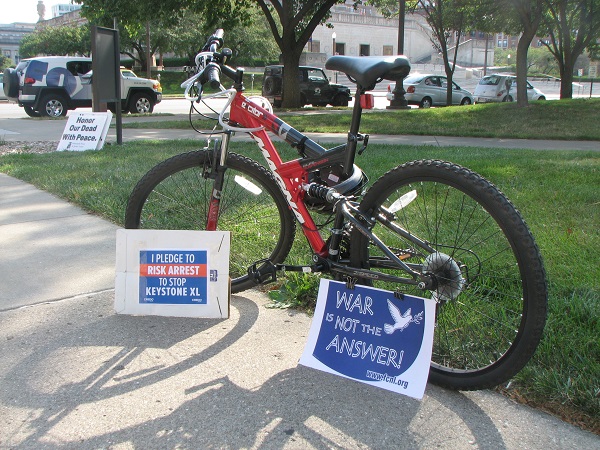
I used the opportunity of traveling to the Prairie Awakening ceremony as a test. It is forty miles from home in Indianola to Bear Creek meeting. It is also about forty miles from the Iowa state Capitol building to Bear Creek Meeting. My bicycle and I were dropped off at the Capitol building in Des Moines, where I participated in a climate action on September 9, 2017.
Then I began the journey of bicycling from the Capitol to Bear Creek meeting. I hadn’t ridden that far, nor had I traveled that bike path before, so this was a test of my vision.
I did finally arrive at the Bear Creek meetinghouse that evening, around 5 pm, pretty much exhausted. There was one gigantic hill to climb near the end that practically had me crying. Well OK, I did cry. I was so grateful that Jackie Leckband had left water and food at the cottage next to the meetinghouse where I spent the night. https://kislingjeff.wordpress.com/2017/09/09/september-journey-day-1/
Unfortunately last year when we were gathered at Kuehn, just as the ceremony was about to begin, a big thunderstorm rained us out.
This year because of the pandemic, several videos were produced for a virtual ceremony. One of the things we did at yesterday morning’s pre meeting via Zoom was to watch and comment about those videos.
The years of Bear Creek Friend’s work with Prairie Awakening provides us with an excellent foundation to continue to build relationships with Native Peoples. Other ways we’ve built connections have been Paula Palmer’s workshops, “Toward Right Relationship with Native Peoples”, Iowa Yearly Meeting (Conservative) panel discussion “Building Bridges with Native Peoples”, some Friends participating on the First Nation-Farmer Climate Unity March, support of the Wet’suwet’en Peoples efforts to stop construction of the Coastal GasLink natural gas pipeline in British Columbia, and with Decolonizing Quakers.
My grandmother, Lorene Standing, said the will of God is often revealed in a series of small steps. I thought that meant a series of spiritual messages and that has been my experience.
But also, looking back over our lives, the series of actions we took, the decisions we made, map the path traveled. Spiritual guidance can help us stay on the path, might tell us what action to take. Each step gives us experience needed to continue on the path. We stray from the path at times. But learn by making mistakes.
This is the third anniversary of the First Nation-Farmer Climate Unity March (described below). When I learned about the March, I immediately felt a leading from the Creator this was something I should do. The experiences during the March were transformational for me.
The Spirit was important in numerous ways. One of the reasons I wanted to join the March was to learn more about Indigenous spirituality, and I did.
The article below describes how my Quaker community supported us spiritually during the March.
The Spirit created the opportunity for me to talk with my new friend, Matthew Lone Bear, about Quaker involvement with the native residential schools. And for him to share a story of the impact of those schools on his own family. (These stories are found on the First Nation-Farmer Climate Unity March website https://firstnationfarmer.com/ )
Our experiences on the March have made it possible for us, native and nonnative people, to work together in many ways since.
Here is a link to the First Nation-Farmer website, where there are many stories, photos and videos from the March. And a link to the website LANDBACKFriends which is about work going on now related to the concepts of LANDBACK.
These are perilous times. Ferocious wildfires, melting glaciers and permafrost, severe drought, and devastating storms show rapidly evolving environmental chaos. Political, economic and social systems are breaking down.
There is also hope as we work together to address these challenges. Mutual Aid works because it is based upon people working and being together in their local communities, solving local problems. And LANDBACK is a framework for Indigenous peoples to teach us how to work to repair our relationships with Mother Earth and each other. It is because of the friendships that formed during the March that many of us are working together on Mutual Aid and LANDBACK.
Following is an article, written shortly after the March, published in On Creation, the publication of Quaker Earthcare Witness. The article is no longer online.
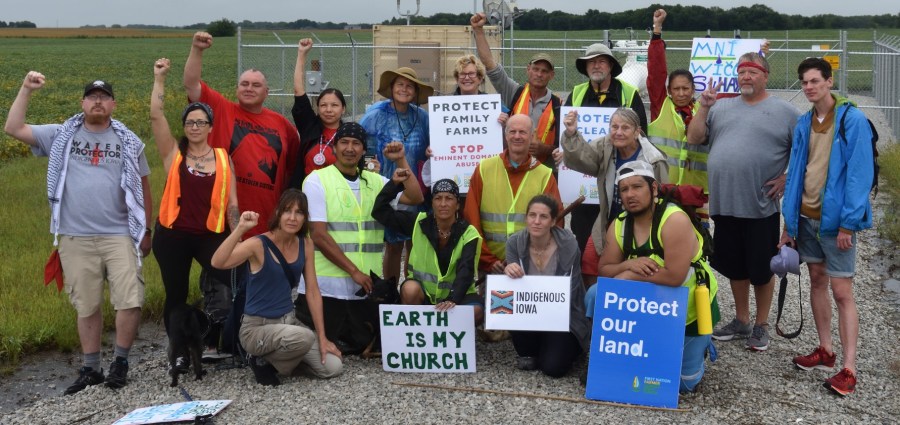
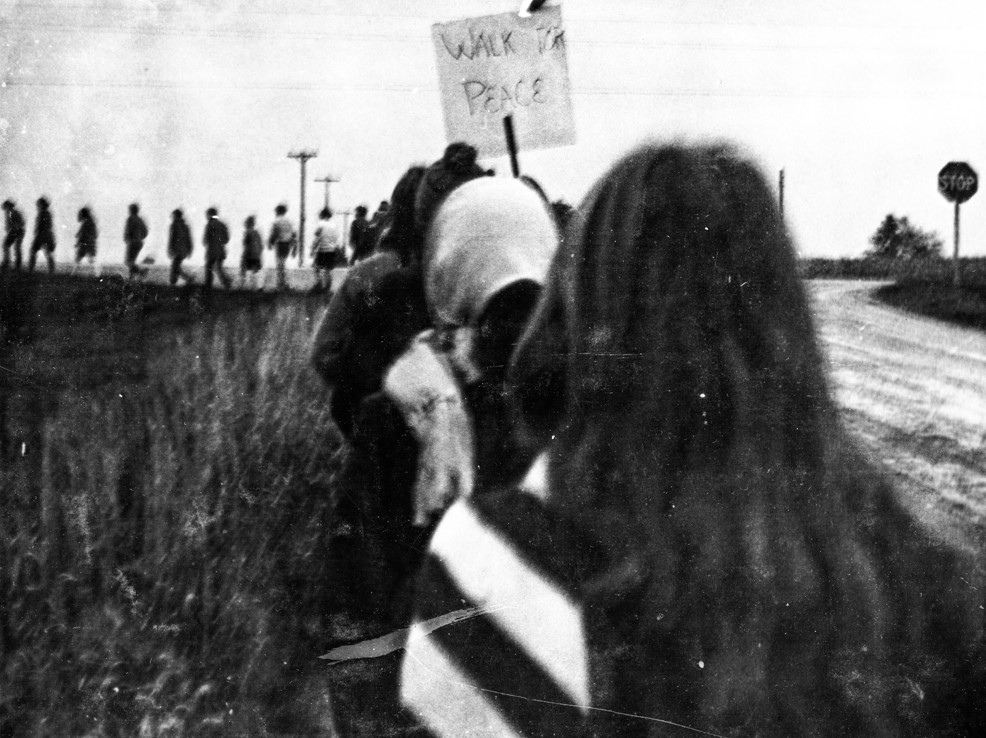
Iowa Yearly Meeting (Conservative) Friends Peter Clay and I recently walked on the First Nation-Farmer Climate Unity March. A group of about thirty that included nearly a dozen Native Americans walked 94 miles along the route of the Dakota Access Pipeline from September 1 – 8, 2018. One of the goals of the March was to bring attention to a case before the Iowa Supreme Court about the improper use of eminent domain to force Iowa farmers to allow construction of the pipeline on their land.
After walking between 9 and 15 miles, most evenings a community forum was held to discuss topics such as farming practices, or the consequences of the pipeline construction. One evening my Scattergood Friends School classmate Lee Tesdell discussed some of his progressive farming practices. Christine Nobiss discussed ways Native farming practices are better for the earth and water. This was an example of how this March helped us come together. As Manape LaMere, one of the headsmen from Standing Rock said, the purpose of the March was to make it possible for us to work together in the future. To do so, we needed to trust each other, and to trust each other we needed to understand each other.
During this March, Quakers in my local meeting, Bear Creek, often sent email messages of encouragement, and held us in their prayers. One of my Quaker friends, Liz Oppenheimer, invited people to offer spiritual support for our March in a couple of ways. One was via a telephone conference call every morning we were marching, from 8:30 to 9:00 am.
The other way Liz created for others to support us was by creating a Facebook group called “Meeting for Worship: Iowa’s Climate Unity March”. Following are a few of the messages shared on that Facebook page:
I see that Jeff has posted some of his recent writing about the march and its issues. My request is that we return to Jeff’s initial questions— sharing our reactions to the idea behind this march, as well as to the issues of pipelines, indigenous rights, misuse of eminent domain, etc.
As we share our own wonderings, questions, and struggle, I hope we can better accompany Jeff, Peter Clay, and other marchers.
George Fox suggested to us that if we answer that of god in others that we can then walk cheerfully over the earth. As I think about Jeff and Peter and the new sisters and brothers they will meet as they march, I realize that this sentiment works the other way also. As they walk over the earth they will then be able to answer to that of god in others.
This morning on the conference call for worship, we heard a vocal prayer of gratitude to Peter Clay, Jeff Kisling, and the other marchers and organizers of the march. We also heard the joyous hymn “Trees of the Field.”
After other Friends had left the call, and literally as my finger was about to hit the Hang Up button on my phone just past 9:00 am, another Friend joined the call. It was Jeff!!
He wants us to know that the marchers and organizers know we are holding them all in prayer and they are very appreciative of our support in this way. When I replied “It’s such a small thing we do,” Jeff reminded me “No, no it’s not.”
We are so blessed to be connected this way, no matter what form our march and our journey takes. And to those of you who are carving out time each day to hold the Climate Unity March in prayer, regardless of when, where, or how, all of us thank you.
Each morning of the March we gathered in a circle to hear about the day’s route and address any questions. The first morning I shared this Quaker support with my fellow marchers during our circle gathering, who expressed appreciation for this.
Some of the most powerful experiences I had during the March were times when prayers were offered. We stopped for prayers every time we crossed the route of the Dakota Access Pipeline. I was honored to be given the opportunity to give prayers at the pipeline crossing just before we reached Pilot Mound. I briefly described Quaker worship, then our circle, holding hands, worshiped in silence for a while.
The pandemic resulted in many people, including Friends Committee on National Legislation (FCNL) staff, remaining home. So, FCNL invited people to attend weekly Quaker meetings for worship via Zoom, called Witness Wednesday Silent Reflection. There are a number of regular attenders, who often speak of how meaningful these meetings have been in these times. This Wednesday there will be a special silent reflection on 20 years of endless war, that anyone is welcome to attend. We will reflect on affirming our fervent hope that endless war will be no more. Signup to receive the Zoom link here:
As we mark the 20th anniversary of the 9/11 attacks, and the unfolding humanitarian crisis and violence in Afghanistan today, join General Secretary Diane Randall for a time of reflection.
Take a moment to reflect in keeping with the Quaker practice of silent worship. Join us virtually on Zoom or by phone in affirming our fervent hope that endless war will be no more.
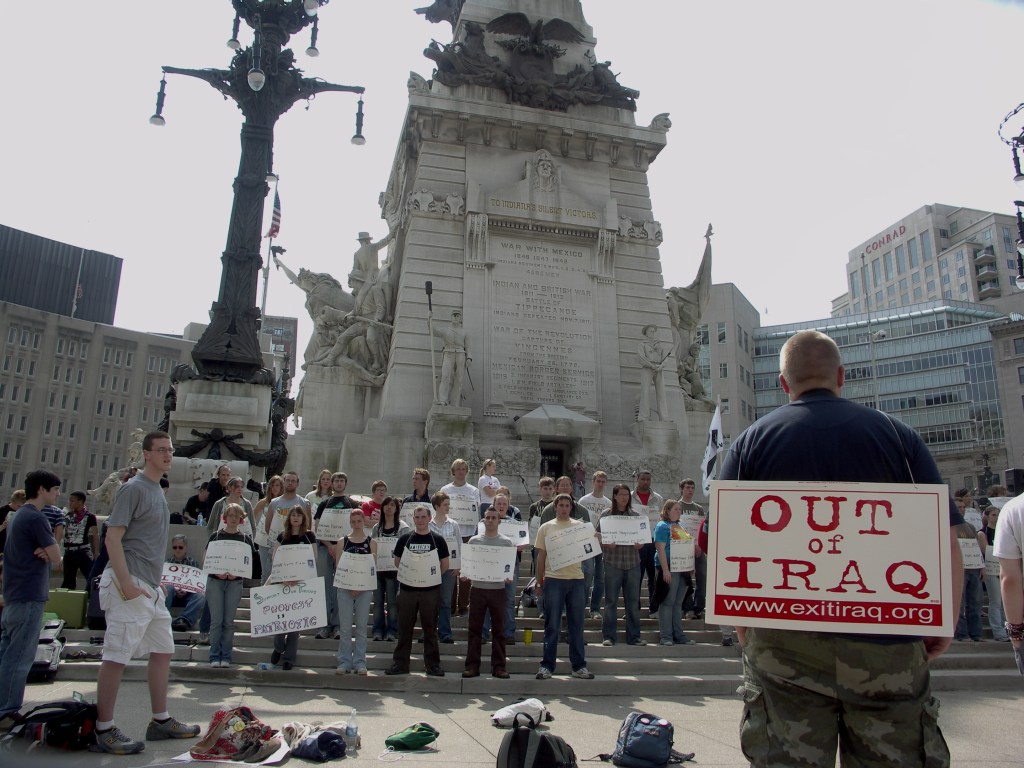
War has never been the answer to the world’s most pressing problems—including terrorism. Military solutions and large-scale violence cannot lead to sustainable peace. Instead, they only make the problem worse by spawning new terrorist groups and setting off cycles of retribution.
Only through the careful, patient work of peacebuilding with local human rights and civil society leaders which includes women, and through diplomacy by regional and international stakeholders can we reach just and durable solutions to the root causes of violence.
As we grieve these deaths and the unfolding humanitarian crisis in Afghanistan, we hold the people of Afghanistan in the Light in the days and months ahead. We affirm our opposition to war and violence and to the ensuing destruction and chaos.
Today, it is our fervent hope that endless war will be no more.
Two Decades of War by Diane Randall, General Secretary, Friends Committee on National Legislation, September 1, 2021
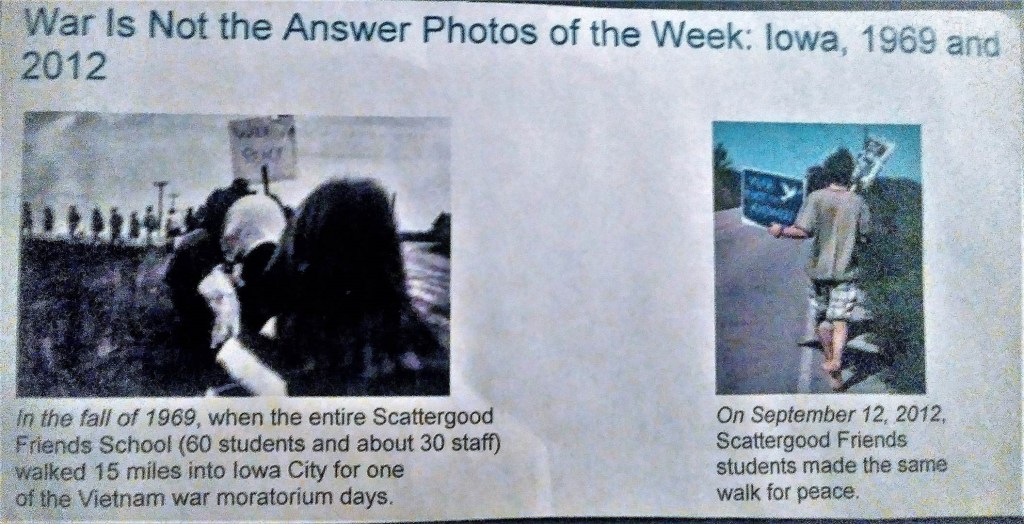
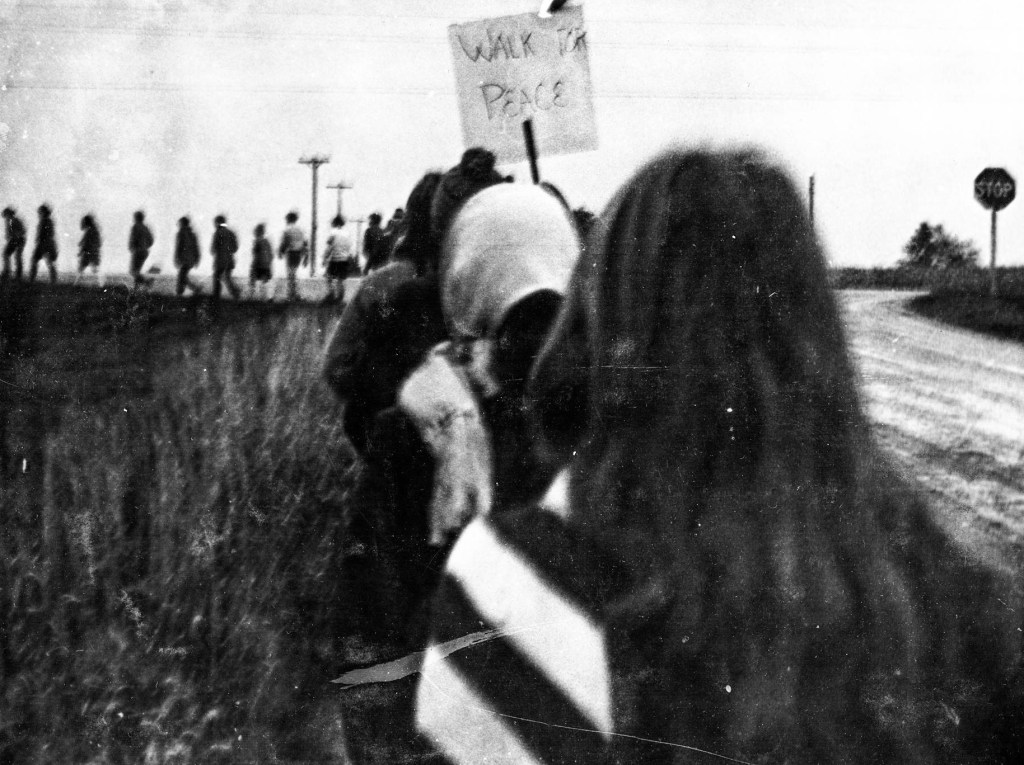
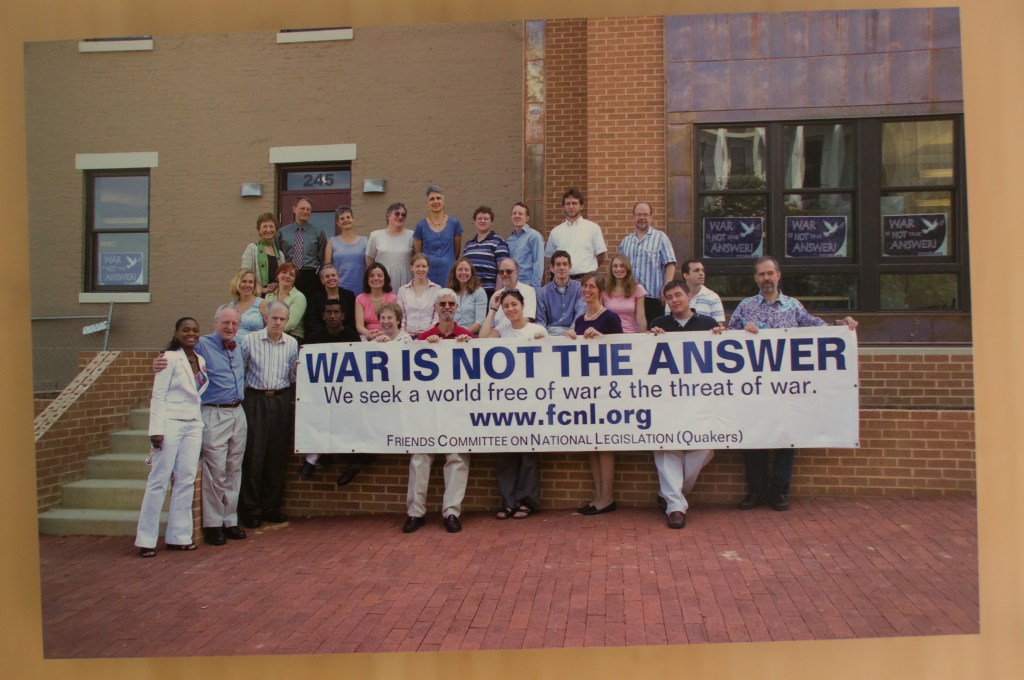
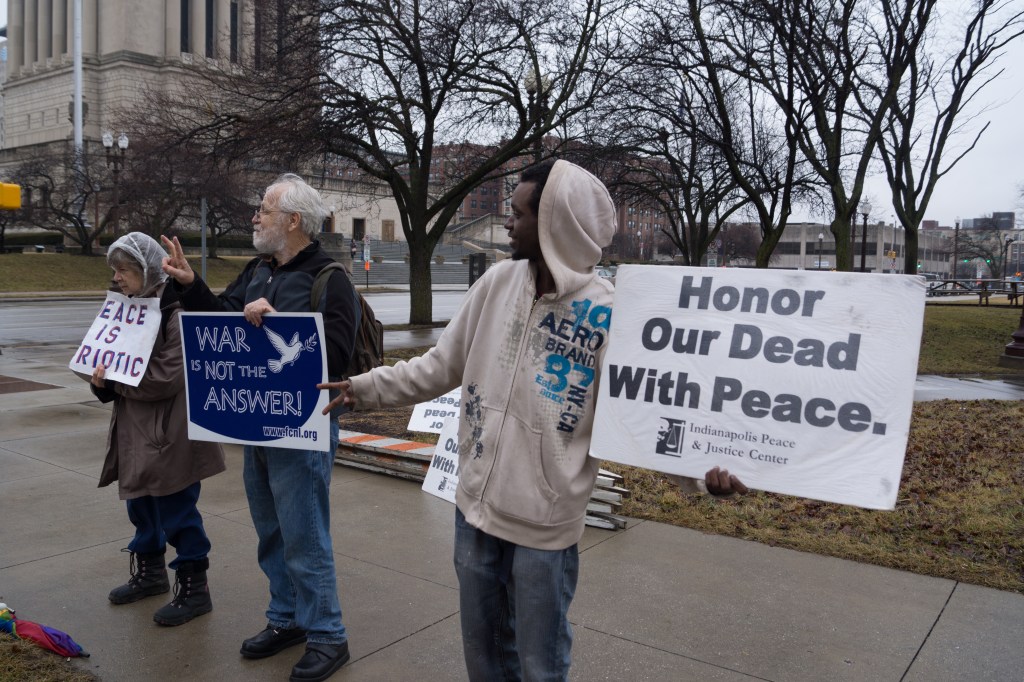
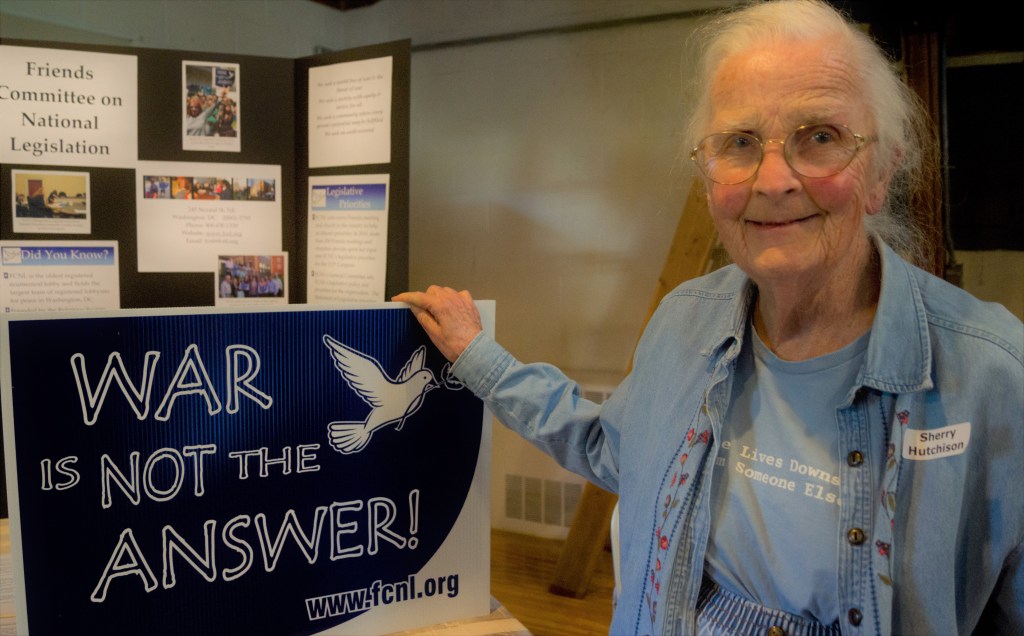
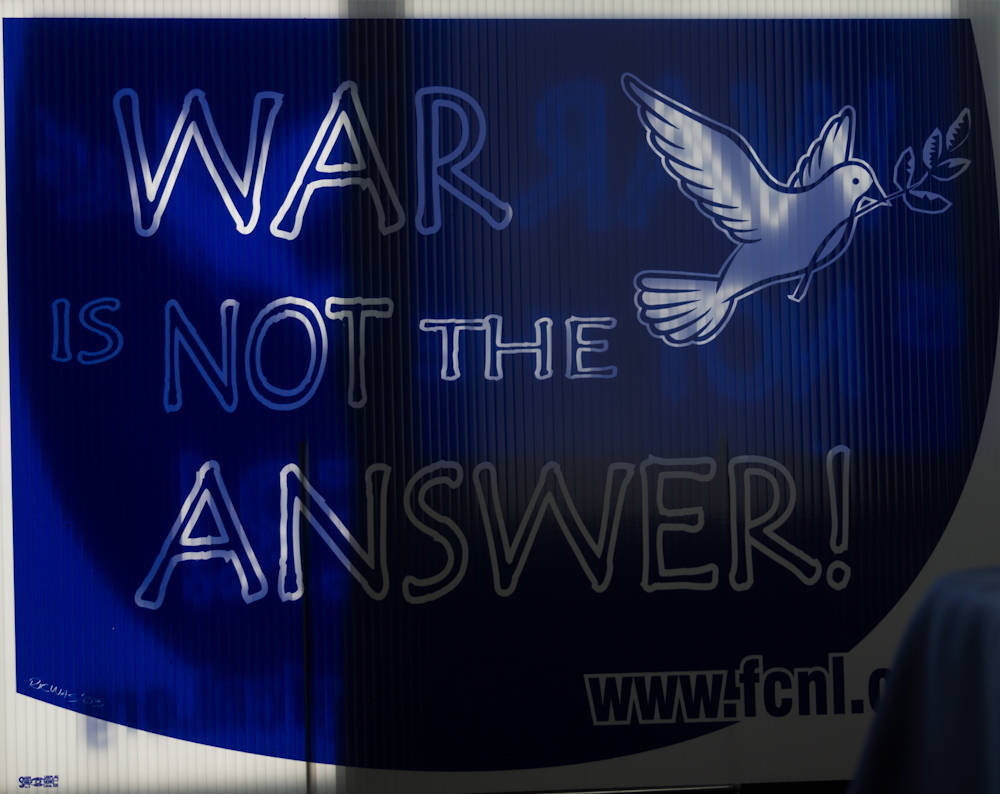
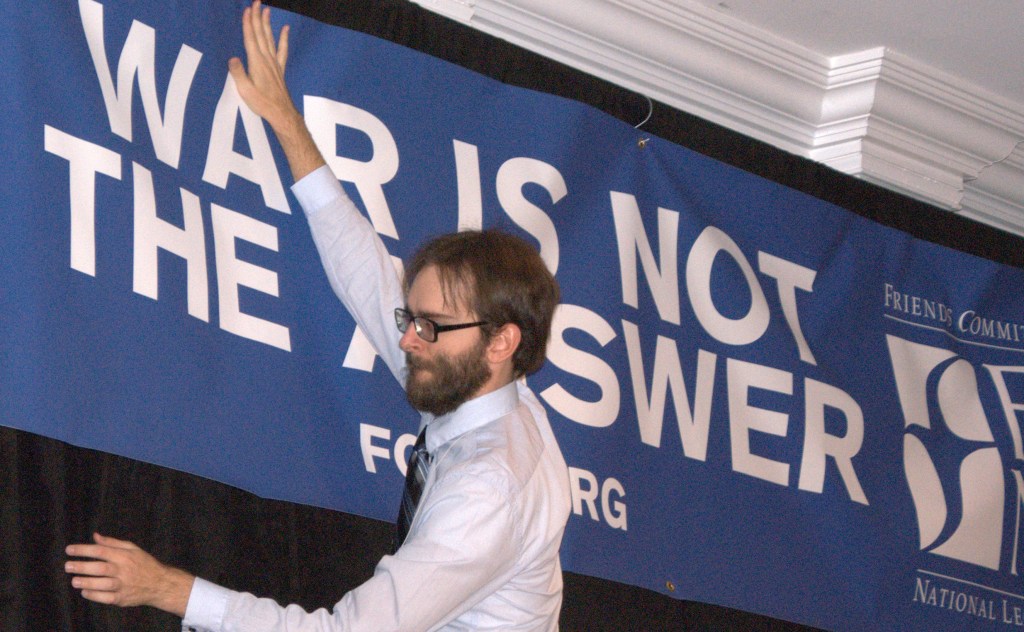
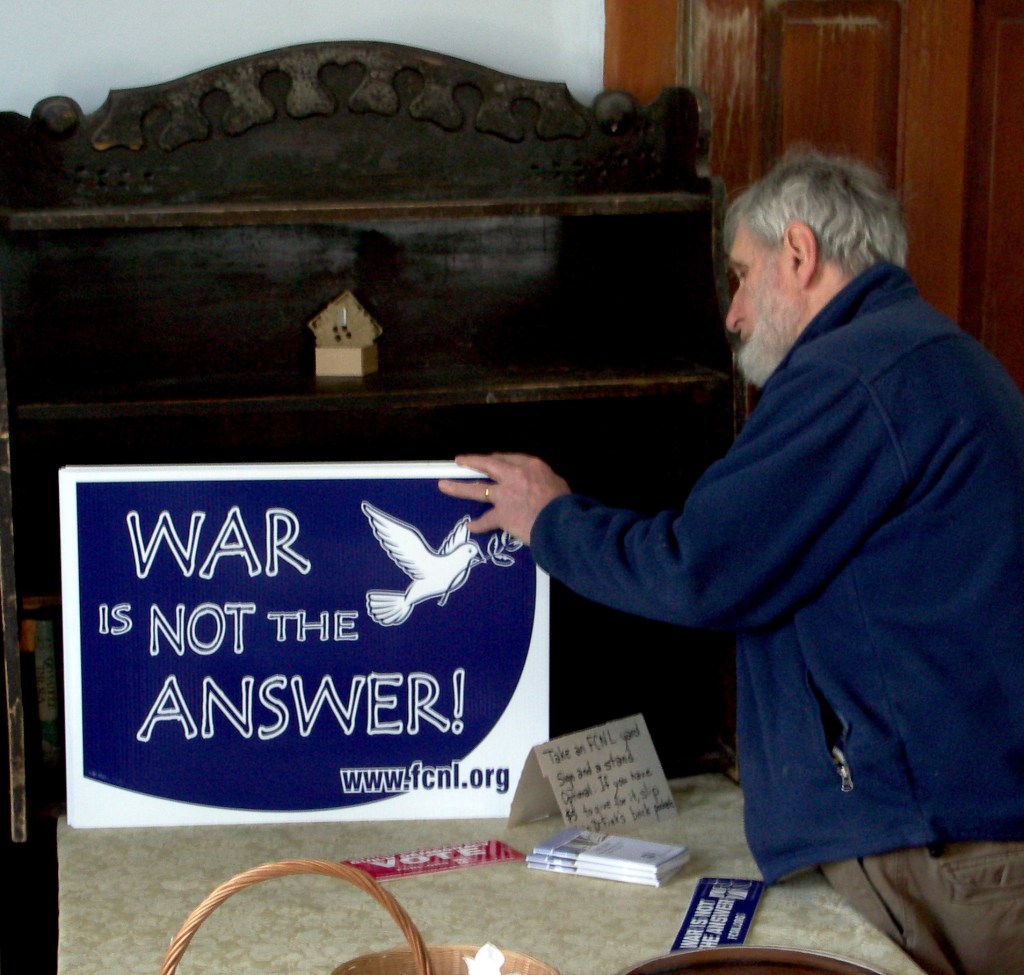
War is not the Answer
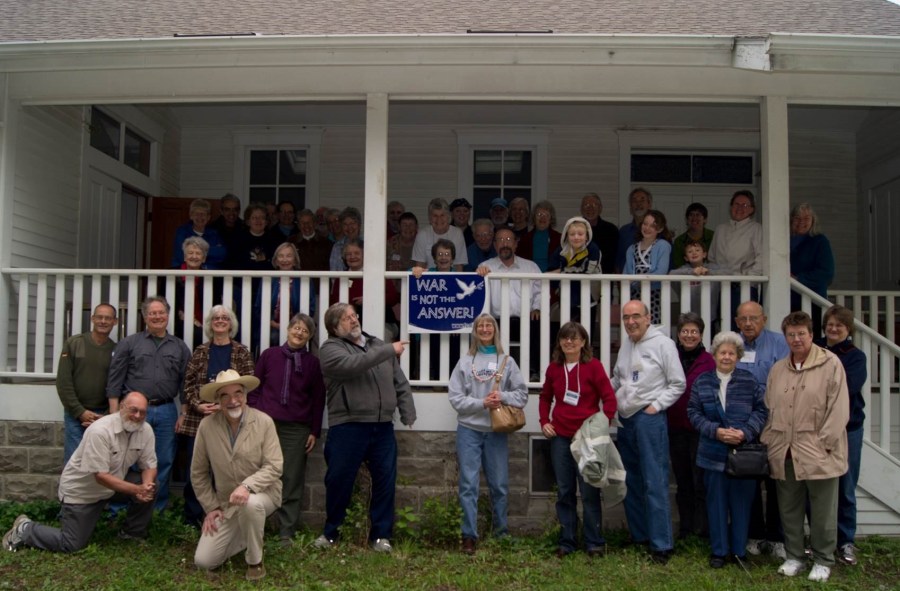
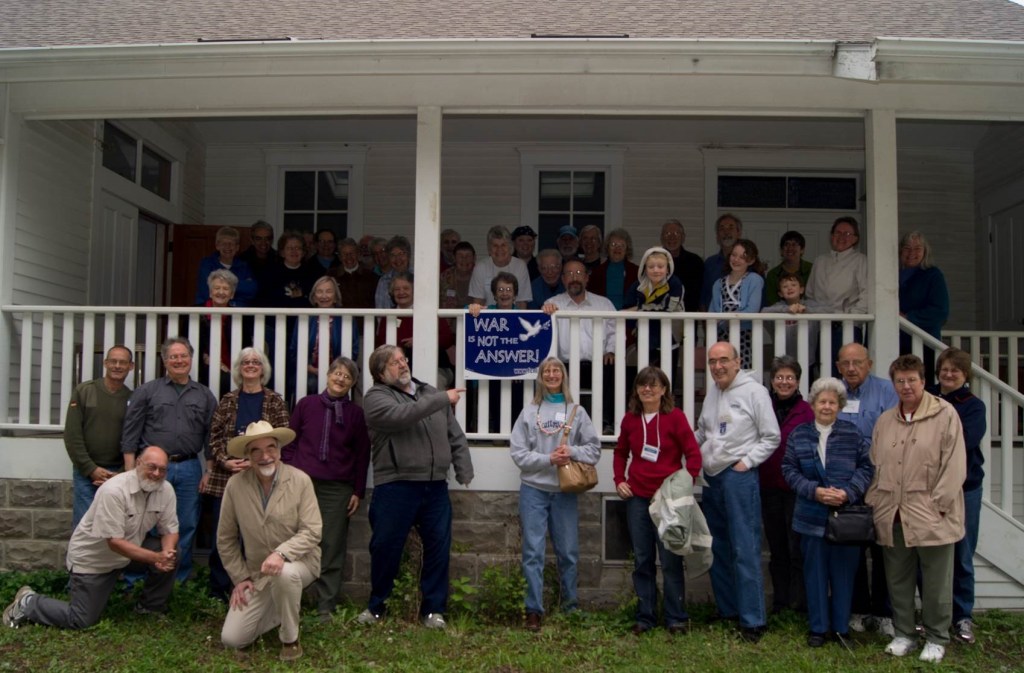
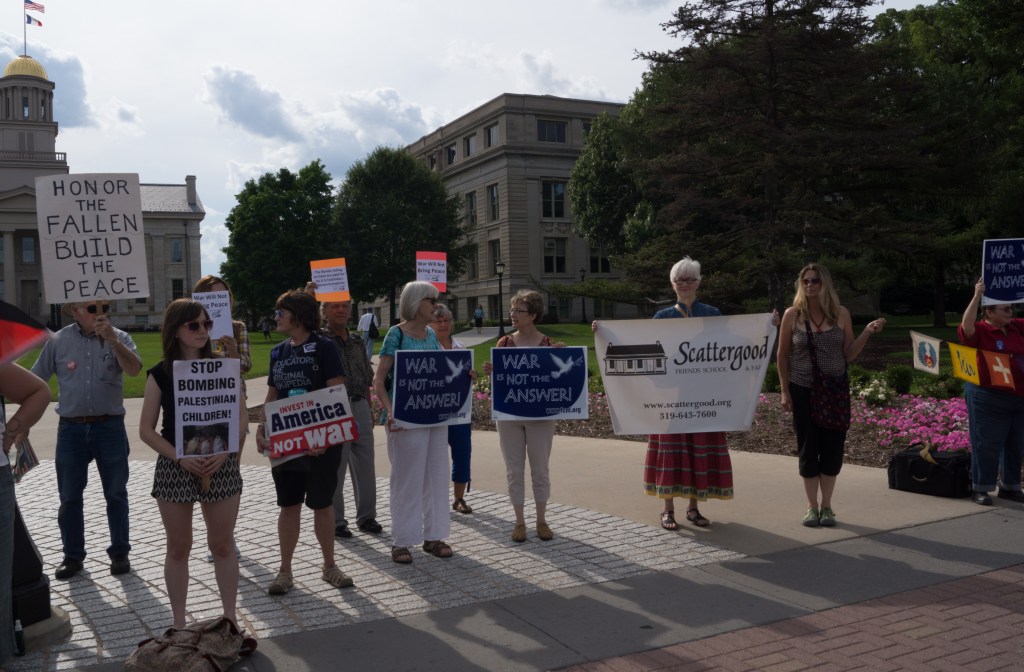
It was post-9/11, and Friends in Atlanta Friends Meeting wanted to publicly witness against war. Friends listened to their hearts’ stirrings during business meeting, and “War is Not the Answer” became the Meeting’s new yard sign.
These words were taken from Martin Luther King Jr.’s speech, Beyond Vietnam: A Time to Break Silence, delivered April 4, 1967 at the Riverside Church in New York.
War is not the answer. Communism will never be defeated by the use of atomic bombs or nuclear weapons. Let us not join those who shout war and, through their misguided passions, urge the United States to relinquish its participation in the United Nations. These are days which demand wise restraint and calm reasonableness. We must not engage in a negative anticommunism, but rather in a positive thrust for democracy, realizing that our greatest defense against communism is to take offensive action in behalf of justice. We must with positive action seek to remove those conditions of poverty, insecurity, and injustice, which are the fertile soil in which the seed of communism grows and develops.
These are revolutionary times. All over the globe men are revolting against old systems of exploitation and oppression, and out of the wounds of a frail world, new systems of justice and equality are being born.
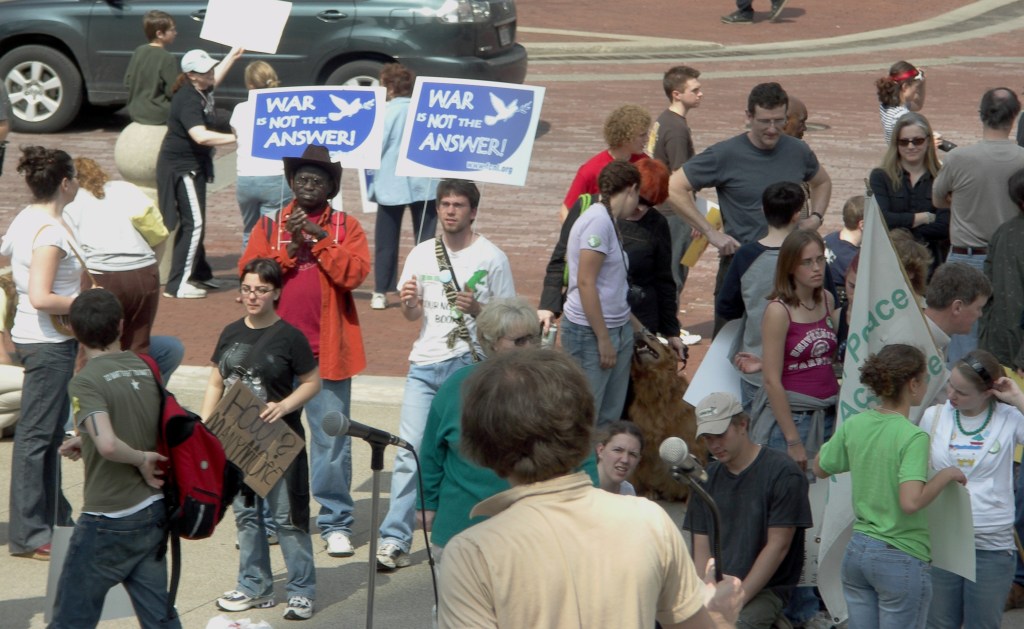
The message – War is Not the Answer – and the signs went viral. FCNL and Friends saw the potency and popularity of the message grew and spread, and the rest is history. With the increasing prospect for an endless war with Iran, War is Not the Answer, has become more relevant.
Friends and other people of faith act when they see broken systems. As we stand on the precipice of another war, Friends are mobilizing across the country to demand Congress halt the spiral into all-out war.
FCNL has distributed more than 2,000,000 “War is Not the Answer” bumper stickers and yard signs since 2002. Demands for the sign are increasing so we are making it available free online for you to download and print. If you’d like to purchase a lawn sign or bumper sticker, you can do so here.
What triggered this blog post was learning Congress is working to require women to register for the Selective Service System (“draft”). Men have been required to do so for decades.
As I began to write about that, I had to decide whether to post this article on my blog Quakers, social justice and revolution where it would fit with what that blog is about.
LANDBACK is about breaking away from white supremacy, the capitalist economic system and the structures that enforce them. So I updated this diagram I’ve been working on to add the military to the justice, police and prison systems that enforce colonial/corporate capitalism.
A growing number of us are working for the abolition of police and prisons. The military enforces white supremacy and capitalism beyond our borders. Thus, I think, abolition of the military, military bases and the use of weaponized drones could be considered part of LANDBACK.
Thinking about LANDBACK as an antiwar framework is intriguing. Mutual Aid is part of the LANDBACK idea. I was very interested to learn Des Moines Mutual Aid’s first public appearance was at an antiwar march:
One year ago today (2020) Des Moines Mutual Aid participated in a march protesting the potential for war or increased hostilities with Iran that followed the fallout of the assassination of Qassem Soleimani by drone strike in Baghdad.
Ronnie James
The immediate collapse of the Afghan government when U.S. troops left Afghanistan after twenty years of war has a great many of people wondering about militarism and war.
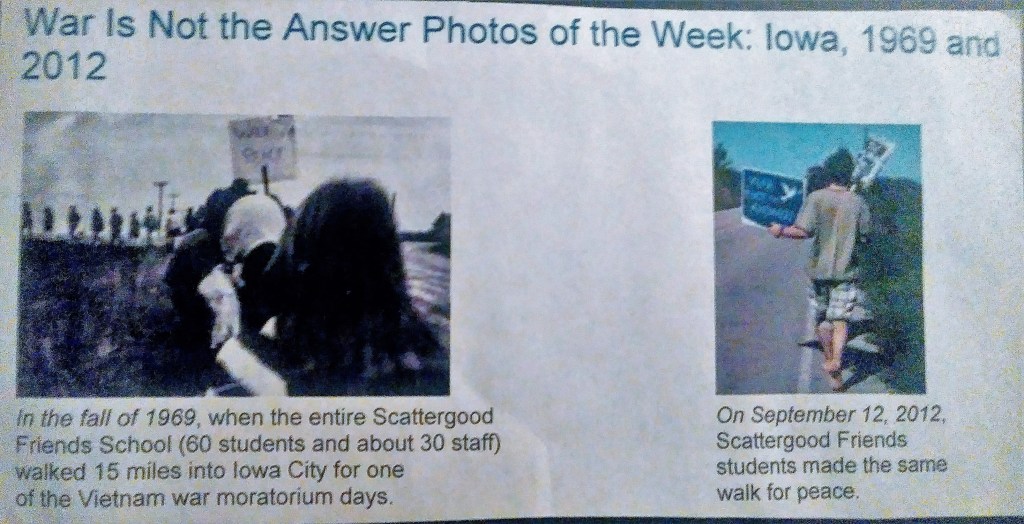
Most Quakers, such as myself, have opposed the draft in many ways, for many years. The issue resulted in a group of Quakers leaving the country called the United States and establishing a thriving community in Costa Rica, a country that does not even have a military. Numerous Quaker men either registered as conscientious objectors, or refused to cooperate with the Selective Service System. Some were sentenced to prison. This is a link to stories about Quaker men and the miltary: Young Quaker Men Face War and Conscription.
Senators on the Armed Services Committee recently approved a revision to military draft laws that would require women to register for the Selective Service System (SSS).
Proponents of the measure, which was included as part of the annual National Defense Authorization Act (NDAA), see it as a matter of gender equality. This argument misses the point: Congress should be focused on abolishing the draft entirely, not expanding it.
As laid out in a coalition letter we supported to members of the Senate Armed Services Committee, this legislation “does not represent a move forward for women; it represents a move backward, imposing on young women a burden that young men have had to bear unjustly for decades – a burden that no young person should have to bear at all.”
















 LANDBACK Friends