Notes to myself continued

Yesterday I wrote about preparing for a discussion about Mutual Aid at my Quaker meeting this Sunday. Describing the use of queries, and then coming up with an initial series of questions.

Now I’m outlining the major topics to discuss. An hour isn’t much time, and the point of queries is to allow people time to respond to them.

I think I should begin by telling the story of how the Spirit led me to connect with Ronnie James, and how he mentored me about Mutual Aid. And then my experiences of being in that Mutual Aid community. It is important to speak from our own experiences.

What are the main points I want to make?

  • We have no choice but to find alternatives since the status quo has begun to and will increasingly collapse.
  • The status quo has been very different for different segments of our society.
  • This is a chance to build alternatives that are just and equitable.
  • This is an opportunity to conserve resources. To move toward living within ecological limits.
  • “It is about acknowledging that we Americans have enjoyed middle-class comforts at the expense of other peoples all over the world.” Grace Lee Boggs
  • A chance to live with spiritual integrity. Which we must do before we can speak to the spiritual needs of anyone else.
  • Mutual Aid addresses the above.

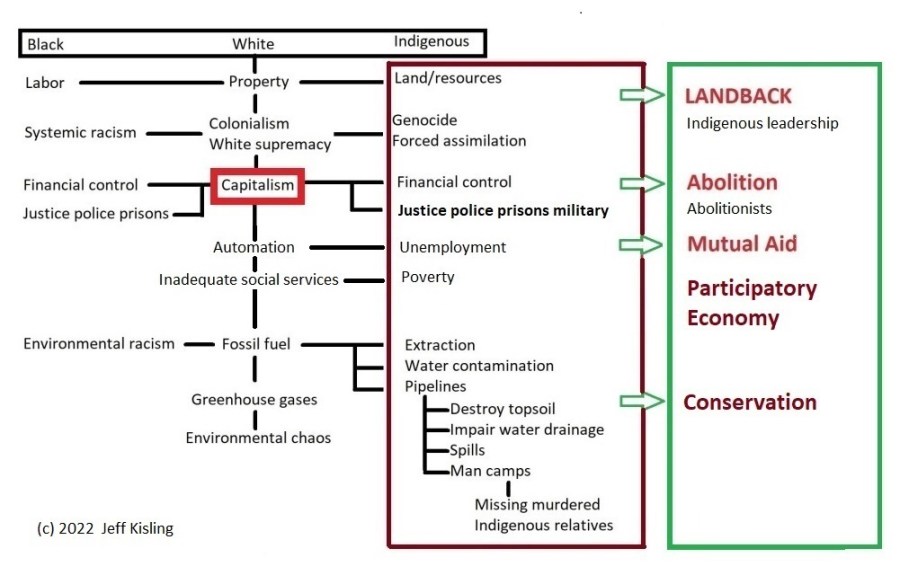
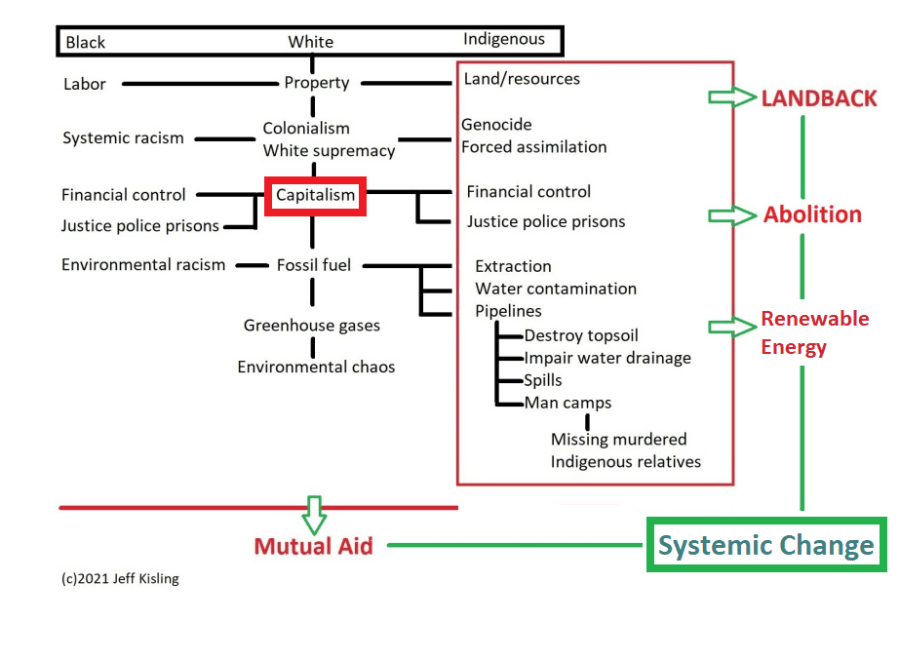
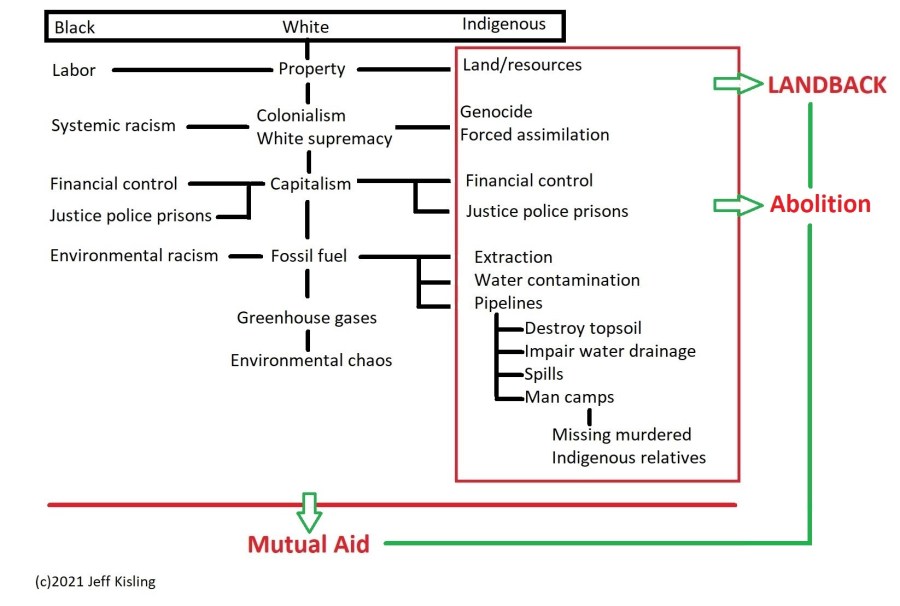
As these graphics explain, there is more than Mutual Aid involved in building the communities we want. Building Mutual Aid communities is a first step because it provides the framework for how a community works together and can address other things like abolition and LANDBACK.

Abolition and the mutual aid that we practice are inextricably linked.

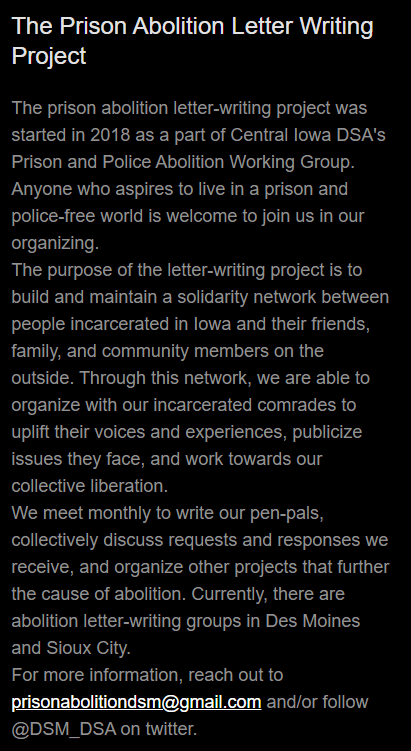
I participate in the Prison Abolition Letter Writing Project that was started in 2018 as part of Central Iowa Democratic Socialists of America’s Prison and Police Abolition Working Group. Several of us from Des Moines Mutual Aid participate in the letter writing project.

And I am a member of the Quakers for Abolition Network (QAN).

We as White Quakers like to think of ourselves as ahead or better than dominant culture, but we have been complicit in a system and mindset that are ubiquitous. Claiming the full truth of our history and committing to repair the harms done are deeply spiritual acts of healing our own wounds of disconnection. I would argue it is the pathway upon which we can, perhaps for the first time, discover and invigorate our faith with its full promise.

What would it mean for us to take seriously and collectively as a Religious Society a call to finish the work of abolition, hand in hand and side by side with those affected and their loved ones? What would it mean for us to stand fully with the calls to abolish the police and fully fund community needs instead? What would it mean to reckon with our past complicity with harm and fully dedicate ourselves to the creation of a liberating Quaker faith that commits to build the revolutionary and healing faith we long to see come to fruition? What would it look like to finally and fully abolish slavery?

A Quaker Call to Abolition and Creation by Lucy Duncan, Friends Journal, April 1, 2021

The next American Revolution, at this stage in our history, is not principally about jobs or health insurance or making it possible for more people to realize the American Dream of upward mobility. It is about acknowledging that we Americans have enjoyed middle-class comforts at the expense of other peoples all over the world. It is about living the kind of lives that will not only slow down global warming but also end the galloping inequality both inside this country and between the Global North and the Global South. It is about creating a new American Dream whose goal is a higher Humanity instead of the higher standard of living dependent on Empire. It is about practicing a new, more active, global, and participatory concept of citizenship. It is about becoming the change we wish to see in the world.

The courage, commitment, and strategies required for this kind of revolution are very different from those required to storm the Winter Palace or the White House. Instead of viewing the U.S. people as masses to be mobilized in increasingly aggressive struggles for higher wages, better jobs, or guaranteed health care, we must have the courage to challenge ourselves to engage in activities that build a new and better world by improving the physical, psychological, political, and spiritual health of ourselves, our families, our communities, our cities, our world, and our planet.

Grace Lee Boggs, The Next American Revolution

Prison Abolition Letter Writing Project

I recently attended my first meeting with the Prison Abolition Letter Writing Project of the Central Iowa Democratic Socialists of America (DSA). I didn’t know who would be there but thought it likely a few of my Mutual Aid friends might. It is a maxim of justice activism that a small core group of people work in many different justice groups in a city, and such was the case. I was glad to see two of my Mutual Aid friends there. Seven of us met in a park shelter not far from the church our Mutual Aid group uses for the food giveaway project each Saturday morning.

I wondered what I would learn about the Prison Abolition Letter Writing Project and was fascinated by what I did learn. I assumed the idea was to establish a relationship with those imprisoned, which it certainly is. But as part of the sample letter shows, the concept is to invite those incarcerated to help those who are not understand what is going on in the prison system. Yet another example of Mutual Aid, where all involved work from the concept that we are all working together. Not “us helping them”.

I am writing to you as a part of the Central Iowa Democratic Socialists of American prison abolition group. I am inviting you to join our solidarity and pen-pal network. We are connecting with people incarcerated in Iowa because we believe the struggles of people both inside and outside of prison walls are intertwined. Specifically, we recognize the need to eliminate systemic injustices produced by the current criminal justice system.

Please let me know if you are interested in taking part in this project. I would love to receive any information from you so that we can make a case to those on the outside to take action on the demands of incarcerated people.

We are the Central Iowa chapter of the Democratic Socialists of America (DSA). Promoting the concept of democratic socialism through political action, direct service, and education. We are building for the future beyond resistance.
https://www.facebook.com/CentralIowaDSA

I became interested in DSA when my friend Fran Quigley, a professor in the Law School at Indiana University, wrote the following in response to my blog post, The Evil of Capitalism, 12/31/2020. Fran’s book was just published. Religious Socialism: Faith in Action for a Better World – August 25, 2021.

This post of yours struck me close to home. I too have become fully convinced of the evils of capitalism. Moreover, I have come to the conclusion that my faith dictates that I work to replace it. Turns out I am far from alone, so I’ve been devoting much of my time this past year to the Religion and Socialism Committee of the DSA, www.religioussocialism.org.
Fran Quigley

I’ve also been participating in the Quaker for Abolition Network, initiated by Mackenzie Barton-Rowledge and Jed Walsh. The following is from an article they wrote for Western Friend.

Mackenzie: Let’s start with: What does being a police and prison abolitionist mean to you?
Jed: The way I think about abolition is first, rejecting the idea that anyone belongs in prison and that police make us safe. The second, and larger, part of abolition is the process of figuring out how to build a society that doesn’t require police or prisons.
Mackenzie: Yes! The next layer of complexity, in my opinion, is looking at systems of control and oppression. Who ends up in jail and prison? Under what circumstances do the police use violence?
As you start exploring these questions, it becomes painfully clear that police and prisons exist to maintain the white supremacist, heteronormative, capitalist status quo.

Abolish the Police by Mackenzie Barton-Rowledge and Jed Walsh, Western Friend, November December 2020

We as White Quakers like to think of ourselves as ahead or better than dominant culture, but we have been complicit in a system and mindset that are ubiquitous. Claiming the full truth of our history and committing to repair the harms done are deeply spiritual acts of healing our own wounds of disconnection. I would argue it is the pathway upon which we can, perhaps for the first time, discover and invigorate our faith with its full promise.

What would it mean for us to take seriously and collectively as a Religious Society a call to finish the work of abolition, hand in hand and side by side with those affected and their loved ones? What would it mean for us to stand fully with the calls to abolish the police and fully fund community needs instead? What would it mean to reckon with our past complicity with harm and fully dedicate ourselves to the creation of a liberating Quaker faith that commits to build the revolutionary and healing faith we long to see come to fruition? What would it look like to finally and fully abolish slavery?

A Quaker Call to Abolition and Creation by Lucy Duncan, Friends Journal, April 1, 2021

Lucy’s article includes this correction, that so many White people do unintentionally:
Correction: The author and FJ editors realize that an earlier version of this article inadvertently erased BIPOC (Black, Indigenous and people of color) Quakers in describing Quakers as though we were/are all White. Certainly there have been Black Friends and Friends of Color in our body from our earliest history. We apologize for this error. This online article has been updated accordingly. We have also clarified the relationship of George Fox with Margaret and Thomas Rous.

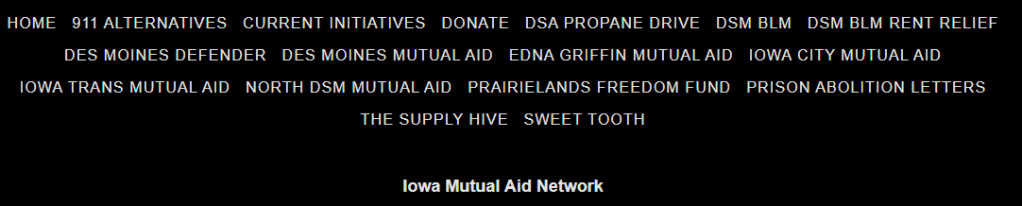
A goal of Mutual Aid is to grow, pulling increasing numbers of people into the work. I’ve been involved in Des Moines Mutual Aid and the food giveaway project for the past year. The Iowa Mutual Aid Network has expanded to include the following organizations. The Prison Abolition Letter Writing Project is a way to bring more people into our mutual work.

The Iowa Mutual Aid Network is made up of numerous individuals, collectives, and affinity groups working together and alongside each other to change the material conditions of oppressed communities in so-called Iowa.

The groups represented on this site are in no way a full accounting of those that are engaged in the struggle.

All Power To The People


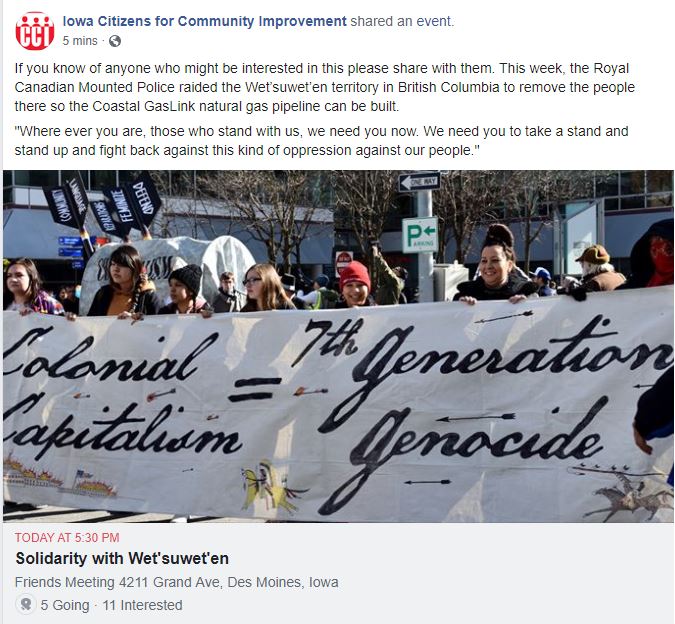
Wet’suwet’en updates 11/20/2021

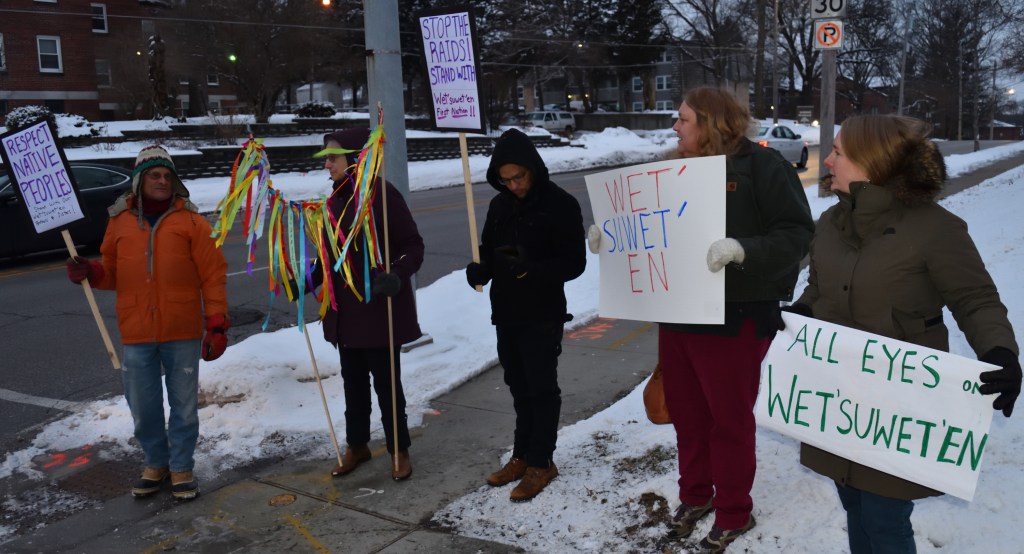
Following are updates from the Wet’suwet’en territory that was invaded again yesterday by the Royal Canadian Mounted Police (RCMP) on behalf of the Coastal GasLink pipeline. Militarized RCMP came with assault rifles and dogs. Three accredited journalists were arrested.

Militarized RCMP raided Coyote Camp today, arresting 14 people including Sleydo’, Chief Woos’s daughter, and three accredited journalists.. 

They came in with assault rifles and dogs, and without a warrant, used axes to break down the door of the cabin Sleydo’ and Chief Woos’s daughter we’re in, and violently removed them from their territory.

Of the people arrested yesterday, most we’re released this afternoon. Five people refused to sign conditions of release that barred return to the territory and are being brought to jail in Prince Rupert where they face court on Monday.

Solidarity actions continued across the country, with rallies, marches, rail blockades, and road closures. 

TAKE ACTION!

🔥 Issue a solidarity statement from your organization or group and tag us.
🔥 Host a solidarity rally or action in your area.
🔥 Pressure the government, banks, and investors.
🔥 Donate. http://go.rallyup.com/wetsuwetenstrong
🔥 Spread the word.      

#WetsuwetenStrong #AllOutForWedzinKwa #ShutDownCanada

Unist’ot’en Solidarity Brigade robertages@telus.net
 

During a similar RCMP invasion two years ago, it was reported that the use of lethal force to shoot Indigenous land defenders was discussed.

Notes from strategy session for raid on Wet’suwet’en nation’s ancestral lands show commanders argued for ‘lethal overwatch’

Canadian police were prepared to shoot Indigenous land defenders blockading construction of a natural gas pipeline in northern British Columbia, according to documents seen by the Guardian.

Notes from a strategy session for a militarized raid on ancestral lands of the Wet’suwet’en nation show that commanders of Canada’s national police force, the Royal Canadian Mounted Police (RCMP), argued that “lethal overwatch is req’d” – a term for deploying an officer who is prepared to use lethal force.

The RCMP commanders also instructed officers to “use as much violence toward the gate as you want” ahead of the operation to remove a roadblock which had been erected by Wet’suwet’en people to control access to their territories and stop construction of the proposed 670km (416-mile) Coastal GasLink pipeline (CGL).

In a separate document, an RCMP officer states that arrests would be necessary for “sterilizing [the] site”.

Wet’suwet’en people and their supporters set up the Gidimt’en checkpoint in December 2018 to block construction of the pipeline through this region of mountains and pine forests 750 miles north of Vancouver.

On 7 January, RCMP officers – dressed in military-green fatigues and armed with assault rifles – descended on the checkpoint, dismantling the gate and arresting 14 people.

Exclusive: Canada police prepared to shoot Indigenous activists, documents show by Jaskiran Dhillon in Wet’suwet’en territory and Will Parrish, The Guardian, Fri 20 Dec 2019

Indira Sheumaker on Des Moines City Council

My friends at the Great Plains Action Society have a graphic that says “Infiltrate the system. Vote.” A variation comes to mind with the news that Indira Sheumaker was elected to the Des Moines City Council. “Infiltrate the system, run for office.” Indira has been involved in the Black Liberation Movement.

Des Moines voters sent a new, young candidate to the City Council chamber in Tuesday’s election, ousting a longtime incumbent, and supported keeping two other council members in office.  

First-time candidate Indira Sheumaker defeated incumbent Bill Gray in the Des Moines City Council’s Ward 1 race. Gray was first elected in 2014.

Sheumaker attended her first council meeting when the group voted on an ordinance to ban racial profiling by the police department. There, she said, she heard “a lot of passionate people” speak up — herself included — but she felt like city leaders moved quickly without considering additional action.

Sheumaker said she would not have run for office if it weren’t for her involvement in last year’s protests with the Black Liberation Movement.

“I got involved protesting, showing up to the (Iowa) Capitol, got tear-gassed … and then a lot of members from organizations and older members of the community were encouraging us to go to City Council meetings,” Sheumaker previously told the Des Moines Register.

Social justice advocate Indira Sheumaker defeats incumbent Bill Gray in Des Moines City Council race by Melody Mercado, Des Moines Register, Nov 4, 2021

From street activism to Des Moines City Council

Sheumaker, 27, represents a new generation of politics, forged during a summer of protests and activism following the murder of George Floyd in Minneapolis in May 2020. Already, she’s marshaled her influence to rally speakers at City Council meetings, organized protests against police brutality and created a grassroots campaign that toppled two-term incumbent Bill Gray.

Now, with a seat on the Des Moines City Council, she faces a new challenge as she seeks to channel that grassroots energy into her role as an elected official. The goal, she said, is not to settle into the entrenched political dynamics she has spent the last year and a half protesting, but to lift up new voices and create avenues for change by being more transparent about the inner workings of Des Moines city government.

“The stuff that isn’t talked about, but isn’t, you know, protected behind some kind of confidentiality barrier … I have no qualms about being completely open about that and telling people what’s going on because people need to know what’s happening in their city,” she said.

From street activism to Des Moines City Council: How might Indira Sheumaker shake up Iowa’s capital city? by Melody Mercado and Brianne Pfannenstiel, Des Moines Register, Nov 6, 2021

A summer of protests in 2020 brought issues of policing and racial justice to the forefront, and those issues shaped city elections in Iowa and across the country this fall.

In her own race, Sheumaker spoke openly about drawing inspiration from the protests, as well as her desire to redirect funding from the city’s police department into social programs, with an eventual goal of making the Des Moines Police Department obsolete.

“I want to be creating a public safety system in Des Moines that’s from the community, is built into the community, and is focused on transformative and restorative justice that is designed to lessen interaction between residents and police,” she said previously.

From street activism to Des Moines City Council: How might Indira Sheumaker shake up Iowa’s capital city? by Melody Mercado and Brianne Pfannenstiel, Des Moines Register, Nov 6, 2021

Defunding the Police for Safety and Justice

“We just won our campaign on a platform centered on Defunding the Police for Safety and Justice. It can be done,” Sheumaker said in a campaign statement. “My goal for this city has always been to work from the bottom up. Not the top down.” In her campaign, Sheumaker also stressed the importance of making food and housing accessible, flood preparedness, rent control, decriminalizing cannabis, tenant rights, and combating corporate greed.

“I want to be the kind of leader who is part of the community, the kind of leader people can talk to you,” Sheumaker told the crowd at a cafe in downtown Des Moines the night election results rolled in, according to Iowa Public Radio. She said given that she’s a protester and activist herself, she can’t tell people not to “show up” on her lawn.

Sheumaker became involved in politics after the police killing of George Floyd when she organized marches for racial justice in Des Moines. Since then, she’s worked steadily with the Black Liberation Movement (which supported her campaign) and advocated for defunding the police

This 27-year-old ran on a campaign to defund the police—and defeated longtime incumbent by Marissa Higgins, Daily Kos, Nov 4, 2021


I’ve been working on the idea of abolition of police and prisons, too. Following is a link to one blog post I’ve written.

https://landbackfriends.com/2021/08/31/abolition-and-racial-capitalism/

A photo in a news story showed Indira sitting in front of a memorial to black children. I drive past there when I go to Des Moines for our Mutual Aid food project. Here are some of my photos of that memorial.

Orange Shirt Day

I’m saddened by the disconnect between Canada’s years of work on truth and reconciliation related to institutions of forced assimilation of Indigenous children and the ongoing militarized response by the government against the Wet’suwet’en peoples (see the tweets at the end for updates).

The investigation related to the remains of Indigenous children on the grounds of residential schools in the US is beginning. And yet, as in Canada, multiple fossil fuel projects continue to be approved. There is increasing resistance to the construction of these pipelines. And a new class of pipelines related to carbon capture are proposed.

Orange Shirt Day will also be observed tomorrow in Canada.


The Orange Shirt Story began in May 2013 during the Truth and Reconciliation Hearings in Williams Lake BC. At that time Kukpi7 Fred Robbins of the Esketemc enlisted the support of the local School District, Regional Government and the Municipalities of the Cariboo, to both honour the survivors of Residential Schools and raise awareness of the Residential School system among the people of the Cariboo. This is the story of Kukpi7 Fred Robbins time at Residential School, the Commemoration events that were organized, and the hopes for the future that Kukpi7 Fred Robbins envisioned. – WARNING Sensitive Content

https://www.canada.ca/en/canadian-heritage/campaigns/national-day-truth-reconciliation.html

Leading up to September 30, the “National Day of Truth and Reconciliation” we need to send the message that things have to change and they have to change NOW.

#WetsuwetenStrong #NoTrespass #WedzinKwa #CGLofftheYintah #Sovereignty #Solidarity #DefendTheYintah #WeAreAllOne #IndigenousSovereignty #TraditionalGovernance

Police Violence at Gidimt’en Checkpoint

The Wet’suwet’en vs. RCMP and Coastal GasLink situation is escalating.

#WetsuwetenStrong #NoTrespass #WedzinKwa #CGLofftheYintah #WeAreAllOne #TraditionalGovernance #StandUpFightBack

Abolition and racial capitalism

It has taken a while to adjust to thinking of abolition as the elimination of prisons instead of the historical context of abolition of the institution of enslavement. Not surprisingly the concept of prison abolition comes up in any discussion of capitalism and building a just future. Police are the enforcers of capitalism.

I am part of a new group of Friends who are interested in abolishing police and prisons called the Quakers for Abolition Network (QAN).

The following is from an article Jed Walsh and Mackenzie Barton-Rowledge, who helped start QAN, wrote for Western Friend.

Mackenzie: Let’s start with: What does being a police and prison abolitionist mean to you?

Jed: The way I think about abolition is first, rejecting the idea that anyone belongs in prison and that police make us safe. The second, and larger, part of abolition is the process of figuring out how to build a society that doesn’t require police or prisons.

M: Yes! The next layer of complexity, in my opinion, is looking at systems of control and oppression. Who ends up in jail and prison? Under what circumstances do the police use violence?

As you start exploring these questions, it becomes painfully clear that police and prisons exist to maintain the white supremacist, heteronormative, capitalist status quo.

Abolish the Police by Mackenzie Barton-Rowledge and Jed Walsh, Western Friend, November December, 2020

This diagram shows abolition, along with LANDBACK and Mutual Aid, as pieces of changes to transition away from systems of capitalism and white supremacy.

I’ve been reading The Red Deal by the Red Nation, which is about empowering Indigenous peoples, in part to help guide us through environmental chaos. What follows are some interesting perspectives on prison abolition.

Austerity is enforced scarcity. The neoliberal policy of the last forty years has been a tax strike of the super wealthy, who have refused to pay their share of taxes and have locked away the world’s wealth in tax havens and offshore accounts. These are resources that should go towards providing services—education, housing, healthcare, public transportation, infrastructure, and environmental restoration—to those who actually produce the wealth: the Indigenous, Black, migrants, women, and children who are the workers of the world. This strike is worth crushing quickly and with prejudice. Direct action alone won’t reallocate wealth if it is not backed by popular mass movements and enforced by state apparatuses wrested away from the elite and powerful.

Prison abolition and an end to border imperialism are key aspects of the Red Deal, for good reason. The GND calls for the creation of millions of “green” jobs, as well as a policy of “just transition” for poor and working-class families and communities that currently depend on resource extraction for basic income and needs, and which will suffer greatly when the extractive industry is shut down. In the United States today, however, about seventy million people—nearly one-third of adults—have some kind of criminal conviction—whether or not they’ve served time—that prevents them from holding certain kinds of jobs. If we add this number of people to the approximately eight million undocumented migrants, the sum is about half the US workforce, two-thirds of whom are not white. Half of the workforce faces employment discrimination because of mass criminalization and incarceration.

The terrorization of Black, Indigenous, Brown, migrant, and poor communities by border enforcement agencies and the police drives down wages and disciplines poor people—whether or not they are working—by keeping them in a state of perpetual uncertainty and precarity. As extreme weather and imperialist interventions continue to fuel migration, especially from Central America, the policies of punishment—such as walls, detention camps, and increased border security—continue to feed capital with cheap, throwaway lives. The question of citizenship—colonizing settler nations have no right to say who does and doesn’t belong—is something that will have to be thoroughly challenged as a “legal” privilege to life chances. Equitable access to employment and social care must break down imperial borders, not reproduce them.

The Red Deal by The Red Nation (pp. 22-23). Common Notions. Kindle Edition.

Calls for abolition of the prison system have expanded in the wake of widespread police violence. Abolition is part of the work of our Mutual Aid community.

Prison abolition and an end to border imperialism are key aspects of the Red Deal

The Red Nation

This same war of conquest is currently using the mass incarceration machine to instill fear in the populace, warehouse cheap labor, and destabilize communities that dare to defy a system that would rather see you dead than noncompliant. This is the same war where it’s soldiers will kill a black or brown body, basically instinctively, because our very existence reminds them of all that they have stolen and the possibility of a revolution that can create a new world where conquest is a shameful memory.
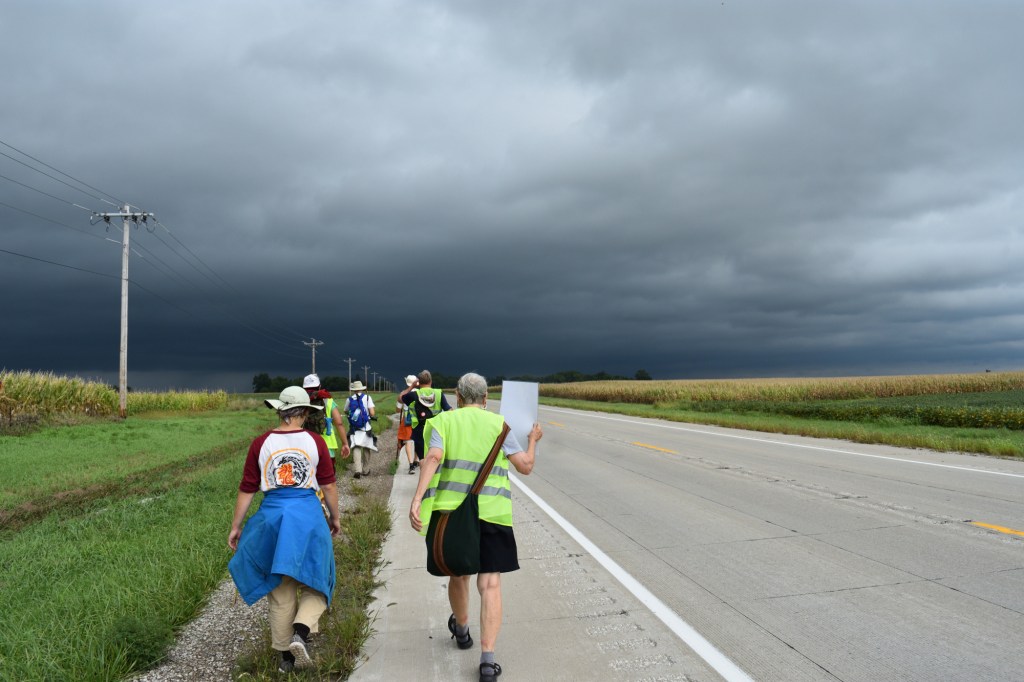
What we have is each other. We can and need to take care of each other. We may have limited power on the political stage, a stage they built, but we have the power of numbers.

Those numbers represent unlimited amounts of talents and skills each community can utilize to replace the systems that fail us.  The recent past shows us that mutual aid is not only a tool of survival, but also a tool of revolution. The more we take care of each other, the less they can fracture a community with their ways of war.

Ronnie James, The Police State and Why We Must Resist

Policing in the United States is a force of racist violence that is entangled at the core of the capitalist system. As Robin D.G. Kelley pointed out on Intercepted With Jeremy Scahill, capitalism and racism are not distinct from one another: “If you think of capitalism as racial capitalism, then the outcome is you cannot eliminate capitalism, overthrow it, without the complete destruction of white supremacy, of the racial regime under which it’s built.”

Police in the United States act with impunity in targeted neighborhoods, public schools, college campuses, hospitals, and almost every other public sphere. Not only do the police view protesters, Black and Indigenous people, and undocumented immigrants as antagonists to be controlled, they are also armed with military-grade weapons. This police militarization is a process that dates at least as far back as President Lyndon Johnson when he initiated the 1965 Law Enforcement Assistance Act, which supplied local police forces with weapons used in the Vietnam War. The public is now regarded as dangerous and suspect; moreover, as the police are given more military technologies and weapons of war, a culture of punishment, resentment and racism intensifies as Black people, in particular, are viewed as a threat to law and order. Unfortunately, employing militarized responses to routine police practices has become normalized. One consequence is that the federal government has continued to arm the police through the Defense Logistics Agency’s 1033 Program, which allows the Defense Department to transfer military equipment free of charge to local enforcement agencies.

TO END RACIAL CAPITALISM, WE WILL NEED TO TAKE ON POLICING By Henry A. Giroux, Truthout, June 20, 2021

State of Intimidation

Yesterday’s article was about ‘Treaties Not Tar Sands’ which summarized the Treaty People Walk for Water. Walkers arrived at the Minnesota Capitol grounds yesterday, ending a 200+ mile walk from the Mississippi headwaters, an effort to draw attention to the state-approved Enbridge Line 3 pipeline. Isn’t it ironic that Enbridge says Line 3 is needed to replace the old pipeline because it isn’t safe any longer?

It is disheartening but unsurprising to hear about the large police response to the peaceful gathering of water protectors. Despite their unconstitutionality, many laws have been passed to criminalize protest. Felony penalties for damage to ‘critical infrastructure’ such as pipelines.

In Iowa last year several activists were banned from the grounds of the Iowa State Capitol because of their participation in rallies against police violence, ironically. That ban was later declared illegal.

Renee Keezer speaks to the crowd at Wednesday’s ‘Treaties Not Tar Sands’ rally.

What’s wrong with this picture? It implies a significant and violent threat where there was none.

The ‘Treaties Not Tar Sands’ rally at the Capitol Wednesday drew 1,000 to 2,000 people. It was a beautiful and powerful event. I will write more about it in the coming days. It deserves more attention.

Tonight, I’m focusing on law enforcement’s massive and intimidating response — and how rally-goers responded.

At one point I counted 33 officers on or near the front steps of the Capitol. And there were many others spread out around the Capitol complex.

The question is: Why is it when large numbers of black and brown people show up for some event, law enforcement feels compelled to use a show of force?

Given all the racial tensions around policing, law enforcement had to know this approach was bad optics. It did it anyway. That means law enforcement either had little concern about making people feel unwelcome, scared, and/or angry, or in fact that was the intention.

Arriving at the Capitol on Tuesday, I was surprised to see two law enforcement officers guarding the Capitol’s west wing. It was barricaded and fenced. No one was anywhere near this entrance. Yet there they were.

Later Tuesday, law enforcement brought in more concrete barricades. I’m curious what those barricades accomplished, as they are easy to hop over. Was law enforcement worried people would try to drive their cars or pick-up trucks up the stairs? The streets already were blocked.

That concrete represents a lot of fear.

Water protectors are used to dealing with police who view them as criminals. Law enforcement was present at Enbridge construction sites up north because Enbridge was paying them to be there as private security.

This ubiquitous police presence is a form of violence. It intimidates. It undermines people’s sense of safety and belonging. It sends the message that law enforcement thinks you’re dangerous.

State of Intimidation: Minnesota law enforcement’s in-your-face approach to ‘Treaties Not Tar Sands’ rally, Healing Minnesota Stories, August 26, 2021

#TreatiesNotTarSands

Water protectors and state sanctioned violence

Protecting water from fossil fuel pipeline projects is an example of #LANDBACK. There is the devastation to the earth during extraction of fossil fuels, during pipeline construction, and when the pipelines leak. The tons of carbon dioxide that will be added to our atmosphere when that fuel is burned. The acidification of the oceans as the water attempts to absorb some of the carbon dioxide from the air.

The routes of pipelines are an example of blatant environmental racism. As just one example, the Dakota Access pipeline (DAPL) was originally going to be built upstream of Bismarck, North Dakota. When there was an uproar from the people there who were concerned about contamination of their water, it was moved to cross the Missouri River just a mile upriver from the Standing Rock Sioux reservation.
(see: Bismarck residents got the Dakota Access Pipeline moved without a fight)

The world saw the despicable display of heavily militarized law enforcement personnel and their equipment attacking Indigenous people who were praying to protect the water.

And silence, never been so loud
And the violence, never been so proud of our people.
Nahko

So many times Indigenous treaty rights were and continue to be violated.

I’m sharing some of my own experiences with fossil fuel pipelines to show how widespread this work to protect the water has been, and continues to be. In Indianapolis in 2013 I was trained to organize and lead nonviolent direct actions as part of the Keystone Pledge of Resistance. Eight years later Enbridge Energy has cancelled the Keystone pipeline project.

I supported the Wet’suwet’en peoples in British Columbia as they struggled to prevent the construction of the Coastal GasLink natural gas pipeline through their beautiful lands. Multiple times militarized Royal Canadian Mounted Police attacked the First Nations people.

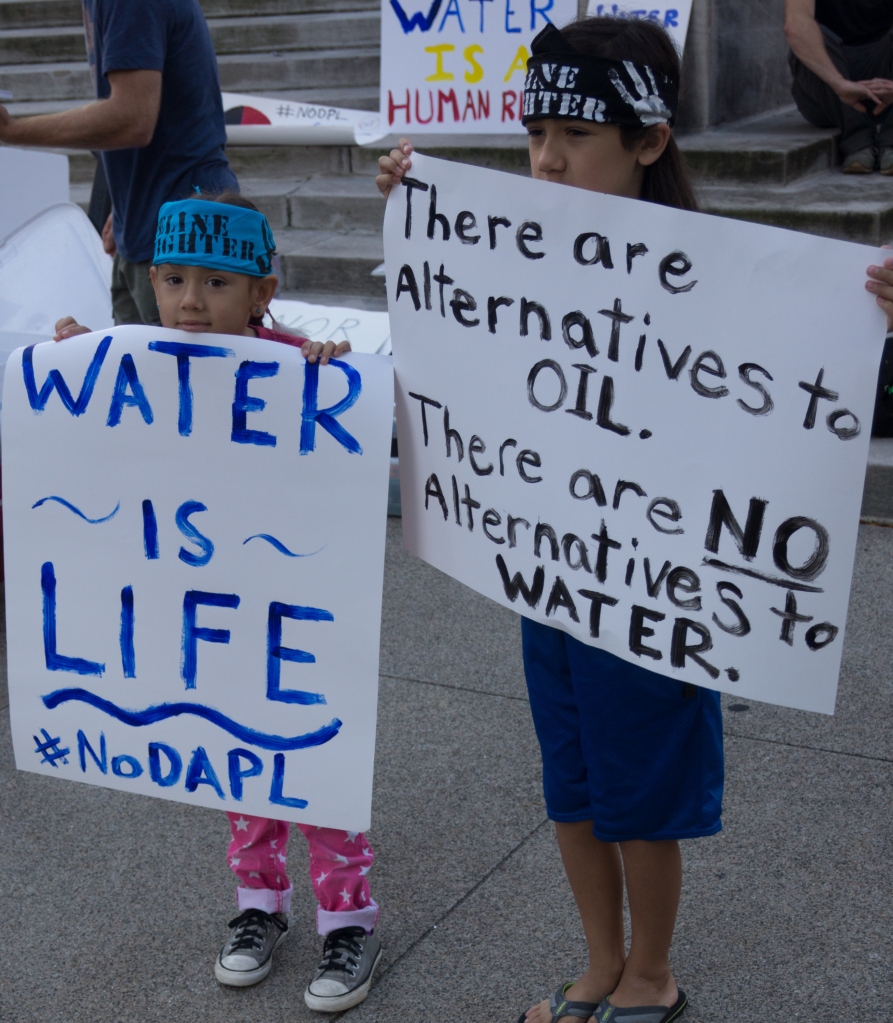
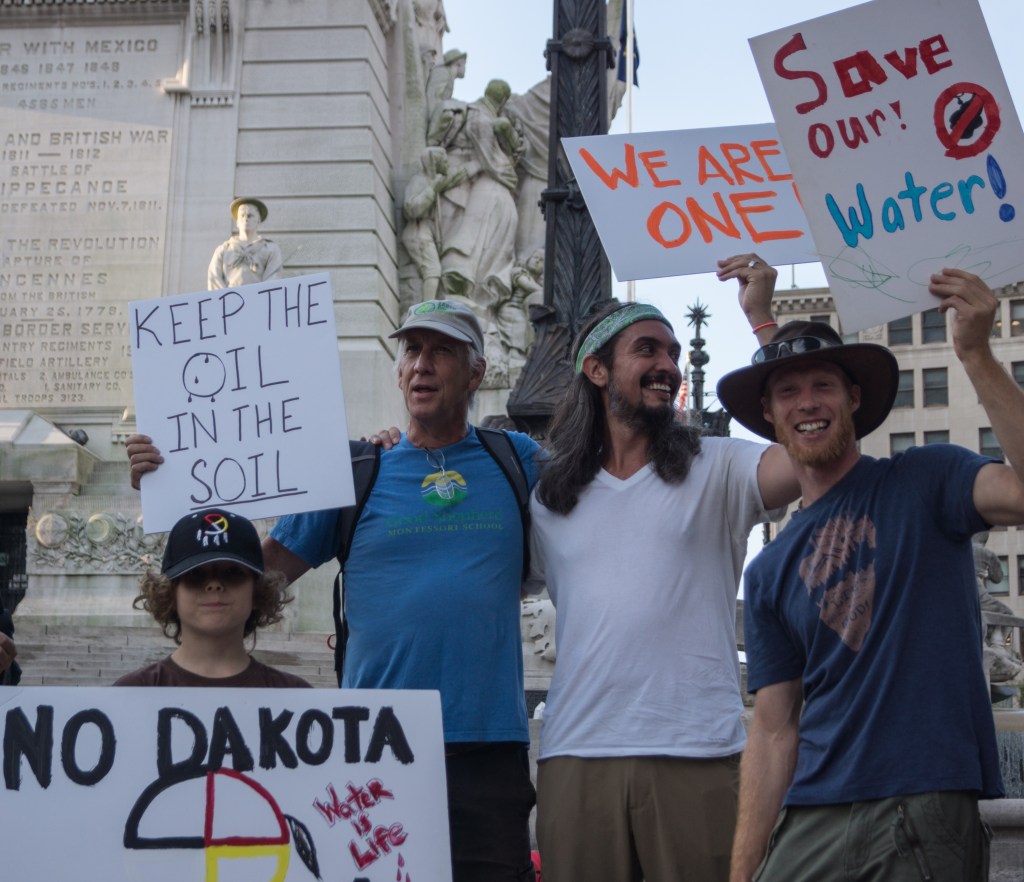
I participated in gatherings to protect the water from the Dakota Access Pipeline in Indianapolis, Iowa and Minnesota. Numerous water protectors were arrested by the state.

I haven’t been involved with the current work against the Line 3 pipeline. (see: Stop Line 3 ). But I am writing about recent events there because there is good news about stopping, at least temporarily, state sanctioned violence against water protectors at Line 3.

In a development progressives called a “huge legal win in the fight against Line 3,” a Minnesota court on Friday ordered police in Hubbard County to stop impeding access to the Giniw Collective’s camp, where anti-pipeline activists have been organizing opposition to Enbridge’s multibillion-dollar tar sands project.

Last month, (county sheriff) Aukes unlawfully blockaded a 90-year-old driveway that serves as the only means of entry and exit to the Giniw Collective’s camp, which is a convergence point for Indigenous-led protests against the expansion of the Line 3 pipeline. Police officers also cited and arrested individuals who attempted to use the driveway to travel to and from the camp.

COURT STOPS POLICE FROM BLOCKADING LINE 3 PROTESTER CAMP by Kenny Stancil, Common Dreams, July 25, 2021

Under the pretext that the small portion of the driveway extending from the Camp’s private property onto Hubbard County property is now suddenly a “trail” and not designated for vehicular traffic local sheriffs have either physically blocked access, at times by forming a line of over twenty officers, several armed with clubs, or issued citations to water protectors who have driven vehicles on the driveway, even when delivering food, water, or other necessary supplies.

Court Orders Police to Cease Illegal Blockade of Indigenous-led Water Protectors Camp at Line 3 Issues Restraining Order Against Sheriff Aukes and Hubbard County

Space between stories, worlds

I’ve been broken by the latest calamity, the verification of the remains of 215 Native children on the grounds of what was a residential school in British Columbia. More tragic is knowing hundreds of other Indigenous children died, or were killed, in these institutions of forced assimilation in the lands called Canada and the United States.

I’ve known about forced assimilation for years. But this is raw, because I see how devastated my Native friends are. And I know Quakers were involved in some of these institutions.

The trauma for Native families has been passed from generation to generation. Some of my Native friends have shared how this affects them and their families today. The news has re-opened deep wounds in Native communities. Many have been triggered by this atrocity. One of my Native friends wrote that she was NOT OK. Another told me, “I’m trying not to be enraged in my mourning.”
[see: Time for a Reset]

I’m deeply troubled. I feel caught between my Native relatives and my Quaker community. To the extent that I’ve said I need to “step away” from my involvement with Quakers for a time. Even though I’m not sure what that means, or what will allow me to return.

What I am not getting Friends to see is capitalism is the root of the problem, for reasons I’ve explained in detail elsewhere.
[See: capitalism | Quakers, social justice and revolution (jeffkisling.com) ]

It is frustrating to know all the work, the good intentions of Friends and others, will not lead to needed solutions as long as that work is done within the context of capitalism. [See the diagram below]

What it would take for me to return to Quaker justice work would be for Quakers to see capitalism must be abandoned. And to actively search for alternatives.

I’ve tried to explain this in An Epistle to Friends Regarding Community, Mutual Aid and LANDBACK. If you are so led, you are invited to sign the letter.


We do not have a new story yet. Each of us is aware of some of its threads, for example in most of the things we call alternative, holistic, or ecological today. Here and there we see patterns, designs, emerging parts of the fabric. But the new mythos has not yet formed.

We will abide for a time in the “space between stories.” It is a very precious — some might say sacred — time. Then we are in touch with the real. Each disaster lays bare the reality underneath our stories. The terror of a child, the grief of a mother, the honesty of not knowing why. In such moments our dormant humanity awakens as we come to each other’s aid, human to human, and learn who we are.

That’s what keeps happening every time there is a calamity before the old beliefs, ideologies, and politics take over again. Now the calamities and contradictions are coming so fast that the story has not enough time to recover. Such is the birth process of a new story.

The More Beautiful World Our Hearts Know Is Possible, Charles Eisenstein

I am in that very precious, sacred time Charles Eisenstein describes. Abiding in the “space between stories”. The teachings of my Native friends have awakened the honesty of not knowing why.

I invite you to be open to new ways of being, such as LANDBACK and Mutual Aid. And pray we can hold onto the space between stories before the old beliefs, ideologies, and politics take over again. There is an urgency to this.

It is instructive that Eisenstein is expressing the concept of Mutual Aid when he writes “in such moments our dormant humanity awakens as we come to each other’s aid, human to human, and learn who we are.

What we have is each other. We can and need to take care of each other. We may have limited power on the political stage, a stage they built, but we have the power of numbers.

Those numbers represent unlimited amounts of talents and skills each community can utilize to replace the systems that fail us.  The recent past shows us that mutual aid is not only a tool of survival, but also a tool of revolution. The more we take care of each other, the less they can fracture a community with their ways of war.

Once we envision that world our ancestors want for us, finding our role is natural.

My friend and mentor Ronnie James, The Police State and Why We Must Resist

Friends express this as seeking what the Inner Light is asking of us.

I urge us to discern whether there are circumscribed limits we might not be aware of, that hold us back from venturing into a new story.