Notes to myself continued

Yesterday I wrote about preparing for a discussion about Mutual Aid at my Quaker meeting this Sunday. Describing the use of queries, and then coming up with an initial series of questions.

Now I’m outlining the major topics to discuss. An hour isn’t much time, and the point of queries is to allow people time to respond to them.

I think I should begin by telling the story of how the Spirit led me to connect with Ronnie James, and how he mentored me about Mutual Aid. And then my experiences of being in that Mutual Aid community. It is important to speak from our own experiences.

What are the main points I want to make?

  • We have no choice but to find alternatives since the status quo has begun to and will increasingly collapse.
  • The status quo has been very different for different segments of our society.
  • This is a chance to build alternatives that are just and equitable.
  • This is an opportunity to conserve resources. To move toward living within ecological limits.
  • “It is about acknowledging that we Americans have enjoyed middle-class comforts at the expense of other peoples all over the world.” Grace Lee Boggs
  • A chance to live with spiritual integrity. Which we must do before we can speak to the spiritual needs of anyone else.
  • Mutual Aid addresses the above.

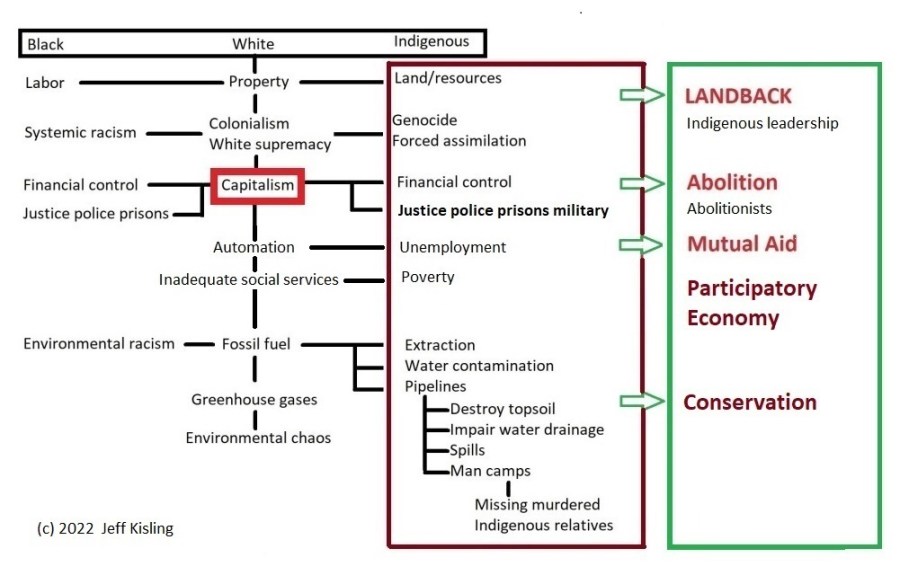
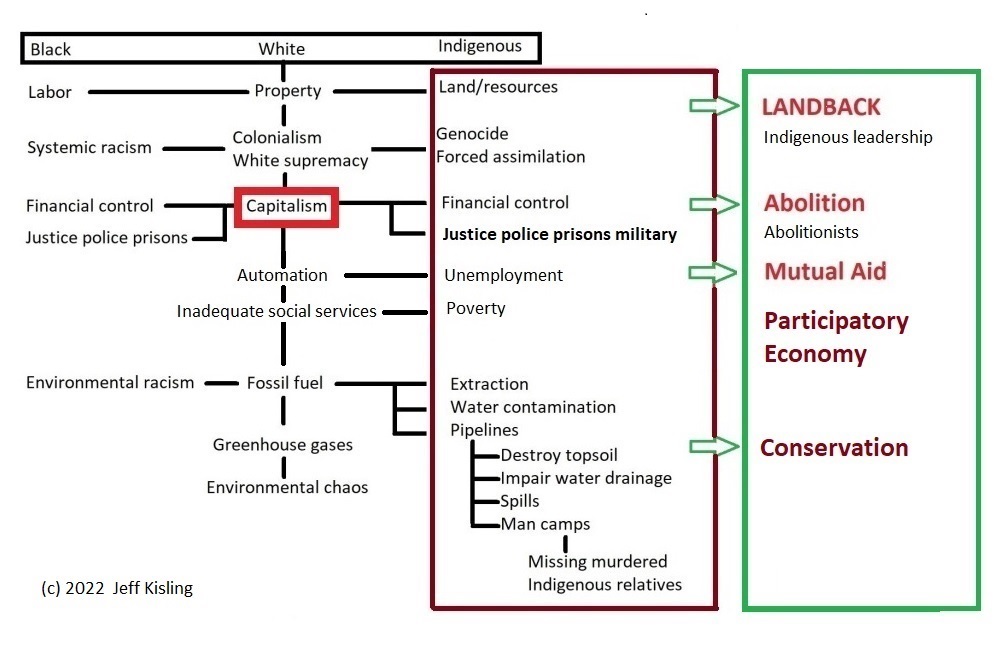
As these graphics explain, there is more than Mutual Aid involved in building the communities we want. Building Mutual Aid communities is a first step because it provides the framework for how a community works together and can address other things like abolition and LANDBACK.

Abolition and the mutual aid that we practice are inextricably linked.
I participate in the Prison Abolition Letter Writing Project that was started in 2018 as part of Central Iowa Democratic Socialists of America’s Prison and Police Abolition Working Group. Several of us from Des Moines Mutual Aid participate in the letter writing project.

And I am a member of the Quakers for Abolition Network (QAN).

We as White Quakers like to think of ourselves as ahead or better than dominant culture, but we have been complicit in a system and mindset that are ubiquitous. Claiming the full truth of our history and committing to repair the harms done are deeply spiritual acts of healing our own wounds of disconnection. I would argue it is the pathway upon which we can, perhaps for the first time, discover and invigorate our faith with its full promise.

What would it mean for us to take seriously and collectively as a Religious Society a call to finish the work of abolition, hand in hand and side by side with those affected and their loved ones? What would it mean for us to stand fully with the calls to abolish the police and fully fund community needs instead? What would it mean to reckon with our past complicity with harm and fully dedicate ourselves to the creation of a liberating Quaker faith that commits to build the revolutionary and healing faith we long to see come to fruition? What would it look like to finally and fully abolish slavery?

A Quaker Call to Abolition and Creation by Lucy Duncan, Friends Journal, April 1, 2021

The next American Revolution, at this stage in our history, is not principally about jobs or health insurance or making it possible for more people to realize the American Dream of upward mobility. It is about acknowledging that we Americans have enjoyed middle-class comforts at the expense of other peoples all over the world. It is about living the kind of lives that will not only slow down global warming but also end the galloping inequality both inside this country and between the Global North and the Global South. It is about creating a new American Dream whose goal is a higher Humanity instead of the higher standard of living dependent on Empire. It is about practicing a new, more active, global, and participatory concept of citizenship. It is about becoming the change we wish to see in the world.

The courage, commitment, and strategies required for this kind of revolution are very different from those required to storm the Winter Palace or the White House. Instead of viewing the U.S. people as masses to be mobilized in increasingly aggressive struggles for higher wages, better jobs, or guaranteed health care, we must have the courage to challenge ourselves to engage in activities that build a new and better world by improving the physical, psychological, political, and spiritual health of ourselves, our families, our communities, our cities, our world, and our planet.

Grace Lee Boggs, The Next American Revolution

Notes to myself

This morning I’m seeking guidance for a way to discuss the concepts of, and my experiences with Mutual Aid in preparation for a discussion about that with my Quaker meeting.

Quakers have a long tradition of prayerfully reflecting upon a series of questions, we call queries, to facilitate our discussions of topics like education, social and economic justice, peace and nonviolence. You can see these queries here: Advices and Queries.

The brilliance of using questions stimulates each of us to engage with the topic, whether we speak aloud about our reflections or not. To facilitate reflection and prayer rather than being lectured to.

Developing queries about Mutual Aid to guide this discussion might be the best approach. So, what should the queries be?

We need to discuss:

  • What is Mutual Aid?
  • What are the pros and cons of charity?
  • Why is Mutual Aid not charity?
  • Examples of vertical and flat/horizontal hierarchy
  • What are Quaker hierarchies?
  • What is the state of our peace and social justice work now?
  • What is a beloved community?
  • Is Mutual Aid closer to being a beloved community than our current conditions?
  • Why is Mutual Aid important now?
  • What is the state of our current economic (capitalism), justice, healthcare, education, and political systems?
  • Is capitalism an unjust economic system?
  • What will we do when our community experiences environmental, economic and/or political catastrophe?
  • What will we do when our shelter, power, and sources of food and water are disrupted?
  • What should we do to prepare for the migration of climate refugees to our communities?
  • How can we provide spiritual support for our wider communities?
  • Can we build Mutual Aid groups when people are physically separated?
  • What are the potential advantages and disadvantages of Mutual Aid?

Although many on the list above are questions, they are not necessarily the best expression of the queries for the discussion. I’ll be working on that next.

Change is difficult. It is far easier to maintain the status quo. But our status quo is rapidly unraveling.

The question below, “what will your choice be?” comes from the Wet’suwet’en peoples who are trying to protect their pristine lands and water from pipeline construction. “We make choices as to enter the uncomfortable place of change & movement, or we continue on this downward spiral.” [At the present time the Royal Canadian Mounted Police are preparing to invade the Wet’suwet’en territory.]

“We make conscious decisions to either sit back and watch, or stand up and be heard.
We make choices as to whether protect our future generations, or we allow for a destitute future for them.
We make choices as to enter the uncomfortable place of change & movement, or we continue on this downward spiral.
What will your choice be?
Will you sit back and allow for human rights violations to occur, or will you #RiseUp with us?”


Wet’suwete’n Access Point at Gidemt’en Facebook Page

Embracing Mutual Aid might be uncomfortable for some. Will we have the courage to enter the uncomfortable place of change and movement?

I’ve been working on this diagram to show relationships between the current situation and how Mutual Aid fits into this larger picture. I don’t think there will be time to include much of this in this Sunday’s discussion. But Mutual Aid is one piece of several changes (LANDBACK, Abolition and a better economic system) we need to make urgently.

There are three key elements of Mutual Aid.

  1. Mutual aid projects work to meet survival needs and build shared understanding about why people do not have what they need.
  2. Mutual aid projects mobilize people, expand solidarity, and build movements.
  3. Mutual Aid projects are participatory, solving problems through collective action rather than waiting for saviors.

    Mutual Aid, Building Solidarity during this Crisis (and the next) by Dean Spade, Verso, 2020

What I don’t know about Mutual Aid

Disclaimer: Before getting to that, I think I should make a disclaimer, especially since I shared the 2021 Peace and Social Concerns report of my yearly meeting, Iowa Yearly Meeting (Conservative). I included that because Mutual Aid is mentioned in the report. “These injustices are some of the effects of systems of white supremacy. The concept of Mutual Aid is becoming an increasingly used model for communities working for justice. The idea is to have a horizontal hierarchy, where everyone has a voice. And work to ensure a vertical hierarchy does not develop. Without a vertical hierarchy, there can, by definition, be no superiority. Several of our meetings are supporting existing Mutual Aid communities or considering creating their own. These are opportunities to begin to disengage from the colonial capitalist system and white supremacy. Ways we can model justice in our own meetings and communities.”

But that doesn’t mean what I’ve been writing on this blog has been approved by the Yearly Meeting.

What I do know about Mutual Aid comes from my two years of experience with Mutual Aid in Des Moines.

I met Ronnie James, and Indigenous organizer and now close friend, when he came to a vigil we held in February 2020 in support of the Wet’suwet’en people’s struggles to prevent the construction of the Coastal GasLink pipeline through their territories. He came because he wanted to know who was supporting the Wet’suwet’en, because their struggles were not being covered in the mainstream media. That was a good organizing strategy, a way to find allies.

Because of the COVID pandemic, he and I didn’t meet in person for several months. But during that time, he was very generous in teaching me about his work with Des Moines Mutual Aid (DMMA). I quickly saw there was much more to Mutual Aid than just distributing free food, or propane tanks for the houseless in winter. I could also tell the people involved in DMMA were very careful about who they associated with because they were on the police radar, so to speak. Several had been arrested, some several times, as they demonstrated to support Des Moines Black Liberation’s protests of police violence after the killing of George Floyd.

But after months of email exchanges, I felt we were getting to know each other well enough that I could ask if it would be appropriate to participate in his work. I knew it was important for allies to be careful about inviting ourselves into situations in ways that are not appropriate.

Fortunately, he said yes, and I have been participating in the food distribution part of Des Moine Mutual Aid nearly every Saturday morning since (for more than a year).

I thought I would see how this worked for a few weeks, and that might be the end of it. But I found the actual experience of being present in this community taught me so much that words written in emails could not.

When I arrived that first morning, apprehensive about what might happen, I was told this was Mutual Aid, which meant all of us were encouraged to take any food we wanted, ourselves. For many weeks I did not take any, but finally realized that was a mistake. It was like I wasn’t really buying into the mutual part of this. I realized this when one of my new friends, in a friendly manner, asked why I wasn’t taking any food. Now I do.

I also witnessed the truly uplifting way every volunteer greeted each car of people who came for the food. It was always, “hi, how are you doing? Have a great day.”

I also saw this insistence of avoiding any kind of vertical hierarchy. No one said, “do this, do that…”. When there was a problem, anyone with a solution was expected to just do it. Or when the van of food arrived, someone would say “the van is here” and whoever wasn’t doing something else would just go out and help unload the food.

Also, one of my new friends who volunteered to help with the food distribution told me she was once in the position of needing the food herself.

And I know my friends always show up. As they did yesterday, New Year’s Day, with a wind chill of -11 degrees. As we had on Christmas day the week before.

So a new person has to learn a new way of working together. Learn how to act in a situation where you aren’t told what to do by someone above you in a vertical hierarchy. To learn to be always aware of what is going on around you. See if there is something that needs to be done, then do it yourself.

Multiple times I’ve heard someone say these Saturday mornings together are the best part of their week. I feel that, too. That’s one of the important parts of Mutual Aid. We are enthusiastic about this work. It pulls people in when they are doing something that has an immediate impact.

This is one of the many reasons I’m encouraging Friends and others to learn about, create and participate in Mutual Aid. Most of the Quaker meetings I’m aware of have dwindling numbers of people attending their meetings. And we don’t attract many/any young people or Black, Indigenous and other people of color (BIPOC).

I’ve thought we should have more workcamps, as we did when I was growing up. Those were experiences people appreciated. Mutual Aid can be the answer today.

But there is a more fundamental reason to adopt Mutual Aid. We need to accept that our political and economic systems are failing. Are not meeting our needs. “We” being those of us fortunate to have had livable incomes. Those who don’t have known the failure of these systems their entire lives. We have no choice but to come up with alternatives. I believe Mutual Aid is one alternative.

Finally, we get to what I don’t know about Mutual Aid. The key to Mutual Aid is for everyone in the community to be involved in the work. But most of us live some distance from our Quaker meetings. Is it possible, or desirable, to find ways to create Mutual Aid communities if people are not physically present with each other? Is ZOOM Mutual Aid possible, or desirable?

I don’t know. If you have some ideas about this, please write them in the comments.

Thank you.

Bear Creek Friends

Resolve to be always beginning

Resolve to be always beginning — to be a beginner. –Rainer Maria Rilke

I’m hoping some Friends might consider Mutual Aid to be part of their new story this new year. Yesterday’s post was an introduction.

This is a link to a lot more information about my experiences with Mutual Aid. Mutual Aid in the Midwest

I realize I didn’t explain yesterday’s comment about friendships with native people. Indigenous peoples have always lived in ways that could be seen as Mutual Aid. And my good friend Ronnie James, an Indigenous organizer, has been my Mutual Aid mentor from the beginning of my experiences. This work is supported by the Great Plains Action Society that Ronnie is part of.

We are Indigenous Peoples of the Great Plains proactively working to resist and Indigenize colonial-capitalist institutions and behaviors. We defend the land where our ancestors lie and where the children walk. Our goal is to reclaim what has been stolen and oppressed to create a better world for us all.

Great Plains Action Society

New Year’s resolutions tend to be about wanting more of something we desire and/or less of something we do not, and while they surely have their noble side, they also often emanate from subtle and less subtle forms of perceived lack, scarcity, comparison, self-flagellation, and judgment. The “should” and “should not” messages we send ourselves when we make resolutions can be harsh and incriminating. These are qualities we may want to endeavor not to perpetuate and strengthen when we make our commitments this year.

How about making “the means more of the ends” by putting gratefulness rather than scarcity at the center of the resolutions we make this year? How about bringing a more gentle form of motivation, rooted in appreciation, celebration, and acceptance, to our goals? How about letting gratitude guide us?

Turn New Year’s Resolutions into Revelations by Kristi Nelson, syndicated from gratefulness.org, Jan 01, 2022

A Call for Quakers to Embrace Mutual Aid

I am writing to make the case for the adoption of Mutual Aid as a framework for Quaker justice work.

This comes from my perspective of a White, Quaker, male (he/him), settler on Ioway land, in the country called the United States. When I refer to Quakers here, I mean White Quakers. Black, Indigenous, and other people of color (BIPOC) Friends have completely different experiences related to white privilege and racism, for example.

My credentials include friendships with Native people here in the Midwest. And to have been part of a Mutual Aid community for the past two years. The following is from these lived experiences, which have excited me, shown me a different way to work for peace and justice.

There are three key elements of Mutual Aid.

  1. Mutual aid projects work to meet survival needs and build shared understanding about why people do not have what they need.
  2. Mutual aid projects mobilize people, expand solidarity, and build movements.
  3. Mutual Aid projects are participatory, solving problems through collective action rather than waiting for saviors.

    Mutual Aid, Building Solidarity during this Crisis (and the next) by Dean Spade, Verso, 2020


Mutual Aid is NOT charity. People often think of their financial support for a cause as aid. But that is not Mutual Aid. Charity involves an agency determining what the need is. Which too often is not what is needed. And has an implied hierarchy of the agency providing aid as superior to those who receive the aid. There are usually rules as to who qualifies for the aid.

Instead, Mutual Aid involves everyone in the community to work on problems that affect everyone. There is not a distinction between those who need help and those providing help. It is explicitly stated that anyone in the community might need help at some point. The whole community determines its needs and how to address those needs. Not a vertical hierarchy like “us helping them”.

Mutual Aid communities work to make sure no vertical hierarchy develops, implied or not. Vertical hierarchies mean some people are seen as superior in some way. Vertical hierarchies are about power. Which is the antithesis of mutuality.

Quakers and hierarchy

I hadn’t thought much about Quakers and vertical hierarchy before getting involved in Mutual Aid. But for example, we have yearly meeting clerks and yearly meeting committee clerks. Members of yearly meeting committees are appointed by local meetings, which might imply they have some superiority in those meetings. “Birthright” Friends are sometimes accorded privilege.

Often Quaker meetings make donations to peace and justice organizations, which is charity. Which usually doesn’t create a mutual relationship with those organizations or the people they serve.

For these reasons I think Quaker communities should embrace Mutual Aid. That would mean connecting with everyone in the neighborhood around the meeting. This is the concept of beloved community.  This might attract neighbors to become involved in the meeting. We would get a better idea of what we might work on together. This would be a way to speak to the spiritual condition of our communities.

This PDF has much more information about Quakers and Mutual Aid:
A Call for Quakers to Embrace Mutual Aid

Following is this year’s report of the Peace and Social Concerns Committee of Iowa Yearly Meeting (Conservative) which includes discussion of Mutual Aid.


Peace and Social Concerns Committee Report 2021
Iowa Yearly Meeting (Conservative)

This has been a year of great upheaval locally, nationally, and globally. The work of our monthly meetings has been impacted by the COVID-19 pandemic. Yet we have found ways to continue our peace and justice work. And had more time for prayer and reflection.

Global chaos from rapidly accelerating environmental devastation is highly likely to occur, breaking down our economic, social, and political systems. As air and water temperatures increase, water supplies are drying up. Widening areas and severity of drought are decreasing crop production and forcing people to flee. Rising oceans are creating more climate refugees. The trend of increasing numbers of more ferocious wildfires, hurricanes and other storms are expected to accelerate. All kinds of infrastructure will likely be destroyed, creating more climate refugees, many migrating to the Midwest. How can we prepare our own communities for these disasters, and plan for the arrival of climate refugees?

Justice work by White Friends has changed in recent years. An important concept of justice work is to follow the leadership of oppressed communities, who are working tirelessly for their liberation. Those who consider themselves White Friends are learning how to step back. Be supporters and allies.

Many injustices today trace their roots to the arrival of white Europeans on this continent. These include a whole history of enslavement as well as genocide of Indigenous peoples. It is important for white Quakers to know we are not expected to feel guilt or blame for injustices that occurred in the past. But knowing what we know now, it is up to us to learn more about those wrongs, and work toward repair and healing.  This will be a primary focus of this committee’s work in the coming year.

As a society we have been forced to face systemic racism. For example, public murders by police have generated sustained protests regarding police brutality, with calls to limit police powers and change or abolish prisons.

Also dating back to the arrival of white Europeans is the genocide of Indigenous peoples. The theft of Native lands. And the atrocities of Native children taken from their families to institutions of forced assimilation, often far away. Places where attempts were made to the erase their culture. Many subjected to physical or sexual abuse. Thousands of Native children died. This intentional cruelty broke the resistance of Native peoples who were trying to hold onto their lands.

The recent validation of the remains of Native children on the grounds of those institutions is having devastating effects in Native communities and those who care about them. Searching the grounds of the institutions in this country is about to begin. Secretary of the Interior, Deb Haaland, has launched a federal investigation into these institutions of forced assimilation in the US

 A number of Catholic churches, who ran those institutions in Canada, have been burned or vandalized.

There are renewed calls for truth and reconciliation. Canadian Yearly Meeting has done a great deal of work on this.

These injustices are some of the effects of systems of white supremacy. The concept of Mutual Aid is becoming an increasingly used model for communities working for justice. The idea is to have a horizontal hierarchy, where everyone has a voice. And work to ensure a vertical hierarchy does not develop. Without a vertical hierarchy, there can, by definition, be no superiority. Several of our meetings are supporting existing Mutual Aid communities or considering creating their own. These are opportunities to begin to disengage from the colonial capitalist system and white supremacy. Ways we can model justice in our own meetings and communities.

We can show up for Black Lives Matter and other racial justice events. We can support those who meet with local, state, and Federal government officials. We can show up in the streets to support agitation for change, train in nonviolent civil disobedience, or accompany arrested activists through the justice system.

We can show up, when appropriate, at events of Native peoples, such as the Prairie Awakening ceremony. We can share Indigenous news on social media platforms, so others are aware of these things.

Indigenous leaders in the Midwest have asked us to learn about and find ways to engage in the concepts of Land Back. The website LANDBack Friends has been created and will be updated as our work continues.  https://landbackfriends.com/

We pray for guidance for how our committee might work together at the intersection of our responsibilities and those of Ministry and Counsel.

We will continue to seek spiritual guidance, both for what we are called to do, and ways to offer spiritual support for those who are not Friends. There is great spiritual poverty in many communities. Spiritual support will be needed by those who suffer the consequences of environmental and other disasters. And those responding to these disasters.

It is important to understand this work depends on us all working together, in the community. Outside our meetinghouses. Developing friendships in the local community. We encourage more engagement with our youth. They can teach us about justice. We and our meetings will be revitalized.

Many monthly meetings are adapting to these changing ways of doing peace and justice work.  Building relationships with communities of black, Indigenous, and other people of color. Exploring ways to be in right relationship with these communities. All of us learning from each other. Sharing our stories. Deepening spiritual connections.

Jeff Kisling, clerk
Peace and Social Concerns Committee


New Year 2022

I’m concerned to see little progress toward solutions for the myriad of problems we face. Especially with accelerating environmental chaos. We’re paralyzed in the face of so many complex problems. Disheartened because nothing makes progress.

I contend that is because, as Albert Einstein said, “we cannot solve our problems with the same thinking we used when we created them.”

I am proposing we implement new ways to approach our justice work. And will ask our peace and social concerns committee to explore how to change our work from a committee structure to a Mutual Aid group. I’m interested to see how faith can be part of Mutual Aid.

This year’s Peace and Social Concerns Committee Report from my Quaker yearly meeting is included below. And this is a link to An Epistle to Friends Regarding Community, Mutual Aid and LANDBACK.

This diagram lists problems and solutions. LANDBACK, Abolition of police and prisons, Mutual Aid, resource conservation and spirituality. Adapted from the more detailed diagram at the end of this.


Peace and Social Concerns Committee Report 2021
Iowa Yearly Meeting (Conservative)

This has been a year of great upheaval locally, nationally, and globally. The work of our
monthly meetings has been impacted by the COVID-19 pandemic. Yet we have found
ways to continue our peace and justice work. And had more time for prayer and
reflection.

Global chaos from rapidly accelerating environmental devastation is highly likely to
occur, breaking down our economic, social, and political systems. As air and water
temperatures increase, water supplies are drying up. Widening areas and severity of
drought are decreasing crop production and forcing people to flee. Rising oceans are
creating more climate refugees. The trend of increasing numbers of more ferocious
wildfires, hurricanes and other storms are expected to accelerate. All kinds of
infrastructure will likely be destroyed, creating more climate refugees, many migrating to
the Midwest. How can we prepare our own communities for these disasters, and plan
for the arrival of climate refugees?

Justice work by White Friends has changed in recent years. An important concept of
justice work is to follow the leadership of oppressed communities, who are working
tirelessly for their liberation. Those who consider themselves White Friends are learning
how to step back. Be supporters and allies.

Many injustices today trace their roots to the arrival of white Europeans on this
continent. These include a whole history of enslavement as well as genocide of
Indigenous peoples. It is important for white Quakers to know we are not expected to
feel guilt or blame for injustices that occurred in the past. But knowing what we know
now, it is up to us to learn more about those wrongs, and work toward repair and
healing. This will be a primary focus of this committee’s work in the coming year.

As a society we have been forced to face systemic racism. For example, public murders
by police have generated sustained protests regarding police brutality, with calls to limit
police powers and change or abolish prisons.

Also dating back to the arrival of white Europeans is the genocide of Indigenous
peoples. The theft of Native lands. And the atrocities of Native children taken from their
families to institutions of forced assimilation, often far away. Places where attempts
were made to the erase their culture. Many subjected to physical or sexual abuse.
Thousands of Native children died. This intentional cruelty broke the resistance of
Native peoples who were trying to hold onto their lands.

The recent validation of the remains of Native children on the grounds of those
institutions is having devastating effects in Native communities and those who care
about them. Searching the grounds of the institutions in this country is about to begin.
Secretary of the Interior, Deb Haaland, has launched a federal investigation into these
institutions of forced assimilation in the US,

A number of Catholic churches, who ran those institutions in Canada, have been
burned or vandalized.

There are renewed calls for truth and reconciliation. Canadian Yearly Meeting has done a
great deal of work on this.

These injustices are some of the effects of systems of white supremacy. The concept of
Mutual Aid is becoming an increasingly used model for communities working for justice.
The idea is to have a horizontal hierarchy, where everyone has a voice. And work to
ensure a vertical hierarchy does not develop. Without a vertical hierarchy, there can, by
definition, be no superiority. Several of our meetings are supporting existing Mutual Aid
communities or considering creating their own. These are opportunities to begin to
disengage from the colonial capitalist system and white supremacy. Ways we can model
justice in our own meetings and communities.

We can show up for Black Lives Matter and other racial justice events. We can support
those who meet with local, state, and Federal government officials. We can show up in
the streets to support agitation for change, train in nonviolent civil disobedience, or
accompany arrested activists through the justice system.

We can show up, when appropriate, at events of Native peoples, such as the Prairie
Awakening ceremony. We can share Indigenous news on social media platforms, so
others are aware of these things.

Indigenous leaders in the Midwest have asked us to learn about and find ways to
engage in the concepts of Land Back. The website LANDBack Friends has been
created and will be updated as our work continues. https://landbackfriends.com/
We pray for guidance for how our committee might work together at the intersection of
our responsibilities and those of Ministry and Counsel.

We will continue to seek spiritual guidance, both for what we are called to do, and ways
to offer spiritual support for those who are not Friends. There is great spiritual poverty in
many communities. Spiritual support will be needed by those who suffer the
consequences of environmental and other disasters. And those responding to these
disasters.

It is important to understand this work depends on us all working together, in the
community. Outside our meetinghouses. Developing friendships in the local community.
We encourage more engagement with our youth. They can teach us about justice. We
and our meetings will be revitalized.

Many monthly meetings are adapting to these changing ways of doing peace and
justice work. Building relationships with communities of black, Indigenous, and other
people of color. Exploring ways to be in right relationship with these communities. All of
us learning from each other. Sharing our stories. Deepening spiritual connections.

Peace and Social Concerns Committee 2021
Iowa Yearly Meeting (Conservative)


An Epistle to Friends Regarding Community, Mutual Aid and LANDBACK


EVICTING COLONIZERS

The complete title of the post quoted below is “WET’SUWET’EN RESISTANCE AND SOLIDARITY: EVICTING THE COLONIZERS” By YintahAccess.com, December 19, 2021.

Wet’suwet’en land defenders have reminded us through their recent re-capture of Coyote Camp – injunctions are only pieces of paper. Canadian law has no legitimacy on stolen land. #LANDBACK

Reconciliation at Gunpoint

CONTENT WARNING: Detailed description of colonial violence and dehumanization at the hands of police and prison/court staff.

In this interview, Layla Staats and Skyler Williams describe their arrest on unceded Cas Yikh territory, and the disgusting lengths that the Canadian state went to try and break their warrior spirits.

Through these desperate and brutal actions, the RCMP and the courts showed the true essence of ‘reconciliation’ in a militarized settler-colonial state.

As Skyler says, and Wet’suwet’en land defenders have reminded us through their recent re-capture of Coyote Camp – injunctions are only pieces of paper. Canadian law has no legitimacy on stolen land.

#AllOutForWedzinKwa #shutdowncanada

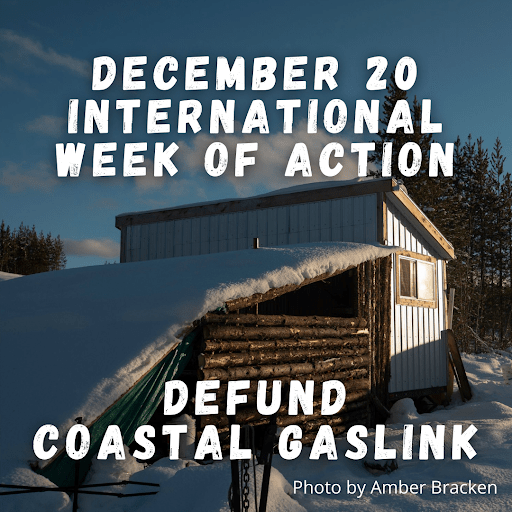
The Wet’suwet’en peoples are calling for this to be an International Week of Action to Defund Coastal GasLink.

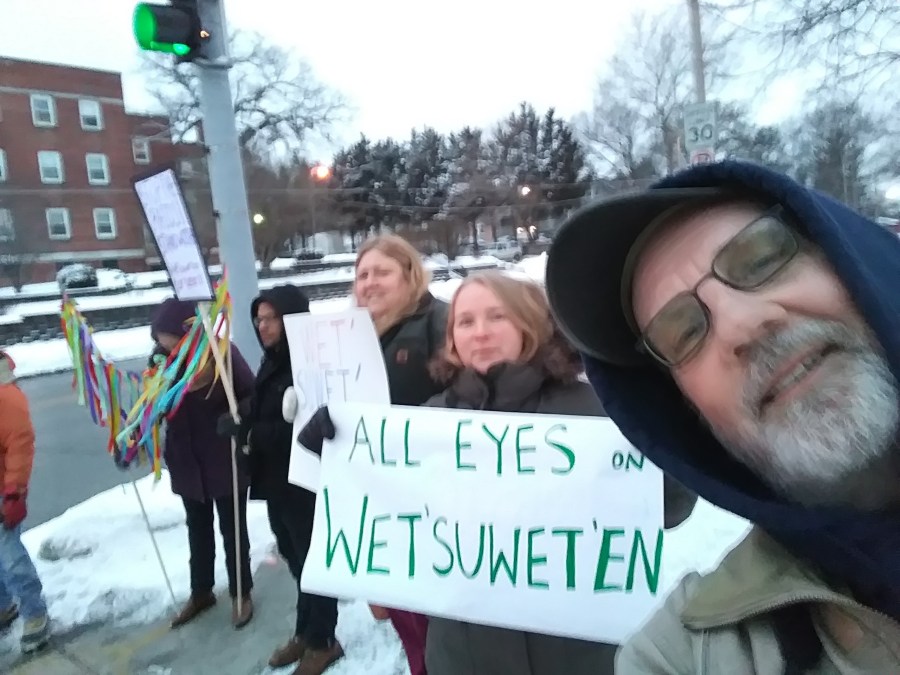
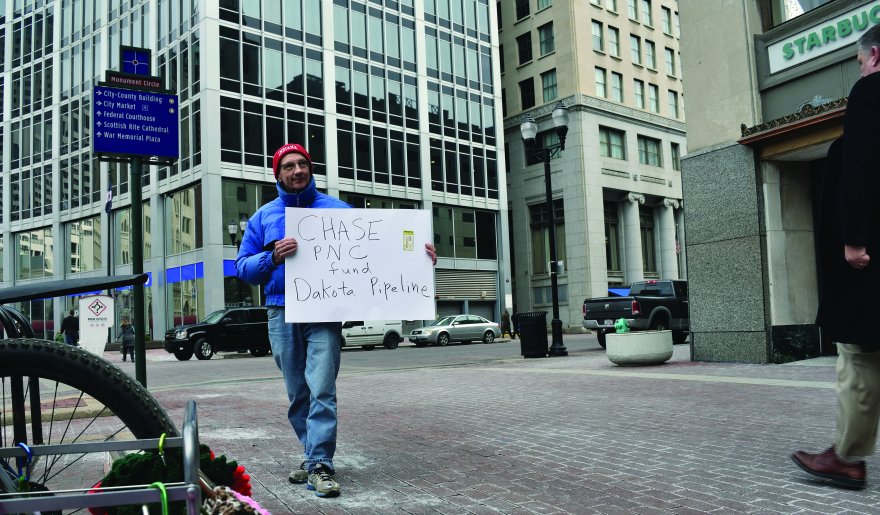
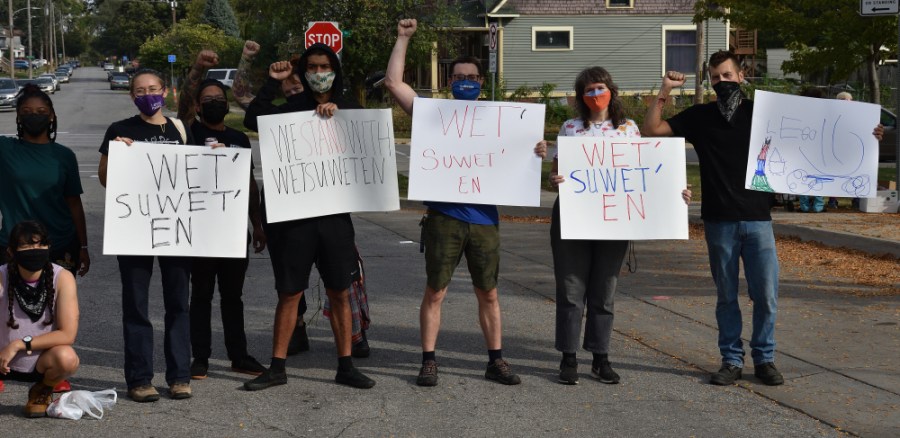
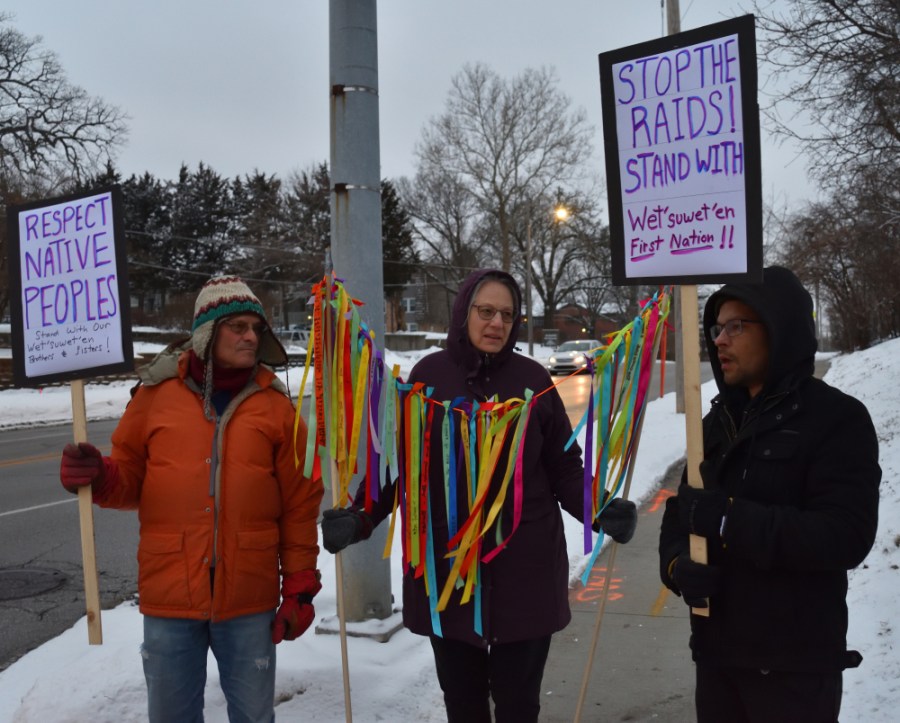
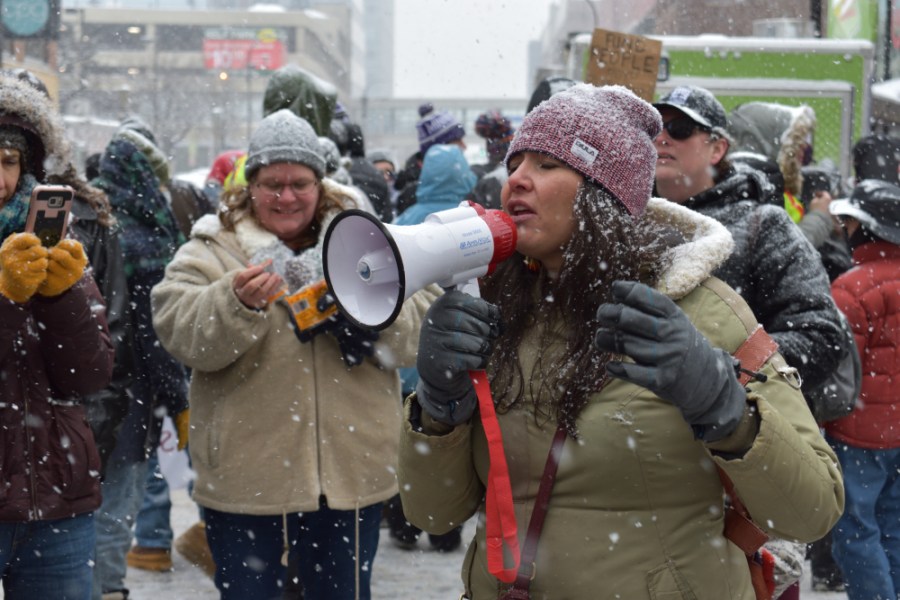
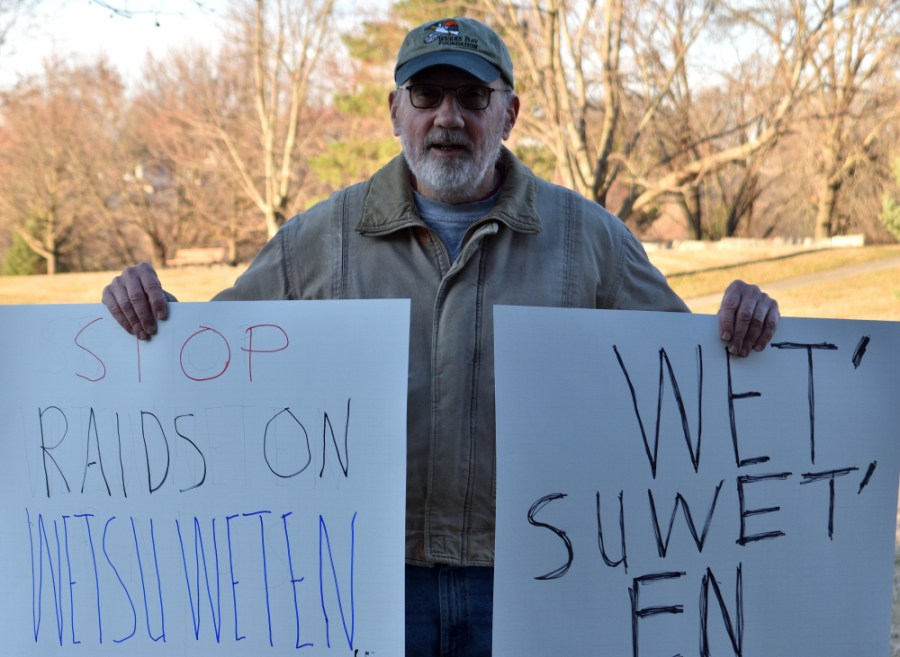
Hold an Action in your city or your town. Banner drop, hold a Rally/March at RBC or Chase headquarters/ building, have a sit in, jam up phone lines, etc…spread the awareness! You can do this. There were just six of us who stood on a street corner at our first vigil in support of the Wet’suwet’en peoples in February 2020. We knew nobody would recognize Wet’suwet’en, but that was our intention, to “spread awareness”. And amazing connections were made at that event. You never know what will happen. That was where I met Ronnie James who taught me the concepts of Mutual Aid.

Wet’suwet’en vigil, Des Moines, Iowa

We have a sacred responsibility to our children, to protect Wedzin Kwa, our clean drinking water, our salmon, and the right to be Wet’suwet’en, for all future generations. We will not endure genocide by oil and gas corporate colonizers. We call on our allies everywhere, to rise up, stand up, fight back! Put pressure on investors, on industry, and the government to put an end to the Coastal GasLink pipeline. All Out for Wedzin Kwa! Join the Wet’suwet’en resistance!

YintahAccess.com

For the third time in three years, the Wet’suwet’en have faced militarized raids on our ancestral territory.

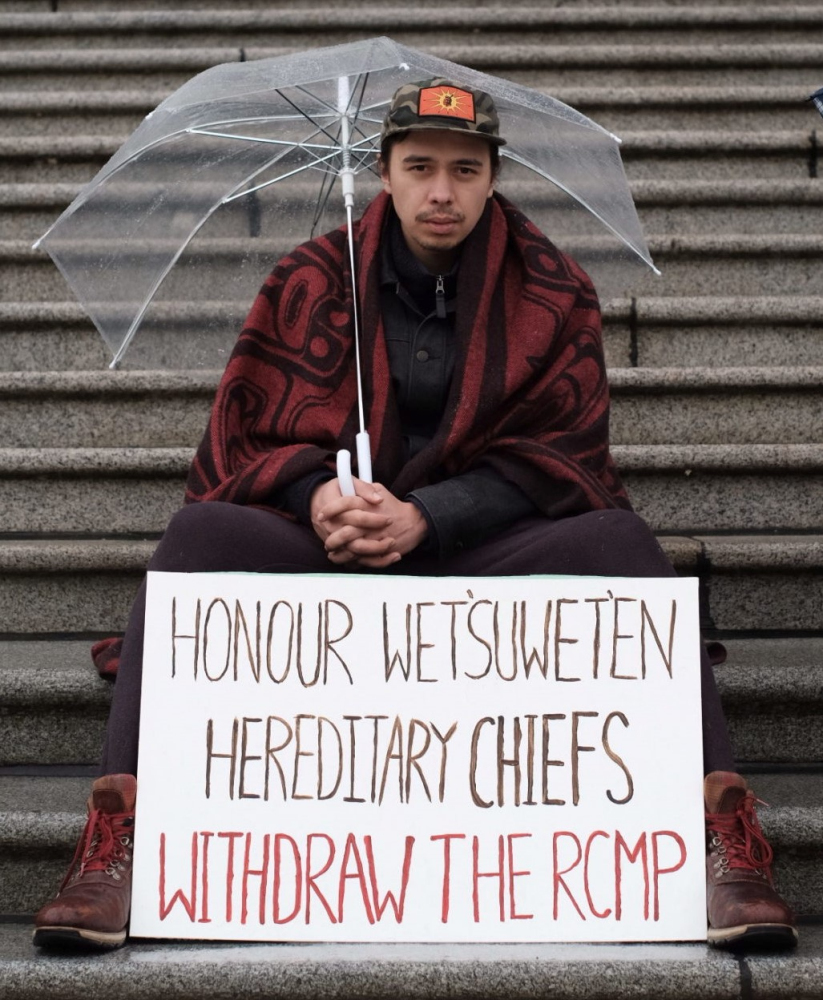
One month ago today, the RCMP violently raided unceded Gidimt’en territory (November 18-19, 2021), removing Indigenous people from their land at gunpoint on behalf of TC Energy’s proposed Coastal GasLink pipeline. The Wet’suwet’en enforced our standing eviction of CGL by closing roads into the territory November 14-17. Following the raids, arrestees received cruel and violent treatment in prison. The conditions set forth by the court are human rights violations to Indigenous peoples. We’re still here. We’re still throwing down. We are more determined than ever to protect our traditional territories for future generations.

In September 2021, Gidimt’en Checkpoint reoccupied Lhudis Bin territory, building a clan cabin on the drill pad site where Coastal GasLink pipeline wants to drill underneath our sacred headwaters, Wedzin Kwa. The Coyote Camp re-occupation of Cas Yikh Gidimt’en Yintah was an historic 56 days long.

CGL took extreme measures to force us from our ancestral lands. They employed fear tactics and threats of violence daily. They surveilled us with helicopters and drones, threatened us with attack dogs, pointed guns at us and chainsawed down the doors to our homes. They put their own workers in danger and used them as political pawns for profit. They tried to break our spirits in prison and in court with torture and colonial “release conditions”.

Again, they threatened to kill us and steal our land. But we’re still here.

In 2010, there were 13 proposed pipeline projects to go through Wet’suwet’en territory. Investors were forced to pull out of these mega-destructive projects through our territory and the CGL pipeline is the only one left, from Enbridge, Pacific Trails Pipeline, Spectra, Pembina, and several others.

Within the first days of the reoccupation there were violent arrests and police brutality on unarmed welcome guests on Cas Yikh yintah. We put a callout for solidarity from our neighboring nations and from our allies. The Haudenosaunee showed up in solidarity and walked the RCMP out of the territory. Gitxsan erected a railway blockade in solidarity with our reoccupation. Others took action in their territories including land back, rolling blockades, highway shut downs and rallies across Turtle Island.

Wet’suwet’en RESISTANCE AND SOLIDARITY: EVICTING THE COLONIZERS” By YintahAccess.com, December 19, 2021.

International Week of Action week of December 20th 2021

We are calling on our supporters and allies to join us to turn our outrage towards RBC once again! Their lack of accountability in financing Colonial Violence and land theft from Indigenous People is unacceptable. We are all in this together and we all have a responsibility to stand up to big financial institutions that invest and keep the fossil fuel industry going full force. With no green sustainability transition in the foreseeable future, all of humanity and our kin are at dangerous risk. With the fires and floods that happened recently south of so-called British Columbia we can’t let any more time pass while big banks are fueling our demise. 

Hold an Action in your city or your town. We know it’s close to the end of the year, we need to make sure RBC doesn’t slip through the cracks and slither away! 

Banner drop, hold a Rally/March at RBC headquarters/ building, have a sit in, jam up phone lines, etc…spread the awareness! 

https://www.yintahaccess.com/

Wet’suwet’en solidarity in Iowa

There will be a gathering in solidarity with the Wet’suwet’en peoples this Wednesday, December 22, at 4:00 PM. at the Chase Bank, 3621 Merle Hay Rd, Des Moines, IA 50310.

Points of Unity

The second anniversary of my connections with Des Moines Mutual Aid is approaching. Our experiences together have literally changed my life. The Spirit led me to this and continues to do so. This can be a way to live through these increasingly uncertain times.

True security lies in the unrestrained embrace of insecurity — in the recognition that we never really stand on solid ground, and never can.

– Oliver Burkeman –
May be an image of text that says 'POINTS OF UNITY DES MOINES MUTUAL AID'
May be an image of text that says '0. We believe in working shoulder to shoulder and standing in solidarity with all oppressed communities. We ourselves are oppressed, and our mutual aid work IS a fight for our collective liberation. We do not believe in a top-down model of charity. Instead we contrast our efforts at horizontal mutual aid, the fostering of mutually beneficial relationships and communities, to dehumanizing and colonizing charity.'
May be an image of text that says '1. We believe in community autonomy We believe that the communities we live and organize in have been largely excluded from state social services, but intensely surveilled and policed by the state repressive apparatus Capitalism is fundamentally unable to meet people's needs. We want to build self- sustaining communities that are independent of the capitalist state both materially and ideologically, and can resist its repression.'
May be an image of text that says '2. We are police and prison abolitionists. oractice Abolition and the mutual aid that we are inextricably linked. We dn' on capitalist institutions or the police to do our work. We believe in building strong and resilient communities which make police obsolete, including community systems of accountability and crisis intervention'
May be an image of text that says '3. We work to raise the political consciousness of our communities. Part of politica education is connecting people's lived experiences to a broader political perspective. Another component is working to ensure that people can meet their basic needs. It is difficult to organize for future liberation when someone is entrenched in day-to- day struggle.'
May be an image of text that says '4.We have open disagreements with each other about ideas and practices. We believe there is no formula for resolving our ideological differences other than working towards our common aims, engaging with each other in a comradely manner, and respecting one another, whether or not we can hash out isagreements in the process.'

The next American Revolution, at this stage in our history, is not principally about jobs or health insurance or making it possible for more people to realize the American Dream of upward mobility. It is about acknowledging that we Americans have enjoyed middle-class comforts at the expense of other peoples all over the world. It is about living the kind of lives that will not only slow down global warming but also end the galloping inequality both inside this country and between the Global North and the Global South. It is about creating a new American Dream whose goal is a higher Humanity instead of the higher standard of living dependent on Empire. It is about practicing a new, more active, global, and participatory concept of citizenship. It is about becoming the change we wish to see in the world.

The courage, commitment, and strategies required for this kind of revolution are very different from those required to storm the Winter Palace or the White House. Instead of viewing the U.S. people as masses to be mobilized in increasingly aggressive struggles for higher wages, better jobs, or guaranteed health care, we must have the courage to challenge ourselves to engage in activities that build a new and better world by improving the physical, psychological, political, and spiritual health of ourselves, our families, our communities, our cities, our world, and our planet.

Grace Lee Boggs,The Next American Revolution

Future of Fossil Fuels

“The Future of Fossil Fuels Hinges on Two Huge Midwestern Pipeline Fights” by PETER MONTAGUE, Common Dreams, December 9, 2021, caught my attention. It is essential to stop construction of so-called Carbon Capture and Storage (CCS) infrastructure that article is about.

But I think the extraction and use of fossil fuels will end prior to the construction of CCS because increasingly frequent and devastating environmental catastrophe will wipe out existing fossil fuel and other infrastructure. Just this year the “atmospheric river” in the northwest caused oil pipelines to be exposed and move up and down as water flowed around them.

The Trans-Alaska Pipeline, one of the world’s largest oil pipelines, could be in danger.

Thawing permafrost threatens to undermine the supports holding up an elevated section of the pipeline, jeopardizing its structural integrity and raising the potential of an oil spill in a delicate and remote landscape.

The slope of permafrost where an 810-foot section of the pipeline is secured has started to shift as it thaws, causing several of the braces holding up the pipeline to twist and bend.

This appears to be the first instance that pipeline supports have been damaged by “slope creep” caused by thawing permafrost, records and interviews with officials involved with managing the pipeline show.

Trouble in Alaska? Massive oil pipeline is threatened by thawing permafrost. The slope of permafrost where an 810-foot section of the pipeline is secured has started to shift as it thaws, causing braces holding up the pipeline to twist and bend. David Hasemery, Inside Climate News, July 11, 2021

The recent, horrendous tornadoes flattened everything in their path. Including water towers so there is no water. Including gas stations. Including power transmission infrastructure. Hospitals, pharmacies, news outlets, churches, schools, prisons, fire and police stations and equipment. Grocery and other stores, banks, car lots, manufacturing facilities. Local, state, and Federal offices, nonprofits, and systems they support such as Social Security and other social safety nets. Homes.

And renewables, including solar panels and wind turbines.

The center of fossil fuel refineries is New Orleans, below sea level, which will flood, wiping out that infrastructure. Transatlantic shipment of fossil fuels will likely end.

Sea level rise will have similar effects on millions who live on the coasts.

The question is what will we do now?

I’ve been working on this diagram that summarizes what I think needs to be done. We haven’t had the will to voluntarily move toward LandBack, abolition, participatory economy, conservation, and Mutual Aid. In the face of all that is collapsing, these are the solutions we need to build on now. This is what I’ve been writing about on LANDBACK Friends. https://landbackfriends.com/

#LANDBACK

Can’t see the forest for the trees

The reason I write so much is to think/pray about things I am led to do. And in hopes others might see ways they can engage in these struggles. We need massive numbers of people to make the radical changes outlined below immediately. I know people have been hearing this for years, but we have two choices today. If we continue to delay, we will absolutely continue to see escalating environmental chaos. I describe an the alternative here.

Writing yesterday’s post, Canadian pipeline and railway protests, I sensed many of my friends would disagree with the idea of sabotage. And question why a white male would be so focused on Indigenous ways in general, and the Wet’suwet’en actions to protect their water, land, and culture specifically.

All my words might result in people not being able to see my view of the forest for the trees. So, this morning I step back to show the forest. Some of the trees are found at the end.


The Forest

  • Settler colonialists stole the land in this country.
  • The land should be returned to Indigenous control (#LANDBACK) because
    • It is the right thing to do
    • Despite broken treaties, it is the legal thing to do
    • It is the only hope we have to slow down the devastation and begin to heal the land, water, air and ourselves
    • LANDBACK does not mean taking away private property. It means returning public lands to Indigenous practices
  • Environmental devastation has been caused by massively excessive fossil fuel burning.
  • Our environmental catastrophe will cause increasingly severe and frequent storms, drought, and damage.
  • There is no time for gradually decreasing fossil fuel emissions.
  • Any nonviolent action (for example, rail sabotage) to stop fossil fuel combustion should be supported.
  • The capitalist economic system drives excessive fossil fuel combustion, so must be replaced
  • Mutual Aid is a framework to organize communities in humane ways. Is an alternative to capitalism that can be implemented immediately. I’ve been working with Mutual Aid communities for the past year.
  • Mutual Aid has been how Indigenous communities worked for thousands of years.
  • As yesterday’s post said, “use your words to inspire others to action – not to beg for change from government bodies complicit in an active genocide.”
  • The efforts of the Wet’suwet’en peoples demonstrate how to accomplish the above. Might be our ‘last best hope’. And deserve our support.

The Trees

  • I am a lifelong Quaker, raised in Quaker communities. I seek and try to follow the guidance from the Spirit or Creator.
  • When I moved to Indianapolis in 1970, I was horrified by the filthy air (this before catalytic converters). I was strongly led to do whatever I could to address that, which included refusing to have a car.
  • I came to Indianapolis to participate in the Friends (Quaker) Volunteer Service mission project in inner city Indianapolis. My first experience in justice work with oppressed communities. I learned the importance of building long term relationships.
  • I tried many ways to convince others to stop burning fossil fuels, with no success.
  • In 2013 environmental activists recognized the decision to approve the Keystone XL pipeline was a chance, finally, to take on the fossil fuel industry. The Keystone Pledge of Resistance trained thousands to participate in acts of nonviolent civil disobedience. I was trained as an Action Lead, where I learned how to organize local civil disobedience acts, including training local activists.
  • Around that time, I was led to connect with the Kheprw Institute (KI), a youth mentoring community, because of their environmental work, including making rain barrels and developing an aquaponics system to grow food.
  • Also, at that time my Quaker meeting participated in the Quaker Social Change Ministry (QSCM) program, which trained us how to make connections with communities experiencing injustice. My experience with the Kheprw Institute made it logical for my Quaker meeting to engage with KI using the QSCM model. I learned much more about social justice work.
  • Next, there were many ways various groups in Indiana came together to try to stop the Dakota Access Pipeline (DAPL). This is how I began to learn about and engage with Indigenous peoples, who were part of the DAPL resistance.
  • Standing Rock showed Indigenous peoples from around the world coming together to try to stop DAPL. Demonstrated to necessity of prayer.
  • When I retired and returned to Iowa, I needed to find those who were doing similar environmental and social justice work. I was excited to make new connections, beginning by attending environmental justice rallies.
  • In 2018 I was blessed to participate in the First Nation-Farmer Climate Unity March. About a dozen Indigenous and a dozen non-native people spent eight days walking and camping along the route of the Dakota Access pipeline. Walking for ninety-four miles down empty gravel roads provided opportunities to share our stories with each other. That was remarkably successful in achieving one of the goals of the March, to create a community of native and non-native people who began to know and trust each other.
  • Since the March, there have been many ways we’ve worked together and deepened our relationships.
  • In January 2020, I came across a YouTube video that showed the Wet’suwet’en peoples in British Columbia evict Coastal GasLink pipeline workers from the pristine land and waters of the Wet’suwet’en territories. After so many years of struggle with little success to stop fossil fuel development I was astounded by the eviction and began to follow that closely.
  • The eviction was temporary and multiple actions to force the construction of the pipeline over the objections of the Wet’suwet’en continued.
  • Shortly after that eviction, militarized Royal Canadian Mounted Police (RCMP) violently invaded and arrested Indigenous peoples.
  • This news was not covered by mainstream media, so the Wet’suwet’en peoples wanted their supports to share what was happening on their social media platforms.
  • I wrote daily blog posts about the Wet’suwet’en and shared those on Facebook and twitter as well.
  • I wanted to make sure I was expressing the situation accurately and appropriately. Not being there in person, I connected with a media contact for the Wet’suwet’en which helped in that regard. That was important to do to avoid what happens too often as supporters cause more harm than good.
  • In February (2020) a few of us had a rally to support the Wet’suwet’en. We advertised the event on Facebook.
  • Ronnie James, and Indigenous organizer in Des Moines saw the event and came to see who was doing this work. That meeting changed my life. Ronnie taught me a great deal about organizing.
  • Ronnie patiently taught me the concepts of Mutual Aid, something I hadn’t known about. Eventually I asked if I could join in the work of Mutual Aid and for over a year, I’ve been part of the grocery giveaway program, one of several Mutual Aid projects in Des Moines.
  • I’m convinced Mutual Aid is the model needed to address justice and survival issues.
  • The Wet’suwet’en peoples are being attacked and arrested again by the RCMP.
  • Environmental devastation continues to unfold with much more severe weather occurring more frequently. With both the pollution of water and increasing drought.
  • Groups like the Extinction Rebellion are using direct action to force attention on the existential threats of environmental chaos and the need to act now.
  • Too many tipping points have been reached to stop evolving environmental chaos.
  • Not only the environment, but social, economic, and political systems are collapsing.
  • Mutual Aid is the way to replace those systems and provide immediate help to all who are impacted.
  • Indigenous peoples’ intergenerational trauma from the policies of forced assimilation is overwhelming as the remains of native children are found on the grounds of the so-called boarding schools
  • Indigenous ways are needed to attempt to heal Mother Earth.
  • Indigenous peoples are taking back control of their lands.