An Epistle to Friends Regarding Community, Mutual Aid and LANDBACK

To protect all living-beings and sacred sites is a feminine act and in complete defiance to Christopher Columbus’ worldview, which is the narrative that we counter every time we celebrate Indigenous People’s Day instead of Columbus Day. –Sikowis Nobiss


It has become clear to some of us who are called Friends that the colonial capitalist economic system and white supremacy are contrary to the Spirit and we must find a better way. We conscientiously object to and resist capitalism and white supremacy.

Jeff Kisling

I am sometimes discouraged that so much work by Indigenous Peoples, so much that I have tried to do, rarely results in any progress toward justice. For White people, we must begin by de-colonizing ourselves.


Dear Friends

The measure of a community is how the needs of its people are met. No one should go hungry, or without shelter or healthcare. Yet in this country known as the United States millions struggle to survive. The capitalist economic system creates hunger, houselessness, illness that is preventable, and despair. A system that requires money for goods and services denies basic needs to anyone who does not have money. Black, Indigenous, and other people of color (BIPOC) are disproportionately affected. Systemic racism. The capitalist system that supports the white materialistic lifestyle is built on stolen land and genocide of Indigenous peoples, and the labor of those who were enslaved in the past or are forced to live on poverty wages today.

Capitalism is revealed as an unjust, untenable system, when there is plenty of food in the grocery stores, but men, women and children are going hungry, living on the streets outside. White supremacy violently enforces the will of wealthy white people on the rest of us.

It has become clear to some of us who are called Friends that the colonial capitalist economic system and white supremacy are contrary to the Spirit and we must find a better way. We conscientiously object to and resist capitalism and white supremacy.

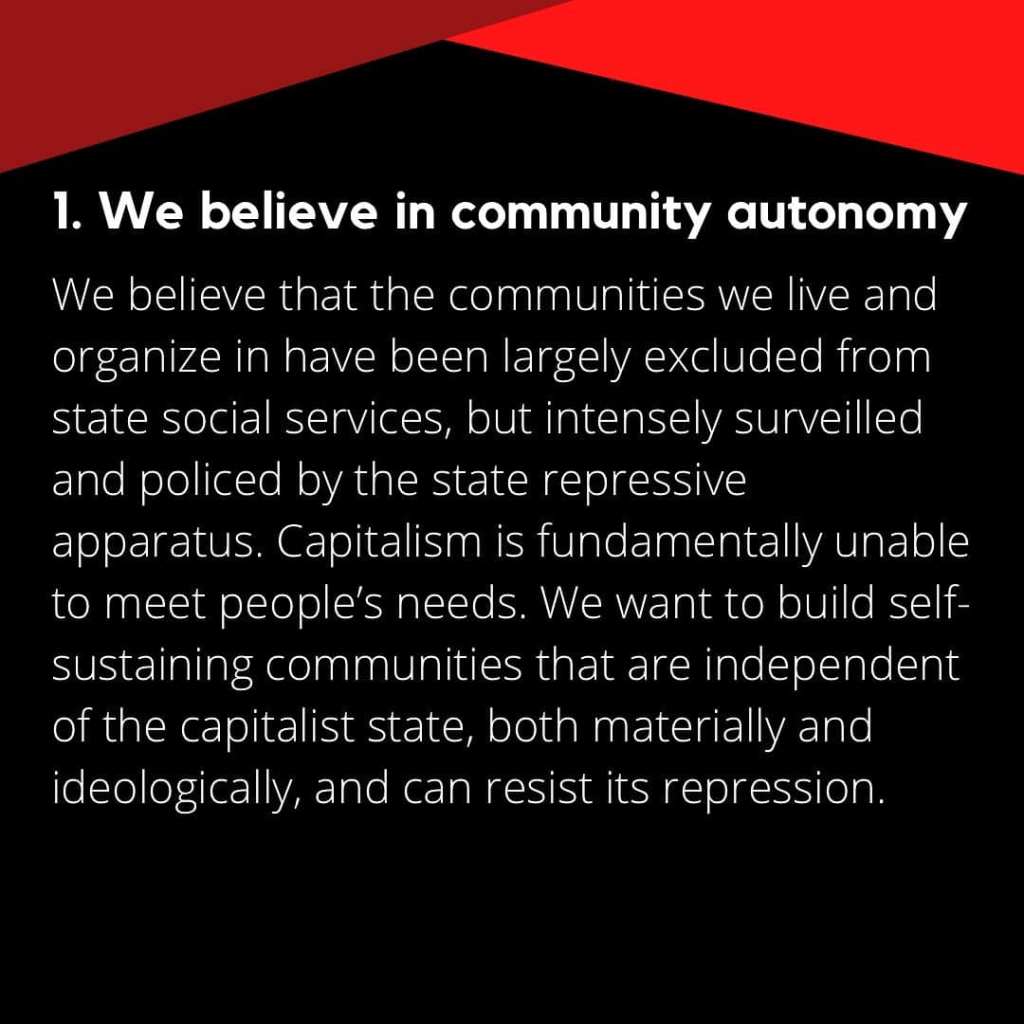
capitalism has violated the communities of marginalized folks. capitalism is about the value of people, property and the people who own property. those who have wealth and property control the decisions that are made. the government comes second to capitalism when it comes to power.

in the name of liberation, capitalism must be reversed and dismantled. meaning that capitalistic practices must be reprogrammed with mutual aid practices. 
Des Moines Black Liberation Movement

Mutual Aid

How do we resist? We rebuild our communities in ways not based on money. Such communities thrive all over the world. Indigenous peoples have always lived this way. Generations of white people once did so in this country. Mutual Aid is a framework that can help us do this today.

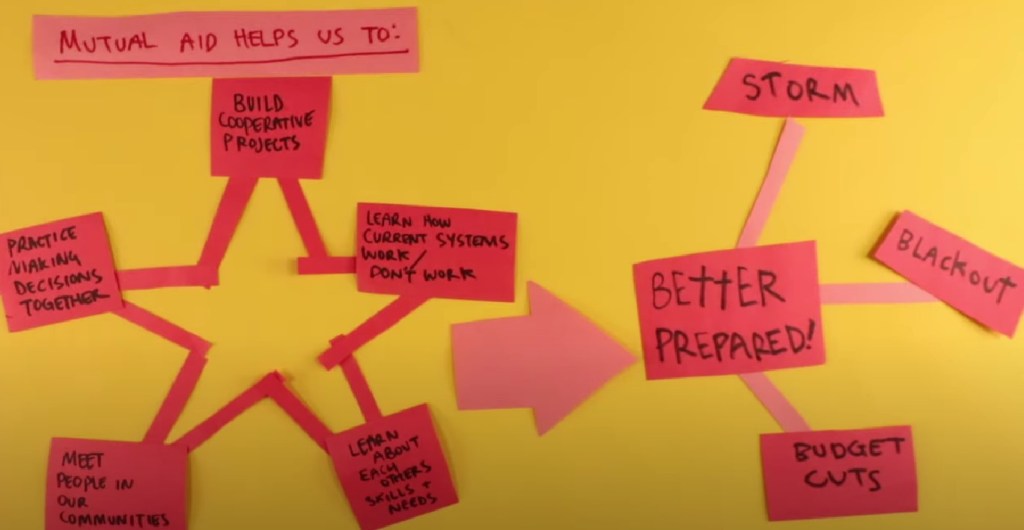
The concept of Mutual Aid is simple to explain but can result in transformative change. Mutual Aid involves everyone coming together to find a solution for problems we all face. This is a radical departure from “us” helping “them”. Instead, we all work together to find and implement solutions.  To work together means we must be physically present with each other. Mutual Aid cannot be done by committee or donations. We build Beloved communities as we get to know each other. Build solidarity. An important part of Mutual Aid is creating these networks of people who know and trust each other. When new challenges arise, these networks are in place, ready to meet them.

Another important part of Mutual Aid is the transformation of those involved. This means both those who are providing help and those receiving it.

With Mutual Aid, people learn to live in a community where there is no vertical hierarchy. A community where everyone has a voice. A model that results in enthusiastic participation. A model that makes the vertical hierarchy required for white supremacy impossible.

Commonly there are several Mutual Aid projects in a community. The initial projects usually relate to survival needs. One might be a food giveaway. Another helping those who need shelter. Many Mutual Aid groups often have a bail fund, to support those arrested for agitating for change. And accompany those arrested when they go to court.

LANDBACK

The other component necessary to move away from colonial capitalism and white supremacy is LANDBACK or ReMatriate.

But the idea of “landback” — returning land to the stewardship of Indigenous peoples — has existed in different forms since colonial governments seized it in the first place. “Any time an Indigenous person or nation has pushed back against the oppressive state, they are exercising some form of landback,” says Nickita Longman, a community organizer from George Gordon First Nation in Saskatchewan, Canada.

The movement goes beyond the transfer of deeds to include respecting Indigenous rights, preserving languages and traditions, and ensuring food sovereignty, housing, and clean air and water. Above all, it is a rallying cry for dismantling white supremacy and the harms of capitalism.

Returning the Land. Four Indigenous leaders share insights about the growing landback movement and what it means for the planet, by Claire Elise Thompson, Grist, February 25, 2020

ReMatriate

“For Indigenous Peoples Day, I would like for folks to better understand and appreciate this movement which has been working its way into the dominant public narrative over the past few years. As a hashtag or sign at a protest, the term Land Back is straightforward. It is a demand that stolen land, sacred sites and sovereign stewardship be returned to whom it was stolen from: Indigenous peoples. It has become popular movement slang used in our ongoing efforts to fend off relentless theft and racial injustice, and a call for reparations.

Land Back is a helpful term but I prefer to use ReMatriate, as it is more inclusive of the many issues that have arisen from land theft, and better describes the Indigenous fight to defend Mother Earth. It is a call to reestablish Indigenous landscapes, bring back Indigenous traditional ecological knowledge and to give stolen power back to the feminine. In a world where unfettered patriarchal violence and greed has brought us to the precipice of a climate extinction, ReMatriation is the return of the matriarchy. This counterbalances the forces of toxic masculinity that, through Christian colonial-capitalist violence, are intent on holding all power and controlling all the life, land and resources on our Mother Earth.”

PERSPECTIVES: Why “ReMatriate” is a more inclusive term for returning land to Indigenous peoples by Sikowis Nobiss, reckon, Oct 3, 2023


What will Friends do?

It matters little what people say they believe when their actions are inconsistent with their words.  Thus, we Friends may say there should not be hunger and poverty, but as long as Friends continue to collaborate in a system that leaves many without basic necessities and violently enforces white supremacy, our example will fail to speak to mankind.

Let our lives speak for our convictions.  Let our lives show that we oppose the capitalist system and white supremacy, and the damages that result.  We can engage in efforts, such as Mutual Aid, LANDBACK, and ReMatriate to build Beloved community. To reach out to our neighbors to join us.

We must begin by changing our own lives if we hope to make a real testimony for peace and justice.


Americans Don’t Understand What Violence Really Is

Racism Made America a Failed State, Just Like Its Greatest Mind Predicted. Americans Don’t Understand What Violence Really Is — And So They’re Stuck in a Vicious Cycle of It is the title of an article, published on Martin Luther King Day, by umair haque, an author I follow.

I often wonder to myself on days like this, and I try to talk about this every year on this day: what might an America that really understood MLK’s message have been like? What kind of country would that have been and become?

The answer is: it would have been a better place for everyone. A more prosperous country, in every way imaginable.

How so? MLK’s central messages were twofold: nonviolence and love. And yet Americans are such violent people — they fetishize and worship violence at such a deep level — that even “leftists” today roll their eyes and laugh at such a message. Love! Lol!!!

But they shouldn’t.

Americans Don’t Understand What Violence Really Is by umair haque, Eudaimonia and Co, January 17, 2022

The article is an interesting discussion of violence, which isn’t usually part of the discussion of nonviolence.

MLK understood — or would have — that all the following things are forms of violence. People forced to “crowdfund” healthcare — to beg their neighbors for pennies for medicine. A workplace culture where being abused and berated by your boss is totally normal. Incomes not rising for half a century — while costs skyrocket to absurd levels. The average American dying in debt. Being forced to choose between healthcare and your life savings. Having to give up your home because you want to educate your kids.

All these things are forms of violence. Violence runs deep. It isn’t just mobs of fascists smearing feces on the walls — though it is also that. It’s what Americans do to one another as everyday interaction — and shrug off as normal. Mental, emotional, social, cultural violence makes up the very fabric of everyday American life. It’s the poisonous residue of slavery. And it’s profoundly traumatic. It has lacerated the American mind, and made violence a legitimate solution to every social problem. But these forms of all-pervasive violence are what a capitalist society is limited to, because everything is competition, rivalry, and ultimately, domination and subjugation.

Americans Don’t Understand What Violence Really Is by umair haque, Eudaimonia and Co, January 17, 2022
This makes me realize Mutual Aid is an expression of nonviolence.

What we have is each other. We can and need to take care of each other. We may have limited power on the political stage, a stage they built, but we have the power of numbers.

Those numbers represent unlimited amounts of talents and skills each community can utilize to replace the systems that fail us.  The recent past shows us that mutual aid is not only a tool of survival, but also a tool of revolution. The more we take care of each other, the less they can fracture a community with their ways of war.

Ronnie James, Des Moines Mutual Aid
This is a video I made years ago.

Not Only Food

I would normally be going to Des Moines this morning to help put together boxes of food with my Des Moines Mutual Aid friends. I won’t because predictions for heavy snow overnight would make travel hazardous. The predictions were accurate. And my brother is visiting.

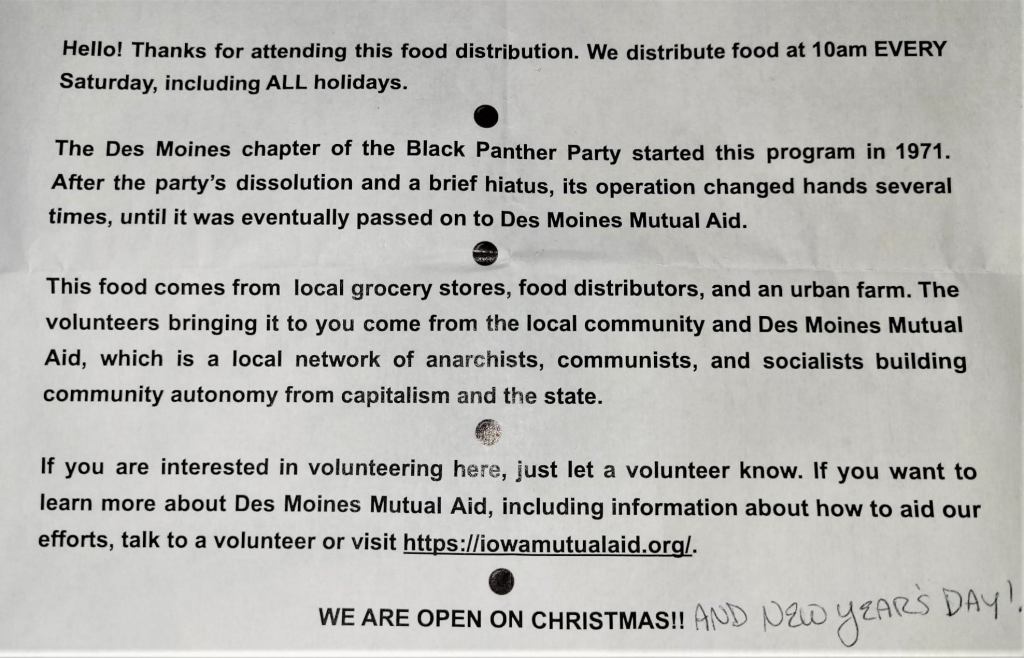
The Des Moines Mutual Aid’s (DMMA) Points of Unity expresses what Mutual Aid is about. DMMA has several projects. One is the free food distribution, which the following describes. This continues the Black Panther Party school breakfast program.

A principle of Mutual Aid is to invite others into the work, mobilizing people and building movements. The statement above is given to those who come to us for food, inviting anyone to join.

One of my Mutual Aid friends asked how I became involved (long story). Then she told me she used to come because she needed food. Now she is happy she can join in the work of distributing the food.

There are three key elements of Mutual Aid.

  1. Mutual aid projects work to meet survival needs and build shared understanding about why people do not have what they need.
  2. Mutual aid projects mobilize people, expand solidarity, and build movements.
  3. Mutual Aid projects are participatory, solving problems through collective action rather than waiting for saviors.

    Mutual Aid, Building Solidarity during this Crisis (and the next) by Dean Spade, Verso, 2020

Now all of us are facing food insecurity as we see grocery stores beginning to have trouble stocking their shelves. I hope this will result in more Mutual Aid projects.

A recent article reminded me about Food Not Bombs.

Every Wednesday, a mix of New Paltz college students and locals congregate in a small workspace just outside of town. It may look like they’re just cooking and packing food to deliver to needy families, but it’s really more than that.

“Like when people say, ‘serving the community,’ well, we want to build a community,” said Katari Sisa, a volunteer for Food Not Bombs New Paltz.

Sisa, a recent graduate of SUNY New Paltz, has been involved at the organization for the last four years now. Sisa says that giving back is necessary right now, with a pandemic raging and, according to data collected by the University of Southern California, nearly 37% of Americans are dealing with food insecurity.

“This is part of a larger project, kind of like a larger vision for a community center and having a kind of consistent spot to do stuff like this from,” Sisa said.

The ultimate goal, organizers say, is to build unity between people and create a more equitable community.

FOOD NOT BOMBS AIMS TO BRING MORE THAN JUST FOOD By John Camera, Spectrum Local News, February 3, 2021

Randomly passing an accomplice on the street and throwing up a fist at each other as we go our separate ways to destroy all that is rotten in this world will never fail to give me extra energy and a single tear of gratitude for what this city is creating.

my friend Ronnie James, Des Moines Mutua Aid

Introduction to Mutual Aid and hierarchies

As I’ve been talking and writing about Mutual Aid, I’m not surprised that most of the questions relate to hierarchies. Mutual Aid is founded on a flat or horizontal hierarchy, where everyone has a voice in decisions.

I would highly recommend Dean Spade’s book , “Mutual Aid: Building Solidarity During This Crisis (and the Next)”. Two of the videos he has produced are very helpful. [See below]

My practical experience related to hierarchies comes from the past two years with Des Moines Mutual Aid. My friend Ronnie James is an Indigenous organizer with twenty years of experience and has been my Mutual Aid mentor.

It is widely acknowledged that it takes time to learn how to be in a mutual aid community. We are so entrenched in vertical hierarchies in our society.

By participating in groups in new ways and practicing new ways of being together, we are both building the world we want and becoming the kind of people who could live in such a world together.

Dean Spade

Here are a few examples of my mutual aid education. One day we had to set up tables in the school yard because the basement of the church we normally use was holding a vaccination clinic that day. Our routine was somewhat interrupted. I was arranging the tables to put the food on. Ronnie came and asked me what I wanted him to do. Even though he had been working with mutual aid for years, he didn’t suggest that I should look to him for decisions in that situation.

Because the vaccination clinic was using the tables we usually used to setup the food boxes, we needed to find other tables.  Ronnie said he was going to go upstairs to look for some. He didn’t say I should go with him, left that decision up to me. I chose to go which turned out to be good because we did find some tables to use. Which were on the third floor. Someone said that was the day Jeff got the tables. There is a lot of humor when we’re together.

I often hear people asking questions, and most commonly someone will say “I would do … but do what you think is best”.

Or when the van of food arrived, someone will say “the van is here.”  Then all who aren’t busy go out to unload it. No one tells certain people to “go unload the van”.

When we’re done, the tables and floor need to be cleaned. Whoever is free just does that.

On the other hand, when there are things we just don’t know, we gravitate to asking Ronnie because of his experience. And there are certain people who routinely go to Hy-Vee to pick up the food, because they know how to do that.

So, Ronnie is accorded respect, but as I said above, he doesn’t tell people what to do. I don’t think that represents a vertical hierarchy.

The people involved in Mutual Aid, with a flat or horizontal hierarchy, all bring different, valuable skills or perspectives, which is used to inform decisions made by the Mutual Aid group.


Most people work or go to school inside hierarchies where disobedience leads to punishment or exclusion. We bring our learned practices of hierarchy with us even when no paycheck or punishment enforces our participation, so even in volunteer groups we often find ourselves in conflicts stemming from learned dominance behaviors. But collective spaces, like mutual aid organizing, can give us opportunities to unlearn conditioning and build new skills and capacities. By participating in groups in new ways and practicing new ways of being together, we are both building the world we want and becoming the kind of people who could live in such a world together.

Dean Spade. Mutual Aid: Building Solidarity During This Crisis (and the Next) (Kindle Locations 208-212). Verso.
Horizontalist and Participatory Characteristics of Mutual Aid ProjectsCharacteristics of Hierarchical, Charitable Non-Profits and Social Service Programs (or what tends to change about mutual aid projects as they move toward becoming charities or social service programs)
“Members” = people making decisions“Members” = donors 
De-professionalized survival work done by volunteersService work staffed by professionals
Beg, borrow, and steal suppliesGrant money for supplies/philanthropic control of program
Use people power to resist any efforts by government to regulate or shut down activitiesFollow government regulations about how the work needs to happen (usually requiring more money, causing reliance on grants, paid staff with professional degrees)
Survival work rooted in deep and wide principles of anti-capitalism, anti-imperialism, racial justice, gender justice, disability justiceSiloed single-issue work, serving a particular population or working on one area of policy reform, disconnected from other ‘issues’
Open meetings, as many people making decisions and doing the work as possibleClosed board meetings, governance by professionals or people associated with big institutions or big donors, program operated by staff, volunteers limited to stuffing envelopes or other menial tasks occasionally, volunteers not part of high level decision making
Efforts to support people facing the most dire conditionsImposing eligibility criteria for services that divide people into “deserving” and “undeserving”
Give things away without expectationsConditions for getting help or participating in something—you have to be sober, have a certain family status, have a certain immigration status, not have outstanding warrants, not have certain convictions, etc.
People participate voluntarily because of passion about injusticePeople come looking for a job, wanting to climb a hierarchy or become “important”
Efforts to flatten hierarchies—e.g. flat wage scales if anyone is paid, training so that new people can do work they weren’t professionally trained to do, rotating facilitation roles, language accessEstablishing and maintaining hierarchies of pay, status, decision-making power, influence
Values self-determination for people impacted or targeted by harmful social conditionsOffers “help” to “underprivileged” absent of a context of injustice or strategy for transforming the conditions; paternalistic; rescue fantasies and saviorism
Consensus decision-making to maximize everyone’s participation, to make sure people impacted by decisions are the ones making them, to avoid under-represented groups getting outvoted, and to build the skill of caring about each other’s participation and concerns rather than caring about being right or winningPerson on top (often Executive Director) decides things or, in some instances, a board votes and majority wins
Direct aid work is connected to other tactics, including disruptive tactics aimed at root causes of the distress the aid addressesDirect aid work disconnected from other tactics, depoliticized, and organization distances itself from disruptive or root causes-oriented tactics in order to retain legitimacy with government or funders
Tendency to assess the work based on how the people facing the crisis the organization wants to stop regard the workTendency to assess the work based on opinions of elites: political officials, bureaucrats, funders, elite media
Engaging with the organization builds broader political participation, solidarity, mobilization, radicalizationEngaging with the organization not aimed at growing participants’ engagement with other “issues,” organizations, or struggles for justice

Characteristics of Mutual Aid vs. Charity Mutual aid projects depart from the charity model in crucial ways. Most mutual aid projects are volunteer based and avoid the careerism, business approach, and charity model of nonprofits. Mutual aid projects strive to include lots of people, rather than just a few people who have been declared “experts” or “professionals.” If we want to provide survival support to as many people as possible, and mobilize as many people as possible for root-causes change, we need to let a lot of people do the work and make decisions about the work together, rather than bottlenecking the process with hierarchies that let only a few people lead.

Despite these important goals, avoiding the pitfalls of co-optation, deservingness hierarchies, saviorism, and disconnect from root-causes work requires constant vigilance. The last half-century of social movement history is full of examples of mutual aid groups that, under pressure from law enforcement, funders, and culture, transformed into charity or social services groups and lost much of their transformative capacity.

Here are some guiding questions for mutual aid groups trying to avoid these dangers and pitfalls:

  • Who controls our project?
  • Who makes decisions about what we do?
  • Does any of the funding we receive come with strings attached that limit who we help or how we help?
  • Do any of our guidelines about who can participate in our work cut out stigmatized and vulnerable people?
  • What is our relationship to law enforcement?
  • How do we introduce new people in our group to our approach to law enforcement?

While there is no single correct model for a mutual aid group, being aware of general tendencies that distinguish mutual aid from other projects can help groups make thoughtful decisions and maintain their integrity and effectiveness.

Dean Spade. Mutual Aid: Building Solidarity During This Crisis (and the Next) (Kindle Locations 640-658). Verso.

A matter of faith

There are two definitions of faith.

  • complete trust or confidence in someone or something.
  • strong belief in God or in the doctrines of a religion, based on spiritual apprehension rather than proof.

I wasn’t familiar with the use of apprehension above. I found one definition is “understanding or grasp”.

I spent a lot of time praying (faith) and thinking about the discussion we were going have at my Quaker meeting, Bear Creek (some of us via ZOOM) related to Mutual Aid. I’ve been deeply involved in Des Moines Mutual Aid (DMMA) for two years, writing nearly daily to share what I’ve been learning. It can be difficult to express lived experiences to those who haven’t had those experiences. Many Friends have had experiences that could be called Mutual Aid in their peace and justice work.

I made mistakes over the years because I had conflicts with the meeting related to the use of fossil fuels. (Meeting refers to my local meeting, Bear Creek.) I didn’t do a good job of inviting the meeting to engage with me about that. Although I understood there are major obstacles to reducing use of fossil fuels where there is no mass transportation, I have been humbled to face that problem myself since I moved to Iowa from Indianapolis several years ago.

One Friend from the meeting had a suggestion that helped us work together on fossil fuel issues. That resulted in the approval of the following Minute by our Yearly Meeting.

Radically reducing fossil fuel use has long been a concern of Iowa Yearly Meeting (Conservative).  A previously approved Minute urged us to reduce our use of personal automobiles.  We have continued to be challenged by the design of our communities that makes this difficult.  This is even more challenging in rural areas.  But our environmental crisis means we must find ways to address this issue quickly.

Friends are encouraged to challenge themselves and to simplify their lives in ways that can enhance their spiritual environmental integrity. One of our meetings uses the term “ethical transportation,” which is a helpful way to be mindful of this.

Long term, we need to encourage ways to make our communities “walkable”, and to expand public transportation systems.  These will require major changes in infrastructure and urban planning.

Carpooling and community shared vehicles would help.  We can develop ways to coordinate neighbors needing to travel to shop for food, attend meetings, visit doctors, etc.  We could explore using existing school buses or shared vehicles to provide intercity transportation.

One immediately available step would be to promote the use of bicycles as a visible witness for non-fossil fuel transportation.  Friends may forget how easy and fun it can be to travel miles on bicycles.  Neighbors seeing families riding their bicycles to Quaker meetings would have an impact on community awareness.  This is a way for our children to be involved in this shared witness.  We should encourage the expansion of bicycle lanes and paths.  We can repair and recycle unused bicycles and make them available to those who have the need.

Iowa Yearly Meeting (Conservative) 2017

That experience has helped me have more faith in the work of our meeting, in the sense of trust in the meeting. And helped me be a better listener.

We had the discussion about Mutual Aid at Bear Creek yesterday and I was very pleased. Friends had interesting and helpful questions and ideas. I was happy to hear what Friends had been doing in their communities related to Mutual Aid.

One of the most thought-provoking questions related to hierarchies. That any group would have differences, such as educational level or class, for example. I didn’t have a good answer at the time. The following video by Dean Spade explains this well. Of course, we all have different experiences and skills. Mutual Aid communities appreciate and encourage the use of community building skills. And helping people build new skills is encouraged.

Vertical versus horizontal hierarchies are related to decision making.

Two of the queries (questions) we considered yesterday relating to hierarchies were:

  • Do we recognize that vertical hierarchies are about power, supremacy and privilege? What are Quaker hierarchies?
  • Do we work to prevent vertical hierarchies in our peace and justice work?

Dean Spade wrote the best book I’m aware of about Mutual Aid. Mutual Aid, Building Solidarity during this Crisis (and the next) by Dean Spade, Verso, 2020

He teaches courses about Mutual Aid and has produced videos related to the subject. The following is a good discussion of horizontal group structures.

These workshops are about building mutual aid groups that can make decisions together, that include everybody, that can prevent and weather conflict, that can sustain work and sustain engagement, that can bring lots of new people into the work and so that it’s well resourced by people power. And that can be a bridge for people towards deeper and bolder movement engagement.

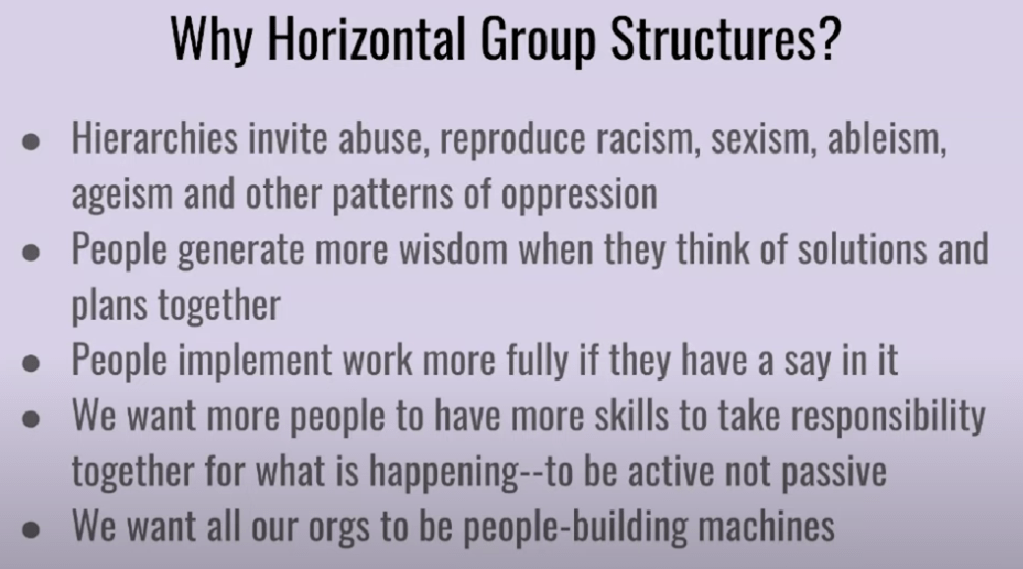
I strongly believe that horizontal group structures, meaning group structures where there’s no boss or executive director or main decider are the way to get there, for a number of reasons, and I want to share those in case that’s new for people.

One big reason is that hierarchies invite abuse and reproduce systems like racism, sexism, ableism, ageism, et cetera. I mean, we see it all the time. It’s like when you set something up as a hierarchy, oftentimes it’s men or white people bossing people around or old people bossing young people around or whatever.

And the bossing around can include worse forms of exploitation and abuse, also. I think that is inherent to hierarchy.

So we’ve seen forever in social justice movements, people set up hierarchical groups and then the same stuff plays out that they were trying to fight.

I think that’s worse, and it’s not as if it can’t happen in horizontal groups. We still have the dynamics. We still have that unlearning to do, but I think that hierarchy invites it.

Dean Spade: Horizontal Group Structures in Mutual Aid Work

Dean Spade: Horizontal Group Structures in Mutual Aid Work

Mutual Aid stories

For the past week I’ve been thinking and praying a lot about Mutual Aid in preparation for a discussion we plan to have at my Quaker meeting tomorrow.

As I have nearly every Saturday for the last year, I was with my Mutual Aid friends this morning for our weekly food distribution. Here are a few stories triggered from what happened this morning.

I had a clear spiritual leading to become involved in Des Moines Mutual Aid. For the sake of brevity, I’ll begin with my return to Iowa in 2017. I was looking for justice activists and soon had the opportunity to walk on the First Nation-Farmer Climate Unity March. A group of about ten native and ten non-native people walked and camped together for ninety-four miles, over eight days, along the path of the Dakota Access pipeline. The intention was for us to get to know each other as we shared stories, and that worked amazingly well. I got to know Sikowis Nobiss, Trisha Etringer, Matthew Lone Bear, Alton and Foxy Onefeather, and Donnielle Wanatee, among others. Various combinations of us worked together since then on things like racist monuments and mascots, Indigenous Peoples’ Day, and an Indigenous led Green New Deal.

There are a lot of photos and blog posts related to this sacred journey here: https://firstnationfarmer.com/ Part of the story relates to the support we received from Friends.

The summer of 2019 Peter Clay, Jim Glasson, Linda Lemons, and I helped arrange for Paula Palmer to have several sessions in the Midwest related to her ministry regarding Quakers and Indigenous peoples.

We wanted to continue this work. On February 7, 2020, we planned to meet at Friends House in Des Moines.

At that time, the Royal Canadian Mounted Police were attacking the Wet’suwet’en peoples in British Columbia. They were clearing the way for the construction of the Coastal GasLink pipeline through Wet’suwet’en territory. There was nothing about that in the mainstream press.

I learned about this when I saw the title of a YouTube video about the eviction of Coastal GasLink personnel from Wet’suwet’en territory. For many years I worked on the Keystone and Dakota Access pipelines resistance when I was in Indianapolis. I remember how shocked I was to see pipeline construction personnel evicted! I’m sure the Spirit led me to learn about the Wet’suwet’en. This struggle has become one of my primary areas of justice work since.

Returning to the February 7 meeting, we thought we would hold a rally in support of the Wet’suwet’en before the meeting we had already planned. I created a Facebook event in case anyone else might want to join us.

As the Spirit would have it though, Ronnie James saw that and joined us. I learned Ronnie has had over 20 years of experience as an Indigenous organizer. He was surprised anyone else in the Midwest knew about the Wet’suwet’en and came to check us out. A great organizing technique.

Peter Clay, Linda Lemons and Ronnie James

Over the subsequent two years Ronnie has become one of my closest friends, as well as my Mutual Aid mentor.

The Des Moines Mutual Aid project I’ve been involved in is the weekly food distribution project. There are many stories related to that but I’ll just tell about things that happened this morning.

About sixty boxes of food are put together in the basement of a church in Des Moines. Then they are taken outside and put on four tables, from which they are loaded into cars as they pull up. People know by word of mouth to park in the parking lot at 10 am. Then one of us directs them to drive up to the tables of food.

I learned those four long tables were donated to the church years ago from a mental health facility that my Quaker meeting, Bear Creek did a lot of work on.

This morning we could only find two of the tables. We looked all over and when we couldn’t find them, we carried a few smaller tables down from the third floor of the church. Shortly after though, when the bread that had been piled on some tables was put in the food boxes, we discovered the tables we were looking for had been hidden by the bread. We had a good laugh about that. Ronnie told me I’d have to write about that on my blog. This is a small example of how we all get to know each other as we work together.

The institutions of forced assimilation are often on my mind. Some Quakers had been involved in those institutions. Ronnie and I had a discussion about that.

I enjoyed hearing him talk about his son. Ronnie said, “he makes me happy (most of the time)”. I remember when Ronnie introduced me to him. He rarely says anything, but his voice sounds just like Ronnie’s. This morning I heard him say “dad”. When I left this morning, he was the only person in the basement. I said, “see you later” and he said, “see you later”. (It feels like I should not write his name. So many of those involved in Mutual Aid have had experiences with the police.)

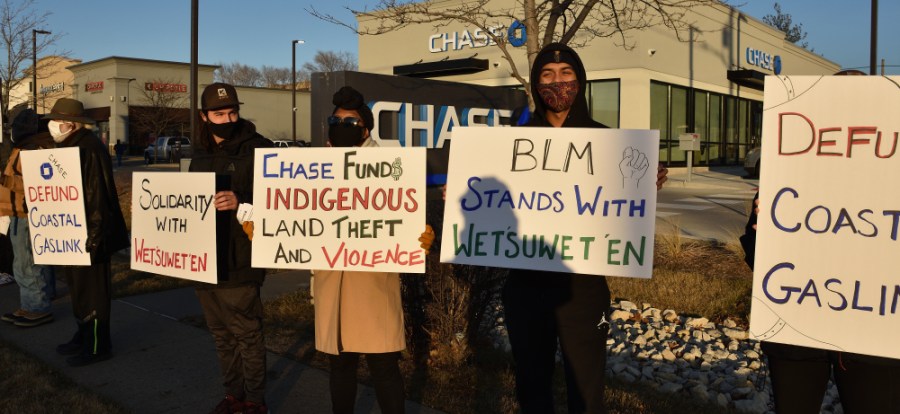
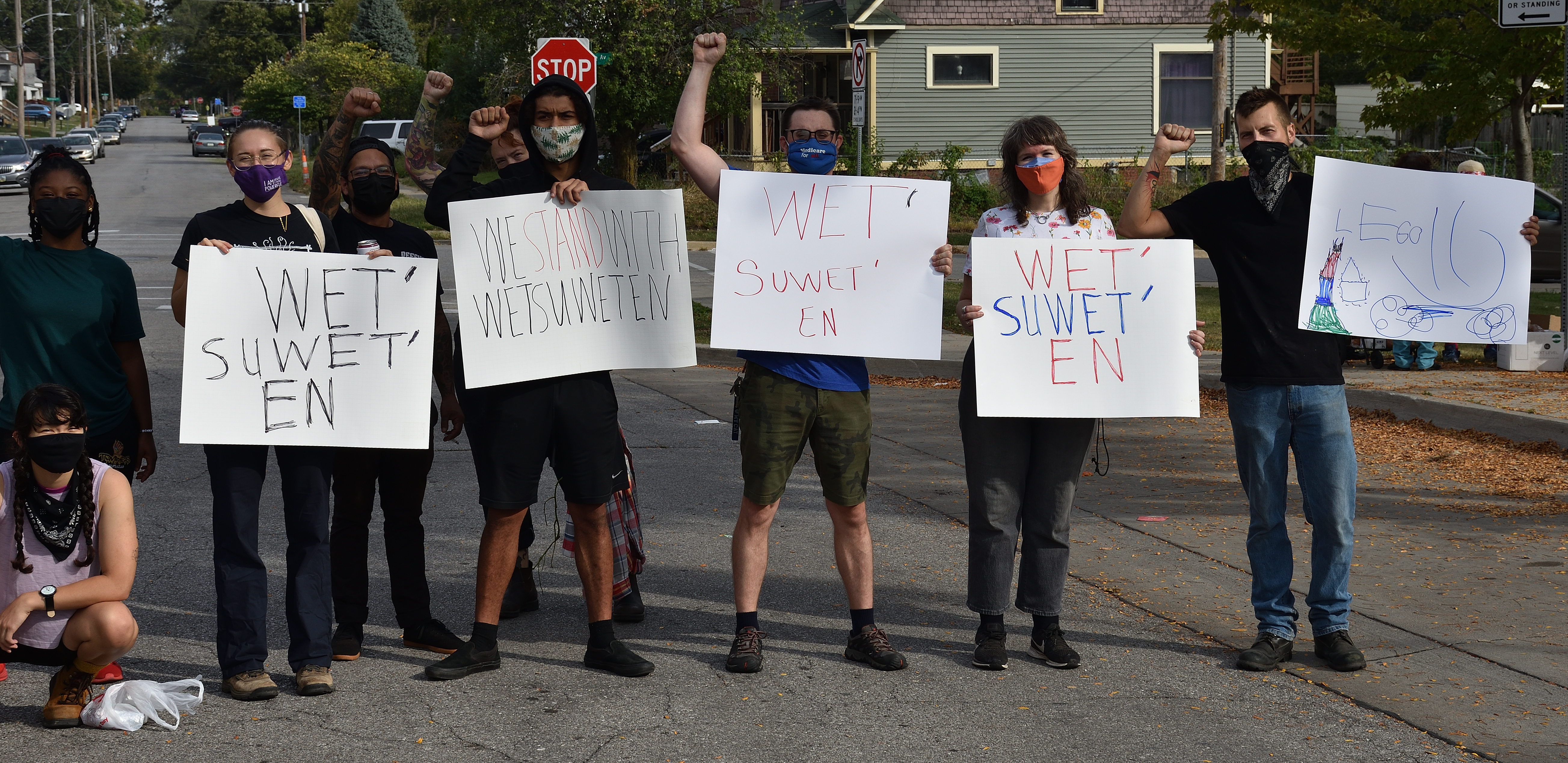
I will finish by returning to the Wet’suwet’en peoples, who are yet again being threatened by the RCMP. When these latest threats began again in November, Ronnie and I talked about whether to do something in support. We decided to invite whoever wanted to hold signs in support after our Mutual Aid work was finished. It was like completing a circle from our initial meeting related to the Wet’suwet’en.

I don’t get opportunities to take photos when with my Mutual Aid friends, again because of concerns related to police. But this time it was OK because of the masks and each person had given permission. When people were lining up, someone said, “across the street”. I thought they meant to move across the street, but what was meant was to line up across the street. And after the first few shots someone said, “wait, am I the only one with a fist up?”

You might notice the sign on the far right. A 5-year-old attends every Saturday, the life of the party. I knew he liked to draw, so I brought markers and a blank sheet for him.

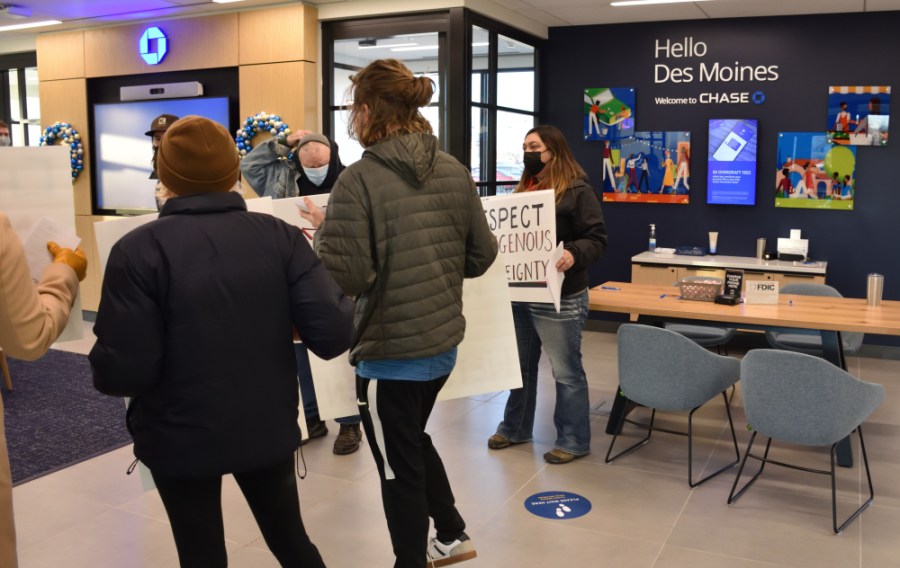
In December, the Wet’suwet’en called on supporters for solidarity actions. Chase bank funds the Coastal GasLink pipeline. A solidarity event was organized at a Chase bank in Des Moines. People were there from Mutual Aid, and Jon Krieg of the American Friends Service Committee (AFSC) and his partner Patti. You will also see one of the leaders of Des Moines Black Liberation there in support of the Wet’suwet’en.

Mutual Aid is the Quaker way of being in the world

This week I’ve been writing to help refine what I hope will happen when we discuss Mutual Aid at my Quaker meeting this weekend. Quakers have a practice of using questions (queries) to help focus and stimulate participation in consideration of topics such as peace, Quaker education, etc. In the tables below I’ve extracted queries from those we routinely consider that relate to Mutual Aid and added others I’ve written.

I think what I will have the most trouble conveying is Mutual Aid represents a paradigm shift away from our current situation. Away from capitalism, white supremacy, insurance-controlled healthcare, militarized police and punishment oriented judicial system, prisons, education that resists teaching critical thinking and promotes white supremacy, and domestic and global militarism. Away from commodifying all natural resources. Continuing extraction and burning of fossil fuels.

Simply put, Mutual Aid is the Quaker way of being in the world.

I’d like us to spend most of the hour’s discussion Sunday hearing what the people in the (Quaker) meeting say about these queries.

At the beginning of the discussion, I want to make the following points.

  • My introduction to Mutual Aid was in response to a strong Spiritual leading.
  • Mutual Aid is NOT charity.
  • Maintaining a flat or horizontal hierarchy is what makes Mutual Aid work.
    • The short video below “Horizontal Group Structures in Mutual Aid Work” does an excellent job of explaining this. The video is by Dean Spade, who wrote the book, “Mutual Aid: Building Solidarity During This Crisis (and the Next).” Verso.
    • MUTUAL is the key.
  • Removing the artificial hierarchies eliminates grouping people by race, class, gender, education, etc. There cannot be white supremacy, for example, if there is no vertical hierarchy.
  • Mutual Aid resists authoritarianism and colonization.
  • Mutual Aid is the Quaker way of being in the world.

The point that seems most difficult to grasp, but is most important to learn, is the difference between Mutual Aid and charity. Charity is an example of a vertical hierarchy. The donors are above the recipients. The recipients are often stigmatized. There is rarely any contact between the two. And there are often strings attached. Recipients must meet certain criteria to qualify for the help/money. And what is offered as help is often not what the recipients actually need.

“Mutual” is the key to Mutual Aid. It can never be “us” helping “them”. The whole community works together to identify and solve problems affecting everyone. There is the understanding that anyone of us might need the help that we are involved in providing. Someone I met when we were putting together boxes of food told me in the past, she was among those who needed the food.

I wrote about using questions (queries) to help guide the discussion and encourage participation by those attending. (Notes to Myself).

Queries related to Mutual Aid
Do we recognize that vertical hierarchies are about power, supremacy and privilege? What are Quaker hierarchies?
Do we work to prevent vertical hierarchies in our peace and justice work?
What are we doing to meet the survival needs of our wider community?
How are we preparing for disaster relief, both for our community, and for the influx of climate refugees?
Are we examples of a Beloved community? How can we invite our friends and neighbors to join our community?

The following lists some of the Yearly Meeting’s queries that apply to Mutual Aid.

Advices and Queries of Iowa Yearly Meeting (Conservative)
OutreachIn what ways do we cooperate with persons and groups with whom we share concerns? How do we reach out to those with whom we disagree?
Civic responsibilityIn what ways do we assume responsibility for the government of our community, state, nation and world?
Environmental responsibilityWhat are we doing about our disproportionate use of the world’s resources?
Social and economic justiceHow are we beneficiaries of inequity and exploitation? How are we victims of inequity and exploitation? In what ways can we address these problems?
What can we do to improve the conditions in our correctional institutions and to address the mental and social problems of those confined there? (This one is related to Abolition of police and prisons)
Peace and nonviolenceWhat are we doing to educate ourselves and others about the causes of conflict in our own lives, our families and our meetings? Do we provide refuge and assistance, including advocacy, for spouses, children, or elderly persons who are victims of violence or neglect?
Do we recognize that we can be perpetrators as well as victims of violence? How do we deal with this? How can we support one another so that healing may take place?
What Is Mutual Aid?

Mutual aid is collective coordination to meet each other’s needs, usually from an awareness that the systems we have in place are not going to meet them. Those systems, in fact, have often created the crisis, or are making things worse. We see examples of mutual aid in every single social movement, whether it’s people raising money for workers on strike, setting up a ride-sharing system during the Montgomery Bus Boycott, putting drinking water in the desert for migrants crossing the border, training each other in emergency medicine because ambulance response time in poor neighborhoods is too slow, raising money to pay for abortions for those who can’t afford them, or coordinating letter-writing to prisoners. These are mutual aid projects. They directly meet people’s survival needs, and are based on a shared understanding that the conditions in which we are made to live are unjust.

There is nothing new about mutual aid— people have worked together to survive for all of human history. But capitalism and colonialism created structures that have disrupted how people have historically connected with each other and shared everything they needed to survive. As people were forced into systems of wage labor and private property, and wealth became increasingly concentrated, our ways of caring for each other have become more and more tenuous.

Today, many of us live in the most atomized societies in human history, which makes our lives less secure and undermines our ability to organize together to change unjust conditions on a large scale. We are put in competition with each other for survival, and we are forced to rely on hostile systems— like health care systems designed around profit, not keeping people healthy, or food and transportation systems that pollute the earth and poison people— for the things we need. More and more people report that they have no one they can confide in when they are in trouble. This means many of us do not get help with mental health, drug use, family violence, or abuse until the police or courts are involved, which tends to escalate rather than resolve harm.

In this context of social isolation and forced dependency on hostile systems, mutual aid— where we choose to help each other out, share things, and put time and resources into caring for the most vulnerable— is a radical act.

Dean Spade. Mutual Aid: Building Solidarity During This Crisis (and the Next) (Kindle Locations 104-120). Verso.

There are three key elements of Mutual Aid.

  1. Mutual aid projects work to meet survival needs and build shared understanding about why people do not have what they need.
  2. Mutual aid projects mobilize people, expand solidarity, and build movements.
  3. Mutual Aid projects are participatory, solving problems through collective action rather than waiting for saviors.

    Mutual Aid, Building Solidarity during this Crisis (and the next) by Dean Spade, Verso, 2020

DateBlog posts related to Mutual Aid discussion
Mutual Aid in the Midwest
12/31/2021A Call for Quakers to Embrace Mutual Aid
1/2/2022What I Don’t Know About Mutual Aid
1/3/2022Notes to Myself
1/4/2022Notes to Myself Continued
1/5/2022Spirituality and Mutual Aid
1/5/2022More Notes on Mutual Aid
1/6/2022Does Mutual Aid speak to your condition?

We did distribute food on Christmas and New Year’s Day.

Does Mutual Aid speak to your condition?

For the past week I’ve been writing daily to prepare for a discussion at my Quaker meeting this Sunday. (See the table at the end listing those posts).

Yesterday’s post is an example of why I need to prepare. I went a bit off track. There is a lot to Mutual Aid, and we can’t cover it all in one hour. I hope there will be interest to continue to explore more about Mutual Aid after this weekend’s discussion.

In the quote below (Quaker) George Fox uses the term “speak to my condition”. I think that might be a way to frame Sunday’s discussion, does Mutual Aid speak to our condition today?

But as I had forsaken the priests, so I left the separate preachers also, and those esteemed the most experienced people; for I saw there was none among them all that could speak to my condition. And when all my hopes in them and in all men were gone, so that I had nothing outwardly to help me, nor could tell what to do, then, oh, then, I heard a voice which said, “There is one, even Christ Jesus, that can speak to thy condition”;

George Fox, (Quaker)

I wrote about using questions (queries) to help guide the discussion and encourage participation by those attending. (Notes to Myself).

Queries related to Mutual Aid
Do we recognize that vertical hierarchies are about power, supremacy and privilege? What are Quaker hierarchies?
Do we work to prevent vertical hierarchies in our peace and justice work?
What are we doing to meet the survival needs of our wider community?
How are we preparing for disaster relief, both for our community, and for the influx of climate refugees?
Are we examples of a Beloved community? How can we invite our friends and neighbors to join our community?

The following table lists some of the queries that we routinely use that apply to Mutual Aid.

Advices and Queries of Iowa Yearly Meeting (Conservative)
OutreachIn what ways do we cooperate with persons and groups with whom we share concerns? How do we reach out to those with whom we disagree?
Civic responsibilityIn what ways do we assume responsibility for the government of our community, state, nation and world?
Environmental responsibilityWhat are we doing about our disproportionate use of the world’s resources?
Social and economic justiceHow are we beneficiaries of inequity and exploitation? How are we victims of inequity and exploitation? In what ways can we address these problems?
What can we do to improve the conditions in our correctional institutions and to address the mental and social problems of those confined there? (This one is related to Abolition of police and prisons)
Peace and nonviolenceWhat are we doing to educate ourselves and others about the causes of conflict in our own lives, our families and our meetings? Do we provide refuge and assistance, including advocacy, for spouses, children, or elderly persons who are victims of violence or neglect?
Do we recognize that we can be perpetrators as well as victims of violence? How do we deal with this? How can we support one another so that healing may take place?

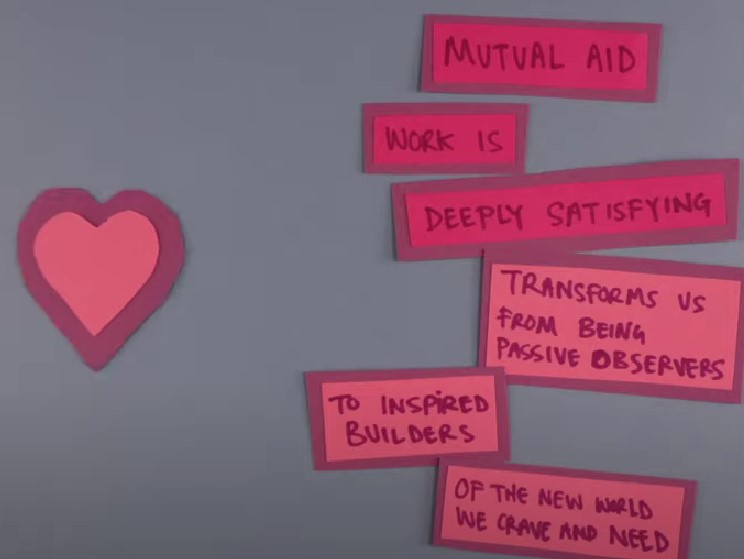
Mutual aid work is not easy. It means forming lasting commitments to doing hard work collaborating with people even when we have conflict. And facing the heart-wrenching realities of the systems we live under. It is also deeply satisfying work that transforms us from being exasperated passive observers of the shitstorm we’re living in to inspired builders of the new world we desperately crave.

Dr Stuart Jeanne Bramhall

There are three key elements of Mutual Aid.

  1. Mutual aid projects work to meet survival needs and build shared understanding about why people do not have what they need.
  2. Mutual aid projects mobilize people, expand solidarity, and build movements.
  3. Mutual Aid projects are participatory, solving problems through collective action rather than waiting for saviors.

    Mutual Aid, Building Solidarity during this Crisis (and the next) by Dean Spade, Verso, 2020
DateBlog posts related to Mutual Aid discussion
Mutual Aid in the Midwest
12/31/2021A Call for Quakers to Embrace Mutual Aid
1/2/2022What I Don’t Know About Mutual Aid
1/3/2022Notes to Myself
1/4/2022Notes to Myself Continued
1/5/2022Spirituality and Mutual Aid
1/5/2022More Notes on Mutual Aid

More notes on Mutual Aid

I’ve been preparing for a discussion my Quaker meeting will have this weekend about Mutual Aid. At the end of this is a table of posts I’ve been writing to help me organize my thoughts. I am not satisfied with how this post has turned out, but these are notes, not a finished document.

Stepping back from the details, I’m reflecting on what I hope will happen as a result of this discussion. My hope is that we begin to use Mutual Aid to guide our work, both in our Quaker meeting and how we do our work in the community for peace and justice.
Mutual Aid requires a paradigm shift from a community of primarily White Quakers immersed in the capitalist economic system, white supremacy, settler colonialism and land theft, forced assimilation, foreign and domestic militarism, state sanctioned violence, punishment oriented criminal justice system, fossil fuel power, and whatever you call our political systems.

Wow!

The greatest obstacle will be to persuade Friends that we should stop participating in those systems. Although that is looking more attractive as these systems are rapidly collapsing now.

Capitalism is economic slavery. Capitalism has forced millions into poverty. Capitalism denies shelter, food, water, healthcare quality education, and the ability to build any wealth at all to millions of people.

There were White Quakers who were involved in the institution of slavery. Even those who did not claim ownership of enslaved men, women and children benefited economically. Continue to benefit.

I don’t think we have many years of civilization left. But I think a few years hence people will look back at this time in a similar way to how we look back on slavery.

Quakers also have their history of participation in the institutions of forced assimilation to atone for. This is a significant barrier between Friends and Indigenous peoples.

In December 2020, Ronnie James and I had the following email exchange:

RonnieI don’t know what you can do. The church is the church’s past, which is its future. It continues to see my people as obstacles in its endless conquest.
JeffI was not feeling worthy of participating in Mutual Aid but thanks to you, I’ve signup up again for this weekend.
RonnieYou’re a good relative Jeff. To be blunt, there is too much damage that the church profits from and needs to protect to have any future there.
JeffI am afraid you are right.
RonnieI wish you the best. I imagine its a hard struggle.

Mutual aid work is not easy. It means forming lasting commitments to doing hard work collaborating with people even when we have conflict. And facing the heart-wrenching realities of the systems we live under. It is also deeply satisfying work that transforms us from being exasperated passive observers of the shitstorm we’re living in to inspired builders of the new world we desperately crave.

Dr Stuart Jeanne Bramhall
DateBlog posts related to Mutual Aid discussion
Mutual Aid in the Midwest
12/31/2021A Call for Quakers to Embrace Mutual Aid
1/2/2022What I Don’t Know About Mutual Aid
1/3/2022Notes to Myself
1/4/2022Notes to Myself Continued
1/5/2022Spirituality and Mutual Aid

Spirituality and Mutual Aid

This continues my preparation for a discussion about Mutual Aid at my Quaker meeting this weekend. A couple of days ago I wrote about using queries (questions) to invite people to participate in the discussion. And began to come up with some queries.

It occurred to me that some of the queries we already have are relevant to the discussion about Mutual Aid. I’ve listed some of those in this table.

Advices and Queries of Iowa Yearly Meeting (Conservative)
OutreachIn what ways do we cooperate with persons and groups with whom we share concerns? How do we reach out to those with whom we disagree?
Civic responsibilityIn what ways do we assume responsibility for the government of our community, state, nation and world?
Environmental responsibilityWhat are we doing about our disproportionate use of the world’s resources?
Social and economic justiceHow are we beneficiaries of inequity and exploitation? How are we victims of inequity and exploitation? In what ways can we address these problems?
What can we do to improve the conditions in our correctional institutions and to address the mental and social problems of those confined there? (This one is related to Abolition of police and prisons)
Peace and nonviolenceWhat are we doing to educate ourselves and others about the causes of conflict in our own lives, our families and our meetings? Do we provide refuge and assistance, including advocacy, for spouses, children, or elderly persons who are victims of violence or neglect?
Do we recognize that we can be perpetrators as well as victims of violence? How do we deal with this? How can we support one another so that healing may take place?

Iowa Yearly Meeting (Conservative) is the yearly meeting my Quaker meeting (Bear Creek) belongs to. (Note: Conservative means maintaining/conserving the beliefs and practices of early Friends). There is an unofficial Facebook group for the yearly meeting. I share most of my blog posts with this group, hence the reference to mutual aid in the following that Marshall Massey wrote recently.

The Christian position, rooted in Deuteronomy 10:14 and Psalm 24:1, is that the Earth and all it contains belongs to the Lord, and we have no more ownership of any part of it than inheres in the right to enjoy a measure of its fruits without selfishness. Thus the early Jerusalem church went so far as to abolish private property, to hold all things in common, and to give to the needy amongst them “as anyone had need” (Acts 2:44-46, 4:32-35).

Friends from the seventeenth through the nineteenth centuries carried this ancient testimony forward, not going all the way to the abolition of private property but certainly giving generously from its fruits to their meetings, pressuring those who failed to give, and relying upon committees of overseers (the Quaker equivalent of deacons) to distribute what had been given to the meeting to those who were in need. In some corners a measure of this practice persists today. This is a testimony of communal sharing and mutual aid (hello, Jeff Kisling!) that we inherit and can revive and carry forward in the very teeth of the American obsession with private wealth, and it is eminently applicable to the right sharing of whatever is in our hands. A meeting can give of its funds to any threadbare storefront church, if it feels so led, without any need of royalty calculations, on the grounds of love and faithfulness alone.

Marshall Massey, member of Iowa Yearly Meeting (Conservative)


Spirituality

I had been having a lot of trouble for the past several years, especially now that I’m blessed to have many Indigenous friends, about Christianity in general, and Quakers in particular related to the institutions and policy of forced assimilation. The only times I’ve brought up Quakers with Indigenous friends are when I’ve acknowledged and apologized for what was done.

Well, there was the time I briefly explained Quaker worship and we spent a little time in silence, holding hands, during the First Nation Farmer Climate Unity March (2018). Each time we walked over the Dakota Access Pipeline as we walked together from Des Moines to Fort Dodge (ninety-four miles) someone would offer prayers.

I bring this up because a number of my Mutual Aid friends are Indigenous people. I first learned about Mutual Aid when I met Ronnie James at a vigil for the Wet’suwet’en peoples in February, 2020. Ronnie is an Indigenous organizer and now a close friend. He mentored me as I learned about Mutual Aid.

I think Quakers and other Christians should be very careful about speaking about our religious beliefs, especially when with Native people.

On the other hand, one of the most impressive things about Mutual Aid, with it’s flat hierarchy, is people aren’t treated as belonging to any particular group. My Mutual Aid community has the greatest diversity I’ve ever experienced in the Midwest and we get along so well because of the mutuality concept. That alone should encourage Friends to seriously consider joining in the work of Mutual Aid.