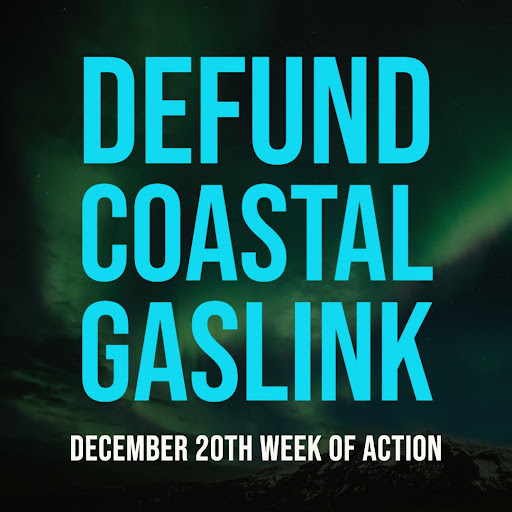
International Week of Action to Defund Coastal GasLink

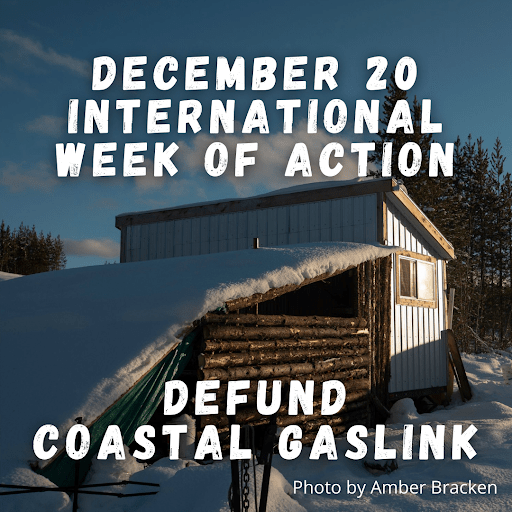
Toolkit: 20 December Week of Action to #DefundCoastalGasLink.
This toolkit is for grassroots activists wishing to take part in the week of action the week of December 20st against Coastal Gaslink’s partners.
https://docs.google.com/document/d/1Q7GBPhpkCBn5f4_X-oxUpDHNnkZsqXsg01eaaM-KLMU/edit

There will be a gathering in solidarity with the Wet’suwet’en peoples this Wednesday, December 22, at 4:00 PM. at the Chase Bank, 3621 Merle Hay Rd, Des Moines, IA 50310.

Chase is one of the major institutions funding fossil fuel projects, including the Coastal GasLink pipeline being built on Wet’suwet’en lands. Pressuring financial institutions to divest funds from fossil fuel projects has been a tactic for many years. Gatherings like this can encourage the bank to consider divesting from fossil fuel projects. They can also provide a public way for individuals to divest their funds from these banks.

https://landbackfriends.com/2021/12/19/wetsuweten-solidarity-in-iowa/

Wet’suwet’en hereditary Chief Woos is taking the fight against Coastal GasLink abroad, calling on international shareholders to divest from the multibillion-dollar gas pipeline.

On Friday, Chief Woos spoke at an annual shareholder meeting of the National Australia Bank (NAB). Last year, NAB pumped $117 million into the company to help it build the pipeline as part of a $6.4-billion loan to Coastal GasLink backed by 27 banks.

“As shareholders of National Australia Bank, you should know that your company is not upholding its own commitments to respect Indigenous and human rights,” he said.

“How do you reconcile your company’s supposed commitments to (the United Nations Declaration on the Rights of Indigenous Peoples, or UNDRIP) while financing a project that is illegal and committing human rights violations and perpetuating the oppression of Indigenous people for the purpose of colonial extractivism?”

On Sunday, the Gidimt’en Checkpoint said it evicted Coastal GasLink workers from the drill site and had reoccupied Coyote Camp. Coyote Camp is where several land defenders and journalists were arrested a month ago during an RCMP raid.

Gidimt’en Checkpoint spokesperson Sleydo’ also spoke at the shareholder’s meeting, describing her recent arrest by the RCMP at gunpoint and being restricted from returning to her territory. The project is contributing to the genocide of her people, she told the shareholders, and asked if the NAB was willing to take accountability for that.

Wet’suwet’en hereditary chief takes fight against Coastal GasLink all the way to the banks
By John Woodside, National Observer, December 20th 2021

Banks and private equity companies are pouring billions on a massive fracked gas pipeline to cross Wet’suwet’en territory: Coastal GasLink. 

Indigenous Hereditary chiefs and supporters have responsibilities to defend the sacred, pristine headwaters of the Wedzin Kwa, in Wet’suwet’en law. They hold uninterrupted title to the land, in colonial law. For peacefully acting in accordance with the law and defending our shared future, land defenders, allies and journalists were removed at gunpoint. 

Banks and investors bankroll the violence it will take to complete and operate Coastal GasLink. It’s time to tell them that no investment is worth damaging the lands and waters of Wet’suwet’en Yintah and the climate all of us share.

Twitter

Follow:  @gidimten, @likhtsamisyu,

Twitter: Week of Action 

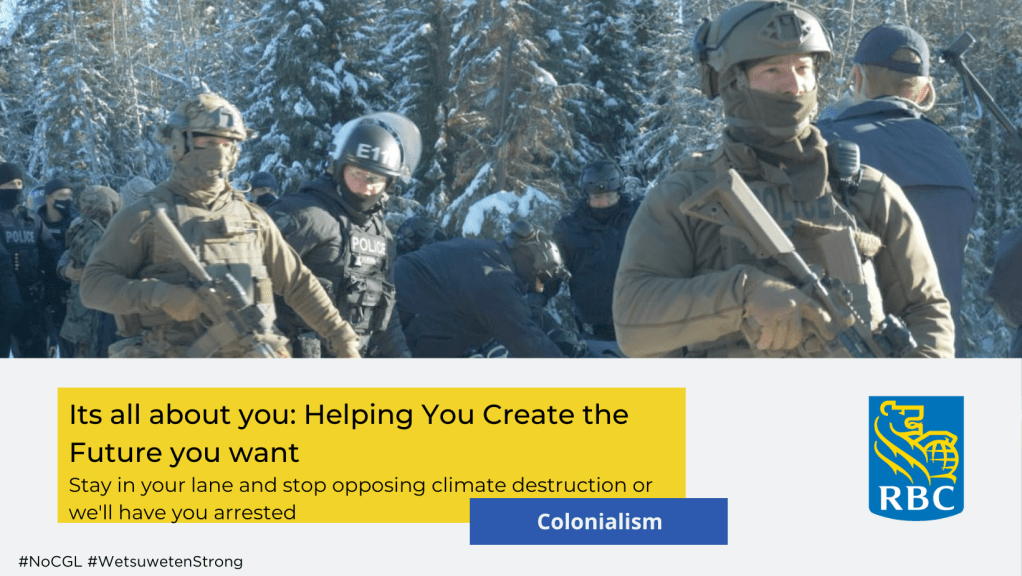
  • .@RBC is funding climate destruction and Indigenous rights violations by bankrolling Coastal GasLink.
  • .@kkr_co is refusing to meet with Wet’suwet’en hereditary chiefs while funding Coastal GasLink on their territory.
  • If we stop the flow of money, we can stop the flow of fracked gas. Let’s organize on the week of December 20 to support frontline Indigenous leaders about the impacts of Coastal GasLink @RBC, @KKR_Co, and @chase needs to drop ➡️ https://bit.ly/Dec20toolkit 
  • Join us the week of December 20 to call on @RBC, @Chase, @kkr_co, and other global finance giants to drop toxic fossil fuels including Coastal GasLink. Learn more and register your action

Hashtags: #DefundCoastalGasLink #DivestCGL, #WetsuwetenStrong #AllOutForWedzinKwa

Yesterday the Gidimt’en Checkpoint said it evicted Coastal GasLink workers from the drill site and had reoccupied Coyote Camp.

Gidimt’en Checkpoint

12/19/2021  · BREAKING –
Gidimt’en Clan Evicts Coastal Gaslink from Drill Site; Re-Occupies Coyote Camp

Early Sunday, Gidimt’en land defenders evicted Coastal Gaslink workers and re-established control of Coyote Camp, the site where Coastal Gaslink plans to drill beneath Wet’suwet’en headwaters.
This courageous action took place one month after a wave of militarized raids on Gidimt’en land, where police with assault weapons, dogs, and sniper rifles arrested 30 people, including land defenders, journalists, and legal observers.
Wet’suwet’en people have never surrendered this land, and we never will. Our lands are not for sale, and the safety of our waters is non-negotiable.
In early 2020, Hereditary Chiefs from all five clans of our nation stood together and issued an eviction to CGL. That eviction remains in force today.
We are calling for supporters to join us on the ground, or take action where you stand.
Take Action:
🔥 Host a solidarity rally or action in your area.
🔥 Issue a solidarity statement from your organization or group. Email to: yintahaccess@gmail.com
🔥 Pressure the government, banks, and investors. http://yintahaccess.com/take-action-1
🔥 Donate. http://go.rallyup.com/wetsuwetenstrong
🔥 Come to Camp. yintahaccess.com/
🔥 Spread the word.
#ShutDownCanada
#AllOutForWedzinKwa
#WetsuwetenStrong
#ExpectUs
More information and developing stories:
Website: Yintahaccess.com
IG: @yintah_access
Twitter: @Gidimten
Facebook: @wetsuwetenstrong
Youtube: Gidimten Access Point
TikTok: GidimtenCheckpoint
Wet’suwet’en solidarity in Iowa

There will be a gathering in solidarity with the Wet’suwet’en peoples this Wednesday, December 22, at 4:00 PM. at the Chase Bank, 3621 Merle Hay Rd, Des Moines, IA 50310.

Chase is one of the major institutions funding fossil fuel projects, including the Coastal GasLink pipeline being built on Wet’suwet’en lands. Pressuring financial institutions to divest funds from fossil fuel projects has been a tactic for many years. Gatherings like this can encourage the bank to consider divesting from fossil fuel projects. They can also provide a public way for individuals to divest their funds from these banks.

Chase Bank, 3621 Merle Hay Rd, Des Moines

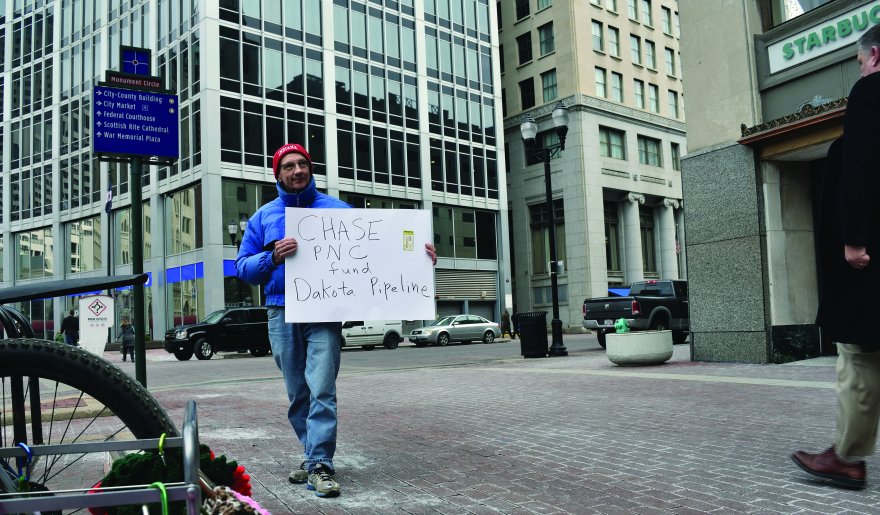
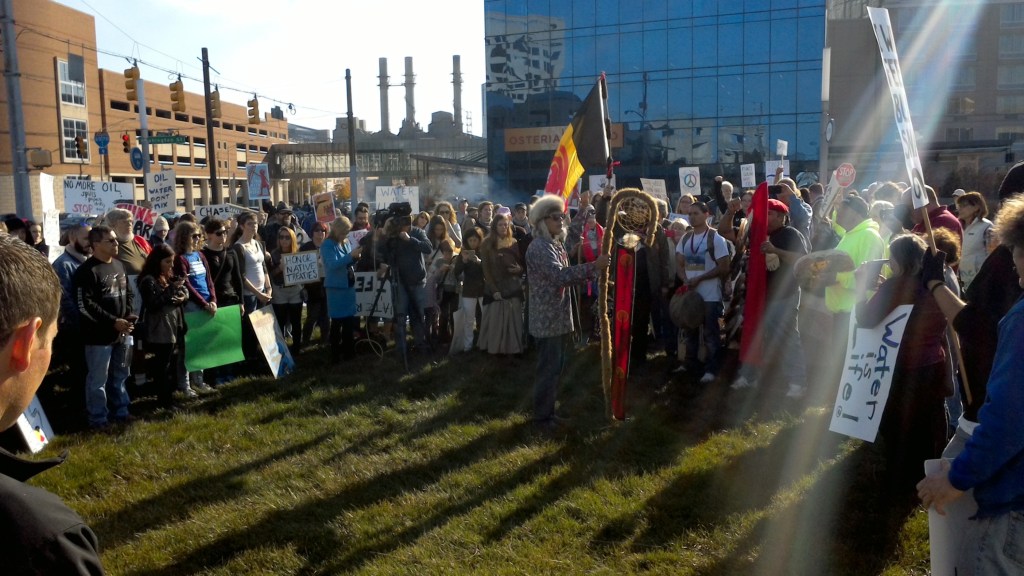
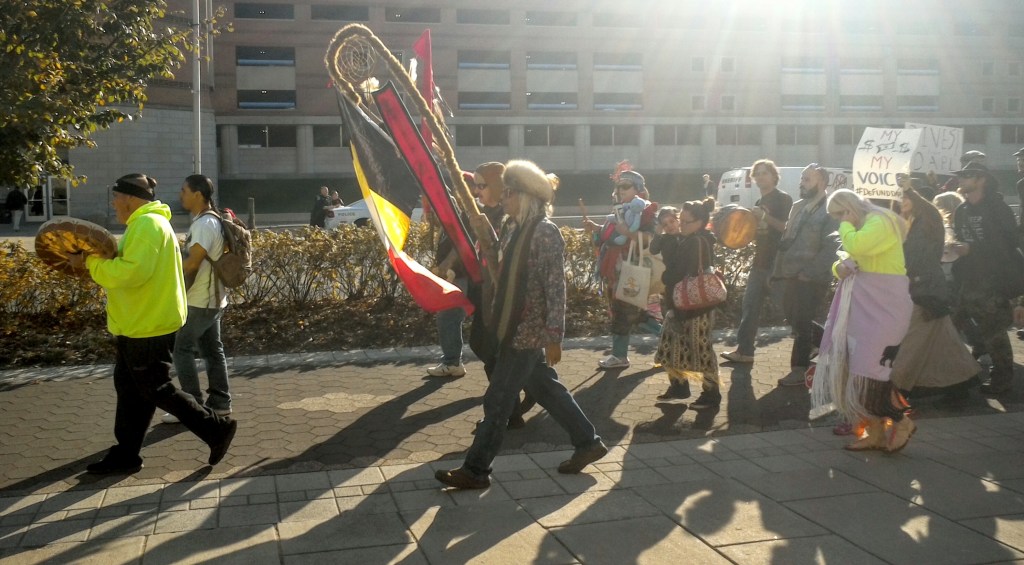
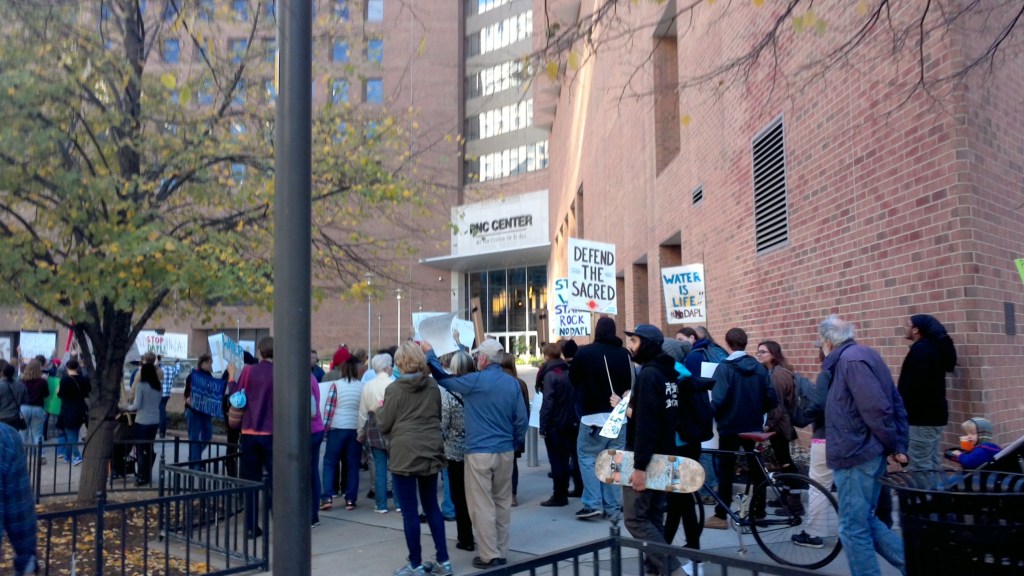
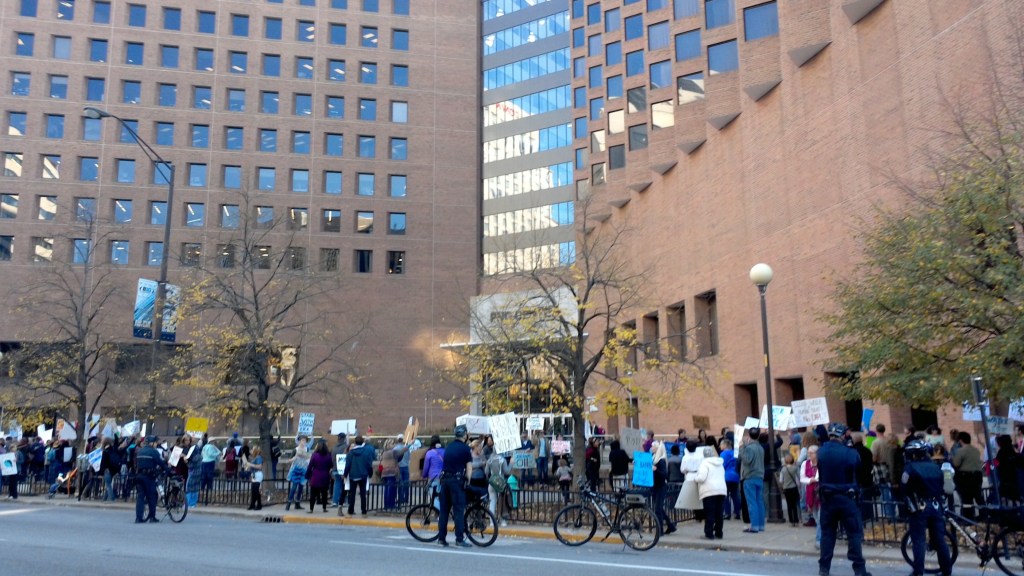
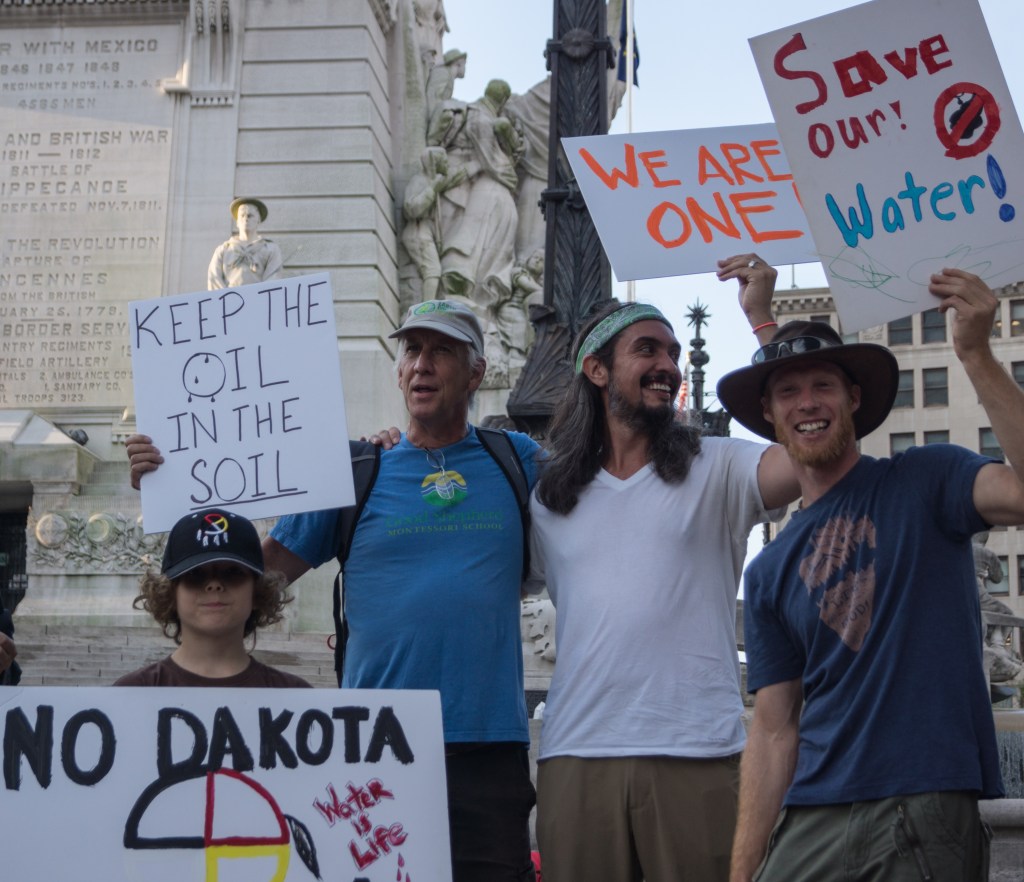
My first experience with divestment occurred in Indianapolis in 2016, where we targeted both Chase and PNC, who were funding the Dakota Access pipeline. Below are some photos from the day we went to those banks, where those who had accounts there closed them.

I had an account at Chase but had not set up an account at another bank, so I couldn’t withdraw my funds that day. The following is what happened when I was ready to close my Chase account.

My own experience in closing my Chase account

In Indianapolis we had been working on defunding the Dakota Access Pipeline (DAPL) for several months. On November 15, 2016, a crowd of about two hundred of us marched through downtown Indianapolis with our signs about defunding the pipeline. We stopped in front of two of the banks involved with funding the pipeline, Chase, and PNC. The crowd stood in silence as people went in to close their accounts. That day the group withdrew $110,000 dollars.


My own effort to close my account was more difficult than I thought it would be. 

First, I had trouble getting the forms from the University to change my paycheck to direct deposit at a different bank. It took time to set up paying bills. I also realized that I had initially chosen Chase bank because they had the most ATM locations. This was important because I don’t own a car. There can be inconveniences from defunding.

I went to the Circle in the center of downtown Indianapolis where the Chase Tower dominates the Indianapolis skyline. I spent about an hour walking around the Circle with my sign, looking to see if anyone else had shown up from my local group. It is a little nerve wracking to be walking around by yourself like that, but no one looks directly at you or engages you.

I was also hoping to get a photo of the sign in front of Chase bank (this was requested as part of the national campaign).  When I walked past Bridget, who sits on the Circle every day, crocheting, she asked me what the sign said, and we had a conversation about the importance of protecting our environment.   She graciously took several photos for me, including the one above.

I had finally worked up the courage to enter the Chase Bank Tower to close my account.  I had no idea what the reaction to entering with my sign would be. I just placed it next to my chair as I waited.  The bank officer greeted me with a smile and said someone would be with me shortly. He came back after about ten minutes to say he appreciated my patience—it was a busy time.

Mostly people coming into the bank ignored me, but there were a few glances in my direction. You can tell when you’re making people uncomfortable. I’ve had a lot of practice with that.

When I was shown into the banker’s office, she saw my sign, smiled, put her hands together, bowed to me, and said, “we are on the same page with this.” She put her finger to her lips with a smile indicating she shouldn’t be saying that. She was very pleasant and helpful. When I left, she took my hand in both of hers.

As I was walking past the lobby officer when I left, I reached out my hand, which he took in both of his hands, giving me a big smile and a little bow as well. I told him I appreciated his patience with my freedom of speech, and he smiled and said, “Of course.”

My little bit was added to the total amount of money divested so far: $72,944,005.39 dollars according to defunddapl.org.

I felt goodwill between me and those in the bank to such an extent that I returned later in the week to drop off copies of the blog article I had written describing how well they had treated me and the whole defunding process. When the banker I had dealt with previously glanced up, she gave me a big smile and waved me in. She got up and again took my hand in hers and asked what she could do for me. She told me she and her husband had talked about our visit and the pipeline.

During meeting for business in February at North Meadow Circle of Friends (Quaker), the meeting approved closing its Chase Bank account in solidarity with the #noDAPL movement.   

This is how our stories spread.

I know I sometimes repeat parts of stories like this from my past. I’ve heard we need to return to and retell our stories. Stories are important to affect change. Often in the retelling I learn something new from today’s perspective.

Keep Mason City’s Racist Mascot in the Past

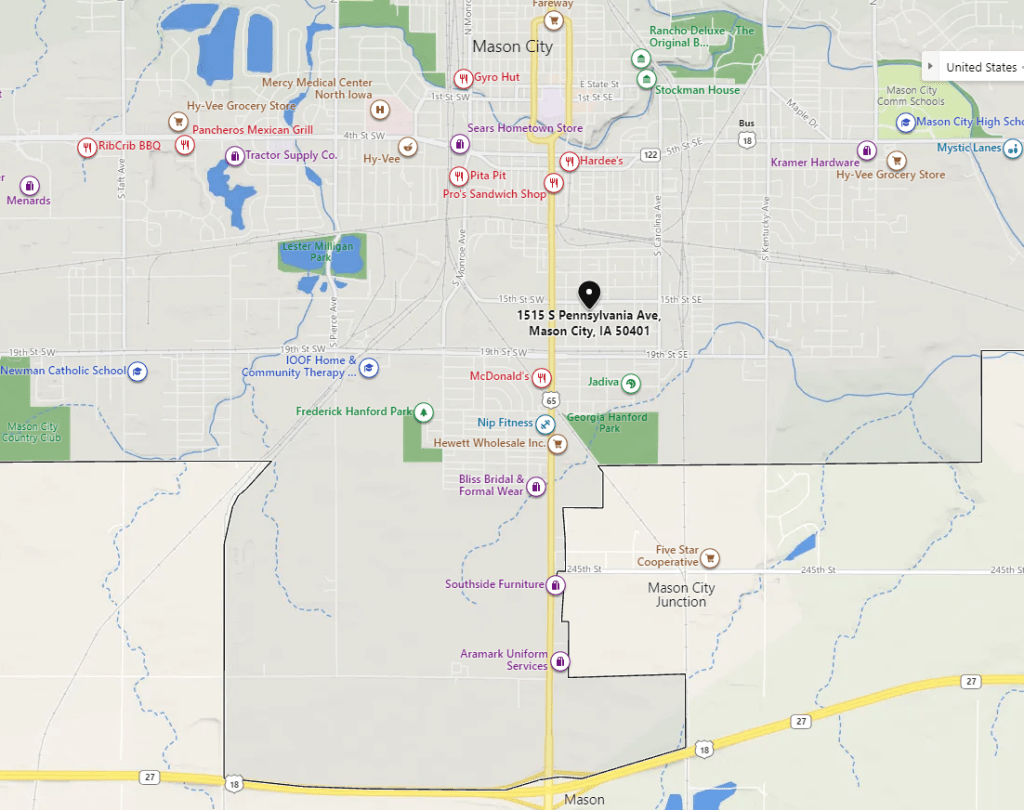
December 20 at 5:30 PM the Mason City Community School District will be meeting at 1515 South Pennsylvania Ave in Mason City (be there by 4:30). Map below.

May be an image of text
https://www.facebook.com/events/4637917899590338/?ti=ls

Monday, December 20, 2021, from 5:30 – 6:30 PM CST
Mason City Community School District Administration Building
1515 South Pennsylvania Avenue, Mason City, Iowa

Important Notes:
– Enter the building on the South side.
If you would like to speak then you must be signed up to speak before 5:30 PM.
– We are encouraging folks to show up by 4:30 PM to fill the room with positivity!
– Folks signed up to speak have 5 minutes allotted, but we encourage shorter testimonies so more may be heard.
– We are there only to make a case to the Mason City School Board that they must NOT reinstate the mascot. We DO NOT encourage any interaction with the “Save the Name” group outside or inside the meeting. We insist on non-violent language and behavior.

The Mason City Community School District realized, after 96 years, that they needed to retire the racist Mohawk mascot. They did so after the St. Regis Mohawk Tribe told them to stop and the Meskwaki Nation/ACLU and Great Plains Action Society have been very public about abolishing racist mascots in Iowa. However, a white-led group of agitators is trying to reverse this decision and their rhetoric is filled with vile, dehumanizing, racist, and transphobic behavior. They managed to present a petition to speak at the December 20th meeting and we would like Indigenous folks and allies to join us in making a strong stand against white supremacy and to set a precedent that racist mascots will no longer be tolerated in Iowa.

Keep Mason City’s Racist Mascot in the Past

This is follow up to previous events about Mason City schools, including an online forum December 12. See more here: Abolish Racist Mascots

Join us for an Indigenous-led forum discussing why mascots in Iowa are harmful and perpetuate white supremacy. Though Iowa has 27 racist “Indian” mascots still being used, we will spotlight the issue in Mason City where white supremacists have organized to protest the rightful retirement of the Mohawk mascot.

Following are graphics from the Great Plains Action Society

“The Des Moines Register identified 27 high schools with Indigenous-themed mascots from a list provided by the Iowa High School Athletic Association. That count does not include the Meskwaki Settlement School Warriors. The Sac and Fox Tribe’s list included elementary and middle schools as well”

https://www.desmoinesregister.com/story/sports/2021/11/30/mason-city-mohawks-name-removed-mascot-debate-continues-iowa-high-school-sports-indigenous-people/6394646001/

#greatplainsactionsociety
#NotYourMascot

Future of Fossil Fuels

“The Future of Fossil Fuels Hinges on Two Huge Midwestern Pipeline Fights” by PETER MONTAGUE, Common Dreams, December 9, 2021, caught my attention. It is essential to stop construction of so-called Carbon Capture and Storage (CCS) infrastructure that article is about.

But I think the extraction and use of fossil fuels will end prior to the construction of CCS because increasingly frequent and devastating environmental catastrophe will wipe out existing fossil fuel and other infrastructure. Just this year the “atmospheric river” in the northwest caused oil pipelines to be exposed and move up and down as water flowed around them.

The Trans-Alaska Pipeline, one of the world’s largest oil pipelines, could be in danger.

Thawing permafrost threatens to undermine the supports holding up an elevated section of the pipeline, jeopardizing its structural integrity and raising the potential of an oil spill in a delicate and remote landscape.

The slope of permafrost where an 810-foot section of the pipeline is secured has started to shift as it thaws, causing several of the braces holding up the pipeline to twist and bend.

This appears to be the first instance that pipeline supports have been damaged by “slope creep” caused by thawing permafrost, records and interviews with officials involved with managing the pipeline show.

Trouble in Alaska? Massive oil pipeline is threatened by thawing permafrost. The slope of permafrost where an 810-foot section of the pipeline is secured has started to shift as it thaws, causing braces holding up the pipeline to twist and bend. David Hasemery, Inside Climate News, July 11, 2021

The recent, horrendous tornadoes flattened everything in their path. Including water towers so there is no water. Including gas stations. Including power transmission infrastructure. Hospitals, pharmacies, news outlets, churches, schools, prisons, fire and police stations and equipment. Grocery and other stores, banks, car lots, manufacturing facilities. Local, state, and Federal offices, nonprofits, and systems they support such as Social Security and other social safety nets. Homes.

And renewables, including solar panels and wind turbines.

The center of fossil fuel refineries is New Orleans, below sea level, which will flood, wiping out that infrastructure. Transatlantic shipment of fossil fuels will likely end.

Sea level rise will have similar effects on millions who live on the coasts.

The question is what will we do now?

I’ve been working on this diagram that summarizes what I think needs to be done. We haven’t had the will to voluntarily move toward LandBack, abolition, participatory economy, conservation, and Mutual Aid. In the face of all that is collapsing, these are the solutions we need to build on now. This is what I’ve been writing about on LANDBACK Friends. https://landbackfriends.com/

#LANDBACK

International Human Crime

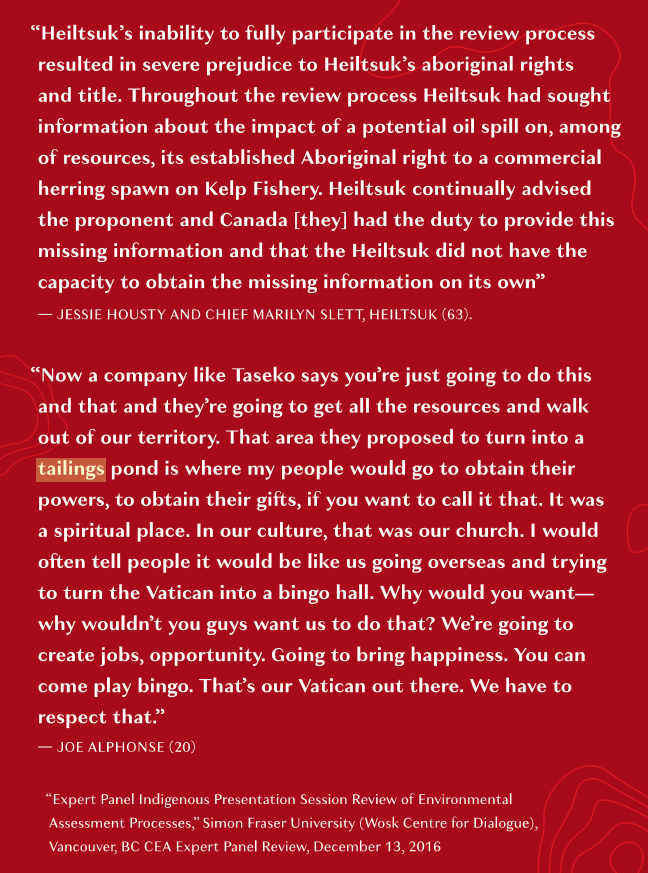
The hundreds of square miles of forests in Canada ripped up for the extraction of tar sands is unbearable to see. Those images have been kept out of the mainstream media. As disturbing are the huge tailings ponds that hold the huge volumes of waste water contaminated during the extraction.

How to deal with that water is a problem that has been continually postponed. But now there are discussions about draining those lakes. Of course, the fossil fuel companies are saying they can clean the water, not to the level of drinking water, but “safe” enough for discharge into the Athabasca River.

Indigenous communities near these tailings ponds have long seen dramatically increased levels of cancer.

NAFTA Commission Probes Toxic Leaks from Tar Sands/Oil Sands Tailings Ponds
https://www.theenergymix.com/2021/12/08/indigenous-communities-face-international-human-crime-as-ottawa-considers-tailings-pond-releases/

Some Indigenous communities in northern Alberta say they’re being handed a choice between terrible options as the federal government develops regulations to allow treated tailings from tar sands/oil sands operations to be released into the environment. One advocate is calling the prospect of tailings releases into the Athabasca River an “international human crime”.

It takes three to four barrels of water to produce one barrel of bitumen, CBC News reports. And under current rules, “companies must store any water used to extract oil during the mining process because it becomes toxic. The massive above-ground lakes are known as tailings ponds, which are harmful to wildlife and have resulted in the death of birds that land on the water, on multiple occasions.”

Indigenous groups in the northern part of the province have been concerned for years that tailings ponds could further pollute their land and drinking water, the news report adds. But with tar sands/oil sands production continuing, fossils intent on increasing their output, and the volume of toxic tailings now standing at about 1.4 trillion litres—the equivalent of 560,000 Olympic swimming pools stretching from Edmonton to Melbourne, Australia—the fossil industry and some scientists say the water “can be treated enough so it can be safely discharged”.

“First Nations and Métis Nations have complained for years how the oilsands, as well as other industries, have caused water volumes and quality to drop, which they say has caused fish populations to decrease sharply over the years and some species to disappear,” the national broadcaster writes. “Research has found elevated cancer rates in Fort Chipewyan, a community located north of Fort McMurray on the western tip of Lake Athabasca, and high levels of heavy metals, such as mercury, and arsenic in animals that are hunted and consumed in the region.”

That reality has fossils, regulators, and researchers worried about the risk of accidental release, with a dam failure or natural disaster triggering a torrent of toxic water. One such dam disaster in Brazil killed 270 people, CBC says. As they continue extracting bitumen, Alberta fossils are required to keep building tailings dams to hold the waste water in perpetuity, and “this scenario is not tolerable,” said Calgary-based water resources engineer Les Sawatzky.

Indigenous Communities Face ‘International Human Crime’ as Ottawa Considers Tailings Pond Releases, The Energy Mix, December 8, 2021

…That’s the sort of conundrum facing Albertans right now when it comes to the massive tailings ponds created by the province’s oilsands companies. Those ponds contain approximately 1.4 trillion litres of water, the equivalent of more than 560,000 Olympic-sized swimming pools, and it’s about to come rushing down the Athabasca River — one way or another.

According to a recent report, the federal government is in the process of developing regulations to allow oil producers to treat and release the water in those ponds, which contain toxic chemicals like mercury, ammonia and naphthenic acids. It’s not like the oil and gas companies that built and filled those ponds have just discovered a new way to make that water safe for the people living downstream. But the longer they’re allowed to collect and grow, the bigger the danger gets of an unplanned release — one that could be caused, ironically, by a climate change-aided weather event like the torrential rains B.C. just experienced.

For an industry that loves to talk about how comparatively “ethical” its operations are, this is a very bad look. After all, the small Indigenous communities downstream from Alberta’s oilsands operations have raised the alarm for years now about the environmental impacts they’re seeing, which range from dwindling fish and wildlife populations to elevated levels of certain cancers. As Bori Arrobo, Fort McKay’s director of sustainability, told CBC, “We don’t want to swap one environmental liability, which is the tailings ponds at the moment, for another, which could be the deterioration of the quality of the water in the Athabasca River and the downstream.”

Feds must protect Albertans from tailing ponds pollution By Max Fawcett, National Observer, December 9th 2021

https://redpaper.yellowheadinstitute.org/

Battle of the Indianola “Indians”

First a reminder about today’s Indigenous-led forum discussing why mascots in Iowa are harmful and perpetuate white supremacy. Though Iowa has 27 racist “Indian” mascots still being used, they will spotlight the issue in Mason City where white supremacists have organized to protest the rightful retirement of the Mohawk mascot.
https://landbackfriends.com/2021/12/11/abolish-racist-mascots/

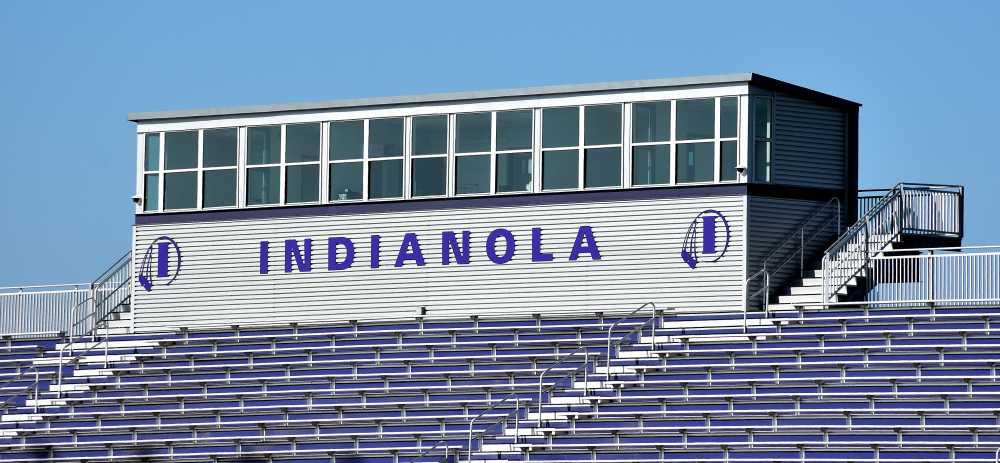
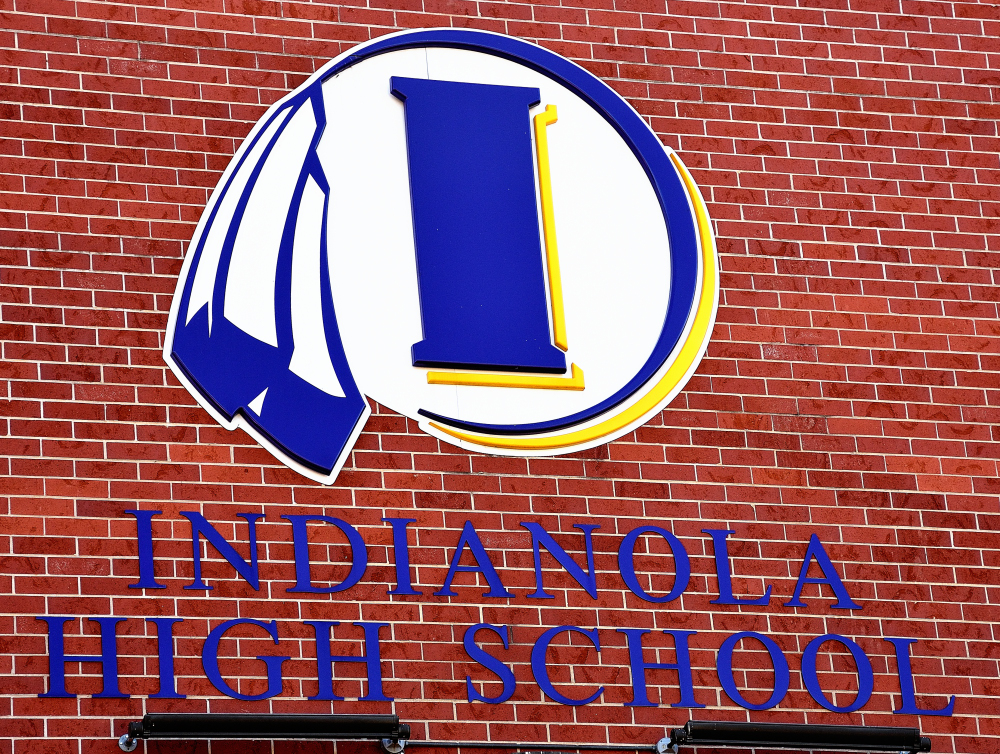
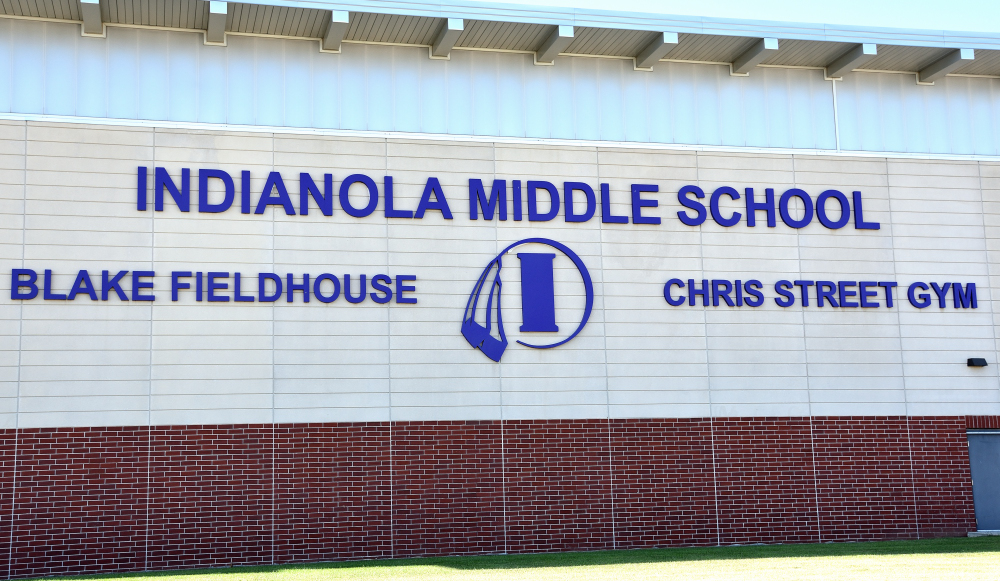
My Mutual Aid mentor and friend Ronnie James has been working on the use of the team name of The Indianola Indians and the usage of Native imagery on school property and apparel. Knowing I live in Indianola, Ronnie asked me to take some photos related to this which I was glad to do. He wrote an excellent article about the Indianola school board meeting he attended in August published by the Great Plains Action Society that he is part of.

After initial discussion among the board, they voted on tabling the issue until after their Nov. 2021 election, where it will be brought back with the intention of an extensive process of public debate. During public comments, there was just one person who argued in favor of the name and imagery by claiming he spent a lot of time asking Natives in Oklahoma their opinion. Another commenter stated they needed more “facts”, while another said something similar but referred to Native “traits” as something they want all students to aspire to, but mentioned Natives in the past tense repeatedly.

When representatives of Great Plains Action Society were afforded time to speak, we brought a large packet of peer reviewed academic research demonstrating the harm that Indigenous mascots and imagery has on Native youth, which we left with the board. We also addressed the board’s intention to table the item. We reminded them that putting this issue aside so as not to harm their chances at reelection and playing politics with it is an act of white supremacy as these actions put their comfort first at the expense of the peoples that it actually affects.

We also offered to begin dialogues with local and national Native orgs and individuals that were not trying to sell them something. In response to one of the board’s reasons to table the item, they claimed that Covid was their highest priority. The room was crammed with 20 or more people (with less than 5% wearing masks) and their school system has no mask mandate. If they were tackling this issue in good faith while getting the school back into pre-Covid shape, then now is a perfect time to act on changing the team name so that when/if we return to normal, the school can start on a good footing working to end white supremacy.

Great Plains Action Society believes some of the school board is acting in good faith, but that they still do not view the name and imagery change as a priority. Based on social media comments, the town itself has a split of those extremely hostile to change and those that support it. We will continue to work with the Board of Education and our relatives that live in the town to keep this in the forefront and finally change the team name.

The Battle of the Indianola Indians
Ronnie James

Debate over the use of Native American-related mascots spans nationwide, with leaders of athletic programs from youth to professional sports grappling over their logos and team names. The Washington Football Team and the Cleveland Guardians, two professional teams that attracted national attention for their use of Indigenous-related mascots, decided in the past two years to remove Native American-related imagery and language from their branding.

Also this fall, the Sac and Fox Tribe of the Mississippi in Iowa — or the Meskwaki Nation — in late October called on 66 Iowa schools to retire their mascots.

Mason City schools’ removal of ‘Mohawks’ leaves 27 Iowa high schools with Indigenous-themed mascots by Alyssa Hertel, Des Moines Register, Oct 30, 2021

A Special Message and Invitation on School Mascots

Greetings Iowa school leaders, school board members, and community members:
We, the undersigned Tribal Nations and local and national Native organizations, call upon you – the 66 K-12 schools in the state of Iowa with Native “themed” school mascots – to retire your mascots.

Meskwaki Nation
Sac & Fox Tribe of the Mississippi in Iowa

https://www.kcci.com/article/indianola-iowa-to-hear-opinions-on-school-mascot/37372273

https://www.kcci.com/article/indianola-school-board-tables-mascot-discussion-turns-focus-to-covid-19/37378481

12/12/2021 at 5:00 pm Central

Watch on YouTube at
https://www.youtube.com/watch?v=-mJic8TyeCs
Watch on GPAS’s FB Page at
https://www.facebook.com/GreatPlainsActionSociety/posts/3027458207541906

Photos I took of the imagery of Indianola schools.

#greatplainsactionsociety #NotYourMascot

Abolish Racist Mascots

The use of Native symbols and names has come to attention as pressure has come to change such names and symbols of national sports teams for example. Tomorrow’s discussion will be about the use of Mohawk in Mason City, Iowa.

The Mason City Community School District reached out to the Saint Regis Mohawk Tribe and asked if the tribe would be open to a partnership and allow the use of imagery and name. The tribe said no and asked for the end of the usage of the “Mohawk” mascot and nickname. (Info from the Globe Gazette).

Last month, the Mason City School Board decided to end the use of the name “Mohawks,” at athletic events and on merchandise. Over the long term building signs and school décor will also be scrubbed of the name, as the district assesses costs related to rebranding.

Shortly after the decision was made, Mason City resident Tom Stalker created the “Mason City Mohawk Save the Name” Facebook page. The group has shared their frustrations about the decision and was given time to speak at Monday night’s meeting.

Mason City school board will revisit Mohawk nickname at Dec. 20 meeting by Abby Koch Dec 6, 2021 Updated Dec 7, 2021

There is an excellent opportunity to learn more about this tomorrow, 12/12/2021 at 5:00 pm Central time, when my friends of the Great Plains Action Society (GPAS) host a discussion of why these mascots are harmful and perpetuate white supremacy.


12/12/2021 at 5:00 pm Central

Watch on YouTube at
https://www.youtube.com/watch?v=-mJic8TyeCs
Watch on GPAS’s FB Page at
https://www.facebook.com/GreatPlainsActionSociety/posts/3027458207541906

Join us for an Indigenous-led forum discussing why mascots in Iowa are harmful and perpetuate white supremacy. Though Iowa has 27 racist “Indian” mascots still being used, we will spotlight the issue in Mason City where white supremacists have organized to protest the rightful retirement of the Mohawk mascot. We will be joined by:

  • – John Kane, Kahnawake Mohawk, Let’s Talk Native With John Kane Radio Show
  • – Rev. Le Anne Clausen de Montes, Mason City resident and the Cofounder of the Iowa Change the Name Coalition
  • – Salvi Montes-Clausen, Latino/Nahuatl and Youth Cofounder of the Iowa Change the Name Coalition
  • – Edouardo Zendejas, Omaha Tribe of NE and author of Mascots That Honor Indians
  • – Keely Driscoll, Meskwaki Nation and Youth Organizer with Great Plains Action Society
  • – Trisha Etringer, Winnebago Tribe of NE and Operations Director with Great Plains Action Society
  • – Jessica Engelking, Anishinaabe and Education Director with Great Plains Action Society
  • – Alexandrea Walker, Winnebago Tribe of NE and Youth Organizer with Great Plains Action Society
  • -Sikowis Nobiss, George Gordon First Nation and Executive Director of Great Plains Action Society
Following are graphics from the Great Plains Action Society

“The Des Moines Register identified 27 high schools with Indigenous-themed mascots from a list provided by the Iowa High School Athletic Association. That count does not include the Meskwaki Settlement School Warriors. The Sac and Fox Tribe’s list included elementary and middle schools as well”

https://www.desmoinesregister.com/story/sports/2021/11/30/mason-city-mohawks-name-removed-mascot-debate-continues-iowa-high-school-sports-indigenous-people/6394646001/

#greatplainsactionsociety #NotYourMascot

Call on RBC to stop funding Coastal GasLink pipeline

Divestment from banks that fund fossil fuel projects has long been an effective way to bring attention to the financial institutions involved in such projects. https://jeffkisling.com/?s=divest

I’ve (@ran activist @jakislin) been involved in numerous divestment campaigns.

As one example, in 2015 I was involved with a divestment campaign by the Rainforest Action Network (RAN) to stop fossil fuel funding by Morgan Stanley. https://jeffkisling.com/2015/11/30/morgan-stanley-stops-financing-coal/

As a result, Morgan Stanley shareholders decided to cut coal financing.

Morgan Stanley and Wells Fargo Cut Coal Financing, Join Growing Movement by Banks in U.S. and Europe

Following is a toolkit from the Wet’suwet’en peoples who are asking us to pressure the RBC and other financial institutions to withdraw funds from the Coastal GasLink pipeline project.

If investors are serious about their commitments to social responsibility and racial justice, they must commit to not financing projects that threaten Wet’suwet’en sovereignty, violate our land and sacrifice our future. Molly Wickham

A difference today is an increasing trend of financial institutions withdrawing support from fossil fuel projects because such projects are increasingly seen as liabilities.

Following is a toolkit from the Wet’suwet’en to help people to apply similar pressure to RBC to stop such financing. These projects and banks have a global reach. Those who are not living in Canada are still affected and are encouraged to join these campaigns.

RBC TOOLKIT https://www.yintahaccess.com/news/rbc-toolkit
https://www.yintahaccess.com/news/rbc-toolkit
Yintah Access — December 9, 2021  

WET’SUWET’EN HEREDITARY CHIEF’S RESPONSE TO RBC LETTER – A TOOL KIT DECEMBER 2021

In this toolkit, you will find template emails, shareable graphics, quick links and template social media posts to amplify the response from Gidimt’en Checkpoint    

What’s happening:  On October 19th 2021 The Gidimt’en Checkpoint from the Wet’suwet’en Members issued a letter to over 35 Coastal GasLink (CGL) investors and banks in Australia, Canada, China, Germany, Japan, Malaysia, the Netherlands, Singapore, South Korea, and the United States. The letter demands investors and banks  — including JP Morgan Chase, Citibank, RBC, Scotiabank, BMO, Royal Dutch Shell, and CaixaBank  — cease and withdraw all support from Coastal GasLink and LNG Canada and highlights how financing the project violates Indigenous rights and breaks any investor commitments to racial justice, reconciliation, and social responsibility. 

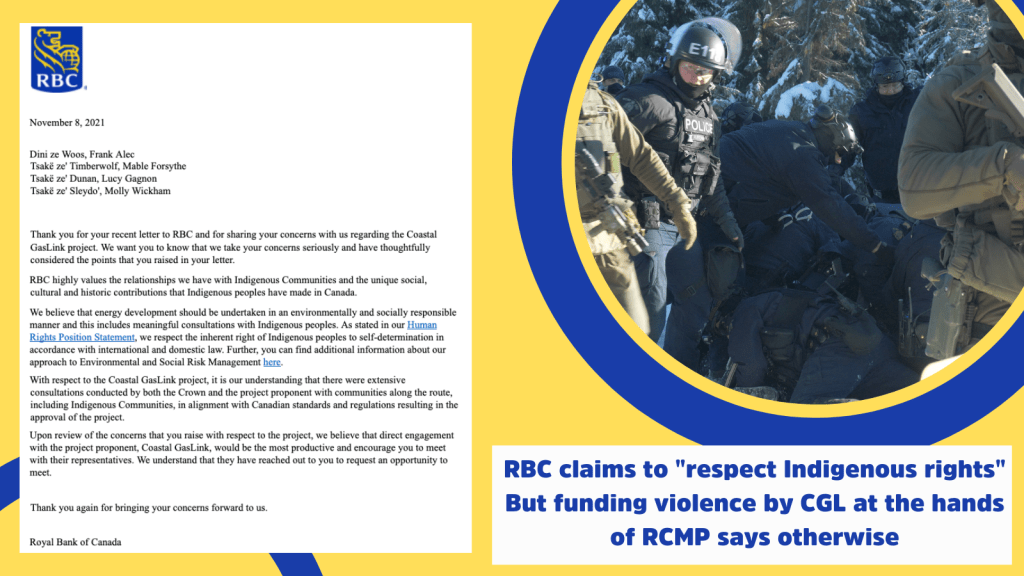
RBC sent this response letter on November 8th 2021 back to Gidimt’en Checkpoint leadership.

The email response was sent from a basic company email address and was unsigned by RBC leadership.  In their email response they claim “RBC highly values the relationships we have with Indigenous Communities and the unique social,  cultural and historic contributions that Indigenous peoples have made in Canada.”   We know this to be false and if they really valued these relationships they would not be funding a destructive project that violates Indigenous sovereignty and ravages sacred headwaters through Wet’suwet’en territory.

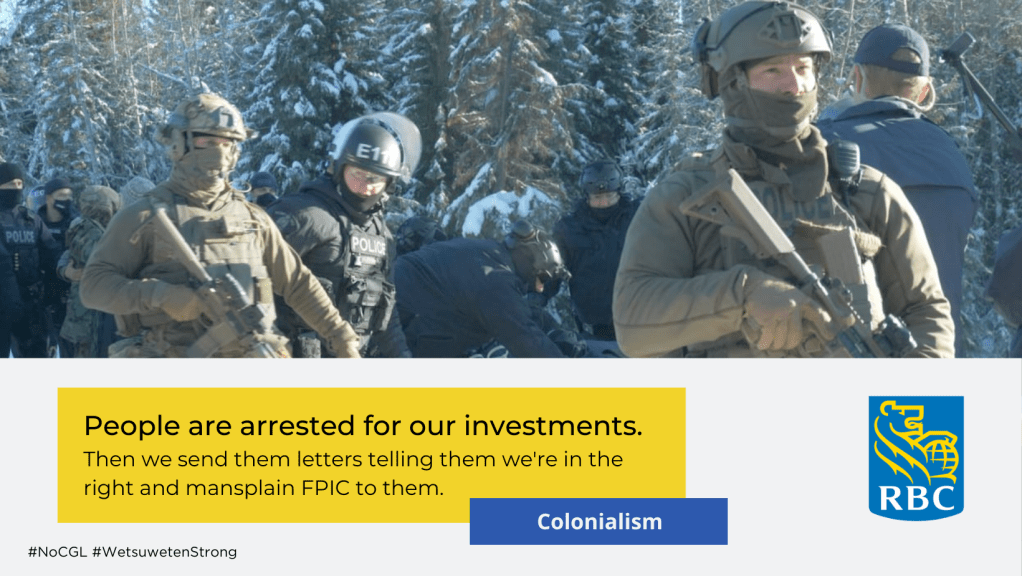
In their letter they also claim “As stated in our Human Rights Position Statement, we respect the inherent right of Indigenous peoples to self-determination in accordance with international and domestic law.” Recent violence perpetrated on land defenders at the hands of RCMP further demonstrates that RBC does not actually practice what they claim are core values.

Help us call out RBC for continuing to perpetuate colonial violence and oppression on Wet’suwet’en people, who have never ceded their right to exclusively use and occupy their territories, they are complicit in this violence by financing Coastal GasLink and TC Energy.

“Reconciliation isn’t financing a project that’s destroying our land, without our consent. Coastal GasLink has not engaged in respectful consultation with us. Backing this project implicates investors in perpetuating violence to our land and on my people,” says Molly Wickham, Gidimt’en, Wet’suwet’en Nation, Hereditary name Sleydo’. “If investors are serious about their commitments to social responsibility and racial justice, they must commit to not financing projects that threaten Wet’suwet’en sovereignty, violate our land and sacrifice our future. Otherwise, when companies talk of reconciliation, it’s just empty promises — and we’ve had more than enough of those already.”

The action that we are currently asking partners to take is amplifying the response letter and targeting RBC

In this toolkit, you will find template emails, shareable graphics, and template social media posts to amplify the response from Gidimt’en Checkpoint

Template Email for your Supporters

Please consider sending this email (or one like it) to your supporter base to help amplify the response letter OR a call to action.
_____________________________________________________________

Hello { {Name}}
RBC, the largest bank in Canada, is one of the biggest funders of the Coastal Gaslink project – a pipeline that would bring fracked gas to the coast for shipping overseas. For years now, the Wet’suwet’en hereditary chiefs have opposed the project, as the pipeline runs through their unceded land.

On October 19th 2021 The Gidimt’en Checkpoint from the Wet’suwet’en Nation issued a letter to over 35 Coastal GasLink (CGL) investors and banks in Australia, Canada, China, Germany, Japan, Malaysia, the Netherlands, Singapore, South Korea, and the United States. The letter demands investors and banks — including JP Morgan Chase, Citibank, RBC, Scotiabank, BMO, Royal Dutch Shell, and CaixaBank  — cease and withdraw all support from Coastal GasLink and LNG Canada and highlights how financing the project violates Indigenous rights and breaks any investor commitments to racial justice, reconciliation, and social responsibility. 

RBC sent this response letter on November 8th 2021 back to Gidimt’en Checkpoint leadership. The email response was sent from a basic company email address and was unsigned by RBC leadership. 
In their email response they claim “RBC highly values the relationships we have with Indigenous Communities and the unique social,  cultural and historic contributions that Indigenous peoples have made in Canada.”   We know this to be false and if they really valued these relationships they would not be funding a destructive project that violates Indigenous sovereignty and ravages sacred headwaters through Wet’suwet’en territory.
In their letter they also claim “As stated in our Human Rights Position Statement, we respect the inherent right of Indigenous peoples to self-determination in accordance with international and domestic law.” Recent violence perpetrated on land defenders at the hands of RCMP further demonstrates that RBC does not actually practice what they claim are core values. Help us call out RBC for continuing to perpetuate colonial violence and oppression on Wet’suwet’en people, who have never ceded their right to exclusively use and occupy their territories, they are complicit in this violence by financing Coastal GasLink and TC Energy.

RBC could stop this violation of Indigenous rights tomorrow, simply by pulling its funding for the Coastal GasLink project. Yet, the Bay Street bank continues to believe that a pipeline transporting fracked gas overseas is more important than averting the climate crisis and respecting Indigenous sovereignty. Over the past five years, RBC has invested $200 billion in fossil fuel projects. It’s the industry’s biggest banker in Canada… and the fifth largest in the world.

But despite its size, a movement is growing across the globe. More and more institutions are quickly realizing that fossil fuels are bad assets. Banks, insurance companies, foundations, universities, and private funds are shifting their money away from fossil fuels.

In order to stop the climate crisis, we need to stop the financing of fossil fuels.

Tell RBC to protect Indigenous rights and pull its money from the controversial Coastal GasLink LNG pipeline.

In Solidarity,    

#WetsuwetenStrong #LandBack #AllEyesOnWetsuweten #ShutDownCanada

Does this path have a good heart?

It is alarming but unsurprising to hear of yet another type of fossil fuel pipeline project.

Far too late, many people are finally being confronted with the consequences of decades of excess fossil fuel burning. And of course, they are clamoring for the problem to be taken care of immediately.

There are no quick fixes.

Carbon Capture and Storage (CCS) is being promoted as part of a solution to reduce atmospheric carbon dioxide (CO2) concentrations. My last blog post was an introduction to CSS.
https://landbackfriends.com/2021/12/04/carbon-capture-in-iowa/

Carbon capture involves several complex processes. The infographic Carbon Capture 101 below from the Department of Energy attempts to explain these processes.

There are many reasons to reject the idea of carbon capture and storage.

But how you look at CSS comes from what you believe about your relationship with Mother Earth. Carbon capture and storage is an attempt to placate us, so we won’t object to continued, wildly excessive fossil fuel burning. Despite the clear consequences of that, greenhouse gas emissions continue to climb!!

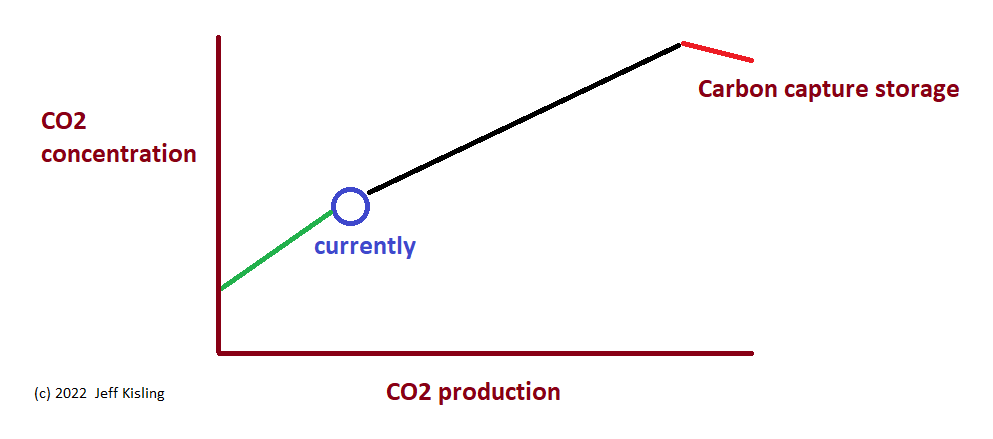
Instead of CCS, we need to drastically reduce greenhouse gas emissions (green line below).

May be an image of 1 person and text
https://www.facebook.com/NoCCSIowa/

Great Plains Action Society

December 4 at 1:48 PM Navigator Heartland Greenway is a Texas-owned company and Summit is an Iowa company owned by Bruce Rastetter, a shining example of the predatory white heteropatriarchy that steals, cheats, and perpetuates violence on the land and the people. CO2 Pipelines are not the answer at all to the climate crisis and are in, fact, just perpetuating the corrupt fossil fuel industry. Find out more at the Iowa Carbon Pipeline Resistance Coalition page.
Please like the page and share it out.
#stopsummit
#stoprastetter
#stopnavigator
#noco2pipelines
#noccs

Carbon capture in Iowa

There is an ancient Lakota prophecy about a black snake that would slither across the land, desecrating the sacred sites and poisoning the water before destroying the Earth.

The following Includes remarks by my friends Sikowis Nobiss (Great Plains Action Society), Lee Tesdell, Ed Fallon (Bold Iowa).

Great Plains Action Society

December 2 at 4:16 PM 

Great Plains Action Society is firmly opposed to so-called carbon capture and sequestration or storage (CCS) projects such as the proposed Summit Midwest Carbon Express. ⁣⁣

The reasons for our opposition are numerous, however, our greatest concern is that CCS only serves the interests of the fossil fuel industry. Carbon capture and sequestration is by design a way to prolong the usage of fossil fuels while reducing CO2 emissions. Amidst this climate emergency we must demand a reduction and phasing out of fossil fuels as a wider part of a just transition. ⁣⁣

We are also concerned about intense water usage as drought and warmer temperatures are greatly affecting access to clean water. Fossil fuel companies have known that their products were contributing to climate change for over forty years and now they see CCS as a government bail out with many governmental subsidies providing just the type of perverse incentive for CCS operators to manipulate the system. ⁣⁣

Additionally, there are the same concerns present with other pipeline projects in the area regarding degradation of the land, disturbance of sacred ceremonial and burial sites. CCS is greenwashing rather than a solution to the climate emergency that Iowans deserve, as Indigenous people we remain committed to the water, the land and the future generations of Iowans.⁣⁣
#noco2pipelines
#stopsummit

Iowa Citizens for Community Improvement
No more public dollars for false carbon storage solutions
Target: Iowa Utilities Board

The background:

Summit Carbon Solutions (aka Bruce Rastetter – Iowa factory farm & ethanol baron) has now started the process for approval of a CO2 pipeline from Iowa to North Dakota, where the CO2 will be buried (or possibly used for fracking). This pipeline will impact at least 30 Iowa counties. Summit is likely to rely on eminent domain to secure the land easements needed to bury much of the pipeline.

Summit intends to obtain the CO2 from Iowa ethanol plants and other industrial polluters in Iowa, and then sell the ethanol to California and other states that have a low carbon fuel standard. The claim is that by sequestering the CO2 from the ethanol plants, the ethanol becomes low carbon fuel and in the process overall emissions are lowered (all while Rastetter and these industries siphon off a bunch of public money and investment that should go towards proven climate solutions).

In reality – Carbon Capture and Sequestration (CCS) is just the latest money making scheme to greenwash fossil fuel pollution and allow dirty industries to continue business as usual. This Top 5 list from our friends at Food & Water Watch is a great resource:

  1. Carbon Capture is an Expensive Failure
  2. Carbon Capture is Energy Intensive
  3. Carbon Capture Actually Increases Emissions
  4. Storage Presents Significant Risks
  5. Carbon Capture Trades Off with Other Critical Solutions (and delays a true clean energy future)

Not enough info you say? Even more reading on why CCS is a bad idea from F&WW here and from Greenpeace here.

Beyond the economics, corporate control, climate/environmental and land use issues is there a human cost or risk from this pipeline?

Glad you asked! A recent CO2 pipeline break in Mississippi led to mass poisoning of one community and is still under investigation:

Why now?

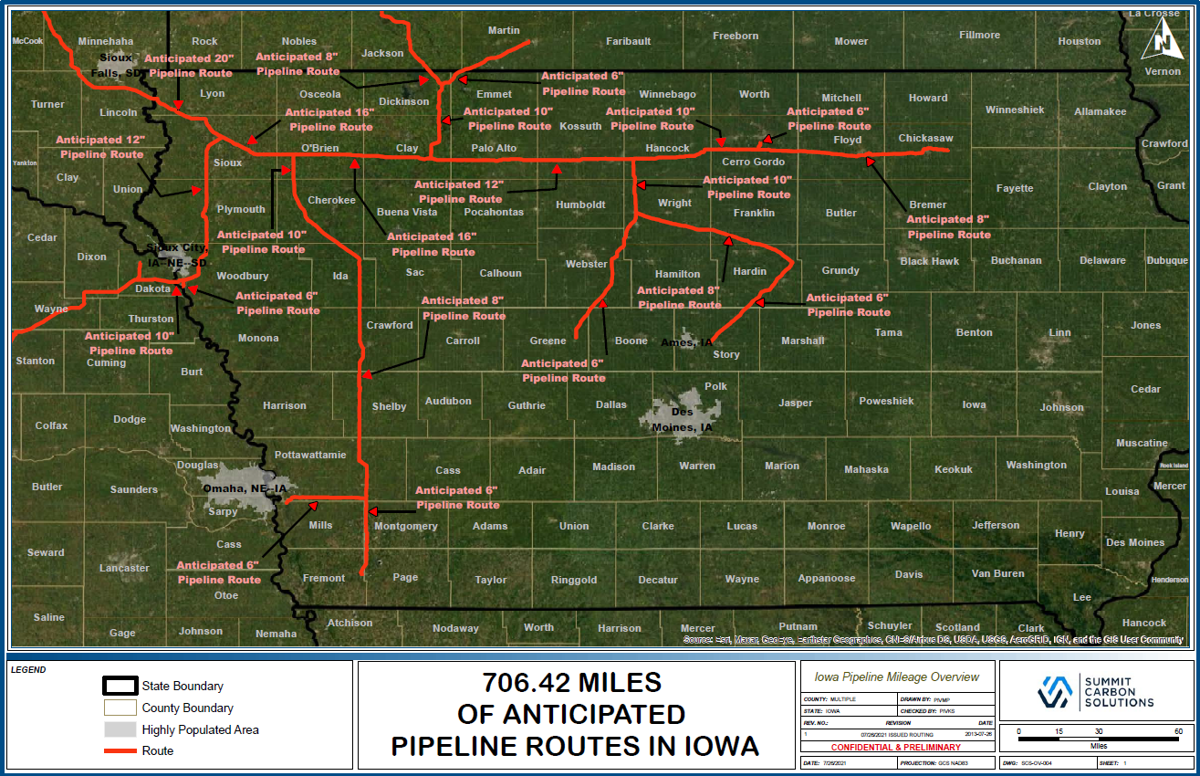
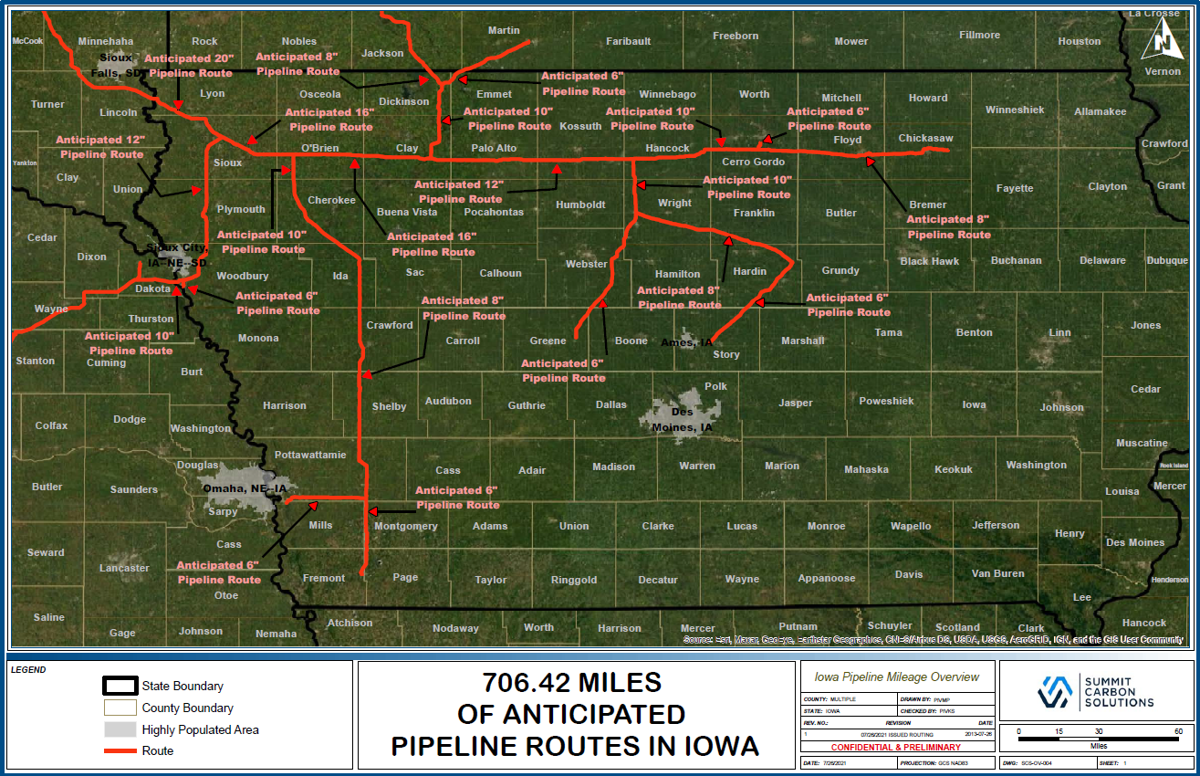
Rastetter and Summit Carbon Solutions filed paperwork for their pipeline permit with the Iowa Utilities Board a week ago. That means that over the coming month, they will be holding initial public meetings in all 30 counties impacted by the pipeline. This is the first step in the permitting process, and will be a barometer for the resistance or support this project will face. Check out the proposed pipeline path for yourself here.

Take Action:

CCS schemes only serve to prop up polluting industries and pad the profits of fossil fuel profiteers by siphoning off public money on expensive “technology” that doesn’t reduce carbon emissions. We call on Bruce Rastetter and Summit Carbon to drop their polluting pipeline plans. We call on the Iowa Utilities Board to deny Summit Carbon’s hazardous liquid pipeline permit application. And we call on Iowa’s elected officials and decision makers to take a stand against this pipeline and to invest in a 100% renewable future that benefits 100% of the people.

Iowa CCI Action
Des Moines, IA

To: Iowa Utilities Board
From: Jeff Kisling

Iowans have a right to clean air, water, and a habitable environment. To get there we need a just transition to a 100% carbon-free energy system. We want our public tax dollars invested into proven and cost-effective technologies needed to get there such as wind and solar. We demand that you reject unproven, costly, and dangerous projects like the Summit Carbon Solutions CO2 pipeline. Which would ultimately prop up fossil fuel extraction and destructive industrial agriculture practices.

We have little time left for the mass mobilization of resources needed to transition to carbon-free energy and the conservation practices that are proven to reduce emissions and sequester carbon. We are calling on you to rule with the majority of Iowans rather than wealthy campaign contributors like Bruce Rastetter and reject the proposed Summit Carbon Solutions pipeline.

Critics of a proposed $4.5 billion pipeline project say Iowa Utilities Board members appointed by former Gov. Terry Branstad have a conflict of interest and should recuse themselves from decisions about the project, which has hired Branstad as an adviser.

Summit Carbon Solutions wants to build a pipeline, called the Midwest Carbon Express, across 30 counties in Iowa to capture carbon emissions from ethanol and other industrial agriculture plants, compress it into a liquid and transport it to North Dakota for permanent sequestration a mile underground.

At a Sept. 13 meeting in Ames, Lee Tesdell, a central Iowa farmland owner, asked whether any of the Iowa Utilities Board members were appointed by Branstad and whether they would recuse themselves from making a decision about whether Summit should receive a permit to build nearly 710 miles of pipeline across Iowa.

TesdelI, whose central Iowa farm is not in the pipeline’s pathway, said he believes board members Branstad appointed have a conflict of interest. “Either Branstad should resign from the Midwest Carbon Express team or they (board members) should recuse themselves,” he said.

Ed Fallon, a former state representative and vocal Dakota Access pipeline opponent, said he believes the Iowa Utilities Board members should recuse themselves. “Given their high-salary positions, they’re beholden to Branstad, and that gives the impression that they would be inclined to vote his way,” Fallon said.

Critics of $4.5 billion carbon capture pipeline say Branstad appointees have conflict, should recuse themselves by Donnelle Eller, Des Moines Register, Sept 20, 2021

No photo description available.

“I, Chief Arvol Looking Horse, of the Lakota, Dakota, and Nakota Nations, ask you to understand an Indigenous perspective on what has happened in America, what we call “Turtle Island.” My words seek to unite the global community through a message from our sacred ceremonies to unite spiritually, each in our own ways of beliefs in the Creator.”

“There needs to be a fast move toward other forms of energy that are safe for all nations upon Mother Earth. We need to understand the types of minds that are continuing to destroy the spirit of our whole global community. Unless we do this, the powers of destruction will overwhelm us.”

“To us, as caretakers of the heart of Mother Earth, falls the responsibility of turning back the powers of destruction. You yourself are the one who must decide.”

“You alone – and only you – can make this crucial choice, to walk in honor or to dishonor your relatives. On your decision depends the fate of the entire World.”

Important Message from Keeper of Sacred White Buffalo Calf Pipe. I, Chief Arvol Looking Horse ask you to understand an Indigenous perspective on what has happened in America, what we call “Turtle Island.” by CHIEF ARVOL LOOKING HORSE, Indian Country Today, Sept 7, 2017

#greatplainsactionsociety
#NoCarbonPipelines
#NoCO2Pipelines
#StopNavigator
#StopSummit
#HiFromNE
#HiFromIA
#NoCCU
#NoCCS