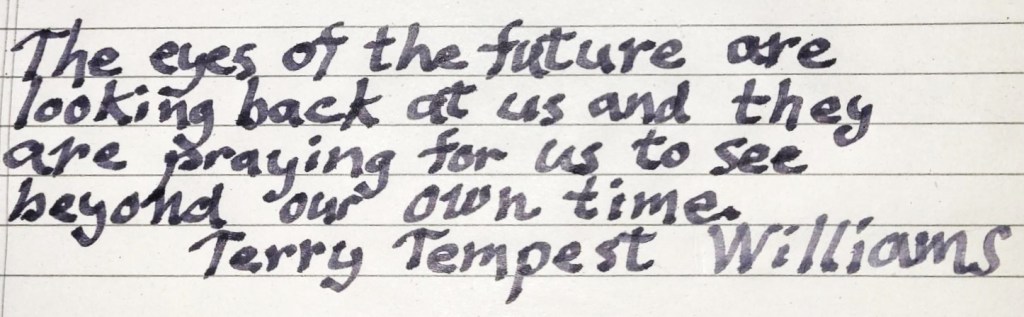
The eyes of the future are looking back at us


There is a native concept of considering what the effects of decisions made today will be on seven generations into the future.

The following quotation makes a two-way connection between us and future generations. Looking at each other over the generations.

The eyes of the future are looking back at us and they are praying for us to see beyond our own time. They are kneeling with hands clasped that we might act with restraint, that we might leave room for the life that is destined to come. To protect what is wild is to protect what is gentle. Perhaps the wilderness we fear is the pause between our own heartbeats, the silent space that says we live only by grace. Wilderness lives by this same grace. Wild mercy is in our hands.

― Terry Tempest Williams, Refuge: An Unnatural History of Family and Place

Similarly, can we not look back at our ancestors? We are our ancestors’ future generation looking back.

I think about this a lot these days. As stories of the remains of native children on the grounds of the institutions of forced assimilation continue. Thousands of children never returned home.

I’ve been praying about what we are doing now and how much harm this is doing to future generations. My Spirit recoils from the likelihood there probably will not be a seventh, or sixth, or fifth generation because of the accelerating rate of environmental collapse.

What have we done?

What will we do?
As we work for change, we are admonished that we need to tell new stories. This morning I found this story Nico Santos tells, from the movie Dragon Rider.

“Wings”

Oh, I’ve been lost in the darkness
I heard your voice from afar
You weren’t my callin’
Whenever the night was starless
And I couldn’t see anymore
You showed me the mornin’

So I-I-I wanna let you know
When life has got you low

I’ll be your wings to fly
When there’s trouble on your mind
Whenever you’re ’bout to fall
There’s nothin’ I won’t try
‘Cause I’ll be your wings to fly
When you’re sufferin’ inside
Come hell or high water
Got you covered all my life
Let these wings take you
High, high
There’s nothin’ I won’t try

We built our own kinda fortress
Nothing can break us apart
Walls won’t be fallin’
These walls won’t be fallin’
I wouldn’t be if it wasn’t for you
I wouldn’t speak if it wasn’t the truth
You are my callin’
You are my callin’

So I-I-I wanna let you know
When life has got you low

I’ll be your wings to fly
When there’s trouble on your mind
Whenever you’re ’bout to fall
There’s nothin’ I won’t try
‘Cause I’ll be your wings to fly
When you’re sufferin’ inside
Come hell or high water
Got you covered all my life
Let these wings take you
High, high
There’s nothin’ I won’t try

You were my eyes, oh, when I couldn’t see
Were my voice, oh, when I couldn’t speak
Can I give it back to you?
Let me give it back to you
You were my legs, oh, when I couldn’t run
Were my heart when my own went numb
I’ll do what I have to do
Everything to get you through

I’ll be your wings to fly
When there’s trouble on your mind
Whenever you’re ’bout to fall
There’s nothin’ I won’t try
‘Cause I’ll be your wings to fly
When you’re sufferin’ inside
Come hell or high water
Got you covered all my life
Let these wings take you
High, high
There’s nothin’ I won’t try
Let these wings take you
High, high
There’s nothin’ I won’t try
Let these wings take you high

Nico Santos, WINGS from the movie Dragon Rider
The Tipping Point that will destroy the world

George Monbiot is known for his environmental and political activism. He writes a weekly column for The Guardian and is the author of a number of books. Popular culture is finally beginning to be alarmed by environmental devastation. The movie Don’t Look Up being a current example.

I’m not promoting the reference to Double Down News at the end of the video, but here is a link to that website. Double Down News, The Future of Journalism.

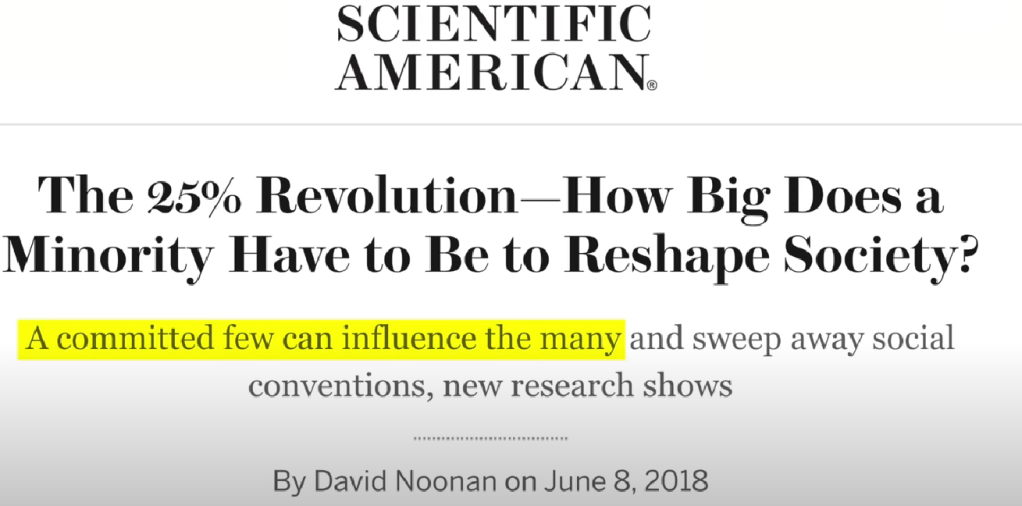
A new study about the power of committed minorities to shift conventional thinking offers some surprising possible answers. Published this week in Science, the paper describes an online experiment in which researchers sought to determine what percentage of total population a minority needs to reach the critical mass necessary to reverse a majority viewpoint. The tipping point, they found, is just 25 percent. At and slightly above that level, contrarians were able to “convert” anywhere from 72 to 100 percent of the population of their respective groups. Prior to the efforts of the minority, the population had been in 100 percent agreement about their original position.

The 25% Revolution – How big does a minority have to be to reshape society? by David Noonan, Scientific American, June 8, 2018

Many people have heard the following Margaret Mead quote. She was referring to a small percentage of people I think.

Never doubt that a small group of thoughtful, committed, citizens can change the world. Indeed, it is the only thing that ever has.

Margaret Mead

Auto-generated transcript of the video above, the tipping point that will destroy the world.

I doubt that 1% of people really understand what we’re facing here,
the prospect of systemic environmental collapse.
The collapse of the whole thing our life support systems in total.
Human beings alongside most of the life on earth today
evolved in particular environmental circumstances which is the earth
in what’s called its holocene state.
That state is kept in a sort of stable equilibrium by the ocean
the atmosphere, the biosphere which means all the life on earth,
the soil the water all of these are complex systems
which come together to create this amazingly complex system
called the earth system.
Complex systems have a set of interesting characteristics
through their self-regulating properties they can absorb
quite a lot of stress and still maintain an equilibrium state.
So if you think about your body you can run a mile
on a hot day really go for it and your body temperature remains
exactly the same as it was before you started.
You can go and have a snowball fight on a really cold day
and stay out for a couple of hours and your body temperature
is still exactly the same as when you started.
And what you’ve got is this system just constantly regulating itself,
and maintaining that body temperature.
But if you are subject to too much cold stress
or too much heat stress things spiral out of control.
And you can spiral into hypothermia
where you get colder and colder and then you die,
or into hyperthermia where you get hotter and hotter
and then you die.
We face quite a similar problem with our earth systems.
they reach a tipping point and once they pass that tipping point they collapse
into a completely different state and when you’ve collapsed when that tipping point has been crossed
there is no going back we’re trying to tell you that the entire planet is about to be destroyed
the way we know whether we are approaching a tipping point is that the outputs from a
system begin to flicker you get more and more fluctuations and what we’ve seen has been what
looks like a great global flickering these extreme weather events droughts heat domes
floods fires and the rest of it you do understand that this is an apocalyptic event i hear you
i hear you far more extreme than anything in the historical record and indeed anything in
the recent prehistorical record either this looks like the flickering which precedes
a tipping point we should be hostile to human life and indeed to most of the life on earth today
i say we sit tight and assess am i to understand correctly that after all of the information you’ve
received today the decision you’re making is to sit tight and assess if you were to take this
seriously you would be throwing at it everything we’ve got much as they did when a different
system the financial system came close to collapse in 2008. it didn’t quite pass its tipping point
but it came pretty close to that started with mortgage defaults in the u.s really quite small
but that was enough to destabilize this already quite fragile system and push the whole thing
until it came very near to total collapse when lehman brothers collapsed that nearly brought
the whole thing down and governments moved with extraordinary speed and decisiveness and poured
altogether trillions of dollars into the global financial system to try to shore it back and
push it back into its safe space into its safe equilibrium state now we can argue about whether
they did the right thing or the wrong thing and the way that they did it bailouts going
to the major criminals in the system and the rest of it we can argue about all that
but there is absolutely no doubt about the need for very rapid and decisive action if
we don’t stop the bleeding in three days half the banks in this room are out of business
in five days we’re all gone if we were to take the same attitude to the tipping point of our
earth systems that’s what we would be doing we’ll be moving in with extraordinary speed and effect
to make that decisive change right here right now rather than saying yeah let’s aim for net
zero by 2050 and we’ll reduce emissions by two percent every year it’s just not
going to work the president’s plan to save earth and make it so we can all have a home
is going to work right every single man woman and child on this planet is going to die i don’t like
him he makes me sad i’m sorry about that yeah kids listen to me you tell your parents if you’re going
to prevent a tipping point you have to push them back into their safe equilibrium state before they
reach that point if governments want things to happen they can make things happen if they choose
to but most of the time they just don’t what’s missing is not the money it’s not the technology
it’s the political will and how come they were ready to bail out the financial sector
but they’re not ready to bail out the planet is it because the planet isn’t paying them
to win the next election it’s not producing their campaign funds for them is it because
the oceans aren’t whispering into their ear is it because the forests don’t own the media
of course there’s only one story everyone’s talking about tonight
topless urgent care centers they are so hooked on the short-term interests of their corporate
sponsors or their oligarch sponsors that they’ll do whatever they want but they won’t do what it
takes to prevent the collapse of life on earth and i’m sure many of the people out there aren’t even
going to listen to what i just said because you know they have their own political ideology but
i i assure you i am not on one side or the other i i’m just telling you the [ __ ] truth now the
hopeful side of the story is this that just as earth systems are complex systems and they can tip
into a different state the same applies to human systems the same applies to society and we can
tip society into a different state and in fact there’s quite a lot of science being done on this
now both observational and experimental science once you get a committed minority of around 25
then the whole of society can tip most people most of the time side with the status quo for
good or for real very often for ill and once you reach that 25 that threshold
that seems to be where the tipping point is and then suddenly people look around and say oh things
have changed i better change with it and they tack round to catch that wind you’ve finally seen it
and that’s what we need to do that’s what we can do we just need to reach that 25
committed minority and society will change and so we need to get together in our millions
to demand the changes required to prevent systemic environmental collapse to demand
that we retain a habitable planet all effective movements are an ecosystem they
need lots of people using their different skills bringing those skills together
do what they do best the alternative media is absolutely essential it’s a crucial component
of that ecosystem of change so please support double down news become a sponsor on patreon

New Year 2022

I’m concerned to see little progress toward solutions for the myriad of problems we face. Especially with accelerating environmental chaos. We’re paralyzed in the face of so many complex problems. Disheartened because nothing makes progress.

I contend that is because, as Albert Einstein said, “we cannot solve our problems with the same thinking we used when we created them.”

I am proposing we implement new ways to approach our justice work. And will ask our peace and social concerns committee to explore how to change our work from a committee structure to a Mutual Aid group. I’m interested to see how faith can be part of Mutual Aid.

This year’s Peace and Social Concerns Committee Report from my Quaker yearly meeting is included below. And this is a link to An Epistle to Friends Regarding Community, Mutual Aid and LANDBACK.

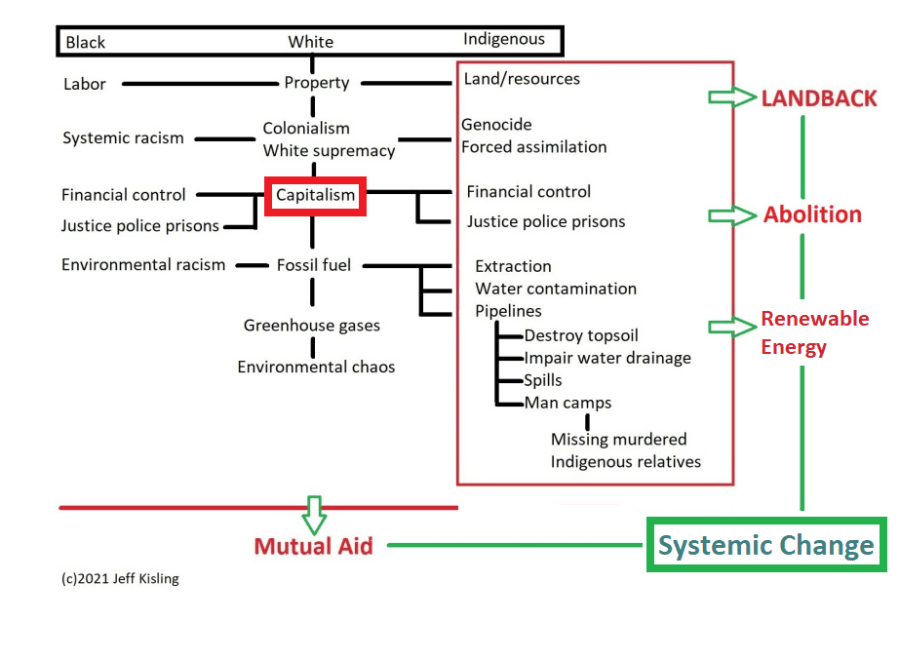
This diagram lists problems and solutions. LANDBACK, Abolition of police and prisons, Mutual Aid, resource conservation and spirituality. Adapted from the more detailed diagram at the end of this.


Peace and Social Concerns Committee Report 2021
Iowa Yearly Meeting (Conservative)

This has been a year of great upheaval locally, nationally, and globally. The work of our
monthly meetings has been impacted by the COVID-19 pandemic. Yet we have found
ways to continue our peace and justice work. And had more time for prayer and
reflection.

Global chaos from rapidly accelerating environmental devastation is highly likely to
occur, breaking down our economic, social, and political systems. As air and water
temperatures increase, water supplies are drying up. Widening areas and severity of
drought are decreasing crop production and forcing people to flee. Rising oceans are
creating more climate refugees. The trend of increasing numbers of more ferocious
wildfires, hurricanes and other storms are expected to accelerate. All kinds of
infrastructure will likely be destroyed, creating more climate refugees, many migrating to
the Midwest. How can we prepare our own communities for these disasters, and plan
for the arrival of climate refugees?

Justice work by White Friends has changed in recent years. An important concept of
justice work is to follow the leadership of oppressed communities, who are working
tirelessly for their liberation. Those who consider themselves White Friends are learning
how to step back. Be supporters and allies.

Many injustices today trace their roots to the arrival of white Europeans on this
continent. These include a whole history of enslavement as well as genocide of
Indigenous peoples. It is important for white Quakers to know we are not expected to
feel guilt or blame for injustices that occurred in the past. But knowing what we know
now, it is up to us to learn more about those wrongs, and work toward repair and
healing. This will be a primary focus of this committee’s work in the coming year.

As a society we have been forced to face systemic racism. For example, public murders
by police have generated sustained protests regarding police brutality, with calls to limit
police powers and change or abolish prisons.

Also dating back to the arrival of white Europeans is the genocide of Indigenous
peoples. The theft of Native lands. And the atrocities of Native children taken from their
families to institutions of forced assimilation, often far away. Places where attempts
were made to the erase their culture. Many subjected to physical or sexual abuse.
Thousands of Native children died. This intentional cruelty broke the resistance of
Native peoples who were trying to hold onto their lands.

The recent validation of the remains of Native children on the grounds of those
institutions is having devastating effects in Native communities and those who care
about them. Searching the grounds of the institutions in this country is about to begin.
Secretary of the Interior, Deb Haaland, has launched a federal investigation into these
institutions of forced assimilation in the US,

A number of Catholic churches, who ran those institutions in Canada, have been
burned or vandalized.

There are renewed calls for truth and reconciliation. Canadian Yearly Meeting has done a
great deal of work on this.

These injustices are some of the effects of systems of white supremacy. The concept of
Mutual Aid is becoming an increasingly used model for communities working for justice.
The idea is to have a horizontal hierarchy, where everyone has a voice. And work to
ensure a vertical hierarchy does not develop. Without a vertical hierarchy, there can, by
definition, be no superiority. Several of our meetings are supporting existing Mutual Aid
communities or considering creating their own. These are opportunities to begin to
disengage from the colonial capitalist system and white supremacy. Ways we can model
justice in our own meetings and communities.

We can show up for Black Lives Matter and other racial justice events. We can support
those who meet with local, state, and Federal government officials. We can show up in
the streets to support agitation for change, train in nonviolent civil disobedience, or
accompany arrested activists through the justice system.

We can show up, when appropriate, at events of Native peoples, such as the Prairie
Awakening ceremony. We can share Indigenous news on social media platforms, so
others are aware of these things.

Indigenous leaders in the Midwest have asked us to learn about and find ways to
engage in the concepts of Land Back. The website LANDBack Friends has been
created and will be updated as our work continues. https://landbackfriends.com/
We pray for guidance for how our committee might work together at the intersection of
our responsibilities and those of Ministry and Counsel.

We will continue to seek spiritual guidance, both for what we are called to do, and ways
to offer spiritual support for those who are not Friends. There is great spiritual poverty in
many communities. Spiritual support will be needed by those who suffer the
consequences of environmental and other disasters. And those responding to these
disasters.

It is important to understand this work depends on us all working together, in the
community. Outside our meetinghouses. Developing friendships in the local community.
We encourage more engagement with our youth. They can teach us about justice. We
and our meetings will be revitalized.

Many monthly meetings are adapting to these changing ways of doing peace and
justice work. Building relationships with communities of black, Indigenous, and other
people of color. Exploring ways to be in right relationship with these communities. All of
us learning from each other. Sharing our stories. Deepening spiritual connections.

Peace and Social Concerns Committee 2021
Iowa Yearly Meeting (Conservative)


An Epistle to Friends Regarding Community, Mutual Aid and LANDBACK


Future of Fossil Fuels

“The Future of Fossil Fuels Hinges on Two Huge Midwestern Pipeline Fights” by PETER MONTAGUE, Common Dreams, December 9, 2021, caught my attention. It is essential to stop construction of so-called Carbon Capture and Storage (CCS) infrastructure that article is about.

But I think the extraction and use of fossil fuels will end prior to the construction of CCS because increasingly frequent and devastating environmental catastrophe will wipe out existing fossil fuel and other infrastructure. Just this year the “atmospheric river” in the northwest caused oil pipelines to be exposed and move up and down as water flowed around them.

The Trans-Alaska Pipeline, one of the world’s largest oil pipelines, could be in danger.

Thawing permafrost threatens to undermine the supports holding up an elevated section of the pipeline, jeopardizing its structural integrity and raising the potential of an oil spill in a delicate and remote landscape.

The slope of permafrost where an 810-foot section of the pipeline is secured has started to shift as it thaws, causing several of the braces holding up the pipeline to twist and bend.

This appears to be the first instance that pipeline supports have been damaged by “slope creep” caused by thawing permafrost, records and interviews with officials involved with managing the pipeline show.

Trouble in Alaska? Massive oil pipeline is threatened by thawing permafrost. The slope of permafrost where an 810-foot section of the pipeline is secured has started to shift as it thaws, causing braces holding up the pipeline to twist and bend. David Hasemery, Inside Climate News, July 11, 2021

The recent, horrendous tornadoes flattened everything in their path. Including water towers so there is no water. Including gas stations. Including power transmission infrastructure. Hospitals, pharmacies, news outlets, churches, schools, prisons, fire and police stations and equipment. Grocery and other stores, banks, car lots, manufacturing facilities. Local, state, and Federal offices, nonprofits, and systems they support such as Social Security and other social safety nets. Homes.

And renewables, including solar panels and wind turbines.

The center of fossil fuel refineries is New Orleans, below sea level, which will flood, wiping out that infrastructure. Transatlantic shipment of fossil fuels will likely end.

Sea level rise will have similar effects on millions who live on the coasts.

The question is what will we do now?

I’ve been working on this diagram that summarizes what I think needs to be done. We haven’t had the will to voluntarily move toward LandBack, abolition, participatory economy, conservation, and Mutual Aid. In the face of all that is collapsing, these are the solutions we need to build on now. This is what I’ve been writing about on LANDBACK Friends. https://landbackfriends.com/

#LANDBACK

Mutual Aid or Collapse

For a long time, we have been observing the breakdown of so many systems we depend on. In medicine we have the term ‘multi system organ failure’. I’ve begun to think of the dysfunction of our economic, political, educational, medical, spiritual, and social support web as being in multi system failure now.

We have three choices.

  1. We can try to continue to ignore these failures. But that is becoming increasingly difficult to do.
  2. We can try to repair those systems, hoping they will keep working a little longer.
  3. Or we can build something new. Which might be a return to how things once were.

The consequences of the Covid pandemic are a preview of the future if change doesn’t happen now. As in NOW. As umair haque says below, “And so what do you expect to happen? If change can’t, then only collapse is left.

I think of Covid as a message backwards, from the future. And it says something like this. Life as you knew it is now over. The future is now going to become a bitter and bruising battle for the basics. The basics. Air, water, food, medicine, energy. Things that many of us once took for granted, and assumed would simply be around, as if by magic.

That age is now coming to an end. Did you ever think that breathable air would be in short supply? Where you have to wear a mask, because the air could infect you with a respiratory virus? That is what the future looks like, except for all the basics.

Life as you know it really is coming to an end, my friend. If it hasn’t already. The problem? Not enough of us can face that simple fact with courage, grace, truth, kindness, love, and goodness. And so what do you expect to happen? If change can’t, then only collapse is left.

Things Feel Bleak Because This Way of Life is Coming to an End. The Lesson of 2021 is Either We Change — or Things Collapse Around Us by umair haque, Eudaimonia, Nov 7, 2021

The phrase about Covid as a message from the future reminds me of this Terry Tempest Williams quote.

The eyes of the future are looking back at us and they are praying for us to see beyond our own time. They are kneeling with hands clasped that we might act with restraint, that we might leave room for the life that is destined to come.

Terry Tempest Williams

When I decided to start my own blog about six years ago, I was led to call it Quakers, social justice, and revolution. I wondered what “revolution” might be about. Now I know this revolution is Mutual Aid. As my friend and Mutual Aid mentor Ronnie James says, “The recent past shows us that mutual aid is not only a tool of survival, but also a tool of revolution”.

“Mutual aid, a radical practice that has been undertaken by marginalized groups for decades”. Setting up Mutual Aid communities is more urgent now as systems we depended on are collapsing.

Mutual Aid Goes Mainstream” is the title of an article published yesterday. Subtitled “Now that the pandemic has shifted from an immediate to a chronic crisis, organizers have a chance to rethink the political implications of their efforts.”

Mutual Aid is one of the main subjects I’ve been writing about for some time.
See the Mutual Aid tab on this blog, https://landbackfriends.com/mutual-aid/
and this link to articles about Mutual Aid on my other website, Quakers, social Justice and revolution https://jeffkisling.com/?s=%22mutual+aid%22

I wrote “An Epistle to Friends Regarding Community, Mutual Aid and LANDBACK” that summarizes what Mutual Aid and LANDBACK are about.

Mutual aid, a radical practice that has been undertaken by marginalized groups for decades, became a mainstream buzzword almost overnight.

Lucia Geng

Last spring, within hours of the University of Chicago’s announcement that classes would be held online, students created a Facebook group to coordinate mutual aid efforts. Even with finals right around the corner, UChicago Mutual Aid came alive with activity. Students eagerly offered and accepted support in the form of advice, essential supplies like food and moving boxes, and spreadsheets listing leads on resources like housing. 

What I witnessed at my college was just one example of the many mutual aid networks, both college-based and non-college-based, that sprung up across the country in response to the COVID-19 pandemic. Mutual aid, a radical practice that has been undertaken by marginalized groups for decades, became a mainstream buzzword almost overnight.

Mutual aid efforts often arise during moments of crisis when those in positions of authority fail to help people, and when the importance of grassroots efforts comes into full focus. When the immediate crisis passes, groups may either fizzle out or choose to adapt to a new context.

“Mutual aid is a form of political participation in which people take responsibility for caring for one another and changing political conditions,” wrote organizer, lawyer, and mutual aid advocate Dean Spade in 2020. Mutual aid involves people “building new social relations that are more survivable.”

MUTUAL AID GOES MAINSTREAM by Lucia Geng, Dissent Magazine, November 9, 2021

I’ve been blessed to have become involved with a local Mutual Aid group for over a year. I’ve seen the concept in action and am now trying to get others involved in Mutual Aid. Some of the reasons why are because the underlying principle of Mutual Aid is the opposite of capitalism. At a time when millions of people are feeling hopeless about the future, isolated, and living in conditions of poverty, Mutual Aid is about supporting everyone in the community. Working in the present to provide food, shelter, and dignity. Not waiting for help from government systems. Government that serves the wealthy and not the rest of us.


As bleak as this is, there is a significant amount of resistance and hope to turn the tide we currently suffer under. We stand on the shoulders of giants that have been doing this work for centuries, and there are many lessons we can learn from.

The first, and possibly the most important, is that it was not always this way, which proves it does not have to stay this way. 

What we have is each other. We can and need to take care of each other. We may have limited power on the political stage, a stage they built, but we have the power of numbers.

Those numbers represent unlimited amounts of talents and skills each community can utilize to replace the systems that fail us.  The recent past shows us that mutual aid is not only a tool of survival, but also a tool of revolution. The more we take care of each other, the less they can fracture a community with their ways of war.

Ronnie James


Capitalist drive to environmental destruction

It seems a paradigm shift is required to understand we can only make progress to protect Mother Earth and future generations by replacing the capitalist economic system. I have struggled to find ways to express this to other white people. When I asked an Indigenous friend about this, he said those who are doing well economically won’t understand until they their circumstances change, and capitalism no longer works for them. Something that is happening to a rapidly increasing number of people.

The Free
https://thefreeonline.wordpress.com/https://thefreeonline.wordpress.com/

I often write about the necessity of replacing the capitalist economic system as essential to addressing our evolving environmental catastrophes. Recently The Free blog of post-capitalist transition re-blogged my post, It’s Decolonization or Extinction. And that starts with Land-Back. Many people and organizations are working toward a post-capitalist world.

As we gather in Glasgow for two weeks of deliberations for the UN Framework Convention on Climate Change Conference of Parties #26, (COP26) otherwise known as the “Conference of Polluters” or the “Conference of Profiteers,” we must be like Jesus in the temple overturning the tables of the money changers. We can no longer accept business as usual in the vein of moneyed interests suppressing ambition and holding us back from the bold commitments necessary to turn the tide of climate change. Too often, we members of frontline communities convene at these meetings, raise our voices and demands, yet find ourselves unwitting spectators to the parade of dominating capitalists who are more concerned with maintaining the status quo and corporate interests than saving the planet.

For Black, Indigenous and People of Color (BIPOC) in the US, capitalism has never really worked out. By design. Indigenous and Black people were not only unwelcome participants in the “free market” system; through enslavement, we were actually the commodities being traded in the market.

As the settlers established dominance, they institutionalized policies, practices and an economy that has evolved into the complex system that prevails today, one that is rooted in exploitation, enclosure of wealth and power, and ruling by force.

So it is that we find ourselves on a collision course with climate change. Energy is produced by extraction and burning of fossil fuels, which sends greenhouse gas emissions into the atmosphere and poisons the communities that host these facilities and practices. Moneyed interests invest in policymakers, trade associations, and political action committees that ensure that the suite of policies include everything from voter suppression to prison, school, and water privatization — all towards concentrating the spoils into the coffers of a handful of profiteers.

CAPITALISM HAS NEVER REALLY WORKED OUT FOR THE EARTH, or For BIPOC Communities. By Jacqueline Patterson, Island Press, November 2, 2021

Promoting anti-authoritarian, mutual-aid, voluntary-cooperation, horizontalism and culture of Sharing.

Buting Community Free Shop and Pantry

And yet, even as humanity faces perhaps the greatest existential crisis in its species’ history, the public debate on climate barely mentions the underlying economic system that brought us to this point and which continues to drive us toward the precipice. Ever since its emergence in the seventeenth century, with the creation of the first limited liability shareholder-owned corporations, capitalism has been premised on viewing the planet as a resource to exploit — its overriding objective to maximize profits from that exploitation as rapidly and extensively as possible. Current mainstream strategies to resolve our twin crises of climate breakdown and ecological overshoot without changing the underlying system of growth-based global capitalism are structurally inadequate.

Solving the Climate Crisis Requires the End of Capitalism by Jeremy Lent, originally published by Patterns of Meaning, October 13, 2021

We all know that massive climate action is needed. But our movements often get bogged down in individual actions and the immediate steps in front of us. We need to think bigger.

To get anywhere close to winning, we need to recognize the capitalist drive to environmental destruction, build up both the environmental and working-class movements and bring them together.

We only want the earth: a new pamphlet from rs21

I’ve worked on this diagram for some time to try to express these ideas. Capitalism (red box) is built on the labor of enslaved African Americans and the land and resources of Indigenous peoples. And to show continuing capitalism will produce more greenhouse gas emissions and worsening environmental chaos.

The solutions include transitioning to new, or returning to old social, political, and economic systems by means of the concepts LANDBACK, Abolition and Mutual Aid. “Promoting anti-authoritarian, mutual-aid, voluntary-cooperation, horizontalism and culture of Sharing.” –Buting Community Free Shop and Pantry


An example of Mutual Aid

Buting Community Free Shop and Pantry
Libreng Palengke
Mutual Aid Not Charity
Culture of Sharing

October 22, 2021

We packed 50 mix vegetables, good for “Pakbet” dish. One meal that can benefit four people in the family. We just put the banner and placards in front of our space with tables for vegetables to be given away for free for those in need. Our way to show solidarity to our neighborhood who were affected by the on-going pandemic crisis.

This self-managed initiatives strictly done by the community. We are not accepting, endorsing and promoting any dole-out or donation coming from the government, politician, Corporate sponsorship, party/NGO’s, foundation or any charitable institution.

This is done by the community, for the community.

Our dedication and passion on community-centered projects and values-oriented initiative will continue. Promoting anti-authoritarian, mutual-aid, voluntary-cooperation, horizontalism and culture of Sharing.

Buting Community Free Shop and Pantry

As we enter into COP26, we must remind ourselves that sometimes the most effective solutions are the simplest ones. We must also remind ourselves that those closest to the problem are best placed to design effective remedies

In the case of climate change, frontline communities are already showing us the way:

CAPITALISM HAS NEVER REALLY WORKED OUT FOR THE EARTH, or For BIPOC Communities. By Jacqueline Patterson, Island Press, November 2, 2021

More on Mutual Aid: https://landbackfriends.com/mutual-aid/

Indigenous led Green New Deal

The book The Red Deal is about an Indigenous led Green New Deal (GND).

The Sunrise Movement was launched as a national campaign for a Green New Deal (GND) in 2017. From the beginning I heard my native friends talk about the importance of a green new deal to be Indigenous led but didn’t have a clear idea of what that meant. In 2019 Sunrise’s Green New Deal tour included a stop in Des Moines. There my friends Trisha Cax-Sep-Gu-Wiga Etringer and Lakasha Yooxot Likipt spoke about Indigenous leadership as part of the GND.

So I’m glad to be reading the recently published book, The Red Deal: Indigenous Action to Save Our Earth by the Red Nation.

The Red Nation is a coalition of Native and non-Native activists, educators, students, and community organizers advocating Native liberation that formed to address the marginalization and invisibility of Native struggles within mainstream social justice organizing, and to foreground the targeted destruction and violence towards Native life and land.”

Inspired by the appeals to divest from the financial institutions funding oil pipelines during the Standing Rock uprising and the Movement for Black Lives’ divest-invest strategy, the Red Deal also targets the institutions of the military, police, and prisons for divestment. Imagine divesting from these institutions and opening up $1 trillion to accomplish the task of saving this Earth for everyone.

In 2018, Winona LaDuke pushed for an Indigenous-led GND. The former Green Party vice-presidential candidate inspired us to think about how divesting from fossil fuel infrastructure—such as billion-dollar oil pipelines—could be reinvested into building wind and solar farms and sustainable agriculture on reservations. Indeed, the most radical appraisals of the GND come from Indigenous people. According to the Indigenous Environmental Network (IEN), the GND, as is, “will leave incentives by industries and governments to continue causing harms to Indigenous communities.” Before endorsing the GND, IEN called for a clear commitment to keep fossil fuels in the ground; reject carbon pricing schemes; strengthen language on Indigenous peoples and uphold Indigenous rights; and stop, not prolong, our current exploitative and abusive economic and political systems.

Nation, The Red. The Red Deal (pp. 18-19). Common Notions. Kindle Edition.

… what if the question all water protectors and land defenders asked was, why don’t we just overturn the system that makes development a threat in the first place? This system, again, is capitalism. Rather than taking an explicitly conservationist approach, the Red Deal instead proposes a comprehensive, full-scale assault on capitalism, using Indigenous knowledge and tried-and-true methods of mass mobilization as its ammunition. In this way, it addresses what are commonly thought of as single issues like the protection of sacred sites—which often manifest in specific uprisings or insurrections—as structural in nature, which therefore require a structural (i.e., non-reformist reform) response that has the abolition of capitalism via revolution as its central goal. We must be straightforward about what is necessary. If we want to survive, there are no incremental or “non-disruptive” ways to reduce emissions. Reconciliation with the ruling classes is out of the question. Market-based solutions must be abandoned. We have until 2050 to reach net-zero carbon emissions. That’s it. Thirty years. The struggle for a carbon-free future can either lead to revolutionary transformation or much worse than what Marx and Engels imagined in 1848, when they forewarned that “the common ruin of the contending classes” was a likely scenario if the capitalist class was not overthrown. The common ruin of entire peoples, species, landscapes, grasslands, waterways, oceans, and forests—which has been well underway for centuries—has intensified more in the last three decades than in all of human existence.

Nation, The Red. The Red Deal (pp. 21-22). Common Notions. Kindle Edition.

I’m of the firm opinion that a system that was built by stolen bodies on stolen land for the benefit of a few is a system that is not repairable. It is operating as designed, and small changes (which are the result of huge efforts) to lessen the blow on those it was not designed for are merely half measures that can’t ever fully succeed.

So the question is now, where do we go from here? Do we continue to make incremental changes while the wealthy hoard more wealth and the climate crisis deepens, or do we do something drastic that has never been done before? Can we envision and create a world where a class war from above isn’t a reality anymore?”

Ronnie James, Des Moines Mutual Aid, Great Plains Action Society

It’s decolonization or extinction. And that starts with land back.

I’ve often written about my inability to convince people why we need to reject the systems of capitalism and endless economic growth. Emblematic of that is nearly fifty years I’ve lived without a car, hoping others might give up theirs, too. I’ve prayed and written so much about protecting Mother Earth for years, with little or no success. Either I was going about this wrong, or no one was listening, or both.

For the past year I’ve been blessed to become part of a local Mutual Aid community. And learning much about the concepts of LANDBACK. I’ve been putting what I’ve been learning on my website, LANDBack Friends, because my native friends tell me teaching white people about those concepts is one of the best ways for white allies to help them. https://landbackfriends.com/

The following statement applies to the land called the United States, as well as Canada.

Canada maintains the same antiquated, paternalistic attitude towards our peoples that sanctioned residential schools and the pass system—they act as if they know what’s best for us. Our rights, our knowledge and values are not included or taken seriously and we are a mere afterthought when our lands are on fire, our communities are evacuating, and as we watch our futures going up in smoke.

Indigenous rights are a counterforce to the climate crisis. Colonialism caused climate change. Indigenous rights are a solution by Eriel Deranger, The Breach, July 30, 2021

As heat and severe weather records are broken again and again, it should be clear by now that there is no limit for capital. There will be no scientific warning or dire catastrophe that leads to a political breakthrough. No huge wildfire, terrible drought or great flood will make governments and corporations change course. To carry on as they are means extinction. And yet they still carry on: more fossil fuels and fewer trees, more pollution and fewer species.

Recognition that there is no way out of this crisis without far-reaching, social upheaval animates the proposals put forward in The Red Deal: Indigenous Action to Save Our EarthThe short book was authored by activists from The Red Nation, a coalition devoted to Indigenous liberation and made up of Native and non-native revolutionaries based mainly in North America.

The authors make clear that they believe the campaign to halt climate change and repair ecological destruction is bound up with the fate of the world’s Indigenous peoples. They say bluntly that “there is no hope for restoring the planet’s fragile and dying ecosystems without Indigenous liberation” and that “it’s decolonization or extinction.”

No Hope for Earth without Indigenous Liberation by Simon Butler, originally published by Climate and Capitalism
August 27, 2021

there is no hope for restoring the planet’s fragile and dying ecosystems without Indigenous liberation

The Red Nation

For us, it’s a larger social problem of underdevelopment. Colonialism has deprived Indigenous people, and all people who are affected by it, of the means to develop according to our needs, principles, and values. It begins with the land. We have been made “Indians” only because we have the most precious commodity to the settler states: land. Vigilante, cop, and soldier often stand between us, our connections to the land, and justice. “Land back” strikes fear in the heart of the settler. But as we show here, it’s the soundest environmental policy for a planet teetering on the brink of total ecological collapse. The path forward is simple: it’s decolonization or extinction. And that starts with land back.

Each movement rises against colonial and corporate extractive projects. But what’s often downplayed is the revolutionary potency of what Indigenous resistance stands for: caretaking and creating just relations between human and other-than-human worlds on a planet thoroughly devastated by capitalism. The image of the water protector and the slogan “Water is Life!” are catalysts of this generation’s climate justice movement. Both are political positions grounded in decolonization—a project that isn’t exclusively about the Indigenous. Anyone who walked through the gates of prayer camps at Standing Rock, regardless of whether they were Indigenous or not, became a water protector. Each carried the embers of that revolutionary potential back to their home communities. Water protectors were on the frontlines of distributing mutual aid to communities in need throughout the pandemic. Water protectors were in the streets of Seattle, Portland, Minneapolis, Albuquerque, and many other cities in the summer of 2020 as police stations burned and monuments to genocide collapsed. The state responds to water protectors—those who care for and defend life—with an endless barrage of batons, felonies, shackles, and chemical weapons. If they weren’t before, our eyes are now open: the police and the military, driven by settler and imperialist rage, are holding back the climate justice movement.

The Red Deal: Indigenous Action to Save Our Earth by The Red Nation

But what’s often downplayed is the revolutionary potency of what Indigenous resistance stands for: caretaking and creating just relations between human and other-than-human worlds on a planet thoroughly devastated by capitalism

The Red Nation

I’ve been working on this diagram for over a year. It’s changed a great deal from the original. I’ve been learning about the concepts of Mutual Aid and LandBack by spending each Saturday morning putting together boxes of food for those in need. It takes awhile to adapt to working with a flat hierarchy of interactions. Nearly every structure we use in the capitalist system is based upon vertical hierarchies. Someone above telling us what to do.

As I’ve learned more about these concepts, it becomes increasingly clear capitalism is a root cause of our environmental chaos. And Mutual Aid and Indigenous leadership are ways to mitigate the increasing damages that are undoubtedly coming.

It’s decolonization or extinction. And that starts with land back.

Do we feel the tipping point first in our souls?

Apocalyptical scenes of floods and huge, ferocious fires dominate the news. Hundreds of square miles destroyed. Huge clouds of smoke stretch across the country. We feel hopeless, not only to control the devastation, but realizing this environmental chaos will only worsen.

Many long to return to normal, to leave this trauma behind. But those of us who live near to the land, who can feel its pulse, hear its secrets whispered in the trees, know that this is just another dream, that “normal” is now lost, a nostalgic memory. The pandemic has taught us about uncertainty, and the need to listen even more closely to the Earth, to sense her present imbalance. Despite all our computer models and plans for a future of green economic growth, we do not know where we are headed (or heading). Here on the coast there is no plan for living with the wildfires, except a prayer and a bag packed.

Meanwhile, in East Africa, the Somali pastoralists have already moved on, after watching their animals die in the years of drought. They’ve left the land they’d walked for centuries, moving into camps. They know that climate change brings hunger and migration, as they suffer the effects of our use of fossil fuels. They did not put carbon into the atmosphere. They are too poor to pollute. But they are among the first to suffer. Here our lives appear the same, food lines may grow, poverty increase, but for most of us our lives are not yet broken. But we can feel how something essential has changed, a barrier passed. Do we feel the tipping point first in our souls, before the fires and smoke turn the air red?

Will the fires and floods finally awaken us, turn our attention back to the living Earth? Or have we lost that connection, that place of belonging? How long before we are forced to wake from this nightmare of alienation? I used to imagine how Spring would come after the hard Winter of materialism, after all those years when we put profit before people, before the more-than-human world. Now, even amidst all the colors and sweetness, I know that this is not the real Spring I was waiting for, but just a moment of wonder, of magic, before the land becomes too dry. Before climate crisis creates a bleaker world. Before we too begin to be broken.

Fire Season by Llewellyn Vaughan-Lee, syndicated from Parabola, Aug 19, 2021

The fires of suffering become the light of consciousness.

Eckhart Tolle

But it is not hopeless.

People often mistake hope for a feeling, but it’s not. It’s a mental discipline, an attentional practice that you can learn. Like any such discipline, it’s work that takes time, which you fail at, succeed, improve, fail at again, and build over years inside yourself.

Hope isn’t just looking at the positive things in this world, or expecting the best. That’s a fragile kind of cheerfulness, something that breaks under the weight of a normal human life. To practice hope is to face hard truths, harder truths than you can face without the practice of hope. You can’t navigate dark places without a light, and hope is that light for humanity’s dark places. Hope lets you study environmental destruction, war, genocide, exploitative relations between peoples. It lets you look into the darkest parts of human history, and even the callous entropy of a universe hell bent on heat death no matter what we do. When you are disciplined in hope, you can face these things because you have learned to put them in context, you have learned to swallow joy and grief together, and wait for peace.

IT IS BITTER TEA THAT INVOLVES YOU SO: A SERMON ON HOPE by Quinn Norton, April 30, 2018

It is not hopeless as long as we have the wisdom, faith, courage to face hard truths. Sadly this wisdom is difficult to find today. As long as we try to hide from hard truths, we will be living in, paralyzed by fear.

The following is from the movie After Earth.

“Fear is not real. The only place that fear can exist is in our thoughts of the future. It is a product of our imagination, causing us to fear things that do not at present and may not ever exist. That is near insanity. Do not misunderstand me, danger is very real, but fear is a choice.”


I’m of the firm opinion that a system that was built by stolen bodies on stolen land for the benefit of a few is a system that is not repairable. It is operating as designed, and small changes (which are the result of huge efforts) to lessen the blow on those it was not designed for are merely half measures that can’t ever fully succeed.

So the question is now, where do we go from here? Do we continue to make incremental changes while the wealthy hoard more wealth and the climate crisis deepens, or do we do something drastic that has never been done before? Can we envision and create a world where a class war from above isn’t a reality anymore?”

Ronnie James

Can we envision and create a world where a class war from above isn’t a reality anymore? That quote from my friend Ronnie James captures what Mutual Aid is about. Rejecting vertical hierarchies of control and instead embracing a flat structure where everyone has a voice. Where we are learning, together, to vanquish fear and create a new world. Becoming dragon slayers.

The following quote has captured my imagination. That dragons represent fear. Fear is what we need to slay. To practice hope is to slay the dragons, to confront fear and move beyond it.


Two difficult truths

My friend Ed Fallon addresses a subject I’ve written a lot about, the large and rapid migration of people to the Midwest as the west coast continues to experience worsening droughts. And wildfires fed by dried trees and brush. Following are excerpts from a recent email message from Ed.

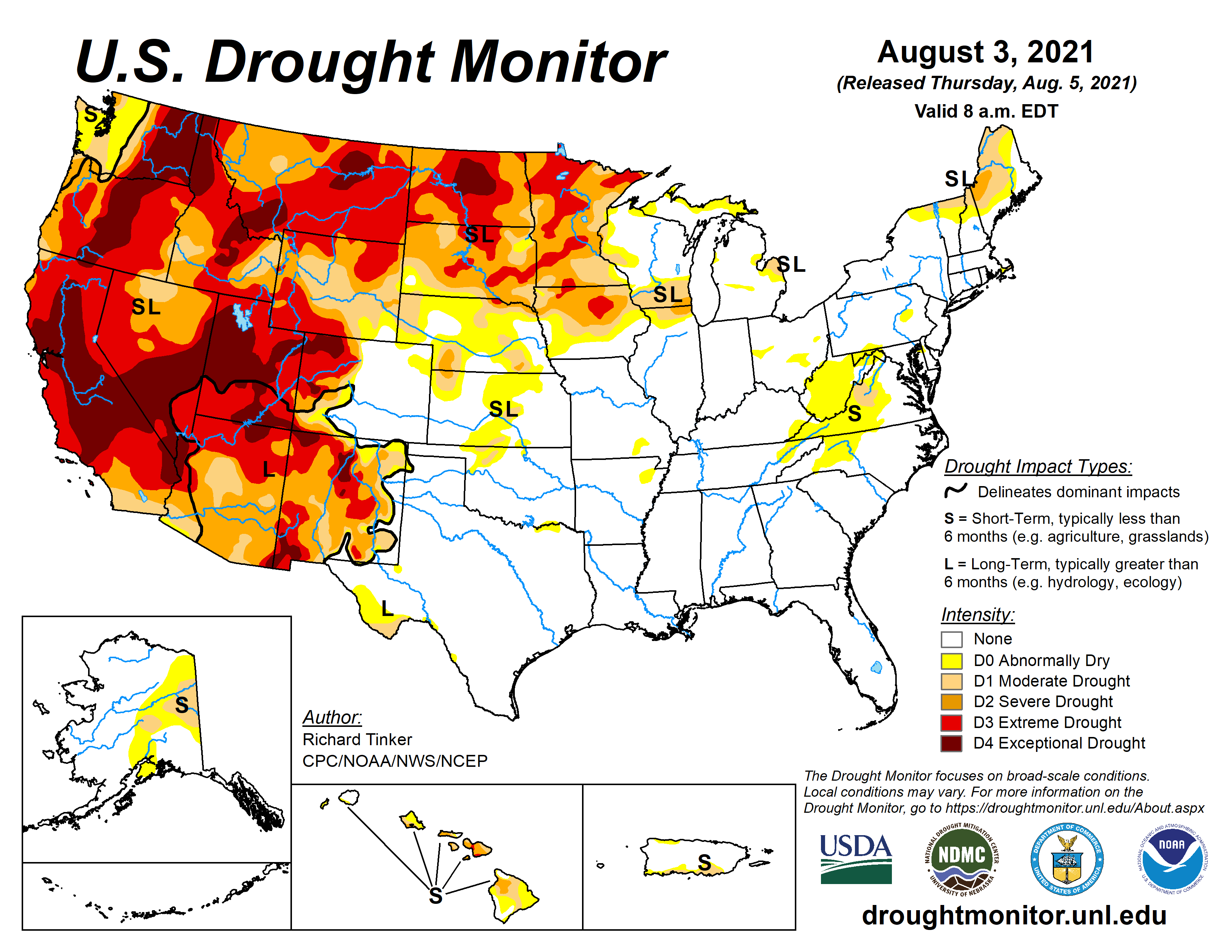
https://droughtmonitor.unl.edu/

The highlight of my week occurs every Thursday at 8:00 a.m. Sadly, it’s not a good highlight.

That’s when the National Drought Mitigation Center releases its update about conditions across the US. Sure, I study the map of the Midwest, where things have improved in some areas. But I spend more time analyzing the map of the US West, where drought conditions continue to worsen each week.

The situation in the West is so bad that those of us living in regions blessed with reliable rainfall need to be honest about two difficult truths.

1. West Coast migrants will move to the Midwest

With the prognosis for ongoing and worsening drought, there is simply no way 70 million people can continue to live in the US West. Even before the Midwest sees migration from coastal areas lost to sea-level rise, we need to prepare for the surge of migrants from our western neighbors.
How soon will the exodus from the West begin? Next year. Yup, 2022. That’s my prediction. The situation is that bad.

2. Second, the Midwest needs to commence an overhaul of its biggest industry: agriculture

Second, the Midwest needs to commence an overhaul of its biggest industry: agriculture. Out West, 80-90 percent of the water from the Colorado River is used for irrigation. Without water, farming at its current scale will not survive. As western farms abandon operations, places with adequate rain will need to fill the food-production void.

In the Midwest, instead of fields and fields of corn and soybeans (largely consumed by cars, animals, and laboratories), those fields need to grow actual food. This won’t be an easy transition. It will take innovation, sacrifice, and boldness. It will also take time, which we don’t have a lot of. So we need to get started now.

The only viable solution to the West’s drought problem in the New Climate Era is a drastically smaller population coupled with a radically altered economic model founded on that bedrock of conservative principles: conservation.

Ed Fallon


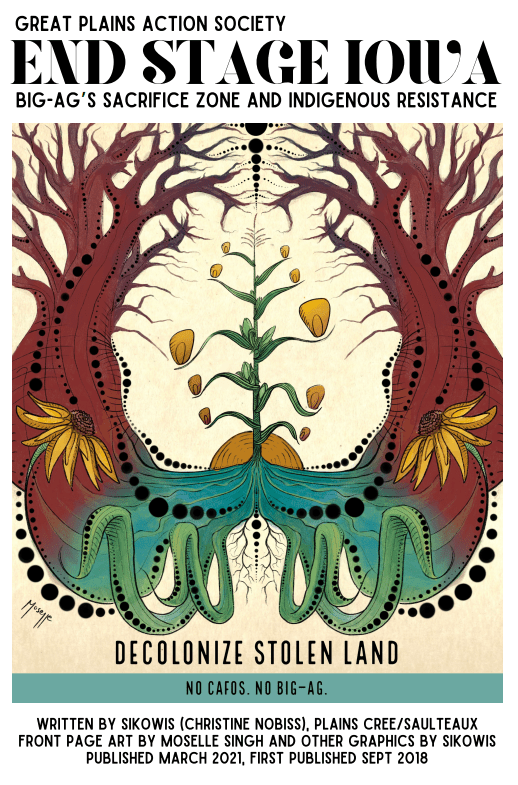
My friend Sikowis (Christine Nobiss) of the Great Plains Action Society has written an excellent zine that addresses the need to overhaul agricultural practices in the Midwest. Following are excepts from that zine.

The crew at Great Plains Action Society has a lot to say about resisting colonial-capitalism, taking climate action, and abolishing white supremacy. All our zines are free to use and disseminate to the public as we believe in copyleft–the practice of granting the right to freely distribute and modify intellectual characteristics with the requirement that the same rights be preserved in derivative works created from that property. This does not, of course, apply to our culture, heritage, and traditions, in any way, which has long been exploited by white supremacist identity thieves. 

The problem with iowa: Big-Ag’s Sacrifice zone

This zine provides an Indigenous perspective on the environmental catastrophe known as the State of Iowa where the water is poisoned, animals are dying, the soil is disappearing, and the landscape is turning into a desert. Indigenous concepts such as regenerative agriculture, sustainable land use, and compassion for the earth have been violently oppressed by an imperialist heteropatriarchy to make way for colonial-capitalist farming practices which are now killing us and wreaking havoc on the climate. The only way to heal this land is to adopt Indigenous ways of being and uplift an Indigenous regenerative economy

Long Term Goal in Iowa

Great Plains Action Society’s long-term goal is to rematriate extensive swaths of Iowa in order to revive tallgrass prairie, restore buffalo populations, along with many other insects, birds, fish, and animal species eradicated from these lands. The buffalo is a keystone species of the prairie as their migratory patterns, individual movements, and diet assist in creating hardier flora resistant to sickness and climate shifts or irregular weather patterns.

Prairie reclamation is vital to resolving Iowa’s environmental issues and combating the global climate crisis. For instance, most prairie grasses have deep and extensive root systems effectively holding soil in place and protecting them from drought conditions. This is particularly important due to increased severe recipitation events and eventual large-scale drought caused by climate change. Prairie plants also help to clean water sources. Most importantly, prairie reclamation can recapture billions of tons of carbon.

Short Term Goals

Organize and Change Laws

Along with many others in Iowa, Great Plains Action Society wants to remove and change dangerous laws that allow colonial farming practices to continue. Our collective is lobbying, writing, campaigning for a factory farm moratorium as well as a lift on Iowa’s Ag-Gag law. We are a member of the Iowa Alliance for Sustainable Agriculture who is a leading coalition working on better land stewardship and livestock production practices. We have also worked with other organizations like Iowa Citizens for Community Improvement, The Pesticide Action Network, Bioneers, SOCAP, and The Women, Food and Agriculture Network to lobby, speak, and help develop projects. For instance, we consulted on a two-year project with the Pesticide Action Network who released an animation on the global repercussions of Big-Ag, which can be found at https://www.seedsandtruth.com/

Building communities for the (near) future

We need to model how to build sustainable communities not only for climate refugees coming to the Midwest, but also for ourselves. When water no longer flows through the pipes, sewer systems fail and there is no electricity, we will all become climate refugees.

These will become chaotic times as people are forced to abandon the lives of comfort they are familiar with. There will be a great need for spiritual support. Especially as traditional church services will be disrupted, how do we envision spiritual support in the coming time?

There have been numerous experiments to build intentional community. But the model needed now must be created with the intention of being replicated many times over with minimal complexity, using locally available materials—a pre-fab community.

Pre-fab Community
  • Community hub with housing and other structures
    • Simple housing
      • Straw bale houses, sod houses, tents
      • Automobiles, buses and RVs
    • Passive solar and solar panels
    • Stores, school, meetinghouse
    • Central kitchen, bathrooms and showers
  • Surrounding fields for food and straw
  • Water supply
    • Wells, cisterns and/or rain barrels
  • Power
    • Solar, wind, horse
  • Manufacturing
    • Pottery
    • Sawmill
  • Communication
    • Radio
    • local networks
  • Transportation
    • Bicycles
    • Horses
    • Pedal powered vehicles
  • Medical
    • Stockpile common medications
    • Essential diagnostic and treatment equipment
    • Medical personnel adapt to work in community
  • Spiritual