Trauma is passed from generation to generation. The recent documentation of the remains of 215 Native children at a boarding school in Canada has re-opened deep wounds in Native communities.
Some of my Native friends have shared how this affects them and their families today. Many have been triggered by this atrocity. One of my Native friends wrote that she was NOT OK. Another told me, “I’m trying not to be enraged in my mourning.” Secretary Haaland says, “Our communities are still mourning”.
Another issue that is so personal to me is the devastating history of the U.S. government’s boarding school policies. Like many of you was, I was deeply impacted by the news of 215 Indigenous children found in a mass grave at a boarding school in Canada. I couldn’t help but think of their families.
Each of those children is a missing family member, a person who was not able to live out their purpose because forced assimilation policy. And did their lives too soon. I thought of my own child who carries this generational trauma with them. I thought of my grandmother who told me about the pain and loneliness she endured when the trains to curl away from her family to boarding school.
I wept with the Indigenous members of our team here at Interior. Our communities are still mourning. The federal policies that attempted to wipe out Native identity, language and culture continued to manifest in the pain our communities face, including long-standing intergenerational trauma cycles of violence and abuse disappearance of Indigenous people, premature deaths, mental disorders, and substance abuse.
Yesterday I wrote how the verification of the remains of 215 children at the Kamloops Indian Residential School affected my Native friends and me.
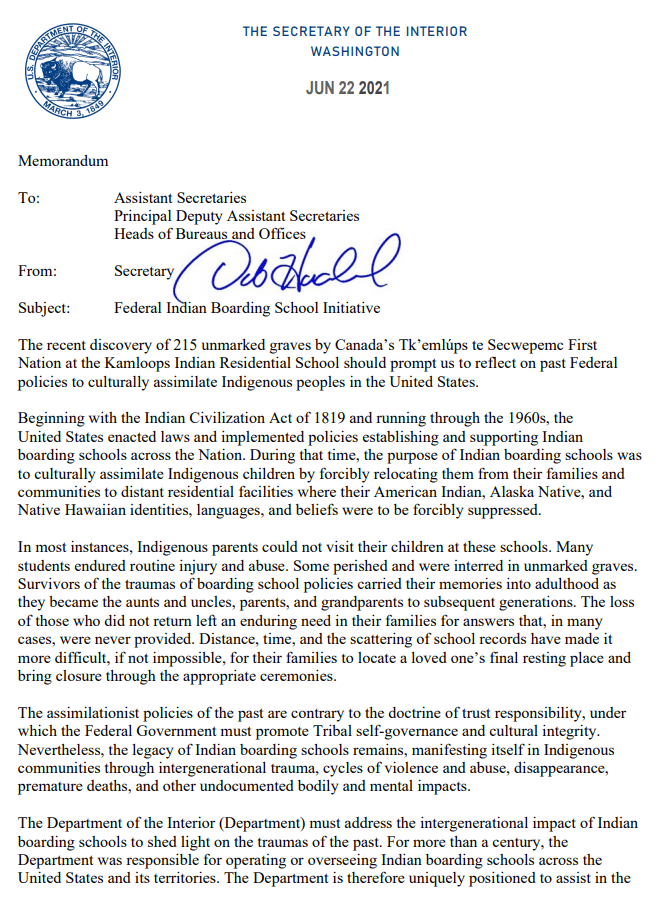
That discovery prompted Secretary of the Interior Deb Haaland to announce a Federal Indian Boarding School Initiative, for a comprehensive review of the troubled legacy of federal boarding school policies.
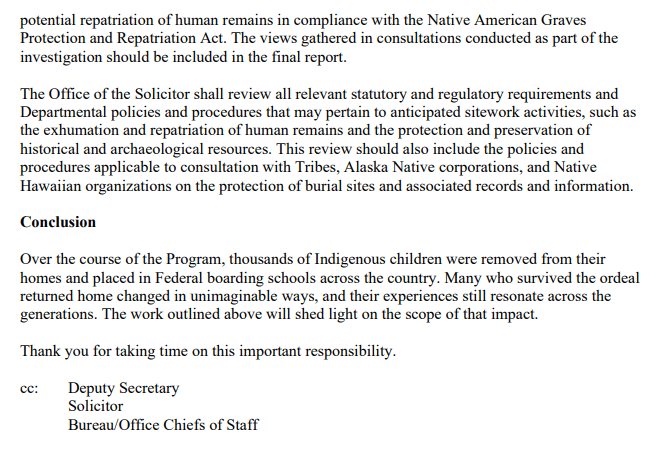
Conclusion Over the course of the Program, thousands of Indigenous children were removed from their homes and placed in Federal boarding schools across the country. Many who survived the ordeal returned home changed in unimaginable ways, and their experiences still resonate across the generations. The work outlined above with shed light on the scope of that impact.
WASHINGTON — In remarks to the National Congress of American Indians 2021 Mid Year Conference today, Secretary of the Interior Deb Haaland announced a Federal Indian Boarding School Initiative, a comprehensive review of the troubled legacy of federal boarding school policies.
Today’s announcement is accompanied by a secreterial memo in which Secretary Haaland directs the Department to prepare a report detailing available historical records, with an emphasis on cemeteries or potential burial sites, relating to the federal boarding school program in preparation for a future site work. This work will occur under the supervision of the Assistant Secretary for Indian Affairs.
“The Interior Department will address the inter-generational impact of Indian boarding schools to shed light on the unspoken traumas of the past, no matter how hard it will be,” said Secretary Haaland. “I know that this process will be long and difficult. I know that this process will be painful. It won’t undo the heartbreak and loss we feel. But only by acknowledging the past can we work toward a future that we’re all proud to embrace.”
Secretary Haaland recently reflected on the inter-generational trauma created by these policies in an op-ed.
“We must shed light on what happened at federal Boarding Schools,” said Principal Deputy Assistant Secretary for Indian Affairs Bryan Newland, who also delivered remarks outlining implementation of this effort. “As we move forward in this work, we will engage in Tribal consultation on how best to use this information, protect burial sites, and respect families and communities.”
Beginning with the Indian Civilization Act of 1819, the United States enacted laws and implemented policies establishing and supporting Indian boarding schools across the nation. The purpose of Indian boarding schools was to culturally assimilate Indigenous children by forcibly relocating them from their families and communities to distant residential facilities where their American Indian, Alaska Native, and Native Hawaiian identities, languages, and beliefs were to be forcibly suppressed. For over 150 years, hundreds of thousands of Indigenous children were taken from their communities.
The Federal Indian Boarding School Initiative will serve as an investigation about the loss of human life and the lasting consequences of residential Indian boarding schools. The primary goal will be to identify boarding school facilities and sites; the location of known and possible student burial sites located at or near school facilities; and the identities and Tribal affiliations of children interred at such locations.
The recent discovery of 215 unmarked graves by Canada’s Tk’emlúps te Secwepemc First Nation at the Kamloops Indian Residential School prompted the Department to undertake this new initiative with the goal of shedding light on these past traumas.
The work will proceed in several phases and include the identification and collection of records and information related to the Department of Interior’s own oversight and implementation of the Indian boarding school program; formal consultations with Tribal Nations, Alaska Native corporations, and Native Hawaiian organizations to clarify the processes and procedures for protecting identified burial sites and associated information; and the submission of a final written report on the investigation to the Secretary by April 1, 2022.
The Interior Department continues to operate residential boarding schools through the Bureau of Indian Education. In sharp contrast to the policies of the past, these schools aim to provide a quality education to students from across Indian Country and to empower Indigenous youth to better themselves and their communities as they seek to practice their spirituality, learn their language, and carry their culture forward.
I’ve been broken by the latest calamity, the verification of the remains of 215 Native children on the grounds of what was a residential school in British Columbia. More tragic is knowing hundreds of other Indigenous children died, or were killed, in these institutions of forced assimilation in the lands called Canada and the United States.
I’ve known about forced assimilation for years. But this is raw, because I see how devastated my Native friends are. And I know Quakers were involved in some of these institutions.
The trauma for Native families has been passed from generation to generation. Some of my Native friends have shared how this affects them and their families today. The news has re-opened deep wounds in Native communities. Many have been triggered by this atrocity. One of my Native friends wrote that she was NOT OK. Another told me, “I’m trying not to be enraged in my mourning.” [see: Time for a Reset]
I’m deeply troubled. I feel caught between my Native relatives and my Quaker community. To the extent that I’ve said I need to “step away” from my involvement with Quakers for a time. Even though I’m not sure what that means, or what will allow me to return.
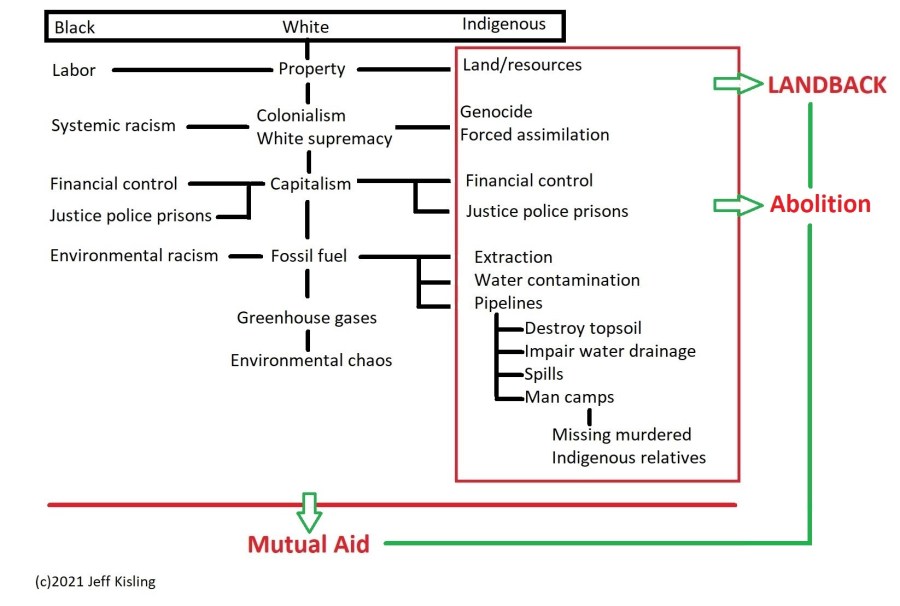
It is frustrating to know all the work, the good intentions of Friends and others, will not lead to needed solutions as long as that work is done within the context of capitalism. [See the diagram below]
What it would take for me to return to Quaker justice work would be for Quakers to see capitalism must be abandoned. And to actively search for alternatives.
We do not have a new story yet. Each of us is aware of some of its threads, for example in most of the things we call alternative, holistic, or ecological today. Here and there we see patterns, designs, emerging parts of the fabric. But the new mythos has not yet formed.
We will abide for a time in the “space between stories.” It is a very precious — some might say sacred — time. Then we are in touch with the real. Each disaster lays bare the reality underneath our stories. The terror of a child, the grief of a mother, the honesty of not knowing why. In such moments our dormant humanity awakens as we come to each other’s aid, human to human, and learn who we are.
That’s what keeps happening every time there is a calamity before the old beliefs, ideologies, and politics take over again. Now the calamities and contradictions are coming so fast that the story has not enough time to recover. Such is the birth process of a new story.
The More Beautiful World Our Hearts Know Is Possible, Charles Eisenstein
I am in that very precious, sacred time Charles Eisenstein describes. Abiding in the “space between stories”. The teachings of my Native friends have awakened the honesty of not knowing why.
I invite you to be open to new ways of being, such as LANDBACK and Mutual Aid. And pray we can hold onto the space between stories before the old beliefs, ideologies, and politics take over again. There is an urgency to this.
It is instructive that Eisenstein is expressing the concept of Mutual Aid when he writes “in such moments our dormant humanity awakens as we come to each other’s aid, human to human, and learn who we are.“
What we have is each other. We can and need to take care of each other. We may have limited power on the political stage, a stage they built, but we have the power of numbers.
Those numbers represent unlimited amounts of talents and skills each community can utilize to replace the systems that fail us. The recent past shows us that mutual aid is not only a tool of survival, but also a tool of revolution. The more we take care of each other, the less they can fracture a community with their ways of war.
Once we envision that world our ancestors want for us, finding our role is natural.
My friend and mentor Ronnie James, The Police State and Why We Must Resist
Friends express this as seeking what the Inner Light is asking of us.
I urge us to discern whether there are circumscribed limits we might not be aware of, that hold us back from venturing into a new story.


 LANDBACK Friends