Wet’suwet’en 1/11/2022

The last time I wrote about the Wet’suwet’en was January 2nd, RCMP Invasion expected on Wet’suwet’en territory. It’s not that the RCMP have left, but there has been a change in tactics. The threat continues.

There’s no question that I am guilty of painting on the street because the reason is so important.

Shawn Selway

We should all show up at these rallies when we are asked to do so by Indigenous people. Believe me, you will feel much better than reading a newspaper about more dead children being found somewhere.

Shawn Selway

Our first rally in support of the Wet’suwet’en was on February 7, 2020.

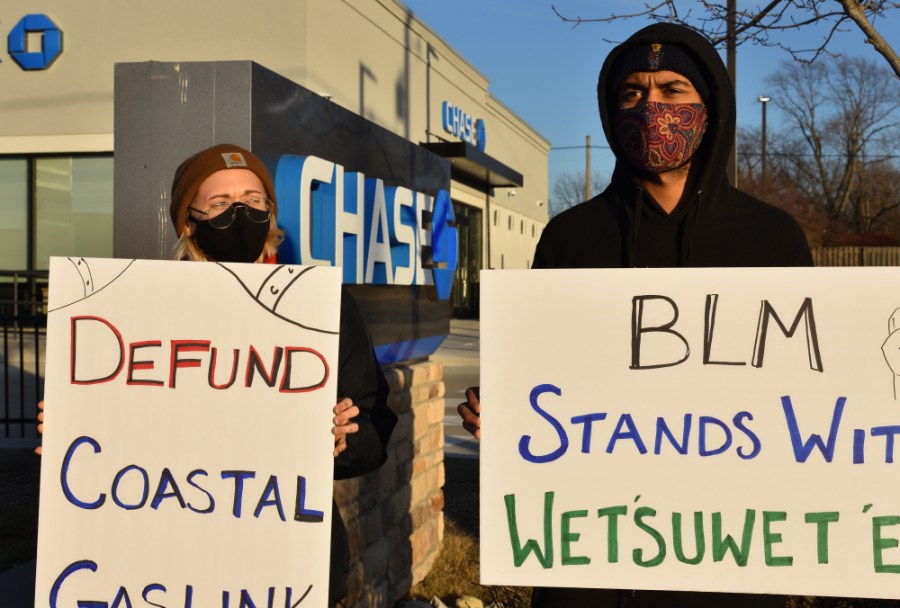
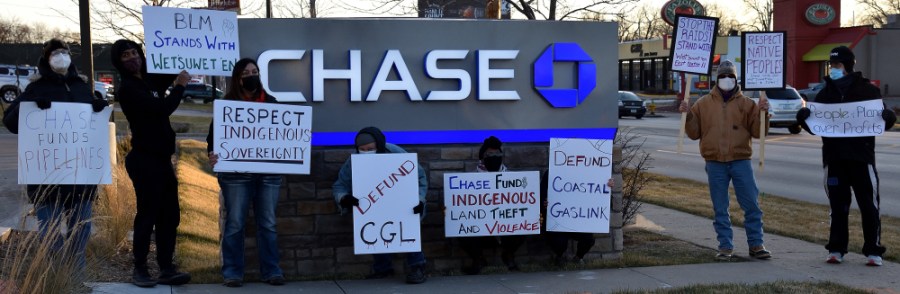
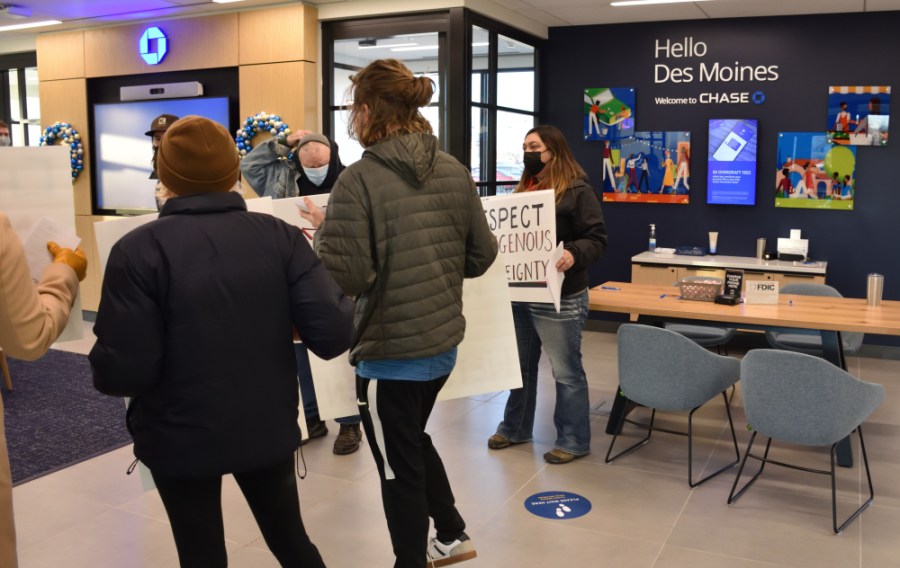
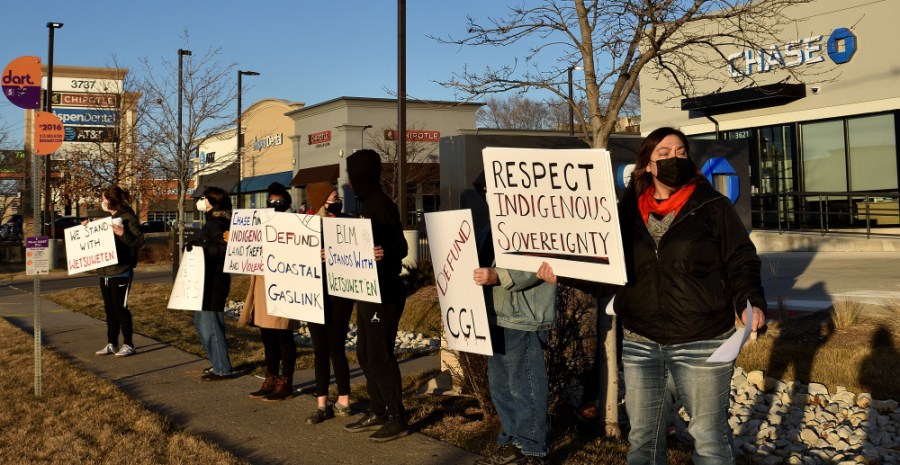
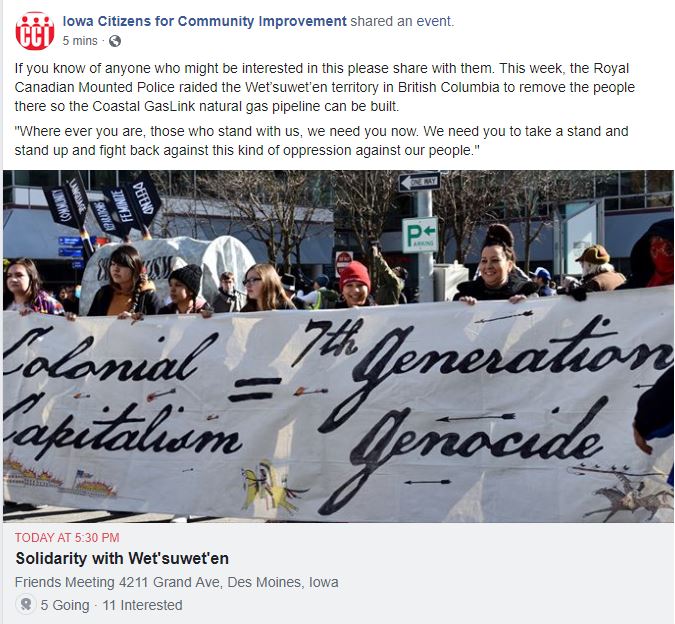
This is from the AFSC Midwest Digest, January 2022. Jon Krieg (AFSC), Patti McKee, Peter Clay, and I were among those at the rally to support the Wet’suwet’en at the Chase bank in Des Moines. (photos below)

https://www.afsc.org/story/midwest-digest-january-2022

Following is a statement from the Rainforest Action Network (RAN) in solidarity with the Wet’suwet’en peoples. I’ve worked with RAN since 2013 when I was trained to be an Action Lead in the Keystone Pledge of Resistance. The following relates to a letter to the editor I wrote that was published in the Indianapolis News about Indiana Senator Donnelly’s support of the Keystone pipeline.

I was glad to be called a RAN activist.

RAN @RAN May 15, 2014
@ran activist @jakislin calls out @sendonnelly on willfully ignoring the dangers of #KXL a_ran.org/iS #NoKXL

Big banks are bankrolling this pipeline: Will you rise up and join the Wet’suwet’en to protect their land?

Right now, Wet’suwet’en Indigenous rights are under attack: Canadian paramilitary troops flew into Indigenous lands in support of fossil fuel giant TC Energy, and their 417-mile fossil fuel pipeline — without the consent of hereditary chiefs. 

Wet’suwet’en hereditary chiefs are urgently calling out for massive global support. Will you take action in solidarity, Jeff?

The Canadian government and big banks like Chase and Royal Bank of Canada (RBC) are forcing disastrous oil pipelines on Wet’suwet’en territories and meeting peaceful protests with violence.

The Coastal Gaslink pipeline WILL have harmful impacts on water, wildlife, the Wet’suwet’en people — and on our global climate. In solidarity with them, tell big banks to stop financing Indigenous rights abuses.
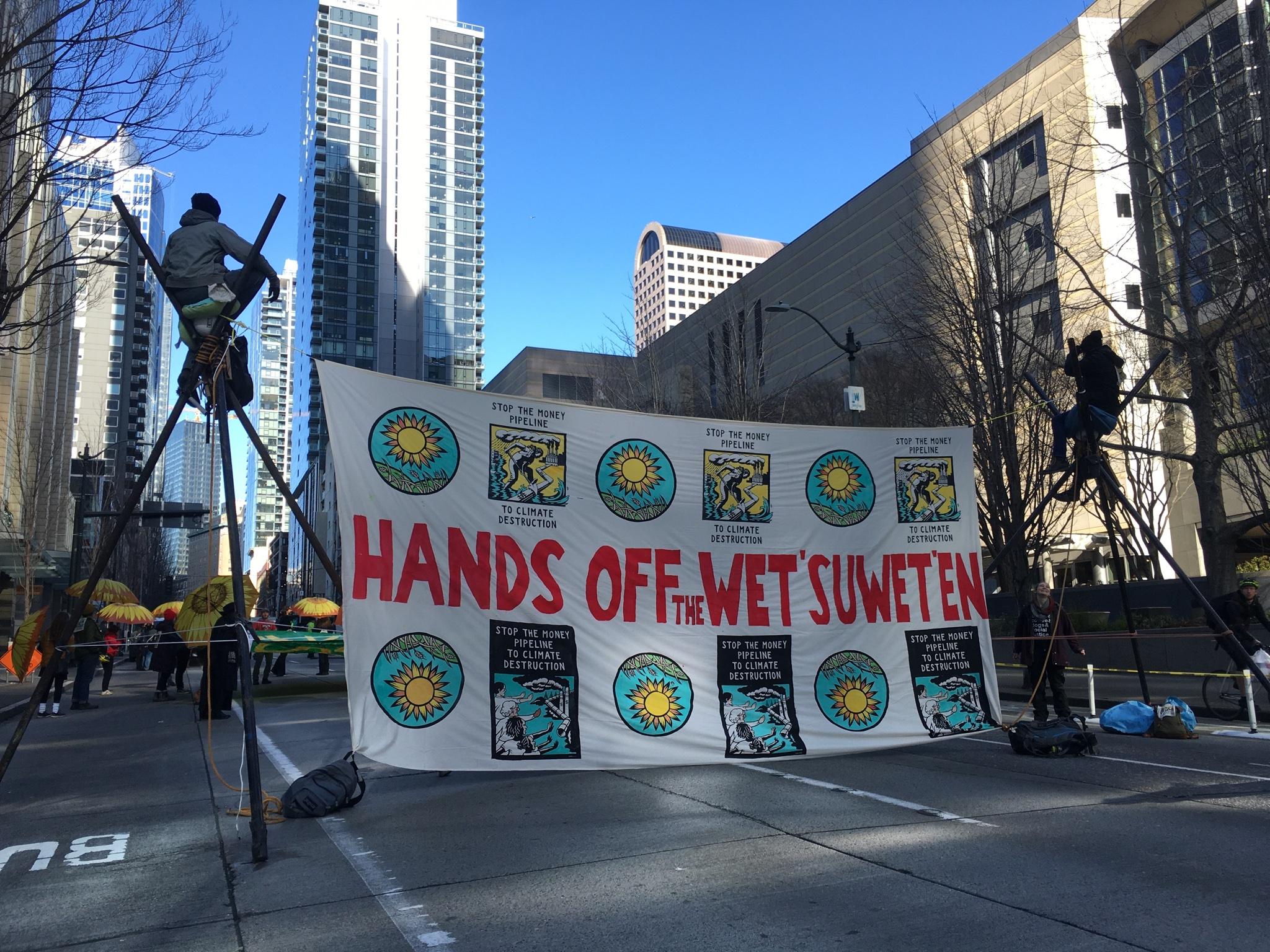
For the past twelve years, the Wet’suwet’en have asserted their sovereignty to stop fossil fuel companies from trespassing on their lands, and they have won. This community organized against two more huge pipelines and defeated them, and we know they can win. Coastal Gaslink is already way over budget. These banks know the investment is incredibly risky, and we have a chance to stop it.

Here in the U.S., we can support the Wet’suwet’en by fighting back against the financial backers of this climate-killing pipeline. Banks from the U.S. to Japan to Canada, including the #1 worst banker of fossil fuels JPMorgan Chase, are funneling BILLIONS in loans to TC Energy, the company behind Coastal GasLink. These banks are directly contributing to the destruction of sacred Wet’suwet’en land and the blatant violation of their rights. 

The bankers behind this pipeline must be held accountable for their role in destroying Indigenous lands and fueling the climate crisis. Will you rise up and join the Wet’suwet’en to protect their land?

We won’t let big banks destroy rivers, air, wildlife, and the climate while hurting people who are protecting what is rightfully theirs. There is no climate justice without Indigenous sovereignty, Jeff. 

“You can’t claim to be a climate leader and still allow a project that will be the largest point source of carbon emissions in our province. And you can’t say you’re adhering to the UN Declaration on the Rights of Indigenous Peoples when you clearly don’t have consent from the actual title holders, and when you’re in violation of the article that says Indigenous peoples can’t be forcibly removed from their own territory.”

ANALYSIS: Coastal GasLink, LNG Controversies Will Haunt B.C. NDP in 2022, Mitchell Beer, The Energy Mix, January 10, 2022

#RiseUpfortheFallen, #RebelForAction, #RebelForLife, #SeLeverPourNotreSurvie, #ActNow, – #AgirMaintenant, #TellTheTruth, – #DireLaVérité, #ExtinctionRebellionCanada, #ExtinctionRebellion, #XRTV, #XR, #IndigenousResistance , #alloutforwedzinkwa, #RCMPofftheYintah, #WetsuwetenStrong, #Cdnpoli , #BCpoli , #ClimateCollapse, #BiosphereCollapse, #DecolonizeBC, #RespectIndigenousSovereignty , #LandBack, #RCMPstanddown, #StopCGL , #StopTMX, #LeaveItInTheGround, #ClimateEmergency , #500YearsIndigenousResistance ,

Three years ago RCMP moved onto Wet’suwet’en territory, tearing down a barricade on a forest service road that blocked access to the planned route of the Coastal GasLink pipeline.

The single-day enforcement on Jan. 7, 2019, resulted in the arrest of 14 people, both Wet’suwet’en and their supporters. But it didn’t bring a resolution to the dispute over the pipeline, opposed by Wet’suwet’en Hereditary Chiefs.

Since then, dozens more have been arrested under an injunction granted to Coastal GasLink, which is building a 670-kilometre gas pipeline from northeast B.C. to an LNG processing facility on the coast in Kitimat.

And the conflict has brought increasing internal pressure on the BC NDP government to find a new approach that better reflects its stated commitment to Indigenous rights.

About 75 people have been arrested in total on the territory, with RCMP enforcement criticized as heavy handed and oppressive. In February 2020, 28 people were arrested over five days at several locations along the road. This November, at least 30 more were arrested over two days at a camp on Gidimt’en Clan territory and a worksite where Coastal GasLink plans to drill under the Morice River, known to the Wet’suwet’en as Wedzin Kwa.

And for three years, RCMP have continued patrolling the Morice, establishing a detachment on the remote resource road and racking up a bill for policing that now exceeds $20 million.

As rumours swirl about plans for a fourth police raid on Wet’suwet’en territory, the B.C. government faces growing pressure from within the NDP to find a new approach, with federal MPs, riding associations and high-profile supporters all calling for change — and getting very little response from B.C.’s ruling party.

BC NDP Faces Internal Pressure to Change Course on the Wet’suwet’en Crisis. The calls come from New Democrats across Canada and within the provincial party’s ranks by Amanda Follett Hosgood, TheTyee.ca, January 10, 2022

#wetsuwetenstrong

COP 26 and Beyond Coal and Gas Alliance

COP 26 can only be seen as a failure since there was no agreement to end fossil fuel extraction and use. Nothing short of that will even slow down environmental collapse. It is not true that the deal “keeps 1.5C within reach” as COP26 President Alok Sharma says. Already the temperature has increased 1.1C. We are on a path to reach at least 2.7C by 2100, if drastic changes aren’t made immediately.

China and India will have to explain themselves to climate-vulnerable nations, COP26 President Alok Sharma has said as the summit ends.

It comes after the two nations pushed for the language on coal to change from “phase out” to “phase down” in the deal agreed in Glasgow.

But Mr Sharma insisted the “historic” deal “keeps 1.5C within reach”.

Under the Glasgow climate pact:

  • Countries were asked to republish their climate action plans by the end of next year, with more ambitious emissions reduction targets for 2030
  • There is an emphasis on the need for developed countries to increase the money they give to those already suffering the effects of climate change – beyond the current $100bn annual target
  • The language about coal has been included for the first time ever in a global climate deal
  • A pledge in a previous draft to “phase out” coal was instead watered down to a commitment to “phase down” coal

COP26: China and India must explain themselves, says Sharma by Malu Cursino, BBC News, Nov 14, 2021


Ed Miliband, shadow business and energy secretary, told the Sky News’ Trevor Phillips programme that “keeping 1.5 degrees alive is frankly in intensive care”.

He said: “The task of the world is to halve global emissions over the coming decade, that’s by 2030, that’s what the scientists tell us is necessary to keep 1.5 degrees alive.

COP26: China and India must explain themselves, says Sharma by Malu Cursino, BBC News, Nov 14, 2021

https://beyondoilandgasalliance.com/
Beyond Oil and Gas Alliance

A new diplomatic alliance to phase out global oil and gas production was formally launched at the UN climate change conference in Glasgow on Thursday, signaling an emerging international front in the fight against climate change.

The Beyond Oil and Gas Alliance, which Quebec announced it would join last week, is led by Costa Rica and Denmark, and now also includes France, Greenland, Ireland, Sweden, Wales, and Quebec as “core” members, California, Portugal, and New Zealand as “associate” members, and Italy which joined as a “friend” of the alliance.

Core membership means the country — or province, in the case of Quebec — has committed to end new exploration permits. Associate members must demonstrate efforts towards an oil and gas phase-out, like ending fossil fuel subsidies. The alliance expects to add new members in the coming months, including Scotland, according to news reports, which could upend the United Kingdom’s oil extraction plans, given much of its reserves are in the North Sea.

“There’s no future for oil and gas in a 1.5-degree world,” said Denmark’s Minister for Climate Dan Jørgensen, at the launch.

Here are the countries that joined the Beyond Oil and Gas Alliance By John Woodside, Canada’s National Observer, November 11th 2021

On 7 November, during the COP26 Coalition People’s Summit, I was on the jury of The People’s Tribunal on the UNFCCC (United Nations Framework Convention on Climate Change) and its failure to address a range of issues. We heard from a range of rapporteurs and witnesses, each speaking with great feeling about the differential climate catastrophes on nature and on human life. Every minute, $11 million is spent to subsidise fossil fuels (that’s $5.9 trillion spent in 2020 alone); this money underwrites the cascading climate catastrophe, yet few funds are raised to mitigate the negative effects of fossil fuels or to transition to renewable forms of energy. The remainder of this newsletter details the findings of the Tribunal, which was comprised of Ambassador Lumumba Di-Aping (former Chief Climate Negotiator for the G77 and China), Katerina Anastasiou (Transform Europe), Samantha Hargreaves (WoMin African Alliance), Larry Lohmann (The Corner House), and me.

There were six charges put before the Tribunal concerning the failures of the UNFCCC to:

  • address the root causes of climate change;
  • address global social and economic injustices;
  • come up with appropriate climate finance for planetary and social survival, including the rights of future generations;
  • create pathways to a just transition;
  • regulate corporations and avoid the corporate capture of the UNFCCC process; and
  • recognise, promote, and protect the Rights of Nature law.


The jury of five listened carefully to the special prosecutor, to the rapporteurs, and to the witnesses. We were unified in our conclusion that the UNFCCC, which was signed by 154 nations in 1992 and ratified by 197 countries by 1994, has utterly failed the peoples of the world and all species that rely on a healthy planet to survive by failing to stop climate change. This perilous inaction has failed to limit the increase of the average global temperature.

In its latest 2021 reports, the Intergovernmental Panel on Climate Change (IPCC) found that the Earth has reached an average temperature increase of 1.1 degrees, while sub-Saharan Africa is close to breaching the ‘safe’ 1.5 degree mark.

The UNFCCC has forged an intimate partnership with the very corporations that have created the climate crisis. It has allowed powerful governments to threaten poor countries into submission, guaranteeing certain misery and death for hundreds of millions of people in the poorest parts of the world over the next two decades.

The UNFCCC’s inaction has permitted powerful oil, mining, agriculture, logging, aviation, fishing, and other corporations to continue their carbon intensive activities unfettered. This has contributed to a growing biodiversity crisis: recent estimates suggest that anywhere from 2,000 species (at the low end) to 100,000 species (at the high end) are being exterminated each year. The UNFCCC is implicated in mass extinction.

The UNFCCC has refused to democratise the process and to listen to those on the frontlines of the crisis. This includes the one billion children who live in the 33 countries that are at ‘extremely high risk’ due to the climate crisis – in other words, almost half of the world’s 2.2 billion children – as well as indigenous communities and working-class and peasant women from the countries and nations that bear the brunt of a crisis that they did not produce.

As the world confronts a rapidly escalating climate crisis – evidenced by flooding, droughts, cyclones, hurricanes, rising sea levels, furious fires, and new pandemics – the poorest, most vulnerable, and highly indebted nations are owed a great climate debt.

Powerful nations in the UNFCCC have forced a rollback on earlier commitments to global redress for the long history of unequal and uneven development between nations. Developed countries pledged $100 billion per year for the climate fund but they have failed to provide that money, thereby neglecting their own commitments. Instead, developed countries plough trillions of dollars into their own national efforts to mitigate the impacts of climate change and support adaptation to a warming climate, while the poorest and most heavily indebted nations are left to fend for themselves.

We, the jury, find that the UNFCCC violated the UN Charter, which demands that UN members states ‘take effective collective measures for the prevention and removal of threats to peace’ (Chapter 1). The Charter charges states ‘to achieve international cooperation in solving international problems’.

The UNFCCC has also violated Chapter IX of the UN Charter, ignoring Article 55’s demand to create ‘conditions of stability and well-being’ as well as ‘economic progress and social progress’ and to promote ‘universal respect for, and observance of, human rights.’ Furthermore, the UNFCCC has violated Article 56, which enjoins member states to take ‘joint and separate action in cooperation’ with the UN.

We, the jury of the People’s Tribunal, find the UNFCCC guilty of the charges made by the special prosecutor and established by the witnesses. In light of our sentence, we claim the following measures of redress for the peoples of the world: (list follows)

WHY ARE YOU ASKING US TO COMPROMISE ON OUR LIVES? By Vijay Prashad, Tricontinental: Institute for Social Research, November 12, 2021


Cannot depend on traditional power sources

Powerful hurricane Ida which gained strength from the hot Gulf waters (from global warming) destroyed square miles of buildings as it came ashore. Then caused massive flooding as it moved through the country.

The entire electrical grid failed in New Orleans! It will be weeks or months before full power returns.

In February this year the power grid for the entire state of Texas failed.

Each hurricane also renews calls to find new ways to produce and distribute energy in the face of climate change, which experts say is leading to more frequent and more devastating storms. In New Orleans, advocates have tried to push Entergy to invest more in renewable energy sources, such as solar and wind, and technologies that provide electricity to the area where it is produced.

Those concerns, along with worries about pollution in residential neighborhoods, fueled resistance to Entergy’s plan to build the new natural gas-powered plant in New Orleans East. Even after the company admitted to playing a role in the hiring of actors to support the project at public meetings, the council approved the plant. Groups that opposed the plan sued, and the case made it to the Louisiana Supreme Court, which upheld the council’s vote.

“​​Over and over we have tried to say we need not only climate action for renewables, but also we need to be adaptive to what is coming, because the traditional system to move power isn’t going to be able to help us weather these storms,” said Logan Atkinson Burke, executive director of the Alliance for Affordable Energy. “We’ve been ignored by utilities and regulators, and we are concerned that now, yet again, we will have this system rebuilt the same way we’ve done it and it will do us no good the next time.”

Slow return of power raises questions about a New Orleans plant that was supposed to deliver electricity after hurricanes. Calls for an investigation of Entergy’s power outages follow a wave of complaints about the company by Jon Schuppe, NBC News, Sept 1, 2021

Hurricane Ida thoroughly wrecked New Orleans’ power supply, preying on vulnerabilities that are only likely to get worse in the future as storms like Ida become more fierce. The storm knocked out all eight transmission lines that bring power into New Orleans, plunging the city into darkness. The damage was so intense that a new gas-fired power plant — sold as something that could keep the lights on after big storms — took days to bring power to the nearest neighborhood.

To keep the lights on in the future, leaders need to abandon old strategies and build up different kinds of energy infrastructure, experts say. The fallout from Ida is yet another reminder of how fragile the country’s existing energy infrastructure is, especially as climate change brings on more extreme weather.

“We’ve been saying, you know, we can’t depend on the traditional system,” says Logan Atkinson Burke, executive director of the local consumer advocacy group Alliance for Affordable Energy. “We need to be planning for the kind of climate impacts that we know are coming, and here they are. Having not planned for them, we’re experiencing the kinds of problems we expected.”

NEW ORLEANS NEEDS A BETTER BACKUP PLAN FOR BLACKOUTS. A new gas plant still isn’t enough to solve the city’s power problems by Justine Calma, Sep 1, 2021

This is what LANDBACK is about, restoring Indigenous ways.

“How about phasing out fossil fuels and quit acting like addicts? Let’s have a new green revolution. Let’s take the green path.” Winona Laduke (in video below). Winona was arrested while protecting the water from Line 3. Honor the Earth says that the “charge of the colonial world is in conflict with the Anishinaabeg,” citing a 2019 White Earth Nation tribal law which requires the White Earth Nation to stand up for and protect the rights of wild rice and other sacred food.

#TreatiesNotTarSands

#LANDBACK