The second anniversary of my connections with Des Moines Mutual Aid is approaching. Our experiences together have literally changed my life. The Spirit led me to this and continues to do so. This can be a way to live through these increasingly uncertain times.
True security lies in the unrestrained embrace of insecurity — in the recognition that we never really stand on solid ground, and never can.
– Oliver Burkeman –
The next American Revolution, at this stage in our history, is not principally about jobs or health insurance or making it possible for more people to realize the American Dream of upward mobility. It is about acknowledging that we Americans have enjoyed middle-class comforts at the expense of other peoples all over the world. It is about living the kind of lives that will not only slow down global warming but also end the galloping inequality both inside this country and between the Global North and the Global South. It is about creating a new American Dream whose goal is a higher Humanity instead of the higher standard of living dependent on Empire. It is about practicing a new, more active, global, and participatory concept of citizenship. It is about becoming the change we wish to see in the world.
The courage, commitment, and strategies required for this kind of revolution are very different from those required to storm the Winter Palace or the White House. Instead of viewing the U.S. people as masses to be mobilized in increasingly aggressive struggles for higher wages, better jobs, or guaranteed health care, we must have the courage to challenge ourselves to engage in activities that build a new and better world by improving the physical, psychological, political, and spiritual health of ourselves, our families, our communities, our cities, our world, and our planet.
“The Future of Fossil Fuels Hinges on Two Huge Midwestern Pipeline Fights” by PETER MONTAGUE, Common Dreams, December 9, 2021, caught my attention. It is essential to stop construction of so-called Carbon Capture and Storage (CCS) infrastructure that article is about.
But I think the extraction and use of fossil fuels will end prior to the construction of CCS because increasingly frequent and devastating environmental catastrophe will wipe out existing fossil fuel and other infrastructure. Just this year the “atmospheric river” in the northwest caused oil pipelines to be exposed and move up and down as water flowed around them.
The Trans-Alaska Pipeline, one of the world’s largest oil pipelines, could be in danger.
Thawing permafrost threatens to undermine the supports holding up an elevated section of the pipeline, jeopardizing its structural integrity and raising the potential of an oil spill in a delicate and remote landscape.
The slope of permafrost where an 810-foot section of the pipeline is secured has started to shift as it thaws, causing several of the braces holding up the pipeline to twist and bend.
This appears to be the first instance that pipeline supports have been damaged by “slope creep” caused by thawing permafrost, records and interviews with officials involved with managing the pipeline show.
The recent, horrendous tornadoes flattened everything in their path. Including water towers so there is no water. Including gas stations. Including power transmission infrastructure. Hospitals, pharmacies, news outlets, churches, schools, prisons, fire and police stations and equipment. Grocery and other stores, banks, car lots, manufacturing facilities. Local, state, and Federal offices, nonprofits, and systems they support such as Social Security and other social safety nets. Homes.
And renewables, including solar panels and wind turbines.
The center of fossil fuel refineries is New Orleans, below sea level, which will flood, wiping out that infrastructure. Transatlantic shipment of fossil fuels will likely end.
Sea level rise will have similar effects on millions who live on the coasts.
The question is what will we do now?
I’ve been working on this diagram that summarizes what I think needs to be done. We haven’t had the will to voluntarily move toward LandBack, abolition, participatory economy, conservation, and Mutual Aid. In the face of all that is collapsing, these are the solutions we need to build on now. This is what I’ve been writing about on LANDBACK Friends. https://landbackfriends.com/
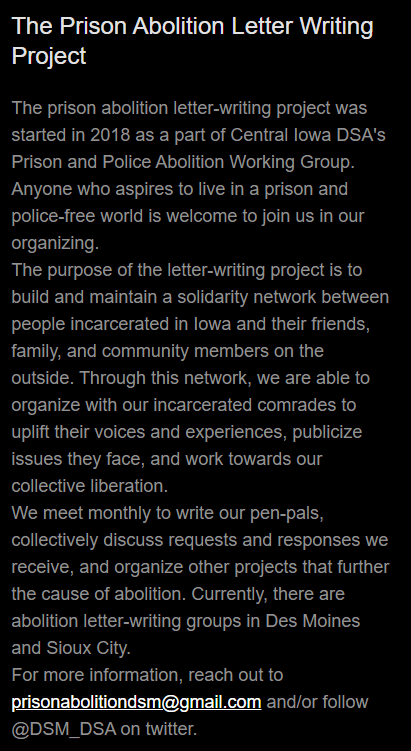
I recently attended my first meeting with the Prison Abolition Letter Writing Project of the Central Iowa Democratic Socialists of America (DSA). I didn’t know who would be there but thought it likely a few of my Mutual Aid friends might. It is a maxim of justice activism that a small core group of people work in many different justice groups in a city, and such was the case. I was glad to see two of my Mutual Aid friends there. Seven of us met in a park shelter not far from the church our Mutual Aid group uses for the food giveaway project each Saturday morning.
I wondered what I would learn about the Prison Abolition Letter Writing Project and was fascinated by what I did learn. I assumed the idea was to establish a relationship with those imprisoned, which it certainly is. But as part of the sample letter shows, the concept is to invite those incarcerated to help those who are not understand what is going on in the prison system. Yet another example of Mutual Aid, where all involved work from the concept that we are all working together. Not “us helping them”.
I am writing to you as a part of the Central Iowa Democratic Socialists of American prison abolition group. I am inviting you to join our solidarity and pen-pal network. We are connecting with people incarcerated in Iowa because we believe the struggles of people both inside and outside of prison walls are intertwined. Specifically, we recognize the need to eliminate systemic injustices produced by the current criminal justice system.
Please let me know if you are interested in taking part in this project. I would love to receive any information from you so that we can make a case to those on the outside to take action on the demands of incarcerated people.
We are the Central Iowa chapter of the Democratic Socialists of America (DSA). Promoting the concept of democratic socialism through political action, direct service, and education. We are building for the future beyond resistance. https://www.facebook.com/CentralIowaDSA
This post of yours struck me close to home. I too have become fully convinced of the evils of capitalism. Moreover, I have come to the conclusion that my faith dictates that I work to replace it. Turns out I am far from alone, so I’ve been devoting much of my time this past year to the Religion and Socialism Committee of the DSA, www.religioussocialism.org. Fran Quigley
I’ve also been participating in the Quaker for Abolition Network, initiated by Mackenzie Barton-Rowledge and Jed Walsh. The following is from an article they wrote for Western Friend.
Mackenzie: Let’s start with: What does being a police and prison abolitionist mean to you? Jed: The way I think about abolition is first, rejecting the idea that anyone belongs in prison and that police make us safe. The second, and larger, part of abolition is the process of figuring out how to build a society that doesn’t require police or prisons. Mackenzie: Yes! The next layer of complexity, in my opinion, is looking at systems of control and oppression. Who ends up in jail and prison? Under what circumstances do the police use violence? As you start exploring these questions, it becomes painfully clear that police and prisons exist to maintain the white supremacist, heteronormative, capitalist status quo.
We as White Quakers like to think of ourselves as ahead or better than dominant culture, but we have been complicit in a system and mindset that are ubiquitous. Claiming the full truth of our history and committing to repair the harms done are deeply spiritual acts of healing our own wounds of disconnection. I would argue it is the pathway upon which we can, perhaps for the first time, discover and invigorate our faith with its full promise.
What would it mean for us to take seriously and collectively as a Religious Society a call to finish the work of abolition, hand in hand and side by side with those affected and their loved ones? What would it mean for us to stand fully with the calls to abolish the police and fully fund community needs instead? What would it mean to reckon with our past complicity with harm and fully dedicate ourselves to the creation of a liberating Quaker faith that commits to build the revolutionary and healing faith we long to see come to fruition? What would it look like to finally and fully abolish slavery?
Lucy’s article includes this correction, that so many White people do unintentionally: Correction: The author and FJ editors realize that an earlier version of this article inadvertently erased BIPOC (Black, Indigenous and people of color) Quakers in describing Quakers as though we were/are all White. Certainly there have been Black Friends and Friends of Color in our body from our earliest history. We apologize for this error. This online article has been updated accordingly.We have also clarified the relationship of George Fox with Margaret and Thomas Rous.
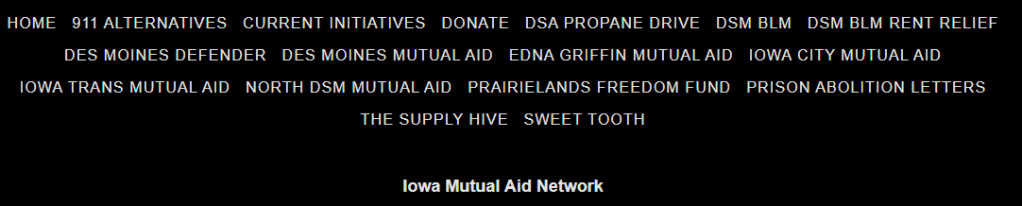
A goal of Mutual Aid is to grow, pulling increasing numbers of people into the work. I’ve been involved in Des Moines Mutual Aid and the food giveaway project for the past year. The Iowa Mutual Aid Network has expanded to include the following organizations. The Prison Abolition Letter Writing Project is a way to bring more people into our mutual work.
The Iowa Mutual Aid Network is made up of numerous individuals, collectives, and affinity groups working together and alongside each other to change the material conditions of oppressed communities in so-called Iowa.
The groups represented on this site are in no way a full accounting of those that are engaged in the struggle.
A recent article in Popular Resistance by Don Fitz is titled, “PATH TO EXTINCTION OR TO A LIVABLE FUTURE. Climate change is not a “thing-unto-itself” but is interwoven into a fabric of oppressive systems. Addressing climate change requires multiple approaches, including participatory economics, financial equality, and mutual aid networks.
COP 26 has shown, once again, that solutions for climate change will not come from societies whose goal is to maintain the status quo. That will not act to decrease fossil fuel extraction and use. That refuse to listen to the wisdom of Indigenous peoples who have lived for millennia in balance with Mother Earth.
It has long been said in many ways that problems cannot be solved by relying on individuals and institutions who created them. The novel crisis of climate change nested within intertwined social problems calls for new ways of thinking – ways which are manifested in new mutual aid groups, new trade unions, and new political institutions.
Stan Cox whacks all three dragon heads in his new book The Path to a Livable Future: A New Politics to Fight Climate Change, Racism and the Next Pandemic. He dismisses the anti-science and racism of climate denialists such as Trump, strips bare the insincerity of the early Biden administration, and uncovers the lurking dangers of energy denial.
The book goes beyond these. Cox demonstrates that climate change is not a “thing-unto-itself” which can be halted by a quick fix of a few trillion dollars; but, is a pernicious stain in an interwoven fabric of oppressive systems. This lays the groundwork for outlining a multiplicity of problems which must be addressed to confront climate change. These include reducing production via a participatory economy, establishing financial equality, and building mutual aid networks.
Readers of this blog know Mutual Aid is a focus of my study, writing, and work. https://landbackfriends.com/?s=%22mutual+aid%22 What Sam Cox says deepens my conviction of the importance of Mutual Aid as a pivotal part of change that is desperately needed now. To immediately address the consequences of our current fossil fuel-based economy.
But I wasn’t familiar with the term participatory economy. I updated the model I’ve been working on to include that. (See below)
The Participatory Economy model, also known as Participatory Economics, or Parecon, was developed by economists Michael Albert and Robin Hahnel and first formally presented in 1991 in Princeton University Press. Drawing on libertarian socialist ideas and real-world examples throughout history, their motivation was to inspire hope, inform strategy and to demonstrate that a viable and better alternative to the two dominant economic systems of the last century, capitalism and a command economy, is possible.
Another term I’ve just learned is “energy denial“. I’ve been guilty of thinking “alternative energy” would play a significant role in transitioning away from fossil fuels.
The term “energy denial” reflects an intense belief that “alternative energy” (AltE) such as solar, wind, and hydro-power cause nothing but trivial problems which should be ignored in order to allow unlimited expansion of production. Michael Klare is one of innumerable progressive authors who use justified hysteria over climate change to demand unjustified spending of trillions of dollars on AltE.
Core to Cox’s analysis is a concept that runs so contrary to conventional leftist wisdom that many will not speak it, read it, or publish it. He is at the forefront of authors willing to melt the golden calf of AltE. He slams congressional proposals for a “Green New Deal,” noting that they fail to include any plans for restricting fossil fuel (FF) production and merely pretend that increases in solar and wind will cause a reduction in its use. Reduction is not written into the plans because FFs are essential for manufacturing AltE equipment. The book portrays the most troubling aspect of AltE to be its promotion as a panacea. This contributes to the preservation of social structures that are most in need of replacement:
As a result, I’ve also changed this diagram by removing “renewable energy” and replacing that with “conservation“.
Thanks to bright green technologies, we can continuously grow the level of consumption on planet Earth and deliver a bloated North American lifestyle to all without inviting climate catastrophe or a general breakdown of natural ecosystems that support all living things.
That’s the big bold lie that politicians are telling themselves this week at yet another climate conference. Greta Thunberg calls such dissembling just so much “blah, blah, blah.”
As I’ll share in this piece, a number of brilliant energy critics from Vaclav Smil to William Rees have done the figuring, acknowledged the physical limits of things, and told us the truth. A truth that is not as uncomfortable as you might think.
It is this. We must contract the global economy, restructure technological society and restore what’s left of natural ecosystems if we want to live and breathe.
Returning to a 1970s Economy Could Save Our Future. We’d contract energy use by half. Shrinking consumption is the solution we can actually live with. Second of two By Andrew Nikiforuk, The Tyee, 4 Nov 2021
For a long time, we have been observing the breakdown of so many systems we depend on. In medicine we have the term ‘multi system organ failure’. I’ve begun to think of the dysfunction of our economic, political, educational, medical, spiritual, and social support web as being in multi system failure now.
We have three choices.
We can try to continue to ignore these failures. But that is becoming increasingly difficult to do.
We can try to repair those systems, hoping they will keep working a little longer.
Or we can build something new. Which might be a return to how things once were.
The consequences of the Covid pandemic are a preview of the future if change doesn’t happen now. As in NOW. As umair haque says below, “And so what do you expect to happen? If change can’t, then only collapse is left.
I think of Covid as a message backwards, from the future. And it says something like this. Life as you knew it is now over. The future is now going to become a bitter and bruising battle for the basics. The basics. Air, water, food, medicine, energy. Things that many of us once took for granted, and assumed would simply be around, as if by magic.
That age is now coming to an end. Did you ever think that breathable air would be in short supply? Where you have to wear a mask, because the air could infect you with a respiratory virus? That is what the future looks like, except for all the basics.
Life as you know it really is coming to an end, my friend. If it hasn’t already. The problem? Not enough of us can face that simple fact with courage, grace, truth, kindness, love, and goodness. And so what do you expect to happen? If change can’t, then only collapse is left.
The phrase about Covid as a message from the future reminds me of this Terry Tempest Williams quote.
The eyes of the future are looking back at us and they are praying for us to see beyond our own time. They are kneeling with hands clasped that we might act with restraint, that we might leave room for the life that is destined to come.
Terry Tempest Williams
When I decided to start my own blog about six years ago, I was led to call it Quakers, social justice, and revolution. I wondered what “revolution” might be about. Now I know this revolution is Mutual Aid. As my friend and Mutual Aid mentor Ronnie James says, “The recent past shows us that mutual aid is not only a tool of survival, but also a tool of revolution”.
“Mutual aid, a radical practice that has been undertaken by marginalized groups for decades”. Setting up Mutual Aid communities is more urgent now as systems we depended on are collapsing.
“Mutual Aid Goes Mainstream” is the title of an article published yesterday. Subtitled “Now that the pandemic has shifted from an immediate to a chronic crisis, organizers have a chance to rethink the political implications of their efforts.”
Mutual aid, a radical practice that has been undertaken by marginalized groups for decades, became a mainstream buzzword almost overnight.
Lucia Geng
Last spring, within hours of the University of Chicago’s announcement that classes would be held online, students created a Facebook group to coordinate mutual aid efforts. Even with finals right around the corner, UChicago Mutual Aid came alive with activity. Students eagerly offered and accepted support in the form of advice, essential supplies like food and moving boxes, and spreadsheets listing leads on resources like housing.
What I witnessed at my college was just one example of the many mutual aid networks, both college-based and non-college-based, that sprung up across the country in response to the COVID-19 pandemic. Mutual aid, a radical practice that has been undertaken by marginalized groups for decades, became a mainstream buzzword almost overnight.
Mutual aid efforts often arise during moments of crisis when those in positions of authority fail to help people, and when the importance of grassroots efforts comes into full focus. When the immediate crisis passes, groups may either fizzle out or choose to adapt to a new context.
“Mutual aid is a form of political participation in which people take responsibility for caring for one another and changing political conditions,” wrote organizer, lawyer, and mutual aid advocate Dean Spade in 2020. Mutual aid involves people “building new social relations that are more survivable.”
I’ve been blessed to have become involved with a local Mutual Aid group for over a year. I’ve seen the concept in action and am now trying to get others involved in Mutual Aid. Some of the reasons why are because the underlying principle of Mutual Aid is the opposite of capitalism. At a time when millions of people are feeling hopeless about the future, isolated, and living in conditions of poverty, Mutual Aid is about supporting everyone in the community. Working in the present to provide food, shelter, and dignity. Not waiting for help from government systems. Government that serves the wealthy and not the rest of us.
As bleak as this is, there is a significant amount of resistance and hope to turn the tide we currently suffer under. We stand on the shoulders of giants that have been doing this work for centuries, and there are many lessons we can learn from.
The first, and possibly the most important, is that it was not always this way, which proves it does not have to stay this way.
What we have is each other. We can and need to take care of each other. We may have limited power on the political stage, a stage they built, but we have the power of numbers.
Those numbers represent unlimited amounts of talents and skills each community can utilize to replace the systems that fail us. The recent past shows us that mutual aid is not only a tool of survival, but also a tool of revolution. The more we take care of each other, the less they can fracture a community with their ways of war.
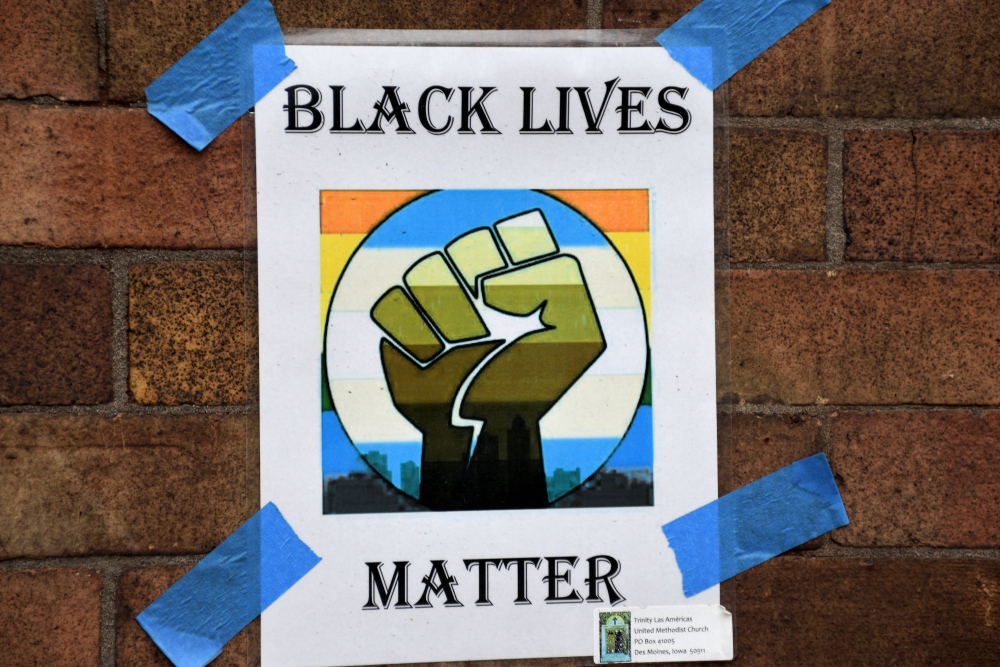
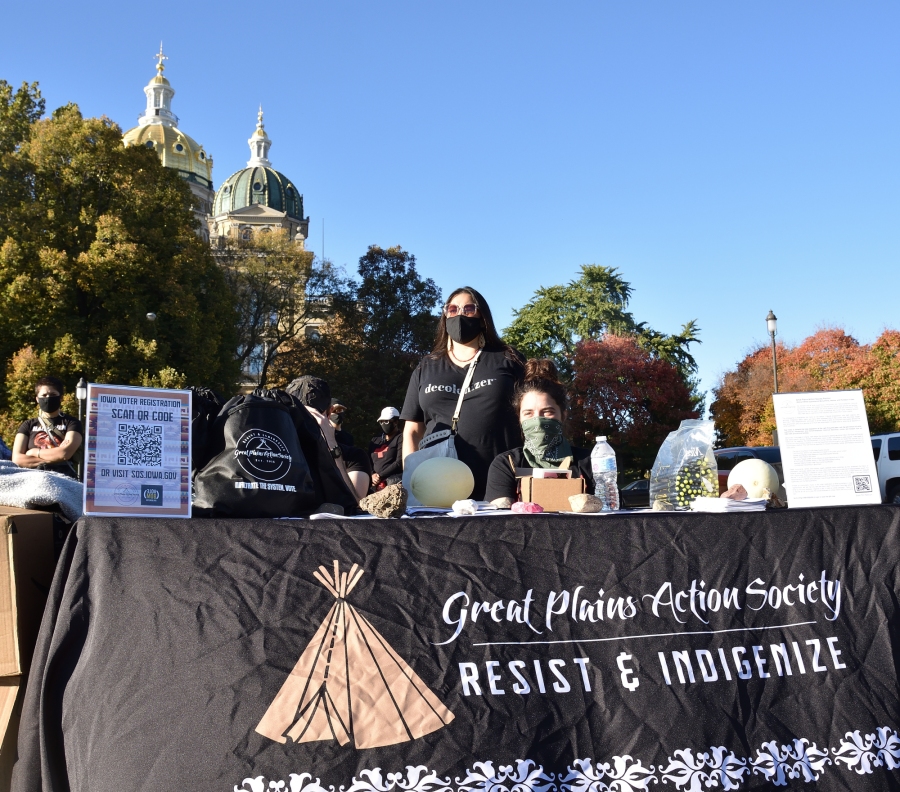
My friends at the Great Plains Action Society have a graphic that says “Infiltrate the system. Vote.” A variation comes to mind with the news that Indira Sheumaker was elected to the Des Moines City Council. “Infiltrate the system, run for office.” Indira has been involved in the Black Liberation Movement.
Des Moines voters sent a new, young candidate to the City Council chamber in Tuesday’s election, ousting a longtime incumbent, and supported keeping two other council members in office.
First-time candidate Indira Sheumaker defeated incumbent Bill Gray in the Des Moines City Council’s Ward 1 race. Gray was first elected in 2014.
Sheumaker attended her first council meeting when the group voted on an ordinance to ban racial profiling by the police department. There, she said, she heard “a lot of passionate people” speak up — herself included — but she felt like city leaders moved quickly without considering additional action.
Sheumaker said she would not have run for office if it weren’t for her involvement in last year’s protests with the Black Liberation Movement.
“I got involved protesting, showing up to the (Iowa) Capitol, got tear-gassed … and then a lot of members from organizations and older members of the community were encouraging us to go to City Council meetings,” Sheumaker previously told the Des Moines Register.
Sheumaker, 27, represents a new generation of politics, forged during a summer of protests and activism following the murder of George Floyd in Minneapolis in May 2020. Already, she’s marshaled her influence to rally speakers at City Council meetings, organized protests against police brutality and created a grassroots campaign that toppled two-term incumbent Bill Gray.
Now, with a seat on the Des Moines City Council, she faces a new challenge as she seeks to channel that grassroots energy into her role as an elected official. The goal, she said, is not to settle into the entrenched political dynamics she has spent the last year and a half protesting, but to lift up new voices and create avenues for change by being more transparent about the inner workings of Des Moines city government.
“The stuff that isn’t talked about, but isn’t, you know, protected behind some kind of confidentiality barrier … I have no qualms about being completely open about that and telling people what’s going on because people need to know what’s happening in their city,” she said.
In her own race, Sheumaker spoke openly about drawing inspiration from the protests, as well as her desire to redirect funding from the city’s police department into social programs, with an eventual goal of making the Des Moines Police Department obsolete.
“I want to be creating a public safety system in Des Moines that’s from the community, is built into the community, and is focused on transformative and restorative justice that is designed to lessen interaction between residents and police,” she said previously.
“We just won our campaign on a platform centered on Defunding the Police for Safety and Justice. It can be done,” Sheumaker said in a campaign statement. “My goal for this city has always been to work from the bottom up. Not the top down.” In her campaign, Sheumaker also stressed the importance of making food and housing accessible, flood preparedness, rent control, decriminalizing cannabis, tenant rights, and combating corporate greed.
“I want to be the kind of leader who is part of the community, the kind of leader people can talk to you,” Sheumaker told the crowd at a cafe in downtown Des Moines the night election results rolled in, according to Iowa Public Radio. She said given that she’s a protester and activist herself, she can’t tell people not to “show up” on her lawn.
Sheumaker became involved in politics after the police killing of George Floyd when she organized marches for racial justice in Des Moines. Since then, she’s worked steadily with the Black Liberation Movement (which supported her campaign) and advocated for defunding the police.
A photo in a news story showed Indira sitting in front of a memorial to black children. I drive past there when I go to Des Moines for our Mutual Aid food project. Here are some of my photos of that memorial.
This morning I had one of those “ah ha” moments, when something changes my perspective in a way that explains things that seemed inexplicable. I don’t remember hearing the term ‘human supremacy‘ before. But as soon as I read that I understood what it is. White supremacy been part of our national conversation for years. Human supremacy extends the idea of white supremacy to the domination of everything non-human by humans.
One of the most important points umair haque makes in the article referenced below is there are no hierarchies. That is the fundamental concept of Mutual Aid. In our Mutual Aid work, we monitor ourselves to avoid any vertical hierarchy from creeping in. That’s something you have to learn and practice when you begin to work in a Mutual Aid community. We are so used to having someone in charge, someone making decisions.
When there isn’t a vertical hierarchy, by definition there can be no supremacy.
As the systems now in place break down because of environmental, economic, and political chaos, we will be forced to find different ways of living. Mutual Aid is one possibility. One that gets away from human supremacy.
One of the most insightful authors I follow is umair haque. His article today is titled “The End of Human Supremacy”.
If I say to you that we need to end white supremacy, you’ll probably agree with me, wise and gentle person that you are. But this is a job, to tell you the truth, that we should have done long, long ago. The work before us this century is much harder, and goes much further. I call it the end of human supremacy.
What I mean by that is something like: at this juncture in history, we walking apes regard ourselves as supreme. Above and beyond everything else, at the top of our own self-imagined hierarchies of life and being. We’re way better — way more powerful than a dumb little virus, aren’t we? Maybe not. And because of that very mistake — human supremacy — our civilization has plunged into the beginnings of collapse.
Because our civilization is built on this pillar, “I think therefore I am,” our economies and societies have developed in a perverted way. They don’t think — therefore they aren’t. They aren’t people — they don’t deserve the rights and protections and guarantees of personhood. They are there to be subjugated, exploited, abused.
Do you see what I mean by human supremacy a little bit now?We’re the only “people” on this planet.And therefore, only we matter. We’ve made a tiny bit of progress. Sure, women and people of color are now allowed into the ranks of “people” — sometimes. But human beings sit still atop our great hierarchies. If I ask you to examine your conception of the world, it will be a modern one, not a premodern one — unlike the ancients, you probably won’t put human beings at the bottom…you’ll put them at the top.
And that’s what we have to undo.
We don’t belong at the top of any hierarchies. There are no hierarchies and there is no top.There are webs and spirals and links between things. But a top? It doesn’t exist. Our entire civilization was brought to a halt by a tiny microbe. Still think we’re at the top? OK, then imagine this. The fish clean the rivers we drink from, the insects and worms turn the soil of our harvests, the trees give us air to breathe. Top? What top?
The End of Human Supremacy. Our Civilization is Collapsing. But Can We Change Fast Enough to Stop It? by umair haque, Eudaimonia, Oct 31, 2021
Eileen Crist knows more than a person should, more than seems healthy, about dying birds and dying watersheds. She’s keenly aware of the global crisis of biodiversity loss and ecological collapse, and she sees what’s driving it: direct causes like climate change and what she calls the “ultimate causes” — population growth, overconsumption, and technological power. But the thing that really interests Crist, the thing that she’s been studying and publicizing for the past three decades as a professor and radical environmental thinker, is an even deeper question: Why is so little being done to address this planetary emergency?
She attempts, with a mix of intellectual rigor and lyrical passion, to provide an answer in her 2019 book, Abundant Earth: Toward an Ecological Civilization. The cause of our inaction, she says, is “human supremacy,” a largely unconscious belief that Homo sapiens are the masters of creation rather than just one humble species among millions. This worldview sanctions not only factory farming, clear-cut logging, mountaintop-removal mining, and bottom-trawl fishing, but also more commonplace behaviors such as cruising along in cars that slaughter wildlife and emit carbon dioxide. As long as human supremacy prevails, Crist writes, “humanity will remain unable to muster the will to scale down and pull back the burgeoning human enterprise that is unraveling Earth’s biological wealth.”
The most important thing to expose and dissect is human supremacy. It often gets referred to by the gentler term anthropocentrism. I view it as a widely shared, unconscious worldview that tells us we are superior to the rest of nature and thus entitled to treat nonhumans and their habitats however we please. Human specialness, human aboveness, and the sanctity of the human prerogative — those are key elements, along with our seizing the power of life and death over nonhumans and our aggressive control of all geographical space.
Human Supremacy by Sara Wright, April 21, 2021. Our Great Reckoning. Eileen Crist On The Consequences Of Human Plunder by LEATH TONINO, DECEMBER 2020
Since the inception of the patriarchal culture (ca. 10000 BCE) we have become conditioned to assume that human supremacy over nature is “natural law.” But there is nothing natural about human supremacy and derivatives such as male supremacy, white supremacy, and other such ideologies of domination.
Despite the collapse of capitalism and the current political system based upon it, there are signs of hope. More and more people are joining with others to build better economic and political systems. Or return to systems that worked in the past for hundreds of years.
I am blessed to have gotten to know people who are doing just that. One of my new friends is Jake Grobe who works at Iowa Citizens for Community Improvement (ICCI). Jake joins in our Mutual Aid work in Des Moines. I knew he was going to the People vs Fossil Fuels Week of Action last week in Washington, DC. I saw some of what he posted online while he was there. And we got to visit yesterday when we were at the Mutual Aid food bank. He described being present when the flag outside the Army Corps of Engineers was replaced with one indicating “No Consultation”, which you can see in the video below. Following is from an email message he sent yesterday. I like the things he said about what gives him hope.
Also below is part of a teach-in my friend Ronnie James presented in 2020. “The recent past shows us that mutual aid is not only a tool of survival, but also a tool of revolution.“
In addition, umair haque writes about the problems with hierarchies. “These two forces naturally oppose one another, like fire and ice — hierarchy and progress. And it seems to me one of the great secrets history tries to teach us is that when we find ways to make them work together, then and only then human possibility opens to its fullest horizons.”
Hierarchy is what Mutual Aid is about. Mutual Aid works to avoid vertical hierarchies. And instead to maintain a flat or horizontal hierarchy, where everyone has a voice.
As an example of how our struggles are interconnected, Jake and Ronnie are in the photo below that was taken after we completed the Mutual Aid food giveaway. We are supporting the Wet’suwet’en peoples who are struggling to protect the water and prevent the construction of the Coastal GasLink pipeline through their pristine lands.
Last week a delegation of CCI members and People’s Action joined thousands in Washington DC for the People vs Fossil Fuels Week of Action. Led by Indigenous and frontline communities, we marched, occupied, and blocked roads alongside faith groups, racial justice groups, and environmental groups to demand federal action to end the era of fossil fuel destruction.
Despite all the promises, the Biden Administration has approved over 2,500 new oil and gas permits on public land, the fastest pace since 2008. He has let projects like the Line 3 tar sands pipeline in Minnesota go online, already polluting sacred water and violating treaty rights. And as I speak, Biden is surrendering to the demands of two blatantly corrupt Senators to gut the Build Back Better bill of programs needed to address the climate crisis.
Reeling with all this has been hard to say the least. Here is where I’m finding hope:
Indigenous people have been resisting genocide for hundreds of years and many continue to lead the fight on the frontlines – there is a lot to learn.
Over 500 of us were arrested in the name of justice last week, many more have put their literal bodies on the line to stop construction of fossil fuel projects, and right now Sunrise youth are going on a hunger strike outside the white house while tens of thousands of workers are on strike.
People seeing their power and using it means we can win, because Mother Earth will regenerate and heal herself, as soon as we stop the harm.
Perhaps, like me, you think things aren’t going so well in the world today — 1930s style authoritarianism, extremism, and stagnation rock the world like a hurricane once again. The question then is this: what kind of world do we want? In this essay I’m going to offer three futures. They’ll contrast the tension between hierarchy and progress. You see, the question in ages like this one is whether hierarchies — which make things comfortable for those above the waterline, even during decline and collapse — can make us more capable of change, growth, and maturity, somehow too. So I will write it from a curious perspective, too — that we each decide, in some way, what kind of future we are to create.
These two forces naturally oppose one another, like fire and ice — hierarchy and progress. And it seems to me one of the great secrets history tries to teach us is that when we find ways to make them work together, then and only then human possibility opens to its fullest horizons.
So what kind of future do we want? One with lots of burdensome, bitter, and polarizing hierarchy — groups vying to pull each other down — which flatlines progress? Or one where consensual hierarchy has collapsed into predation — no one can agree to govern or be governed, so monsters rule — which leads to super-charged regress? Or one in which, improbably, hierarchy and progress have learned, improbably, to walk hand in hand? That choice, I think, is the one that will define these times.
As bleak as this is, there is a significant amount of resistance and hope to turn the tide we currently suffer under. We stand on the shoulders of giants that have been doing this work for centuries, and there are many lessons we can learn from.
The first, and possibly the most important, is that it was not always this way, which proves it does not have to stay this way.
What we have is each other. We can and need to take care of each other. We may have limited power on the political stage, a stage they built, but we have the power of numbers.
Those numbers represent unlimited amounts of talents and skills each community can utilize to replace the systems that fail us. The recent past shows us that mutual aid is not only a tool of survival, but also a tool of revolution.
If we are to survive, and more importantly, thrive, we know what we will have to do.
All Power To The People.
Ronnie James, The Police State and Why We Must Resist, 8/22/2020
New or worsening catastrophes seem to be coming at us daily. Worse things than we can imagine are yet to come. When I say “we” in most cases I mean white people since many things below are race related.
I often think of what Albert Einstein said, “problems cannot be solved with the same mind set that created them.”
There are several reasons I’ve been praying, thinking, and writing about the precarious place we are at now. We need to build alternatives to the systems of capitalism, materialism, militarism, incarceration, racism, and white supremacy. Systems rooted in stolen lands and stolen labor. Not only because they are founded on injustice, but because these systems are failing now. (See: Time for a reset)
Any chance we have to address these injustices and mitigate these dangers requires changing our mind set. Looking back over my life it seems like an endless struggle to try to change people’s mind set, with no success.
What is different now is changes are being forced upon us.
Deepening environmental chaos is one of the main drivers of change. Millions of people have lost their homes and communities because of fires and storms. Lack of water will increasingly force many to relocate. Drought will decimate food production.
Our political and social systems are breaking down with the rise of authoritarianism and the police state.
Violence is increasing dramatically in the face of these dangers. Civil discourse is often impossible. Who could have imagined violence at school board meetings? Of children being yelled at for wearing masks? School shootings? An insurrection at the US Capitol?
However much we continue to try to avoid dealing with these threats to the society we grew up in, we are being forced to deal with these changes and what they portend.
What might be some worst-case scenarios?
Clean water becomes increasingly scarce. Many industries result in significant water pollution including runoff of agricultural fertilizers and pesticides, and massive amounts of sewage from concentrated farming practices. Fossil fuel mining such as fracking and tar sands pollute vast quantities of water.
Food insecurity will increase as drought spreads or fires destroy farmland and communities. Continued warming will decrease crop yields.
Electricity will increasingly be interrupted or cease as energy systems and electrical grids fail or cannot meet demands, resulting in problems with
refrigeration, heating, and air conditioning
operation of people’s myriad electrical devices including phones and computers. Social media will disappear.
computer systems involved in every aspect of modern life
physical plants
communication networks
water sanitation and sewage systems
coordinating purchasing and shipping
hospital and pharmacy systems
energy systems
educational institutions
manufacturing
air traffic and flight control
military systems
judicial systems, including police dispatch and legal documents.
operation of carceral systems
Some political systems will become increasingly authoritarian as many citizens demand protection from “others”.
Social disorder will preclude political order.
There are other things to add to the list.
To reiterate, these systems are beginning to fail now. And will continue to do so. We will not be able to continue to avoid thinking and doing something about them.
Think about the related problems from just one of these: no functioning cell phones, tablets or computers. What might happen when there are no longer any social media platforms? How will young people who have never known a time before there were cell phones going to react?
I’ve been thinking of these things in the context of justice work. Lobbying our legislatures to support peace and justice issues will no longer be relevant (or possible). The injustices we often work on as distinct issues will be drowned out by increasing chaos.
Our work for justice should be to engage with systems that are replacing our broken ones. This would actually be returning to systems such as LANDBACK, Abolition, and Mutual Aid.
This diagram I’ve been working on shows some of the ways people are building ways to adapt as old systems collapse.
More information about LANDBACK, Abolition, and Mutual Aid can be found with the following links.
I know now cannot be the future. What I’m saying is there are so many crises that urgently need action now. How long can we keep procrastinating? (That’s a rhetorical question.)
The list of crises is long and new ones continue to appear.
Despite all we are being confronted with now, we will look back on these days in the future and wish we could return to what we have now. Instead, we will increasingly be affected by worsening consequences of these crises.
It is increasingly difficult to make sense of all that is going on today. All the bad things I had anticipated for the future are suddenly happening now. And things I never imagined, like the assaults on truth, science, governance, health, and safety come at a time when they are desperately needed. It is difficult to make sense of it all.
If these things can confound and divide us both within and between cultures, then we have little hope of generating the coherent dialogue, let alone the collective resolve, that is required to overcome the formidable global-scale problems converging before us.
James Allen
sensemaking–the action or process of making sense of or giving meaning to something, especially new developments and experiences.
At the collective level, a loss of sensemaking erodes shared cultural and value structures and renders us incapable of generating the collective wisdom necessary to solve complex societal problems like those described above. When that happens the centre cannot hold.
Threats to sensemaking are manifold. Among the most readily observable sources are the excesses of identity politics, the rapid polarisation of the long-running culture war, the steep and widespread decline in trust in mainstream media and other public institutions, and the rise of mass disinformation technologies, e.g. fake news working in tandem with social media algorithms designed to hijack our limbic systems and erode our cognitive capacities. If these things can confound and divide us both within and between cultures, then we have little hope of generating the coherent dialogue, let alone the collective resolve, that is required to overcome the formidable global-scale problems converging before us.
Following is a diagram I’ve been working on to help me make sense of where things are now, and ways to build a better future.
Where things stand now is represented by the path beneath the WHITE heading. Capitalism is outline in red because it represents the injustices capitalism is based on and indicates remaining on this path will continue to result in environmental chaos. See: Rejecting Capitalismhttps://landbackfriends.com/2021/10/06/rejecting-capitalism/
The BLACK column represents the stolen labor of those who were enslaved and continues today with all the aspects of systemic economic, judicial system, and environmental racism.
The INDIGENOUS column represents the theft of native lands, genocide and forced assimilation. Includes the consequences of destroying the land and widespread pollution of water. And the epidemic of violence against native peoples, specifically missing and murdered Indigenous relatives.
Many people have been working on alternatives, some for years, others more recently. Some of these alternatives are listed in the green box labeled Green New Deal and Red Deal (which is an Indigenous led green new deal).
The website I recently created, LANDBACK Friends, contains more information about these topics.
As sometimes happens, I spend so much time writing background information that I don’t get to the subject I’d planned to write about. What I had intended to write was why I believe we need to think and work “outside the box”. The box in this case represented by columns Black, White and Indigenous, which is a sketch of the current situation. We should not waste more time and effort trying to make incremental changes to those existing systems. And instead work for LANDBACK, Abolition and Mutual Aid. Which my good friend Ronnie James expresses more eloquently here:
I’m of the firm opinion that a system that was built by stolen bodies on stolen land for the benefit of a few is a system that is not repairable. It is operating as designed, and small changes (which are the result of huge efforts) to lessen the blow on those it was not designed for are merely half measures that can’t ever fully succeed.
So the question is now, where do we go from here? Do we continue to make incremental changes while the wealthy hoard more wealth and the climate crisis deepens, or do we do something drastic that has never been done before? Can we envision and create a world where a class war from above isn’t a reality anymore?”








 LANDBACK Friends