Does Mutual Aid speak to your condition?

For the past week I’ve been writing daily to prepare for a discussion at my Quaker meeting this Sunday. (See the table at the end listing those posts).

Yesterday’s post is an example of why I need to prepare. I went a bit off track. There is a lot to Mutual Aid, and we can’t cover it all in one hour. I hope there will be interest to continue to explore more about Mutual Aid after this weekend’s discussion.

In the quote below (Quaker) George Fox uses the term “speak to my condition”. I think that might be a way to frame Sunday’s discussion, does Mutual Aid speak to our condition today?

But as I had forsaken the priests, so I left the separate preachers also, and those esteemed the most experienced people; for I saw there was none among them all that could speak to my condition. And when all my hopes in them and in all men were gone, so that I had nothing outwardly to help me, nor could tell what to do, then, oh, then, I heard a voice which said, “There is one, even Christ Jesus, that can speak to thy condition”;

George Fox, (Quaker)

I wrote about using questions (queries) to help guide the discussion and encourage participation by those attending. (Notes to Myself).

Queries related to Mutual Aid
Do we recognize that vertical hierarchies are about power, supremacy and privilege? What are Quaker hierarchies?
Do we work to prevent vertical hierarchies in our peace and justice work?
What are we doing to meet the survival needs of our wider community?
How are we preparing for disaster relief, both for our community, and for the influx of climate refugees?
Are we examples of a Beloved community? How can we invite our friends and neighbors to join our community?

The following table lists some of the queries that we routinely use that apply to Mutual Aid.

Advices and Queries of Iowa Yearly Meeting (Conservative)
OutreachIn what ways do we cooperate with persons and groups with whom we share concerns? How do we reach out to those with whom we disagree?
Civic responsibilityIn what ways do we assume responsibility for the government of our community, state, nation and world?
Environmental responsibilityWhat are we doing about our disproportionate use of the world’s resources?
Social and economic justiceHow are we beneficiaries of inequity and exploitation? How are we victims of inequity and exploitation? In what ways can we address these problems?
What can we do to improve the conditions in our correctional institutions and to address the mental and social problems of those confined there? (This one is related to Abolition of police and prisons)
Peace and nonviolenceWhat are we doing to educate ourselves and others about the causes of conflict in our own lives, our families and our meetings? Do we provide refuge and assistance, including advocacy, for spouses, children, or elderly persons who are victims of violence or neglect?
Do we recognize that we can be perpetrators as well as victims of violence? How do we deal with this? How can we support one another so that healing may take place?

Mutual aid work is not easy. It means forming lasting commitments to doing hard work collaborating with people even when we have conflict. And facing the heart-wrenching realities of the systems we live under. It is also deeply satisfying work that transforms us from being exasperated passive observers of the shitstorm we’re living in to inspired builders of the new world we desperately crave.

Dr Stuart Jeanne Bramhall

There are three key elements of Mutual Aid.

  1. Mutual aid projects work to meet survival needs and build shared understanding about why people do not have what they need.
  2. Mutual aid projects mobilize people, expand solidarity, and build movements.
  3. Mutual Aid projects are participatory, solving problems through collective action rather than waiting for saviors.

    Mutual Aid, Building Solidarity during this Crisis (and the next) by Dean Spade, Verso, 2020
DateBlog posts related to Mutual Aid discussion
Mutual Aid in the Midwest
12/31/2021A Call for Quakers to Embrace Mutual Aid
1/2/2022What I Don’t Know About Mutual Aid
1/3/2022Notes to Myself
1/4/2022Notes to Myself Continued
1/5/2022Spirituality and Mutual Aid
1/5/2022More Notes on Mutual Aid

More notes on Mutual Aid

I’ve been preparing for a discussion my Quaker meeting will have this weekend about Mutual Aid. At the end of this is a table of posts I’ve been writing to help me organize my thoughts. I am not satisfied with how this post has turned out, but these are notes, not a finished document.

Stepping back from the details, I’m reflecting on what I hope will happen as a result of this discussion. My hope is that we begin to use Mutual Aid to guide our work, both in our Quaker meeting and how we do our work in the community for peace and justice.

Mutual Aid requires a paradigm shift from a community of primarily White Quakers immersed in the capitalist economic system, white supremacy, settler colonialism and land theft, forced assimilation, foreign and domestic militarism, state sanctioned violence, punishment oriented criminal justice system, fossil fuel power, and whatever you call our political systems.

Wow!

The greatest obstacle will be to persuade Friends that we should stop participating in those systems. Although that is looking more attractive as these systems are rapidly collapsing now.

Capitalism is economic slavery. Capitalism has forced millions into poverty. Capitalism denies shelter, food, water, healthcare quality education, and the ability to build any wealth at all to millions of people.

There were White Quakers who were involved in the institution of slavery. Even those who did not claim ownership of enslaved men, women and children benefited economically. Continue to benefit.

I don’t think we have many years of civilization left. But I think a few years hence people will look back at this time in a similar way to how we look back on slavery.

Quakers also have their history of participation in the institutions of forced assimilation to atone for. This is a significant barrier between Friends and Indigenous peoples.

In December 2020, Ronnie James and I had the following email exchange:

RonnieI don’t know what you can do. The church is the church’s past, which is its future. It continues to see my people as obstacles in its endless conquest.
JeffI was not feeling worthy of participating in Mutual Aid but thanks to you, I’ve signup up again for this weekend.
RonnieYou’re a good relative Jeff. To be blunt, there is too much damage that the church profits from and needs to protect to have any future there.
JeffI am afraid you are right.
RonnieI wish you the best. I imagine its a hard struggle.

Mutual aid work is not easy. It means forming lasting commitments to doing hard work collaborating with people even when we have conflict. And facing the heart-wrenching realities of the systems we live under. It is also deeply satisfying work that transforms us from being exasperated passive observers of the shitstorm we’re living in to inspired builders of the new world we desperately crave.

Dr Stuart Jeanne Bramhall
DateBlog posts related to Mutual Aid discussion
Mutual Aid in the Midwest
12/31/2021A Call for Quakers to Embrace Mutual Aid
1/2/2022What I Don’t Know About Mutual Aid
1/3/2022Notes to Myself
1/4/2022Notes to Myself Continued
1/5/2022Spirituality and Mutual Aid

Spirituality and Mutual Aid

This continues my preparation for a discussion about Mutual Aid at my Quaker meeting this weekend. A couple of days ago I wrote about using queries (questions) to invite people to participate in the discussion. And began to come up with some queries.

It occurred to me that some of the queries we already have are relevant to the discussion about Mutual Aid. I’ve listed some of those in this table.

Advices and Queries of Iowa Yearly Meeting (Conservative)
OutreachIn what ways do we cooperate with persons and groups with whom we share concerns? How do we reach out to those with whom we disagree?
Civic responsibilityIn what ways do we assume responsibility for the government of our community, state, nation and world?
Environmental responsibilityWhat are we doing about our disproportionate use of the world’s resources?
Social and economic justiceHow are we beneficiaries of inequity and exploitation? How are we victims of inequity and exploitation? In what ways can we address these problems?
What can we do to improve the conditions in our correctional institutions and to address the mental and social problems of those confined there? (This one is related to Abolition of police and prisons)
Peace and nonviolenceWhat are we doing to educate ourselves and others about the causes of conflict in our own lives, our families and our meetings? Do we provide refuge and assistance, including advocacy, for spouses, children, or elderly persons who are victims of violence or neglect?
Do we recognize that we can be perpetrators as well as victims of violence? How do we deal with this? How can we support one another so that healing may take place?

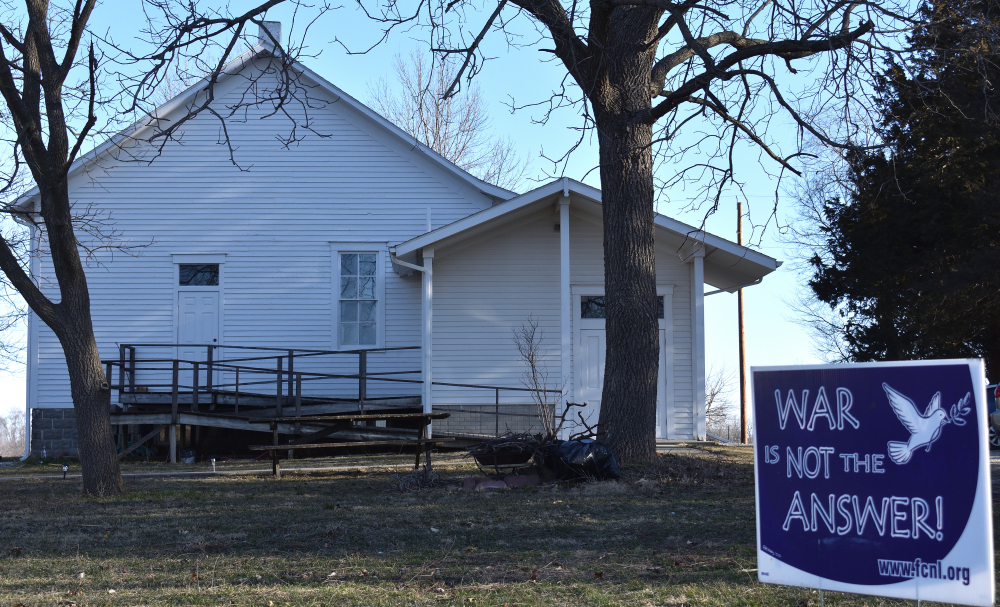
Iowa Yearly Meeting (Conservative) is the yearly meeting my Quaker meeting (Bear Creek) belongs to. (Note: Conservative means maintaining/conserving the beliefs and practices of early Friends). There is an unofficial Facebook group for the yearly meeting. I share most of my blog posts with this group, hence the reference to mutual aid in the following that Marshall Massey wrote recently.

The Christian position, rooted in Deuteronomy 10:14 and Psalm 24:1, is that the Earth and all it contains belongs to the Lord, and we have no more ownership of any part of it than inheres in the right to enjoy a measure of its fruits without selfishness. Thus the early Jerusalem church went so far as to abolish private property, to hold all things in common, and to give to the needy amongst them “as anyone had need” (Acts 2:44-46, 4:32-35).

Friends from the seventeenth through the nineteenth centuries carried this ancient testimony forward, not going all the way to the abolition of private property but certainly giving generously from its fruits to their meetings, pressuring those who failed to give, and relying upon committees of overseers (the Quaker equivalent of deacons) to distribute what had been given to the meeting to those who were in need. In some corners a measure of this practice persists today. This is a testimony of communal sharing and mutual aid (hello, Jeff Kisling!) that we inherit and can revive and carry forward in the very teeth of the American obsession with private wealth, and it is eminently applicable to the right sharing of whatever is in our hands. A meeting can give of its funds to any threadbare storefront church, if it feels so led, without any need of royalty calculations, on the grounds of love and faithfulness alone.

Marshall Massey, member of Iowa Yearly Meeting (Conservative)


Spirituality

I had been having a lot of trouble for the past several years, especially now that I’m blessed to have many Indigenous friends, about Christianity in general, and Quakers in particular related to the institutions and policy of forced assimilation. The only times I’ve brought up Quakers with Indigenous friends are when I’ve acknowledged and apologized for what was done.

Well, there was the time I briefly explained Quaker worship and we spent a little time in silence, holding hands, during the First Nation Farmer Climate Unity March (2018). Each time we walked over the Dakota Access Pipeline as we walked together from Des Moines to Fort Dodge (ninety-four miles) someone would offer prayers.

I bring this up because a number of my Mutual Aid friends are Indigenous people. I first learned about Mutual Aid when I met Ronnie James at a vigil for the Wet’suwet’en peoples in February, 2020. Ronnie is an Indigenous organizer and now a close friend. He mentored me as I learned about Mutual Aid.

I think Quakers and other Christians should be very careful about speaking about our religious beliefs, especially when with Native people.

On the other hand, one of the most impressive things about Mutual Aid, with it’s flat hierarchy, is people aren’t treated as belonging to any particular group. My Mutual Aid community has the greatest diversity I’ve ever experienced in the Midwest and we get along so well because of the mutuality concept. That alone should encourage Friends to seriously consider joining in the work of Mutual Aid.

Notes to myself continued

Yesterday I wrote about preparing for a discussion about Mutual Aid at my Quaker meeting this Sunday. Describing the use of queries, and then coming up with an initial series of questions.

Now I’m outlining the major topics to discuss. An hour isn’t much time, and the point of queries is to allow people time to respond to them.

I think I should begin by telling the story of how the Spirit led me to connect with Ronnie James, and how he mentored me about Mutual Aid. And then my experiences of being in that Mutual Aid community. It is important to speak from our own experiences.

What are the main points I want to make?

  • We have no choice but to find alternatives since the status quo has begun to and will increasingly collapse.
  • The status quo has been very different for different segments of our society.
  • This is a chance to build alternatives that are just and equitable.
  • This is an opportunity to conserve resources. To move toward living within ecological limits.
  • “It is about acknowledging that we Americans have enjoyed middle-class comforts at the expense of other peoples all over the world.” Grace Lee Boggs
  • A chance to live with spiritual integrity. Which we must do before we can speak to the spiritual needs of anyone else.
  • Mutual Aid addresses the above.

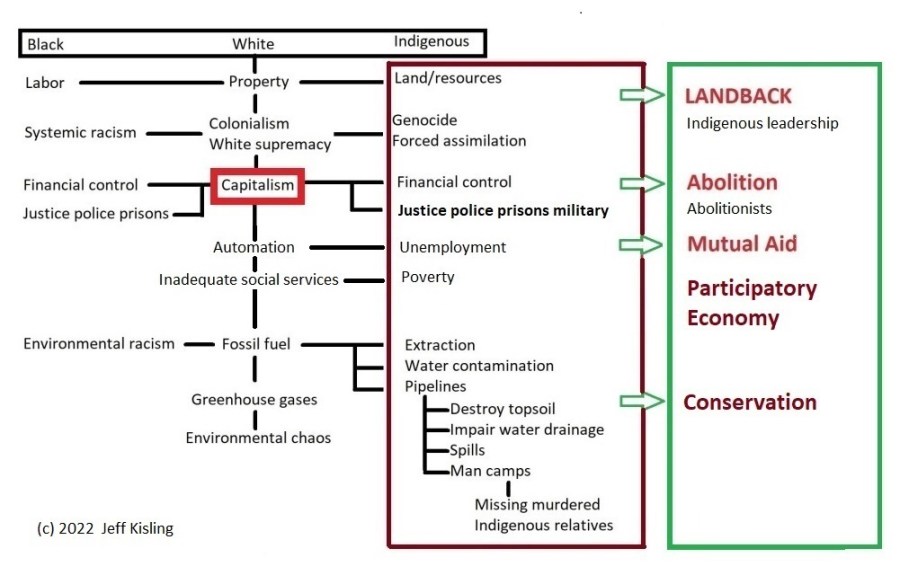
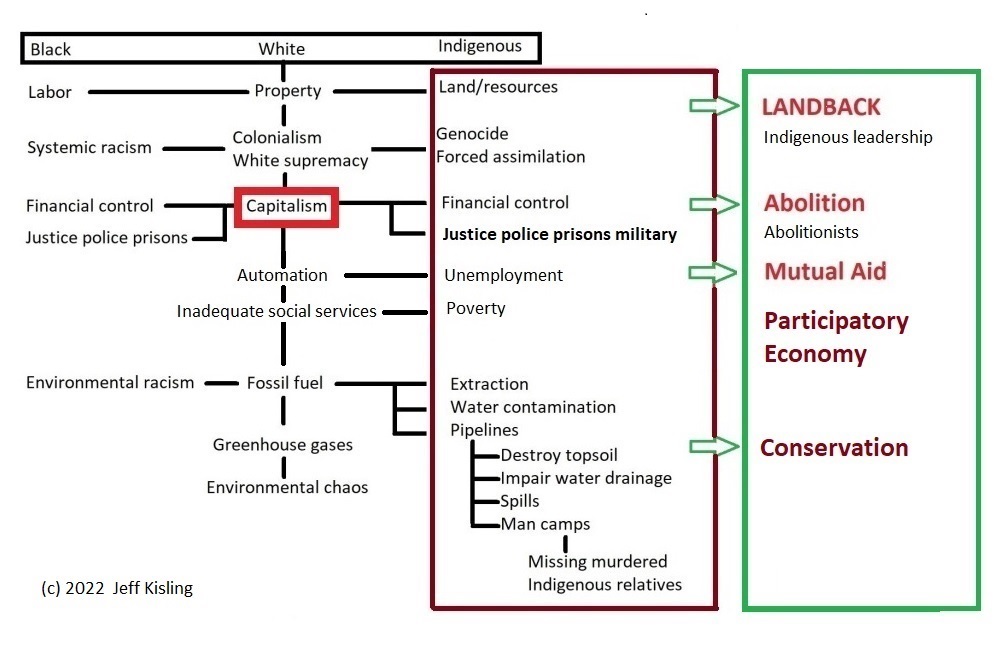
As these graphics explain, there is more than Mutual Aid involved in building the communities we want. Building Mutual Aid communities is a first step because it provides the framework for how a community works together and can address other things like abolition and LANDBACK.

Abolition and the mutual aid that we practice are inextricably linked.

I participate in the Prison Abolition Letter Writing Project that was started in 2018 as part of Central Iowa Democratic Socialists of America’s Prison and Police Abolition Working Group. Several of us from Des Moines Mutual Aid participate in the letter writing project.

And I am a member of the Quakers for Abolition Network (QAN).

We as White Quakers like to think of ourselves as ahead or better than dominant culture, but we have been complicit in a system and mindset that are ubiquitous. Claiming the full truth of our history and committing to repair the harms done are deeply spiritual acts of healing our own wounds of disconnection. I would argue it is the pathway upon which we can, perhaps for the first time, discover and invigorate our faith with its full promise.

What would it mean for us to take seriously and collectively as a Religious Society a call to finish the work of abolition, hand in hand and side by side with those affected and their loved ones? What would it mean for us to stand fully with the calls to abolish the police and fully fund community needs instead? What would it mean to reckon with our past complicity with harm and fully dedicate ourselves to the creation of a liberating Quaker faith that commits to build the revolutionary and healing faith we long to see come to fruition? What would it look like to finally and fully abolish slavery?

A Quaker Call to Abolition and Creation by Lucy Duncan, Friends Journal, April 1, 2021

The next American Revolution, at this stage in our history, is not principally about jobs or health insurance or making it possible for more people to realize the American Dream of upward mobility. It is about acknowledging that we Americans have enjoyed middle-class comforts at the expense of other peoples all over the world. It is about living the kind of lives that will not only slow down global warming but also end the galloping inequality both inside this country and between the Global North and the Global South. It is about creating a new American Dream whose goal is a higher Humanity instead of the higher standard of living dependent on Empire. It is about practicing a new, more active, global, and participatory concept of citizenship. It is about becoming the change we wish to see in the world.

The courage, commitment, and strategies required for this kind of revolution are very different from those required to storm the Winter Palace or the White House. Instead of viewing the U.S. people as masses to be mobilized in increasingly aggressive struggles for higher wages, better jobs, or guaranteed health care, we must have the courage to challenge ourselves to engage in activities that build a new and better world by improving the physical, psychological, political, and spiritual health of ourselves, our families, our communities, our cities, our world, and our planet.

Grace Lee Boggs, The Next American Revolution

Notes to myself

This morning I’m seeking guidance for a way to discuss the concepts of, and my experiences with Mutual Aid in preparation for a discussion about that with my Quaker meeting.

Quakers have a long tradition of prayerfully reflecting upon a series of questions, we call queries, to facilitate our discussions of topics like education, social and economic justice, peace and nonviolence. You can see these queries here: Advices and Queries.

The brilliance of using questions stimulates each of us to engage with the topic, whether we speak aloud about our reflections or not. To facilitate reflection and prayer rather than being lectured to.

Developing queries about Mutual Aid to guide this discussion might be the best approach. So, what should the queries be?

We need to discuss:

  • What is Mutual Aid?
  • What are the pros and cons of charity?
  • Why is Mutual Aid not charity?
  • Examples of vertical and flat/horizontal hierarchy
  • What are Quaker hierarchies?
  • What is the state of our peace and social justice work now?
  • What is a beloved community?
  • Is Mutual Aid closer to being a beloved community than our current conditions?
  • Why is Mutual Aid important now?
  • What is the state of our current economic (capitalism), justice, healthcare, education, and political systems?
  • Is capitalism an unjust economic system?
  • What will we do when our community experiences environmental, economic and/or political catastrophe?
  • What will we do when our shelter, power, and sources of food and water are disrupted?
  • What should we do to prepare for the migration of climate refugees to our communities?
  • How can we provide spiritual support for our wider communities?
  • Can we build Mutual Aid groups when people are physically separated?
  • What are the potential advantages and disadvantages of Mutual Aid?

Although many on the list above are questions, they are not necessarily the best expression of the queries for the discussion. I’ll be working on that next.

Change is difficult. It is far easier to maintain the status quo. But our status quo is rapidly unraveling.

The question below, “what will your choice be?” comes from the Wet’suwet’en peoples who are trying to protect their pristine lands and water from pipeline construction. “We make choices as to enter the uncomfortable place of change & movement, or we continue on this downward spiral.” [At the present time the Royal Canadian Mounted Police are preparing to invade the Wet’suwet’en territory.]

“We make conscious decisions to either sit back and watch, or stand up and be heard.
We make choices as to whether protect our future generations, or we allow for a destitute future for them.
We make choices as to enter the uncomfortable place of change & movement, or we continue on this downward spiral.
What will your choice be?
Will you sit back and allow for human rights violations to occur, or will you #RiseUp with us?”


Wet’suwete’n Access Point at Gidemt’en Facebook Page

Embracing Mutual Aid might be uncomfortable for some. Will we have the courage to enter the uncomfortable place of change and movement?

I’ve been working on this diagram to show relationships between the current situation and how Mutual Aid fits into this larger picture. I don’t think there will be time to include much of this in this Sunday’s discussion. But Mutual Aid is one piece of several changes (LANDBACK, Abolition and a better economic system) we need to make urgently.

There are three key elements of Mutual Aid.

  1. Mutual aid projects work to meet survival needs and build shared understanding about why people do not have what they need.
  2. Mutual aid projects mobilize people, expand solidarity, and build movements.
  3. Mutual Aid projects are participatory, solving problems through collective action rather than waiting for saviors.

    Mutual Aid, Building Solidarity during this Crisis (and the next) by Dean Spade, Verso, 2020

RCMP Invasion expected on Wet’suwet’en territory

Readers of my blogs know what an influence the struggles of the Wet’suwet’en peoples have had on my life. It was at a vigil for the Wet’suwet’en in February, 2020, that I met Ronnie James and became involved in Des Moines Mutual Aid. Links to articles about the Wet’suwet’en can be found below.

I am deeply saddened to hear that another invasion of the Wet’suwet’en territory is expected.

Statement from Gidim’ten Checkpoint: 

For the fourth time in four years, we have received information that dozens of militarized RCMP are en route to Wet’suwet’en territory, to facilitate construction of the Coastal GasLink pipeline and to steal our unceded lands at gunpoint. We continue to hold the drill pad site, where Coastal Gaslink plans to tunnel beneath our pristine and sacred headwaters.

RCMP have booked up local hotels for the next month. We have also received word from the Union of BC Indian Chiefs that the C-IRG unit of the RCMP – the paramilitary unit that protects private industries who are seeking to destroy Indigenous lands – are being deployed onto our lands.

We need boots on the ground and all eyes on Wet’suwet’en territory as we continue to stand up for our lands, our waters, and our future generations! If you can’t be here, take action where you stand – at investors’ offices, RBC branches, or your local police detachment.

#ShutDownCanada
#AllOutForWedzinKwa
#WetsuwetenStrong


Logan Staats is mentioned in the video above. His beautiful new song, “Deadman” is another example of the power of art to call attention to injustice. The track comes alongside a visual accompaniment partially shot at the site of a former residential school.

Logan was beaten and arrested by the RCMP while supporting the Wet’suwet’en peoples. I was only peacefully singing our water song and hugging/protecting a 70-year-old matriarch. I was free’d and remain steadfast and committed to defending the land from sea to sea all across Turtle Island.

“I wrote “Dead Man” while in rehab. It’s not about a girl. The culture is the love that I’m asking for. The love for myself. That was stolen from me – by the government, the crown, the church. When I sing “GIVE ME BACK MY LOVE”, I’m speaking about my culture, my pride, the love for myself.” – Logan Staats

Mohawk singer-songwriter Logan Staats makes his return with the new single “Deadman,” which signals the storyteller and activist’s debut release under the Indigenous-owned label, Red Music Rising.

“I wrote ‘Deadman’ while in rehab. It’s not about a girl; the culture is the love that I’m asking for,” he revealed in a press release.

The love Staats pleads for in the song is not romantic but rather a demand for something cherished, stolen by settler colonialism. “The love for myself that was stolen from me — by the government, the crown, the church. When I sing ‘Give back my love,’ I’m speaking about my culture, my pride and my love for myself.”

As a descendent of residential school survivors, Staats delivers the single alongside a video partially shot on the property of the Mohawk Institute — a former residential school in Brantford, ON — and at Land Back Lane, where Six Nations land defenders have been fighting development on unceded Six Nations territory.

In a statement, Staats recalled fighting for land sovereignty alongside the land defenders in Wet’suwet’en territory:

Recently I’ve been spending a lot of time on the West Coast in Wet’suwet’en territory after answering the call of the Hereditary Chiefs there and standing in solidarity with the land defenders on their sovereign ground. After serving an eviction notice to Coastal Gas Link, a for-profit corporation conducting illegal activities on Wet’suwet’en territory, heavily armed RCMP officers were flown in and conducted a raid on the traditional lands or ‘Yin’tah’. During that raid I was punched in the ear, my head was slammed into the frozen pavement by my braids, and I was kneed in my spine and held down while I was handcuffed and bleeding… all after I was only peacefully singing our water song and hugging/protecting a 70-year-old matriarch. I was hauled off to jail along with my sister Layla Black, several other land defenders, elders; along with members of the press. With the support of my community and people rallying across nations, I was free’d and remain steadfast and committed to defending the land from sea to sea all across Turtle Island.

Logan Staats Announces Red Music Rising Debut with New Single “Deadman”. The track comes alongside a visual accompaniment partially shot at the site of a former residential school by Haley Bentham, exclaim.ca, Nov 25, 2021

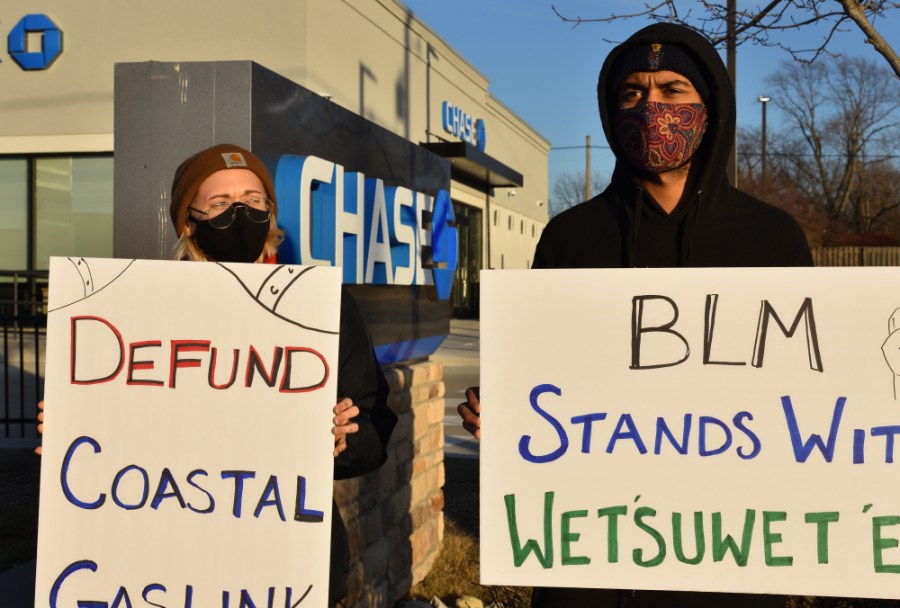
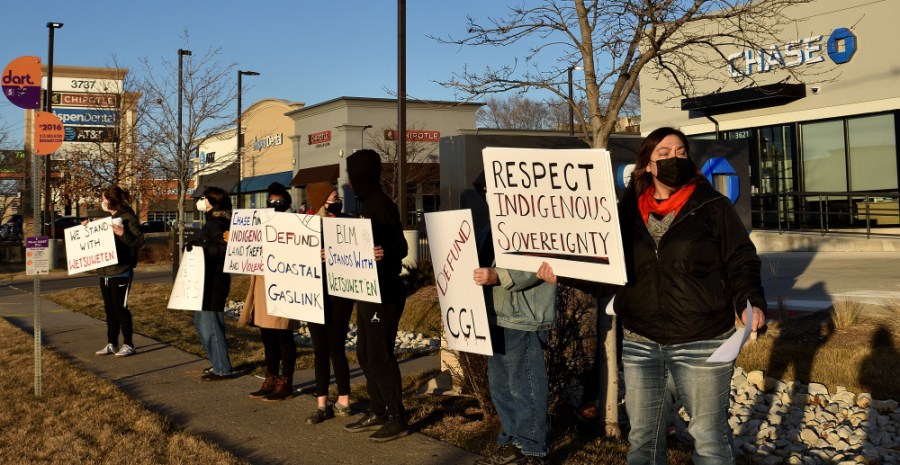
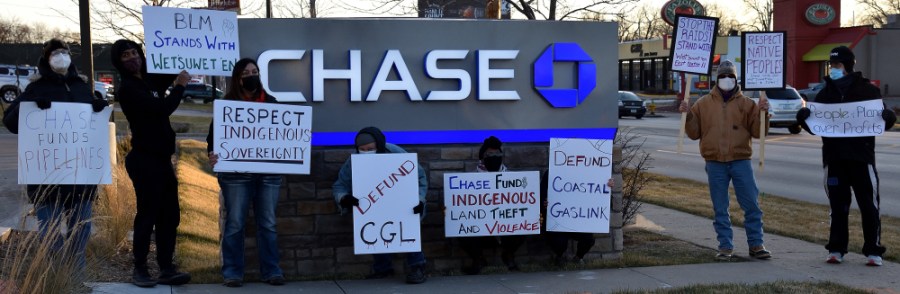
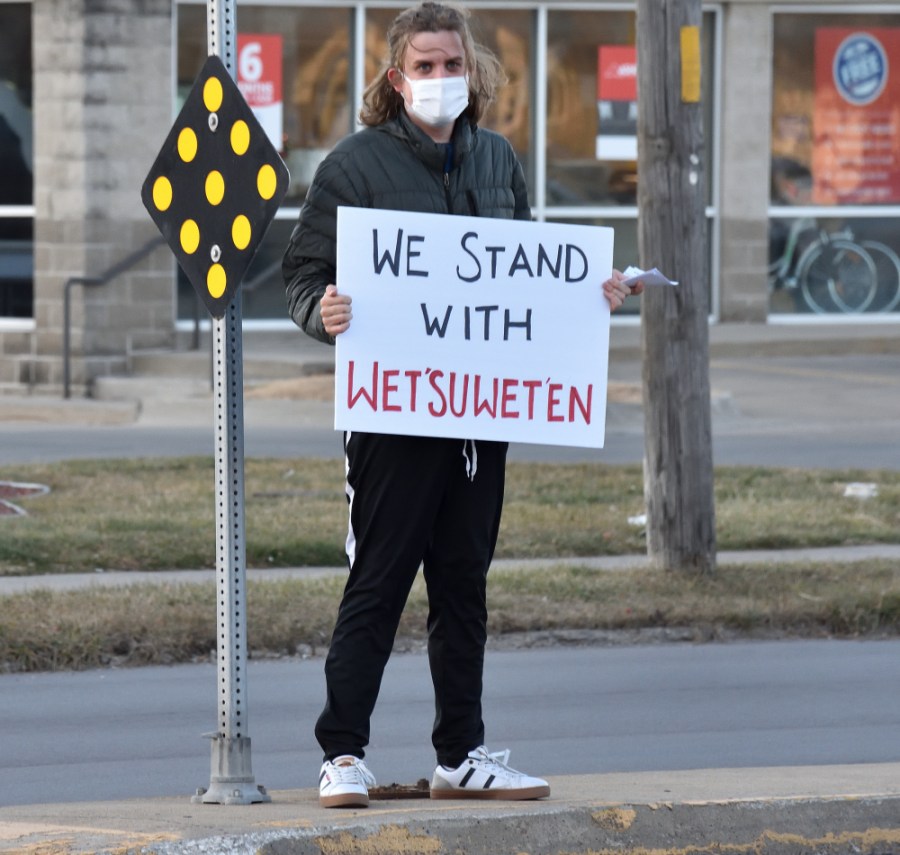
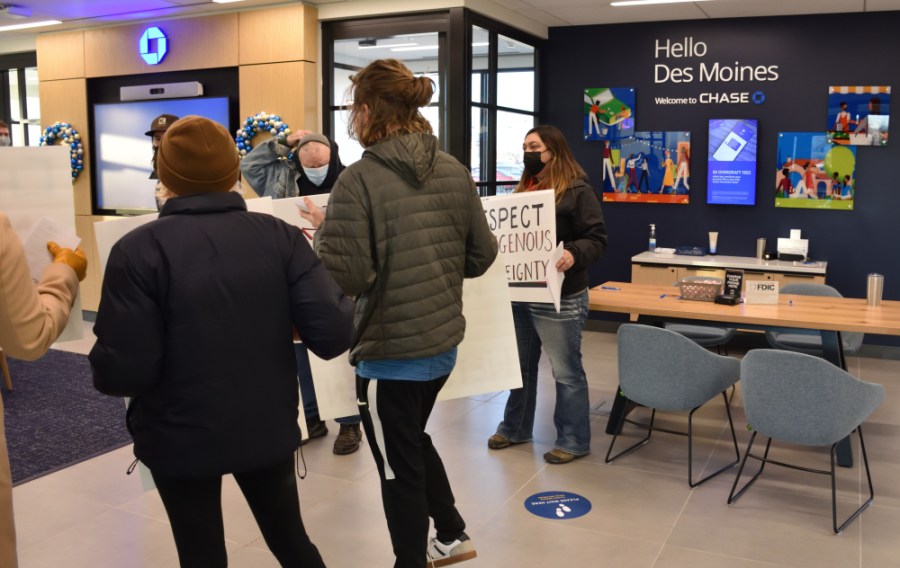
Iowa Solidarity with the Wet’suwet’en is about our action at Chase Bank in Des Moines on December 23, 2021. Chase is one of the main financial institutions supporting the Coastal GasLink pipeline through Wet’suwet’en territory. (Photos below).

Articles about the Wet’suwet’en on my blog Quakers, social justice and revolution. https://jeffkisling.com/?s=wetsuweten

And more recent articles on my blog LANDBACK Friends https://landbackfriends.com/?s=wetsuweten

What I don’t know about Mutual Aid

Disclaimer: Before getting to that, I think I should make a disclaimer, especially since I shared the 2021 Peace and Social Concerns report of my yearly meeting, Iowa Yearly Meeting (Conservative). I included that because Mutual Aid is mentioned in the report. “These injustices are some of the effects of systems of white supremacy. The concept of Mutual Aid is becoming an increasingly used model for communities working for justice. The idea is to have a horizontal hierarchy, where everyone has a voice. And work to ensure a vertical hierarchy does not develop. Without a vertical hierarchy, there can, by definition, be no superiority. Several of our meetings are supporting existing Mutual Aid communities or considering creating their own. These are opportunities to begin to disengage from the colonial capitalist system and white supremacy. Ways we can model justice in our own meetings and communities.”

But that doesn’t mean what I’ve been writing on this blog has been approved by the Yearly Meeting.

What I do know about Mutual Aid comes from my two years of experience with Mutual Aid in Des Moines.

I met Ronnie James, and Indigenous organizer and now close friend, when he came to a vigil we held in February 2020 in support of the Wet’suwet’en people’s struggles to prevent the construction of the Coastal GasLink pipeline through their territories. He came because he wanted to know who was supporting the Wet’suwet’en, because their struggles were not being covered in the mainstream media. That was a good organizing strategy, a way to find allies.

Because of the COVID pandemic, he and I didn’t meet in person for several months. But during that time, he was very generous in teaching me about his work with Des Moines Mutual Aid (DMMA). I quickly saw there was much more to Mutual Aid than just distributing free food, or propane tanks for the houseless in winter. I could also tell the people involved in DMMA were very careful about who they associated with because they were on the police radar, so to speak. Several had been arrested, some several times, as they demonstrated to support Des Moines Black Liberation’s protests of police violence after the killing of George Floyd.

But after months of email exchanges, I felt we were getting to know each other well enough that I could ask if it would be appropriate to participate in his work. I knew it was important for allies to be careful about inviting ourselves into situations in ways that are not appropriate.

Fortunately, he said yes, and I have been participating in the food distribution part of Des Moine Mutual Aid nearly every Saturday morning since (for more than a year).

I thought I would see how this worked for a few weeks, and that might be the end of it. But I found the actual experience of being present in this community taught me so much that words written in emails could not.

When I arrived that first morning, apprehensive about what might happen, I was told this was Mutual Aid, which meant all of us were encouraged to take any food we wanted, ourselves. For many weeks I did not take any, but finally realized that was a mistake. It was like I wasn’t really buying into the mutual part of this. I realized this when one of my new friends, in a friendly manner, asked why I wasn’t taking any food. Now I do.

I also witnessed the truly uplifting way every volunteer greeted each car of people who came for the food. It was always, “hi, how are you doing? Have a great day.”

I also saw this insistence of avoiding any kind of vertical hierarchy. No one said, “do this, do that…”. When there was a problem, anyone with a solution was expected to just do it. Or when the van of food arrived, someone would say “the van is here” and whoever wasn’t doing something else would just go out and help unload the food.

Also, one of my new friends who volunteered to help with the food distribution told me she was once in the position of needing the food herself.

And I know my friends always show up. As they did yesterday, New Year’s Day, with a wind chill of -11 degrees. As we had on Christmas day the week before.

So a new person has to learn a new way of working together. Learn how to act in a situation where you aren’t told what to do by someone above you in a vertical hierarchy. To learn to be always aware of what is going on around you. See if there is something that needs to be done, then do it yourself.

Multiple times I’ve heard someone say these Saturday mornings together are the best part of their week. I feel that, too. That’s one of the important parts of Mutual Aid. We are enthusiastic about this work. It pulls people in when they are doing something that has an immediate impact.

This is one of the many reasons I’m encouraging Friends and others to learn about, create and participate in Mutual Aid. Most of the Quaker meetings I’m aware of have dwindling numbers of people attending their meetings. And we don’t attract many/any young people or Black, Indigenous and other people of color (BIPOC).

I’ve thought we should have more workcamps, as we did when I was growing up. Those were experiences people appreciated. Mutual Aid can be the answer today.

But there is a more fundamental reason to adopt Mutual Aid. We need to accept that our political and economic systems are failing. Are not meeting our needs. “We” being those of us fortunate to have had livable incomes. Those who don’t have known the failure of these systems their entire lives. We have no choice but to come up with alternatives. I believe Mutual Aid is one alternative.

Finally, we get to what I don’t know about Mutual Aid. The key to Mutual Aid is for everyone in the community to be involved in the work. But most of us live some distance from our Quaker meetings. Is it possible, or desirable, to find ways to create Mutual Aid communities if people are not physically present with each other? Is ZOOM Mutual Aid possible, or desirable?

I don’t know. If you have some ideas about this, please write them in the comments.

Thank you.

Bear Creek Friends

Resolve to be always beginning

Resolve to be always beginning — to be a beginner. –Rainer Maria Rilke

I’m hoping some Friends might consider Mutual Aid to be part of their new story this new year. Yesterday’s post was an introduction.

This is a link to a lot more information about my experiences with Mutual Aid. Mutual Aid in the Midwest

I realize I didn’t explain yesterday’s comment about friendships with native people. Indigenous peoples have always lived in ways that could be seen as Mutual Aid. And my good friend Ronnie James, an Indigenous organizer, has been my Mutual Aid mentor from the beginning of my experiences. This work is supported by the Great Plains Action Society that Ronnie is part of.

We are Indigenous Peoples of the Great Plains proactively working to resist and Indigenize colonial-capitalist institutions and behaviors. We defend the land where our ancestors lie and where the children walk. Our goal is to reclaim what has been stolen and oppressed to create a better world for us all.

Great Plains Action Society

New Year’s resolutions tend to be about wanting more of something we desire and/or less of something we do not, and while they surely have their noble side, they also often emanate from subtle and less subtle forms of perceived lack, scarcity, comparison, self-flagellation, and judgment. The “should” and “should not” messages we send ourselves when we make resolutions can be harsh and incriminating. These are qualities we may want to endeavor not to perpetuate and strengthen when we make our commitments this year.

How about making “the means more of the ends” by putting gratefulness rather than scarcity at the center of the resolutions we make this year? How about bringing a more gentle form of motivation, rooted in appreciation, celebration, and acceptance, to our goals? How about letting gratitude guide us?

Turn New Year’s Resolutions into Revelations by Kristi Nelson, syndicated from gratefulness.org, Jan 01, 2022

A Call for Quakers to Embrace Mutual Aid

I am writing to make the case for the adoption of Mutual Aid as a framework for Quaker justice work.

This comes from my perspective of a White, Quaker, male (he/him), settler on Ioway land, in the country called the United States. When I refer to Quakers here, I mean White Quakers. Black, Indigenous, and other people of color (BIPOC) Friends have completely different experiences related to white privilege and racism, for example.

My credentials include friendships with Native people here in the Midwest. And to have been part of a Mutual Aid community for the past two years. The following is from these lived experiences, which have excited me, shown me a different way to work for peace and justice.

There are three key elements of Mutual Aid.

  1. Mutual aid projects work to meet survival needs and build shared understanding about why people do not have what they need.
  2. Mutual aid projects mobilize people, expand solidarity, and build movements.
  3. Mutual Aid projects are participatory, solving problems through collective action rather than waiting for saviors.

    Mutual Aid, Building Solidarity during this Crisis (and the next) by Dean Spade, Verso, 2020


Mutual Aid is NOT charity. People often think of their financial support for a cause as aid. But that is not Mutual Aid. Charity involves an agency determining what the need is. Which too often is not what is needed. And has an implied hierarchy of the agency providing aid as superior to those who receive the aid. There are usually rules as to who qualifies for the aid.

Instead, Mutual Aid involves everyone in the community to work on problems that affect everyone. There is not a distinction between those who need help and those providing help. It is explicitly stated that anyone in the community might need help at some point. The whole community determines its needs and how to address those needs. Not a vertical hierarchy like “us helping them”.

Mutual Aid communities work to make sure no vertical hierarchy develops, implied or not. Vertical hierarchies mean some people are seen as superior in some way. Vertical hierarchies are about power. Which is the antithesis of mutuality.

Quakers and hierarchy

I hadn’t thought much about Quakers and vertical hierarchy before getting involved in Mutual Aid. But for example, we have yearly meeting clerks and yearly meeting committee clerks. Members of yearly meeting committees are appointed by local meetings, which might imply they have some superiority in those meetings. “Birthright” Friends are sometimes accorded privilege.

Often Quaker meetings make donations to peace and justice organizations, which is charity. Which usually doesn’t create a mutual relationship with those organizations or the people they serve.

For these reasons I think Quaker communities should embrace Mutual Aid. That would mean connecting with everyone in the neighborhood around the meeting. This is the concept of beloved community.  This might attract neighbors to become involved in the meeting. We would get a better idea of what we might work on together. This would be a way to speak to the spiritual condition of our communities.

This PDF has much more information about Quakers and Mutual Aid:
A Call for Quakers to Embrace Mutual Aid

Following is this year’s report of the Peace and Social Concerns Committee of Iowa Yearly Meeting (Conservative) which includes discussion of Mutual Aid.


Peace and Social Concerns Committee Report 2021
Iowa Yearly Meeting (Conservative)

This has been a year of great upheaval locally, nationally, and globally. The work of our monthly meetings has been impacted by the COVID-19 pandemic. Yet we have found ways to continue our peace and justice work. And had more time for prayer and reflection.

Global chaos from rapidly accelerating environmental devastation is highly likely to occur, breaking down our economic, social, and political systems. As air and water temperatures increase, water supplies are drying up. Widening areas and severity of drought are decreasing crop production and forcing people to flee. Rising oceans are creating more climate refugees. The trend of increasing numbers of more ferocious wildfires, hurricanes and other storms are expected to accelerate. All kinds of infrastructure will likely be destroyed, creating more climate refugees, many migrating to the Midwest. How can we prepare our own communities for these disasters, and plan for the arrival of climate refugees?

Justice work by White Friends has changed in recent years. An important concept of justice work is to follow the leadership of oppressed communities, who are working tirelessly for their liberation. Those who consider themselves White Friends are learning how to step back. Be supporters and allies.

Many injustices today trace their roots to the arrival of white Europeans on this continent. These include a whole history of enslavement as well as genocide of Indigenous peoples. It is important for white Quakers to know we are not expected to feel guilt or blame for injustices that occurred in the past. But knowing what we know now, it is up to us to learn more about those wrongs, and work toward repair and healing.  This will be a primary focus of this committee’s work in the coming year.

As a society we have been forced to face systemic racism. For example, public murders by police have generated sustained protests regarding police brutality, with calls to limit police powers and change or abolish prisons.

Also dating back to the arrival of white Europeans is the genocide of Indigenous peoples. The theft of Native lands. And the atrocities of Native children taken from their families to institutions of forced assimilation, often far away. Places where attempts were made to the erase their culture. Many subjected to physical or sexual abuse. Thousands of Native children died. This intentional cruelty broke the resistance of Native peoples who were trying to hold onto their lands.

The recent validation of the remains of Native children on the grounds of those institutions is having devastating effects in Native communities and those who care about them. Searching the grounds of the institutions in this country is about to begin. Secretary of the Interior, Deb Haaland, has launched a federal investigation into these institutions of forced assimilation in the US

 A number of Catholic churches, who ran those institutions in Canada, have been burned or vandalized.

There are renewed calls for truth and reconciliation. Canadian Yearly Meeting has done a great deal of work on this.

These injustices are some of the effects of systems of white supremacy. The concept of Mutual Aid is becoming an increasingly used model for communities working for justice. The idea is to have a horizontal hierarchy, where everyone has a voice. And work to ensure a vertical hierarchy does not develop. Without a vertical hierarchy, there can, by definition, be no superiority. Several of our meetings are supporting existing Mutual Aid communities or considering creating their own. These are opportunities to begin to disengage from the colonial capitalist system and white supremacy. Ways we can model justice in our own meetings and communities.

We can show up for Black Lives Matter and other racial justice events. We can support those who meet with local, state, and Federal government officials. We can show up in the streets to support agitation for change, train in nonviolent civil disobedience, or accompany arrested activists through the justice system.

We can show up, when appropriate, at events of Native peoples, such as the Prairie Awakening ceremony. We can share Indigenous news on social media platforms, so others are aware of these things.

Indigenous leaders in the Midwest have asked us to learn about and find ways to engage in the concepts of Land Back. The website LANDBack Friends has been created and will be updated as our work continues.  https://landbackfriends.com/

We pray for guidance for how our committee might work together at the intersection of our responsibilities and those of Ministry and Counsel.

We will continue to seek spiritual guidance, both for what we are called to do, and ways to offer spiritual support for those who are not Friends. There is great spiritual poverty in many communities. Spiritual support will be needed by those who suffer the consequences of environmental and other disasters. And those responding to these disasters.

It is important to understand this work depends on us all working together, in the community. Outside our meetinghouses. Developing friendships in the local community. We encourage more engagement with our youth. They can teach us about justice. We and our meetings will be revitalized.

Many monthly meetings are adapting to these changing ways of doing peace and justice work.  Building relationships with communities of black, Indigenous, and other people of color. Exploring ways to be in right relationship with these communities. All of us learning from each other. Sharing our stories. Deepening spiritual connections.

Jeff Kisling, clerk
Peace and Social Concerns Committee


Why the Fundamental Challenge of the 21st Century is Community

umair haque writes a daily article on his website, Eudaimonia & Co. His December 26 article “Why the Fundamental Challenge of the 21st Century is Community” provides an interesting perspective on my recent experiences with Mutual Aid and evolving vision for what could come next.

umair says we need to expand our sense of moral community to include everything, living and inanimate. And “the way of enmity, the way of violence, dominance, hierarchy, greed, hate — it must end.”

Those are some of the reasons I’ve been led to become involved with Mutual Aid, which is about building communities and rejecting dominance and hierarchy. Reasons why I believe my Quaker faith community should embrace the concepts of Mutual Aid.

These are also reasons I believe faith communities have an especially important role to play now, to help “expand our sense of moral community”. Quakers are the Religious Society of Friends. umair writes “what is the bond between members of a moral community? Friendship.”

As my friend Ronnie James says:

As bleak as this is, there is a significant amount of resistance and hope to turn the tide we currently suffer under. We stand on the shoulders of giants that have been doing this work for centuries, and there are many lessons we can learn from.

The first, and possibly the most important, is that it was not always this way, which proves it does not have to stay this way. 

What we have is each other. We can and need to take care of each other. We may have limited power on the political stage, a stage they built, but we have the power of numbers.

Those numbers represent unlimited amounts of talents and skills each community can utilize to replace the systems that fail us.  The recent past shows us that mutual aid is not only a tool of survival, but also a tool of revolution. The more we take care of each other, the less they can fracture a community with their ways of war. Organized groups like The American Indian Movement and the Black Panther Party for Self Defense showed that we can build not only aggressive security forces for our communities, but they also built many programs that directly responded to the general wellbeing of their communities. This tradition began long before them and continues to this day. Look into the Zapatistas in Southern so-called Mexico for a current and effective example.

These people’s security forces, or the “policing of the police” not only helps to minimize the abuse and trauma they can inflict on us, but it begins to shift the power balance from them to us.

Mutual Aid programs that help our most marginalized or other events that work to maintain our spirits result in stronger communities. A strong community is less vulnerable to police intrusion. 99% of our conflicts can be solved by those affected by them, but only with the support of those around them. Anytime we call on the police to mediate our problems, we are risking ourselves or a loved one from being hurt or worse.

We each have skills and resources we can utilize towards the abolition project. Some of us can use the halls of the system to make short term change there, others have skills that produce food, provide medical care, or care for our precious youth, some are skilled in the more confrontational tactics needed. Once we envision that world our ancestors want for us, finding our role is natural.

If we are to survive, and more importantly, thrive, we know what we will have to do.

The Police State and Why We Must Resist, Ronnie James, Des Moines Mutual Aid

Now think of the next set of problems we face as a civilization. “Climate change,” aka global warming, ecological collapse, and mass extinction. They are already beginning to hit us hard. How much longer will parts of the American West or Australia be livable? How long is it until whole water systems and energy grids begin to fail? How much longer before we hit tipping points — like the ice-caps albedo, how much they reflect the sunlight, diminishes and pushes warming to runaway state?

To solve those problems, we need to expand our sense of moral community much, much more radically and dramatically. Animals have to be included in our moral community, as aware, feeling, truly living things, whose lives have intrinsic and inherent worth — not just meat to slaughter. So too do trees and rivers. So too do the icecaps and oceans.

Our moral community has to expand so radically and dramatically that we begin to see the world around us in terms that resemble the ancient world much more than the modern one. For the ancients, the world was alive — with the spirits of nature. Poseidon, the God of the Sea was a member — an elder, in fact — of the moral community in the West. You didn’t want to anger him, by, say, polluting the ocean the way we do. In other places, everything from animals to the wind itself was a member of the moral community — and treated with respect and dignity and friendship.

What is the bond between members of a moral community? Friendship. What do I miss about Europe? Friendship — like between me and the people in my neighbourhood, the way that we’ll just stop in the street and talk for half an hour, and before we know it the sun’s setting, so why don’t you come over for dinner? Friendship is what binds members of a moral community. It’s the reason I can’t order you to be an attack mob, like pundits in other places can and do. We have bonds of friendship — you and me, amongst this whole community. What we don’t have is bonds of subservience, hierarchy, dominance, sealed and reproduced by violence.

“Why the Fundamental Challenge of the 21st Century is Community” by umair haque, Eudaimonia & CO., Dec 26, 2021

Enmity is the force rising in the world. The values of the tribe are rising — hate, violence, dominance, hierarchy. That is why there is this perpetual search for scapegoats and scarecrows — that is what tribes need to go on existing, punching bags, untouchables, enemies.

But the lesson should be clear. The way of enmity only leads to disaster. Look at Britain. Look at America. Look at the way the West won’t spend pennies, literally, to end the pandemic — while it cries alligator tears that yet another wave has hit it. The way of enmity, the way of violence, dominance, hierarchy, greed, hate — it must end.

Civiliation does not have a future with those values. Humanity does not have a future with those values. There is nothing left to exploit. There is no enemy left to blame. The only enemy left is us.

Our moral community has to expand radically and dramatically. In this century. Beginning now. In the next decade or two — three, tops — it must begin to include all of life. Every tree, forest, ocean, river, icecap. Or else they will all disappear, and we will perish, in great waves of pain and despair, right along with them. Millions upon millions of us will die, in more and more extreme and terrible ways. I don’t say that to scare you, or threaten you. I say it because it shouldn’t happen.

“Why the Fundamental Challenge of the 21st Century is Community” by umair haque, Eudaimonia & CO., Dec 26, 2021