
When I joked with a friend about running, he said the only running he would be doing was from the police. Sadly, he was serious.
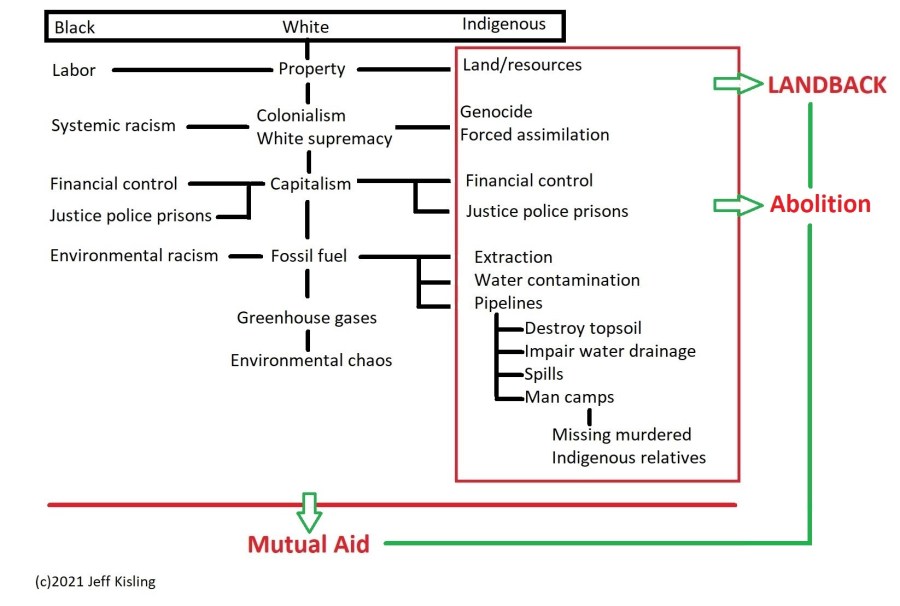
LANDBACK and Mutual Aid work to abolish the status quo of colonial, or racial capitalism, and white supremacy. This quote is by a good friend of mine, who introduced me to the food giveaway program I’ve been participating in for over a year.
So I work with a dope crew called Des Moines Mutual Aid, and on Saturday mornings we do a food giveaway program that was started by the Panthers as their free breakfast program and has carried on to this day. Anyways, brag, brag, blah, blah.
So I get to work and I need to call my boss, who is also a very good old friend, because there is network issues. He remembers and asks about the food giveaway which is cool and I tell him blah blah it went really well. And then he’s like, “hey, if no one tells you, I’m very proud of what you do for the community” and I’m like “hold on hold on. Just realize that everything I do is to further the replacing of the state and destroying western civilization and any remnants of it for future generations.” He says “I know and love that. Carry on.”
Policing in the United States is a force of racist violence that is entangled at the core of the capitalist system. As Robin D.G. Kelley pointed out on Intercepted With Jeremy Scahill, capitalism and racism are not distinct from one another: “If you think of capitalism as racial capitalism, then the outcome is you cannot eliminate capitalism, overthrow it, without the complete destruction of white supremacy, of the racial regime under which it’s built.”
Police in the United States act with impunity in targeted neighborhoods, public schools, college campuses, hospitals, and almost every other public sphere. Not only do the police view protesters, Black and Indigenous people, and undocumented immigrants as antagonists to be controlled, they are also armed with military-grade weapons. This police militarization is a process that dates at least as far back as President Lyndon Johnson when he initiated the 1965 Law Enforcement Assistance Act, which supplied local police forces with weapons used in the Vietnam War. The public is now regarded as dangerous and suspect; moreover, as the police are given more military technologies and weapons of war, a culture of punishment, resentment and racism intensifies as Black people, in particular, are viewed as a threat to law and order. Unfortunately, employing militarized responses to routine police practices has become normalized. One consequence is that the federal government has continued to arm the police through the Defense Logistics Agency’s 1033 Program, which allows the Defense Department to transfer military equipment free of charge to local enforcement agencies.
TO END RACIAL CAPITALISM, WE WILL NEED TO TAKE ON POLICING By Henry A. Giroux, Truthout, June 20, 2021
Police brutality cannot be separated from the lethal nature of white supremacy
TO END RACIAL CAPITALISM, WE WILL NEED TO TAKE ON POLICING By Henry A. Giroux, Truthout, June 20, 2021
But even more important, imprisonment is the punitive solution to a whole range of social problems that are not being addressed by those social institutions that might help people lead better, more satisfying lives. This is the logic of what has been called the imprisonment binge: Instead of building housing, throw the homeless in prison. Instead of developing the educational system, throw the illiterate in prison. Throw people in prison who lose jobs as the result of de-industrialization, globalization of capital, and the dismantling of the welfare state. Get rid of all of them. Remove these dispensable populations from society. According to this logic the prison becomes a way of disappearing people in the false hope of disappearing the underlying social problems they represent.
Angela Y. Davis, Abolition Democracy
it is racism that is the trigger that disproportionately escalates police encounters with people of color. However, even more sadly, it is systemic racism that normalizes it, or legitimates it, making it largely acceptable to white American eyes and consciences. For it is not only the police who have this problem, but our entire society.
Armed Racism Keeps No One Safe By Robert C. Koehler, Common Wonders, 4/17/2021
For the past several months I’ve been attending Zoom meetings with a group of Quakers, mainly younger Friends, about abolition of police and prisons.
This same war of conquest is currently using the mass incarceration machine to instill fear in the populace, warehouse cheap labor, and destabilize communities that dare to defy a system that would rather see you dead than noncompliant. This is the same war where it’s soldiers will kill a black or brown body, basically instinctively, because our very existence reminds them of all that they have stolen and the possibility of a revolution that can create a new world where conquest is a shameful memory.
What we have is each other. We can and need to take care of each other. We may have limited power on the political stage, a stage they built, but we have the power of numbers.
Those numbers represent unlimited amounts of talents and skills each community can utilize to replace the systems that fail us. The recent past shows us that mutual aid is not only a tool of survival, but also a tool of revolution. The more we take care of each other, the less they can fracture a community with their ways of war.
Ronnie James, The Police State and Why We Must Resist

Our very existence reminds them of all that they have stolen and the possibility of a revolution that can create a new world where conquest is a shameful memory
Ronnie James
People like me who want to abolish prisons and police, however, have a vision of a different society, built on cooperation instead of individualism, on mutual aid instead of self-preservation. What would the country look like if it had billions of extra dollars to spend on housing, food and education for all? This change in society wouldn’t happen immediately, but the protests show that many people are ready to embrace a different vision of safety and justice.
Yes, We Mean Literally Abolish the Police, Because reform won’t happen By Mariame Kaba, The New York Times, June 12, 2020
The challenge that Kaba and other abolitionists are posing does not advocate for liberal reforms. Their call is to advance a radical restructuring of society. Central to their call for social change is that such a task be understood as both political and educational. This necessitates the development of political and pedagogical struggles that take seriously the need to rethink the attack on the public imagination and attack on critical agency, identity and everyday life. Also at stake is the need to identify and reclaim those institutions, such as schools, that are necessary to produce and connect an educated public to the struggle for a substantive and radical democracy. The current crisis cannot be faced through limited calls for police reforms. It demands a more comprehensive view not only of oppression and the forces through which it is produced, legitimated and normalized, but also of political struggle itself.
TO END RACIAL CAPITALISM, WE WILL NEED TO TAKE ON POLICING By Henry A. Giroux, Truthout, June 20, 2021
We each have skills and resources we can utilize towards the abolition project. Some of us can use the halls of the system to make short term change there, others have skills that produce food, provide medical care, or care for our precious youth, some are skilled in the more confrontational tactics needed. Once we envision that world our ancestors want for us, finding our role is natural.
Ronnie James, The Police State and Why We Must Resist
Once we envision that world our ancestors want for us, finding our role is natural.
Ronnie James


 LANDBACK Friends