The failure of the US Congress to act to address the crisis of those who face eviction is a glaring example of our broken political, economic and social justice systems. Politicians who objected to renewal of the moratorium on evictions should have come up with an alternative. But did not. Conservative estimates show between 50,000 and 65,000 people face eviction in Iowa in August (Des Moines Register).
Everyone has the right to food, water and shelter.
This is another example of the importance of Mutual Aid. Another example of not waiting for help from the government. 50,000 evictions cannot be handled by one Mutual Aid group like my Des Moines Mutual Aid group. But Mutual Aid groups in every community would. Think about starting your own Mutual Aid group. In the meantime, please donate here.
How to find help if you’re facing eviction For renters who may get an eviction notice, the first piece of advice experts say is: Stay put. A tacked-on notice from your landlord does not mean your family must leave your apartment, said Eric Burmeister, executive director of the Polk County Housing Trust Fund. Only a judge can order a notice to vacate. The process can take 30 to 60 days. Experts say it’s better to call for help before a formal eviction notice is filed with the courts. Many nonprofit organizations can help with finding assistance and negotiating a payment plan with your landlord to avoid a court order. It’s also important not to skip the eviction hearing. If a renter does, the judge can issue a default judgement in favor of the landlord. There are several numbers to call for help: United Way: 211 Iowa Legal Aid: 800-332-0419 Iowa Rent and Utility Assistance Program:iowahousingrecovery.com, 855-300-5885 Polk County rental assistance, IMPACT Community Action Partnership: 515-518-4770
In these increasingly troubled times I find myself thinking about the concept of sensemaking, the action or process of making sense of or giving meaning to something, especially new developments and experiences.
It is increasingly difficult to make sense of all that is going on today. All the bad things I had anticipated for the future are suddenly happening now. And things I never imagined, like the assaults on truth and science, come at a time when they are desperately needed.
At the collective level, a loss of sensemaking erodes shared cultural and value structures and renders us incapable of generating the collective wisdom necessary to solve complex societal problems like those described above. When that happens the centre cannot hold.
Threats to sensemaking are manifold. Among the most readily observable sources are the excesses of identity politics, the rapid polarisation of the long-running culture war, the steep and widespread decline in trust in mainstream media and other public institutions, and the rise of mass disinformation technologies, e.g. fake news working in tandem with social media algorithms designed to hijack our limbic systems and erode our cognitive capacities. If these things can confound and divide us both within and between cultures, then we have little hope of generating the coherent dialogue, let alone the collective resolve, that is required to overcome the formidable global-scale problems converging before us.
sensemaking the action or process of making sense of or giving meaning to something, especially new developments and experiences
Celebrants have an important part to play in the legacy humanity caries into the future. I suggest that our responsibility as ceremonialists, as humans who help other humans meaningfully connect with the web of life, is to find ways now to help people connect with the story of this world’s beauty, even as the world we love recedes. I believe there is a gift we can bring to our communities, to help people learn the art of losing. To help us all to meet the rising tides.
I believe faith communities and Indigenous ways need to play a crucial role in helping us move through the oncoming, increasingly severe chaos. Faith can provide sensemaking for those who have no framework for making sense of our broken systems.
People of faith can be celebrants. Indigenous peoples are celebrants, their cultures based upon a timeless connection to Mother Earth.
The problems before us are emergent phenomena with a life of their own, and the causes requiring treatment are obscure. They are what systems scientists call wicked problems: problems that harbour so many complex non-linear interdependencies that they not only seem impossible to understand and solve, but tend to resist our attempts to do so. For such wicked problems, our conventional toolkits — advocacy, activism, conscientious consumerism, and ballot casting — are grossly inadequate and their primary utility may be the self-soothing effect it has on the well-meaning souls who use them.
If we are to find a new kind of good life amid the catastrophes these myths have spawned, then we need to radically rethink the stories we tell ourselves. We need to dig deep into old stories and reveal their wisdom, as well as lovingly nurture the emergence of new stories into being.
How do we rethink the stories we tell ourselves? We need to let go of the stories we have discovered to be untrue. Learn about, and embrace stories of other cultures. Seek, and really listen for, Spiritual guidance. Then actually implement that guidance.
One idea is to share stories from earlier times. “We need to dig deep into old stories and reveal their wisdom.” The Quaker Stories Project is an example. https://quakerstories.wordpress.com/
We need to re-think those stories. To consider what they say about our world today. To see if they represent something we have lost. Something it might be good to return to. The past leading into the future.
Seeking out new people and experiences are ways we can create new stories. For more than a year I have been learning new stories from my friends in the Mutual Aid community. We have been learning, together, how to live and work together in ways without a vertical hierarchy. Where decisions no longer come from leaders who try to wield power without consent. As my friend Ronnie James, who is my Mutual Aid mentor says:
I’m of the firm opinion that a system that was built by stolen bodies on stolen land for the benefit of a few is a system that is not repairable. It is operating as designed, and small changes (which are the result of huge efforts) to lessen the blow on those it was not designed for are merely half measures that can’t ever fully succeed.
So the question is now, where do we go from here? Do we continue to make incremental changes while the wealthy hoard more wealth and the climate crisis deepens, or do we do something drastic that has never been done before? Can we envision and create a world where a class war from above isn’t a reality anymore?”
Ronnie James
Our ancestors are ashamed of us, my friends. We are the people who disgraced the past, to create a myth called “the future.” That myth failed because there was no soul in it, no depth, no humanity. It was a vision of power, control, slavery, and violence, if we strip the gloss away
It all comes down to what type of ancestor I want to be for my descendants. Do I want to be a regular nobody that did nothing to protect our planet or do I want to be like Crazy Horse who fought and died for the little bit of land that we have left to protect? We have that chance right now to make that decision. This kind of resistance runs through all of our blood because we are the Indigenous Peoples of these lands. It’s at vital choice for the survival of humankind.
Yesterday I wrote about umair haque’s article We’re Losing the Battle for the Future because I believe he accurately lays out where we are at this moment. And, more importantly, has some suggestions about what we can do. As does the excerpt below from the report of the Peace and Social Concerns Committee of Iowa Yearly Meeting (Conservative).
It’s true that the past was backwards. Our civilisation’s was. Slavery, empire, Inquisition. But there is a healthy respect, too, for a deeper past. The way that indigenous peoples have far more sophisticated ethical notions than ours, ones of interdependence with nature. Or the way that their societies were often far more consensual and nonviolent than ours, too.
We need to go back, probably, to go forward. The future isn’t a thing we can make with machines. Our mistake, our undoing. The future needs to carry forward what’s good in the past, what’s true, what’s beautiful, and keep on doing it. We didn’t do that. We gave up the old ways — the really old ones. The ones which would have said that taking a life, even a little one, without thanking it, without grieving for it, brings shame. Or the ones which would have been repelled and sickened in their souls by the idea of ripping down a forest or polluting an ocean.
Our ancestors are ashamed of us, my friends. We are the people who disgraced the past, to create a myth called “the future.” That myth failed because there was no soul in it, no depth, no humanity. It was a vision of power, control, slavery, and violence, if we strip the gloss away. Machines — or subhumans — doing the work we didn’t want to do, so we could gorge ourselves into oblivion, instead of grappling with the big, beautiful, dangerous questions of being alive, existing, feeling, being connected, here, now on a tiny ball of dust, spinning through the darkness. The meaning and purpose and truth and beauty of it all. What kind of creepy way of life is that? Is that even living much at all?
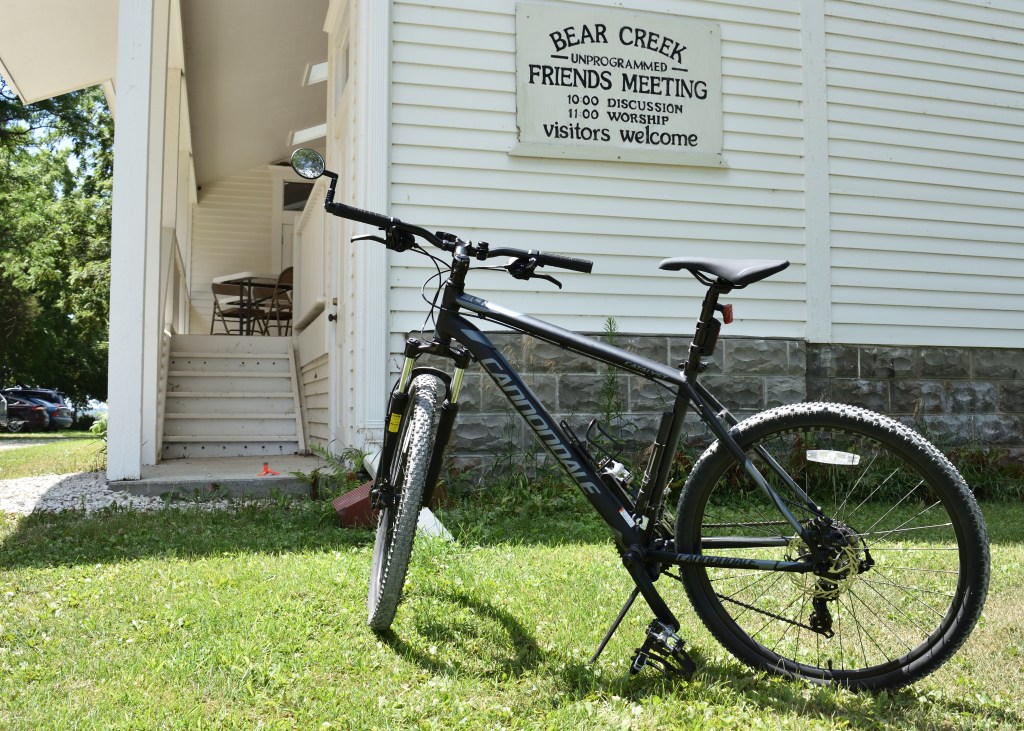
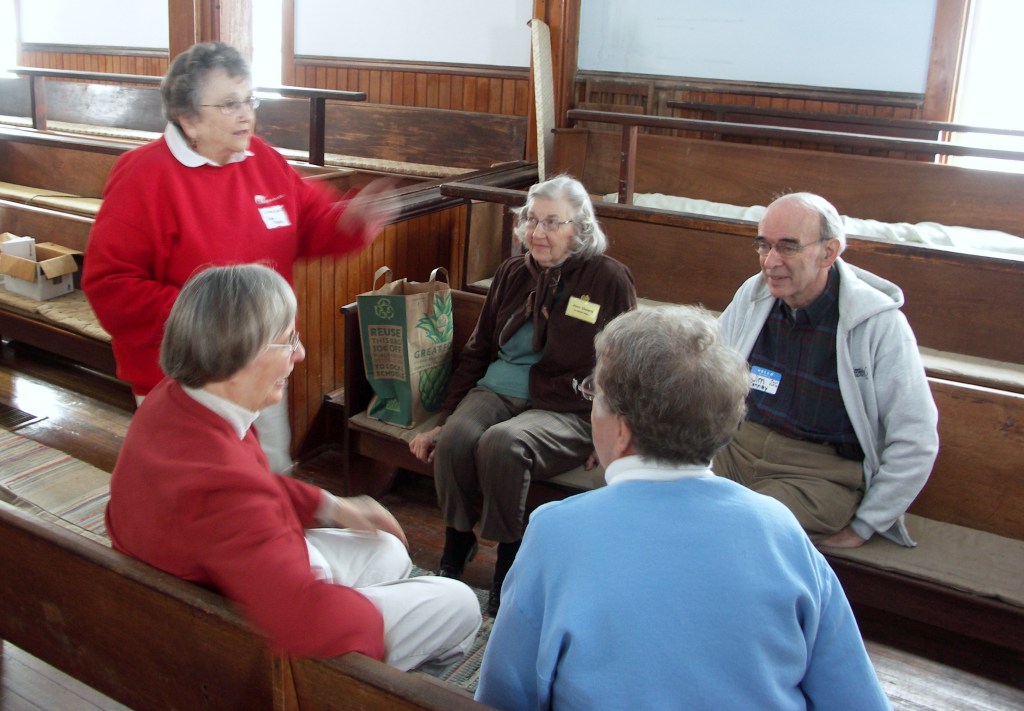
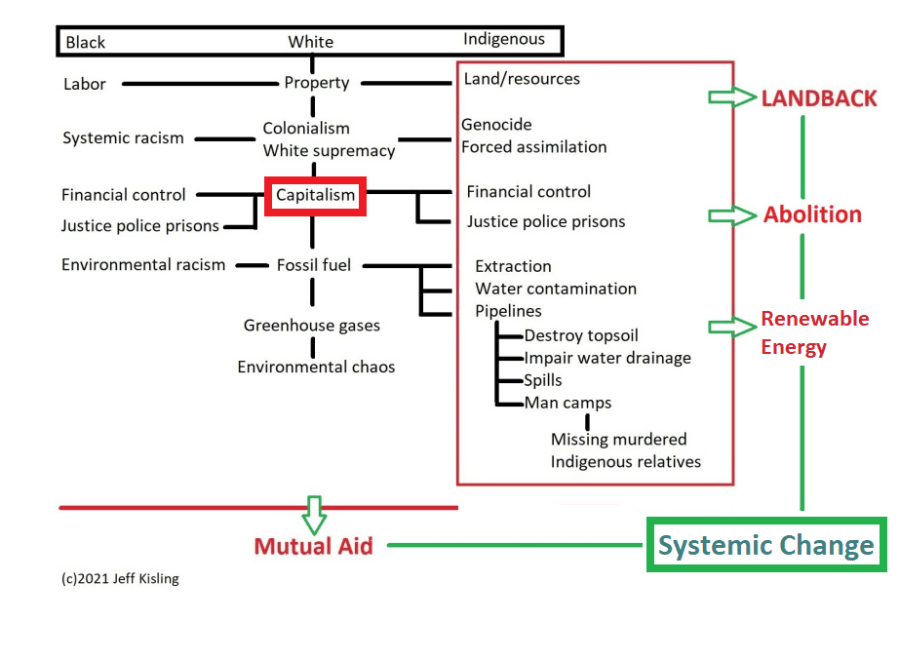
These injustices are some of the effects of systems of white supremacy. The concept of Mutual Aid is becoming an increasingly used model for communities working for justice. The idea is to have a horizontal hierarchy, where everyone has a voice. And work to ensure a vertical hierarchy does not develop. Without a vertical hierarchy, there can, by definition, be no superiority. Several of our meetings are supporting existing Mutual Aid communities or considering creating their own. These are opportunities to begin to disengage from the colonial capitalist system and white supremacy. Ways we can model justice in our own meetings and communities.
We can show up for Black Lives Matter and other racial justice events. We can support those who meet with local, state, and Federal government officials. We can show up in the streets to support agitation for change, train in nonviolent civil disobedience, or accompany arrested activists through the justice system.
We can show up, when appropriate, at events of Native peoples, such as the Prairie Awakening ceremony. We can share Indigenous news on social media platforms, so others are aware of these things.
Indigenous leaders in the Midwest have asked us to learn about and find ways to engage in the concepts of Land Back. The website LANDBack Friends has been created and will be updated as our work continues. https://landbackfriends.com/
Peace and Social Concerns, Iowa Yearly Meeting (Conservative) 2021
LANDBACK is a movement that has existed for generations with a long legacy of organizing and sacrifice to get Indigenous Lands back into Indigenous hands. Currently, there are LANDBACK battles being fought all across Turtle Island, to the north and the South.
As NDN Collective, we are stepping into this legacy with the launch of the LANDBACK Campaign as a mechanism to connect, coordinate, resource and amplify this movement and the communities that are fighting for LANDBACK. The closure of Mount Rushmore, return of that land and all public lands in the Black Hills, South Dakota is our cornerstone battle, from which we will build out this campaign. Not only does Mount Rushmore sit in the heart of the sacred Black Hills, but it is an international symbol of white supremacy and colonization. To truly dismantle white supremacy and systems of oppression, we have to go back to the roots. Which, for us, is putting Indigneous Lands back in Indigenous hands.
The closure of Mount Rushmore, return of that land and all public lands in the Black Hills, South Dakota is our cornerstone battle, from which we will build out this campaign.
In addition, LANDBACK is more than just a campaign. It is a meta narrative that allows us to deepen our relationships across the field of organizing movements working towards true collective liberation. It allows us to envision a world where Black, Indigenous & POC liberation co-exists. It is our political, organizing and narrative framework from which we do the work.
Don’t burn bridges: even when there is conflict between groups or organizers remember that we are fighting for all of our peoples and we will continue to be in community even after this battle
Don’t defend our ways
Organize to win
Move from abundance – We come from a space of scarcity. We must work from a place of abundance
We bring our people with us
Deep relationships by attraction, not promotion
Divest/invest
We value our warriors
Room for grace- be able to be human
We cannot let our oppressors inhumanity take away from ours
The following introduction to LANDBACK comes from LANDBACK.ORG
On July 3, 2020, Land Defenders took to Mt.Rushmore to reignite the fight for the Black Hills and the closure of Mt. Rushmore, a symbol of white supremacy and racism. Now, 21 of those Land Defenders who stood in defense of the sacred Ȟesápa, the ancestral homelands of Lakota and many other Indigenous Nations, are facing criminal charges.Inspired by the action taken that day, NDN Collective has developed the LANDBACK campaign, a mutli-faceted campaign to get Indigenous lands back into Indigenous hands, and empower Indigenous people across Turtle Island with the tools and strategies to do LANDBACK work in their own communities.The LANDBACK Campaign will officially launch on Indigenous Peoples’ Day, October 12, 2020.
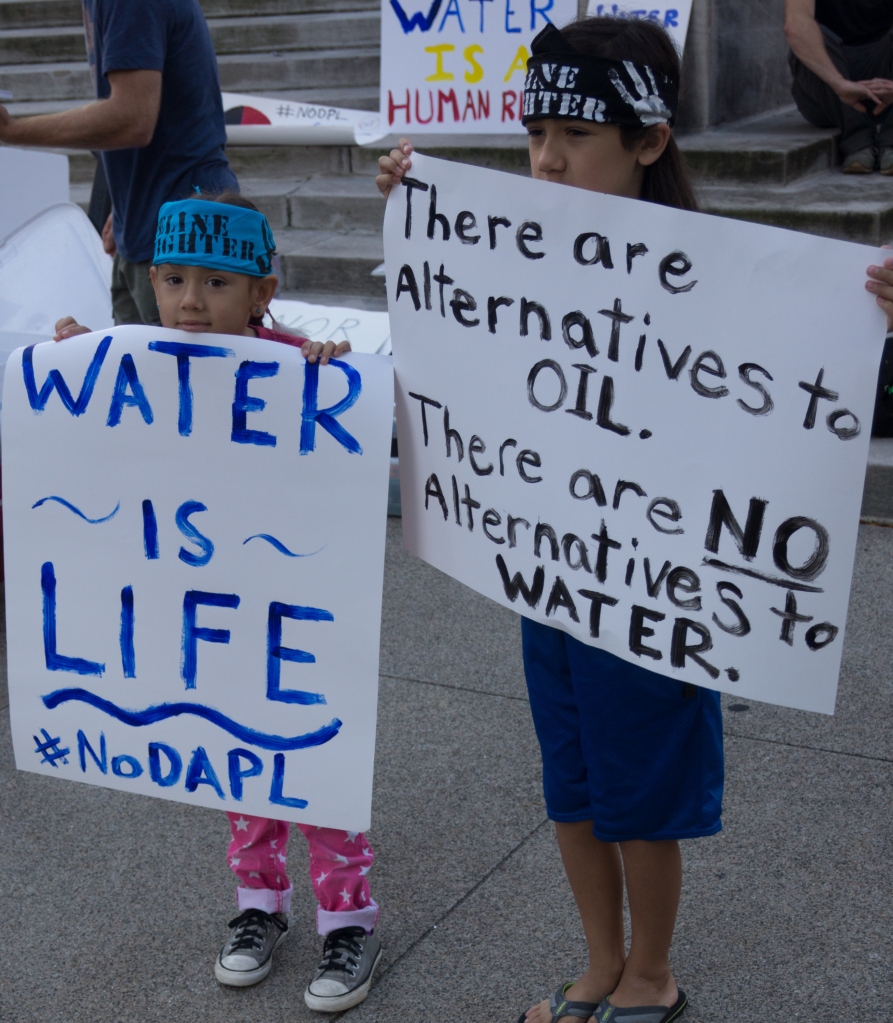
Protecting water from fossil fuel pipeline projects is an example of #LANDBACK. There is the devastation to the earth during extraction of fossil fuels, during pipeline construction, and when the pipelines leak. The tons of carbon dioxide that will be added to our atmosphere when that fuel is burned. The acidification of the oceans as the water attempts to absorb some of the carbon dioxide from the air.
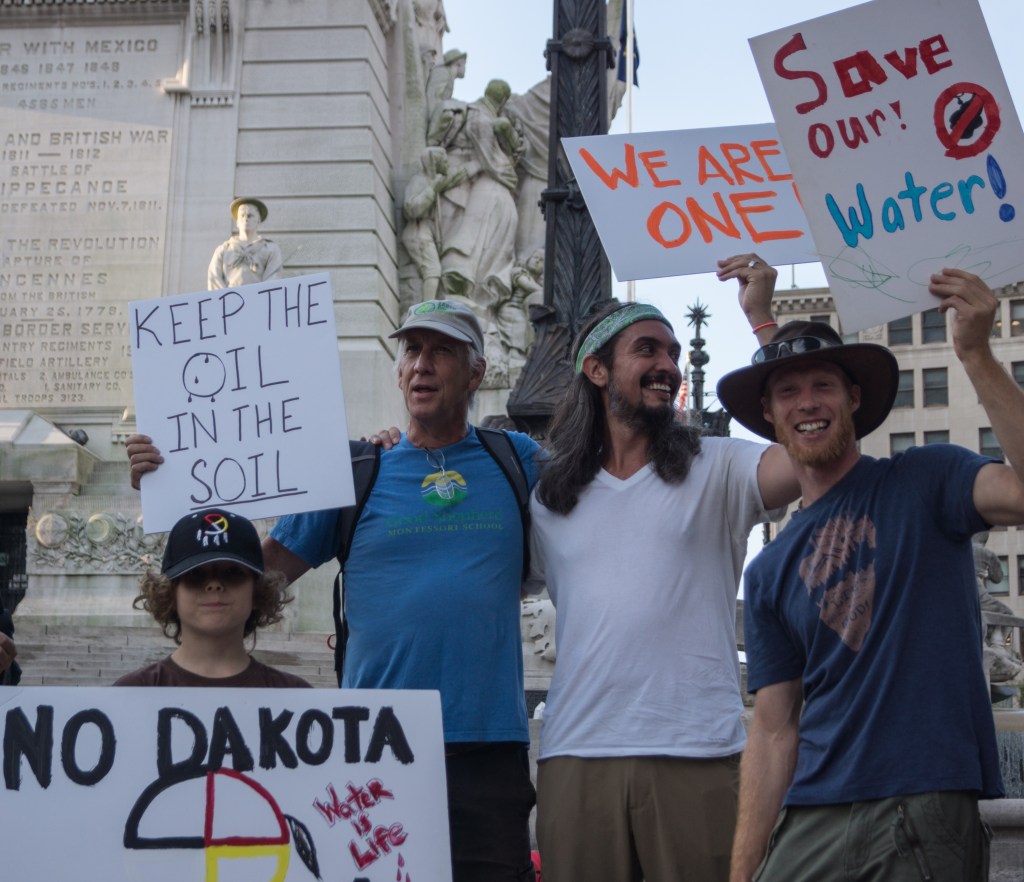
The routes of pipelines are an example of blatant environmental racism. As just one example, the Dakota Access pipeline (DAPL) was originally going to be built upstream of Bismarck, North Dakota. When there was an uproar from the people there who were concerned about contamination of their water, it was moved to cross the Missouri River just a mile upriver from the Standing Rock Sioux reservation. (see: Bismarck residents got the Dakota Access Pipeline moved without a fight)
The world saw the despicable display of heavily militarized law enforcement personnel and their equipment attacking Indigenous people who were praying to protect the water.
And silence, never been so loud And the violence, never been so proud of our people. Nahko
So many times Indigenous treaty rights were and continue to be violated.
I’m sharing some of my own experiences with fossil fuel pipelines to show how widespread this work to protect the water has been, and continues to be. In Indianapolis in 2013 I was trained to organize and lead nonviolent direct actions as part of the Keystone Pledge of Resistance. Eight years later Enbridge Energy has cancelled the Keystone pipeline project.
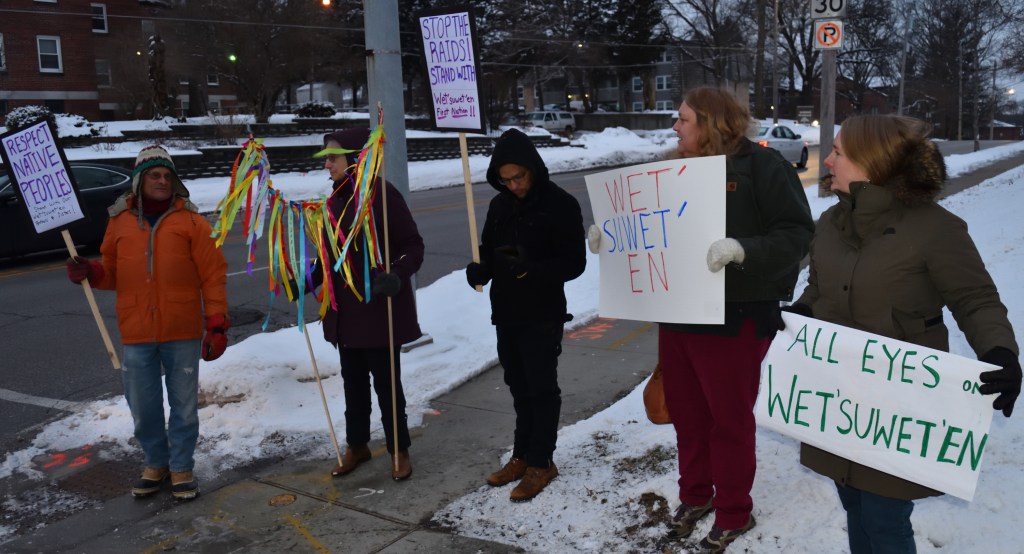
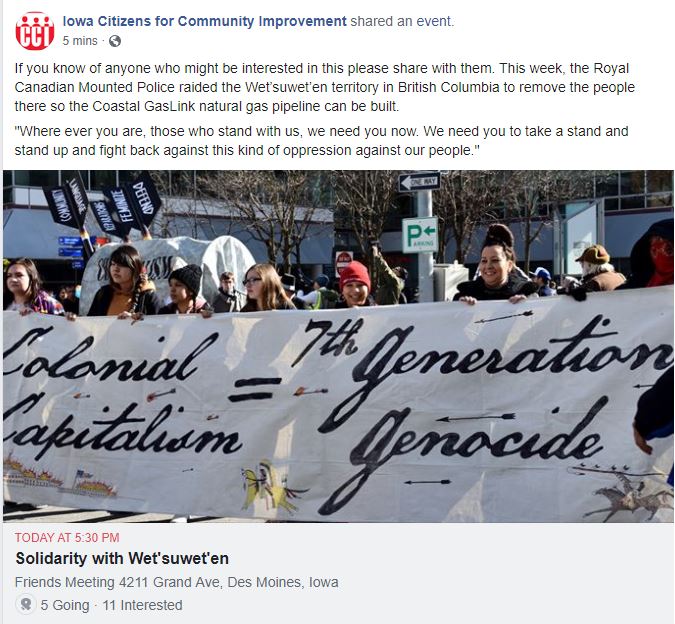
I supported the Wet’suwet’en peoples in British Columbia as they struggled to prevent the construction of the Coastal GasLink natural gas pipeline through their beautiful lands. Multiple times militarized Royal Canadian Mounted Police attacked the First Nations people.
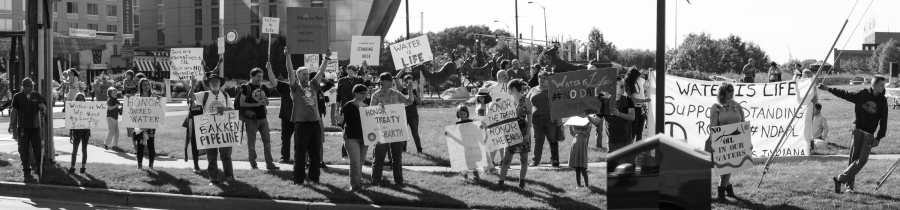
I participated in gatherings to protect the water from the Dakota Access Pipeline in Indianapolis, Iowa and Minnesota. Numerous water protectors were arrested by the state.
I haven’t been involved with the current work against the Line 3 pipeline. (see: Stop Line 3 ). But I am writing about recent events there because there is good news about stopping, at least temporarily, state sanctioned violence against water protectors at Line 3.
In a development progressives called a “huge legal win in the fight against Line 3,” a Minnesota court on Friday ordered police in Hubbard County to stop impeding access to the Giniw Collective’s camp, where anti-pipeline activists have been organizing opposition to Enbridge’s multibillion-dollar tar sands project.
Last month, (county sheriff) Aukes unlawfully blockaded a 90-year-old driveway that serves as the only means of entry and exit to the Giniw Collective’s camp, which is a convergence point for Indigenous-led protests against the expansion of the Line 3 pipeline. Police officers also cited and arrested individuals who attempted to use the driveway to travel to and from the camp.
Under the pretext that the small portion of the driveway extending from the Camp’s private property onto Hubbard County property is now suddenly a “trail” and not designated for vehicular traffic local sheriffs have either physically blocked access, at times by forming a line of over twenty officers, several armed with clubs, or issued citations to water protectors who have driven vehicles on the driveway, even when delivering food, water, or other necessary supplies.
This is a HUGE legal win in the fight against Line 3!! The court put a *restraining order* on the police from blockading camps and issuing citations. Keep up the fight! https://t.co/161AD4RvMO
Water defender Winona LaDuke says the Biden administration "is throwing Indigenous people under the bus" by allowing the Canadian energy company Enbridge to continue construction of the Line 3 pipeline in Minnesota. https://t.co/V4pPFnOIUJpic.twitter.com/9PMrwPVq67
The following is from the Peace and Social Concerns Committee of Iowa Yearly Meeting (Conservative) that was approved yesterday.
Global chaos from rapidly accelerating environmental devastation is highly likely to occur, breaking down our economic, social, and political systems. As air and water temperatures increase, water supplies are drying up. Widening areas and severity of drought are decreasing crop production and forcing people to flee. Rising oceans are creating more climate refugees. The trend of increasing numbers of more ferocious wildfires, hurricanes and other storms are expected to accelerate. All kinds of infrastructure will likely be destroyed, creating more climate refugees, many migrating to the Midwest. How can we prepare our own communities for these disasters, and plan for the arrival of climate refugees?
Peace and Social Concerns, Iowa Yearly Meeting (Conservative) 2021
So if the future isn’t “the future” — if the myth of constant growth, progress, and expansion, driven by miraculous labour-saving technology — anymore, then, well, what’s in store for us? The answer to that’s pretty simple. Regress is.
What does a world crossing the threshold of runaway global warming have in store for it? You might imagine that people will unite in some kind of grand, noble revolution to save the planet, but unfortunately, that’s not going to happen. Instead, the opposite is.
People will flee from Fire and Flood and Plague Belts. As they do, entire economies will begin to collapse, and societies implode. Think about a Napa Valley that can’t make wine. Factories that can’t produce things, homes which can’t be insured, basic infrastructure systems — transport, food, water, energy — which no longer work. Bang. Game over. Entire regions and cities just wink out. As they do, economies grow depressed, while prices skyrocket. If you have a sense that that’s beginning to happen already, you’re precisely correct.
As huge waves of “human capital flight” — read mass migration — ensue, the political result will be, sadly, that today’s nationalism becomes tomorrow’s fascism. Look at how fast Britain — once the envy of the world, gentle, kind, friendly, expansive — fell into a catastrophic nationalism that utterly wrecked its future. Depressed economies need scapegoats. Demagogues arise to point the finger at anyone remotely foreign, different, other. The future looks ultra-fascist, at least to those who’ve studied history.
Do you think any nation will be happy to welcome, say, a million climate refugees? When it’s own systems are already buckling, because the planet’s boiling? When it’s own regions are flooding or burning or both? Of course not. It’ll be fodder for demagogues, who’ll blame the migrants for the woes of the pure and true.
Meanwhile, living on a burning planet is going to continue basically driving much of the human race verifiably insane. Take a look at how fast and hard bizarre delusions spread. It’s not just Facebook — that’s just the mechanism. It’s that life is incredibly stressful, to the point that many of us can’t cope. We need the delusions, just to make through another day. Much easier to hate someone slightly different from you than work together to solve real problems. Much easier to descend into superstition and fanaticism and fundamentalism than think through the plight we’re in these days.
Faith in the future is one of the linchpins which held our civilisation together. The myths of technological progress, economic growth, and living standards rising in tandem forever — eternally — are what sold the thing known as “the global economy” to the world. Only now they appear to have been proven badly wrong. The people dismissed as “pessimists” and “alarmists” in the 70s and 80s and 90s — ecologists, climate scientists, economists — appear to have been exactly right.
For a long time I’ve admired the thinking and writing of umair haque. Recently he has written a series of articles about environmental chaos that provide insight to our unfolding catastrophe in ways I haven’t found elsewhere. This morning I decided to learn more about him and was surprised to find he established the website he articles appear on, Eudaimonia. He says, ” you can think of it as a lab, consultancy, thinktank — what it really is is an invitation.”
September 14, 2017, he published The Story. Life, the World, Now, You, and Me, that tells how he came to create Eudaimonia.
Hi. I’m Umair. I want to tell you a little story about life, death, meaning, purpose, happiness, you, me, the world, and why I founded Eudaimonia & Co.
A couple of years ago, right at the peak of it all, jetting around the globe, writing books, giving speeches, invulnerable as a rock, I got sick. Keeling-over-losing-fifty-pounds-in-a-month-sick. The doctors told me I had months to live. And after the heart-stopping panic subsided, a funny thing happened: I was happy, thinking and writing about the meaning of it all, in a way I’d never really been discussing economics, leadership, and society.
Dying young — or at least thinking you’re going to — is like climbing the Mount Everest of inner clarity. You think about life. Not in a mournful way. Maybe you haven’t lived enough for that yet. Just in an appreciative one. Life is a funny thing. Unique, singular, strange. Camus famously called it absurd. It’s the only thing in a lonely, clockwork universe that struggles. Rivers flow, clouds dissipate, oceans ebb. But only life undertakes an improbable, uncertain, difficult quest for self-realization. A tree stretches into the sun. A little bird builds a nest. You strive mightily all your days long for happiness, meaning, purpose, grace, defiance, rebellion, truth, knowledge, beauty, love. That quest is what makes life so strikingly different from dust, fire, mud, air.
The economic paradigm of human organization doesn’t care. About life. Yours, mine, our grandkids, our planet’s. In any of it’s three aspects: not it’s potential, nor it’s possibility, nor it’s reality — life a beautiful and universal quest for self-realization. It’s sole end is maximizing immediate income.
And that’s the hidden thread that connects today’s four Massive Existential Problems. Climate change happens when the planet’s well-being is used up to maximize immediate income. Stagnation happens when people’s well-being is used up to maximize immediate income. Inequality happens when a society’s well-being is used up to maximize immediate income. And extremism is a result of all that ripping yesterday’s stable and prosperous social contracts to shreds. Today’s great global problems are just surface manifestations of the same underlying breakdown — a badly, fatally, irreparably broken paradigm of human organization.
The paradigm is the problem. A solely, paradigmatically, one-dimensional economic approach to human organization. That old, rusting, busted, industrial-age, economic paradigm is what’s created the Massive Existential Threats the world faces today. The single-minded pursuit of maximizing short-term income (versus, for example, optimizinglong-run well-being) is what’s ignited inequality, stagnation, climate change, and extremism — and the later problems that are likely to stem from them.
So. How can we begin crafting that better paradigm?
I call it moving from an economic paradigm to a eudaimonic paradigm of human organization. It has new ends for organizations: five new goals that elevate and expand life, versus blindly maximizing income. And it has new means: design principles with which to build organizations that can accomplish those ends. Together, those ends and means make up a little framework that I call “eudaimonics”. It’s meant to help us build organizations that are better at creating wealth, well-being, and human possibility, not just maximizing income, because life itself is the true measure of the success any and every organization, from a family to a company to a city to a country to the world itself.
So. A brief summary. Human organizations have become treadmills. But they should be gardens.In which lives flourish, grow, fruit, and flower. The great challenge of this age isn’t single-mindedly maximizing one-dimensional income as the sole end and purpose of human existence, but elevating and expanding life’s possibility. Whether mine, yours, our grandkids’ or our planet’s. That noble, beautiful, improbable quest for self-realization — eudaimonia — is the reason we’re all here, each and every one.
Remember me? There I was, happily dying. And then the fates did what fates do. Pulled the rug out from under me. I didn’t die. The old world did. And the new world isn’t yet born. We’re going to have to create it, give painful birth to it, drag it out of ourselves, kicking and screaming, with love and grace. Even those of us, like me, who thought they’d be content watching the sun set.
Hence, this little organization. You can think of it as a lab, consultancy, thinktank — what it really is is an invitation. So if you’d like to join me on this quest, consider all this yours.














 LANDBACK Friends