New Year 2022

I’m concerned to see little progress toward solutions for the myriad of problems we face. Especially with accelerating environmental chaos. We’re paralyzed in the face of so many complex problems. Disheartened because nothing makes progress.

I contend that is because, as Albert Einstein said, “we cannot solve our problems with the same thinking we used when we created them.”

I am proposing we implement new ways to approach our justice work. And will ask our peace and social concerns committee to explore how to change our work from a committee structure to a Mutual Aid group. I’m interested to see how faith can be part of Mutual Aid.

This year’s Peace and Social Concerns Committee Report from my Quaker yearly meeting is included below. And this is a link to An Epistle to Friends Regarding Community, Mutual Aid and LANDBACK.

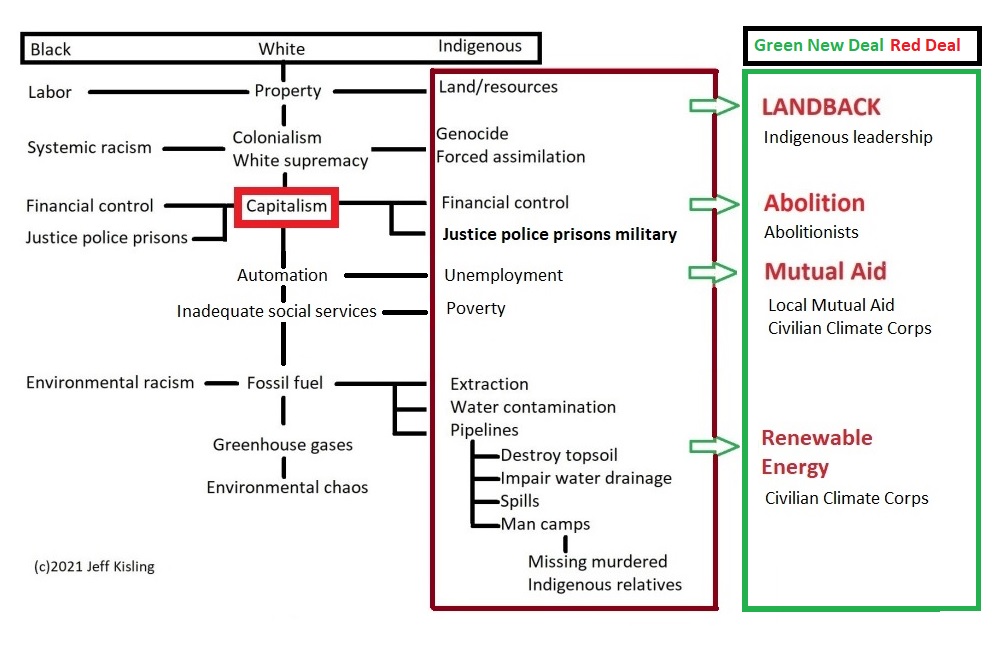
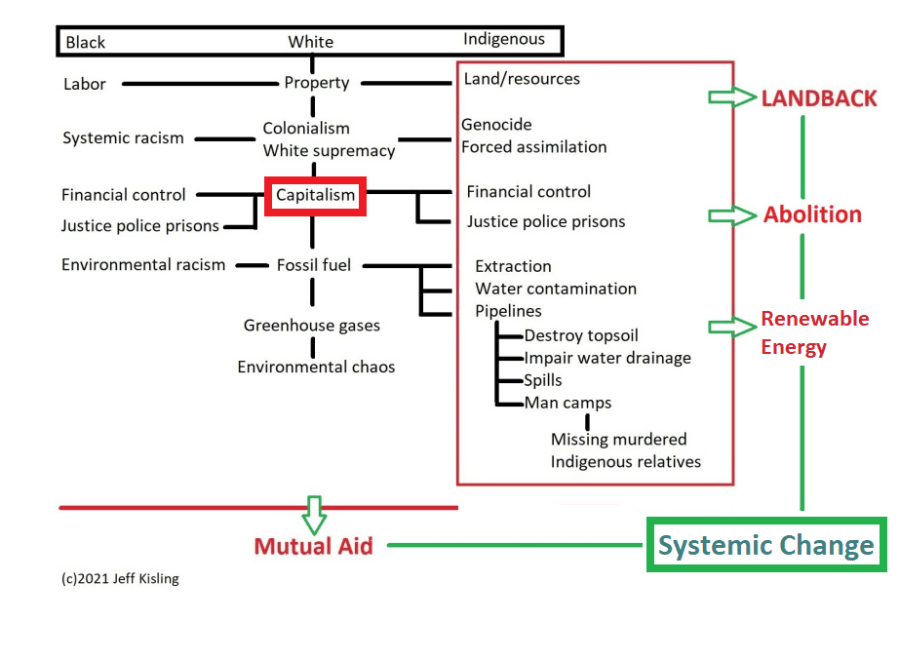
This diagram lists problems and solutions. LANDBACK, Abolition of police and prisons, Mutual Aid, resource conservation and spirituality. Adapted from the more detailed diagram at the end of this.


Peace and Social Concerns Committee Report 2021
Iowa Yearly Meeting (Conservative)

This has been a year of great upheaval locally, nationally, and globally. The work of our
monthly meetings has been impacted by the COVID-19 pandemic. Yet we have found
ways to continue our peace and justice work. And had more time for prayer and
reflection.

Global chaos from rapidly accelerating environmental devastation is highly likely to
occur, breaking down our economic, social, and political systems. As air and water
temperatures increase, water supplies are drying up. Widening areas and severity of
drought are decreasing crop production and forcing people to flee. Rising oceans are
creating more climate refugees. The trend of increasing numbers of more ferocious
wildfires, hurricanes and other storms are expected to accelerate. All kinds of
infrastructure will likely be destroyed, creating more climate refugees, many migrating to
the Midwest. How can we prepare our own communities for these disasters, and plan
for the arrival of climate refugees?

Justice work by White Friends has changed in recent years. An important concept of
justice work is to follow the leadership of oppressed communities, who are working
tirelessly for their liberation. Those who consider themselves White Friends are learning
how to step back. Be supporters and allies.

Many injustices today trace their roots to the arrival of white Europeans on this
continent. These include a whole history of enslavement as well as genocide of
Indigenous peoples. It is important for white Quakers to know we are not expected to
feel guilt or blame for injustices that occurred in the past. But knowing what we know
now, it is up to us to learn more about those wrongs, and work toward repair and
healing. This will be a primary focus of this committee’s work in the coming year.

As a society we have been forced to face systemic racism. For example, public murders
by police have generated sustained protests regarding police brutality, with calls to limit
police powers and change or abolish prisons.

Also dating back to the arrival of white Europeans is the genocide of Indigenous
peoples. The theft of Native lands. And the atrocities of Native children taken from their
families to institutions of forced assimilation, often far away. Places where attempts
were made to the erase their culture. Many subjected to physical or sexual abuse.
Thousands of Native children died. This intentional cruelty broke the resistance of
Native peoples who were trying to hold onto their lands.

The recent validation of the remains of Native children on the grounds of those
institutions is having devastating effects in Native communities and those who care
about them. Searching the grounds of the institutions in this country is about to begin.
Secretary of the Interior, Deb Haaland, has launched a federal investigation into these
institutions of forced assimilation in the US,

A number of Catholic churches, who ran those institutions in Canada, have been
burned or vandalized.

There are renewed calls for truth and reconciliation. Canadian Yearly Meeting has done a
great deal of work on this.

These injustices are some of the effects of systems of white supremacy. The concept of
Mutual Aid is becoming an increasingly used model for communities working for justice.
The idea is to have a horizontal hierarchy, where everyone has a voice. And work to
ensure a vertical hierarchy does not develop. Without a vertical hierarchy, there can, by
definition, be no superiority. Several of our meetings are supporting existing Mutual Aid
communities or considering creating their own. These are opportunities to begin to
disengage from the colonial capitalist system and white supremacy. Ways we can model
justice in our own meetings and communities.

We can show up for Black Lives Matter and other racial justice events. We can support
those who meet with local, state, and Federal government officials. We can show up in
the streets to support agitation for change, train in nonviolent civil disobedience, or
accompany arrested activists through the justice system.

We can show up, when appropriate, at events of Native peoples, such as the Prairie
Awakening ceremony. We can share Indigenous news on social media platforms, so
others are aware of these things.

Indigenous leaders in the Midwest have asked us to learn about and find ways to
engage in the concepts of Land Back. The website LANDBack Friends has been
created and will be updated as our work continues. https://landbackfriends.com/
We pray for guidance for how our committee might work together at the intersection of
our responsibilities and those of Ministry and Counsel.

We will continue to seek spiritual guidance, both for what we are called to do, and ways
to offer spiritual support for those who are not Friends. There is great spiritual poverty in
many communities. Spiritual support will be needed by those who suffer the
consequences of environmental and other disasters. And those responding to these
disasters.

It is important to understand this work depends on us all working together, in the
community. Outside our meetinghouses. Developing friendships in the local community.
We encourage more engagement with our youth. They can teach us about justice. We
and our meetings will be revitalized.

Many monthly meetings are adapting to these changing ways of doing peace and
justice work. Building relationships with communities of black, Indigenous, and other
people of color. Exploring ways to be in right relationship with these communities. All of
us learning from each other. Sharing our stories. Deepening spiritual connections.

Peace and Social Concerns Committee 2021
Iowa Yearly Meeting (Conservative)


An Epistle to Friends Regarding Community, Mutual Aid and LANDBACK


Points of Unity

The second anniversary of my connections with Des Moines Mutual Aid is approaching. Our experiences together have literally changed my life. The Spirit led me to this and continues to do so. This can be a way to live through these increasingly uncertain times.

True security lies in the unrestrained embrace of insecurity — in the recognition that we never really stand on solid ground, and never can.

– Oliver Burkeman –
May be an image of text that says 'POINTS OF UNITY DES MOINES MUTUAL AID'
May be an image of text that says '0. We believe in working shoulder to shoulder and standing in solidarity with all oppressed communities. We ourselves are oppressed, and our mutual aid work IS a fight for our collective liberation. We do not believe in a top-down model of charity. Instead we contrast our efforts at horizontal mutual aid, the fostering of mutually beneficial relationships and communities, to dehumanizing and colonizing charity.'
May be an image of text that says '1. We believe in community autonomy We believe that the communities we live and organize in have been largely excluded from state social services, but intensely surveilled and policed by the state repressive apparatus Capitalism is fundamentally unable to meet people's needs. We want to build self- sustaining communities that are independent of the capitalist state both materially and ideologically, and can resist its repression.'
May be an image of text that says '2. We are police and prison abolitionists. oractice Abolition and the mutual aid that we are inextricably linked. We dn' on capitalist institutions or the police to do our work. We believe in building strong and resilient communities which make police obsolete, including community systems of accountability and crisis intervention'
May be an image of text that says '3. We work to raise the political consciousness of our communities. Part of politica education is connecting people's lived experiences to a broader political perspective. Another component is working to ensure that people can meet their basic needs. It is difficult to organize for future liberation when someone is entrenched in day-to- day struggle.'
May be an image of text that says '4.We have open disagreements with each other about ideas and practices. We believe there is no formula for resolving our ideological differences other than working towards our common aims, engaging with each other in a comradely manner, and respecting one another, whether or not we can hash out isagreements in the process.'

The next American Revolution, at this stage in our history, is not principally about jobs or health insurance or making it possible for more people to realize the American Dream of upward mobility. It is about acknowledging that we Americans have enjoyed middle-class comforts at the expense of other peoples all over the world. It is about living the kind of lives that will not only slow down global warming but also end the galloping inequality both inside this country and between the Global North and the Global South. It is about creating a new American Dream whose goal is a higher Humanity instead of the higher standard of living dependent on Empire. It is about practicing a new, more active, global, and participatory concept of citizenship. It is about becoming the change we wish to see in the world.

The courage, commitment, and strategies required for this kind of revolution are very different from those required to storm the Winter Palace or the White House. Instead of viewing the U.S. people as masses to be mobilized in increasingly aggressive struggles for higher wages, better jobs, or guaranteed health care, we must have the courage to challenge ourselves to engage in activities that build a new and better world by improving the physical, psychological, political, and spiritual health of ourselves, our families, our communities, our cities, our world, and our planet.

Grace Lee Boggs,The Next American Revolution

Mutual Aid or Collapse

For a long time, we have been observing the breakdown of so many systems we depend on. In medicine we have the term ‘multi system organ failure’. I’ve begun to think of the dysfunction of our economic, political, educational, medical, spiritual, and social support web as being in multi system failure now.

We have three choices.

  1. We can try to continue to ignore these failures. But that is becoming increasingly difficult to do.
  2. We can try to repair those systems, hoping they will keep working a little longer.
  3. Or we can build something new. Which might be a return to how things once were.

The consequences of the Covid pandemic are a preview of the future if change doesn’t happen now. As in NOW. As umair haque says below, “And so what do you expect to happen? If change can’t, then only collapse is left.

I think of Covid as a message backwards, from the future. And it says something like this. Life as you knew it is now over. The future is now going to become a bitter and bruising battle for the basics. The basics. Air, water, food, medicine, energy. Things that many of us once took for granted, and assumed would simply be around, as if by magic.

That age is now coming to an end. Did you ever think that breathable air would be in short supply? Where you have to wear a mask, because the air could infect you with a respiratory virus? That is what the future looks like, except for all the basics.

Life as you know it really is coming to an end, my friend. If it hasn’t already. The problem? Not enough of us can face that simple fact with courage, grace, truth, kindness, love, and goodness. And so what do you expect to happen? If change can’t, then only collapse is left.

Things Feel Bleak Because This Way of Life is Coming to an End. The Lesson of 2021 is Either We Change — or Things Collapse Around Us by umair haque, Eudaimonia, Nov 7, 2021

The phrase about Covid as a message from the future reminds me of this Terry Tempest Williams quote.

The eyes of the future are looking back at us and they are praying for us to see beyond our own time. They are kneeling with hands clasped that we might act with restraint, that we might leave room for the life that is destined to come.

Terry Tempest Williams

When I decided to start my own blog about six years ago, I was led to call it Quakers, social justice, and revolution. I wondered what “revolution” might be about. Now I know this revolution is Mutual Aid. As my friend and Mutual Aid mentor Ronnie James says, “The recent past shows us that mutual aid is not only a tool of survival, but also a tool of revolution”.

“Mutual aid, a radical practice that has been undertaken by marginalized groups for decades”. Setting up Mutual Aid communities is more urgent now as systems we depended on are collapsing.

Mutual Aid Goes Mainstream” is the title of an article published yesterday. Subtitled “Now that the pandemic has shifted from an immediate to a chronic crisis, organizers have a chance to rethink the political implications of their efforts.”

Mutual Aid is one of the main subjects I’ve been writing about for some time.
See the Mutual Aid tab on this blog, https://landbackfriends.com/mutual-aid/
and this link to articles about Mutual Aid on my other website, Quakers, social Justice and revolution https://jeffkisling.com/?s=%22mutual+aid%22

I wrote “An Epistle to Friends Regarding Community, Mutual Aid and LANDBACK” that summarizes what Mutual Aid and LANDBACK are about.

Mutual aid, a radical practice that has been undertaken by marginalized groups for decades, became a mainstream buzzword almost overnight.

Lucia Geng

Last spring, within hours of the University of Chicago’s announcement that classes would be held online, students created a Facebook group to coordinate mutual aid efforts. Even with finals right around the corner, UChicago Mutual Aid came alive with activity. Students eagerly offered and accepted support in the form of advice, essential supplies like food and moving boxes, and spreadsheets listing leads on resources like housing. 

What I witnessed at my college was just one example of the many mutual aid networks, both college-based and non-college-based, that sprung up across the country in response to the COVID-19 pandemic. Mutual aid, a radical practice that has been undertaken by marginalized groups for decades, became a mainstream buzzword almost overnight.

Mutual aid efforts often arise during moments of crisis when those in positions of authority fail to help people, and when the importance of grassroots efforts comes into full focus. When the immediate crisis passes, groups may either fizzle out or choose to adapt to a new context.

“Mutual aid is a form of political participation in which people take responsibility for caring for one another and changing political conditions,” wrote organizer, lawyer, and mutual aid advocate Dean Spade in 2020. Mutual aid involves people “building new social relations that are more survivable.”

MUTUAL AID GOES MAINSTREAM by Lucia Geng, Dissent Magazine, November 9, 2021

I’ve been blessed to have become involved with a local Mutual Aid group for over a year. I’ve seen the concept in action and am now trying to get others involved in Mutual Aid. Some of the reasons why are because the underlying principle of Mutual Aid is the opposite of capitalism. At a time when millions of people are feeling hopeless about the future, isolated, and living in conditions of poverty, Mutual Aid is about supporting everyone in the community. Working in the present to provide food, shelter, and dignity. Not waiting for help from government systems. Government that serves the wealthy and not the rest of us.


As bleak as this is, there is a significant amount of resistance and hope to turn the tide we currently suffer under. We stand on the shoulders of giants that have been doing this work for centuries, and there are many lessons we can learn from.

The first, and possibly the most important, is that it was not always this way, which proves it does not have to stay this way. 

What we have is each other. We can and need to take care of each other. We may have limited power on the political stage, a stage they built, but we have the power of numbers.

Those numbers represent unlimited amounts of talents and skills each community can utilize to replace the systems that fail us.  The recent past shows us that mutual aid is not only a tool of survival, but also a tool of revolution. The more we take care of each other, the less they can fracture a community with their ways of war.

Ronnie James


Human Supremacy

This morning I had one of those “ah ha” moments, when something changes my perspective in a way that explains things that seemed inexplicable. I don’t remember hearing the term ‘human supremacy‘ before. But as soon as I read that I understood what it is. White supremacy been part of our national conversation for years. Human supremacy extends the idea of white supremacy to the domination of everything non-human by humans.

One of the most important points umair haque makes in the article referenced below is there are no hierarchies. That is the fundamental concept of Mutual Aid. In our Mutual Aid work, we monitor ourselves to avoid any vertical hierarchy from creeping in. That’s something you have to learn and practice when you begin to work in a Mutual Aid community. We are so used to having someone in charge, someone making decisions.

When there isn’t a vertical hierarchy, by definition there can be no supremacy.

As the systems now in place break down because of environmental, economic, and political chaos, we will be forced to find different ways of living. Mutual Aid is one possibility. One that gets away from human supremacy.

One of the most insightful authors I follow is umair haque. His article today is titled “The End of Human Supremacy”.

If I say to you that we need to end white supremacy, you’ll probably agree with me, wise and gentle person that you are. But this is a job, to tell you the truth, that we should have done long, long ago. The work before us this century is much harder, and goes much further. I call it the end of human supremacy.

What I mean by that is something like: at this juncture in history, we walking apes regard ourselves as supreme. Above and beyond everything else, at the top of our own self-imagined hierarchies of life and being. We’re way better — way more powerful than a dumb little virus, aren’t we? Maybe not. And because of that very mistake — human supremacy — our civilization has plunged into the beginnings of collapse.

Because our civilization is built on this pillar, “I think therefore I am,” our economies and societies have developed in a perverted way. They don’t think — therefore they aren’t. They aren’t people — they don’t deserve the rights and protections and guarantees of personhood. They are there to be subjugated, exploited, abused.

Do you see what I mean by human supremacy a little bit now? We’re the only “people” on this planet. And therefore, only we matter. We’ve made a tiny bit of progress. Sure, women and people of color are now allowed into the ranks of “people” — sometimes. But human beings sit still atop our great hierarchies. If I ask you to examine your conception of the world, it will be a modern one, not a premodern one — unlike the ancients, you probably won’t put human beings at the bottom…you’ll put them at the top.

And that’s what we have to undo.

We don’t belong at the top of any hierarchies. There are no hierarchies and there is no top. There are webs and spirals and links between things. But a top? It doesn’t exist. Our entire civilization was brought to a halt by a tiny microbe. Still think we’re at the top? OK, then imagine this. The fish clean the rivers we drink from, the insects and worms turn the soil of our harvests, the trees give us air to breathe. Top? What top?

The End of Human Supremacy. Our Civilization is Collapsing. But Can We Change Fast Enough to Stop It? by umair haque, Eudaimonia, Oct 31, 2021

Eileen Crist knows more than a person should, more than seems healthy, about dying birds and dying watersheds. She’s keenly aware of the global crisis of biodiversity loss and ecological collapse, and she sees what’s driving it: direct causes like climate change and what she calls the “ultimate causes” — population growth, overconsumption, and technological power. But the thing that really interests Crist, the thing that she’s been studying and publicizing for the past three decades as a professor and radical environmental thinker, is an even deeper question: Why is so little being done to address this planetary emergency?

She attempts, with a mix of intellectual rigor and lyrical passion, to provide an answer in her 2019 book, Abundant Earth: Toward an Ecological Civilization. The cause of our inaction, she says, is “human supremacy,” a largely unconscious belief that Homo sapiens are the masters of creation rather than just one humble species among millions. This worldview sanctions not only factory farming, clear-cut logging, mountaintop-removal mining, and bottom-trawl fishing, but also more commonplace behaviors such as cruising along in cars that slaughter wildlife and emit carbon dioxide. As long as human supremacy prevails, Crist writes, “humanity will remain unable to muster the will to scale down and pull back the burgeoning human enterprise that is unraveling Earth’s biological wealth.”

The most important thing to expose and dissect is human supremacy. It often gets referred to by the gentler term anthropocentrism. I view it as a widely shared, unconscious worldview that tells us we are superior to the rest of nature and thus entitled to treat nonhumans and their habitats however we please. Human specialness, human aboveness, and the sanctity of the human prerogative — those are key elements, along with our seizing the power of life and death over nonhumans and our aggressive control of all geographical space.

Human Supremacy by Sara Wright, April 21, 2021. Our Great Reckoning. Eileen Crist On The Consequences Of Human Plunder by LEATH TONINO, DECEMBER 2020

Since the inception of the patriarchal culture (ca. 10000 BCE) we have become conditioned to assume that human supremacy over nature is “natural law.” But there is nothing natural about human supremacy and derivatives such as male supremacy, white supremacy, and other such ideologies of domination. 

Musings on Human Supremacy, Religious Patriarchy, and Industrial Ecology by Luis Teodoro Gutiérrez, originally published by Mother Pelican, May 3, 2021

Another World is Possible

Despite the collapse of capitalism and the current political system based upon it, there are signs of hope. More and more people are joining with others to build better economic and political systems. Or return to systems that worked in the past for hundreds of years.

I am blessed to have gotten to know people who are doing just that. One of my new friends is Jake Grobe who works at Iowa Citizens for Community Improvement (ICCI). Jake joins in our Mutual Aid work in Des Moines. I knew he was going to the People vs Fossil Fuels Week of Action last week in Washington, DC. I saw some of what he posted online while he was there. And we got to visit yesterday when we were at the Mutual Aid food bank. He described being present when the flag outside the Army Corps of Engineers was replaced with one indicating “No Consultation”, which you can see in the video below. Following is from an email message he sent yesterday. I like the things he said about what gives him hope.

Also below is part of a teach-in my friend Ronnie James presented in 2020. “The recent past shows us that mutual aid is not only a tool of survival, but also a tool of revolution.

In addition, umair haque writes about the problems with hierarchies. “These two forces naturally oppose one another, like fire and ice — hierarchy and progress. And it seems to me one of the great secrets history tries to teach us is that when we find ways to make them work together, then and only then human possibility opens to its fullest horizons.”

Hierarchy is what Mutual Aid is about. Mutual Aid works to avoid vertical hierarchies. And instead to maintain a flat or horizontal hierarchy, where everyone has a voice.

As an example of how our struggles are interconnected, Jake and Ronnie are in the photo below that was taken after we completed the Mutual Aid food giveaway. We are supporting the Wet’suwet’en peoples who are struggling to protect the water and prevent the construction of the Coastal GasLink pipeline through their pristine lands.

Last week a delegation of CCI members and People’s Action joined thousands in Washington DC for the People vs Fossil Fuels Week of Action. Led by Indigenous and frontline communities, we marched, occupied, and blocked roads alongside faith groups, racial justice groups, and environmental groups to demand federal action to end the era of fossil fuel destruction. 

Words mean nothing without action: call Biden to demand a halt to Line 3.

Despite all the promises, the Biden Administration has approved over 2,500 new oil and gas permits on public land, the fastest pace since 2008. He has let projects like the Line 3 tar sands pipeline in Minnesota go online, already polluting sacred water and violating treaty rights. And as I speak, Biden is surrendering to the demands of two blatantly corrupt Senators to gut the Build Back Better bill of programs needed to address the climate crisis. 

Reeling with all this has been hard to say the least. Here is where I’m finding hope:

  • Indigenous people have been resisting genocide for hundreds of years and many continue to lead the fight on the frontlines – there is a lot to learn.
  • Over 500 of us were arrested in the name of justice last week, many more have put their literal bodies on the line to stop construction of fossil fuel projects, and right now Sunrise youth are going on a hunger strike outside the white house while tens of thousands of workers are on strike.

People seeing their power and using it means we can win, because Mother Earth will regenerate and heal herself, as soon as we stop the harm.

Jake Grobe, Iowa CCI

Perhaps, like me, you think things aren’t going so well in the world today — 1930s style authoritarianism, extremism, and stagnation rock the world like a hurricane once again.
The question then is this: what kind of world do we want? In this essay I’m going to offer three futures. They’ll contrast the tension between hierarchy and progress. You see, the question in ages like this one is whether hierarchies — which make things comfortable for those above the waterline, even during decline and collapse — can make us more capable of change, growth, and maturity, somehow too. So I will write it from a curious perspective, too — that we each decide, in some way, what kind of future we are to create.

These two forces naturally oppose one another, like fire and ice — hierarchy and progress. And it seems to me one of the great secrets history tries to teach us is that when we find ways to make them work together, then and only then human possibility opens to its fullest horizons.

So what kind of future do we want? One with lots of burdensome, bitter, and polarizing hierarchy — groups vying to pull each other down — which flatlines progress? Or one where consensual hierarchy has collapsed into predation — no one can agree to govern or be governed, so monsters rule — which leads to super-charged regress? Or one in which, improbably, hierarchy and progress have learned, improbably, to walk hand in hand? That choice, I think, is the one that will define these times.

(How) We Need To Fix The World. If We Don’t Change the Path We’re On… by umair haque, Eudaimonia and Co, Oct 2021

As bleak as this is, there is a significant amount of resistance and hope to turn the tide we currently suffer under. We stand on the shoulders of giants that have been doing this work for centuries, and there are many lessons we can learn from.

The first, and possibly the most important, is that it was not always this way, which proves it does not have to stay this way. 

What we have is each other. We can and need to take care of each other. We may have limited power on the political stage, a stage they built, but we have the power of numbers.

Those numbers represent unlimited amounts of talents and skills each community can utilize to replace the systems that fail us.  The recent past shows us that mutual aid is not only a tool of survival, but also a tool of revolution.

If we are to survive, and more importantly, thrive, we know what we will have to do.

All Power To The People.

Ronnie James, The Police State and Why We Must Resist, 8/22/2020


Mutual Aid supports the Wet’suwet’en peoples

Rejecting capitalism

With so much upheaval, both in the natural world and man-made systems, it is important to have a vision of the future we want to build. We have limited capacity, of both time and other resources, making it important to determine how we can most wisely use them. And there are an increasing number of crises requiring attention and resources now if we are going to have any chance of slowing these evolving catastrophes.

Fundamentally, we must decide whether to work for incremental changes to the existing systems or transition to new ones.

I’m having a tough time convincing people that the capitalist economic system, and the political systems supporting capitalism, are fundamentally unjust.

One’s view of capitalism is determined by how well capitalism is working for you. If you are fortunate to have income to cover expenses, you probably don’t want to change. Change is difficult.

Otherwise, you understand capitalism is unjust. An economic system built on money is unjust when millions of people live in poverty because they don’t have adequate, or any income. Are denied goods and services simply due to the lack of money.

When there was close to full employment capitalism seemed to work. But as jobs were lost to automation or moving them out of the country to take advantage of cheap labor elsewhere, millions have been thrown into poverty. To lack food, shelter, healthcare, education, spiritual support, dignity.

Capitalism is unjust because it has been built on stolen land and the labor of enslaved people.

As my good friend Ronnie James says:

I’m of the firm opinion that a system that was built by stolen bodies on stolen land for the benefit of a few is a system that is not repairable. It is operating as designed, and small changes (which are the result of huge efforts) to lessen the blow on those it was not designed for are merely half measures that can’t ever fully succeed.

So the question is now, where do we go from here? Do we continue to make incremental changes while the wealthy hoard more wealth and the climate crisis deepens, or do we do something drastic that has never been done before? Can we envision and create a world where a class war from above isn’t a reality anymore?”

Ronnie James

Thanks to Ronnie, I’ve been learning about, and participating in an alternative to capitalism, Mutual Aid. “Can we envision and create a world where a class war from above isn’t a reality anymore?” One of the fundamental principles of Mutual Aid is working to maintain a horizontal or flat hierarchy. To work to avoid a vertical hierarchy. One of the great advantages of this lack of vertical hierarchy is any kind of supremacy, e.g. white supremacy, is not even a possibility.

So I work with a dope crew called Des Moines Mutual Aid, and on Saturday mornings we do a food giveaway program that was started by the Panthers as their free breakfast program and has carried on to this day. Anyways, brag, brag, blah, blah.

So I get to work and I need to call my boss, who is also a very good old friend, because there is network issues. He remembers and asks about the food giveaway which is cool and I tell him blah blah it went really well. And then he’s like, “hey, if no one tells you, I’m very proud of what you do for the community” and I’m like “hold on hold on. Just realize that everything I do is to further the replacing of the state and destroying western civilization and any remnants of it for future generations.” He says “I know and love that. Carry on.”

Ronnie James

This is a link to much more about Mutual Aid: https://landbackfriends.com/mutual-aid/

This diagram identifies LANDBACK, Abolition of police and prisons, and Mutual Aid as paths to a better society and future for us all.

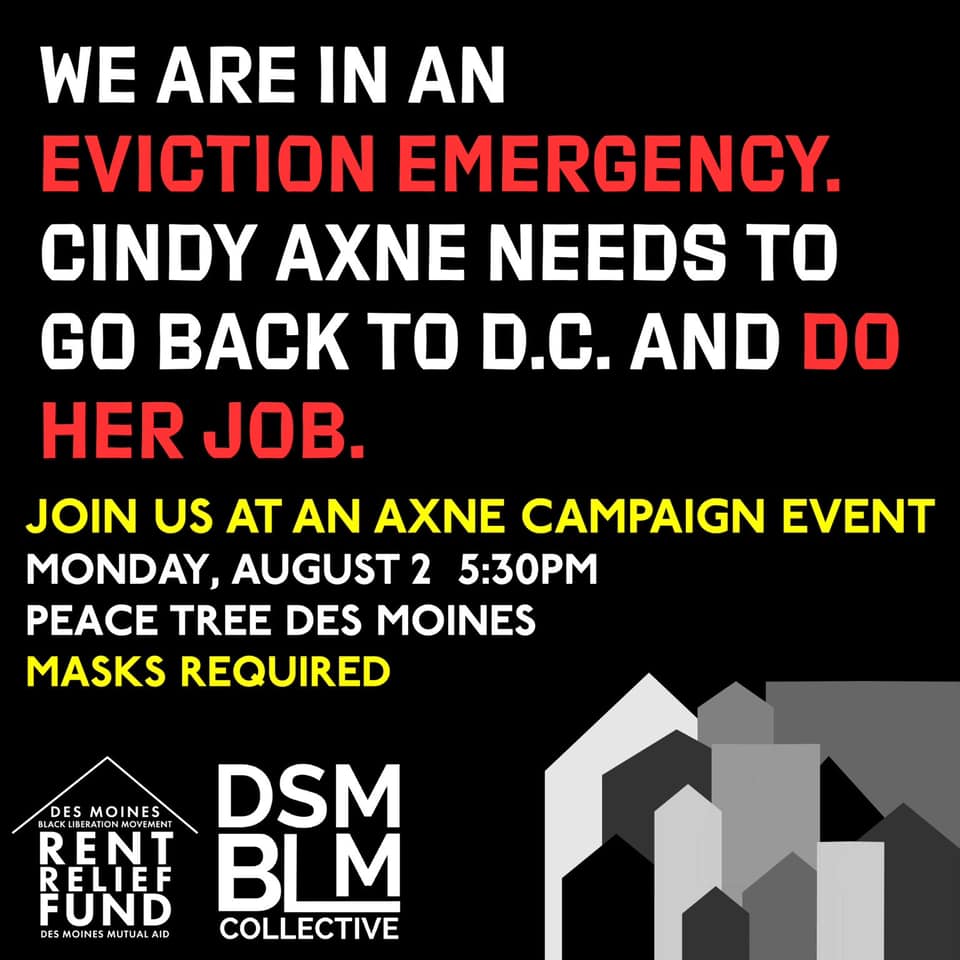
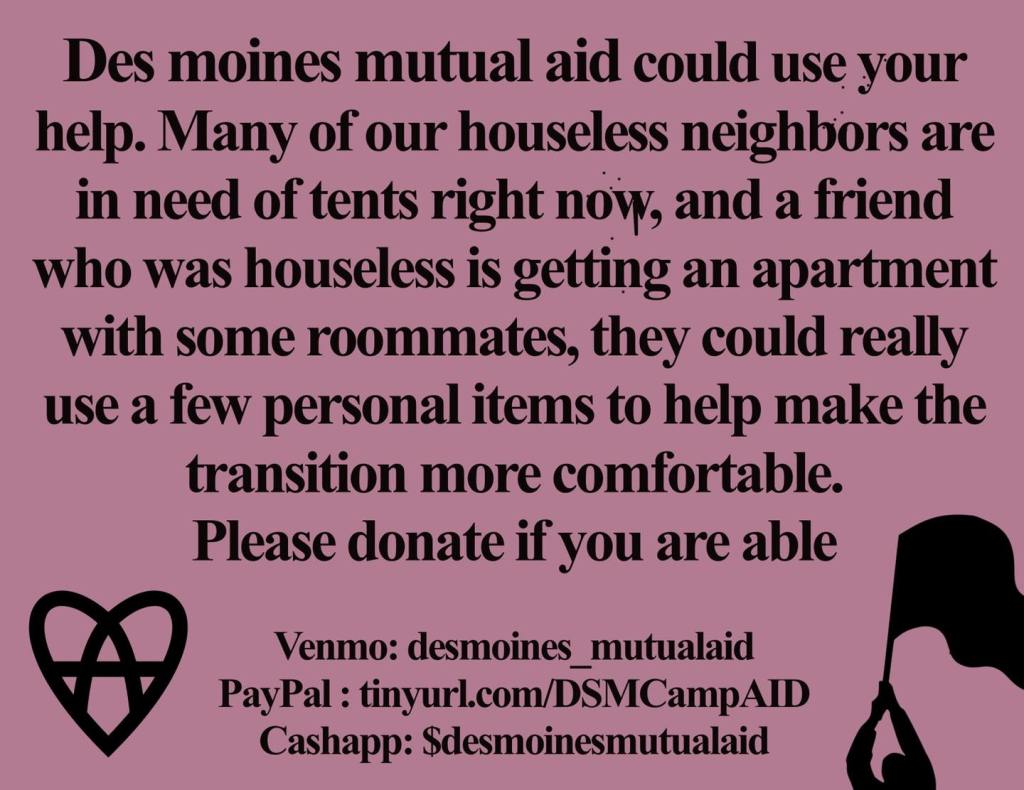
Des Moines Mutual Aid is a collective that does outreach for homeless folks in our community, houseless folks in our community. We also assist BLM with their rent relief fund, and most of the work we’ve done is running the bail fund for the protests over the summer. In the course of that work, we have witnessed firsthand the violence that is done upon people of color, Black people specifically, by the white supremacist forces of the state – in this state, in this city, in this county. There is absolutely a state of emergency for people of color and Black people in Iowa. The state of emergency has been a long time coming. We will support – DMMA will absolutely support any and all efforts of this community – BLM, and the people of color community more generally- to keep themselves safe. Power to the people.

Patrick Stahl, Des Moines Mutual Aid

mutual aid is the new economy. mutual aid is community. it is making sure your elderly neighbor down the street has a ride to their doctor’s appointment. mutual aid is making sure the children in your neighborhood have dinner, or a warm coat for the upcoming winter. mutual aid is planting community gardens.

capitalism has violated the communities of marginalized folks. capitalism is about the value of people, property and the people who own property. those who have wealth and property control the decisions that are made. the government comes second to capitalism when it comes to power.

in the name of liberation, capitalism must be reversed and dismantled. meaning that capitalistic practices must be reprogrammed with mutual aid practices.

Des Moines Black Liberation

Randomly passing an accomplice on the street and throwing up a fist at each other as we go our separate ways to destroy all that is rotten in this world will never fail to give me extra energy and a single tear of gratitude for what this city is creating.

Ronnie James

Civilian Climate Corps and Mutual Aid

Senate Democrats have included a Civilian Climate Corp in the reconciliation bill currently being debated. Yesterday’s article was an introduction to the idea of a Civilian Climate Corps (CCC) and included a link for you to send letters to your representatives asking them to vote for it.

I’m really excited about the possibility of a CCC because that could be the final piece for a plan to address many social ills and make real progress to mitigate the environmental chaos that will continue and worsen. I’ve updated this diagram to include how a CCC could fit in.

I’ve been working with Des Moines Mutual Aid for over a year, which has taught me a great deal by seeing this concept in action.
https://landbackfriends.com/mutual-aid/

Mutual Aid works because Mutual Aid groups are made up of the people living in the neighborhood. Mutual Aid results in people getting to know and trust each other because it is about action, not meetings and plans for the future. And the work is to address the needs of the community, like food and shelter. Those involved get the satisfaction of making change happen immediately.

Mutual Aid should be integrated into the Civilian Climate Corps idea!

Key to the success of Mutual Aid is working to maintain a horizontal hierarchy, where everyone has a voice. Attention is paid to avoid vertical hierarchy from forming. Everyone is treated with respect, because we know circumstances might change where we need the help of Mutual Aid ourselves.

Because of these experiences, I wanted to find ways for Mutual Aid to be embraced by more communities. We need vast numbers of people to join in this work.

But how? Just talking to people doesn’t really demonstrate how Mutual Aid works.

Mutual Aid should be integrated into the Civilian Climate Corps idea!

That is how colonial capitalism can be replaced. That is how we can rapidly transition from fossil fuels. That is how we can rebuild caring communities.

Mutual Aid and Hurricane Ida

It is difficult to not feel discouraged and helpless in the face of devastation from Hurricane Ida, severe drought and ferocious wildfires in the West, Coronavirus pandemic, mass incarceration, domestic terrorism, and subversion of our political and judicial systems. Clearly environmental chaos is rapidly evolving and these disasters will continue to grow in frequency and extent.

Cause for hope are mutual aid responses to Ida’s damage. “This is how we’ll forge the good, just and beloved community,” Akuno says. “We’ve got to organize that into existence.”

(Kali) Akuno explained that he advocates for rational and democratic planning, decision making and resource sharing, in opposition to the laissez-faire approach of governments, which basically say, “Y’all have to fend for yourselves and good luck.” Mobilizing people and helping them gain the political confidence to demand better systems takes time and relationship-building, Akuno says, and in his decades-long experience as a community organizer he has come to know of an essential first step: “It’s important for people to know that there are other people who actually give a shit. You have to show them that you do.”

On Thursday, a van full of Cooperation Jackson’s members will embark on a mutual aid effort to distribute generators, solar-powered device chargers, potable water and canned food to people in Biloxi and Gulfport, Mississippi, as well as in New Orleans.

In addition to meeting people’s immediate needs, the group is delivering a message: It doesn’t have to be this way. Activists are communicating that in order to make sure that the rebuild is controlled on the ground as much as possible, it’s essential to build relationships, stay in touch and let each other know how we can support each other as we move through this crisis. They’re also emphasizing that mutual aid efforts can be paired with fights against the powerful systems that are hard to overcome, but that must be overcome.

“This is how we’ll forge the good, just and beloved community,” Akuno says. “We’ve got to organize that into existence. [Global] warming is already beating most of the models. We weren’t supposed to be at this point for another 20-25 years, but we’re already here. We have to come up with a survival plan based on what people think it will take, and what they’re willing to do.”

To that end, the petition, which integrates the United Nations principles for Internally Displaced People (IDPs), sets forth demands and guiding principles meant to be a moral compass to make sure that sweeping changes aren’t enacted without the people’s voice being central to the process. The petition asks for a plan of return: “If you’re going to evacuate people, how are they going to get home?” Bradberry asks. It further demands that any evacuation plan must adhere to the UN’s guidance for IDPs — for example, people must be evacuated as close to home as possible and families must not be separated.

Louisiana Activists Mobilize to Prevent “Shock Doctrine” Policies in Wake of Ida by Frances Madeson, Truthout, Sept 2, 2021

Organizers and activists in Louisiana and Mississippi are regionally coordinating their relief response in the wake of Hurricane Ida, and linking the immediate survival needs of people with a coherent set of political demands expressed in a petition to lawmakers including President Biden, calling for a humanitarian approach to evacuation and evacuees. Both initiatives draw on lessons learned from past disasters like Hurricane Katrina in 2005.

Hurricane Ida has been another devastating blow to the New Orleans region and we would like to make sure that a just and equitable recovery is implemented. In the rush for basic needs, there are many important things that can get overlooked in the rush. We must TAKE ACTION NOW to ensure that the recovery efforts support the people in the region.

There are many organizations in Louisiana that were developed due to the failure of the government to act during Katrina. It is our goal to facilitate collaborative efforts and not attempt to override or minimize them.

Here are some things that will get lost in the rush to help. But these are no less important than clothes, food, etc.

  • Utilize United Nations Human Rights Commission Regulations Governing Internally Displaced Persons: Guiding Principles on Internal Displacement
  • Establish a communications network for messaging in and out 
  • ***Establish a network for collection and disbursement of medication, Insulin, etc***
  • Engage the support of local, state & national organizations
  • Mandate alterations for Insurance Code & Conduct after the disaster to motivate assistance over bureaucratic delay
  • Enforce 1st source hiring
  • Enforce prevailing wages in recovery
  • Simplify the process for reimbursing churches and individuals housing evacuees
  • Pass Gulf Coast Civic Works like legislation to fund the rebuilding of coast following storm
  • Uphold universal voting rights – UN
  • Moratorium on rent, utilities, etc 
  • Evacuation, use models provided by National & International Allies
  • Evacuation response and procedures must be humanitarian and not militaristic
  • MUST include a plan for citizens to return – unlike Katrina plan
  • Evacuation must be in line with United Nations principles for IDP
  • People should be evacuated as close to home as possible
  • Must have access to participate in processes governing the recovery/return home
  • Establish governing rules to maintain families connections (no breaking up of families)

For more information contact:  Stephen Bradberry, info@bennuadvisory.com
Stephen Bradberry is a founder of Bennu Advisory Group, http://bennuadvisory.com, and is a New Orleans-based advocate and organizer. He is a recipient of the RFK Human Rights Award in recognition of his work in the Gulf Coast post-Katrina and Rita.

Louisiana Activists Mobilize to Prevent “Shock Doctrine” Policies in Wake of Ida by Frances Madeson, Truthout, Sept 2, 2021

Even as President Joe Biden and Louisiana Governor John Bel Edwards continue to send federal aid relief to the southeastern states, grassroots organizations have taken up the mantle to secure resources and offer localized help to those affected by the storm. As we’ve seen during the Covid-19 pandemic and in the wake of last year’s George Floyd protests, mutual aid groups and other local organizations are able to directly respond to the needs of their communities in times of crisis, thanks to volunteer efforts and donations. Here are just a few of those groups assisting in the relief efforts for Hurricane Ida.

This non-profit consortium of indigenous tribes in Louisiana has provided regular storm updates for Ida on their Facebook page and set up a Relief and Recovery Fund for local tribe members. Other tribal groups in the Delta area with Ida relief funds include the Point au Chien Tribe, United Houma Nation, Grand Caillou/Dulac Band of Biloxi-Chitimacha-Choctaw, and the Atakapa Ishak Nation. A longer list and map of tribes who were affected by the hurricane, along with their individual aid efforts, can be found at Bvlbancha Public Access’s Ida Relief Doc.

Hurricane Ida: How to Help Louisiana, Other Areas Hit Hardest by the Storm. Mutual aid funds are helping communities in the southeast that were devastated by the storm — and they need our help by Claire Shaffer, Rolling Stone, Sept 2, 2021

This article discusses three groups using mutual aid for disaster response.

As climate change continues to produce more intense hurricane seasons, many communities have stopped relying on federal money, which is slow to arrive, and started looking to their neighbors for hurricane relief. Here are three groups using mutual aid as a tool for natural disaster response.

Hurricane Relief Through Mutual Aid. Three groups using mutual aid as a tool for natural disaster response by Isabella Garcia, yes!, Nov 3, 2020

Treaties Not Tar Sands

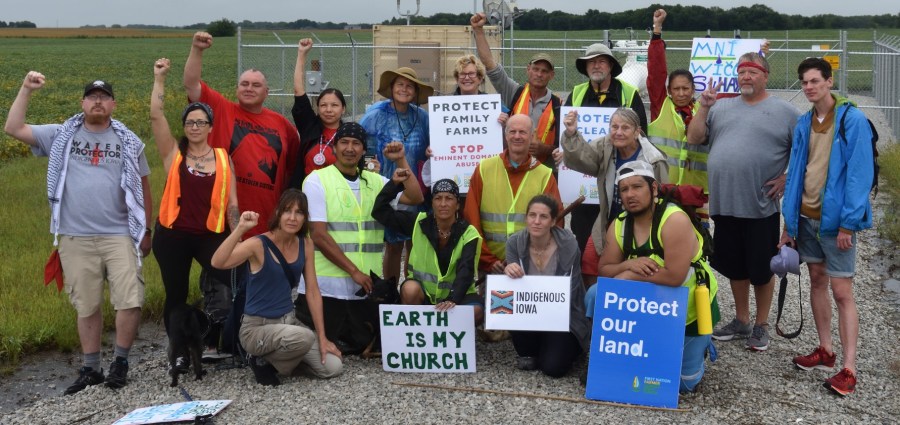
Protecting water from fossil fuel pipeline projects is an example of #LANDBACK. There is the devastation of the earth and water during extraction of fossil fuels, pipeline construction, and when the pipelines leak. The tons of carbon dioxide that will be added to our atmosphere when that fuel is burned. The acidification of the oceans as the water attempts to absorb some of the carbon dioxide from the air.

There is growing recognition among white people that Native peoples should lead efforts to protect Mother Earth. Indigenous peoples world wide have lived in sustainable ways for centuries. And Indigenous peoples have treaty rights to preserve many of their connections to the lands, including access for fishing and growing rice. Treaties that have all been broken, but remain in effect.

Now, helping to lead opposition to the Line 3 pipeline extension in Minnesota, (Tara) Houska says she’s become a firm believer in a “holistic approach to land protection.”

“I’ve also become more firm in my position that as the holders of the last remaining biodiversity on planet Earth, the need to center and uphold tribal sovereignty and indigenous rights, specifically indigenous land rights, is absolutely critical towards any sort of solution there could be involving climate,” she told The Hill in a phone interview from the frontlines of the protests.

Battles over pipelines, she said, are representative of larger tribal environmental struggles, but are a particularly salient issue because of “the immediate localized harms of both spills and degradation to ecosystems through the construction, and harms to the people in the communities by way of manned camps and the influx of out-of-state workers into an area.”

‘The land is us’ — Tribal activist turns from Keystone XL to Line 3 by Zack Budryk, The Hill, 8/1/2021
Water Walkers Headed to Minnesota Capitol
Water Walkers headed for the Capitol: Why They Walk

From Monday, August 23 through Thursday, August 26, water protectors will hold space at the Minnesota State Capitol — with a great big gathering (all welcome!) on Wednesday the 25th to welcome the Treaty People Walk for Water as they reach the end of their 256 mile journey.

Enbridge is racing to complete Line 3, and aims to finish construction and have oil flowing by the end of the year. Our governor and state agencies have failed us — and we need President Biden to step up and ensure that treaties are upheld. Starting on Monday the 23rd, Indigenous grandmothers from White Earth plan to hold ceremony space on the Capitol lawn, along with a powerful visual display of resistance by artist Rory Wakemup. Everyone is welcome to come by between the 10am opening to 5pm closing of the ceremony space each day. Join for lunch and stay for morning and afternoon talking circles to deepen knowledge and build community.

ON AUGUST 25, ALL ARE INVITED TO GATHER for a huge day of ceremony, solidarity, and action to stop Line 3! Since August 7, water protectors have been traveling on foot 256 miles from Line 3’s upstream Mississippi River crossing to St. Paul. They will arrive on the 25th and we need to be there to welcome them! Along with elected officials and community leaders, we will call for action and make ourselves heard. Some may choose to hold space for as long as it takes — if this is you, come with what you need to stay, such as a tent.

SCHEDULE:- Aug 23-26: ceremony, talking circles; opening 10am and closing 5pm daily. Come learn, share, build community.
– August 25 at 12pm: Folks are welcome to join the walkers outside the Martin Luther King Rec Center between noon and 1:00pm on Aug 25th (where they will be having lunch), then to walk with them for the last 1.5 miles to the capitol (arriving around 2)
– Aug 25 at 2pm: big welcome gathering for walkers w/ rally & speakers & food! Some people may choose to hold space past 5pm in the evening and into the 26th.Our state leaders have had years to take action but have sat back — and worse, Gov. Walz has directed state agencies to expedite construction. Principles of free, prior, and informed consent with the Anishinaabe have not been upheld. Given their unwillingness to stop the pipeline, we need President Biden to step in and direct the Army Corps to cancel this pipeline’s permits. This pipeline directly violates treaties, preventing Anishinaabe communities from exercising their guaranteed rights to hunt, fish and engage in cultural practices. It’s also a climate disaster and a carbon bomb, threatening to release as much greenhouse gas emissions as 50 coal plants at a time when the newest IPCC report shows we don’t have time to spare. Multiple pending legal cases against the project deserve to be heard. It’s time to act.

We will have more details to come, and encourage you to keep checking back for information! The time is now to #StopLine3.RSVP on our website – treatiesnottarsands.com

Minnesota is the Land of 10,000 contradictions around racial equity.

Gov. Tim Walz issued an executive order in 2019 committing the state to meaningful consultation with Native Nations. He followed that up by allowing Enbridge to build its Line 3 tar sands pipeline over strong tribal opposition with little or no consultation.

The Minnesota Pollution Control Agency (MPCA) has touted its racial justice framework. When the agency approved permits for Enbridge Line 3, a majority of its Environmental Justice Working Group resigned, writing: “… we cannot continue to legitimize and provide cover for the MPCA’s war on black and brown people.”

Native grandmothers, water protectors, and their allies are not letting up. They have set up camp on the Capitol lawn as a sign both of their ongoing resistance to Line 3 and their long-standing commitment to uphold treaty rights.

The state has responded with fear: erecting fencing around the Capitol and sending a heavy police presence.

The ‘Treaties Not Tar Sands’ encampment will remain until Thursday. Organizers are planning a ceremony for 10 a.m. Tuesday, with talking circles in the afternoon.

The major event is Wednesday at 2 p.m. when walkers arrive on the Capitol grounds, ending a 200+ mile walk from the Mississippi headwaters to the Capitol, an effort to draw attention to the travesty that is the state-approved Enbridge Line 3 pipeline.

Four-day ‘Treaties Not Tar Sands’ Encampment opens on the State Capitol Mall, Healing Minnesota Stories, August 24, 2021

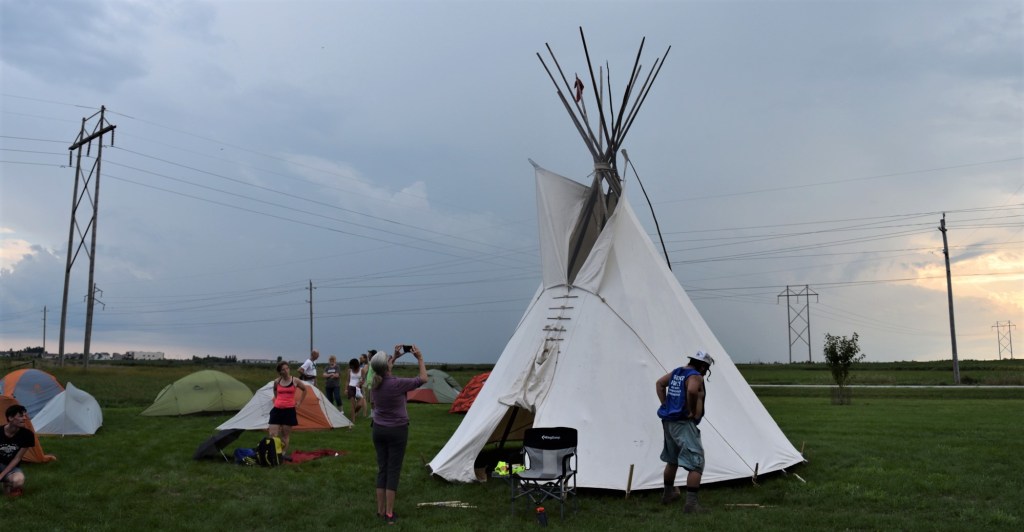
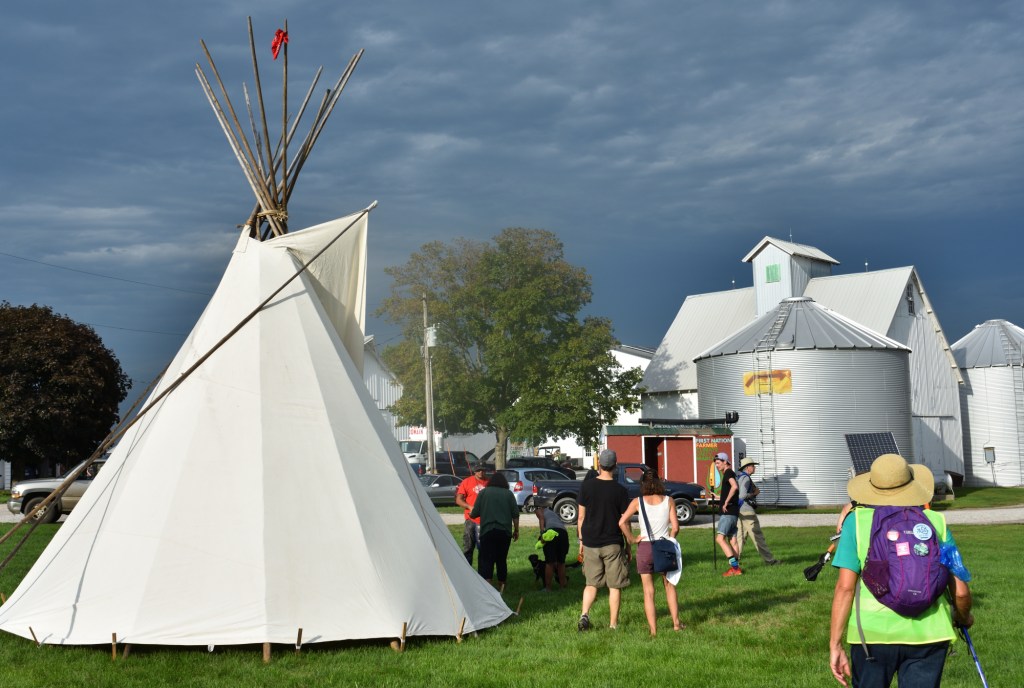
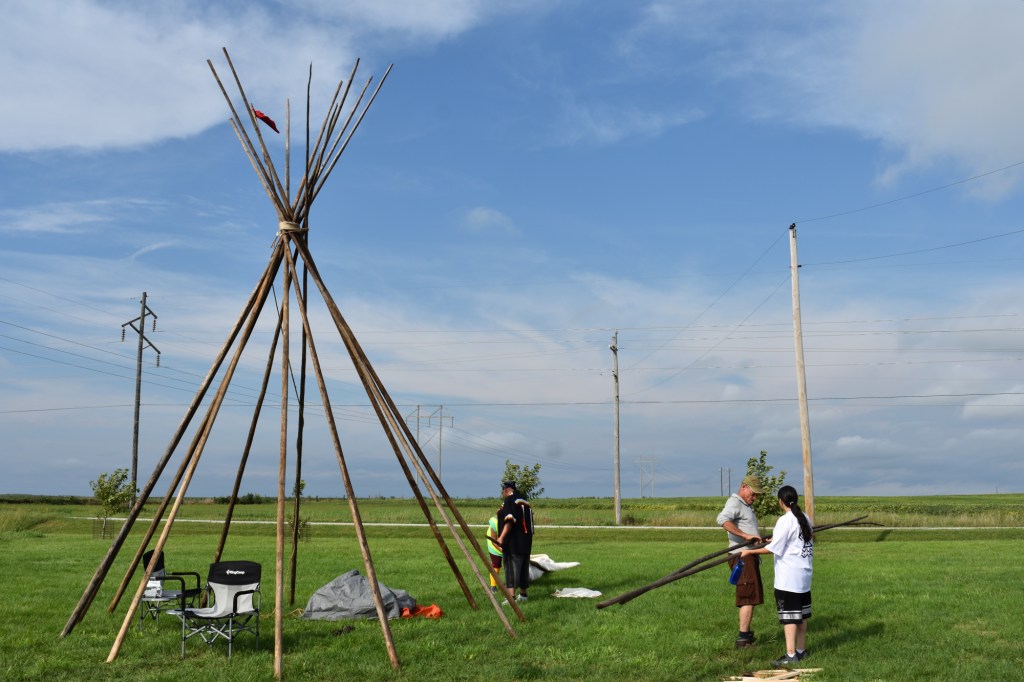
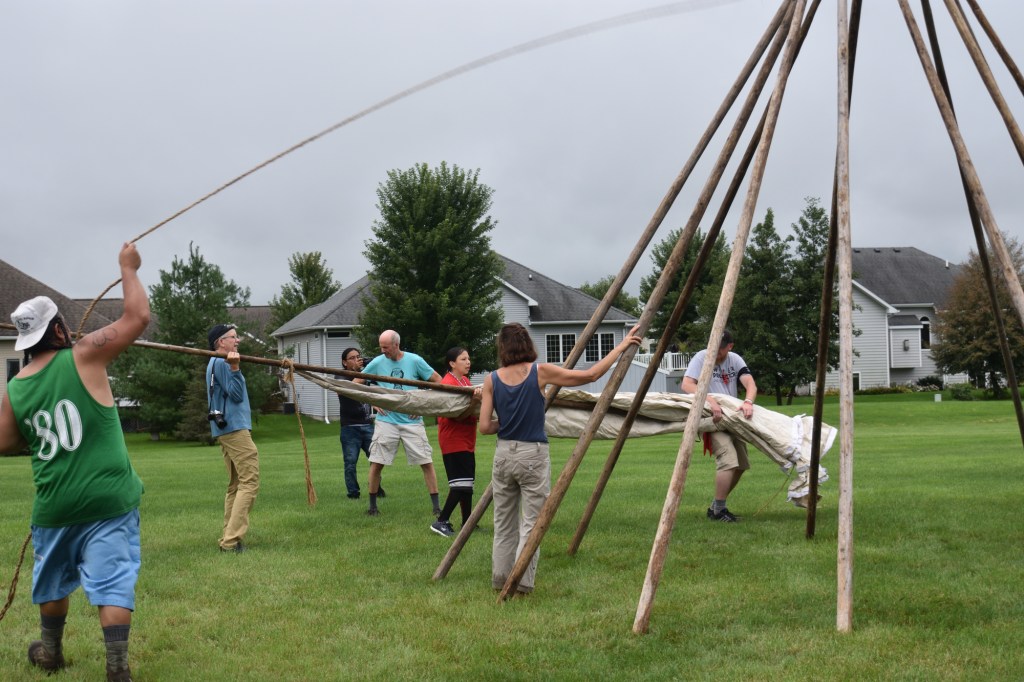
Included in the article above is a photo essay about the tepees that have been erected at the state capitol. Showing volunteers learning how to put up tepees.

During the First Nation-Farmer Climate Unity March in 2018, a tepee was put up at most of our daily destinations. This video shows how the tepee was set up when we arrived in Ames, Iowa.


Do we feel the tipping point first in our souls?

Apocalyptical scenes of floods and huge, ferocious fires dominate the news. Hundreds of square miles destroyed. Huge clouds of smoke stretch across the country. We feel hopeless, not only to control the devastation, but realizing this environmental chaos will only worsen.

Many long to return to normal, to leave this trauma behind. But those of us who live near to the land, who can feel its pulse, hear its secrets whispered in the trees, know that this is just another dream, that “normal” is now lost, a nostalgic memory. The pandemic has taught us about uncertainty, and the need to listen even more closely to the Earth, to sense her present imbalance. Despite all our computer models and plans for a future of green economic growth, we do not know where we are headed (or heading). Here on the coast there is no plan for living with the wildfires, except a prayer and a bag packed.

Meanwhile, in East Africa, the Somali pastoralists have already moved on, after watching their animals die in the years of drought. They’ve left the land they’d walked for centuries, moving into camps. They know that climate change brings hunger and migration, as they suffer the effects of our use of fossil fuels. They did not put carbon into the atmosphere. They are too poor to pollute. But they are among the first to suffer. Here our lives appear the same, food lines may grow, poverty increase, but for most of us our lives are not yet broken. But we can feel how something essential has changed, a barrier passed. Do we feel the tipping point first in our souls, before the fires and smoke turn the air red?

Will the fires and floods finally awaken us, turn our attention back to the living Earth? Or have we lost that connection, that place of belonging? How long before we are forced to wake from this nightmare of alienation? I used to imagine how Spring would come after the hard Winter of materialism, after all those years when we put profit before people, before the more-than-human world. Now, even amidst all the colors and sweetness, I know that this is not the real Spring I was waiting for, but just a moment of wonder, of magic, before the land becomes too dry. Before climate crisis creates a bleaker world. Before we too begin to be broken.

Fire Season by Llewellyn Vaughan-Lee, syndicated from Parabola, Aug 19, 2021

The fires of suffering become the light of consciousness.

Eckhart Tolle

But it is not hopeless.

People often mistake hope for a feeling, but it’s not. It’s a mental discipline, an attentional practice that you can learn. Like any such discipline, it’s work that takes time, which you fail at, succeed, improve, fail at again, and build over years inside yourself.

Hope isn’t just looking at the positive things in this world, or expecting the best. That’s a fragile kind of cheerfulness, something that breaks under the weight of a normal human life. To practice hope is to face hard truths, harder truths than you can face without the practice of hope. You can’t navigate dark places without a light, and hope is that light for humanity’s dark places. Hope lets you study environmental destruction, war, genocide, exploitative relations between peoples. It lets you look into the darkest parts of human history, and even the callous entropy of a universe hell bent on heat death no matter what we do. When you are disciplined in hope, you can face these things because you have learned to put them in context, you have learned to swallow joy and grief together, and wait for peace.

IT IS BITTER TEA THAT INVOLVES YOU SO: A SERMON ON HOPE by Quinn Norton, April 30, 2018

It is not hopeless as long as we have the wisdom, faith, courage to face hard truths. Sadly this wisdom is difficult to find today. As long as we try to hide from hard truths, we will be living in, paralyzed by fear.

The following is from the movie After Earth.

“Fear is not real. The only place that fear can exist is in our thoughts of the future. It is a product of our imagination, causing us to fear things that do not at present and may not ever exist. That is near insanity. Do not misunderstand me, danger is very real, but fear is a choice.”


I’m of the firm opinion that a system that was built by stolen bodies on stolen land for the benefit of a few is a system that is not repairable. It is operating as designed, and small changes (which are the result of huge efforts) to lessen the blow on those it was not designed for are merely half measures that can’t ever fully succeed.

So the question is now, where do we go from here? Do we continue to make incremental changes while the wealthy hoard more wealth and the climate crisis deepens, or do we do something drastic that has never been done before? Can we envision and create a world where a class war from above isn’t a reality anymore?”

Ronnie James

Can we envision and create a world where a class war from above isn’t a reality anymore? That quote from my friend Ronnie James captures what Mutual Aid is about. Rejecting vertical hierarchies of control and instead embracing a flat structure where everyone has a voice. Where we are learning, together, to vanquish fear and create a new world. Becoming dragon slayers.

The following quote has captured my imagination. That dragons represent fear. Fear is what we need to slay. To practice hope is to slay the dragons, to confront fear and move beyond it.