Rejecting capitalism

With so much upheaval, both in the natural world and man-made systems, it is important to have a vision of the future we want to build. We have limited capacity, of both time and other resources, making it important to determine how we can most wisely use them. And there are an increasing number of crises requiring attention and resources now if we are going to have any chance of slowing these evolving catastrophes.

Fundamentally, we must decide whether to work for incremental changes to the existing systems or transition to new ones.

I’m having a tough time convincing people that the capitalist economic system, and the political systems supporting capitalism, are fundamentally unjust.

One’s view of capitalism is determined by how well capitalism is working for you. If you are fortunate to have income to cover expenses, you probably don’t want to change. Change is difficult.

Otherwise, you understand capitalism is unjust. An economic system built on money is unjust when millions of people live in poverty because they don’t have adequate, or any income. Are denied goods and services simply due to the lack of money.

When there was close to full employment capitalism seemed to work. But as jobs were lost to automation or moving them out of the country to take advantage of cheap labor elsewhere, millions have been thrown into poverty. To lack food, shelter, healthcare, education, spiritual support, dignity.

Capitalism is unjust because it has been built on stolen land and the labor of enslaved people.

As my good friend Ronnie James says:

I’m of the firm opinion that a system that was built by stolen bodies on stolen land for the benefit of a few is a system that is not repairable. It is operating as designed, and small changes (which are the result of huge efforts) to lessen the blow on those it was not designed for are merely half measures that can’t ever fully succeed.

So the question is now, where do we go from here? Do we continue to make incremental changes while the wealthy hoard more wealth and the climate crisis deepens, or do we do something drastic that has never been done before? Can we envision and create a world where a class war from above isn’t a reality anymore?”

Ronnie James

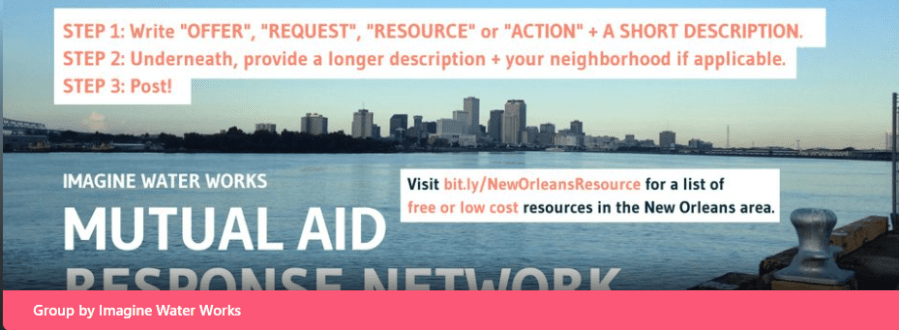
Thanks to Ronnie, I’ve been learning about, and participating in an alternative to capitalism, Mutual Aid. “Can we envision and create a world where a class war from above isn’t a reality anymore?” One of the fundamental principles of Mutual Aid is working to maintain a horizontal or flat hierarchy. To work to avoid a vertical hierarchy. One of the great advantages of this lack of vertical hierarchy is any kind of supremacy, e.g. white supremacy, is not even a possibility.

So I work with a dope crew called Des Moines Mutual Aid, and on Saturday mornings we do a food giveaway program that was started by the Panthers as their free breakfast program and has carried on to this day. Anyways, brag, brag, blah, blah.

So I get to work and I need to call my boss, who is also a very good old friend, because there is network issues. He remembers and asks about the food giveaway which is cool and I tell him blah blah it went really well. And then he’s like, “hey, if no one tells you, I’m very proud of what you do for the community” and I’m like “hold on hold on. Just realize that everything I do is to further the replacing of the state and destroying western civilization and any remnants of it for future generations.” He says “I know and love that. Carry on.”

Ronnie James

This is a link to much more about Mutual Aid: https://landbackfriends.com/mutual-aid/

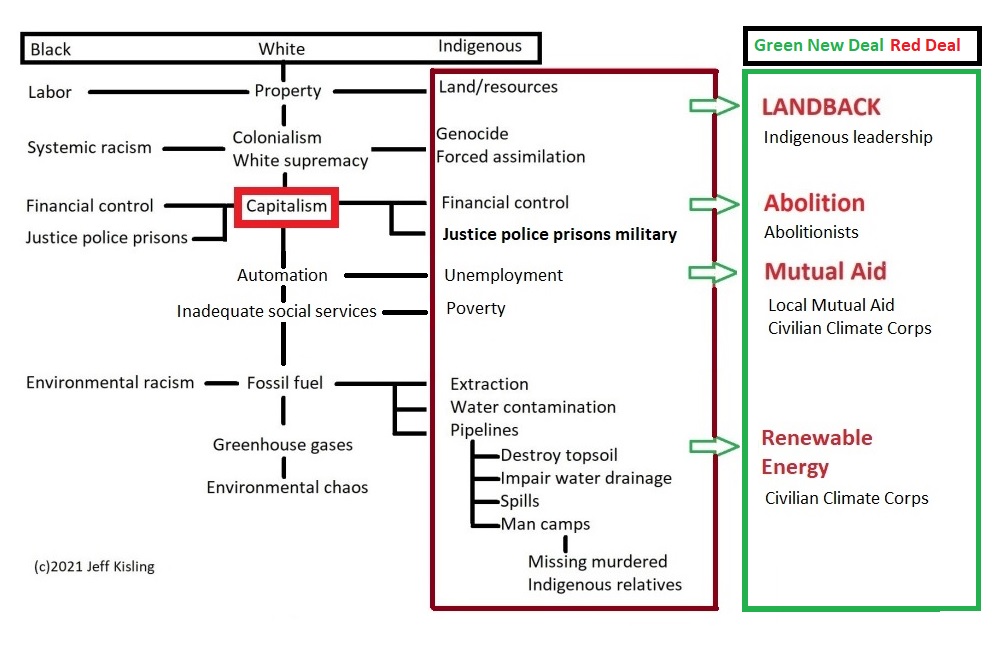
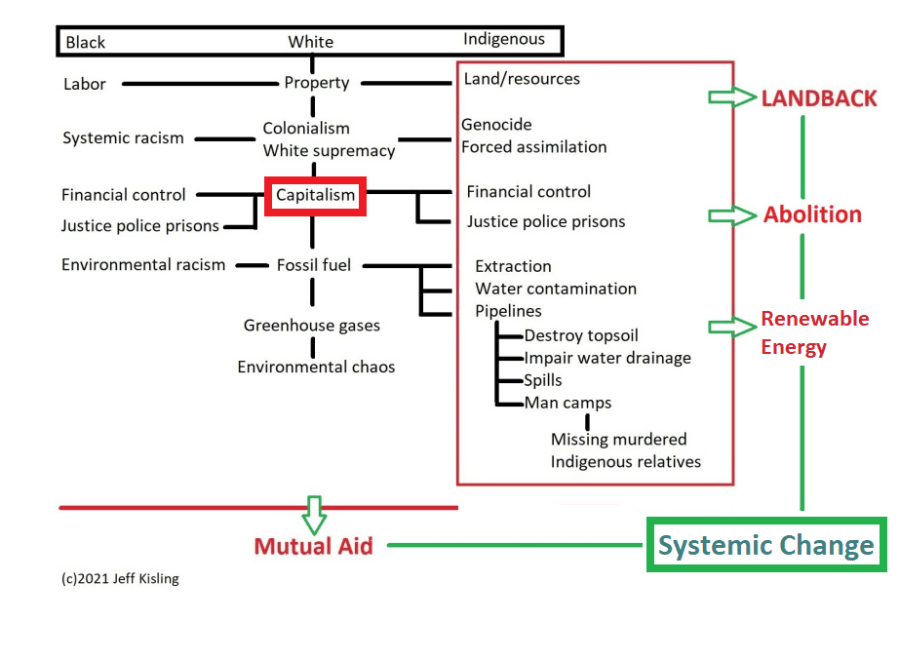
This diagram identifies LANDBACK, Abolition of police and prisons, and Mutual Aid as paths to a better society and future for us all.

Des Moines Mutual Aid is a collective that does outreach for homeless folks in our community, houseless folks in our community. We also assist BLM with their rent relief fund, and most of the work we’ve done is running the bail fund for the protests over the summer. In the course of that work, we have witnessed firsthand the violence that is done upon people of color, Black people specifically, by the white supremacist forces of the state – in this state, in this city, in this county. There is absolutely a state of emergency for people of color and Black people in Iowa. The state of emergency has been a long time coming. We will support – DMMA will absolutely support any and all efforts of this community – BLM, and the people of color community more generally- to keep themselves safe. Power to the people.

Patrick Stahl, Des Moines Mutual Aid

mutual aid is the new economy. mutual aid is community. it is making sure your elderly neighbor down the street has a ride to their doctor’s appointment. mutual aid is making sure the children in your neighborhood have dinner, or a warm coat for the upcoming winter. mutual aid is planting community gardens.

capitalism has violated the communities of marginalized folks. capitalism is about the value of people, property and the people who own property. those who have wealth and property control the decisions that are made. the government comes second to capitalism when it comes to power.

in the name of liberation, capitalism must be reversed and dismantled. meaning that capitalistic practices must be reprogrammed with mutual aid practices.

Des Moines Black Liberation

Randomly passing an accomplice on the street and throwing up a fist at each other as we go our separate ways to destroy all that is rotten in this world will never fail to give me extra energy and a single tear of gratitude for what this city is creating.

Ronnie James

What You Get into Will Change You

Recently a series of things happened that provoked some reflection. I saw the quote, “what you get into will change you. Sometimes in life you just don’t know what you’re getting into”, which prompted me to write the following.

A lot happened to me since retiring and returning to Iowa four years ago. I hadn’t given a lot of thought to what would happen when I returned to Iowa. I had stayed connected with Iowa Quakers and involved with them as much as I could from a distance. So, there were already some relationships to build on.

In Indianapolis I was blessed to have made many friends as we worked to protect water and oppose the Keystone XL and Dakota Access pipelines. I was also most fortunate to become involved with the Kheprw Institute (KI), a youth mentoring and empowerment community. And North Meadow Circle of Friends Quaker meeting. It was hard to leave but I stay in touch.

What follows are stories of my justice experiences since returning to Iowa. They are offered in case they might be helpful for you and your own work.

I’m frustrated more people don’t engage in justice work. Why are we here if not to grow and engage with family and our communities? Most people either don’t know how to engage or don’t want to. I’m frustrated because there is so much work to be done. We are experiencing environmental catastrophes that will only worsen and occur more frequently. We need masses of people to prepare now for the evolving chaos.

Also, these experiences will be good for you. I know from experience “what you get into will change you”. https://www.dailygood.org/story/2795/what-you-get-into-will-change-you-phyllis-cole-dai/

It is important to recognize “sometimes in life you just don’t know what you’re getting into.” Those can be times of great opportunity. I encourage you to get involved in opportunities like this, as long as doing so is relevant to what you are called to do.

What you get into will change you. Sometimes in life you just don’t know what you’re getting into.

Phyllis Cole-Dai

The most important step is to figure out what you should do. There are so many problems. Many people get burned out by trying to do too many things. People of faith rely on faith to help us figure this out. Keep what you are led to do in mind. You must be vigilant as you look for opportunities to get involved with justice work. And just as vigilant to decline to get involved in things not related to what you are called to do. Maintaining this focus is crucial for success.

First Nation-Farmer Climate Unity

I had long wanted to get to know some Indigenous people for numerous reasons, such as spirituality and sustainable living. Fortunately, an ideal opportunity to do so was to walk and camp along the path of the Dakota Access pipeline with a small group of native and nonnative people. The intention was for those in the group to get to know each other as we walked 10-15 miles/day, put up our tents, and have meals together.

During the First Nation-Farmer Climate Unity March (Sept. 1 – 8, 2018) Manape said we were on a sacred journey. During the March, Donnielle said we are a tribe. This morning I’m realizing the following stories about the past are part of my sacred journey. Also thinking of the many new friends found as part of this journey. I’m thinking how much I would have missed if I didn’t recognize and take advantage of this amazing opportunity.

Wet’suwet’en

Last Saturday morning began by watching a new video (see below) from the Wet’suwet’en people in British Columbia. Gidimt’en Checkpoint spokesperson Sleydo’ (Molly Wickham) and Elder Janet Williams found a film crew trespassing on Gidimt’en territory, making a commercial to promote Coastal Gaslink’s plans to tunnel beneath the sacred headwaters.

I first learned about the Wet’suwet’en’s struggles in January, 2020, when I saw a remarkable video of Sleydo’ evicting the Coastal GasLink workers from Wet’suwet’en territory. “All CGL workers have now been peacefully evicted from Unist’ot’en and Gidimt’en territories. Under the authority of Anuk nu’at’en (Wet’suwet’en law), and with support of the Wet’suwet’en hereditary chiefs of all five clans, the Wet’suwet’en are standing up for the last of our lands and we need you to stand with us. We will honour the instructions of our ancestors, and continue to protect our lands from trespassers.”

I began to follow what was happening with the Wet’suwet’en, especially when they started asking people to write about what was happening, since the mainstream media was not. A few of us, who had worked together on some Indigenous related events, organized a vigil in support of the Wet’suwet’en:

We didn’t expect anyone to join us. Fortunately, Ronnie James did. In the photo are Peter Clay, Linda Lemons and Ronnie James. Ronnie is an Indigenous organizer with many years of experience and interested to see who organized and attended our vigil. After he left, I realized I didn’t have a way to contact him. Fortunately, he accepted my Facebook Friend request. We began to have numerous conversations (via social media), where he patiently taught me a great deal about organizing, Indigenous thought, and Mutual Aid. (See: https://landbackfriends.com/mutual-aid/)


Peter Clay, Linda Lemons and Ronnie James
Mutual Aid

Meeting and becoming great fiends with Ronnie changed the course of my life. I eventually joined the work of Des Moines Mutual Aid (DMMA). Every Saturday morning, I participate in the free food distribution program. About a dozen of us put together sixty boxes of food, that we then put in the cars of those who need it. It is amazing this food distribution has been in existence in Des Moines since the Black Panthers organized the free breakfast program for school kids in the 1970’s.

Putting together the boxes of food, we move as a well-oiled machine. There is a little visiting as we pass each other when putting the food into boxes. I learn a lot about the justice work people are doing in central Iowa, since my Mutual Aid friends are also involved in many such projects.

Saturday there was a lull while waiting for another food delivery that provided a chance to talk with Ronnie. I mentioned the story below about the continued oppression of the Wet’suwet’en peoples and reminded him that we had met at the vigil for the Wet’suwet’en mentioned above. I told him that was something he taught me about organizing. Going to justice events to meet people. I said I wouldn’t have known about Mutual Aid if not for him attending that Wet’suwet’en vigil. He replied I probably would have learned about Mutual Aid because it had been in the news a lot recently.

Ronnie mentioned that was the first time he had been at Friends House, where the Wet’suwet’en vigil was held. Des Moines Mutual Aid has its offices in Friends House now. I had just spoken with Jon Krieg who works with the American Friends Service Committee (AFSC), whose offices had been in Friends House. Recently AFSC had moved out and Jon mentioned he missed visiting with Ronnie.

Des Moines Valley Friends meeting, which meets in a meetinghouse attached to Friends House, has been allowing another Mutual Aid group to use their kitchen to cook meals that are taken to the houseless camps.

Another set of connections relates to the Great Plains Action Society (GPAS), founded by my friend Christine Nobiss, who was also on the First Nation-Farmer Climate Unity March. Ronnie’s Mutual Aid work is supported by GPAS.

Prairie Awakening/Prairie Awoke

Saturday was also the day of the annual Prairie Awakening/Prairie Awoke ceremony, an annual event sponsored by the Dallas County Conservation Board. The ceremony is held in the Kuehn Conservation Area. My Quaker meeting, Bear Creek, has been involved with the ceremony for over ten years. A number of Friends attended.

While there, I was able to talk with my friend Rodger Routh, who grew up in the Earlham, Iowa (where Bear Creek meeting is) community. Rodger is a photographer/videographer and justice advocate, who is often at the same events I attend. Jon Krieg (AFSC, mentioned above) is also a photographer. It is common for the three of us to be at the justice related events.

LANDBACK

One of the principles of justice work is to follow the leadership of the communities affected by injustice. In Indianapolis, the Kheprw Institute would let us (Quakers in this case) know what we could do for them.

Recently I had a chance to ask Christine how nonnative people could best support her and her work now. She told me to learn and teach others about the concepts of LANDBACK. So, I created a website named LANDBACK Friends, where I’ve been sharing what I am learning about LANDBACK. https://landbackfriends.com/

Maintaining connections

As the completion of a circle, I was so glad to be contacted by my friends at the Kheprw Institute (KI) in Indianapolis. Aghilah contacted me because KI is interested to learn more about LANDBACK. Evidently, they have been following my blog since I left Indianapolis and reading what I’ve been writing about LANDBACK.

Quakers for Abolition Network

My blog also made it possible for one of my new friends, Jed Walsh, to contact me about the work he and Mackenzie Barton-Rowledge are doing related to abolition of police and prisons. I wrote a little in their article that was just published by the Western Friend, https://westernfriend.org/article/quakers-abolition-network.

Conclusion

We are moving more deeply into collapse. Fueled by the consequences of environmental chaos, our economic and political systems are failing. We must work now to build ways to deal with this collapse. I’ve been working on this diagram to illustrate how people are building such systems. It is important to build Mutual Aid communities. And embrace the principles of LANDBACK. “What you get into will change you”.


This document has a lot more information about Quakers, the Wet’suwet’en peoples, and LANDBACK. Scroll down to move through the document.


#LANDBACK

Civilian Climate Corps and Mutual Aid

Senate Democrats have included a Civilian Climate Corp in the reconciliation bill currently being debated. Yesterday’s article was an introduction to the idea of a Civilian Climate Corps (CCC) and included a link for you to send letters to your representatives asking them to vote for it.

I’m really excited about the possibility of a CCC because that could be the final piece for a plan to address many social ills and make real progress to mitigate the environmental chaos that will continue and worsen. I’ve updated this diagram to include how a CCC could fit in.

I’ve been working with Des Moines Mutual Aid for over a year, which has taught me a great deal by seeing this concept in action.
https://landbackfriends.com/mutual-aid/

Mutual Aid works because Mutual Aid groups are made up of the people living in the neighborhood. Mutual Aid results in people getting to know and trust each other because it is about action, not meetings and plans for the future. And the work is to address the needs of the community, like food and shelter. Those involved get the satisfaction of making change happen immediately.

Mutual Aid should be integrated into the Civilian Climate Corps idea!

Key to the success of Mutual Aid is working to maintain a horizontal hierarchy, where everyone has a voice. Attention is paid to avoid vertical hierarchy from forming. Everyone is treated with respect, because we know circumstances might change where we need the help of Mutual Aid ourselves.

Because of these experiences, I wanted to find ways for Mutual Aid to be embraced by more communities. We need vast numbers of people to join in this work.

But how? Just talking to people doesn’t really demonstrate how Mutual Aid works.

Mutual Aid should be integrated into the Civilian Climate Corps idea!

That is how colonial capitalism can be replaced. That is how we can rapidly transition from fossil fuels. That is how we can rebuild caring communities.

Militarism and LANDBACK

What triggered this blog post was learning Congress is working to require women to register for the Selective Service System (“draft”). Men have been required to do so for decades.

As I began to write about that, I had to decide whether to post this article on my blog Quakers, social justice and revolution where it would fit with what that blog is about.

Or whether it might fit with the posts on this blog that I recently started about LANDBACK. I’ve been learning about LANDBACK, and wonder how militarism fits into this idea.
(For an introduction to LANDBACK see: https://landbackfriends.com/2021/07/29/landback-movement/)

LANDBACK is about breaking away from white supremacy, the capitalist economic system and the structures that enforce them. So I updated this diagram I’ve been working on to add the military to the justice, police and prison systems that enforce colonial/corporate capitalism.

A growing number of us are working for the abolition of police and prisons. The military enforces white supremacy and capitalism beyond our borders. Thus, I think, abolition of the military, military bases and the use of weaponized drones could be considered part of LANDBACK.

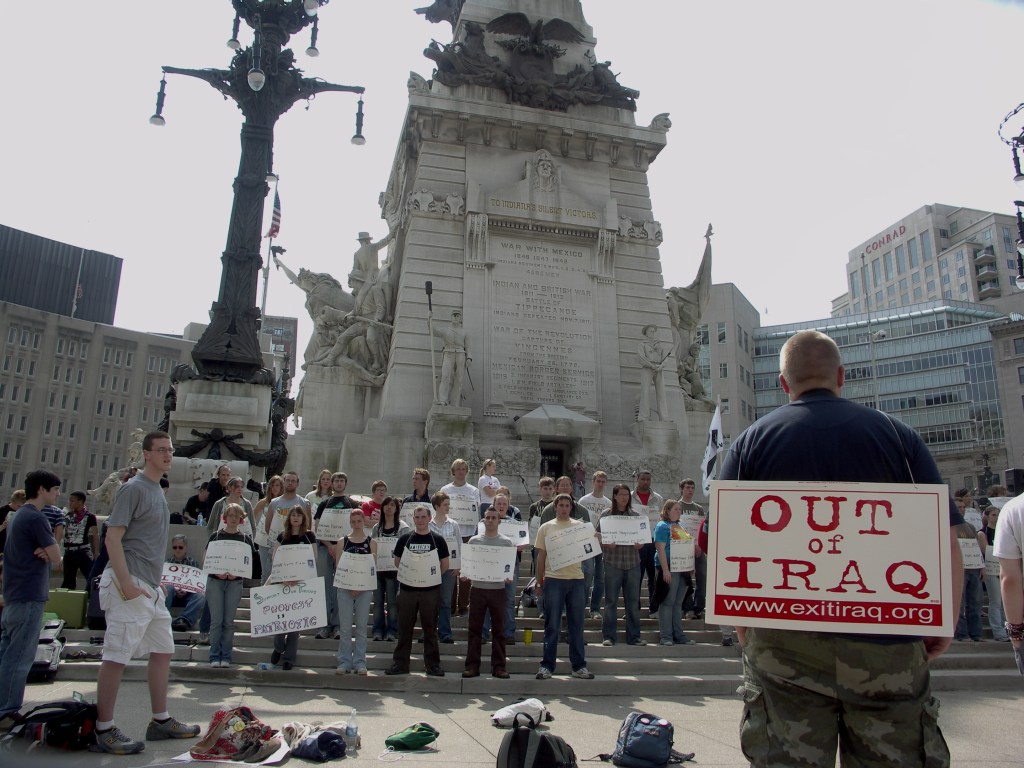
Thinking about LANDBACK as an antiwar framework is intriguing. Mutual Aid is part of the LANDBACK idea. I was very interested to learn Des Moines Mutual Aid’s first public appearance was at an antiwar march:

One year ago today (2020) Des Moines Mutual Aid participated in a march protesting the potential for war or increased hostilities with Iran that followed the fallout of the assassination of Qassem Soleimani by drone strike in Baghdad.

Ronnie James

The immediate collapse of the Afghan government when U.S. troops left Afghanistan after twenty years of war has a great many of people wondering about militarism and war.

Most Quakers, such as myself, have opposed the draft in many ways, for many years. The issue resulted in a group of Quakers leaving the country called the United States and establishing a thriving community in Costa Rica, a country that does not even have a military. Numerous Quaker men either registered as conscientious objectors, or refused to cooperate with the Selective Service System. Some were sentenced to prison. This is a link to stories about Quaker men and the miltary: Young Quaker Men Face War and Conscription.

Senators on the Armed Services Committee recently approved a revision to military draft laws that would require women to register for the Selective Service System (SSS).

Proponents of the measure, which was included as part of the annual National Defense Authorization Act (NDAA), see it as a matter of gender equality. This argument misses the point: Congress should be focused on abolishing the draft entirely, not expanding it.

As laid out in a coalition letter we supported to members of the Senate Armed Services Committee, this legislation “does not represent a move forward for women; it represents a move backward, imposing on young women a burden that young men have had to bear unjustly for decades – a burden that no young person should have to bear at all.”

Congress Should Abolish the Selective Service System, Not Expand It by Alex Frandsen, Friends Committee on National Legislation (FCNL), August 12, 2021

Indigenous led Green New Deal

The book The Red Deal is about an Indigenous led Green New Deal (GND).

The Sunrise Movement was launched as a national campaign for a Green New Deal (GND) in 2017. From the beginning I heard my native friends talk about the importance of a green new deal to be Indigenous led but didn’t have a clear idea of what that meant. In 2019 Sunrise’s Green New Deal tour included a stop in Des Moines. There my friends Trisha Cax-Sep-Gu-Wiga Etringer and Lakasha Yooxot Likipt spoke about Indigenous leadership as part of the GND.

So I’m glad to be reading the recently published book, The Red Deal: Indigenous Action to Save Our Earth by the Red Nation.

The Red Nation is a coalition of Native and non-Native activists, educators, students, and community organizers advocating Native liberation that formed to address the marginalization and invisibility of Native struggles within mainstream social justice organizing, and to foreground the targeted destruction and violence towards Native life and land.”

Inspired by the appeals to divest from the financial institutions funding oil pipelines during the Standing Rock uprising and the Movement for Black Lives’ divest-invest strategy, the Red Deal also targets the institutions of the military, police, and prisons for divestment. Imagine divesting from these institutions and opening up $1 trillion to accomplish the task of saving this Earth for everyone.

In 2018, Winona LaDuke pushed for an Indigenous-led GND. The former Green Party vice-presidential candidate inspired us to think about how divesting from fossil fuel infrastructure—such as billion-dollar oil pipelines—could be reinvested into building wind and solar farms and sustainable agriculture on reservations. Indeed, the most radical appraisals of the GND come from Indigenous people. According to the Indigenous Environmental Network (IEN), the GND, as is, “will leave incentives by industries and governments to continue causing harms to Indigenous communities.” Before endorsing the GND, IEN called for a clear commitment to keep fossil fuels in the ground; reject carbon pricing schemes; strengthen language on Indigenous peoples and uphold Indigenous rights; and stop, not prolong, our current exploitative and abusive economic and political systems.

Nation, The Red. The Red Deal (pp. 18-19). Common Notions. Kindle Edition.

… what if the question all water protectors and land defenders asked was, why don’t we just overturn the system that makes development a threat in the first place? This system, again, is capitalism. Rather than taking an explicitly conservationist approach, the Red Deal instead proposes a comprehensive, full-scale assault on capitalism, using Indigenous knowledge and tried-and-true methods of mass mobilization as its ammunition. In this way, it addresses what are commonly thought of as single issues like the protection of sacred sites—which often manifest in specific uprisings or insurrections—as structural in nature, which therefore require a structural (i.e., non-reformist reform) response that has the abolition of capitalism via revolution as its central goal. We must be straightforward about what is necessary. If we want to survive, there are no incremental or “non-disruptive” ways to reduce emissions. Reconciliation with the ruling classes is out of the question. Market-based solutions must be abandoned. We have until 2050 to reach net-zero carbon emissions. That’s it. Thirty years. The struggle for a carbon-free future can either lead to revolutionary transformation or much worse than what Marx and Engels imagined in 1848, when they forewarned that “the common ruin of the contending classes” was a likely scenario if the capitalist class was not overthrown. The common ruin of entire peoples, species, landscapes, grasslands, waterways, oceans, and forests—which has been well underway for centuries—has intensified more in the last three decades than in all of human existence.

Nation, The Red. The Red Deal (pp. 21-22). Common Notions. Kindle Edition.

I’m of the firm opinion that a system that was built by stolen bodies on stolen land for the benefit of a few is a system that is not repairable. It is operating as designed, and small changes (which are the result of huge efforts) to lessen the blow on those it was not designed for are merely half measures that can’t ever fully succeed.

So the question is now, where do we go from here? Do we continue to make incremental changes while the wealthy hoard more wealth and the climate crisis deepens, or do we do something drastic that has never been done before? Can we envision and create a world where a class war from above isn’t a reality anymore?”

Ronnie James, Des Moines Mutual Aid, Great Plains Action Society

Abolition and racial capitalism

It has taken a while to adjust to thinking of abolition as the elimination of prisons instead of the historical context of abolition of the institution of enslavement. Not surprisingly the concept of prison abolition comes up in any discussion of capitalism and building a just future. Police are the enforcers of capitalism.

I am part of a new group of Friends who are interested in abolishing police and prisons called the Quakers for Abolition Network (QAN).

The following is from an article Jed Walsh and Mackenzie Barton-Rowledge, who helped start QAN, wrote for Western Friend.

Mackenzie: Let’s start with: What does being a police and prison abolitionist mean to you?

Jed: The way I think about abolition is first, rejecting the idea that anyone belongs in prison and that police make us safe. The second, and larger, part of abolition is the process of figuring out how to build a society that doesn’t require police or prisons.

M: Yes! The next layer of complexity, in my opinion, is looking at systems of control and oppression. Who ends up in jail and prison? Under what circumstances do the police use violence?

As you start exploring these questions, it becomes painfully clear that police and prisons exist to maintain the white supremacist, heteronormative, capitalist status quo.

Abolish the Police by Mackenzie Barton-Rowledge and Jed Walsh, Western Friend, November December, 2020

This diagram shows abolition, along with LANDBACK and Mutual Aid, as pieces of changes to transition away from systems of capitalism and white supremacy.

I’ve been reading The Red Deal by the Red Nation, which is about empowering Indigenous peoples, in part to help guide us through environmental chaos. What follows are some interesting perspectives on prison abolition.

Austerity is enforced scarcity. The neoliberal policy of the last forty years has been a tax strike of the super wealthy, who have refused to pay their share of taxes and have locked away the world’s wealth in tax havens and offshore accounts. These are resources that should go towards providing services—education, housing, healthcare, public transportation, infrastructure, and environmental restoration—to those who actually produce the wealth: the Indigenous, Black, migrants, women, and children who are the workers of the world. This strike is worth crushing quickly and with prejudice. Direct action alone won’t reallocate wealth if it is not backed by popular mass movements and enforced by state apparatuses wrested away from the elite and powerful.

Prison abolition and an end to border imperialism are key aspects of the Red Deal, for good reason. The GND calls for the creation of millions of “green” jobs, as well as a policy of “just transition” for poor and working-class families and communities that currently depend on resource extraction for basic income and needs, and which will suffer greatly when the extractive industry is shut down. In the United States today, however, about seventy million people—nearly one-third of adults—have some kind of criminal conviction—whether or not they’ve served time—that prevents them from holding certain kinds of jobs. If we add this number of people to the approximately eight million undocumented migrants, the sum is about half the US workforce, two-thirds of whom are not white. Half of the workforce faces employment discrimination because of mass criminalization and incarceration.

The terrorization of Black, Indigenous, Brown, migrant, and poor communities by border enforcement agencies and the police drives down wages and disciplines poor people—whether or not they are working—by keeping them in a state of perpetual uncertainty and precarity. As extreme weather and imperialist interventions continue to fuel migration, especially from Central America, the policies of punishment—such as walls, detention camps, and increased border security—continue to feed capital with cheap, throwaway lives. The question of citizenship—colonizing settler nations have no right to say who does and doesn’t belong—is something that will have to be thoroughly challenged as a “legal” privilege to life chances. Equitable access to employment and social care must break down imperial borders, not reproduce them.

The Red Deal by The Red Nation (pp. 22-23). Common Notions. Kindle Edition.

Calls for abolition of the prison system have expanded in the wake of widespread police violence. Abolition is part of the work of our Mutual Aid community.

Prison abolition and an end to border imperialism are key aspects of the Red Deal

The Red Nation

This same war of conquest is currently using the mass incarceration machine to instill fear in the populace, warehouse cheap labor, and destabilize communities that dare to defy a system that would rather see you dead than noncompliant. This is the same war where it’s soldiers will kill a black or brown body, basically instinctively, because our very existence reminds them of all that they have stolen and the possibility of a revolution that can create a new world where conquest is a shameful memory.

What we have is each other. We can and need to take care of each other. We may have limited power on the political stage, a stage they built, but we have the power of numbers.

Those numbers represent unlimited amounts of talents and skills each community can utilize to replace the systems that fail us.  The recent past shows us that mutual aid is not only a tool of survival, but also a tool of revolution. The more we take care of each other, the less they can fracture a community with their ways of war.

Ronnie James, The Police State and Why We Must Resist

Policing in the United States is a force of racist violence that is entangled at the core of the capitalist system. As Robin D.G. Kelley pointed out on Intercepted With Jeremy Scahill, capitalism and racism are not distinct from one another: “If you think of capitalism as racial capitalism, then the outcome is you cannot eliminate capitalism, overthrow it, without the complete destruction of white supremacy, of the racial regime under which it’s built.”

Police in the United States act with impunity in targeted neighborhoods, public schools, college campuses, hospitals, and almost every other public sphere. Not only do the police view protesters, Black and Indigenous people, and undocumented immigrants as antagonists to be controlled, they are also armed with military-grade weapons. This police militarization is a process that dates at least as far back as President Lyndon Johnson when he initiated the 1965 Law Enforcement Assistance Act, which supplied local police forces with weapons used in the Vietnam War. The public is now regarded as dangerous and suspect; moreover, as the police are given more military technologies and weapons of war, a culture of punishment, resentment and racism intensifies as Black people, in particular, are viewed as a threat to law and order. Unfortunately, employing militarized responses to routine police practices has become normalized. One consequence is that the federal government has continued to arm the police through the Defense Logistics Agency’s 1033 Program, which allows the Defense Department to transfer military equipment free of charge to local enforcement agencies.

TO END RACIAL CAPITALISM, WE WILL NEED TO TAKE ON POLICING By Henry A. Giroux, Truthout, June 20, 2021