Canadian pipeline and railway protests

Railway protests across Canada in support of the Wet’suwet’en and other First Nation peoples have been used effectively for several years. Following are excerpts from a detailed discussion of Canadian railway protests found on Wikipedia.

“Rail was a harbinger of colonized settlements and the genocide of Indigenous peoples.”

And among the other interesting things in the article Glorious Rage below are the following expressions of Mutual Aid:

“As allies/accomplices/dissidents, one of our greatest strengths against the state or organized bodies is our own flexibility and adaptiveness – often a quality hierarchical systems or organizational bodies don’t have.

Also, “use your words to inspire others to action – not to beg for change from government bodies complicit in an active genocide.”

Canadian pipeline and railway protests

The 2020 Canadian pipeline and railway protests were a series of civil disobedience protests held in Canada. The main issue behind the protests was the construction of the Coastal GasLink Pipeline (CGL) through 190 kilometres (120 mi) of Wetʼsuwetʼen First Nation territory in British Columbia (BC), land that is unceded. Other concerns of the protesters were indigenous land rights, the actions of police, land conservation, and the environmental impact of energy projects.

In February 2020, after the RCMP enforced the second court injunction, removing the Wetʼsuwetʼen blockades and arresting Wetʼsuwetʼen land defenders, solidarity protests sprang up across Canada. Many were rail blockades, including one blockade near Tyendinaga Mohawk Territory which halted traffic along a major Canadian National Railway (CNR) line between Toronto and Montreal and led to a shutdown of passenger rail service and rail freight operations in much of Canada. The Eastern Ontario blockade was itself removed by the Ontario Provincial Police. Blockades and protests continued through March in BC, Ontario and Quebec. Discussions between representatives of the Wetʼsuwetʼen and the governments of Canada and British Columbia have led to a provisional agreement on the Wetʼsuwetʼen land rights in the area.

2021 Wedzin Kwa blockade

 On September 25, 2021, Cas Yikh house and Gidimtʼen clan members erected new blockades on the Morice West Forest Service Road to block CGL’s attempts to drill under the Morice River (known as Wedzin Kwa in Babine-Witsuwetʼen). Sleydoʼ (Molly Wickham), one of the leaders of Gidimtʼen Access Point, claimed that the work near the river would disrupt her people’s livelihoods as well as the salmon population. She called on supporters to join the new blockades. A Gidimtʼen Access Point press release called the Wedzin Kwa “sacred headwaters that nourish the Wetʼsuwetʼen Yintah [territory] and all those within its catchment area”.

Coastal GasLink president Tracy Robinson issued a statement about the drilling, saying “the clearing is now complete, and our crews will utilize a micro-tunnel method which is a type of trenchless crossing that is constructed well below the riverbed and does not disturb the stream or the bed and banks of the river”. Robinson claimed that micro-tunnelling was deemed to be the safest and most environmentally-responsible method after consulting with experts, regulations, and best practices. She also noted that there was still an enforceable injunction to prevent any opposition to CGL carrying out its work. In the days after the new blockades went up, the RCMP moved in to remove two of them, in the process arresting at least one individual.[56][57]

Solidarity Protests

Several major protests blocked access to the Port of VancouverDeltaport, and two other ports in Metro Vancouver for a number of days before the Metro Vancouver police began enforcing an injunction on the morning of February 10, 2020, arresting 47 protesters who refused to cease obstructing the port.[72][73][74]

Protests on February 15 over 200 people in Toronto blocked Macmillan Yard, the second largest rail classification yard in Canada.[75] On February 16 and 17 temporarily blocked the Rainbow Bridge in Niagara Falls, Ontario and Thousand Islands Bridge in Ivy Lea, Ontario, two major border crossings between the United States and Canada.[76] At the same time, Miꞌkmaq demonstrators partially blocked access to the Confederation Bridge, the sole road link to Prince Edward Island.[77] On February 18, several activists were arrested for trespassing at BC Premier Horgan’s residence.[78]On February 24, 2020 individuals shut down a major junction in Hamilton, ON.

A nation-wide student walkout occurred March 4, with university students across the country showing their support for the Wetʼsuwetʼen protesters.[79][80][81]

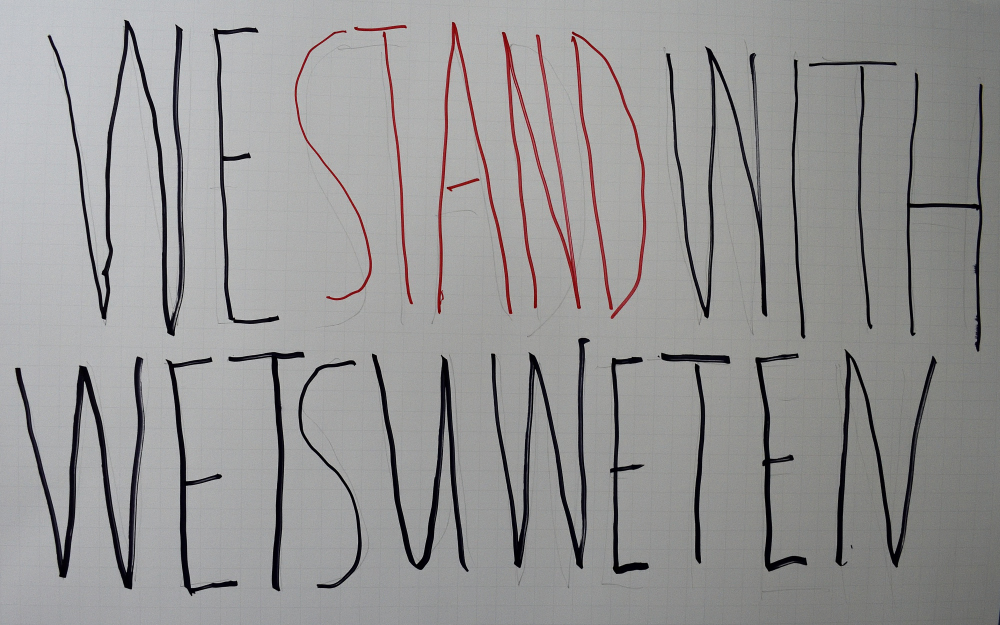
The protests led to the creation of several hashtags, used widely on social media in relation to coverage of the protests. These include #ShutDownCanada,[82] #WetsuwetenStrong,[83] #LandBack,[84] and #AllEyesOnWetsuweten.[85]

Wikipedia 2020 Canadian pipeline and railway protests

I’m sharing part of a message from north-shore.info detailing how to disrupt rail service. I share this as a matter of education. As it says, “detailed below for your reference, education and delight!” I do agree with the statement that the violence against the Wet’suwet’en “is an act of genocide. An active genocide. An armed invasion by the colonial state.”

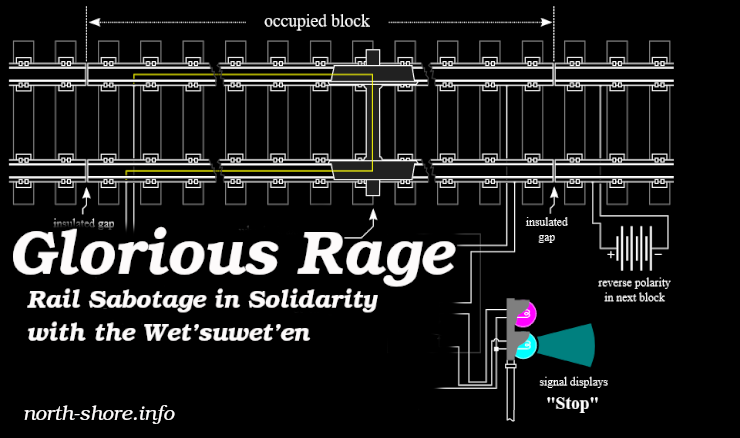
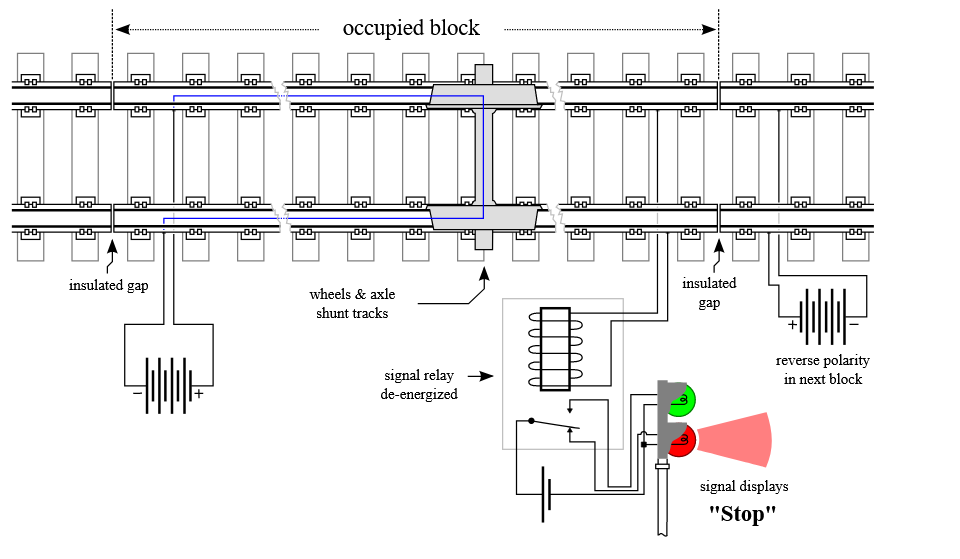
Each method used will have tripped the automatic block signalling system into its failsafe setting of “occupied track” – meaning all rail traffic on the impacted track comes to a stop until checked out and in some cases repaired. This also means interferences were safer than any of the militarized RCMP’s three unjustified raids on Wet’suwet’en people.

Glorious Rage: Rail Sabotage in Solidarity with the Wet’suwet’en

Our goal as North Shore Counter-Info is to make it easy to share ideas and practices as part of the struggle against domination. Sharing this text helps our project do its work. Soli to folks on the ground!
There is nothing left unsaid.
RCMP Out.
CGL off the Yintah.
Defend the Wedzin Kwa.

This is an act of genocide. An active genocide.
An armed invasion by the colonial state.

There is nothing left to say: they do not listen to words.
So just do; that is what we have done.
One recent evening, allies/accomplices went out into the night to pick up where others may have left off in the spring of 2020: targeting rail infrastructure.

Using various methods (detailed below for your reference, education and delight!) we disrupted rail all over so-called southern Ontario throughout the night, hitting nearly a dozen different spots on both CN and CP rail lines. We did this in heartfelt solidarity with the Wet’suwet’en defending their Yintah from destruction, and fuelled our actions with the justified rage we feel towards the RCMP and state for once against invading their territory on behalf of a private corporation.

Rail was a harbinger of colonized settlements and the genocide of Indigenous peoples across so-called Canada, and also an indefensible way to target the kkkanadian economy, so we find it an ideal target as people unable to be standing shoulder to shoulder with the Wet’suwet’en land defenders.

While some crews opted for the copper wire method, others found inspiration in other means of targeting railway circuits – including severing low voltage track circuits and the arson of railway signal bungalows.

Each method used will have tripped the automatic block signalling system into its failsafe setting of “occupied track” – meaning all rail traffic on the impacted track comes to a stop until checked out and in some cases repaired. This also means interferences were safer than any of the militarized RCMP’s three unjustified raids on Wet’suwet’en people.

We encourage others to join us in action. Use your words to inspire others to action – not to beg for change from government bodies complicit in an active genocide.

Shut it down. That’s all there is left to do.
Never Cede
Never Surrender.

Glorious Rage: Rail Sabotage in Solidarity with the Wet’suwet’en by Anonymous submission to North Shore, November 27, 2021

A map of the Canadian National Railway system, showing the system marked in red lines across the continental United States and Canada.
https://en.wikipedia.org/wiki/2020_Canadian_pipeline_and_railway_protests#/media/File:Canadian_National_System_Map.PNG

Map of the Canadian National Railway system. Much of the network east of Toronto was temporarily shut down on February 13, 2020, due to protests and blockades in eastern Canada.
#WetsuwetenStrong
#LandBack
#AllEyesOnWetsuweten
#ShutDownCanada

Prison Abolition Letter Writing Project

I recently attended my first meeting with the Prison Abolition Letter Writing Project of the Central Iowa Democratic Socialists of America (DSA). I didn’t know who would be there but thought it likely a few of my Mutual Aid friends might. It is a maxim of justice activism that a small core group of people work in many different justice groups in a city, and such was the case. I was glad to see two of my Mutual Aid friends there. Seven of us met in a park shelter not far from the church our Mutual Aid group uses for the food giveaway project each Saturday morning.

I wondered what I would learn about the Prison Abolition Letter Writing Project and was fascinated by what I did learn. I assumed the idea was to establish a relationship with those imprisoned, which it certainly is. But as part of the sample letter shows, the concept is to invite those incarcerated to help those who are not understand what is going on in the prison system. Yet another example of Mutual Aid, where all involved work from the concept that we are all working together. Not “us helping them”.

I am writing to you as a part of the Central Iowa Democratic Socialists of American prison abolition group. I am inviting you to join our solidarity and pen-pal network. We are connecting with people incarcerated in Iowa because we believe the struggles of people both inside and outside of prison walls are intertwined. Specifically, we recognize the need to eliminate systemic injustices produced by the current criminal justice system.

Please let me know if you are interested in taking part in this project. I would love to receive any information from you so that we can make a case to those on the outside to take action on the demands of incarcerated people.

We are the Central Iowa chapter of the Democratic Socialists of America (DSA). Promoting the concept of democratic socialism through political action, direct service, and education. We are building for the future beyond resistance.
https://www.facebook.com/CentralIowaDSA

I became interested in DSA when my friend Fran Quigley, a professor in the Law School at Indiana University, wrote the following in response to my blog post, The Evil of Capitalism, 12/31/2020. Fran’s book was just published. Religious Socialism: Faith in Action for a Better World – August 25, 2021.

This post of yours struck me close to home. I too have become fully convinced of the evils of capitalism. Moreover, I have come to the conclusion that my faith dictates that I work to replace it. Turns out I am far from alone, so I’ve been devoting much of my time this past year to the Religion and Socialism Committee of the DSA, www.religioussocialism.org.
Fran Quigley

I’ve also been participating in the Quaker for Abolition Network, initiated by Mackenzie Barton-Rowledge and Jed Walsh. The following is from an article they wrote for Western Friend.

Mackenzie: Let’s start with: What does being a police and prison abolitionist mean to you?
Jed: The way I think about abolition is first, rejecting the idea that anyone belongs in prison and that police make us safe. The second, and larger, part of abolition is the process of figuring out how to build a society that doesn’t require police or prisons.
Mackenzie: Yes! The next layer of complexity, in my opinion, is looking at systems of control and oppression. Who ends up in jail and prison? Under what circumstances do the police use violence?
As you start exploring these questions, it becomes painfully clear that police and prisons exist to maintain the white supremacist, heteronormative, capitalist status quo.

Abolish the Police by Mackenzie Barton-Rowledge and Jed Walsh, Western Friend, November December 2020

We as White Quakers like to think of ourselves as ahead or better than dominant culture, but we have been complicit in a system and mindset that are ubiquitous. Claiming the full truth of our history and committing to repair the harms done are deeply spiritual acts of healing our own wounds of disconnection. I would argue it is the pathway upon which we can, perhaps for the first time, discover and invigorate our faith with its full promise.

What would it mean for us to take seriously and collectively as a Religious Society a call to finish the work of abolition, hand in hand and side by side with those affected and their loved ones? What would it mean for us to stand fully with the calls to abolish the police and fully fund community needs instead? What would it mean to reckon with our past complicity with harm and fully dedicate ourselves to the creation of a liberating Quaker faith that commits to build the revolutionary and healing faith we long to see come to fruition? What would it look like to finally and fully abolish slavery?

A Quaker Call to Abolition and Creation by Lucy Duncan, Friends Journal, April 1, 2021

Lucy’s article includes this correction, that so many White people do unintentionally:
Correction: The author and FJ editors realize that an earlier version of this article inadvertently erased BIPOC (Black, Indigenous and people of color) Quakers in describing Quakers as though we were/are all White. Certainly there have been Black Friends and Friends of Color in our body from our earliest history. We apologize for this error. This online article has been updated accordingly. We have also clarified the relationship of George Fox with Margaret and Thomas Rous.

A goal of Mutual Aid is to grow, pulling increasing numbers of people into the work. I’ve been involved in Des Moines Mutual Aid and the food giveaway project for the past year. The Iowa Mutual Aid Network has expanded to include the following organizations. The Prison Abolition Letter Writing Project is a way to bring more people into our mutual work.

The Iowa Mutual Aid Network is made up of numerous individuals, collectives, and affinity groups working together and alongside each other to change the material conditions of oppressed communities in so-called Iowa.
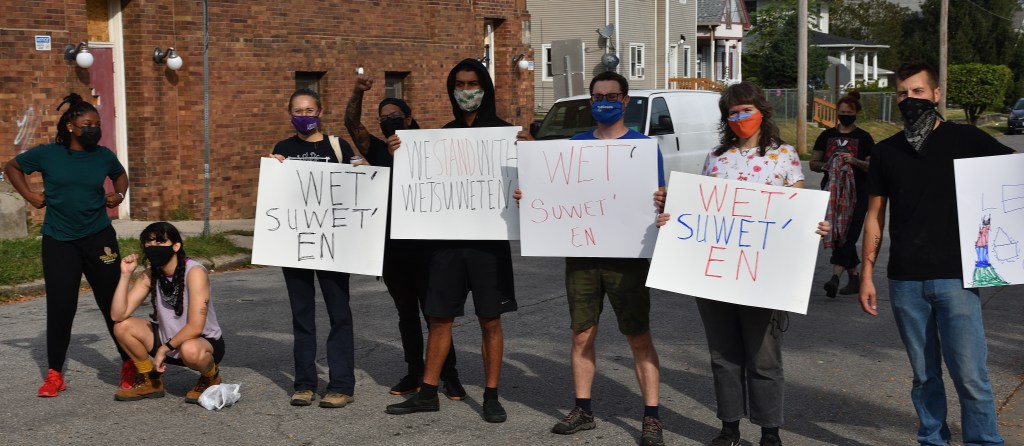
The groups represented on this site are in no way a full accounting of those that are engaged in the struggle.

All Power To The People


Wet’suwet’en Enforce Mandatory Evacuation

You never know what might happen when you join a struggle for justice. One day in January 2020, I saw this video, “Coastal Gaslink Evicted from Unist’ot’en Territory”. I was amazed! I had been working for years on the Keystone XL and Dakota Access Pipeline resistance. But had not known about the Wet’suwet’en peoples in British Columbia and their efforts to protect the water and their beautiful lands from construction of the Coastal Gaslink pipeline.

I was especially interested because of the issues of Indigenous rights and began to closely follow these stories. https://landbackfriends.com/?s=wetsuweten

Not surprisingly there was little written about this in the mainstream media. Then, as now, the Wet’suwet’en asked supporters to share their stories on social media, which I did. My Quaker meeting wrote a statement about this and sent a letter to British Columbia Premier John Horgan, January 26, 2020. (below)

On February 7, 2020, several of us held a vigil in Des Moines, Iowa, to support the Wet’suwet’en. This vigil was life changing for me because that is where I met Ronnie James, an Indigenous organizer with many years of experience. I first learned of the concepts of Mutual Aid from Ronnie and to this day we work on Des Moines Mutual Aid projects. Mutual Aid and LANDBACK have become the focus of my study and writing. https://landbackfriends.com/

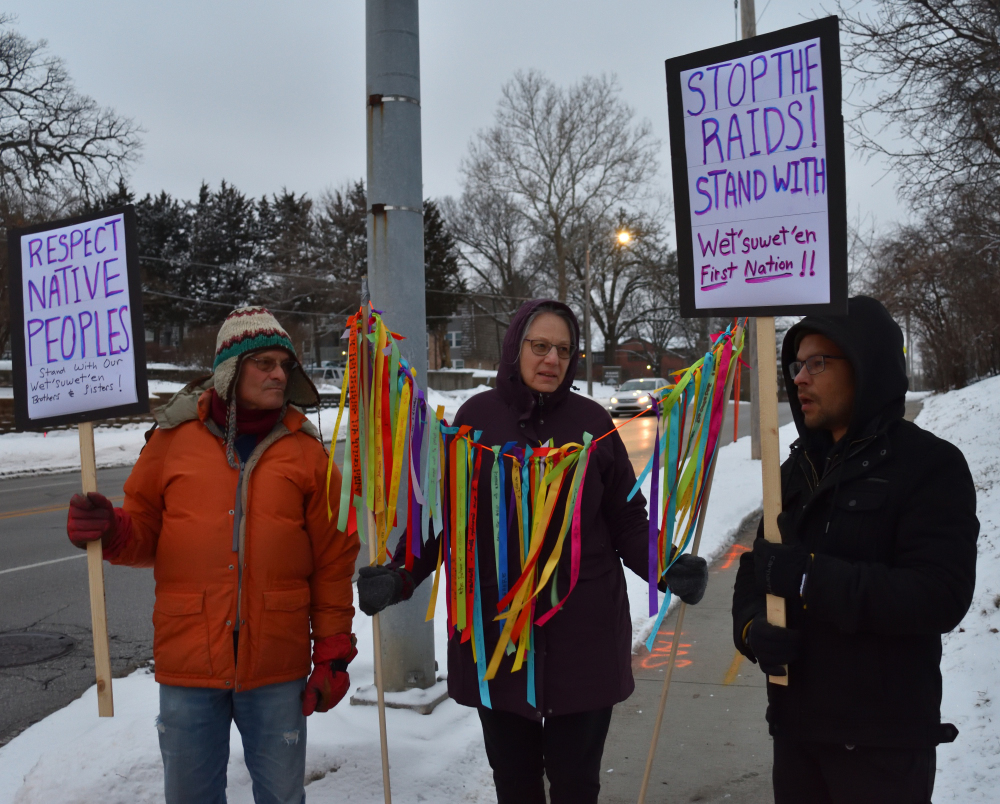
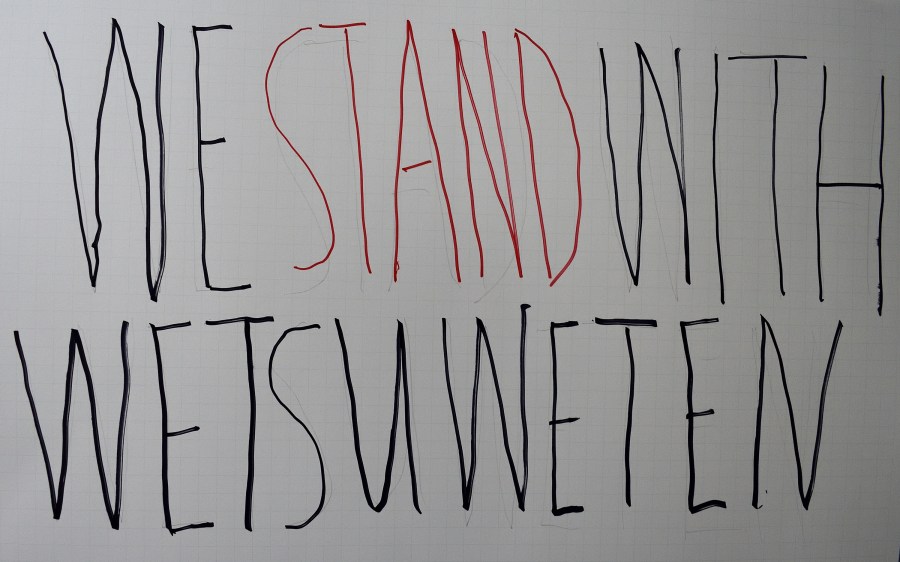
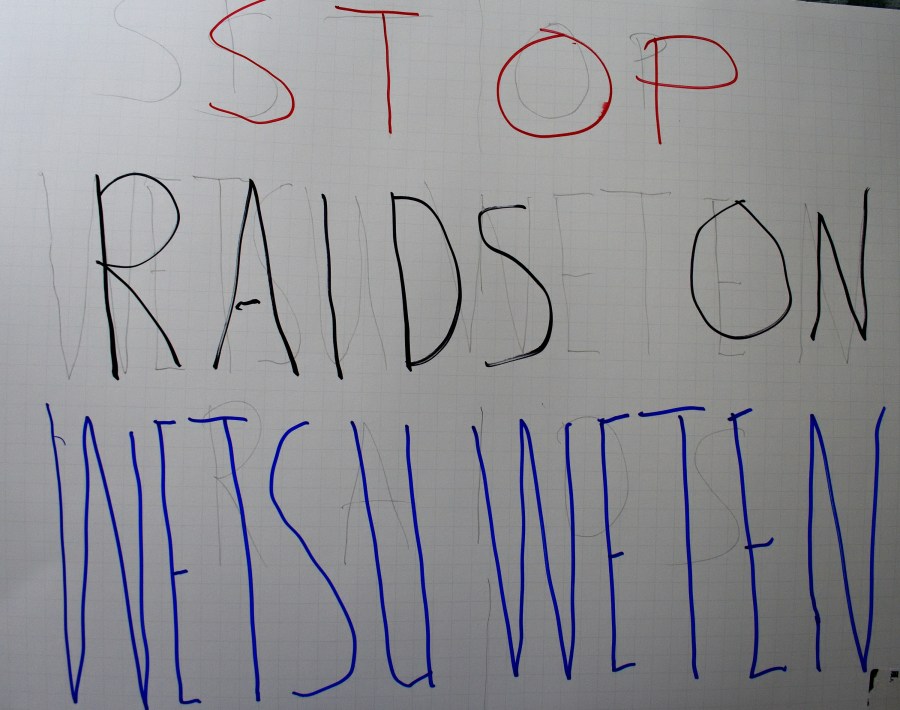
This photo was taken a couple of weeks ago when some of our Mutual Aid friends offered their support for the Wet’suwet’en. You probably notice using the same signs we used in 2020.

The reason for all this backstory is because Sunday the Wet’suwet’en enforced the eviction notice that was first given to Coastal Gaslink in the video above, in January, 2020. Following are stories of what has happened since. You can find updates on twitter at https://twitter.com/Gidimten

The Gidimt’en Clan of the Wet’suwet’en Nation has told Coastal GasLink it will enforce the eviction of pipeline workers from its territories in central B.C.

The enforcement notice, issued at 5 a.m. PT Sunday, provided an eight-hour window for CGL workers to move out of the territory before the access road was blocked.  

Jennifer Wickham, media co-ordinator for the Gidimt’en checkpoint, which monitors access to part of the territory, says the Morice River Forest Service Road is now impassible for all vehicles, including supply trucks. She says only a handful of CGL workers were seen leaving the area before the blockades went up along the access road Sunday afternoon.

On Sept. 25, members of the Gidimt’en Clan of the Wet’suwet’en and supporters established a camp on a CGL work site south of Houston, halting plans to drill under the Wedzin Kwa (Morice River). Wickham called the river “the major concern” right now. She says the enforcement notice is “the next step” in the actions taken to protect the Wet’suwet’en sacred headwaters, salmon spawning river, and source of clean drinking water. 

Wet’suwet’en clan members say they are enforcing eviction of Coastal GasLink from territories. The enforcement notice, issued early Sunday, provided 8 hours for workers to leave before roads blocked By Kate Partridge, CBC News, Nov 15, 2021

This morning, we upheld our laws and issued a mandatory evacuation order for all pipeline workers trespassing on our territory. We are enforcing the eviction order from January 2020, where Wet’suwet’en Hereditary Chiefs representing all clans of our nation stood together and removed Coastal GasLink from our lands. We will never abandon our children to live in a world with no clean water. We uphold our ancestral responsibilities. We continue to protect our yintah and invite all of our supporters to join us on the ground or to take action where you stand.There will be no pipelines on Wet’suwet’en territory.

For more info www.yintahaccess.com#AllOutForWedzinKwa#ResponsibiliyNotRights#WetsuwetenStrong


“This morning Cas Yikh enforced the eviction to Coastal GasLink. CGL was given 8 hours to evacuate the yintah.

CGL has been trespassing and violating our laws for too long. We will continue to uphold our laws! Join us.”

May be an image of text

Bear Creek Friends (Quaker) meetinghouse is in the Iowa countryside. Many members have been involved in agriculture and care about protecting Mother Earth. A number of Friends have various relationships with Indigenous peoples. Some Friends have worked to protect water and to stop the construction of fossil fuel pipelines in the United States, such as the Keystone XL and Dakota Access pipelines.

We are concerned about the tensions involving the Wet’suwet’en Peoples, who are working to protect their water and lands in British Columbia. Most recently they are working to prevent the construction of several pipelines through their territory. Such construction would do severe damage to the land, water, and living beings.

Bear Creek Friends (Quaker) Meeting, Iowa Yearly Meeting (Conservative) January 26, 2020

John Horgan.
PO BOX 9041 STN PROV GOVT
VICTORIA, BC V8W 9E1.
Email premier@gov.bc.ca

John Horgan,

We’re concerned that you are not honoring the tribal rights and unceded Wet’suwet’en territories and are threatening a raid instead.

We ask you to de-escalate the militarized police presence, meet with the Wet’suwet’en Hereditary Chiefs, and hear their demands:

That the province cease construction of the Coastal Gaslink Pipeline project and suspend permits.

That the United Nations Declaration on the Rights of Indigenous Peoples (UNDRIP) and tribal rights to free, prior, and informed consent (FPIC) are respected by the state and RCMP.

That the Royal Canadian Mounted Police (RCMP) and associated security and policing services be withdrawn from Wet’suwet’en lands, in agreement with the most recent letter provided by the United Nations Committee on the Elimination of Racial Discrimination’s (CERD) request.

That the provincial and federal government, RCMP and private industry employed by Coastal GasLink (CGL) respect Wet’suwet’en laws and governance system, and refrain from using any force to access tribal lands or remove people.

Bear Creek Monthly Meeting of Friends (Quakers)
19186 Bear Creek Road, Earlham, Iowa, 50072

#WetsuwetenStrong
#AllOutForWedzinKwa
#NoPipelineNovember

Interwoven into a Fabric of Oppressive Systems

A recent article in Popular Resistance by Don Fitz is titled, “PATH TO EXTINCTION OR TO A LIVABLE FUTURE. Climate change is not a “thing-unto-itself” but is interwoven into a fabric of oppressive systems. Addressing climate change requires multiple approaches, including participatory economics, financial equality, and mutual aid networks.

COP 26 has shown, once again, that solutions for climate change will not come from societies whose goal is to maintain the status quo. That will not act to decrease fossil fuel extraction and use. That refuse to listen to the wisdom of Indigenous peoples who have lived for millennia in balance with Mother Earth.

It has long been said in many ways that problems cannot be solved by relying on individuals and institutions who created them. The novel crisis of climate change nested within intertwined social problems calls for new ways of thinking – ways which are manifested in new mutual aid groups, new trade unions, and new political institutions.

Stan Cox whacks all three dragon heads in his new book The Path to a Livable Future: A New Politics to Fight Climate Change, Racism and the Next Pandemic. He dismisses the anti-science and racism of climate denialists such as Trump, strips bare the insincerity of the early Biden administration, and uncovers the lurking dangers of energy denial.

The book goes beyond these. Cox demonstrates that climate change is not a “thing-unto-itself” which can be halted by a quick fix of a few trillion dollars; but, is a pernicious stain in an interwoven fabric of oppressive systems. This lays the groundwork for outlining a multiplicity of problems which must be addressed to confront climate change. These include reducing production via a participatory economy, establishing financial equality, and building mutual aid networks.

PATH TO EXTINCTION OR TO A LIVABLE FUTURE By Don Fitz, Popular Resistance, November 7, 2021

Readers of this blog know Mutual Aid is a focus of my study, writing, and work. https://landbackfriends.com/?s=%22mutual+aid%22 What Sam Cox says deepens my conviction of the importance of Mutual Aid as a pivotal part of change that is desperately needed now. To immediately address the consequences of our current fossil fuel-based economy.

But I wasn’t familiar with the term participatory economy. I updated the model I’ve been working on to include that. (See below)

The Participatory Economy model, also known as Participatory Economics, or Parecon, was developed by economists Michael Albert and Robin Hahnel and first formally presented in 1991 in Princeton University Press. Drawing on libertarian socialist ideas and real-world examples throughout history, their motivation was to inspire hope, inform strategy and to demonstrate that a viable and better alternative to the two dominant economic systems of the last century, capitalism and a command economy, is possible.

Participatory Economy


Another term I’ve just learned is “energy denial“. I’ve been guilty of thinking “alternative energy” would play a significant role in transitioning away from fossil fuels.

The term “energy denial” reflects an intense belief that “alternative energy” (AltE) such as solar, wind, and hydro-power cause nothing but trivial problems which should be ignored in order to allow unlimited expansion of production.  Michael Klare is one of innumerable progressive authors who use justified hysteria over climate change to demand unjustified spending of trillions of dollars on AltE.

Core to Cox’s analysis is a concept that runs so contrary to conventional leftist wisdom that many will not speak it, read it, or publish it.  He is at the forefront of authors willing to melt the golden calf of AltE.  He slams congressional proposals for a “Green New Deal,” noting that they fail to include any plans for restricting fossil fuel (FF) production and merely pretend that increases in solar and wind will cause a reduction in its use.  Reduction is not written into the plans because FFs are essential for manufacturing AltE equipment.  The book portrays the most troubling aspect of AltE to be its promotion as a panacea.  This contributes to the preservation of social structures that are most in need of replacement:

PATH TO EXTINCTION OR TO A LIVABLE FUTURE By Don Fitz, Popular Resistance, November 7, 2021

As a result, I’ve also changed this diagram by removing “renewable energy” and replacing that with “conservation“.

Thanks to bright green technologies, we can continuously grow the level of consumption on planet Earth and deliver a bloated North American lifestyle to all without inviting climate catastrophe or a general breakdown of natural ecosystems that support all living things.

That’s the big bold lie that politicians are telling themselves this week at yet another climate conference. Greta Thunberg calls such dissembling just so much “blah, blah, blah.”

As I’ll share in this piece, a number of brilliant energy critics from Vaclav Smil to William Rees have done the figuring, acknowledged the physical limits of things, and told us the truth. A truth that is not as uncomfortable as you might think.

It is this. We must contract the global economy, restructure technological society and restore what’s left of natural ecosystems if we want to live and breathe.

Returning to a 1970s Economy Could Save Our Future. We’d contract energy use by half. Shrinking consumption is the solution we can actually live with. Second of two By Andrew Nikiforuk, The Tyee, 4 Nov 2021

Mutual Aid or Collapse

For a long time, we have been observing the breakdown of so many systems we depend on. In medicine we have the term ‘multi system organ failure’. I’ve begun to think of the dysfunction of our economic, political, educational, medical, spiritual, and social support web as being in multi system failure now.

We have three choices.

  1. We can try to continue to ignore these failures. But that is becoming increasingly difficult to do.
  2. We can try to repair those systems, hoping they will keep working a little longer.
  3. Or we can build something new. Which might be a return to how things once were.

The consequences of the Covid pandemic are a preview of the future if change doesn’t happen now. As in NOW. As umair haque says below, “And so what do you expect to happen? If change can’t, then only collapse is left.

I think of Covid as a message backwards, from the future. And it says something like this. Life as you knew it is now over. The future is now going to become a bitter and bruising battle for the basics. The basics. Air, water, food, medicine, energy. Things that many of us once took for granted, and assumed would simply be around, as if by magic.

That age is now coming to an end. Did you ever think that breathable air would be in short supply? Where you have to wear a mask, because the air could infect you with a respiratory virus? That is what the future looks like, except for all the basics.

Life as you know it really is coming to an end, my friend. If it hasn’t already. The problem? Not enough of us can face that simple fact with courage, grace, truth, kindness, love, and goodness. And so what do you expect to happen? If change can’t, then only collapse is left.

Things Feel Bleak Because This Way of Life is Coming to an End. The Lesson of 2021 is Either We Change — or Things Collapse Around Us by umair haque, Eudaimonia, Nov 7, 2021

The phrase about Covid as a message from the future reminds me of this Terry Tempest Williams quote.

The eyes of the future are looking back at us and they are praying for us to see beyond our own time. They are kneeling with hands clasped that we might act with restraint, that we might leave room for the life that is destined to come.

Terry Tempest Williams

When I decided to start my own blog about six years ago, I was led to call it Quakers, social justice, and revolution. I wondered what “revolution” might be about. Now I know this revolution is Mutual Aid. As my friend and Mutual Aid mentor Ronnie James says, “The recent past shows us that mutual aid is not only a tool of survival, but also a tool of revolution”.

“Mutual aid, a radical practice that has been undertaken by marginalized groups for decades”. Setting up Mutual Aid communities is more urgent now as systems we depended on are collapsing.

Mutual Aid Goes Mainstream” is the title of an article published yesterday. Subtitled “Now that the pandemic has shifted from an immediate to a chronic crisis, organizers have a chance to rethink the political implications of their efforts.”

Mutual Aid is one of the main subjects I’ve been writing about for some time.
See the Mutual Aid tab on this blog, https://landbackfriends.com/mutual-aid/
and this link to articles about Mutual Aid on my other website, Quakers, social Justice and revolution https://jeffkisling.com/?s=%22mutual+aid%22

I wrote “An Epistle to Friends Regarding Community, Mutual Aid and LANDBACK” that summarizes what Mutual Aid and LANDBACK are about.

Mutual aid, a radical practice that has been undertaken by marginalized groups for decades, became a mainstream buzzword almost overnight.

Lucia Geng

Last spring, within hours of the University of Chicago’s announcement that classes would be held online, students created a Facebook group to coordinate mutual aid efforts. Even with finals right around the corner, UChicago Mutual Aid came alive with activity. Students eagerly offered and accepted support in the form of advice, essential supplies like food and moving boxes, and spreadsheets listing leads on resources like housing. 

What I witnessed at my college was just one example of the many mutual aid networks, both college-based and non-college-based, that sprung up across the country in response to the COVID-19 pandemic. Mutual aid, a radical practice that has been undertaken by marginalized groups for decades, became a mainstream buzzword almost overnight.

Mutual aid efforts often arise during moments of crisis when those in positions of authority fail to help people, and when the importance of grassroots efforts comes into full focus. When the immediate crisis passes, groups may either fizzle out or choose to adapt to a new context.

“Mutual aid is a form of political participation in which people take responsibility for caring for one another and changing political conditions,” wrote organizer, lawyer, and mutual aid advocate Dean Spade in 2020. Mutual aid involves people “building new social relations that are more survivable.”

MUTUAL AID GOES MAINSTREAM by Lucia Geng, Dissent Magazine, November 9, 2021

I’ve been blessed to have become involved with a local Mutual Aid group for over a year. I’ve seen the concept in action and am now trying to get others involved in Mutual Aid. Some of the reasons why are because the underlying principle of Mutual Aid is the opposite of capitalism. At a time when millions of people are feeling hopeless about the future, isolated, and living in conditions of poverty, Mutual Aid is about supporting everyone in the community. Working in the present to provide food, shelter, and dignity. Not waiting for help from government systems. Government that serves the wealthy and not the rest of us.


As bleak as this is, there is a significant amount of resistance and hope to turn the tide we currently suffer under. We stand on the shoulders of giants that have been doing this work for centuries, and there are many lessons we can learn from.

The first, and possibly the most important, is that it was not always this way, which proves it does not have to stay this way. 

What we have is each other. We can and need to take care of each other. We may have limited power on the political stage, a stage they built, but we have the power of numbers.

Those numbers represent unlimited amounts of talents and skills each community can utilize to replace the systems that fail us.  The recent past shows us that mutual aid is not only a tool of survival, but also a tool of revolution. The more we take care of each other, the less they can fracture a community with their ways of war.

Ronnie James


Capitalist drive to environmental destruction

It seems a paradigm shift is required to understand we can only make progress to protect Mother Earth and future generations by replacing the capitalist economic system. I have struggled to find ways to express this to other white people. When I asked an Indigenous friend about this, he said those who are doing well economically won’t understand until they their circumstances change, and capitalism no longer works for them. Something that is happening to a rapidly increasing number of people.

The Free
https://thefreeonline.wordpress.com/https://thefreeonline.wordpress.com/

I often write about the necessity of replacing the capitalist economic system as essential to addressing our evolving environmental catastrophes. Recently The Free blog of post-capitalist transition re-blogged my post, It’s Decolonization or Extinction. And that starts with Land-Back. Many people and organizations are working toward a post-capitalist world.

As we gather in Glasgow for two weeks of deliberations for the UN Framework Convention on Climate Change Conference of Parties #26, (COP26) otherwise known as the “Conference of Polluters” or the “Conference of Profiteers,” we must be like Jesus in the temple overturning the tables of the money changers. We can no longer accept business as usual in the vein of moneyed interests suppressing ambition and holding us back from the bold commitments necessary to turn the tide of climate change. Too often, we members of frontline communities convene at these meetings, raise our voices and demands, yet find ourselves unwitting spectators to the parade of dominating capitalists who are more concerned with maintaining the status quo and corporate interests than saving the planet.

For Black, Indigenous and People of Color (BIPOC) in the US, capitalism has never really worked out. By design. Indigenous and Black people were not only unwelcome participants in the “free market” system; through enslavement, we were actually the commodities being traded in the market.

As the settlers established dominance, they institutionalized policies, practices and an economy that has evolved into the complex system that prevails today, one that is rooted in exploitation, enclosure of wealth and power, and ruling by force.

So it is that we find ourselves on a collision course with climate change. Energy is produced by extraction and burning of fossil fuels, which sends greenhouse gas emissions into the atmosphere and poisons the communities that host these facilities and practices. Moneyed interests invest in policymakers, trade associations, and political action committees that ensure that the suite of policies include everything from voter suppression to prison, school, and water privatization — all towards concentrating the spoils into the coffers of a handful of profiteers.

CAPITALISM HAS NEVER REALLY WORKED OUT FOR THE EARTH, or For BIPOC Communities. By Jacqueline Patterson, Island Press, November 2, 2021

Promoting anti-authoritarian, mutual-aid, voluntary-cooperation, horizontalism and culture of Sharing.

Buting Community Free Shop and Pantry

And yet, even as humanity faces perhaps the greatest existential crisis in its species’ history, the public debate on climate barely mentions the underlying economic system that brought us to this point and which continues to drive us toward the precipice. Ever since its emergence in the seventeenth century, with the creation of the first limited liability shareholder-owned corporations, capitalism has been premised on viewing the planet as a resource to exploit — its overriding objective to maximize profits from that exploitation as rapidly and extensively as possible. Current mainstream strategies to resolve our twin crises of climate breakdown and ecological overshoot without changing the underlying system of growth-based global capitalism are structurally inadequate.

Solving the Climate Crisis Requires the End of Capitalism by Jeremy Lent, originally published by Patterns of Meaning, October 13, 2021

We all know that massive climate action is needed. But our movements often get bogged down in individual actions and the immediate steps in front of us. We need to think bigger.

To get anywhere close to winning, we need to recognize the capitalist drive to environmental destruction, build up both the environmental and working-class movements and bring them together.

We only want the earth: a new pamphlet from rs21

I’ve worked on this diagram for some time to try to express these ideas. Capitalism (red box) is built on the labor of enslaved African Americans and the land and resources of Indigenous peoples. And to show continuing capitalism will produce more greenhouse gas emissions and worsening environmental chaos.

The solutions include transitioning to new, or returning to old social, political, and economic systems by means of the concepts LANDBACK, Abolition and Mutual Aid. “Promoting anti-authoritarian, mutual-aid, voluntary-cooperation, horizontalism and culture of Sharing.” –Buting Community Free Shop and Pantry


An example of Mutual Aid

Buting Community Free Shop and Pantry
Libreng Palengke
Mutual Aid Not Charity
Culture of Sharing

October 22, 2021

We packed 50 mix vegetables, good for “Pakbet” dish. One meal that can benefit four people in the family. We just put the banner and placards in front of our space with tables for vegetables to be given away for free for those in need. Our way to show solidarity to our neighborhood who were affected by the on-going pandemic crisis.

This self-managed initiatives strictly done by the community. We are not accepting, endorsing and promoting any dole-out or donation coming from the government, politician, Corporate sponsorship, party/NGO’s, foundation or any charitable institution.

This is done by the community, for the community.

Our dedication and passion on community-centered projects and values-oriented initiative will continue. Promoting anti-authoritarian, mutual-aid, voluntary-cooperation, horizontalism and culture of Sharing.

Buting Community Free Shop and Pantry

As we enter into COP26, we must remind ourselves that sometimes the most effective solutions are the simplest ones. We must also remind ourselves that those closest to the problem are best placed to design effective remedies

In the case of climate change, frontline communities are already showing us the way:

CAPITALISM HAS NEVER REALLY WORKED OUT FOR THE EARTH, or For BIPOC Communities. By Jacqueline Patterson, Island Press, November 2, 2021

More on Mutual Aid: https://landbackfriends.com/mutual-aid/

Human Supremacy

This morning I had one of those “ah ha” moments, when something changes my perspective in a way that explains things that seemed inexplicable. I don’t remember hearing the term ‘human supremacy‘ before. But as soon as I read that I understood what it is. White supremacy been part of our national conversation for years. Human supremacy extends the idea of white supremacy to the domination of everything non-human by humans.

One of the most important points umair haque makes in the article referenced below is there are no hierarchies. That is the fundamental concept of Mutual Aid. In our Mutual Aid work, we monitor ourselves to avoid any vertical hierarchy from creeping in. That’s something you have to learn and practice when you begin to work in a Mutual Aid community. We are so used to having someone in charge, someone making decisions.

When there isn’t a vertical hierarchy, by definition there can be no supremacy.

As the systems now in place break down because of environmental, economic, and political chaos, we will be forced to find different ways of living. Mutual Aid is one possibility. One that gets away from human supremacy.

One of the most insightful authors I follow is umair haque. His article today is titled “The End of Human Supremacy”.

If I say to you that we need to end white supremacy, you’ll probably agree with me, wise and gentle person that you are. But this is a job, to tell you the truth, that we should have done long, long ago. The work before us this century is much harder, and goes much further. I call it the end of human supremacy.

What I mean by that is something like: at this juncture in history, we walking apes regard ourselves as supreme. Above and beyond everything else, at the top of our own self-imagined hierarchies of life and being. We’re way better — way more powerful than a dumb little virus, aren’t we? Maybe not. And because of that very mistake — human supremacy — our civilization has plunged into the beginnings of collapse.

Because our civilization is built on this pillar, “I think therefore I am,” our economies and societies have developed in a perverted way. They don’t think — therefore they aren’t. They aren’t people — they don’t deserve the rights and protections and guarantees of personhood. They are there to be subjugated, exploited, abused.

Do you see what I mean by human supremacy a little bit now? We’re the only “people” on this planet. And therefore, only we matter. We’ve made a tiny bit of progress. Sure, women and people of color are now allowed into the ranks of “people” — sometimes. But human beings sit still atop our great hierarchies. If I ask you to examine your conception of the world, it will be a modern one, not a premodern one — unlike the ancients, you probably won’t put human beings at the bottom…you’ll put them at the top.

And that’s what we have to undo.

We don’t belong at the top of any hierarchies. There are no hierarchies and there is no top. There are webs and spirals and links between things. But a top? It doesn’t exist. Our entire civilization was brought to a halt by a tiny microbe. Still think we’re at the top? OK, then imagine this. The fish clean the rivers we drink from, the insects and worms turn the soil of our harvests, the trees give us air to breathe. Top? What top?

The End of Human Supremacy. Our Civilization is Collapsing. But Can We Change Fast Enough to Stop It? by umair haque, Eudaimonia, Oct 31, 2021

Eileen Crist knows more than a person should, more than seems healthy, about dying birds and dying watersheds. She’s keenly aware of the global crisis of biodiversity loss and ecological collapse, and she sees what’s driving it: direct causes like climate change and what she calls the “ultimate causes” — population growth, overconsumption, and technological power. But the thing that really interests Crist, the thing that she’s been studying and publicizing for the past three decades as a professor and radical environmental thinker, is an even deeper question: Why is so little being done to address this planetary emergency?

She attempts, with a mix of intellectual rigor and lyrical passion, to provide an answer in her 2019 book, Abundant Earth: Toward an Ecological Civilization. The cause of our inaction, she says, is “human supremacy,” a largely unconscious belief that Homo sapiens are the masters of creation rather than just one humble species among millions. This worldview sanctions not only factory farming, clear-cut logging, mountaintop-removal mining, and bottom-trawl fishing, but also more commonplace behaviors such as cruising along in cars that slaughter wildlife and emit carbon dioxide. As long as human supremacy prevails, Crist writes, “humanity will remain unable to muster the will to scale down and pull back the burgeoning human enterprise that is unraveling Earth’s biological wealth.”

The most important thing to expose and dissect is human supremacy. It often gets referred to by the gentler term anthropocentrism. I view it as a widely shared, unconscious worldview that tells us we are superior to the rest of nature and thus entitled to treat nonhumans and their habitats however we please. Human specialness, human aboveness, and the sanctity of the human prerogative — those are key elements, along with our seizing the power of life and death over nonhumans and our aggressive control of all geographical space.

Human Supremacy by Sara Wright, April 21, 2021. Our Great Reckoning. Eileen Crist On The Consequences Of Human Plunder by LEATH TONINO, DECEMBER 2020

Since the inception of the patriarchal culture (ca. 10000 BCE) we have become conditioned to assume that human supremacy over nature is “natural law.” But there is nothing natural about human supremacy and derivatives such as male supremacy, white supremacy, and other such ideologies of domination. 

Musings on Human Supremacy, Religious Patriarchy, and Industrial Ecology by Luis Teodoro Gutiérrez, originally published by Mother Pelican, May 3, 2021

Levels of Reality

Wow. The rate at which our environment, economy, political system and social safety programs are collapsing is accelerating much faster than anyone expected. My intension in writing these blog posts is to help me understand what is happening, what crises need attention. Explore possible solutions. And hopefully stimulate others to act to address these urgent problems.

We need to mobilize people to work for change. That requires accurately identifying what the primary problems are. Then discover ways to address those problems.

It is an understatement to say I have not been successful in this process. For example, over forty years ago I realized I could not own a car. I knew fossil fuels were not renewable, so we needed to protect those reserves for future generations. The effects on air quality were obvious from the smell and sight of clouds of smog, this being before catalytic converters.

It was obvious, to me, that we needed to do everything we could to reduce the use of fossil fuels. But either that was not obvious to others, or they chose to ignore the dangers. I tried all the ways I could think of, but it is clear nothing worked.

I was intrigued when I read the article cited below about different levels of reality. That might help me understand my failure to convince others to reduce fossil fuel consumption.

Anyway, we have three or four levels of reality that we should be discussing all the time because they’re incredibly important. But, generally speaking, American politicians and media don’t talk about the deeper layers. In fact, they only talk about the surface layer.

So, using this past presidential election as an example: Layer one was — Who’s going to win? Biden or Trump? That’s the surface layer. It was fair to talk about it and fair to debate it. But if we stop at that and don’t dig deeper, we don’t actually know anything about reality. It would be like licking the top crust of an apple pie and saying, “I get it. It tastes like crust. It’s dry and crumbly.” But in fact, you still have no idea what an apple pie is.

Now let’s move on to layer two (which is already a layer beyond what your mainstream corporate media will ever report on). Layer two is the slightly deeper understanding that  American oligarchs win each election no matter what. They win it in multiple ways — one is by making sure progressives, socialists, libertarians, anarchists, communists, etc. are purged from the process. The other way they dominate every election is with cold, hard cash. And the third — perhaps the most important way — is that our system simply does not pass anything through the government that isn’t beneficial to the business community.

Wow. Sounds like layer two is kind of important. But nope, the mainstream media will never mention it. They pretend it’s not happening.

THE FOUR LAYERS OF REALITY — AND WHY WE’RE ONLY ALLOWED TO TALK ABOUT ONE By Lee Camp,Scheer Post, October 22, 2021
There are at least four different aspects of our daily American lives that affect everything from how we think to where we live.

With the trashing of political norms by the previous administration, the capitol insurrection, the difficulty in passing Biden’s agenda, etc, more people are becoming aware of the second layer.

Layer three: Capitalism and environmental collapse. Under our current economic system, the most powerful people (the corporatocracy) will eventually own everything. It’s inevitable. The gravity of capitalism pulls everything towards corporate hegemony. Every time. In every way. You can sometimes score roadblocks that slow them down, but that’s all it does — slow them down. As they take control, the environment — the NATURAL WORLD — will be destroyed.

So that’s what talking about level three looks like. It’s talking about the economic system and its global impact. And yet again, the corporate media will pretty much never have that discussion.

THE FOUR LAYERS OF REALITY — AND WHY WE’RE ONLY ALLOWED TO TALK ABOUT ONE By Lee Camp,Scheer Post, October 22, 2021

I’ve been studying, writing, and talking about capitalism and environmental chaos for years now. Fossil fuel energy powers our capitalist economy. Any effort to curb production for environmental reasons has been doomed to failure. The country has witnessed the continued violent, militarized response to those working to protect water and Mother Earth.

Level four — Now we really get deep. Level four is the true analysis of our reality. And there are a lot of different topics in level four.
Or level four could be something like, “Why do we live the way we do — in single-family houses or apartments? We live inside seclusion boxes, hardly interacting with our fellow humans except at our wage slavery jobs where we go, ‘Hey Jim. At least it’s hump day’ or some dumb crap like that. What the hell is this existence?”

That’s level four. It’s getting pretty deep into the philosophical realm. But so why don’t our media think the most basic questions of our existence are important at all? They don’t think it makes sense to occasionally talk about level four? 

But can’t the deepest echelons of our reality ever come up in the mainstream narrative? 

We are left at level one because it serves as a beautiful distraction. Never talk about the deeper economic system. Never talk about how nations are used to divide us. Never talk about how corporations own our society. Media only reports surface level reality.

THE FOUR LAYERS OF REALITY — AND WHY WE’RE ONLY ALLOWED TO TALK ABOUT ONE By Lee Camp,Scheer Post, October 22, 2021

Activists I know understand capitalism is responsible for environmental chaos. But as I said, I’ve had no success in convincing others of that. Or those who do know are unwilling to consider alternatives. Don’t want to make changes that diminish material possessions and services.

What are alternatives? Mutual Aid is a framework that can replace capitalism. The premise of Mutual Aid is the opposite of capitalism, supremacy, and materialism. Mutual Aid is based on a horizontal, or flat hierarchy where everyone has a voice. Everyone can participate in building their community in ways that help each member. The immediate survival needs of everyone are met by a structure not based on money.

This idea of levels of reality is useful for me. Because our society is stuck on the surface reality, it is difficult to get people to the level of capitalism and environmental collapse.

I’ve caused a lot of tension when trying to get people to understand justice work cannot be successful if the work is constrained to the surface level. Many are upset, for instance, when I suggest lobbying elected officials is a waste of effort.

This is a diagram I’ve been working on to try to visually depict these ideas.
See also:
Capitalism https://landbackfriends.com/?s=capitalism
Mutual Aid https://landbackfriends.com/?s=mutual%20aid

Another World is Possible

Despite the collapse of capitalism and the current political system based upon it, there are signs of hope. More and more people are joining with others to build better economic and political systems. Or return to systems that worked in the past for hundreds of years.

I am blessed to have gotten to know people who are doing just that. One of my new friends is Jake Grobe who works at Iowa Citizens for Community Improvement (ICCI). Jake joins in our Mutual Aid work in Des Moines. I knew he was going to the People vs Fossil Fuels Week of Action last week in Washington, DC. I saw some of what he posted online while he was there. And we got to visit yesterday when we were at the Mutual Aid food bank. He described being present when the flag outside the Army Corps of Engineers was replaced with one indicating “No Consultation”, which you can see in the video below. Following is from an email message he sent yesterday. I like the things he said about what gives him hope.

Also below is part of a teach-in my friend Ronnie James presented in 2020. “The recent past shows us that mutual aid is not only a tool of survival, but also a tool of revolution.

In addition, umair haque writes about the problems with hierarchies. “These two forces naturally oppose one another, like fire and ice — hierarchy and progress. And it seems to me one of the great secrets history tries to teach us is that when we find ways to make them work together, then and only then human possibility opens to its fullest horizons.”

Hierarchy is what Mutual Aid is about. Mutual Aid works to avoid vertical hierarchies. And instead to maintain a flat or horizontal hierarchy, where everyone has a voice.

As an example of how our struggles are interconnected, Jake and Ronnie are in the photo below that was taken after we completed the Mutual Aid food giveaway. We are supporting the Wet’suwet’en peoples who are struggling to protect the water and prevent the construction of the Coastal GasLink pipeline through their pristine lands.

Last week a delegation of CCI members and People’s Action joined thousands in Washington DC for the People vs Fossil Fuels Week of Action. Led by Indigenous and frontline communities, we marched, occupied, and blocked roads alongside faith groups, racial justice groups, and environmental groups to demand federal action to end the era of fossil fuel destruction. 

Words mean nothing without action: call Biden to demand a halt to Line 3.

Despite all the promises, the Biden Administration has approved over 2,500 new oil and gas permits on public land, the fastest pace since 2008. He has let projects like the Line 3 tar sands pipeline in Minnesota go online, already polluting sacred water and violating treaty rights. And as I speak, Biden is surrendering to the demands of two blatantly corrupt Senators to gut the Build Back Better bill of programs needed to address the climate crisis. 

Reeling with all this has been hard to say the least. Here is where I’m finding hope:

  • Indigenous people have been resisting genocide for hundreds of years and many continue to lead the fight on the frontlines – there is a lot to learn.
  • Over 500 of us were arrested in the name of justice last week, many more have put their literal bodies on the line to stop construction of fossil fuel projects, and right now Sunrise youth are going on a hunger strike outside the white house while tens of thousands of workers are on strike.

People seeing their power and using it means we can win, because Mother Earth will regenerate and heal herself, as soon as we stop the harm.

Jake Grobe, Iowa CCI

Perhaps, like me, you think things aren’t going so well in the world today — 1930s style authoritarianism, extremism, and stagnation rock the world like a hurricane once again.
The question then is this: what kind of world do we want? In this essay I’m going to offer three futures. They’ll contrast the tension between hierarchy and progress. You see, the question in ages like this one is whether hierarchies — which make things comfortable for those above the waterline, even during decline and collapse — can make us more capable of change, growth, and maturity, somehow too. So I will write it from a curious perspective, too — that we each decide, in some way, what kind of future we are to create.

These two forces naturally oppose one another, like fire and ice — hierarchy and progress. And it seems to me one of the great secrets history tries to teach us is that when we find ways to make them work together, then and only then human possibility opens to its fullest horizons.

So what kind of future do we want? One with lots of burdensome, bitter, and polarizing hierarchy — groups vying to pull each other down — which flatlines progress? Or one where consensual hierarchy has collapsed into predation — no one can agree to govern or be governed, so monsters rule — which leads to super-charged regress? Or one in which, improbably, hierarchy and progress have learned, improbably, to walk hand in hand? That choice, I think, is the one that will define these times.

(How) We Need To Fix The World. If We Don’t Change the Path We’re On… by umair haque, Eudaimonia and Co, Oct 2021

As bleak as this is, there is a significant amount of resistance and hope to turn the tide we currently suffer under. We stand on the shoulders of giants that have been doing this work for centuries, and there are many lessons we can learn from.

The first, and possibly the most important, is that it was not always this way, which proves it does not have to stay this way. 

What we have is each other. We can and need to take care of each other. We may have limited power on the political stage, a stage they built, but we have the power of numbers.

Those numbers represent unlimited amounts of talents and skills each community can utilize to replace the systems that fail us.  The recent past shows us that mutual aid is not only a tool of survival, but also a tool of revolution.

If we are to survive, and more importantly, thrive, we know what we will have to do.

All Power To The People.

Ronnie James, The Police State and Why We Must Resist, 8/22/2020


Mutual Aid supports the Wet’suwet’en peoples

Completing a circle

I first learned about the Wet’suwet’en peoples in British Columbia when I saw this YouTube video, Coastal Gaslink Evicted from Unist’ot’en Territory, January 5, 2020. Having worked so hard to protect water from the Keystone XL and Dakota Access pipelines, I was amazed to see this peaceful eviction of a pipeline company.

From that day I closely followed any news I could find about the Wet’suwet’en peoples. Not surprisingly there was almost nothing in the mainstream news. As a result, people involved in the conflicts continually asked us to use social media to spread the news of what was happening there. I try to do that as much as I can. I was in contact with those at the scene to send them news of what we were doing in Iowa. And validate what I was hearing from other sources.

February 8, 2020
“We need you.”

All eyes needed! One of the most important Indigenous movements is under attack right now for attempting to protect their land from a gas pipeline.
With the second day of heavily armed Royal Canadian Mounted Police raids underway at #Wetsuweten watch camps in Nothern British Columbia, thousands of people across so-called Canada are throwing down right now.
This international human rights violation must be stopped. Stand in solidarity with the Wet’suwet’en.  http://unistoten.camp/supportertoolkit2020/?

“We make conscious decisions to either sit back and watch or stand up and be heard. We make choices as to whether protect our future generations, or we allow for a destitute future for them. We make choices as to enter the uncomfortable place of change & movement, or we continue on this downward spiral. What will your choice be? Will you sit back and allow for human rights violations to occur, or will you #RiseUp with us?” Wet’suwete’n Access Point at Gidemt’en 

My Quaker meeting is in the countryside near Earlham, Iowa, and approved this statement. We also sent a letter in support of the Wet’suwet’en to British Columbia Premier, John Horgan.

We are concerned about the tensions involving the Wet’suwet’en Peoples, who are working to protect their water and lands in British Columbia. Most recently they are working to prevent the construction of several pipelines through their territory. Such construction would do severe damage to the land, water, and living beings. Bear Creek Friends Meeting

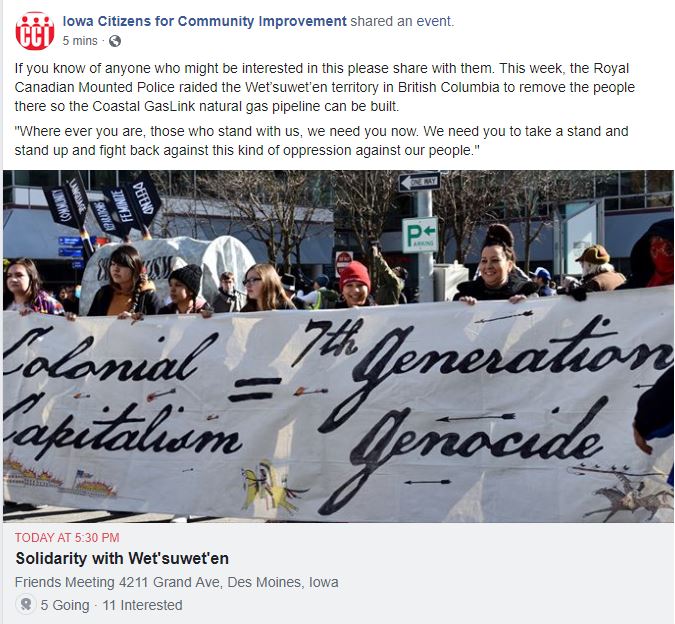
Several of us gathered in Des Moines, Iowa, for a vigil in solidarity with the Wet’suwet’en peoples. Our friends at Bold Iowa and Iowa Citizens for Community Improvement (ICCI) helped notify people about our vigil. We didn’t think many people would join us. But we know it is not the number of people, just that there are people publicly supporting the Wet’suwet’en. You never know what the people driving past might think or do. A sign displaying simply “Wet’suwet’en” might make some curious enough to look into this. Raising awareness and supporting each other is good. Each of us at the vigil drew strength from each other. As it says above, “what will your choice be?” Will you gather with a few friends and your signs to stand on a street corner in your town?

Fortunately, Ronnie James, who has become a good friend, came to the vigil. I learned Ronnie had years of experience as an Indigenous organizer. He is part of the Great Plains Action Society, and his focus is on Mutual Aid. One of the organizing skills he taught me was to attend events related to our work to meet new people to work with. I believe this was a spirit led connection. Not only would I have missed getting to know Ronnie and those he works with, but I might not have learned about Mutual Aid.

Ronnie has patiently taught me about his work and Mutual Aid since that meeting. I learned about the free food distribution project, which I was surprised to learn had been in operation since the Panther’s Free school breakfast program began in the early 1970’s.

So I work with a dope crew called Des Moines Mutual Aid, and on Saturday mornings we do a food giveaway program that was started by the Panthers as their free breakfast program and has carried on to this day. Anyways, brag, brag, blah, blah.

So I get to work and I need to call my boss, who is also a very good old friend, because there is network issues. He remembers and asks about the food giveaway which is cool and I tell him blah blah it went really well. And then he’s like, “hey, if no one tells you, I’m very proud of what you do for the community” and I’m like “hold on hold on. Just realize that everything I do is to further the replacing of the state and destroying western civilization and any remnants of it for future generations.” He says “I know and love that. Carry on.”

Ronnie James

I was fascinated with this work. Not only the projects themselves, but how the Mutual Aid model was used. One of the key aspects of Mutual Aid is working to ensure a horizontal or flat hierarchy, where each person has a voice, is maintained. As opposed to the vertical hierarchies that organize the vast majority of organizations. If there is no vertical hierarchy, there can be no superiority.

There are significantly increasing tensions now between the Wet’suwet’en peoples and the Royal Canadian Mounted Police. All signs indicate another invasion of the Wet’suwet’en territory by the RCMP. The Wet’suwet’en people are asking for our support now. (CGL is Coastal GasLink pipeline).

Gidimt’en Occupation of CGL Drill Site Continues! Callout for Week of Action 10/9-10/15

Cas Yikh of the Gidimt’en Clan are counting on supporters to go ALL OUT in a mobilization for the biggest battle yet to protect our sacred headwaters, Wedzin Kwa. We have remained steadfast in our fight for self-determination, and we are still unceded, undefeated, sovereign and victorious.

We are humbled by the power of our allies, friends and supporters. We have love, respect, and gratitude for those that stood their ground beside us on the yintah to defend Wedzin Kwa. We vow to reciprocate the solidarity from everyone that followed, all our allies/relatives and supporters that put their feet in the street defending Indigenous sovereignty.

Now, we need you to rise up again.

October 9th-15th 2021, go #AllOutForWedzinKwa.

Learning of these new tensions, I thought we should have another vigil in support of the Wet’suwet’en. I know Ronnie is extremely busy now, but I asked him whether those of us who gather every Saturday morning for the Mutual Aid food project might show public support, as he and I did in early 2020.

He agreed he was busy, but he would meet to support the Wet’suwet’en peoples again if I was willing to organize it. He said I could ask the others at the food project if they would be interested.

This is an example of how Mutual Aid works. Without a vertical hierarchy, there wasn’t a ‘leader’ who needed to approve such a gathering. It was up to me to organize and invite others.

When I arrived at Mutual Aid yesterday morning, Ronnie asked if I had brought the Wet’suwet’en signs that we had made for the 2020 vigil, and I had. Then as distributing the food was winding down, he suggested I tell the others about the Wet’suwet’en and invite those willing to stay so we could get a photo showing our support. Again, he didn’t tell me what to do, but offered the suggestion. So, I announced the photo shoot and asked anyone interested to stay for that. I was grateful to those who did.

My friends avoid photos because their activism sometimes brings police attention. As usually happens, activists are involved in many different issues. There were arrests last year during the unrest related to George Floyd and police violence. But we have not stopped having our own mask mandate, so that worked out well for the photos.

I brought poster boards and markers because Jack, five years old, nearly always comes to the food project with his mother. And is the life of the party! I know he really likes to draw. So I ask Jack (and his mother) if he wanted to make a sign, which you can see on the far right in the photos.

This is the completion of a circle that began with signs and meeting Ronnie in early 2020, and comes around to using the same signs, with Ronnie and others, yesterday. With a lot of work in between. I believe we will continue to move along the circle.

#AllOutForWedzinKwa
#wetsuwetenstrong